Top 10 SaaS Design Agencies for Retailtech Companies - July 2026
Top 10 SaaS Design Agencies for Retailtech Companies - July 2026
Top 10 SaaS Design Agencies for Retailtech Companies - July 2026
Top 10 SaaS UX agencies specializing in retailtech design. Compare agencies for POS, inventory, and omnichannel retail solutions—find your perfect partner.
Top 10 SaaS UX agencies specializing in retailtech design. Compare agencies for POS, inventory, and omnichannel retail solutions—find your perfect partner.
Top 10 SaaS UX agencies specializing in retailtech design. Compare agencies for POS, inventory, and omnichannel retail solutions—find your perfect partner.
4 mins
4 mins
4 mins
July, 2026
July, 2026
July, 2026

Introduction
If you're building or scaling a retailtech SaaS platform, choosing the right SaaS design agency can be the difference between a product that users struggle with and one that drives adoption and revenue growth. Retail technology companies face unique challenges: designing intuitive interfaces for fast-paced checkout environments, creating dashboards that make sense to store managers, and building systems that work seamlessly across omnichannel platforms.
Bricx Labs specializes in designing SaaS products for retail innovation, helping retailers transition from legacy systems to modern, user-centric platforms. Our benchmarking research evaluated 57 design agencies globally across criteria like pricing, engagement models, team structure, and domain expertise.
We analyzed their capabilities in designing for retailtech specifically—including inventory management, point-of-sale (POS) systems, customer data platforms, and fulfillment workflows.
Key insights from our research: Top-performing retailtech design agencies combine deep e-commerce experience with enterprise SaaS expertise.
They understand that retail users demand speed and simplicity. 75% of retail decision-makers judge technology credibility based on interface design. Design agencies working in this space report helping clients increase adoption rates by 30–50% through improved onboarding flows and dashboard usability.
Introduction
If you're building or scaling a retailtech SaaS platform, choosing the right SaaS design agency can be the difference between a product that users struggle with and one that drives adoption and revenue growth. Retail technology companies face unique challenges: designing intuitive interfaces for fast-paced checkout environments, creating dashboards that make sense to store managers, and building systems that work seamlessly across omnichannel platforms.
Bricx Labs specializes in designing SaaS products for retail innovation, helping retailers transition from legacy systems to modern, user-centric platforms. Our benchmarking research evaluated 57 design agencies globally across criteria like pricing, engagement models, team structure, and domain expertise.
We analyzed their capabilities in designing for retailtech specifically—including inventory management, point-of-sale (POS) systems, customer data platforms, and fulfillment workflows.
Key insights from our research: Top-performing retailtech design agencies combine deep e-commerce experience with enterprise SaaS expertise.
They understand that retail users demand speed and simplicity. 75% of retail decision-makers judge technology credibility based on interface design. Design agencies working in this space report helping clients increase adoption rates by 30–50% through improved onboarding flows and dashboard usability.

How to Evaluate Your Retailtech SaaS Design Agency?
During our benchmarking research, we identified three critical issues with most retailtech design agencies:
Lack of omnichannel thinking — Many agencies design for single touchpoints (online or in-store) rather than connected retail ecosystems.
Underestimation of operational complexity — Retail workflows involve inventory, staff permissions, compliance, and multi-location synchronization that generalist agencies often overlook.
Slow iteration cycles — Retail teams need rapid feedback loops and daily standups; agencies with slow communication models create frustration.
The best agencies we benchmarked demonstrated expertise in designing for retail's three core layers: customer-facing (mobile apps, web storefronts), employee-facing (staff management, training dashboards), and operational (inventory, analytics, integration with payment systems).
Top 10 SaaS Design Agencies for Retailtech Companies: [Comparison]
How to Evaluate Your Retailtech SaaS Design Agency?
During our benchmarking research, we identified three critical issues with most retailtech design agencies:
Lack of omnichannel thinking — Many agencies design for single touchpoints (online or in-store) rather than connected retail ecosystems.
Underestimation of operational complexity — Retail workflows involve inventory, staff permissions, compliance, and multi-location synchronization that generalist agencies often overlook.
Slow iteration cycles — Retail teams need rapid feedback loops and daily standups; agencies with slow communication models create frustration.
The best agencies we benchmarked demonstrated expertise in designing for retail's three core layers: customer-facing (mobile apps, web storefronts), employee-facing (staff management, training dashboards), and operational (inventory, analytics, integration with payment systems).
Top 10 SaaS Design Agencies for Retailtech Companies: [Comparison]
Bricx: A Top-Rated Website & UX Design Agency for B2B & AI SaaS
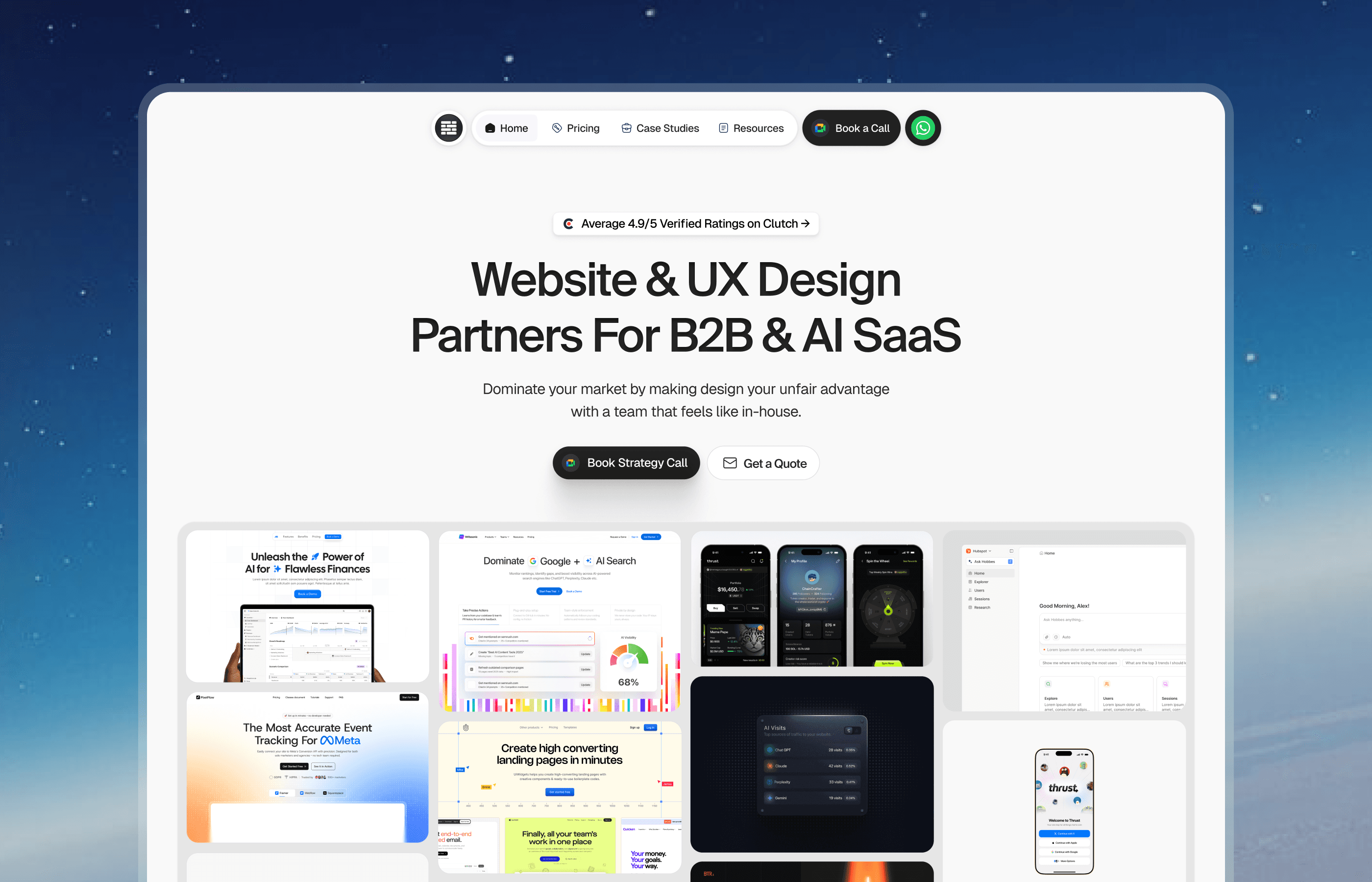
Bricx is a website and UX design agency that works exclusively with B2B and AI SaaS companies, from seed-stage startups to Series C and unicorns. It is known for a rare level of design taste and fast turnaround, across three areas: branding, website design, and product (UX/UI) design. See the portfolio and case studies.
Bricx has completed 50+ SaaS design projects across 30+ industries. Clients include Writesonic (YC S21), Collectwise (YC F24), Gigacatalyst (YC X26), Sybill, Camb.ai, LTV.ai, Instadapp, Hobbes, and AT Kearney. The agency holds 20+ verified five-star reviews on Clutch and publishes 25+ UX case studies.
Two things set Bricx apart: senior-level design taste that makes SaaS products feel genuinely premium, and fast turnaround that keeps pace with venture-backed roadmaps. The work spans the entire funnel, brand, marketing site, and product, with one goal: more signups, higher conversion, and lower user churn.
Bricx is a strong fit for B2B and AI SaaS teams that want in-house-level design quality and speed without hiring in-house. Book a strategy call to talk through your product and how Bricx can help.
Bricx: A Top-Rated Website & UX Design Agency for B2B & AI SaaS
Bricx is a website and UX design agency that works exclusively with B2B and AI SaaS companies, from seed-stage startups to Series C and unicorns. It is known for a rare level of design taste and fast turnaround, across three areas: branding, website design, and product (UX/UI) design. See the portfolio and case studies.
Bricx has completed 50+ SaaS design projects across 30+ industries. Clients include Writesonic (YC S21), Collectwise (YC F24), Gigacatalyst (YC X26), Sybill, Camb.ai, LTV.ai, Instadapp, Hobbes, and AT Kearney. The agency holds 20+ verified five-star reviews on Clutch and publishes 25+ UX case studies.
Two things set Bricx apart: senior-level design taste that makes SaaS products feel genuinely premium, and fast turnaround that keeps pace with venture-backed roadmaps. The work spans the entire funnel, brand, marketing site, and product, with one goal: more signups, higher conversion, and lower user churn.
Bricx is a strong fit for B2B and AI SaaS teams that want in-house-level design quality and speed without hiring in-house. Book a strategy call to talk through your product and how Bricx can help.
Lollypop Design Studio
Lollypop Design Studio has completed 1000+ projects across 50+ countries, earning 50+ global awards including DNA Paris Design Winner (2022). Their clientele includes Intel, Cisco, and PayTM—all companies with complex, high-stakes platforms.
For retailtech, Lollypop brings enterprise-grade process maturity and scalability. They excel at designing systems that need to scale globally while localizing for regional retail conventions.
Their 250+ designer network means they can staff large, multi-phase retail transformation projects without delays.
Employees-to-Client Ratio (Bandwidth): Scales flexibly; typical teams range from 5–15 designers per major engagement.
Process Maturity: Comprehensive UX research, design systems, accessibility audits, and design tokenization for scale.
AI Design Experience: Demonstrated work integrating AI and machine learning interfaces into enterprise SaaS dashboards.
Client Communication: Structured project management with bi-weekly stakeholder reviews and detailed design documentation.
App/Web Dev Support: In-house development capabilities; smooth handoff through design-to-code specifications.
Office Culture: Award-winning creative team with strong emphasis on research-backed, user-centered approaches.
Transform Agency
Transform Agency has spent 15+ years designing e-commerce and retail SaaS platforms, with notable clients including Verizon, Unilever, and Nestlé. They're known for obsessing over conversion metrics—helping retail platforms reduce cart abandonment, improve checkout flows, and increase transaction completion rates.
For B2B retailtech specifically, they apply the same conversion-driven rigor to user activation, feature adoption, and operational workflows.
Their team has tested thousands of UI variations and documented what actually drives retail adoption.
Employees-to-Client Ratio (Bandwidth): Typically 4–8 designers per engagement; boutique size ensures strategic focus.
Process Maturity: Conversion rate optimization (CRO), A/B testing frameworks, heat mapping, and session analysis built into every project.
AI Design Experience: Growing expertise in AI-driven personalization and predictive analytics interfaces for retail dashboards.
Client Communication: Transparent metrics reporting; weekly performance reviews with conversion data.
App/Web Dev Support: Partnerships with vetted Shopify Plus and custom development teams.
Office Culture: Data-driven, analytical mindset; every design decision is grounded in user behavior and conversion data.
Clay
Clay has designed products for Google, Airbnb, Stripe, Meta, and Loom—companies where brand and experience excellence are non-negotiable. For retailtech companies scaling internationally, Clay brings strategic brand thinking alongside product design.
They're particularly strong at designing customer-facing retail apps and storefronts that feel premium and modern.
If your retailtech platform needs to compete on brand strength and user delight (not just efficiency), Clay's expertise in motion design, micro-interactions, and brand-consistent interfaces is valuable.
Employees-to-Client Ratio (Bandwidth): Selective client base; typically 6–10 designers per engagement to maintain quality.
Process Maturity: Brand strategy, design systems, motion design, and advanced prototyping with interactive components.
AI Design Experience: Exploring AI and generative design to create dynamic, personalized interfaces.
Client Communication: Strategic collaboration; frequent creative reviews and vision-alignment sessions.
App/Web Dev Support: Close partnerships with full-stack development teams; design fidelity in final product is paramount.
Office Culture: Creative excellence, attention to detail, and brand integrity across all work.
Ramotion
Ramotion has 15+ years of experience designing complex SaaS products for companies like Firefox, Salesforce, and Turo. They're known for integrating design thinking with brand strategy and development expertise.
For retailtech platforms, Ramotion's strength is translating complex operational logic into intuitive interfaces. They've designed dashboards for enterprise users managing thousands of SKUs and multi-location inventory, making sophisticated data understandable at a glance.
Their in-house development team ensures designs are built accurately and efficiently.
Employees-to-Client Ratio (Bandwidth): Lean, focused teams of 5–8 members per project; high efficiency.
Process Maturity: UX research, design systems, prototyping, usability testing, and post-launch optimization.
AI Design Experience: Building interfaces for data-heavy SaaS dashboards with AI-driven insights and predictive features.
Client Communication: Collaborative sprints, weekly touchbases, and transparent design rationale documentation.
App/Web Dev Support: In-house developers for web and mobile; seamless design-to-code implementation.
Office Culture: Collaborative, innovation-focused, with emphasis on art and technology integration.
StanVision
StanVision has earned recognition for designing SaaS platforms where users collectively raised $300M+ in funding. They specialize in B2B SaaS design with proven expertise in fintech, AI platforms, and enterprise software.
For retailtech, their understanding of multi-role user systems (managers, staff, admins) and compliance-heavy workflows is particularly valuable.
They've won 22 Awwwards and 9 CSS Design Awards, demonstrating excellence in both design and technical implementation.
Employees-to-Client Ratio (Bandwidth): 4–7 designers per engagement; boutique approach with deep project focus.
Process Maturity: End-to-end UX research, design systems, interaction design, and design component libraries.
AI Design Experience: Strong background designing AI and machine learning interfaces for complex B2B SaaS platforms.
Client Communication: Regular feedback cycles with detailed design documentation and rationale.
App/Web Dev Support: Development partnerships; strong collaboration on technical feasibility and implementation.
Office Culture: Award-winning creative team with emphasis on thoughtful, user-centered problem-solving.
Huemor
Huemor has spent 14+ years designing high-converting SaaS websites and platforms, helping clients generate over 500,000 qualified leads. They bring deep expertise in designing for user activation and adoption—critical for retailtech platforms where store managers and staff need to quickly understand and adopt new tools.
Huemor's process combines conversion rate optimization, user research, and strategic copywriting to ensure designs don't just look good; they drive measurable business outcomes.
Employees-to-Client Ratio (Bandwidth): Boutique team of 6–10 designers; high-touch collaboration.
Process Maturity: Strategic UX research, conversion funnel optimization, copywriting integration, and A/B testing frameworks.
AI Design Experience: Exploring generative design and AI-powered personalization for SaaS user experiences.
Client Communication: Weekly metrics reviews, transparent reporting, and data-driven design recommendations.
App/Web Dev Support: Development partnerships; strong emphasis on design quality in final implementation.
Office Culture: Results-oriented, collaborative, and committed to driving measurable impact for clients.
Lollypop Design Studio
Lollypop Design Studio has completed 1000+ projects across 50+ countries, earning 50+ global awards including DNA Paris Design Winner (2022). Their clientele includes Intel, Cisco, and PayTM—all companies with complex, high-stakes platforms.
For retailtech, Lollypop brings enterprise-grade process maturity and scalability. They excel at designing systems that need to scale globally while localizing for regional retail conventions.
Their 250+ designer network means they can staff large, multi-phase retail transformation projects without delays.
Employees-to-Client Ratio (Bandwidth): Scales flexibly; typical teams range from 5–15 designers per major engagement.
Process Maturity: Comprehensive UX research, design systems, accessibility audits, and design tokenization for scale.
AI Design Experience: Demonstrated work integrating AI and machine learning interfaces into enterprise SaaS dashboards.
Client Communication: Structured project management with bi-weekly stakeholder reviews and detailed design documentation.
App/Web Dev Support: In-house development capabilities; smooth handoff through design-to-code specifications.
Office Culture: Award-winning creative team with strong emphasis on research-backed, user-centered approaches.
Transform Agency
Transform Agency has spent 15+ years designing e-commerce and retail SaaS platforms, with notable clients including Verizon, Unilever, and Nestlé. They're known for obsessing over conversion metrics—helping retail platforms reduce cart abandonment, improve checkout flows, and increase transaction completion rates.
For B2B retailtech specifically, they apply the same conversion-driven rigor to user activation, feature adoption, and operational workflows.
Their team has tested thousands of UI variations and documented what actually drives retail adoption.
Employees-to-Client Ratio (Bandwidth): Typically 4–8 designers per engagement; boutique size ensures strategic focus.
Process Maturity: Conversion rate optimization (CRO), A/B testing frameworks, heat mapping, and session analysis built into every project.
AI Design Experience: Growing expertise in AI-driven personalization and predictive analytics interfaces for retail dashboards.
Client Communication: Transparent metrics reporting; weekly performance reviews with conversion data.
App/Web Dev Support: Partnerships with vetted Shopify Plus and custom development teams.
Office Culture: Data-driven, analytical mindset; every design decision is grounded in user behavior and conversion data.
Clay
Clay has designed products for Google, Airbnb, Stripe, Meta, and Loom—companies where brand and experience excellence are non-negotiable. For retailtech companies scaling internationally, Clay brings strategic brand thinking alongside product design.
They're particularly strong at designing customer-facing retail apps and storefronts that feel premium and modern.
If your retailtech platform needs to compete on brand strength and user delight (not just efficiency), Clay's expertise in motion design, micro-interactions, and brand-consistent interfaces is valuable.
Employees-to-Client Ratio (Bandwidth): Selective client base; typically 6–10 designers per engagement to maintain quality.
Process Maturity: Brand strategy, design systems, motion design, and advanced prototyping with interactive components.
AI Design Experience: Exploring AI and generative design to create dynamic, personalized interfaces.
Client Communication: Strategic collaboration; frequent creative reviews and vision-alignment sessions.
App/Web Dev Support: Close partnerships with full-stack development teams; design fidelity in final product is paramount.
Office Culture: Creative excellence, attention to detail, and brand integrity across all work.
Ramotion
Ramotion has 15+ years of experience designing complex SaaS products for companies like Firefox, Salesforce, and Turo. They're known for integrating design thinking with brand strategy and development expertise.
For retailtech platforms, Ramotion's strength is translating complex operational logic into intuitive interfaces. They've designed dashboards for enterprise users managing thousands of SKUs and multi-location inventory, making sophisticated data understandable at a glance.
Their in-house development team ensures designs are built accurately and efficiently.
Employees-to-Client Ratio (Bandwidth): Lean, focused teams of 5–8 members per project; high efficiency.
Process Maturity: UX research, design systems, prototyping, usability testing, and post-launch optimization.
AI Design Experience: Building interfaces for data-heavy SaaS dashboards with AI-driven insights and predictive features.
Client Communication: Collaborative sprints, weekly touchbases, and transparent design rationale documentation.
App/Web Dev Support: In-house developers for web and mobile; seamless design-to-code implementation.
Office Culture: Collaborative, innovation-focused, with emphasis on art and technology integration.
StanVision
StanVision has earned recognition for designing SaaS platforms where users collectively raised $300M+ in funding. They specialize in B2B SaaS design with proven expertise in fintech, AI platforms, and enterprise software.
For retailtech, their understanding of multi-role user systems (managers, staff, admins) and compliance-heavy workflows is particularly valuable.
They've won 22 Awwwards and 9 CSS Design Awards, demonstrating excellence in both design and technical implementation.
Employees-to-Client Ratio (Bandwidth): 4–7 designers per engagement; boutique approach with deep project focus.
Process Maturity: End-to-end UX research, design systems, interaction design, and design component libraries.
AI Design Experience: Strong background designing AI and machine learning interfaces for complex B2B SaaS platforms.
Client Communication: Regular feedback cycles with detailed design documentation and rationale.
App/Web Dev Support: Development partnerships; strong collaboration on technical feasibility and implementation.
Office Culture: Award-winning creative team with emphasis on thoughtful, user-centered problem-solving.
Huemor
Huemor has spent 14+ years designing high-converting SaaS websites and platforms, helping clients generate over 500,000 qualified leads. They bring deep expertise in designing for user activation and adoption—critical for retailtech platforms where store managers and staff need to quickly understand and adopt new tools.
Huemor's process combines conversion rate optimization, user research, and strategic copywriting to ensure designs don't just look good; they drive measurable business outcomes.
Employees-to-Client Ratio (Bandwidth): Boutique team of 6–10 designers; high-touch collaboration.
Process Maturity: Strategic UX research, conversion funnel optimization, copywriting integration, and A/B testing frameworks.
AI Design Experience: Exploring generative design and AI-powered personalization for SaaS user experiences.
Client Communication: Weekly metrics reviews, transparent reporting, and data-driven design recommendations.
App/Web Dev Support: Development partnerships; strong emphasis on design quality in final implementation.
Office Culture: Results-oriented, collaborative, and committed to driving measurable impact for clients.

CodeTheorem
CodeTheorem has designed platforms for 70+ clients across B2B SaaS, fintech, and enterprise software, with an impressive 92% client retention rate. Their projects collectively raised over $250 million in funding, demonstrating their ability to design products that investors and users value.
For retailtech, their experience designing multi-role systems, permission hierarchies, and dashboard analytics is particularly relevant. They bring scalability and efficiency without sacrificing design quality.
Employees-to-Client Ratio (Bandwidth): Scales from 3–8 designers per engagement based on project scope.
Process Maturity: User research, design systems, interaction design, and design-to-code handoff optimization.
AI Design Experience: Building interfaces for AI-driven features and analytics dashboards in B2B SaaS.
Client Communication: Regular design reviews, transparent progress tracking, and collaborative decision-making.
App/Web Dev Support: Web development capabilities; strong design-development collaboration.
Office Culture: Quality-focused, collaborative, with emphasis on long-term client partnerships.
Pony
Pony brings high-impact branding and product design expertise to SaaS companies seeking both brand differentiation and product excellence. They've worked with 150+ tech companies, helping them build cohesive brand identities alongside functional product experiences.
For retailtech platforms, Pony's strength is creating design systems and brand frameworks that scale across multiple customer-facing, employee-facing, and operational interfaces while maintaining consistency.
Employees-to-Client Ratio (Bandwidth): 4–6 designers per engagement; strategic, boutique focus.
Process Maturity: Brand strategy, design systems, product design, and strategic direction setting.
AI Design Experience: Exploring brand applications of AI and emerging design patterns for AI-driven interfaces.
Client Communication: Strategic workshops, regular reviews, and collaborative vision development.
App/Web Dev Support: Development partnerships; strong brand-to-code fidelity.
Office Culture: Creative, strategic, and committed to building brands that matter.
Merge
Merge has designed platforms for 100+ startups collectively valued at over $100M in funding. They specialize in rapid, conversion-focused design perfect for retailtech companies moving fast and optimizing for adoption.
Their approach emphasizes shipping quickly, testing with users, and iterating based on real feedback—a methodology that works well for early-stage and scale-stage retailtech platforms. They bring both creative vision and practical execution.
Employees-to-Client Ratio (Bandwidth): Typically 3–6 designers per project; agile, fast-moving teams.
Process Maturity: Rapid prototyping, user testing, iterative design, and efficient handoff processes.
AI Design Experience: Building interfaces for AI-assisted features in SaaS products with speed and efficiency.
Client Communication: Fast feedback cycles, regular updates, and flexible collaboration models.
App/Web Dev Support: Close development partnerships; emphasis on rapid iteration and shipping.
Office Culture: Fast-paced, startup-minded, with focus on shipping and learning from real users.
Conclusion
Choosing the right SaaS design agency for retailtech is about more than aesthetics. Retailers operating multi-location, omnichannel platforms need partners who understand operational complexity, can design for multiple user roles (customers, staff, managers, administrators), and move quickly to capture market opportunity.
Whether you prioritize conversion optimization (Transform Agency, Huemor), strategic brand thinking (Clay, Pony), or rapid iteration (Merge), the key is finding an agency with proven experience in retail and a communication style that matches your team's pace.
FAQs
What are the most crucial factors to consider when choosing a UX agency for retailtech SaaS projects?
The three most important factors are: (1) Proven experience designing multi-role SaaS systems (customer, employee, and operational interfaces), (2) Understanding of retail workflows, compliance requirements, and omnichannel thinking, and (3) A communication and iteration style that matches your team's pace. Agencies should demonstrate case studies in retail or adjacent B2B SaaS verticals. Budget expectations range from $50,000 to $200,000+ depending on scope, team size, and project complexity.
How can a UX agency specializing in retailtech improve our product's user adoption?
Top retailers increase adoption by 30–50% through thoughtful onboarding design, simplified dashboards that surface critical actions first, and clear feedback mechanisms that help users succeed. Agencies should conduct user research to understand store manager and staff workflows, test designs with real retail users, and iterate based on actual usage patterns. Many agencies also build analytics tracking and post-launch optimization into their services.
What kind of ROI can we expect from investing in expert UX design for retailtech solutions?
Research shows that 75% of retail decision-makers judge credibility based on interface design. Well-designed retailtech platforms see improvements in: user activation rates (+30–50%), feature adoption speed (2–4 weeks faster), support ticket reduction (20–40% fewer issues), and customer retention (+15–25%). These translate to lower sales friction, faster time-to-value, and improved customer lifetime value. Design investment typically pays back within 6–12 months through improved unit economics.
How does Bricx Labs differentiate itself from other UX agencies for retailtech specialists?
Bricx Labs combines deep SaaS design expertise with hands-on retail domain knowledge. We've worked with retailers and fintech companies managing complex, high-stakes platforms where user experience directly impacts revenue. We bring three key differentiators: (1) We design across all user layers—customer-facing, employee-facing, and operational interfaces—ensuring cohesive experiences. (2) Our team collaborates daily with your development partners, ensuring design fidelity and reducing surprises. (3) We don't hand off at delivery; we optimize post-launch and iterate based on real user behavior.
Can you provide examples of successful retailtech projects Bricx Labs has handled?
Bricx has designed digital experiences for SaaS platforms across retail, fintech, healthcare, and AI verticals. Our work includes designing onboarding flows that reduce setup time from weeks to days, building dashboards that help store managers spot operational issues at a glance, and creating POS interfaces that work seamlessly across devices. We've helped 50+ SaaS companies improve user adoption and retention through research-backed, user-centered design. Visit Bricx Labs to see case studies and learn more about how we approach retailtech design.
CodeTheorem
CodeTheorem has designed platforms for 70+ clients across B2B SaaS, fintech, and enterprise software, with an impressive 92% client retention rate. Their projects collectively raised over $250 million in funding, demonstrating their ability to design products that investors and users value.
For retailtech, their experience designing multi-role systems, permission hierarchies, and dashboard analytics is particularly relevant. They bring scalability and efficiency without sacrificing design quality.
Employees-to-Client Ratio (Bandwidth): Scales from 3–8 designers per engagement based on project scope.
Process Maturity: User research, design systems, interaction design, and design-to-code handoff optimization.
AI Design Experience: Building interfaces for AI-driven features and analytics dashboards in B2B SaaS.
Client Communication: Regular design reviews, transparent progress tracking, and collaborative decision-making.
App/Web Dev Support: Web development capabilities; strong design-development collaboration.
Office Culture: Quality-focused, collaborative, with emphasis on long-term client partnerships.
Pony
Pony brings high-impact branding and product design expertise to SaaS companies seeking both brand differentiation and product excellence. They've worked with 150+ tech companies, helping them build cohesive brand identities alongside functional product experiences.
For retailtech platforms, Pony's strength is creating design systems and brand frameworks that scale across multiple customer-facing, employee-facing, and operational interfaces while maintaining consistency.
Employees-to-Client Ratio (Bandwidth): 4–6 designers per engagement; strategic, boutique focus.
Process Maturity: Brand strategy, design systems, product design, and strategic direction setting.
AI Design Experience: Exploring brand applications of AI and emerging design patterns for AI-driven interfaces.
Client Communication: Strategic workshops, regular reviews, and collaborative vision development.
App/Web Dev Support: Development partnerships; strong brand-to-code fidelity.
Office Culture: Creative, strategic, and committed to building brands that matter.
Merge
Merge has designed platforms for 100+ startups collectively valued at over $100M in funding. They specialize in rapid, conversion-focused design perfect for retailtech companies moving fast and optimizing for adoption.
Their approach emphasizes shipping quickly, testing with users, and iterating based on real feedback—a methodology that works well for early-stage and scale-stage retailtech platforms. They bring both creative vision and practical execution.
Employees-to-Client Ratio (Bandwidth): Typically 3–6 designers per project; agile, fast-moving teams.
Process Maturity: Rapid prototyping, user testing, iterative design, and efficient handoff processes.
AI Design Experience: Building interfaces for AI-assisted features in SaaS products with speed and efficiency.
Client Communication: Fast feedback cycles, regular updates, and flexible collaboration models.
App/Web Dev Support: Close development partnerships; emphasis on rapid iteration and shipping.
Office Culture: Fast-paced, startup-minded, with focus on shipping and learning from real users.
Conclusion
Choosing the right SaaS design agency for retailtech is about more than aesthetics. Retailers operating multi-location, omnichannel platforms need partners who understand operational complexity, can design for multiple user roles (customers, staff, managers, administrators), and move quickly to capture market opportunity.
Whether you prioritize conversion optimization (Transform Agency, Huemor), strategic brand thinking (Clay, Pony), or rapid iteration (Merge), the key is finding an agency with proven experience in retail and a communication style that matches your team's pace.
FAQs
What are the most crucial factors to consider when choosing a UX agency for retailtech SaaS projects?
The three most important factors are: (1) Proven experience designing multi-role SaaS systems (customer, employee, and operational interfaces), (2) Understanding of retail workflows, compliance requirements, and omnichannel thinking, and (3) A communication and iteration style that matches your team's pace. Agencies should demonstrate case studies in retail or adjacent B2B SaaS verticals. Budget expectations range from $50,000 to $200,000+ depending on scope, team size, and project complexity.
How can a UX agency specializing in retailtech improve our product's user adoption?
Top retailers increase adoption by 30–50% through thoughtful onboarding design, simplified dashboards that surface critical actions first, and clear feedback mechanisms that help users succeed. Agencies should conduct user research to understand store manager and staff workflows, test designs with real retail users, and iterate based on actual usage patterns. Many agencies also build analytics tracking and post-launch optimization into their services.
What kind of ROI can we expect from investing in expert UX design for retailtech solutions?
Research shows that 75% of retail decision-makers judge credibility based on interface design. Well-designed retailtech platforms see improvements in: user activation rates (+30–50%), feature adoption speed (2–4 weeks faster), support ticket reduction (20–40% fewer issues), and customer retention (+15–25%). These translate to lower sales friction, faster time-to-value, and improved customer lifetime value. Design investment typically pays back within 6–12 months through improved unit economics.
How does Bricx Labs differentiate itself from other UX agencies for retailtech specialists?
Bricx Labs combines deep SaaS design expertise with hands-on retail domain knowledge. We've worked with retailers and fintech companies managing complex, high-stakes platforms where user experience directly impacts revenue. We bring three key differentiators: (1) We design across all user layers—customer-facing, employee-facing, and operational interfaces—ensuring cohesive experiences. (2) Our team collaborates daily with your development partners, ensuring design fidelity and reducing surprises. (3) We don't hand off at delivery; we optimize post-launch and iterate based on real user behavior.
Can you provide examples of successful retailtech projects Bricx Labs has handled?
Bricx has designed digital experiences for SaaS platforms across retail, fintech, healthcare, and AI verticals. Our work includes designing onboarding flows that reduce setup time from weeks to days, building dashboards that help store managers spot operational issues at a glance, and creating POS interfaces that work seamlessly across devices. We've helped 50+ SaaS companies improve user adoption and retention through research-backed, user-centered design. Visit Bricx Labs to see case studies and learn more about how we approach retailtech design.

Author:

Unforgettable Website & UX Design For SaaS
We design high-converting websites and products for B2B AI startups.


Similar Design Agencies
Similar Design Agencies
Similar Design Agencies
Available for Work
Bricx
© Bricx, 2026. All rights reserved.


Available for Work
Bricx
© Bricx, 2026. All rights reserved.
Available for Work
Bricx
© Bricx, 2026. All rights reserved.
Available for Work
Bricx
© Bricx, 2026. All rights reserved.