Top 10 SaaS Design Agencies for Web3 SaaS - May 2026
Top 10 SaaS Design Agencies for Web3 SaaS - May 2026
Top 10 SaaS Design Agencies for Web3 SaaS - May 2026
Looking for the best SaaS design agencies for web3 SaaS? Explore our list of 10 firms building fast, user-friendly, and scalable products for blockchain-powered platforms.
Looking for the best SaaS design agencies for web3 SaaS? Explore our list of 10 firms building fast, user-friendly, and scalable products for blockchain-powered platforms.
Looking for the best SaaS design agencies for web3 SaaS? Explore our list of 10 firms building fast, user-friendly, and scalable products for blockchain-powered platforms.
4 mins
4 mins
4 mins
April, 2026
April, 2026
April, 2026

Introduction
If you're building a Web3 SaaS — wallets, DeFi dashboards, NFT marketplaces, blockchain analytics tools, dev-tool SaaS, smart-contract management platforms — you know how critical design is. You need UX that balances bleeding-edge blockchain logic with usability for sometimes non-technical users. Complexity must be hidden; trust must be built. The right design agency becomes a bridge between crypto complexity and user-friendly SaaS flow.
Over the past few months, we spoke with 57+ design agencies worldwide, ran real sales calls, and evaluated them using a standardized project brief tailored for Web3 SaaS. We compared them across:
Pricing & Engagement Model
Payment Structure
Delivery Timeline & Stability
Team Structure & Size
Domain Expertise (SaaS + Web3 / blockchain / FinTech)
Depth of UX & Product Thinking (onboarding flows, security UX, data dashboards)
Business Thinking (conversion, trust management, activation, retention)
Client Collaboration & Communication
Dev Handoff Quality & Documentation (especially for complex, data-driven interfaces)
Work Setup (Remote / Hybrid / In-House readiness)
All our findings fed into “The Ultimate UX Agency Benchmarking Report for 2025.” From that, we hand-picked the 10 best SaaS design agencies for Web3 SaaS — those who showed strong understanding of blockchain user needs, deep SaaS discipline, and capacity to handle complex, data-rich interfaces securely and understandably.
By the end, you’ll know which design partner fits your Web3 startup’s product, growth ambitions, and UX complexity.
Introduction
If you're building a Web3 SaaS — wallets, DeFi dashboards, NFT marketplaces, blockchain analytics tools, dev-tool SaaS, smart-contract management platforms — you know how critical design is. You need UX that balances bleeding-edge blockchain logic with usability for sometimes non-technical users. Complexity must be hidden; trust must be built. The right design agency becomes a bridge between crypto complexity and user-friendly SaaS flow.
Over the past few months, we spoke with 57+ design agencies worldwide, ran real sales calls, and evaluated them using a standardized project brief tailored for Web3 SaaS. We compared them across:
Pricing & Engagement Model
Payment Structure
Delivery Timeline & Stability
Team Structure & Size
Domain Expertise (SaaS + Web3 / blockchain / FinTech)
Depth of UX & Product Thinking (onboarding flows, security UX, data dashboards)
Business Thinking (conversion, trust management, activation, retention)
Client Collaboration & Communication
Dev Handoff Quality & Documentation (especially for complex, data-driven interfaces)
Work Setup (Remote / Hybrid / In-House readiness)
All our findings fed into “The Ultimate UX Agency Benchmarking Report for 2025.” From that, we hand-picked the 10 best SaaS design agencies for Web3 SaaS — those who showed strong understanding of blockchain user needs, deep SaaS discipline, and capacity to handle complex, data-rich interfaces securely and understandably.
By the end, you’ll know which design partner fits your Web3 startup’s product, growth ambitions, and UX complexity.

How To Evaluate Your Agency?
Design for Web3 isn’t just “normal SaaS + wallet switch.” It’s a distinct beast. When picking a design agency, prioritize:
1. Blockchain & Crypto UX Experience
Ensure the agency has worked on Web3 flows — wallet integrations, token swaps, permissions, security prompts, gas fees, on-chain data. If they’ve shipped dashboards or DeFi apps before, they “get it.” Otherwise, they risk building confusing UX that betrays user trust.
2. Data-Heavy, Real-Time Dashboards & Performance
Web3 SaaS often surfaces real-time on-chain data, portfolio values, transaction history, blockchain analytics. Your agency should know how to design performant dashboards that stay usable under heavy data load — not just pretty mockups.
3. Security, Permission & Trust Flows
Blockchain apps deal with money, tokens, and irreversible actions. UX must make security clear (confirmations, permissions, disclaimers), minimize user error, and build clarity/trust. The agency must understand that UX has real consequences here.
4. Modular & Scalable Design Systems
As your Web3 product evolves — new tokens, chains, features — UI must scale without becoming a mess. Agencies should build component libraries, token-agnostic UI, and scalable design systems to support future growth.
5. Strong Collaboration & Developer Handoff
Web3 stacks are complex: front-end + smart contracts + multi-chain APIs. Clean, annotated design specs and tight collaboration with engineering are essential so that UI and backend logic align, and security flows don’t get lost in translation.
Top 10 SaaS Design Agencies for Web3 SaaS: [Comparison]
Here’s a list of the top 10 SaaS design agencies for Web3 SaaS.
How To Evaluate Your Agency?
Design for Web3 isn’t just “normal SaaS + wallet switch.” It’s a distinct beast. When picking a design agency, prioritize:
1. Blockchain & Crypto UX Experience
Ensure the agency has worked on Web3 flows — wallet integrations, token swaps, permissions, security prompts, gas fees, on-chain data. If they’ve shipped dashboards or DeFi apps before, they “get it.” Otherwise, they risk building confusing UX that betrays user trust.
2. Data-Heavy, Real-Time Dashboards & Performance
Web3 SaaS often surfaces real-time on-chain data, portfolio values, transaction history, blockchain analytics. Your agency should know how to design performant dashboards that stay usable under heavy data load — not just pretty mockups.
3. Security, Permission & Trust Flows
Blockchain apps deal with money, tokens, and irreversible actions. UX must make security clear (confirmations, permissions, disclaimers), minimize user error, and build clarity/trust. The agency must understand that UX has real consequences here.
4. Modular & Scalable Design Systems
As your Web3 product evolves — new tokens, chains, features — UI must scale without becoming a mess. Agencies should build component libraries, token-agnostic UI, and scalable design systems to support future growth.
5. Strong Collaboration & Developer Handoff
Web3 stacks are complex: front-end + smart contracts + multi-chain APIs. Clean, annotated design specs and tight collaboration with engineering are essential so that UI and backend logic align, and security flows don’t get lost in translation.
Top 10 SaaS Design Agencies for Web3 SaaS: [Comparison]
Here’s a list of the top 10 SaaS design agencies for Web3 SaaS.
Bricx - The #1 Website & UX Agency For B2B & AI SaaS
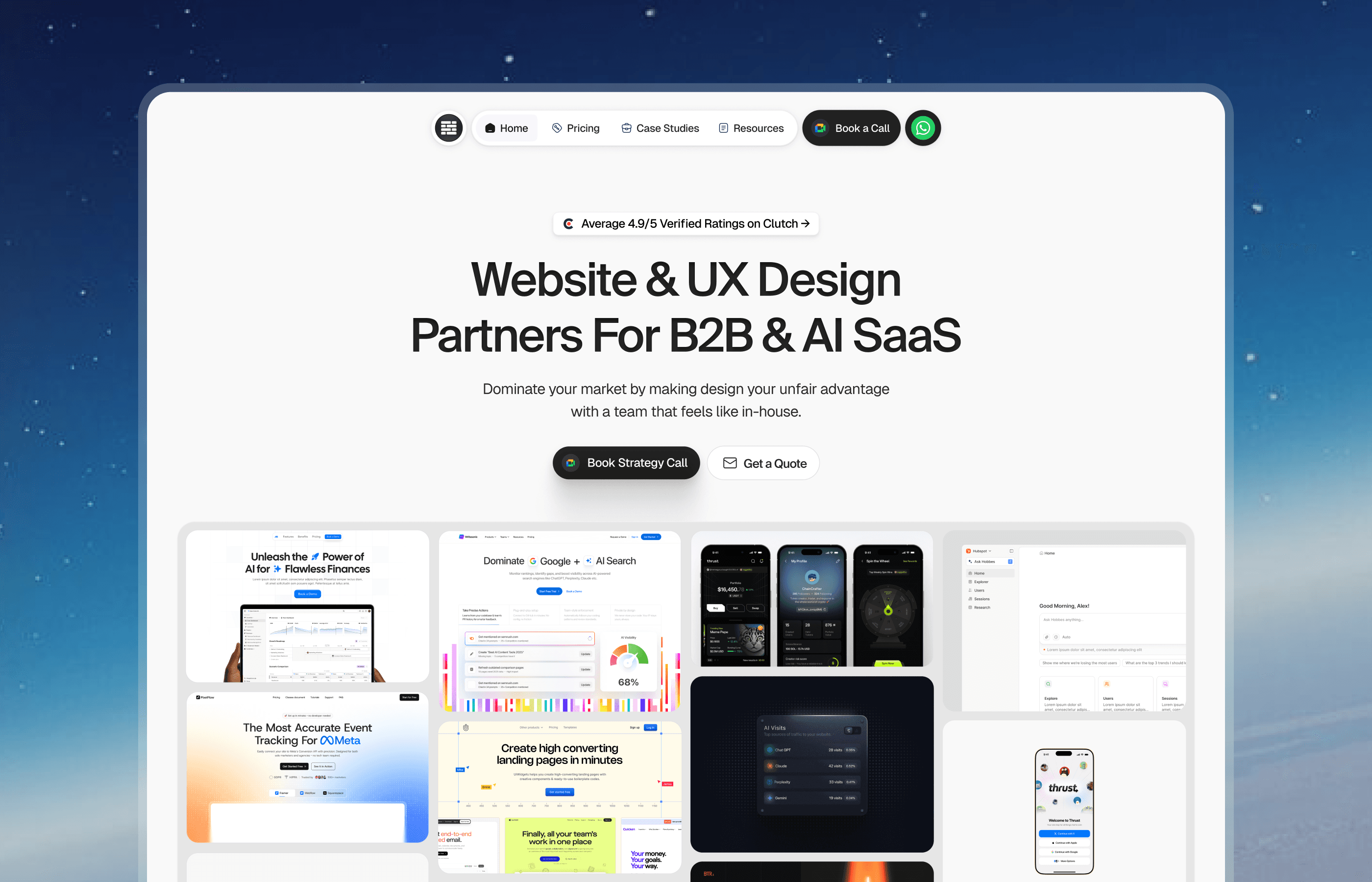
We at Bricx work exclusively with B2B & AI SaaS companies. See Bricx's portfolio & case studies. Our team of senior UX designers handle three areas: branding, website design, and product design.
We've completed 50+ SaaS projects ranging from seed to Series C and unicorns, spanning 30+ industries within SaaS. Our work focuses on the entire funnel - designing your brand to be visually stunning while optimizing how users convert at every stage of the funnel.
Our clients include Writesonic (YC S21), Sybill, Camb.ai, LTV.ai, AT Kearney, and others. We've built up 25+ UX case studies documenting projects we've completed. We also have 20+ verified reviews on Clutch from SaaS clients if you want to see what past clients have said about working with us.
Book a call to talk through what you're working on. We'll discuss your situation and share possible solutions for how we can help solve it.
Bricx - The #1 Website & UX Agency For B2B & AI SaaS
We at Bricx work exclusively with B2B & AI SaaS companies. See Bricx's portfolio & case studies. Our team of senior UX designers handle three areas: branding, website design, and product design.
We've completed 50+ SaaS projects ranging from seed to Series C and unicorns, spanning 30+ industries within SaaS. Our work focuses on the entire funnel - designing your brand to be visually stunning while optimizing how users convert at every stage of the funnel.
Our clients include Writesonic (YC S21), Sybill, Camb.ai, LTV.ai, AT Kearney, and others. We've built up 25+ UX case studies documenting projects we've completed. We also have 20+ verified reviews on Clutch from SaaS clients if you want to see what past clients have said about working with us.
Book a call to talk through what you're working on. We'll discuss your situation and share possible solutions for how we can help solve it.
Ramotion
Ramotion brings design system discipline and UI polish — crucial for Web3 SaaS products that aim to stand out in a crowded market (think NFT platforms, crypto analytics, or enterprise blockchain tools). Their strength is in creating coherent, clean, scalable UI across modules: dashboards, user settings, multi-role admin panels, and public-facing sections — all while maintaining a professional, brand-safe interface.
They can help you create consistent UI/UX across token dashboards, analytics charts, wallet sections, user profiles, and admin tools. For Web3 companies looking to scale visually and functionally — especially those targeting both retail users and enterprise clients — Ramotion offers a solid balance of polish and process.
Employees-to-Client Ratio (Bandwidth): Balanced pods suitable for multi-feature products.
Process Maturity: High — version controlled UI libraries and design standards.
Web3 Readiness: Moderate; experienced with complex dashboards, though might need guidance on blockchain specifics.
Client Communication: Structured design reviews and support for scaling product modules.
App/Web Dev Support: Clean assets, reusable components — good for extensible Web3 projects.
Office Culture: Quality-focused, scalable, and suitable for high-growth SaaS environments.
Clay
Clay is a great option when your Web3 SaaS is enterprise-grade: blockchain infrastructure tools, compliance dashboards, institutional DeFi platforms, or multi-tenant blockchain services. With robust design ops, component libraries, and heavy documentation practices, Clay scales well with complexity — especially for products serving institutions or businesses that demand maturity and stability.
They specialize in multi-role interfaces, permissions management, audit logs, analytics dashboards, and institutional workflows — exactly the kind of features many Web3 B2B SaaS tools need. If you target enterprise clients or require compliance-grade UX, Clay’s structured, disciplined approach and senior design talent make them a compelling partner.
Employees-to-Client Ratio (Bandwidth): High — multiple designers and pods to support large-scale projects.
Process Maturity: Extremely mature — design ops, version control, detailed handoff procedures, QA alignment.
Web3 & Data Complexity Handling: Strong; experienced with data-heavy dashboards and complex user roles.
Client Communication: PM-led, disciplined, suitable for enterprise-grade workflows.
App/Web Dev Support: Best-in-class design tokens, component libraries, and scalable architecture.
Office Culture: Systematic, enterprise-ready, and process-oriented — ideal for institutional Web3 SaaS.
Momentum Design Lab
Momentum works well for Web3 SaaS products that span multiple modules — think wallets, analytics, admin tools, marketplace dashboards, compliance panels — and need consistent UX across all of them. Their strength lies in UX research, modular architecture design, and building scalable frontend structures that adapt as features expand.
They help you maintain clarity and usability even as data complexity grows: cross-chain analytics, user roles, permission workflows, real-time updates, transaction histories. Their documentation, design system, and structured delivery process make them a strong bet for teams aiming to scale their Web3 platform responsibly.
Employees-to-Client Ratio (Bandwidth): Large, multidisciplinary teams capable of handling many modules.
Process Maturity: High — research-backed design, modular component libraries, and systematic release cadence.
Web3 & Data Visualization Experience: Good; experienced in building dashboards and complex data flows.
Client Communication: PM-driven coordination supporting cross-functional collaboration.
App/Web Dev Support: Detailed UI spec sheets, component mapping, and scalable layout frameworks.
Office Culture: Process-oriented, scalable, enterprise-ready — good for growing Web3 SaaS operations.
Eleken
Eleken is a solid pick for Web3 startups aiming for simplicity, clarity, and user-friendly design — especially for early-stage products like token wallets, portfolio trackers, or simple DeFi dashboards. They excel at building clean flows and intuitive UI without overwhelming users — a vital quality when many Web3 users are onboarding for the first time.
They balance usability and functionality: simple onboarding, clear wallet connect flows, token balance views, history logs, and basic analytics — all in an accessible, user-friendly interface. For founders needing clarity-first design that doesn’t overcomplicate, Eleken offers a dependable, cost-effective path forward.
Employees-to-Client Ratio (Bandwidth): Dedicated small teams per project — ideal for MVPs and early builds.
Process Maturity: Lean but reliable — good for rapid iterations and early feature sets.
Web3 Readiness: Basic-to-moderate — suitable for standard flows like wallets, dashboards, token display.
Client Communication: Simple, transparent, founder-friendly.
App/Web Dev Support: Clean handoffs, reusable UI components, suitable for initial development.
Office Culture: Pragmatic, user-first, and startup-friendly.
Arounda
Arounda is helpful when you need good-looking UI and clean UX quickly — perhaps for a Web3 dashboard, NFT marketplace interface, token swap UI, or public-facing landing + product pages. Their flexibility and speed make them a good fit when you’re trying to ship features fast and iterate often.
They do a good job of combining functional UX with modern visuals — making your Web3 product feel polished and approachably designed without overengineering. Particularly good for earlier-stage teams wanting both speed and credibility.
Employees-to-Client Ratio (Bandwidth): Flexible — adjusts based on project scope.
Process Maturity: Milestone-driven and adaptable — works well for iterative releases.
Web3 Readiness: Moderate; fine for UI-driven flows and token dashboards.
Client Communication: Async-friendly and adaptable — suits startup realities.
App/Web Dev Support: Well-structured UI assets and spec sheets.
Office Culture: Creative, efficient, and growth-minded.
Zajno
Zajno brings strong UI/UX polish — especially useful if your Web3 SaaS includes a public product: NFT marketplace, token explorer, marketing-facing dashboards, or user portals. Their strengths in motion design, aesthetic polish, and modern interfaces help build credibility and trust — something especially important in Web3, where first impressions matter more.
They can help make complex flows look approachable: wallet onboarding, token swap flows, portfolio views — all wrapped in a refined, clean interface. If design and first impression matter for your audience, Zajno adds value.
Employees-to-Client Ratio (Bandwidth): Small focused creative teams — good for UI/UX-heavy modules.
Process Maturity: Creative-first but structured review cycles — appropriate for interface-driven features.
Web3 Readiness: Basic; UI-first rather than deep blockchain logic support.
Client Communication: High-touch collaborative approach — good for polishing UI flows.
App/Web Dev Support: Motion specs, UI guidelines, interaction design deliverables.
Office Culture: Design-driven, expressive, user-centric — beneficial when aesthetic matters.
Ramotion
Ramotion brings design system discipline and UI polish — crucial for Web3 SaaS products that aim to stand out in a crowded market (think NFT platforms, crypto analytics, or enterprise blockchain tools). Their strength is in creating coherent, clean, scalable UI across modules: dashboards, user settings, multi-role admin panels, and public-facing sections — all while maintaining a professional, brand-safe interface.
They can help you create consistent UI/UX across token dashboards, analytics charts, wallet sections, user profiles, and admin tools. For Web3 companies looking to scale visually and functionally — especially those targeting both retail users and enterprise clients — Ramotion offers a solid balance of polish and process.
Employees-to-Client Ratio (Bandwidth): Balanced pods suitable for multi-feature products.
Process Maturity: High — version controlled UI libraries and design standards.
Web3 Readiness: Moderate; experienced with complex dashboards, though might need guidance on blockchain specifics.
Client Communication: Structured design reviews and support for scaling product modules.
App/Web Dev Support: Clean assets, reusable components — good for extensible Web3 projects.
Office Culture: Quality-focused, scalable, and suitable for high-growth SaaS environments.
Clay
Clay is a great option when your Web3 SaaS is enterprise-grade: blockchain infrastructure tools, compliance dashboards, institutional DeFi platforms, or multi-tenant blockchain services. With robust design ops, component libraries, and heavy documentation practices, Clay scales well with complexity — especially for products serving institutions or businesses that demand maturity and stability.
They specialize in multi-role interfaces, permissions management, audit logs, analytics dashboards, and institutional workflows — exactly the kind of features many Web3 B2B SaaS tools need. If you target enterprise clients or require compliance-grade UX, Clay’s structured, disciplined approach and senior design talent make them a compelling partner.
Employees-to-Client Ratio (Bandwidth): High — multiple designers and pods to support large-scale projects.
Process Maturity: Extremely mature — design ops, version control, detailed handoff procedures, QA alignment.
Web3 & Data Complexity Handling: Strong; experienced with data-heavy dashboards and complex user roles.
Client Communication: PM-led, disciplined, suitable for enterprise-grade workflows.
App/Web Dev Support: Best-in-class design tokens, component libraries, and scalable architecture.
Office Culture: Systematic, enterprise-ready, and process-oriented — ideal for institutional Web3 SaaS.
Momentum Design Lab
Momentum works well for Web3 SaaS products that span multiple modules — think wallets, analytics, admin tools, marketplace dashboards, compliance panels — and need consistent UX across all of them. Their strength lies in UX research, modular architecture design, and building scalable frontend structures that adapt as features expand.
They help you maintain clarity and usability even as data complexity grows: cross-chain analytics, user roles, permission workflows, real-time updates, transaction histories. Their documentation, design system, and structured delivery process make them a strong bet for teams aiming to scale their Web3 platform responsibly.
Employees-to-Client Ratio (Bandwidth): Large, multidisciplinary teams capable of handling many modules.
Process Maturity: High — research-backed design, modular component libraries, and systematic release cadence.
Web3 & Data Visualization Experience: Good; experienced in building dashboards and complex data flows.
Client Communication: PM-driven coordination supporting cross-functional collaboration.
App/Web Dev Support: Detailed UI spec sheets, component mapping, and scalable layout frameworks.
Office Culture: Process-oriented, scalable, enterprise-ready — good for growing Web3 SaaS operations.
Eleken
Eleken is a solid pick for Web3 startups aiming for simplicity, clarity, and user-friendly design — especially for early-stage products like token wallets, portfolio trackers, or simple DeFi dashboards. They excel at building clean flows and intuitive UI without overwhelming users — a vital quality when many Web3 users are onboarding for the first time.
They balance usability and functionality: simple onboarding, clear wallet connect flows, token balance views, history logs, and basic analytics — all in an accessible, user-friendly interface. For founders needing clarity-first design that doesn’t overcomplicate, Eleken offers a dependable, cost-effective path forward.
Employees-to-Client Ratio (Bandwidth): Dedicated small teams per project — ideal for MVPs and early builds.
Process Maturity: Lean but reliable — good for rapid iterations and early feature sets.
Web3 Readiness: Basic-to-moderate — suitable for standard flows like wallets, dashboards, token display.
Client Communication: Simple, transparent, founder-friendly.
App/Web Dev Support: Clean handoffs, reusable UI components, suitable for initial development.
Office Culture: Pragmatic, user-first, and startup-friendly.
Arounda
Arounda is helpful when you need good-looking UI and clean UX quickly — perhaps for a Web3 dashboard, NFT marketplace interface, token swap UI, or public-facing landing + product pages. Their flexibility and speed make them a good fit when you’re trying to ship features fast and iterate often.
They do a good job of combining functional UX with modern visuals — making your Web3 product feel polished and approachably designed without overengineering. Particularly good for earlier-stage teams wanting both speed and credibility.
Employees-to-Client Ratio (Bandwidth): Flexible — adjusts based on project scope.
Process Maturity: Milestone-driven and adaptable — works well for iterative releases.
Web3 Readiness: Moderate; fine for UI-driven flows and token dashboards.
Client Communication: Async-friendly and adaptable — suits startup realities.
App/Web Dev Support: Well-structured UI assets and spec sheets.
Office Culture: Creative, efficient, and growth-minded.
Zajno
Zajno brings strong UI/UX polish — especially useful if your Web3 SaaS includes a public product: NFT marketplace, token explorer, marketing-facing dashboards, or user portals. Their strengths in motion design, aesthetic polish, and modern interfaces help build credibility and trust — something especially important in Web3, where first impressions matter more.
They can help make complex flows look approachable: wallet onboarding, token swap flows, portfolio views — all wrapped in a refined, clean interface. If design and first impression matter for your audience, Zajno adds value.
Employees-to-Client Ratio (Bandwidth): Small focused creative teams — good for UI/UX-heavy modules.
Process Maturity: Creative-first but structured review cycles — appropriate for interface-driven features.
Web3 Readiness: Basic; UI-first rather than deep blockchain logic support.
Client Communication: High-touch collaborative approach — good for polishing UI flows.
App/Web Dev Support: Motion specs, UI guidelines, interaction design deliverables.
Office Culture: Design-driven, expressive, user-centric — beneficial when aesthetic matters.

Cuberto
Cuberto is a good option when you need a modern, polished UI for front-facing parts of your Web3 SaaS: landing pages, token dashboards, user profile pages, or marketing-integrated product sections. Their visual design craft helps projects that want to look sleek and contemporary — appealing to early adopters or investors.
For functionality-heavy parts (like complex dashboards or wallet logic), you might need additional design ops support. But for public-facing UI and polished UX, Cuberto does well.
Employees-to-Client Ratio (Bandwidth): Small dedicated design team per project.
Process Maturity: Creative-driven with clear delivery phases — manageable for front-end/interface work.
Web3 Readiness: Limited; focused more on visual polish than deep blockchain UX.
Client Communication: Flexible, creative-friendly, easy to integrate.
App/Web Dev Support: Clean UI/UX specs and interaction assets.
Office Culture: Bold, design-driven, UI-first — good for public-facing SaaS products.
Uizard Studio
Uizard Studio is particularly useful for Web3 teams experimenting with new features, token dashboards, onboarding flows, or MVP versions before full build-out. Their AI-driven design workflow allows you to prototype, iterate, test UI — and validate with users — without committing heavy engineering or design resources immediately.
This can be especially valuable in Web3, where user behavior might change rapidly, and you may want to iterate wallet UX, data displays, or token flows quickly.
Employees-to-Client Ratio (Bandwidth): Lean but productivity boosted by automation and tooling.
Process Maturity: Fast, flexible — great for experimentation and early feature rollout.
Web3 Readiness: Moderate; ideal for prototypes, flow testing, and early design validation.
Client Communication: Async-friendly, minimal overhead — good for dynamic teams.
App/Web Dev Support: Prototype-ready flows and annotated specs for quick handoff.
Office Culture: Startup-aligned, experimental, agile.
Adam Fard Studio
When your Web3 SaaS enters maturity — more features, more flows, more complexity — UX debt can accumulate fast. Adam Fard Studio shines in cleanup: refining UX, restructuring flows, auditing, making complex dashboards intuitive, and ensuring usability across modules. For startups scaling rapidly, this UX-focused discipline helps maintain clarity and reduce user friction.
They also help with onboarding flows, user permissions, data visualization, and UX audits — all critical in complex Web3 SaaS with many user types and data layers.
Employees-to-Client Ratio (Bandwidth): Senior-led UX pods — good for structured UX improvements.
Process Maturity: Research → UX → UI → dev-ready deliverables — systematic and robust.
Web3 Readiness: Good for UX structure, diagrams, info architecture; ideal for complex dashboards and admin tools.
Client Communication: Strategic, structured, feedback-driven — helpful when balancing many features.
App/Web Dev Support: Detailed UX documentation, flow maps, and clean specs for development teams.
Office Culture: Analytical, methodical, user + product-first — suitable for long-term product health.
Conclusion
Web3 SaaS sits at the intersection of complex blockchain logic, financial data, real-time updates, and high user expectations. Design mistakes don’t just lead to friction — they can erode trust, cause security concerns, or block adoption entirely.
You need a design partner who understands:
Blockchain & on-chain data complexity
Wallets, permissions, token flows, transaction UX
Data-rich dashboards and performance constraints
Security, clarity, and trust-focused UX
Scalable, modular design systems for cross-feature growth
Tight collaboration with developers and engineers
If you want a partner who combines deep SaaS design expertise, Web3 awareness, product-level thinking, and scalable delivery, then Bricx emerges as the strongest choice among SaaS design agencies for Web3 SaaS. They deliver high-end UX, understand blockchain intricacies, and scale with you as your product and user base grow.
FAQs
What makes a good design agency for Web3 SaaS?
A good design agency for Web3 SaaS combines strong SaaS-product UX skills (dashboards, subscription flows, data visualization, scalable UI) with blockchain awareness (wallets, decentralized flows, security, transparency). They don’t just build “pretty front-ends” — they design interfaces that communicate trust, simplify crypto/blockchain complexity, and remain intuitive for both crypto-native and non-crypto users.
Why is specialized UX design especially important for Web3?
Because Web3 often introduces complexity and unfamiliar concepts (blockchain, private keys, tokens, gas fees), poor UX can alienate users — even if the backend is powerful. Thoughtful design helps lower the barrier to entry, educates users, builds trust, and makes decentralized products accessible at scale. Good UX also reduces support burden, errors, and user hesitations around sensitive actions (transactions, staking, approvals).
What services should a SaaS + Web3-aware design agency offer?
They should cover: user research (including user segments with varying crypto literacy), onboarding & education flows, wallet/transaction UI/UX, dashboards/analytics, data visualization, responsive design (mobile/web), design-system architecture for scalability, prototyping & testing, and ongoing iteration. They should also advise on security-aware UX, feedback/error states, and clarity for blockchain-specific flows.
What challenges are unique when building Web3 SaaS UX?
The main challenges: bridging the gap between blockchain complexity and user familiarity; ensuring transparency and trust (since Web3 involves real value and sometimes irreversible actions); designing for a wide user base with different crypto-experience levels; handling dynamic data (on-chain status, real-time balances, transactions, cross-chain). Also, scaling UI consistently as features or chains grow adds complexity.
When should a Web3 startup hire a specialized SaaS design agency?
When building a product that combines SaaS-style features (dashboards, subscriptions, dashboards, role-based access) with decentralized or blockchain functionality — especially if you expect growth, multi-tenant usage, or public adoption. It’s also wise when user experience matters for adoption (wallet onboarding, transactions, analytics).
What return on investment (ROI) can a Web3 SaaS expect from good UX design?
With good design, you improve user onboarding and retention, lower friction around crypto operations (less support, fewer errors), increase trust and adoption from non-crypto users, and build a scalable product foundation — reducing technical debt, making future feature additions safer and easier, and positioning product for broader market reach beyond crypto-savvy early adopters.
Cuberto
Cuberto is a good option when you need a modern, polished UI for front-facing parts of your Web3 SaaS: landing pages, token dashboards, user profile pages, or marketing-integrated product sections. Their visual design craft helps projects that want to look sleek and contemporary — appealing to early adopters or investors.
For functionality-heavy parts (like complex dashboards or wallet logic), you might need additional design ops support. But for public-facing UI and polished UX, Cuberto does well.
Employees-to-Client Ratio (Bandwidth): Small dedicated design team per project.
Process Maturity: Creative-driven with clear delivery phases — manageable for front-end/interface work.
Web3 Readiness: Limited; focused more on visual polish than deep blockchain UX.
Client Communication: Flexible, creative-friendly, easy to integrate.
App/Web Dev Support: Clean UI/UX specs and interaction assets.
Office Culture: Bold, design-driven, UI-first — good for public-facing SaaS products.
Uizard Studio
Uizard Studio is particularly useful for Web3 teams experimenting with new features, token dashboards, onboarding flows, or MVP versions before full build-out. Their AI-driven design workflow allows you to prototype, iterate, test UI — and validate with users — without committing heavy engineering or design resources immediately.
This can be especially valuable in Web3, where user behavior might change rapidly, and you may want to iterate wallet UX, data displays, or token flows quickly.
Employees-to-Client Ratio (Bandwidth): Lean but productivity boosted by automation and tooling.
Process Maturity: Fast, flexible — great for experimentation and early feature rollout.
Web3 Readiness: Moderate; ideal for prototypes, flow testing, and early design validation.
Client Communication: Async-friendly, minimal overhead — good for dynamic teams.
App/Web Dev Support: Prototype-ready flows and annotated specs for quick handoff.
Office Culture: Startup-aligned, experimental, agile.
Adam Fard Studio
When your Web3 SaaS enters maturity — more features, more flows, more complexity — UX debt can accumulate fast. Adam Fard Studio shines in cleanup: refining UX, restructuring flows, auditing, making complex dashboards intuitive, and ensuring usability across modules. For startups scaling rapidly, this UX-focused discipline helps maintain clarity and reduce user friction.
They also help with onboarding flows, user permissions, data visualization, and UX audits — all critical in complex Web3 SaaS with many user types and data layers.
Employees-to-Client Ratio (Bandwidth): Senior-led UX pods — good for structured UX improvements.
Process Maturity: Research → UX → UI → dev-ready deliverables — systematic and robust.
Web3 Readiness: Good for UX structure, diagrams, info architecture; ideal for complex dashboards and admin tools.
Client Communication: Strategic, structured, feedback-driven — helpful when balancing many features.
App/Web Dev Support: Detailed UX documentation, flow maps, and clean specs for development teams.
Office Culture: Analytical, methodical, user + product-first — suitable for long-term product health.
Conclusion
Web3 SaaS sits at the intersection of complex blockchain logic, financial data, real-time updates, and high user expectations. Design mistakes don’t just lead to friction — they can erode trust, cause security concerns, or block adoption entirely.
You need a design partner who understands:
Blockchain & on-chain data complexity
Wallets, permissions, token flows, transaction UX
Data-rich dashboards and performance constraints
Security, clarity, and trust-focused UX
Scalable, modular design systems for cross-feature growth
Tight collaboration with developers and engineers
If you want a partner who combines deep SaaS design expertise, Web3 awareness, product-level thinking, and scalable delivery, then Bricx emerges as the strongest choice among SaaS design agencies for Web3 SaaS. They deliver high-end UX, understand blockchain intricacies, and scale with you as your product and user base grow.
FAQs
What makes a good design agency for Web3 SaaS?
A good design agency for Web3 SaaS combines strong SaaS-product UX skills (dashboards, subscription flows, data visualization, scalable UI) with blockchain awareness (wallets, decentralized flows, security, transparency). They don’t just build “pretty front-ends” — they design interfaces that communicate trust, simplify crypto/blockchain complexity, and remain intuitive for both crypto-native and non-crypto users.
Why is specialized UX design especially important for Web3?
Because Web3 often introduces complexity and unfamiliar concepts (blockchain, private keys, tokens, gas fees), poor UX can alienate users — even if the backend is powerful. Thoughtful design helps lower the barrier to entry, educates users, builds trust, and makes decentralized products accessible at scale. Good UX also reduces support burden, errors, and user hesitations around sensitive actions (transactions, staking, approvals).
What services should a SaaS + Web3-aware design agency offer?
They should cover: user research (including user segments with varying crypto literacy), onboarding & education flows, wallet/transaction UI/UX, dashboards/analytics, data visualization, responsive design (mobile/web), design-system architecture for scalability, prototyping & testing, and ongoing iteration. They should also advise on security-aware UX, feedback/error states, and clarity for blockchain-specific flows.
What challenges are unique when building Web3 SaaS UX?
The main challenges: bridging the gap between blockchain complexity and user familiarity; ensuring transparency and trust (since Web3 involves real value and sometimes irreversible actions); designing for a wide user base with different crypto-experience levels; handling dynamic data (on-chain status, real-time balances, transactions, cross-chain). Also, scaling UI consistently as features or chains grow adds complexity.
When should a Web3 startup hire a specialized SaaS design agency?
When building a product that combines SaaS-style features (dashboards, subscriptions, dashboards, role-based access) with decentralized or blockchain functionality — especially if you expect growth, multi-tenant usage, or public adoption. It’s also wise when user experience matters for adoption (wallet onboarding, transactions, analytics).
What return on investment (ROI) can a Web3 SaaS expect from good UX design?
With good design, you improve user onboarding and retention, lower friction around crypto operations (less support, fewer errors), increase trust and adoption from non-crypto users, and build a scalable product foundation — reducing technical debt, making future feature additions safer and easier, and positioning product for broader market reach beyond crypto-savvy early adopters.
Cuberto
Cuberto is a good option when you need a modern, polished UI for front-facing parts of your Web3 SaaS: landing pages, token dashboards, user profile pages, or marketing-integrated product sections. Their visual design craft helps projects that want to look sleek and contemporary — appealing to early adopters or investors.
For functionality-heavy parts (like complex dashboards or wallet logic), you might need additional design ops support. But for public-facing UI and polished UX, Cuberto does well.
Employees-to-Client Ratio (Bandwidth): Small dedicated design team per project.
Process Maturity: Creative-driven with clear delivery phases — manageable for front-end/interface work.
Web3 Readiness: Limited; focused more on visual polish than deep blockchain UX.
Client Communication: Flexible, creative-friendly, easy to integrate.
App/Web Dev Support: Clean UI/UX specs and interaction assets.
Office Culture: Bold, design-driven, UI-first — good for public-facing SaaS products.
Uizard Studio
Uizard Studio is particularly useful for Web3 teams experimenting with new features, token dashboards, onboarding flows, or MVP versions before full build-out. Their AI-driven design workflow allows you to prototype, iterate, test UI — and validate with users — without committing heavy engineering or design resources immediately.
This can be especially valuable in Web3, where user behavior might change rapidly, and you may want to iterate wallet UX, data displays, or token flows quickly.
Employees-to-Client Ratio (Bandwidth): Lean but productivity boosted by automation and tooling.
Process Maturity: Fast, flexible — great for experimentation and early feature rollout.
Web3 Readiness: Moderate; ideal for prototypes, flow testing, and early design validation.
Client Communication: Async-friendly, minimal overhead — good for dynamic teams.
App/Web Dev Support: Prototype-ready flows and annotated specs for quick handoff.
Office Culture: Startup-aligned, experimental, agile.
Adam Fard Studio
When your Web3 SaaS enters maturity — more features, more flows, more complexity — UX debt can accumulate fast. Adam Fard Studio shines in cleanup: refining UX, restructuring flows, auditing, making complex dashboards intuitive, and ensuring usability across modules. For startups scaling rapidly, this UX-focused discipline helps maintain clarity and reduce user friction.
They also help with onboarding flows, user permissions, data visualization, and UX audits — all critical in complex Web3 SaaS with many user types and data layers.
Employees-to-Client Ratio (Bandwidth): Senior-led UX pods — good for structured UX improvements.
Process Maturity: Research → UX → UI → dev-ready deliverables — systematic and robust.
Web3 Readiness: Good for UX structure, diagrams, info architecture; ideal for complex dashboards and admin tools.
Client Communication: Strategic, structured, feedback-driven — helpful when balancing many features.
App/Web Dev Support: Detailed UX documentation, flow maps, and clean specs for development teams.
Office Culture: Analytical, methodical, user + product-first — suitable for long-term product health.
Conclusion
Web3 SaaS sits at the intersection of complex blockchain logic, financial data, real-time updates, and high user expectations. Design mistakes don’t just lead to friction — they can erode trust, cause security concerns, or block adoption entirely.
You need a design partner who understands:
Blockchain & on-chain data complexity
Wallets, permissions, token flows, transaction UX
Data-rich dashboards and performance constraints
Security, clarity, and trust-focused UX
Scalable, modular design systems for cross-feature growth
Tight collaboration with developers and engineers
If you want a partner who combines deep SaaS design expertise, Web3 awareness, product-level thinking, and scalable delivery, then Bricx emerges as the strongest choice among SaaS design agencies for Web3 SaaS. They deliver high-end UX, understand blockchain intricacies, and scale with you as your product and user base grow.
FAQs
What makes a good design agency for Web3 SaaS?
A good design agency for Web3 SaaS combines strong SaaS-product UX skills (dashboards, subscription flows, data visualization, scalable UI) with blockchain awareness (wallets, decentralized flows, security, transparency). They don’t just build “pretty front-ends” — they design interfaces that communicate trust, simplify crypto/blockchain complexity, and remain intuitive for both crypto-native and non-crypto users.
Why is specialized UX design especially important for Web3?
Because Web3 often introduces complexity and unfamiliar concepts (blockchain, private keys, tokens, gas fees), poor UX can alienate users — even if the backend is powerful. Thoughtful design helps lower the barrier to entry, educates users, builds trust, and makes decentralized products accessible at scale. Good UX also reduces support burden, errors, and user hesitations around sensitive actions (transactions, staking, approvals).
What services should a SaaS + Web3-aware design agency offer?
They should cover: user research (including user segments with varying crypto literacy), onboarding & education flows, wallet/transaction UI/UX, dashboards/analytics, data visualization, responsive design (mobile/web), design-system architecture for scalability, prototyping & testing, and ongoing iteration. They should also advise on security-aware UX, feedback/error states, and clarity for blockchain-specific flows.
What challenges are unique when building Web3 SaaS UX?
The main challenges: bridging the gap between blockchain complexity and user familiarity; ensuring transparency and trust (since Web3 involves real value and sometimes irreversible actions); designing for a wide user base with different crypto-experience levels; handling dynamic data (on-chain status, real-time balances, transactions, cross-chain). Also, scaling UI consistently as features or chains grow adds complexity.
When should a Web3 startup hire a specialized SaaS design agency?
When building a product that combines SaaS-style features (dashboards, subscriptions, dashboards, role-based access) with decentralized or blockchain functionality — especially if you expect growth, multi-tenant usage, or public adoption. It’s also wise when user experience matters for adoption (wallet onboarding, transactions, analytics).
What return on investment (ROI) can a Web3 SaaS expect from good UX design?
With good design, you improve user onboarding and retention, lower friction around crypto operations (less support, fewer errors), increase trust and adoption from non-crypto users, and build a scalable product foundation — reducing technical debt, making future feature additions safer and easier, and positioning product for broader market reach beyond crypto-savvy early adopters.

Author:


Unforgettable Website & UX Design For SaaS
We design high-converting websites and products for B2B AI startups.


Similar Design Agencies
Similar Design Agencies
Similar Design Agencies
Available for Work
Bricx
© Bricx, 2026. All rights reserved.


Available for Work
Bricx
© Bricx, 2026. All rights reserved.
Available for Work
Bricx
© Bricx, 2026. All rights reserved.
Available for Work
Bricx
© Bricx, 2026. All rights reserved.