10 Best shadcn Design Agencies (2026)
The 10 best shadcn design agencies, compared on pricing, Clutch rating, engagement model and hourly rate, drawn from a documented benchmark of 57 agencies.
Aug 20, 202611 min read
Best shadcn design agencies
shadcn/ui is not a dependency. The CLI copies source files into your repository, so the day an agency finishes, your engineers own every component it touched and there is no upstream release to pull fixes from. That changes what is being bought: not screens, but code a team maintains for years. It creates the opposite problem on screen too, because the defaults are recognisable and a product built on untouched shadcn looks like every other product built on untouched shadcn. The work is theming the primitives and knowing which ones to leave alone.
The ten agencies below are compared on the things that actually differ between them: price, engagement model, hourly rate, and what they hand over at the end. Every agency here carries a verified Clutch profile, and the ratings below are taken from it. Each entry says what an agency is worth hiring for and where it is the wrong choice for shadcn UI design.
How the ten agencies compare
| Agency | Best for | Starting price | Clutch rating | Not a fit for |
|---|---|---|---|---|
| Bricx | Themed shadcn systems, handed over | $25,000+ | 5.0/5, 27 reviews | Backend engineering, consumer apps |
| Bird Marketing | Search performance around a product | $5,000+ | 5.0/5, 74 reviews | Component libraries, token systems |
| Brainhub | Replacing components in legacy front ends | $50,000+ | 4.9/5, 53 reviews | Theming, visual design decisions |
| Brocoders | Renovating an existing SaaS front end | $10,000+ | 5.0/5, 37 reviews | Design-led work, brand systems |
| Coderfy | Building screens from supplied designs | $10,000+ | 4.9/5, 9 reviews | Owning the design system |
| Django Stars | Front-end rebuilds during migration | $10,000+ | 4.8/5, 61 reviews | Visual design, theme decisions |
| Excellent Webworld | High screen counts at low rates | $25,000+ | 4.9/5, 63 reviews | Design direction, component decisions |
| Paper Tiger | Design and build under one roof | $25,000+ | 4.9/5, 18 reviews | Dense product interfaces |
| Bop Design | B2B marketing site matching the product | $25,000+ | 5.0/5, 127 reviews | In-product UX, component work |
| Somo | Mobile strategy and early concepts | $10,000+ | 4.5/5, 3 reviews | React component systems |
Best shadcn design agency: Bricx
Bricx is the best B2B and AI SaaS teams who want the component layer themed properly and handed back as code their own engineers keep shipping against. Bricx has completed 50+ SaaS design projects across 30+ industries, with clients including Writesonic (YC S21), Collectwise (YC F24), Gigacatalyst (YC X26), Sybill, Camb.ai, LTV.ai, Instadapp, Hobbes and AT Kearney. The agency holds 27 verified reviews on Clutch at an average of 5.0/5.
Bricx works exclusively with B2B and AI SaaS companies, from seed stage through Series C, covering branding, website design, product UX/UI and end-to-end development. Engagements start at $25,000. Bricx runs design and front-end development in the same team, so tokens, components and screens are decided together rather than reconciled afterwards. Across 50+ SaaS projects, including Writesonic, Sybill and Collectwise, the interface has been handed to client engineers who extend it without the design team in the room.
A whole new user interface was designed in 30 days. Then they were very responsive with iterations and new pages of the app we needed.
- Starting price
- $25,000+
- Engagement model
- Fixed-scope projects and monthly retainers
- Timeline
- First delivery within the first week; full scope varies by project
- Clutch
- 5.0/5, 27 reviews
- Hourly rate
- $50 - $99
- Best for
- B2B and AI SaaS products where the component layer ships as code the client's own engineers own outright.
- Not a fit for
- backend engineering, consumer apps outside B2B and AI SaaS, or budgets under $25,000.
Bird Marketing

Bird Marketing's listed service mix is Search Engine Optimization at 100%, which on a page about a component collection copied into a repository is worth stating plainly. Its reviews describe SEO, Google Ads and website development for a healthcare recruiter, a real estate firm and a plumbing company, with a Salesforce integration in one. The relevant work here is the traffic around a product rather than the product's interface.
Nothing in its public record describes component libraries, design tokens or front-end handover, and 74 reviews at 5.0 from London since 2010 all point at demand generation. A buyer choosing on React component expertise would be choosing on evidence Bird Marketing has not published.
- Starting price
- $5,000+
- Engagement model
- Project and retainer
- Clutch
- 5.0/5, 74 reviews
- Hourly rate
- $100 - $149
- Team size
- 10 - 49 people
- Best for
- the marketing site and search performance around a product rather than the product itself.
- Not a fit for
- component library work, design token systems, or budgets under $25,000.
Brainhub
Brainhub is 45% web development with a further 20% in enterprise application modernisation, which is the situation most shadcn adoption actually arrives in: an existing front end where components get replaced one screen at a time rather than a clean new repository. Its reviews describe front-end work in Angular and .NET carried out alongside a client's own engineers, so code changing hands is the normal ending.
Design is not a listed service anywhere in its mix, so the theming judgement that stops a product looking like the default starter has to come from elsewhere. With a $50,000 minimum from Gliwice, it is priced for an engineering programme, not a component design pass.
- Starting price
- $50,000+
- Engagement model
- Project and retainer
- Clutch
- 4.9/5, 53 reviews
- Hourly rate
- $50 - $99
- Team size
- 50 - 249 people
- Best for
- modernising an existing front end where components are swapped in gradually.
- Not a fit for
- theming and visual design decisions, or budgets under $25,000.
Brocoders
Brocoders describes itself as an on-demand technical team for SaaS products, and its case studies are the kind of codebase a copied component library ends up living inside: a payroll software renovation, a telehealth platform, an AI-based learning platform. A renovation is the harder version of this job, because the primitives have to slot into components somebody else already wrote and shipped to real users.
Web design is 15% of its mix, with custom software at 25%, mobile at 20% and AI development at 15% taking the larger share, so the balance favours building over deciding. Its industry spread tops out around 10% anywhere, meaning engineering capacity rather than a domain shortcut.
- Starting price
- $10,000+
- Engagement model
- Project and retainer
- Clutch
- 5.0/5, 37 reviews
- Hourly rate
- $50 - $99
- Team size
- 50 - 249 people
- Best for
- SaaS teams rebuilding a working product's interface with an outside engineering team.
- Not a fit for
- design-led engagements or brand systems, or budgets under $25,000.
Coderfy
Coderfy's most relevant review is the one where an advertising agency handed over a Figma file and Coderfy built the working prototype from it. That is the split many component-library projects take: design decided in one place, primitives assembled and themed in code somewhere else, here at $25 to $49 an hour. It has run from Boca Raton since 2022 with a $10,000 minimum.
Nine Clutch reviews is the thinnest public record on this page, and the described work runs to websites, mortgage calculators and a bakery brand rather than a design system anyone had to maintain. If components must survive three years of a client's own engineers, that record does not yet demonstrate it.
- Starting price
- $10,000+
- Engagement model
- Project and retainer
- Clutch
- 4.9/5, 9 reviews
- Hourly rate
- $25 - $49
- Team size
- 10 - 49 people
- Best for
- turning a finished Figma file into working components at a low hourly rate.
- Not a fit for
- owning design decisions or a system meant to last years, or budgets under $25,000.
Django Stars
Django Stars splits its work evenly between custom software development and web development, and its reviews describe rebuilding the front end while migrating a monolithic Django application to microservices. That migration moment is exactly when teams decide they would rather own their components as source than depend on a library. Financial services accounts for 60% of its clients, from Kyiv, since 2008.
No design service appears in its mix at all, so the type scale, colour tokens and density that separate a themed product from the default starter stay on the client's side of the line. For a fintech front end that already has a design language to follow, that division works cleanly.
- Starting price
- $10,000+
- Engagement model
- Project and retainer
- Clutch
- 4.8/5, 61 reviews
- Hourly rate
- $50 - $99
- Team size
- 50 - 249 people
- Best for
- fintech teams rebuilding a front end as part of a platform migration.
- Not a fit for
- visual design or theme decisions, or budgets under $25,000.
Excellent Webworld
Excellent Webworld's reviews describe building a business panel and an admin panel alongside a booking and delivery app, and admin surfaces are where a copied component library earns its keep: tables, dialogs, forms and menus that recur in every internal tool. At 250 to 999 people charging $25 to $49 an hour, it is the volume option here for a large surface area of screens.
It also builds to designs handed to it, as one review of an iOS app describes, which is the right expectation to set. With 15% of its mix in enterprise application modernisation and no UX design listed, the component and theming decisions are not part of what is being bought.
- Starting price
- $25,000+
- Engagement model
- Project and retainer
- Clutch
- 4.9/5, 63 reviews
- Hourly rate
- $25 - $49
- Team size
- 250 - 999 people
- Best for
- large admin and panel builds where the designs already exist.
- Not a fit for
- design direction or component-level decisions, or budgets under $25,000.
Paper Tiger

Paper Tiger carries the most even split on this page for work that spans design and code, at 30% UX/UI, 30% web design and 30% web development, which puts the person choosing radii and the person shipping the component under one roof. Its reviews describe taking an investment firm from mood boards to high-fidelity design and moving a hotel chain off Squarespace.
That published work is marketing sites and brand-facing pages rather than application interfaces, so a token system meant to carry a product's dense screens is a step past what the record shows. At $150 to $199 an hour from Ridgewood, that step gets expensive to take during discovery.
- Starting price
- $25,000+
- Engagement model
- Project and retainer
- Clutch
- 4.9/5, 18 reviews
- Hourly rate
- $150 - $199
- Team size
- 10 - 49 people
- Best for
- teams that want the visual decisions and the front-end code from the same studio.
- Not a fit for
- dense application interfaces or product design systems, or budgets under $25,000.
Bop Design
Bop Design serves business services clients at 100% and calls itself the B2B web design agency, with case studies for Kaseware, SmartChoice, StaticWorx and Origin One. For a company standing up a themed component library, the adjacent job is the marketing site that has to match it, and holding type, colour and spacing consistent across both is what its 127 reviews at 5.0 describe.
Web design is 60% of the mix, branding 15% and low-code development 10%, with no product UX listed anywhere, so the application itself sits outside its remit. Every decision inside the component files still belongs to whoever owns the repository.
- Starting price
- $25,000+
- Engagement model
- Project and retainer
- Clutch
- 5.0/5, 127 reviews
- Hourly rate
- $150 - $199
- Team size
- 10 - 49 people
- Best for
- B2B companies whose marketing site has to match a newly themed product.
- Not a fit for
- in-product UX or component library work, or budgets under $25,000.
Somo
Somo's most telling review describes designing an app as far as wireframes and then handing it to the client's in-house development team to finish. Handover is the point on which a copied component library lives or dies, since those files become the client's source the moment they land. Somo has worked from London since 2009, with 15% of its mix in enterprise application modernisation.
Three Clutch reviews at 4.5 is the thinnest public record here, and at $150 to $199 an hour the evidence per dollar is slim. Its named strengths are mobile strategy and app marketing rather than web component systems, so the React side of this work is unproven.
- Starting price
- $10,000+
- Engagement model
- Project and retainer
- Clutch
- 4.5/5, 3 reviews
- Hourly rate
- $150 - $199
- Team size
- 50 - 249 people
- Best for
- mobile-led concepts taken to wireframes before an internal team builds them.
- Not a fit for
- React component system work, or budgets under $25,000.
How much does a shadcn design engagement cost?
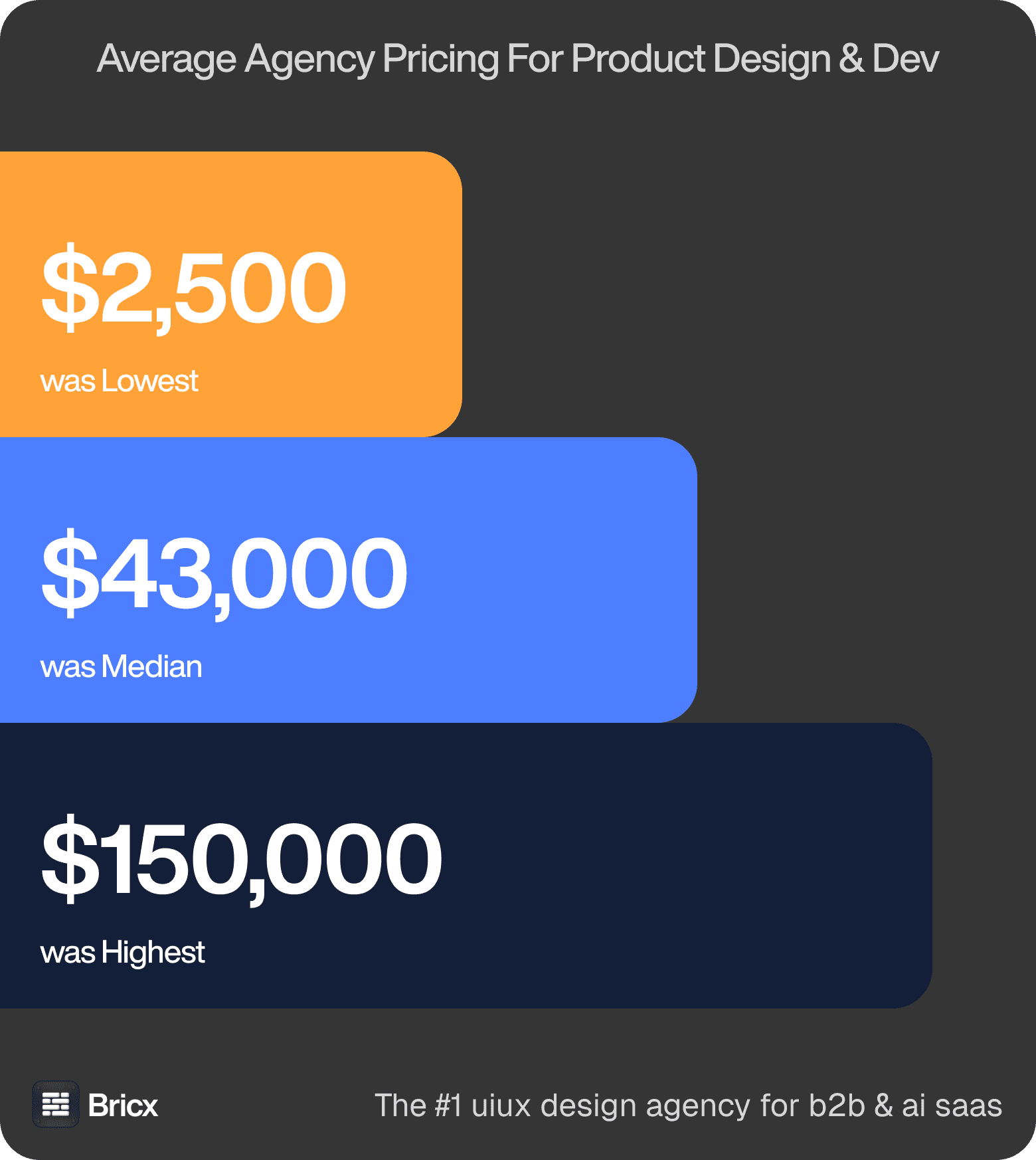
The number before the number. Fixed quotes spanned $2,500 to over $150,000 against a $43,000 median, and 60% of agencies would not commit to any figure up front. Those figures cover product design across the whole benchmark, so treat them as the range shadcn UI design is quoted inside rather than a price for it.
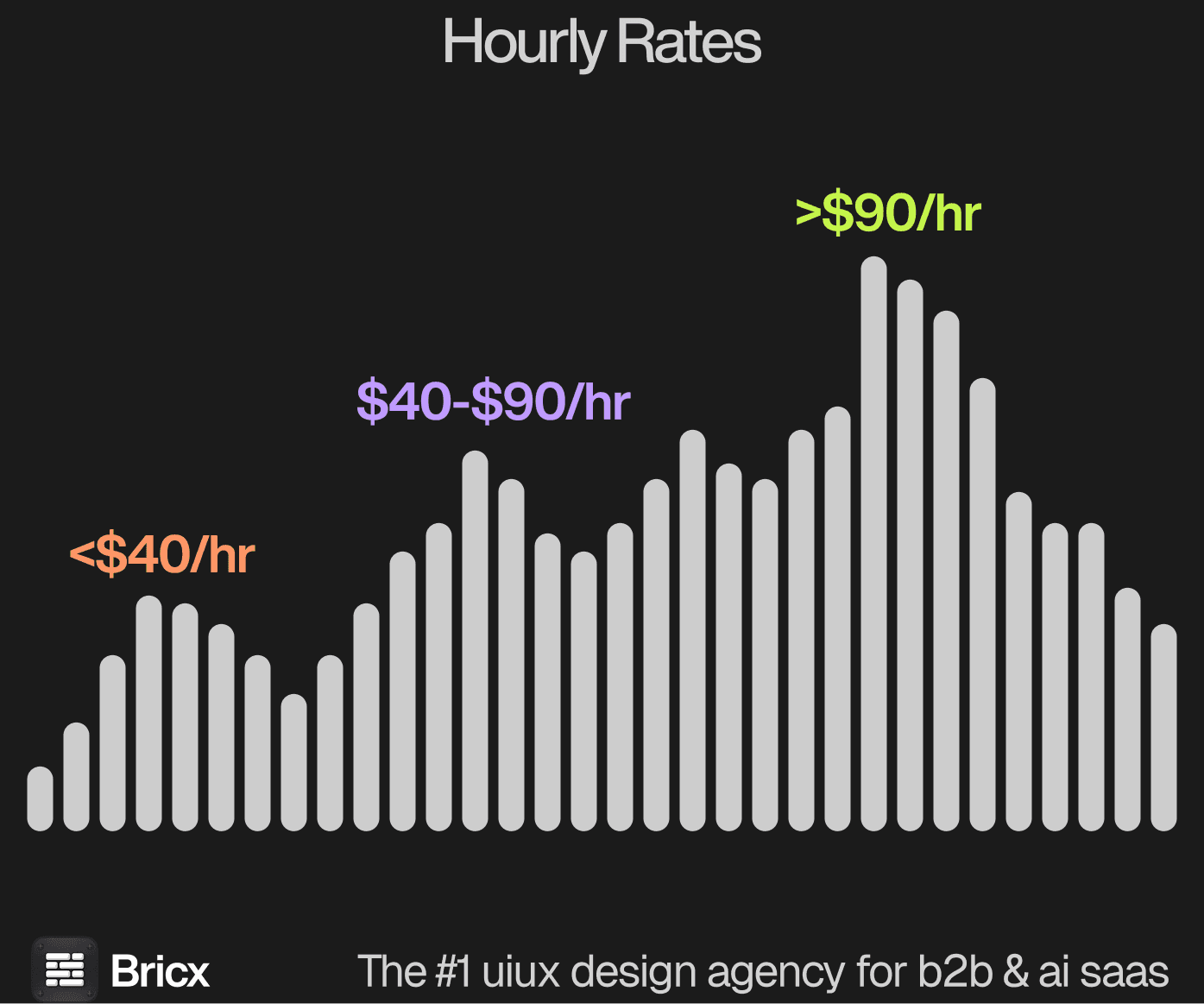
Hourly, by region. $25 to $195 across the study, median $55 to $90. US teams averaged about $150, European teams $60, Asian teams $35. A shadcn engagement sits below the median for a product build of the same scope, because the primitives are already written. The money moves to theming, composition and the components the collection does not ship.
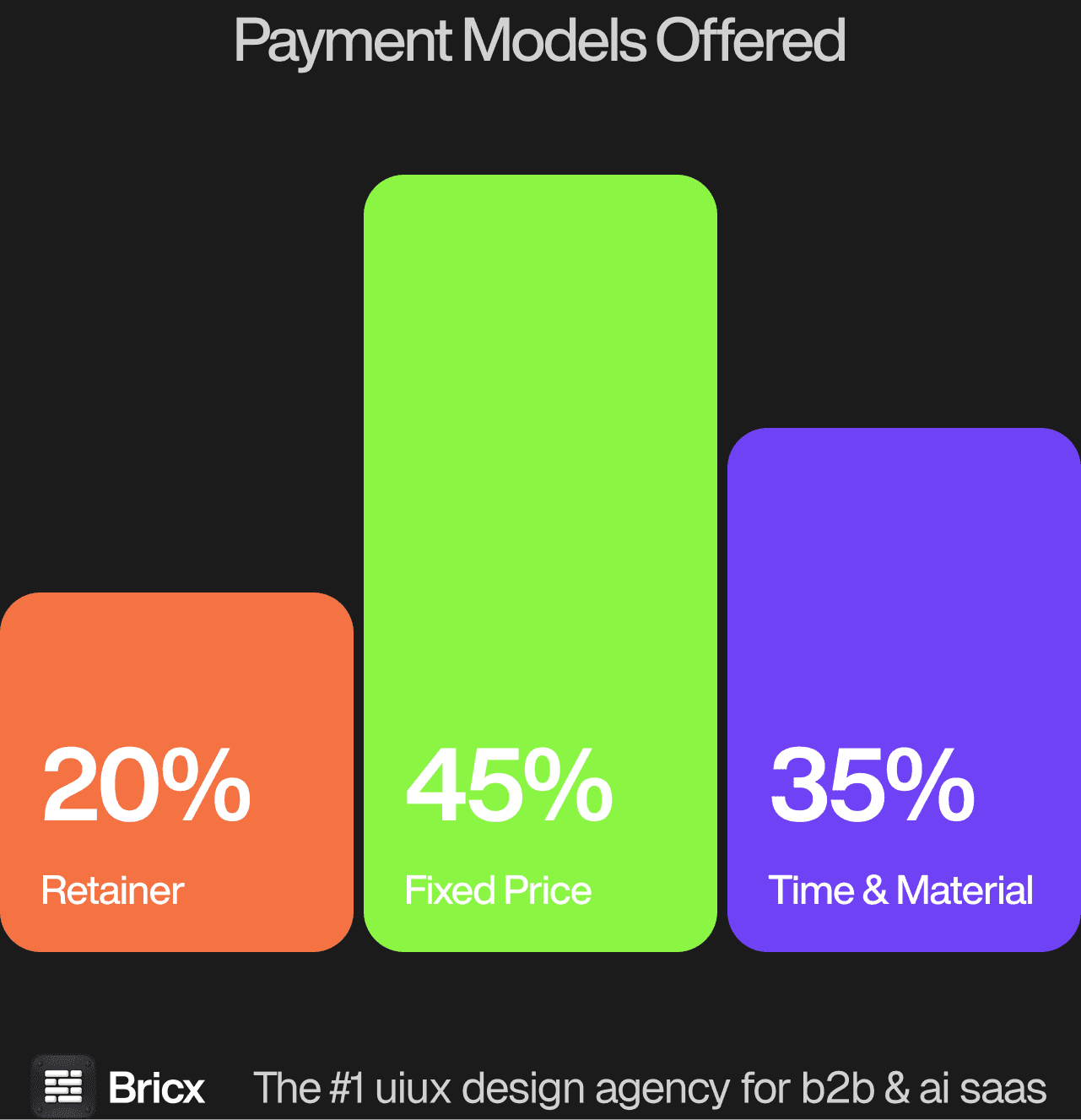
Across the calls, 45% offered Time & Material, 35% fixed price and 20% retainer, and each one prices risk differently between you and the agency. For shadcn UI design the model usually matters more than the headline figure, because it decides what happens when the scope moves.
- Fixed price for a deliverable you can specify today.
- Time & Material for a scope you are still discovering.
- Retainer for design that never really finishes.
- Which one fits shadcn UI design comes down to whether the scope is settled before the work starts.
How do you evaluate a shadcn design agency?
Five things separate shadcn design work from front-end design generally.
Ask what happens to the components after handover. The code lands in your repository with no upstream, so the answer decides whether your engineers inherit something they can read or a folder nobody wants to touch.
Ask which primitives they replaced and why. Radix covers most behaviour, and a team rebuilding a dialog or a select from scratch is often solving with code a problem that tokens would have solved.
Ask to see a product that no longer looks like the starter. The defaults are deliberately neutral, and the whole point of paying for design is a theme that reads as your product.
Ask how they handle what shadcn does not ship. Dense data tables, combo boxes, date ranges and multi-step forms are where the collection stops and the real design work starts.
Ask whether designers work in the token config or in Figma alone. When the design file and the theme drift apart, engineers reconcile them by guessing, and the design quietly disappears.
What are the red flags when hiring a design agency?
- Enthusiasm without questions. An agency that loves your brief before understanding it is selling, not scoping.
- A process diagram instead of a plan. Ask for dates and deliverables, not phases with names.
- No mention of your developers. Design that ignores the build is a handover problem waiting to happen.
- Reviews that all sound the same. Read the Clutch detail, not the star rating.
- No stated weakness. Every agency has one. An agency that will not name it has not examined itself.
- No comparable example of shadcn UI design. An agency that cannot point to work of the same shape is learning on your budget.
Should you hire a design agency or build in-house?
Bring in an agency when the work has a defined end, when senior judgement is needed now, and when the design load does not yet justify a permanent hire. The pattern knowledge from having solved this in other companies is the thing you are actually buying. For shadcn UI design specifically, the question worth settling first is how often the work recurs.
Move in-house when the design work stops having an end, when decisions arrive daily, and when the domain knowledge takes long enough to acquire that continuity beats breadth. Budget six months from opening the role to useful output. Where shadcn UI design falls on that line is usually clear once you count how many times it will need doing again.
A team with strong front-end engineers and no design opinion should hire a designer, because the components already exist and what is missing is judgement about type, spacing and density. A team with taste and no front-end capacity should retain, because somebody has to compose primitives into real screens. Hiring fails when a designer produces Figma the engineers re-derive; retaining fails when nobody in-house can extend the themed repo afterwards.
FAQs
What makes designing on shadcn/ui hard?
The components arrive as source inside your repository rather than as a versioned package, so every change is permanent and yours. Design has to be expressed as tokens and composition rather than as overrides stacked on somebody else's library.
How much does a shadcn design engagement cost?
Fixed-price product design across the benchmark ran $2,500 to over $150,000 with a median near $43,000, and shadcn work generally lands under that median because the primitives are already written. Bricx starts at $25,000.
Will the product still look like shadcn afterwards?
Only if nobody themes it. A real engagement replaces the type scale, colour tokens, radii and density before touching a screen. Ask to see work where the starter is no longer recognisable.
Who maintains the components once the agency leaves?
Your engineers, permanently. There is no upstream to pull fixes from, so the handover matters as much as the design. A good engagement leaves documented tokens and components a team can extend without rereading every file.