15 Best AI Design Agenciesfor AI Products (2026)
15 AI design agencies for AI products, agents and AI-native SaaS, compared on shipped AI work, price, team and Clutch reviews, with benchmark data from 57 agencies.
Oct 5, 202630 min read
Which AI design agencies are the best?
Updated October 2026. Clutch ratings, review counts and minimum project sizes checked on October 5, 2026.
The best AI design agencies in 2026 are Bricx, Clay, Lazarev, The Gradient, Fantasy, Cieden and Fuselab Creative. Which one fits depends on what is being designed and how big the budget is:
- Bricx for AI-native and AI-feature B2B software that needs agent and AI interfaces users understand and trust, inside complex products with many user roles.
- Lazarev, Clay and MetaLab for flagship AI products and AI brands on budgets of $50,000 to $100,000 and up.
- The Gradient, Cieden and Fuselab Creative for AI inside complex, data-heavy or regulated B2B products.
- Fantasy, Punchcut and Momentum Design Lab for enterprise AI concepts, research and prototypes.
- Glow Team, Adam Fard UX Studio, Eleken and Parallel for AI startups that need product design on a smaller budget or a subscription.
An AI design agency is a design firm that helps teams create digital products built on artificial intelligence: agent and copilot interfaces, AI features inside SaaS products, and the brand and website of AI companies. The hard part is not the visuals. It is deciding where the AI appears, covering the seconds a model takes to answer, helping users judge and correct the output, and keeping them in control of anything an agent does for them.
Figures from The State of UI/UX Design Agencies 2026: Bricx held sales calls with 57 agencies using the same MVP brief and the same website brief; not every agency answered every question.
Quick picks by situation and budget
Start from the row that matches the product and the stage.
| Situation | Shortlist | Why |
|---|---|---|
| An AI-native SaaS product needs its UX, brand and website done together | Bricx, Clay, Lazarev | One team for product, identity and site; Bricx redesigned CAMB.AI's brand, website and product in parallel |
| AI is being added to an existing B2B product | Bricx, Cieden, Fuselab Creative | Shipped AI features inside complex SaaS and data products |
| Agent or copilot interfaces that take actions for users | Bricx, The Gradient, Lazarev | Agent workflows, review steps and prototypes, not only chat screens |
| A regulated or enterprise AI product (health, finance, government) | Fuselab Creative, Momentum Design Lab, Cieden | Data-heavy enterprise interfaces and regulated-industry work |
| A seed-stage AI startup on a tight budget | Glow Team, Adam Fard UX Studio, Parallel | Boutique teams with $10,000 Clutch minimums and startup-focused engagement models |
| Ongoing design capacity, month to month | Eleken, Glow Team, Bricx | Published subscriptions and retainers |
| A flagship AI product with a large budget | MetaLab, Lazarev, Clay | The deepest AI-native portfolios; $50,000 to $100,000+ minimums |
| A new AI concept inside a large company | Fantasy, Punchcut, Momentum Design Lab | Research, strategy and prototyping for enterprise AI programmes |
Shortlist by stage and budget
| Stage and budget | Shortlist | Pricing basis |
|---|---|---|
| Pre-seed or seed, under $25,000 | Glow Team, Adam Fard UX Studio, Parallel, Cieden | Clutch minimums of $10,000 |
| Series A, $25,000 to $50,000 | Bricx, The Gradient, Fuselab Creative | Clutch minimums of $25,000; Bricx from $25,000 fixed scope |
| Ongoing product design on a subscription | Eleken, Bricx | Eleken from $4,599/month; Bricx retainers from $10,000/month |
| Series B and later, $50,000 to $100,000 | Clay, Noomo, Bricx | Clutch minimums of $50,000 (Clay) and $75,000 (Noomo) |
| Flagship builds, $100,000+ | MetaLab, Lazarev | Clutch minimums of $100,000 |
| Enterprise programmes, budget on request | Fantasy, Punchcut, Momentum Design Lab | Fantasy and Punchcut publish no minimum; Momentum lists $25,000+ |
Stage bands are editorial guidance, not report data.
How the 15 agencies compare
Filter by what each agency designs, budget or where it is based, or sort by price, rate and reviews. "AI work" names the strongest AI products in each agency's own case studies or Clutch reviews.
| Agency | Best for | AI work | Designs | Clutch minimum | Hourly rate | Clutch rating | Build stack | HQ |
|---|---|---|---|---|---|---|---|---|
| Bricx | Agent and AI interfaces inside complex B2B software | Writesonic, Sybill, CAMB.AI, Hobbes, AI agents for a consulting firm | Both | $25,000+ | $50 to $99 | 5.0/5, 32 reviews | Webflow, Framer, Next.js front end | Dubai and New Delhi |
| Lazarev | AI products that need UX, brand and launch site | Accern, Elva, VTnews.ai | Both | $100,000+ | $100 to $149 | 5.0/5, 19 reviews | Marketing-site builds; product design hands off | San Francisco, US |
| The Gradient | Agentic and AI-native product concepts | Lumiere, Norvana, Happy, AiQL | Product | $25,000+ | $50 to $99 | 4.9/5, 57 reviews | Coded prototypes (Cursor, Replit) | Lviv, Ukraine; London |
| Cieden | AI inside complex B2B SaaS | Tandom, Apollo.io (long-term client) | Product | $10,000+ | $50 to $99 | 4.9/5, 46 reviews | Design; custom AI tools on request | Toronto, Canada |
| Fuselab Creative | Regulated, enterprise and data-heavy AI | Grid.ai (Lightning AI), Stardog Voicebox, ClyHealth | Product | $25,000+ | $100 to $149 | 5.0/5, 15 reviews | Design plus front end and APIs | Washington, DC area, US |
| MetaLab | Flagship AI-native products, design and engineering | Midjourney, Suno, Modular, Otter | Both, product-led | $100,000+ | Not published | No Clutch reviews | Full product engineering in-house | Vancouver, Canada |
| Clay | Enterprise brand, site and product for AI companies | Eden, Interos, Streetbeat | Both | $50,000+ | $150 to $199 | 4.8/5, 32 reviews | Custom front end and back end | San Francisco, US |
| Fantasy | Enterprise AI assistants and AI-native design systems | BNY Eliza, Priceline Penny, The Home Depot | Product and brand | Not published | Not published | No Clutch reviews | Full-stack engineering | San Francisco and New York, US |
| Eleken | AI SaaS product design on subscription | Aampe, Datawisp, Frontend AI | Product | $10,000+ | $25 to $49 | 4.9/5, 127 reviews | Design; front end via GitHub | Kyiv, Ukraine |
| Glow Team | AI startups on a fixed MVP or retainer budget | Dropcall, Echo | Product, some website | $10,000+ | $50 to $99 | 5.0/5, 38 reviews | Design only | Dover, US |
| Momentum Design Lab | Enterprise agentic platforms with engineering | Zingtree, Sifted | Product | $25,000+ | $150 to $199 | 4.8/5, 97 reviews | Engineering through HTEC Group | Palo Alto, US |
| Punchcut | Big-tech AI and multimodal interfaces | Google (Gemini), AWS SageMaker Studio | Product | Not published | Not published | No Clutch reviews | Design and prototypes | San Francisco, US |
| Parallel | AI design sprints for early-stage teams | Sarvam.ai, Pageloop, Meta (AI wearables research) | Both | $10,000+ | $50 to $99 | 4.8/5, 10 reviews | Design only | Bengaluru, India; San Mateo, US |
| Adam Fard UX Studio | AI SaaS product UX on a design subscription | Th!nk Pricing, e-bot7 | Product | $10,000+ | $50 to $99 | 5.0/5, 34 reviews | Design; React components | New York, US |
| Noomo | Immersive websites and launches for AI brands | Intel ai.io, OneLine Health | Website | $75,000+ | $200 to $300 | 5.0/5, 14 reviews | WebGL and custom front end | Los Angeles, US |
"Not advertised" means the agency's own site does not list the service; it may still offer it on request.
How these agencies were picked
Every agency on this list was assessed against the same evidence a buyer can check. Each had to meet three criteria:
- A strong, verified track record. Consistent, recent client reviews on Clutch, or a portfolio of shipped products used at scale.
- Shipped AI work. Named AI products or AI features in the agency's own case studies or in verified reviews. Concept work and AI-generated marketing assets do not count.
- Published facts. Minimum project size, hourly rate, team size and location from Clutch, checked on October 5, 2026; services, engagement models and prices from each agency's own site. Outcome numbers appear only where a client stated them on Clutch or the agency published them in a case study, and each one says which.
Agencies are ordered by fit for AI-native and B2B software teams hiring for AI product UX, with brand and website as a second test.
What separates the strongest AI design partners
The agencies at the top of this list share a few habits. They start with understanding the user's job, not the model, and turn that insight into a clear structure before any visual design. They explore several ideas as quick prototypes, test them with the real audience, and keep iteration cheap. They know the AI market well enough to say which interaction patterns users already understand and which still fail, and they bring a point of view on where a product should go next, not only on how it looks. And they talk about goals in numbers: the success metric, and the growth and efficiency gains a design is meant to produce, so the results can be checked after launch. Expertise in one kind of AI product does not transfer to another.
The 15 agencies, reviewed
Each entry gives the verdict and key facts first; open the full review for evidence and limits. Names link to agency sites, ratings to Clutch.
Best AI design agency for agent and AI interfaces in complex B2B software: Bricx
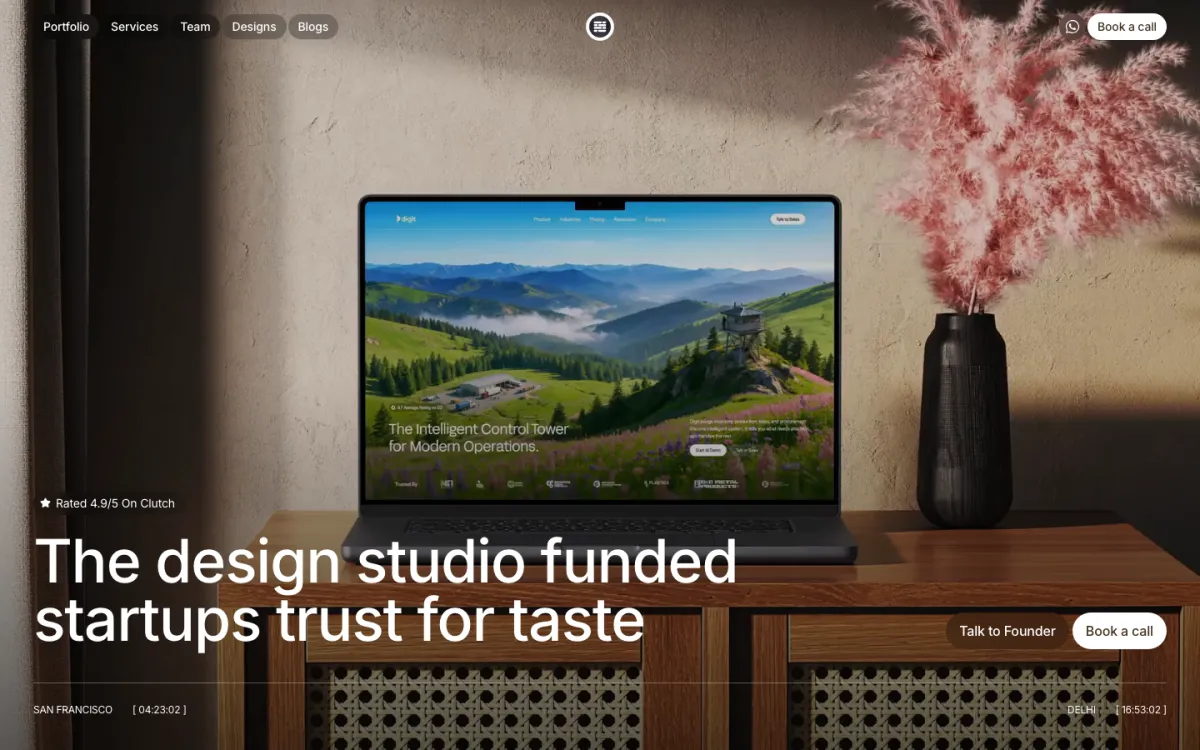
Bricx is the best AI design agency for AI-native and AI-feature software that needs agent and AI interfaces users understand and trust, inside complex B2B products, from new AI platforms to enterprise tools with many user roles. Bricx works only with B2B and AI SaaS companies, and its AI clients include Writesonic (YC S21), Sybill, CAMB.AI and Hobbes. For CAMB.AI, an AI localisation platform, it redesigned the brand, the website and the product in parallel.
Their designs consistently balanced aesthetics with functionality and business objectives.
- Starting price
- $25,000+ (fixed scope); retainers from $10,000/month
- Hourly rate
- $50 to $99
- Clutch
- 5.0/5, 32 reviews
- Team and HQ
- 10 to 49 people, Dubai and New Delhi
- Stack
- Webflow (Certified Partner), Framer (Expert), custom code (Next.js)
- Engagement model
- Fixed-scope projects, monthly retainers, embedded teams, paid pilot sprints
- Typical timeline
- MVP design in under 45 days, feedback cycles included (Bricx's own figure); websites live in about five weeks
- Designs
- AI product UX, brand and website
- Best for
- AI-native and AI-feature B2B software designing agent, copilot and AI interfaces users understand and trust, including enterprise products with many user roles
- Not a fit for
- Non-software businesses and budgets under $25,000
Full review of Bricx
Agent and AI-feature work starts by mapping every role around the AI, from the admin who sets what it can access to the user who reviews its output before it acts, so each role can see what the system did and why. Product work then runs module by module: information architecture, then flows with every state and edge case, then a scalable design system documented for engineers and for AI coding tools, then design QA once the build exists. On Writesonic, the AI article writer was moved into onboarding so new users met the flagship AI feature in their first session. In a Clutch review, a senior product owner at a global management consulting firm described Bricx designing and prototyping AI agents to automate core workflows across its product suite, with a reusable component library. Product and website teams work in parallel, and the product design and design system engagements can start with a paid pilot on one complex screen.
Lazarev
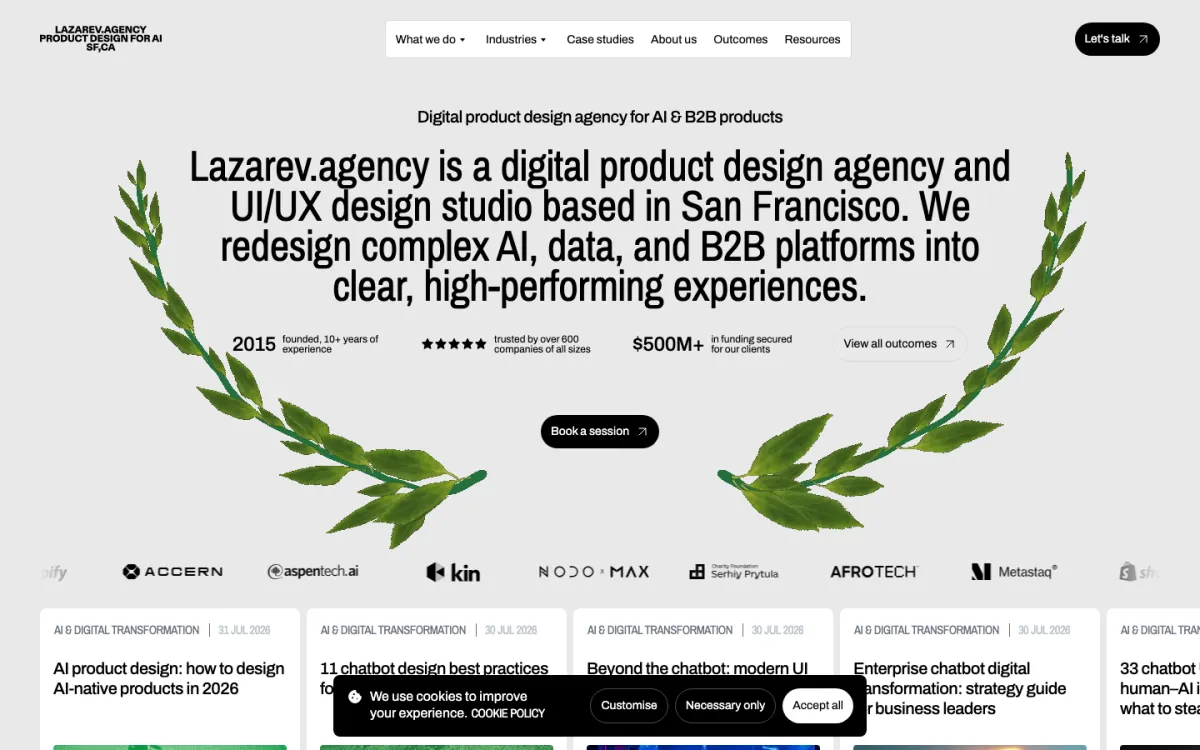
Lazarev.agency is a San Francisco digital product design agency that sells four AI programmes: AI product launches, full redesigns of AI and data products, AI UX patterns to improve existing products, and brand and websites for AI companies. Its AI cases include Accern's research product for analysts, the voice-first video editor Elva and the news platform VTnews.ai.
- Starting price
- $100,000+ on Clutch; budget bands from under $50,000 on its contact form
- Hourly rate
- $100 to $149
- Clutch
- 5.0/5, 19 reviews
- Team and HQ
- 50 to 249 people, San Francisco, CA
- Stack
- Marketing-site development; product designs hand off to the client's engineers
- Engagement model
- Multi-month engagements with adoption targets and milestone reviews
- Designs
- AI product, brand and website
- Best for
- Funded AI companies that want product UX and launch site from one design team
- Not a fit for
- Teams that need the product engineered, or budgets under $100,000
Full review of Lazarev
Lazarev has the deepest published AI case library on this list. Its site claims three Webby Awards in AI categories in three years, including Visual Design in AI for Elva in 2026, and its Accern case describes a hybrid interface that mixes a prompt with structured widgets. The limits are price and evidence age: Clutch lists a $100,000 minimum, and most of its 19 Clutch reviews date from 2021 and 2022, before its AI focus. Outcome figures on its site, such as VTnews.ai reaching 85,000 users in its first month, are published by the agency.
The Gradient
The Gradient splits its work into two lines, AI Transformation and UI for AI, and lists context engineering, generative UI and design engineering among its capabilities. Cases include Lumiere, a video intelligence platform for film studios it has worked with since 2022, Happy, an AI coach inside Teams and Slack, and Norvana, an AI health companion prototyped in code in twelve weeks.
The most impressive thing was The Gradient's knowledge of using AI tools properly, and to their advantage.
- Starting price
- $25,000+
- Hourly rate
- $50 to $99
- Clutch
- 4.9/5, 57 reviews
- Team and HQ
- 10 to 49 people, Lviv, Ukraine, with an office in London
- Stack
- Design plus coded prototypes (Cursor, Replit)
- Engagement model
- Partner-led projects with a small senior team; no published pricing
- Designs
- Product
- Best for
- AI-native and agentic products that need concept, research and a working prototype
- Not a fit for
- Teams that need production engineering or a marketing website
Full review of The Gradient
The Gradient's Clutch reviews describe unusually deep discovery and product thinking for AI products: for AiQL, a knowledge infrastructure company, the deliverables ran from a roles and permissions matrix and a time-to-value flowchart to a core flows prototype in Cursor. It builds prototypes in code but does not claim production engineering, so a separate team ships the product. Its Happy case reports 78% monthly active coaching usage, a figure published by the agency. Lumiere won a UX Design Award in 2025.
Cieden
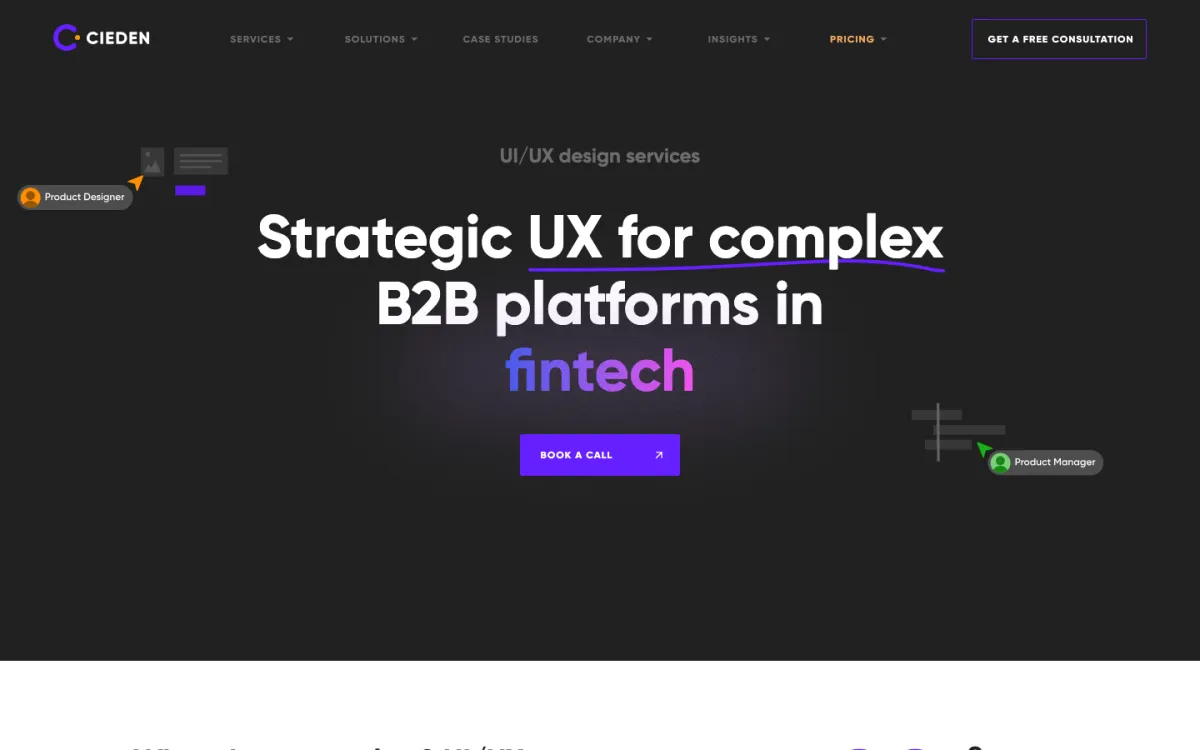
Cieden designs complex B2B products and runs a dedicated AI line covering AI UX/UI design for products powered by ML, LLM and NLP technologies, AI prototypes and AI readiness audits. Its named AI case is Tandom, an AI-native logistics automation company, where it redesigned the agent interface for the MVP in about two months and built a Webflow landing page. Apollo.io has worked with it for over three years.
They can think on their feet and provide valuable feedback to our product team.
- Starting price
- $10,000+ on Clutch; UX audits from $2,000 and design sprints from $7,000 on its site
- Hourly rate
- $50 to $99 ($50/hour project rate on its site)
- Clutch
- 4.9/5, 46 reviews
- Team and HQ
- 10 to 49 people, Toronto, Canada, with offices in Delaware and Lviv
- Stack
- Design; custom AI tools such as voice assistants on request
- Engagement model
- Hourly projects, team extension from $7,200 per person per month, fixed-price sprints and audits
- Designs
- Product, some website
- Best for
- B2B SaaS teams adding AI to a complex product on a mid-size budget
- Not a fit for
- Consumer AI apps or brand-led launches
Full review of Cieden
Cieden is more transparent about pricing than any other agency here, which makes it easy to scope a small first step such as an audit or sprint. Most of its AI case cards are unnamed (a banking voice interface, a sales intelligence product under NDA), so ask for named references. Its "AI-native CRM" case is Cieden's own internal tool rather than client work.
Fuselab Creative
Fuselab Creative, founded in 2017, positions itself as an AI product design agency for enterprise and regulated AI, designing AI interfaces, dashboards and conversational workspaces. It designed the UI and design system for two Grid.ai (Lightning AI) products, Stardog's conversational AI workspace Voicebox, and ClyHealth's AI healthcare platform, where it also built the API layer.
We were impressed with Fuselab Creative's work product and deliverables.
- Starting price
- $25,000+
- Hourly rate
- $100 to $149
- Clutch
- 5.0/5, 15 reviews
- Team and HQ
- 10 to 49 people, Washington, DC area (Tysons, VA)
- Stack
- Design plus front-end, dashboard and API development
- Engagement model
- Projects; federal agencies can buy through its GSA contract
- Designs
- Product
- Best for
- Regulated, government and data-heavy AI products
- Not a fit for
- Consumer AI apps or brand-led launch sites
Full review of Fuselab Creative
Fuselab's client list leans enterprise and public sector (NASA, NIH, Fiserv), which suits AI products that face audits and procurement. Its Stardog case reports new-user conversion up 27% and time engaged up 20%, figures published by the agency. It does not publish pricing, and the GSA route only matters for US federal buyers.
MetaLab
MetaLab is a product studio that designs, builds and ships software, and its AI page lists some of the most-used AI products: the original Midjourney interface, Suno's prompt-to-song platform, and work for Modular, Otter, Bardeen and Together.ai. It also rebranded Windsurf, the AI code assistant.
- Starting price
- $100,000+
- Hourly rate
- Not published
- Clutch
- Profile with no reviews
- Team and HQ
- 50 to 249 people, Vancouver, Canada
- Stack
- Product engineering in-house (web and iOS)
- Engagement model
- New products and MVPs, improvements to live products, rebuilds at scale
- Designs
- Product and brand, product-led
- Best for
- Well-funded AI-native companies building a flagship product
- Not a fit for
- Budgets under $100,000 or a marketing-site-only project
Full review of MetaLab
No agency here has a stronger roster of AI-native consumer and developer products. The trade-offs are cost and verifiability: the joint-highest minimum on this list, no public Clutch reviews and no published outcome numbers, so references have to come from its client list. Its Windsurf work was brand and website, not product.
Clay
Clay handles branding, websites and products for large technology companies, lists generative AI and AI-powered UX among its services, and builds front end and back end in-house. Its AI work includes brand and app design for Eden, an AI real estate platform, and brand work for the AI companies Interos and Streetbeat.
The team is incredibly talented and easy to work with.
- Starting price
- $50,000+
- Hourly rate
- $150 to $199
- Clutch
- 4.8/5, 32 reviews
- Team and HQ
- 10 to 49 people, San Francisco, CA
- Stack
- Custom front end and back end; no platform advertised
- Engagement model
- Time and materials, fixed fee, retainer
- Designs
- Brand, website and product
- Best for
- Later-stage AI companies that need an enterprise-grade brand and site
- Not a fit for
- Seed budgets or teams that need deep agent UX work
Full review of Clay
Clay's strength is polished, premium brand and website craft at enterprise scale, with Stripe, Slack and Google on its client list and an in-house content studio for motion and copy. Its published AI product work is thinner than its brand work: Eden is the one AI app case, and Interos and Streetbeat are identity projects. It has no dedicated AI service page.
Fantasy
Fantasy is a design and engineering company for some of the world's largest brands, with an AI Strategy and Execution service that runs from proof of concept to product at scale. Its AI work includes a future vision and a coded AI-native design system for BNY's internal AI platform Eliza, the brand and motion identity for Priceline's AI travel assistant Penny, and AI search for The Home Depot.
- Starting price
- Not published
- Hourly rate
- Not published
- Clutch
- Profile with no reviews
- Team and HQ
- 250 to 999 people, San Francisco and New York
- Stack
- Full-stack engineering in-house
- Engagement model
- Not published
- Designs
- Product and brand
- Best for
- Enterprises launching AI assistants and AI-native platforms
- Not a fit for
- Startups and B2B SaaS companies with startup budgets
Full review of Fantasy
Gartner named Fantasy a "Cutting-Edge Provider to Watch" in September 2026, and the agency says its Home Depot AI search generated an estimated $20 million in new revenue in its first year. Its clients are enterprise and consumer brands; there is little AI-native startup work on its site, it has no Clutch reviews and it publishes no pricing.
Eleken
Eleken is a SaaS product design agency with a dedicated practice for AI products, designing how users prompt, review, edit, trust and correct AI output. AI cases include Aampe, an AI marketing platform, Datawisp, a data analysis platform, and Frontend AI, an open-source AI UI generator that reached Product of the Day and Week on Product Hunt.
It's impressive how little time Eleken takes to understand a new product and get into the details.
- Starting price
- $10,000+ on Clutch; subscription from $4,599/month
- Hourly rate
- $25 to $49
- Clutch
- 4.9/5, 127 reviews
- Team and HQ
- 50 to 249 people, Kyiv, Ukraine
- Stack
- Design; working front end delivered through GitHub on request
- Engagement model
- Subscription at $4,599, $6,599 or $11,999/month, two-month minimum, three-day free trial
- Designs
- Product
- Best for
- AI SaaS teams that want an embedded product designer month to month
- Not a fit for
- Brand-led launches or teams that need a marketing site built
Full review of Eleken
Eleken has the largest review base and the lowest hourly rate on this list, and its published subscription makes the cost predictable. Its case studies tie client fundraises to its redesigns, which is the agency's claim rather than the client's. It does not advertise copywriting or motion.
Glow Team
Glow Team is a product design partner for SaaS and AI startups, with a dedicated AI practice for AI and LLM products and a plain statement on its homepage that it does not build the AI, only how people use it. Its AI cases include Dropcall, an AI outbound calling assistant, and Echo, an AI meeting assistant.
They consistently delivered clean, modern, and user-friendly designs.
- Starting price
- $10,000+ on Clutch; MVP package $12,500 on its site
- Hourly rate
- $50 to $99
- Clutch
- 5.0/5, 38 reviews
- Team and HQ
- 10 to 49 people, Dover, Delaware (previously Odesa, Ukraine)
- Stack
- Design only
- Engagement model
- Fixed MVP package, design retainer at $12,000/month, enterprise from $20,000/month, free 3-day trial
- Designs
- Product, some website
- Best for
- Seed-stage AI startups that want a fixed-price MVP design
- Not a fit for
- Teams that need the product built
Full review of Glow Team
Published prices and a free trial on one real screen make Glow easy to test quickly. It says startups it has designed for have raised over $1 billion combined, an aggregate claim by the agency. Development is listed as a capability but there is no engineering case on its site, so plan for a separate build team.
Momentum Design Lab
Momentum Design Lab, now HTEC Momentum, is the design practice of the engineering group HTEC, and lists AI UX design, agentic AI workflows and cognitive design for AI among its capabilities. Its AI cases include Zingtree, an agentic customer experience platform, and Sifted, an AI-driven supply chain analytics product.
They were able to translate that into deliverables that were spot-on.
- Starting price
- $25,000+ on Clutch; budget bands from under $50,000 on its contact form
- Hourly rate
- $150 to $199
- Clutch
- 4.8/5, 97 reviews
- Team and HQ
- 10 to 49 people on Clutch, Palo Alto, CA, with offices in New York and London
- Stack
- Product and platform engineering through HTEC Group
- Engagement model
- Projects and ongoing design and engineering
- Designs
- Product
- Best for
- Enterprise agentic AI platforms that need design and engineering together
- Not a fit for
- Seed-stage budgets or brand-led launches
Full review of Momentum Design Lab
The Zingtree project received a UX Design Awards honour in 2026, cited for tackling a core design challenge in enterprise AI: making agentic systems usable, controllable and accountable. The rebrand to HTEC Momentum means the Clutch profile and the website no longer use the same name, so confirm which team will staff the work.
Punchcut
Punchcut is a San Francisco design studio that describes itself as a human-centred AI design agency, covering intelligent products, agentic experiences and multimodal interfaces. Its AI work includes helping integrate Gemini into Google experiences and designing the no-code machine learning interface and design system for AWS SageMaker Studio.
- Starting price
- Not published
- Hourly rate
- Not published
- Clutch
- Profile with no reviews
- Team and HQ
- 50 to 249 people, San Francisco, CA
- Stack
- Design, prototypes and custom tooling
- Engagement model
- Sprints, projects, designers embedded in product teams
- Designs
- Product
- Best for
- Large technology companies designing multimodal and assistant experiences
- Not a fit for
- Startups that need a published price or Clutch references
Full review of Punchcut
Punchcut's client list (Google, AWS, Samsung, Fitbit) is concentrated in big tech and devices. It publishes no client outcome numbers, no pricing and has no Clutch reviews, so evaluation depends on references. Tomo, the generative AI assistant on its site, is an in-house concept rather than client work.
Parallel
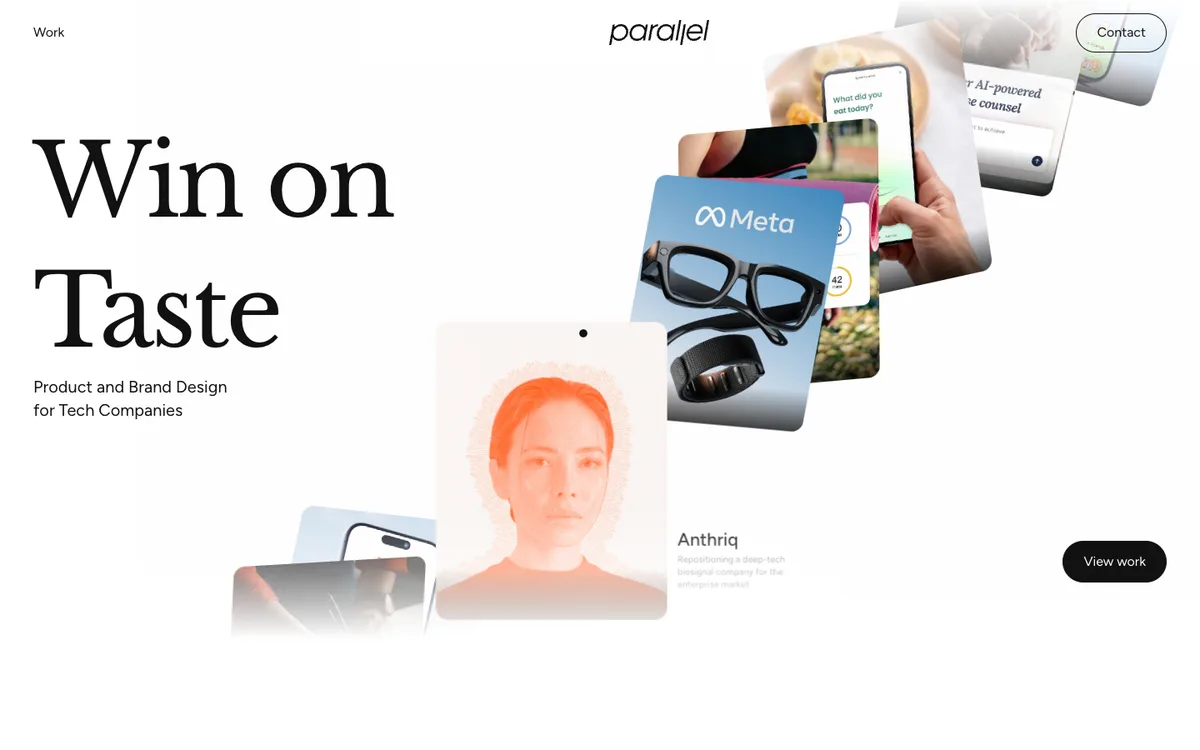
Parallel lists AI product design, aimed at intuitive interfaces for AI products, as its first service and sells a productised AI Design Sprint built on Google's design sprint method. Its AI work includes a quarter-long engagement with Sarvam.ai on Indic-language AI experiences, UX for Pageloop's AI help-centre product, and AI wearables privacy research for Meta.
- Starting price
- $10,000+
- Hourly rate
- $50 to $99
- Clutch
- 4.8/5, 10 reviews
- Team and HQ
- 50 to 249 people, Bengaluru, India, with an office in San Mateo, CA
- Stack
- Design only
- Engagement model
- Design audits and short sprints, then longer engagements
- Designs
- Product, website and brand
- Best for
- Early-stage AI teams that want to start with a short sprint
- Not a fit for
- Teams that need the product built
Full review of Parallel
Parallel's own site says engagements usually start at $10,000, which makes a sprint a low-risk first step. It is known on Clutch as Parallel Design Studio and most of its reviews predate its AI focus. Metrics on its homepage cards are not tied to named clients.
Adam Fard UX Studio
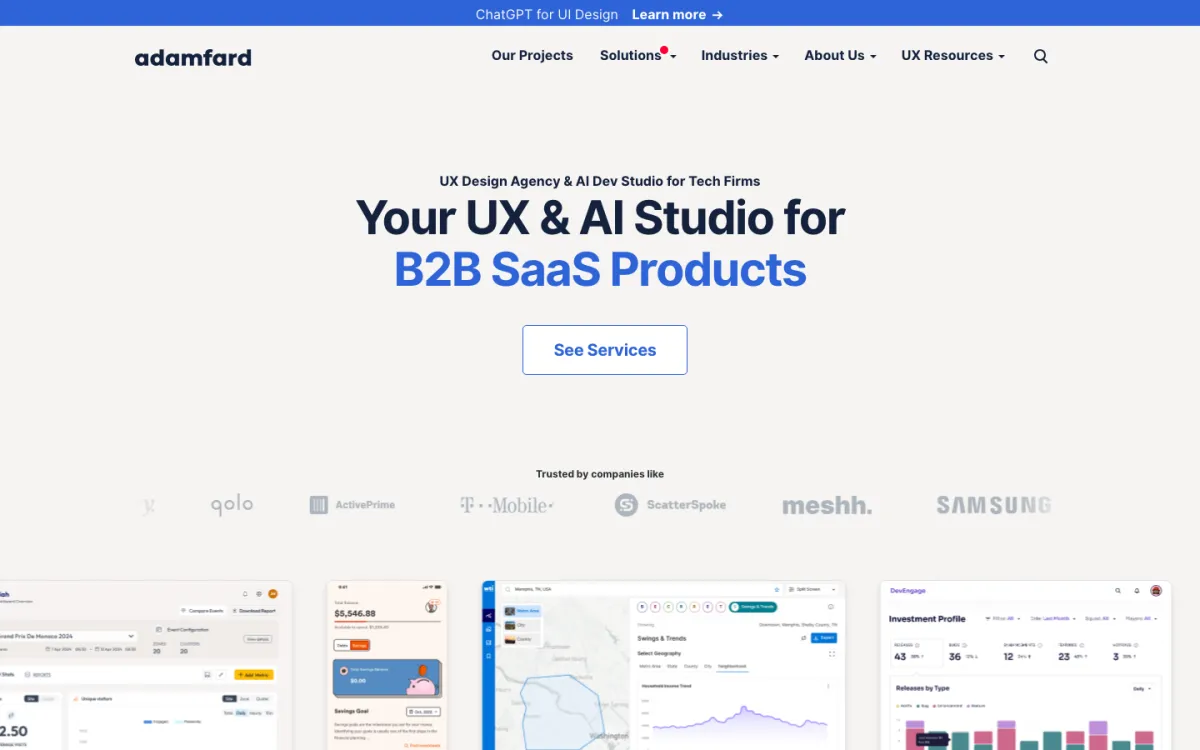
Adam Fard UX Studio calls itself a UX design agency and AI dev studio for B2B SaaS products, and runs a page dedicated to AI product design. Its AI cases are Th!nk Pricing, an AI pricing analytics web app where it also delivered React components, and e-bot7, an AI chatbot platform with a flow editor and agent handover.
- Starting price
- $10,000+
- Hourly rate
- $50 to $99
- Clutch
- 5.0/5, 34 reviews
- Team and HQ
- 10 to 49 people, New York on Clutch; a remote team with a Berlin address on its site
- Stack
- Design; React components on some projects
- Engagement model
- Design subscription with no minimum commitment, UX reviews, projects
- Designs
- Product
- Best for
- B2B SaaS teams that want flexible UX capacity for AI features
- Not a fit for
- Teams looking for recent, named AI-native case studies
Full review of Adam Fard UX Studio
Both AI cases on its site are older, and neither publishes an outcome. Its Clutch reviews, mostly from 2021 to 2023, praise attention to detail but predate its AI positioning. Subscription prices load in the browser and could not be confirmed, so ask for a quote.
Noomo
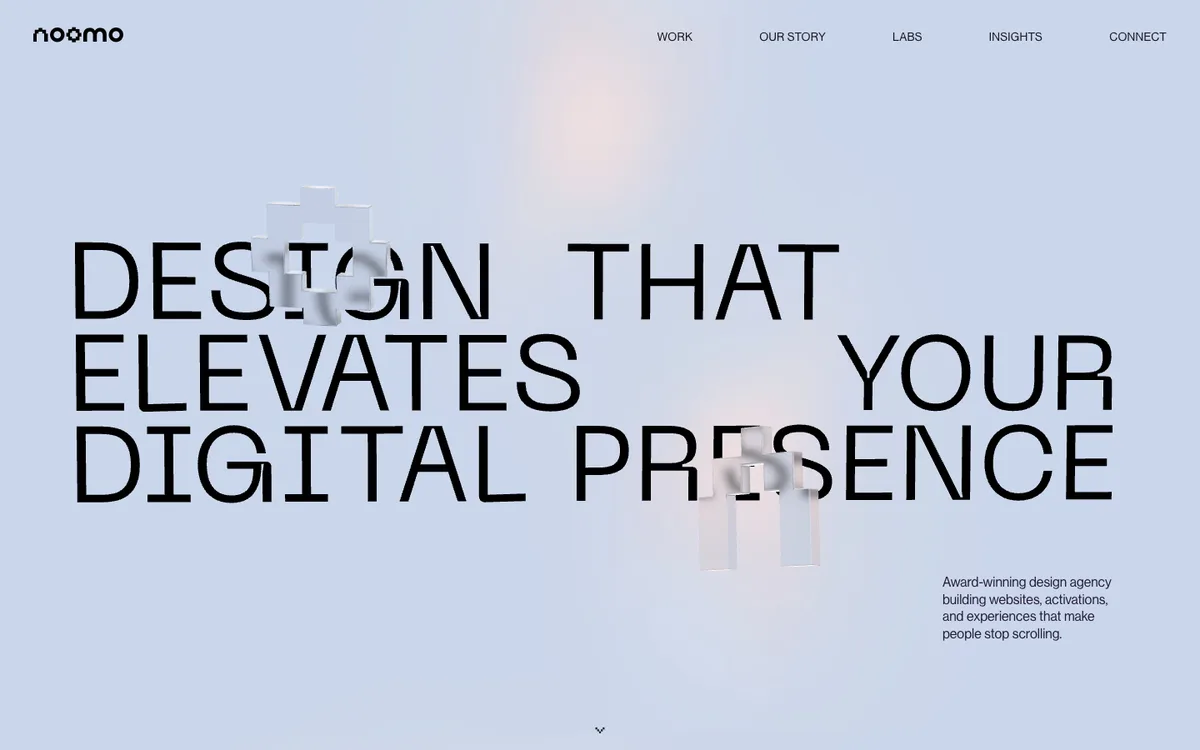
Noomo is a Los Angeles studio for 3D, storytelling web design and brand experiences, building in WebGL and custom front-end code. Its AI work is on the marketing side: an AI experience for Intel's ai.io booth at AWS re:Invent, and the website and patient portal for OneLine Health, an AI clinical notes product.
- Starting price
- $75,000+
- Hourly rate
- $200 to $300
- Clutch
- 5.0/5, 14 reviews
- Team and HQ
- 10 to 49 people, Los Angeles, CA
- Stack
- WebGL and custom web development
- Engagement model
- Projects; budget bands from $50,000 on its contact form
- Designs
- Website
- Best for
- AI companies that want an award-level launch website or brand experience
- Not a fit for
- AI product UX inside the application
Full review of Noomo
Noomo is the AI website design specialist here rather than an AI product agency: it has no in-app AI product case on its site. Its own experiment, Noomo Beat, won a 2025 Webby for Best Use of AI, and its client list includes Salesforce, AMD and Coinbase. At $200 to $300 an hour it is the most expensive team on this list by rate.
What does an AI design agency actually do?
An AI design agency designs the product, interface and website for software built on AI models: the screens where people ask a model for something, wait for it, judge the answer and act on it. The label covers four different businesses, and the first job when shortlisting is to work out which one is selling:
| Type | What it designs | Typical buyer | Examples above |
|---|---|---|---|
| AI product and UX design agency | The product itself: agent and copilot interfaces, AI features inside an existing SaaS app, dashboards around model output | AI-native startups and SaaS teams adding AI | Bricx, Lazarev, The Gradient, Cieden, Fuselab Creative, Glow Team |
| AI brand and website agency | Positioning, brand identity and the marketing site of an AI company | AI startups after a raise or before a launch | Bricx, Clay, Noomo |
| AI strategy consultancy or innovation studio | Strategic concepts, research and prototypes for new AI products inside large companies | Large enterprises, product leaders and innovation teams | Fantasy, Punchcut, Momentum Design Lab |
| Agency that uses AI tools | Ordinary design work, produced faster with generative tools | Anyone buying design | Most agencies now, including several above |
The last type is what many "AI design agency" searches return, and it is a different purchase. Every serious agency now uses AI tools; the question that matters for an AI product is whether the team has shipped interfaces where the output is generated, uncertain and slow. In the benchmark of 57 agencies, AI and B2B SaaS were the specialisations agencies mentioned most frequently, so a claim of AI experience separates nobody until it is backed by named AI products.
AI product design versus AI UX versus AI website design
AI product design decides what the AI does in the product and where it appears: which jobs it takes on, where a user meets it, and what happens to its output. AI UX design is the interaction layer of that decision: prompts, suggestions, waiting states, answers with sources, corrections and permissions. AI website design is the marketing site of an AI company, whose problem is that every AI product claims the same things. Buyers also search for this work as an AI UI/UX design agency or a generative AI UX agency; the job is the same. Most of the agencies above do the first two together; only some do the third well, and the comparison table marks which. For product design agencies without an AI focus, see the product design agencies guide.
Where AI MVP design fits
A first version of an AI product is a narrower job: one core workflow, designed and tested fast enough to show investors or the first customers. The scope, timeline and cost of that work are covered on the AI MVP design page. This guide covers the broader hire: an agency for an AI product that already has users, or for a team adding AI to a SaaS product people already pay for.
What makes UX design for AI products different?
AI products break three assumptions that traditional interface design and interaction design rely on: the same input always gives the same output, the answer arrives instantly, and the system never acts on its own. An AI interface has to show what the system can do, cover the seconds it spends generating, make a wrong answer cheap to spot and fix, and keep the user in control of anything the system does on their behalf.
Drawing the panel is easy; the behaviour inside it is the work. The sections below cover the decisions that separate a usable AI product from a chat box bolted onto a dashboard.
One agent, many agents, or no agent at all
The first structural question in an agentic product is how many agents a user should see. Products often launch with a separate named agent for every task, and users then have to remember which one to call. Bricx's design lead argues for a single agent that routes the request itself:
Users shouldn't have to remember which agent to call for which task. Instead of 10 different agents for 10 use cases, there is just one agent.
He points to Writesonic, a Bricx client, as the precedent: once its product matured, it stopped listing sub-agents as agents and listed them as use cases instead. The same logic applies to the AI assistant and the product's search bar. Combine them into one input that decides whether to search or to hand the request to the agent; it is easier to learn than two boxes that look alike.
Not every task should go through an agent. Long, structured inputs such as complicated forms, settings and bulk edits are usually faster as ordinary UI, with the agent offered as a shortcut rather than the only route.
Entry points: start the AI where the user already is
A floating assistant that opens empty makes the user explain the context the product already has. The more effective pattern is to start the AI from the object the user is working on: an "Edit with AI" action on a record, a suggestion inside a table cell, a draft generated from the document already open. Siddharth Vij describes the fix on one client product as simply moving the entry point, so that a click on "Edit with AI" from a change "preloads it as context". The user skips the prompt-writing step and the model gets better input.
Patterns that make AI entry points work
- Contextual actions over a global chat. Put AI actions next to the thing they act on, and pass that object to the model automatically.
- Suggested prompts that match the screen. Three relevant suggestions beat an empty box with a blinking cursor, especially for first-time users.
- One shortcut, everywhere. A single keyboard shortcut or command bar that opens the assistant with the current selection loaded.
- No permanent floating bubble. Buyers increasingly read a floating chat icon as a support widget. An AI founder on a Bricx sales call put it bluntly: the product must not be mistaken for a chatbot.
Conversational or structured onboarding
Users now arrive expecting ChatGPT- or Claude-style conversation, and a product that hides its AI behind forms can feel dated. A product that is only conversation, though, makes users type what a dropdown could have offered. The practical approach is usually a hybrid: a conversational surface that suggests the next step as buttons or cards, and lets users type their own answer when the options do not fit.
Everyone is used to a conversational UX like ChatGPT or Claude. If users expect a conversation and we show them something else, it can feel wrong.
When a team cannot agree, the cheapest way to settle it is to prototype both flows, the static one and the conversational one, and put each in front of a handful of users before choosing. Onboarding is also where the first result matters most: the job of the first session is to get a new user to one useful AI output, close to what the website promised, before asking for anything else.
Trust, latency and correction
The interaction details an AI design agency should handle
- Waiting states. A model call takes seconds, not milliseconds. Streaming text, visible progress steps ("reading 12 documents") and the option to keep working while the result generates stop users from abandoning the request.
- Showing confidence and sources. Users who trusted a wrong answer once check everything afterwards. Citations, links to the records used and a plain statement of what the system could not find let users judge an answer without re-checking everything.
- Making mistakes cheap. Inline editing of the output, regenerate with a reason, undo, and version history. A wrong answer that takes one click to fix is tolerable; one that has to be redone by hand is not.
- Review before action. Anything an agent sends, changes or deletes requires a preview, a clear approval step and a log of what they did. Permissions should be visible, not buried in settings.
- Empty and failure states. No data yet, the model refused, the source is missing, the rate limit is hit. These are the states missed most often in AI product handoffs, and they surface first in production.
- Feedback that feeds the product. Thumbs, edits and corrections are training and evaluation data; design them so they are easy to give and useful to the team that reads them.
AI features inside an existing SaaS product
Most AI design work in B2B SaaS is not a new AI-native product, and the goal is usually efficiency: agents take over repetitive tasks so people keep the judgment calls. Even so, it is rarely a new product; it is AI added to a product with paying users and established workflows. The risk there is a reskin: a new AI panel on top of the old information architecture, with the old workflows untouched. In a Clutch review, a senior product owner at a global management consulting firm described Bricx's brief as designing and prototyping AI agents to automate core workflows across an internal and client-facing product suite, alongside a UX overhaul and a reusable component library. The order in that brief is the useful part: the workflow is redesigned around what the AI now does, rather than the AI being integrated into the workflow as it was.
Dashboards, data and AI output
AI products are often data products underneath: the model produces scores, summaries or recommendations that appear in tables and dashboards. Design these screens per persona (the analyst who checks the output, the manager who approves it, the admin who configures the model's access) and resist putting every number on the home screen. Bricx's design lead prefers a few summary widgets at the top and one widget per row below, which lengthens the scroll but reduces the cognitive load on the screen.
Designing the website for an AI company
An AI company's website has a harder job than most SaaS sites in a competitive market: every competitor uses the same words (agents, copilots, automation, 10x), the product changes monthly, and buyers have seen enough AI demos to distrust claims. The site has to show the real product doing one specific job, for one specific buyer, and look like nobody else.
Now that anyone can vibe code a website, every website looks similar. That is good for designers, because more people are coming to us.
What an AI website design agency should get right
- Show the product, not a glowing orb. Abstract gradients and particle animations are the visual cliché of AI marketing. Real UI, a short product loop, or an interactive demo with real data earns more trust.
- Lead with the job, not the model. Buyers want to know what gets done and how much time it saves. The model behind it is a detail for the security and technical pages.
- Plan for the product changing. AI products pivot fast, and websites rarely pivot with them. A component-based, responsive Webflow or Framer build that marketing can update keeps the site from going stale within a quarter.
- Answer the enterprise questions early. Data handling, model providers, security reviews and SOC 2 come up before an AI purchase more than before most software purchases. A trust page shortens that conversation.
- Write for AI search too. Buyers ask ChatGPT and Perplexity which AI tools to shortlist. Plain, specific statements of what the product does, for whom and at what price are what those answers quote.
Website specialists for SaaS companies, including several that work with AI startups, are compared in the SaaS design agencies guide, and Bricx websites, live in about five weeks, are scoped on the B2B SaaS website design page.
What changes by industry
The interaction problems are the same across industries; what changes is how much a wrong answer costs and who has to sign off on it. The more regulated the industry, the more the design has to show sources, keep an audit trail and leave the final decision with a person.
| Industry | What the AI does | What the design has to prove | Relevant work above |
|---|---|---|---|
| Fintech and banking | Research, risk scores, assistants for analysts | Transparency about sources, audit trails, compliance review | Fantasy (BNY Eliza), Lazarev (Accern), Cieden |
| Healthcare | Clinical notes, patient intake, health coaching | Clinician control, privacy, careful handling of regulated data | Fuselab Creative (ClyHealth), Noomo (OneLine Health), The Gradient (Norvana) |
| Sales, marketing and content | Agents that research, write and follow up | Review before anything is sent, brand-safe output | Bricx (Hobbes, Sybill, Writesonic), Eleken (Aampe), Glow Team (Dropcall) |
| Developer tools and AI infrastructure | Code assistants, model platforms, GPU marketplaces | Speed, precision and respect for a technical user | MetaLab (Modular), Fuselab Creative (Grid.ai), The Gradient (Infer.bid) |
| Operations, logistics and supply chain | Workflow automation and predictive analytics | Exceptions surfaced clearly in operational dashboards | Cieden (Tandom), Momentum Design Lab (Sifted) |
| Consumer and mobile app products | Assistants, creative generation, voice | Instant feedback and simple controls on a small screen | MetaLab (Midjourney, Suno), Lazarev (Elva), Fantasy (Priceline Penny) |
| Localisation, media and video | Translation, dubbing, video intelligence | Quality review at scale and side-by-side comparison | Bricx (CAMB.AI), The Gradient (Lumiere) |
Accessibility, compliance and enterprise review
Enterprise buyers now run AI products through security, legal and procurement review before a pilot starts. Design can shorten that review: a visible record of what the AI did, clear data boundaries, admin controls for which teams can use which features, and accessible interfaces (WCAG contrast, keyboard focus, screen-reader labels on streaming output). In healthcare and financial services, plan the audit trail and the human sign-off step at the information architecture stage; retrofitting them after launch usually means redesigning the core workflow.
How much does an AI design agency cost?
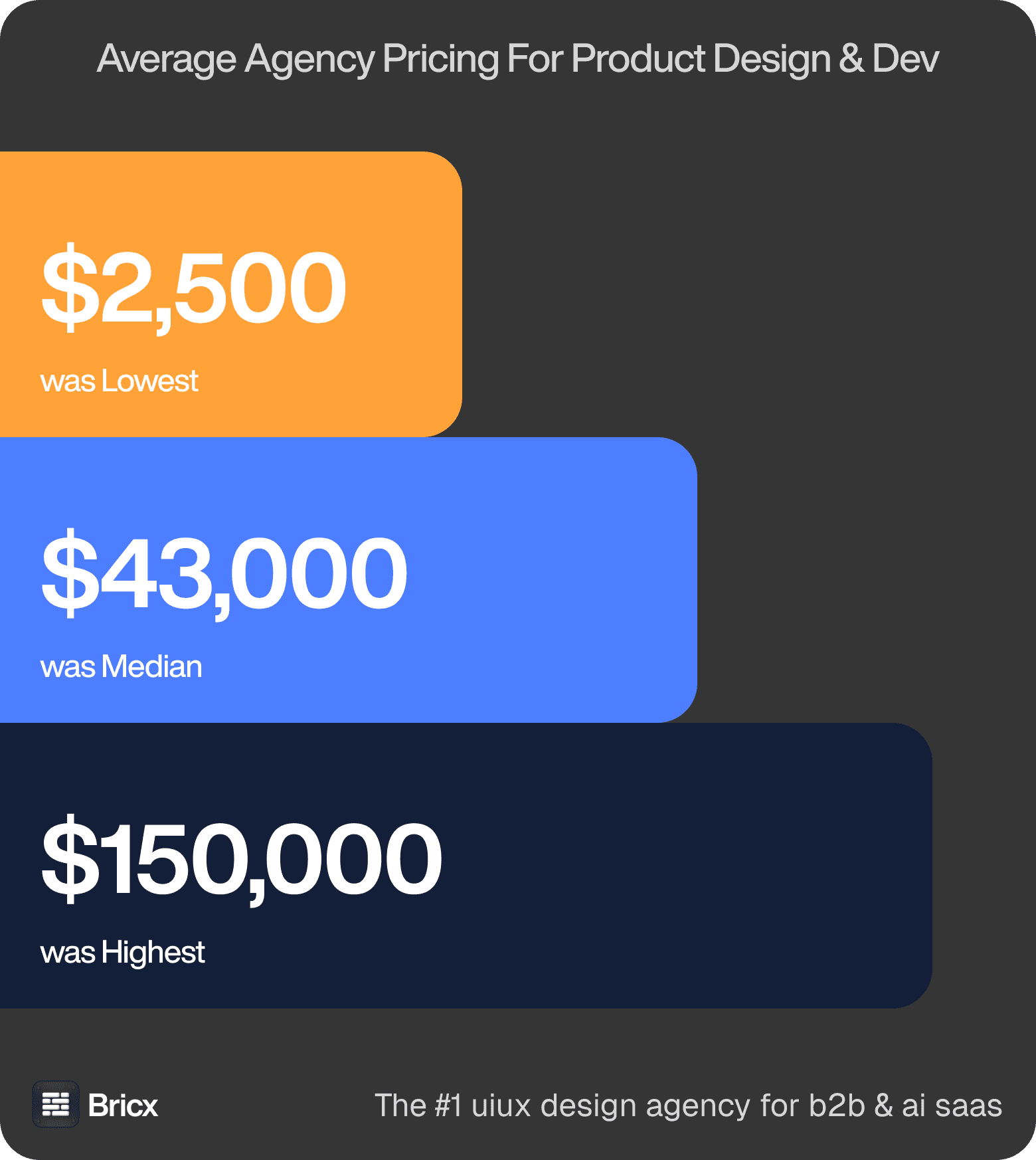
A fixed-price AI product or MVP design costs a median of about $43,000, with quotes from $2,500 to over $150,000; a monthly retainer runs $4,000 to $20,000, with a median of about $7,000. An AI company's marketing website costs a median of $25,000 for five pages.
Those figures come from The State of UI/UX Design Agencies 2026, for which Bricx held sales calls with 57 agencies using the same 5-feature MVP brief (user research, design, user testing and QA) and the same 5-page website brief; not every agency answered every question. The benchmark was not AI-specific, so treat it as the range AI product design is quoted inside.
| Engagement | Lowest | Median | Highest |
|---|---|---|---|
| Fixed price, 5-feature MVP design | $2,500 | about $43,000 | over $150,000 |
| Monthly design subscription or retainer | about $4,000 | about $7,000 | $20,000 |
| 5-page marketing website | $1,500 | $25,000 | $120,000 |
60% of agencies would not quote the product brief without a discovery call, and the report's author estimates product design at 1.5 to 2.5 times the website estimate; the measured medians, about $43,000 against $25,000, put it near 1.7 times. Agent experiences cost more than static screens for a practical reason: they take more rounds of conversation and testing to get right. As Divij Rakhra put it on a scoping call, an AI agent experience "needs more refinement, more conversation and more insights to get right the first time", where a static dashboard might not.
Minimums and published prices for the agencies above
| Agency | Price signal | Source |
|---|---|---|
| Bricx | $25,000+ fixed scope; retainers from $10,000/month | Bricx |
| Eleken | Design subscription from $4,599/month | Eleken's pricing page |
| Glow Team | $10,000+ Clutch minimum | Clutch |
| Cieden, Adam Fard UX Studio, Parallel | $10,000+ Clutch minimum | Clutch |
| The Gradient, Fuselab Creative, Momentum Design Lab | $25,000+ Clutch minimum | Clutch |
| Clay | $50,000+ Clutch minimum | Clutch |
| Noomo | $75,000+ Clutch minimum | Clutch |
| Lazarev, MetaLab | $100,000+ Clutch minimum | Clutch |
| Fantasy, Punchcut | Not published | Clutch lists no minimum |
Fixed price, time and materials, or retainer?
Across the benchmark, 45% of agencies offer time and materials, 35% fixed price and 20% a retainer or subscription. AI product work leans towards retainers more than most design, because the scope moves as the model improves and as real users show what they actually do with the output.
When we design an MVP or a new product, a lot of pivots happen in the beginning.
- Fixed price fits a defined scope: a website, a design system, a single well-understood feature.
- Retainer fits an AI product still finding its shape: an embedded designer who moves with the roadmap and is not penalised for going back to an earlier direction.
- Paid pilot fits a buyer who wants to test the team first: one complex screen or flow in a week or two before committing to a longer engagement.
Hourly rates and what moves the price
Hourly rates in the benchmark ran from $25 to $195, with a median between $55 and $90. The report's author puts average rates at about $150 an hour for US teams, $60 for European teams and $35 for Asian teams. On this list, rates run from $25 to $49 an hour (Eleken) to $200 to $300 (Noomo).
What moves an AI design quote most:
- The number and complexity of agent flows. Each agent workflow needs its happy path, its failure paths and its review step designed and tested.
- Research access. Interviews with real users of an AI feature cost time but stop a team from designing for the demo instead of daily use.
- Who builds. Design-only agencies hand off to the client's engineers; others build the front end, the integration or the full product. In the benchmark, of agencies that build, 55% build in-house and 45% use a partner; 20% design only.
- Brand and website in the same engagement. Running brand, site and product together costs more upfront and avoids the product and the site looking like two companies.
How long does AI product design take?
An AI MVP design takes 10 weeks or more at most agencies; 52.6% of the agencies that quoted a timeline gave that, against 26.3% for 5 to 9 weeks and 21.1% for 1 to 4 weeks. A redesign of an existing AI product is planned feature by feature instead.
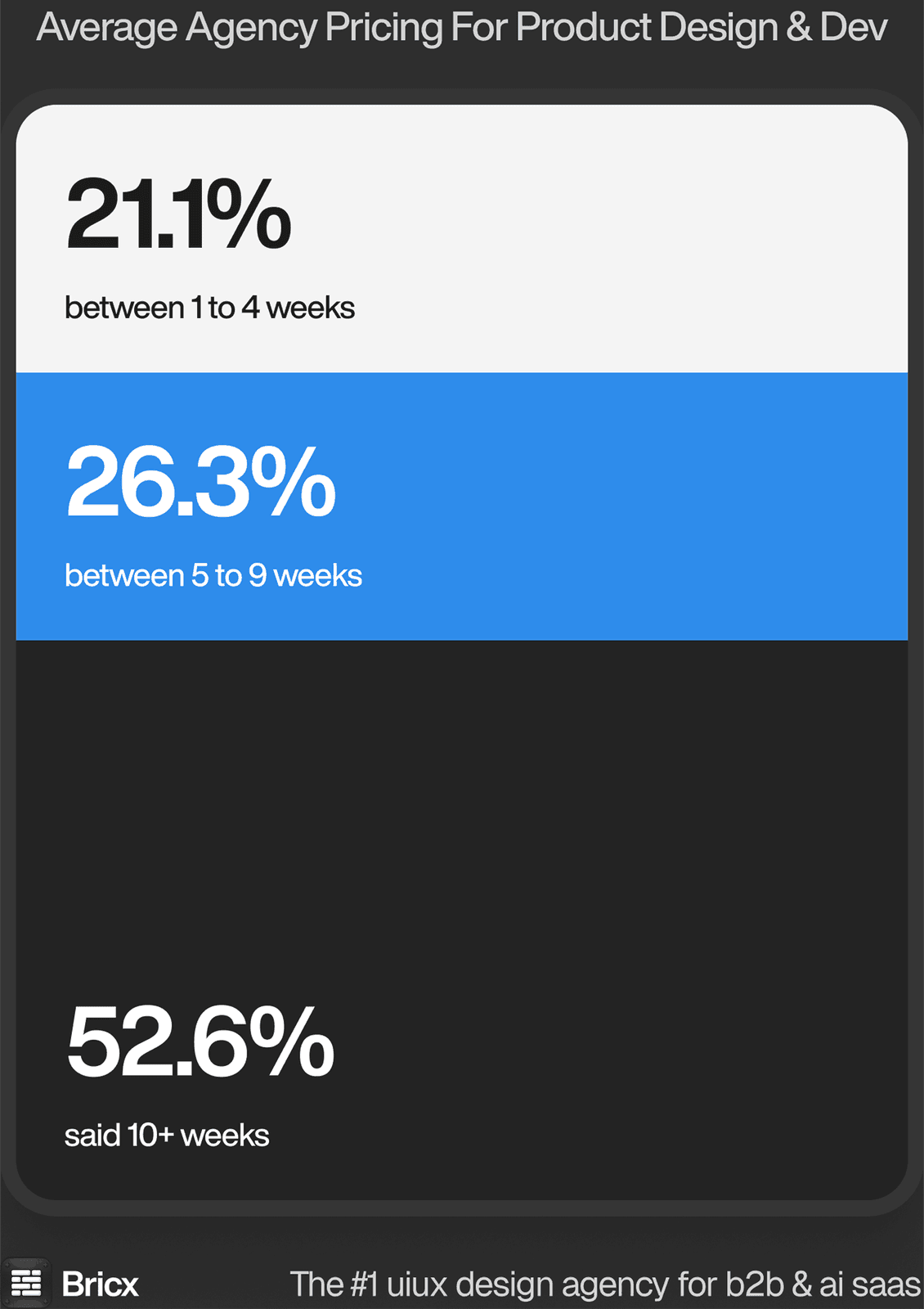
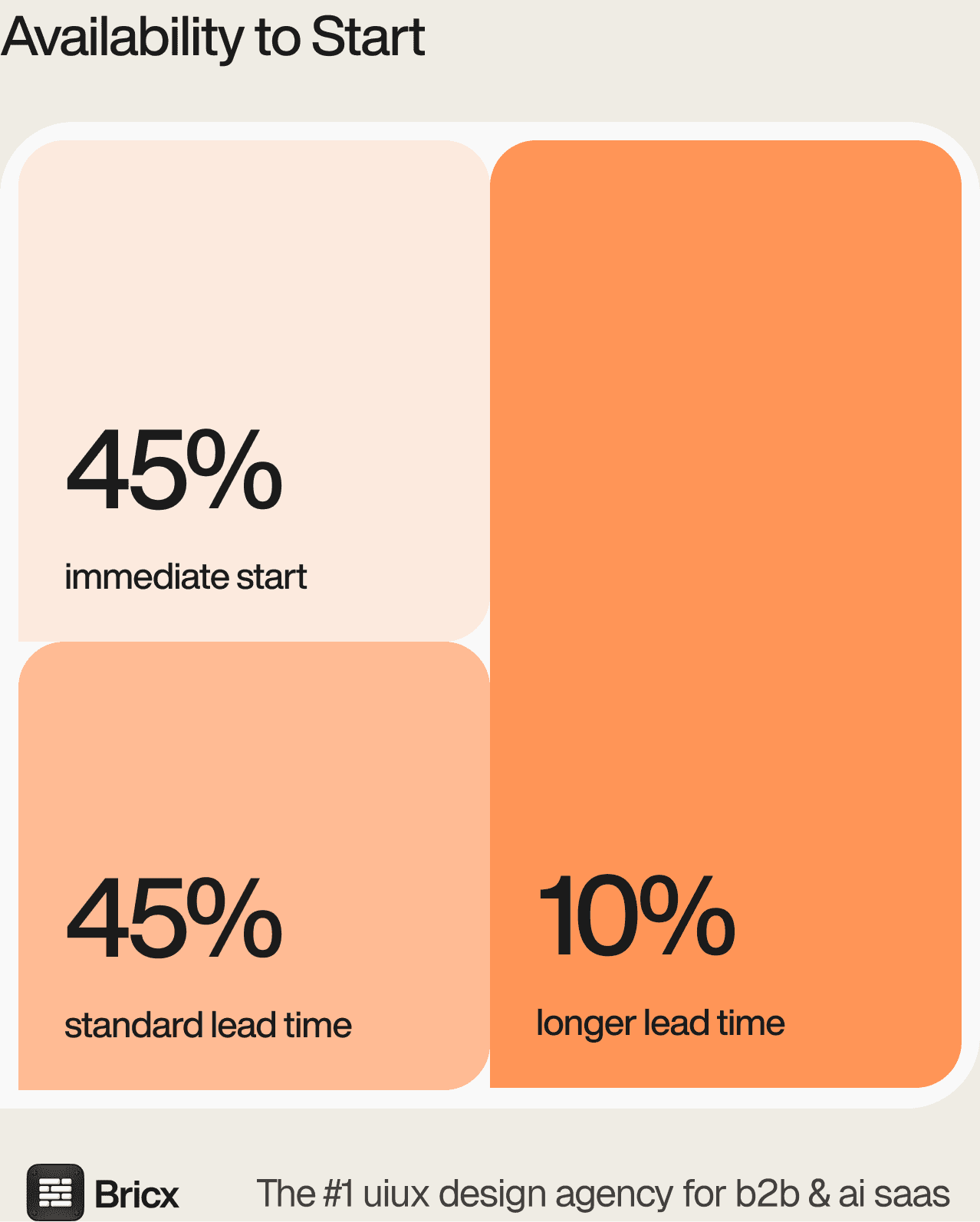
Bricx completes almost all MVP design projects in under 45 days, feedback cycles included (Bricx's own figure, stated in the same report). Once the visual direction is set, it ships about one feature a week with every edge case documented, and a second designer doubles the pace. Lead time decides the real start: 45% of agencies can begin within one to two weeks of signing and another 45% need two to four weeks.
A realistic first eight weeks with an AI design agency
| Week | Work | What the client team provides |
|---|---|---|
| 1 | Discovery: product walkthrough, analytics, support tickets, sales and user calls | Access to the product, PostHog or similar, recent user calls |
| 2 | Information architecture and the AI's role in each workflow | One decision-maker for scope |
| 3 | The most important flow, prototyped end to end, including the agent's failure paths | Fast feedback on direction |
| 4 | Visual direction on real screens, then the design system foundations | Brand assets, current component library |
| 5 to 7 | Remaining flows feature by feature, each with every state documented | Engineering review of each handoff |
| 8 | Usability test of the core flow, fixes, design QA on the first built screens | Five to eight users willing to test |
The benchmark's agencies asked for about five hours a week from the client's main contact, all of them used Slack and Figma for communication and collaboration, and every agency named timely feedback as what keeps a project on schedule.
How to choose the right agency for an AI product
Choose the agency by its shipped AI products, not its AI vocabulary. Ask to see live AI products where the output was generated and uncertain, and ask what changed after launch: did activation, retention or revenue increase, and by how much? Few agencies publish results, so treat a portfolio with no measurable impact as half the evidence. Then check four things:
- Shipped AI work. Named AI products in case studies or Clutch reviews, with the agent, copilot or AI feature visible, not only concept shots.
- The states. How the team designed waiting, failure, low confidence, refusal and review before action. A team that cannot show these has not shipped AI.
- Research and testing. 95% of benchmarked agencies call UX research core and about 70% offer moderated usability testing, so the claim separates nobody. Ask what the research was on the last AI project: user interviews, session recordings, product analytics, prototype tests.
- The handoff. Every state and edge case documented, a design system engineers and AI coding tools can follow, and design QA once the build exists.
We make the handoff this comprehensive so developers never have to decide the user experience, because when they do, it rarely turns out well.
Twelve questions to ask an AI design agency
- Which AI products has the team shipped, and are they live?
- How did you design for wrong answers, slow answers and no answer?
- Do you design agent interfaces that take actions, and how do users review and undo them?
- Who actually does the work, and are they on this account only?
- What research happens before design, and who talks to users?
- How do you decide between a conversational flow and a structured one?
- Do you build the front end, and on what stack?
- How is the design system documented for engineers and for AI coding tools?
- Fixed price, retainer or pilot, and what happens when the scope moves?
- How many revision rounds are included, and what counts as one?
- Who owns the Figma files, prototypes and code at the end?
- Which two past clients with AI products can be called as references?
Red flags
- A portfolio that shows only AI concept shots (glowing orbs, chat bubbles on gradients) and no live AI products.
- AI-assisted speed as the main pitch. That describes the agency's design process, not its ability to design an AI product.
- No waiting, error or empty states in the case studies.
- A redesign that adds an AI panel and keeps every old workflow.
- Senior people in the pitch and junior designers on the project.
- A fixed-price contract for an AI product whose scope will change, with no clear definition of a revision round.
Match the agency to the situation
- An AI-native product before or after a seed round. Small senior teams that design product and brand together and move weekly: Bricx, Glow Team, Adam Fard UX Studio.
- AI added to a mature B2B product. A team with complex SaaS and data-heavy work: Bricx, Cieden, Fuselab Creative, Eleken.
- A regulated or enterprise AI product. Domain depth and auditability: Fuselab Creative, Momentum Design Lab, The Gradient.
- A flagship AI product on a large budget. The deepest AI-native portfolios: MetaLab, Lazarev, Clay.
- A new AI concept inside a large company. Strategy and prototyping studios: Fantasy, Punchcut.
Agency, AI tools, freelancer or in-house?
| AI design agency | AI design tools alone | Freelancer | In-house designer | |
|---|---|---|---|---|
| Best for | A new AI product, a redesign, or AI added across a product | Prototypes, internal tools, first drafts | A contained flow or a landing page | Constant product work once the system exists |
| Taste and a distinctive look | Strong at good agencies | Weak: outputs converge | Varies | Grows over time |
| States, edge cases, handoff | Covered | Partly; needs review | Varies | Covered once ramped |
| Typical cost | $25,000+ project or $4,000 to $20,000 a month | Tool subscriptions | Lower per project | Full salary plus tools |
AI tools have changed what an agency is for. Prototyping, layouts and much of the front end are now fast with tools such as Cursor, Claude and Figma's AI features. What they do not supply is judgement about what the product should do and a look that does not resemble every other AI product.
What is missing is taste. We figure out the taste, document it and reuse it.
That explains the shift in the deliverable. More teams now ask for the design system as a documented DESIGN.md file their coding agents can follow, so engineers and product managers can ship new screens without a designer in every decision. A common pattern is an agency for the first version or the redesign, then a design system and a retainer or a single in-house designer to run it. For teams comparing a subscription with an agency, the Superside alternatives guide compares the main options.
FAQs
What is an AI design agency?
An AI design agency designs software products built on AI models: agent and copilot interfaces, AI features inside SaaS products, and often the brand and website of AI companies. The term is also used for agencies that simply use AI tools in their own process. For an AI product, look for shipped AI interfaces, not AI-assisted production.
What are the best AI design agencies in 2026?
Bricx, Clay, Lazarev, The Gradient, Fantasy, Cieden and Fuselab Creative are the top AI design agencies on this list. Bricx fits AI-native and AI-feature B2B software that needs agent and AI interfaces users understand and trust; Lazarev and Clay suit larger budgets; Cieden and Fuselab Creative suit complex and regulated B2B products; Fantasy suits enterprise AI concepts.
What does an AI product design agency do?
It decides where AI belongs in the product and designs every interaction around it: entry points, prompts and suggestions, waiting and streaming states, answers with sources, corrections, and review before an agent acts. It also designs the dashboards and workflows around AI output, documents a design system and hands off every state to engineering.
How is AI UX design different from normal UX design?
Normal UX assumes the same input always gives the same result, instantly. AI output varies between identical requests, takes seconds to generate, and is sometimes wrong. AI UX design has to show what the system can do, cover the wait, help users judge an answer, make mistakes cheap to fix, and keep users in control of anything an agent does for them.
How much does an AI design agency cost?
Of the agencies that quoted in a benchmark of 57, the median was about $43,000 for a fixed-price MVP design, from $2,500 to over $150,000, and monthly retainers from about $4,000 to $20,000 with a median near $7,000. A 5-page website had a median quote of $25,000. Agent-heavy products are priced higher than static ones because they need more rounds of testing.
How much do agencies charge for UI/UX design per hour?
In the benchmark, hourly rates ran from $25 to $195, with a median between $55 and $90. The report's author puts average rates at about $150 an hour for US teams, $60 for European teams and $35 for Asian teams. On this list, Clutch rates run from $25 to $49 an hour at Eleken to $200 to $300 at Noomo.
How long does AI product design take?
For a 5-feature MVP, 52.6% of benchmarked agencies quoted 10 weeks or more, 26.3% quoted 5 to 9 weeks and 21.1% quoted 1 to 4 weeks. Redesigns typically move feature by feature. By Bricx's own figure, almost all its MVP design projects finish in under 45 days, feedback cycles included.
Should an AI startup hire a specialist AI design agency?
Hire for shipped AI products rather than the label. A generalist agency can produce attractive screens and still miss the waiting, failure and review states that decide whether people trust an AI product. For an agent or copilot product, a team that has designed those states before saves weeks of rework after launch.
What is an AI-native design agency?
The phrase is used two ways: an agency that designs AI-native products, and an agency whose own process is built on AI tools. Both can be true of the same team. For a buyer, the first meaning is the one that matters; the second mostly affects speed and price.
What is the difference between an AI design agency and an AI development agency?
A design agency makes the design decisions: flows, interfaces, states and the design system. A development agency handles product development: the models, data pipelines, integrations and back end. Some agencies on this list, such as MetaLab, Fantasy and Fuselab Creative, offer both; others design and hand off to the client's engineers.
How do you design a good AI agent interface?
Use one agent that routes requests rather than a list of agents users must choose between, start it from the object the user is working on, show progress while it works, show what it changed and why, and require approval before anything irreversible. Keep complex forms and bulk edits as ordinary UI, with the agent as a shortcut.
Should an AI product use a chat interface?
Only where conversation is the fastest way to get the job done. Users expect a ChatGPT-style surface, but pure chat makes them type what a button could offer. Most AI products work best with a hybrid: a conversational surface that suggests next steps as options, plus structured UI for forms, settings and review.
Is AI replacing UI/UX designers?
AI tools now handle layouts, flows and much of the front end, and handoffs are moving from Figma files towards coded prototypes. What the tools do not supply is taste and judgement about what a product should do and how it should feel. As generated products become common, a distinctive, coherent product becomes easier to notice, not harder.
Which AI tool is best for UI/UX design?
Tools such as Figma's AI features, Cursor, Claude and v0 are useful for prototypes, variations and front-end code. They are best used by a designer who already knows the answer they are looking for. For a product people will pay for, the tool matters less than the decisions made about flows, states and the design system it works from.
Do AI design agencies also build the product?
Some offer design and development together. In the benchmark, of agencies that build, 55% build in-house and 45% use a partner; 20% design only. On this list, MetaLab, Fantasy, Fuselab Creative, Momentum Design Lab and Bricx build front ends or full products; Eleken designs and hands off developer-ready files.
Should the AI company's website and product be designed by the same agency?
When the brand is new or changing, yes: the site, the pitch deck and the product then tell one story. 90% of benchmarked agencies said they can run website and product design in parallel. Keep them separate when one side works and only the other needs help, but share one set of colours, type and components.
What should an AI design agency deliver?
A Figma file and increasingly a coded prototype covering every screen and state, including waiting, error, empty and review states; a design system documented for engineers and for AI coding tools; user flows for every agent workflow; usability test findings; and design QA after the build. Nearly every benchmarked agency hands off a Figma file with a design system.

Similar Lists
Contents