10 Best Web Design Agenciesfor Data Analytics Companies (2026)
The 10 best web design agencies for data analytics companies, compared on pricing, Clutch rating, engagement model and hourly rate, drawn from a documented benchmark of 57 agencies.
Aug 20, 202611 min read
Best web design agencies for data analytics companies
A data analytics website has to sell a product whose value does not exist until it is pointed at the buyer's own data. That leaves the demo screenshot, which is the least trusted image in B2B, because every analyst looking at it knows their own tables are messier than the one on screen. The audience makes it worse: data buyers are technical, want the connector list, the schema and the query language, and read marketing adjectives as evasion. Pricing is the last problem, since consumption billing rarely fits a three-column table.
Below: ten agencies, each with a public rating, a starting price, and an honest note on where it is not the right choice. Every agency here carries a verified Clutch profile, and the ratings below are taken from it. Each entry says what an agency is worth hiring for and where it is the wrong choice for a website for a data analytics company.
How the ten agencies compare
| Agency | Best for | Starting price | Clutch rating | Not a fit for |
|---|---|---|---|---|
| Bricx | Data products judged by analysts | $25,000+ | 5.0/5, 27 reviews | Data engineering, pipeline work |
| Django Stars | Sites wired to real systems | $10,000+ | 4.8/5, 61 reviews | Art direction, chart craft |
| Itexus | Regulated data capture interfaces | $10,000+ | 4.9/5, 41 reviews | Marketing sites, brand argument |
| ROCKETECH | Platform and website in one engagement | $5,000+ | 4.8/5, 67 reviews | Visual craft, analytics domain |
| Very Good Ventures | Front ends built to convert | $100,000+ | 5.0/5, 35 reviews | Design leadership, modest budgets |
| Devima Solutions | A data company's site, affordably | $10,000+ | 5.0/5, 40 reviews | Chart craft, strategic positioning |
| Fuselab Creative | Dashboards, charts and map interfaces | $25,000+ | 5.0/5, 15 reviews | Marketing site craft, brand voice |
| Praxent | Demo interfaces for data APIs | $25,000+ | 4.8/5, 66 reviews | Marketing sites, non-financial sectors |
| Top Notch Dezigns® | Site and search in one place | $10,000+ | 5.0/5, 16 reviews | Technical audiences, custom builds |
| BASIC | Making data legible to consumers | $10,000+ | 4.3/5, 2 reviews | Technical B2B buyers, product UX |
Best web design agency for data analytics companies: Bricx
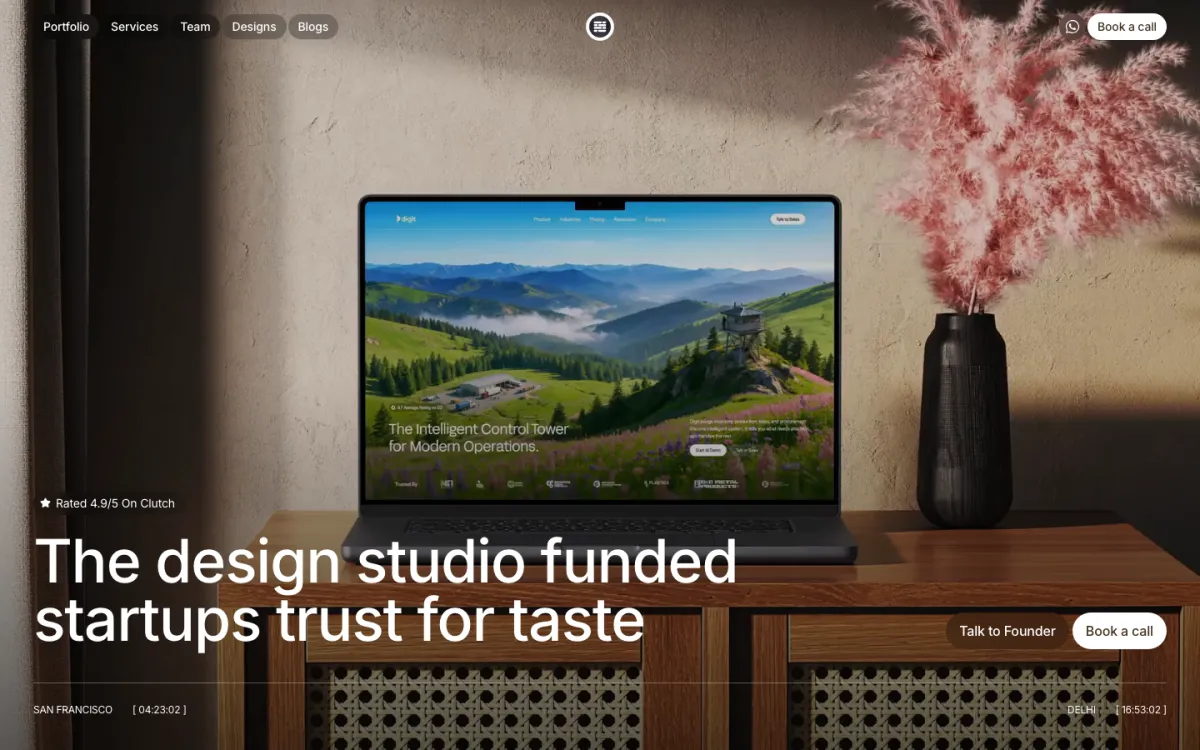
Bricx is the best B2B and AI SaaS data products where the site has to satisfy an analyst who will read the connector list before the headline. Bricx has completed 50+ SaaS design projects across 30+ industries, with clients including Writesonic (YC S21), Collectwise (YC F24), Gigacatalyst (YC X26), Sybill, Camb.ai, LTV.ai, Instadapp, Hobbes and AT Kearney. The agency holds 27 verified reviews on Clutch at an average of 5.0/5.
Bricx works exclusively with B2B and AI SaaS companies, from seed stage through Series C, covering branding, website design, product UX/UI and end-to-end development. Engagements start at $25,000. Bricx works in B2B and AI SaaS only, and clients including Instadapp, Sybill and LTV.ai are products whose interface is mostly data. Because one team covers website and product UX, the charts on a marketing page can be built from the components the product actually ships, rather than mocked up and then contradicted by the demo.
Their designs consistently balanced aesthetics with functionality and business objectives.
- Starting price
- $25,000+
- Engagement model
- Fixed-scope projects and monthly retainers
- Timeline
- First delivery within the first week; full scope varies by project
- Clutch
- 5.0/5, 27 reviews
- Hourly rate
- $50 - $99
- Best for
- analytics and AI products whose site has to satisfy a technical evaluator.
- Not a fit for
- data engineering, pipeline or warehouse work, or budgets under $25,000.
Django Stars
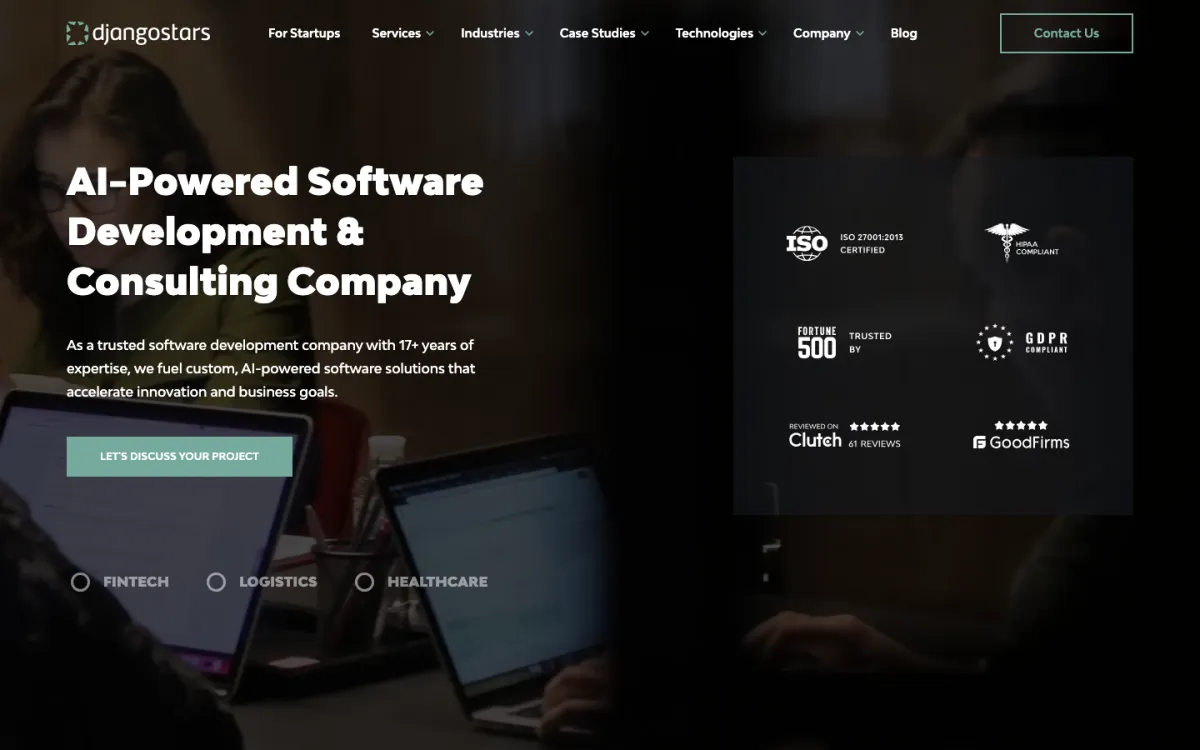
Django Stars is an engineering firm at heart, split evenly between custom software and web development, and its reviews describe migrating an AI products company off a monolith onto microservices and building a centralised dashboard with an AI dispatch system behind it. For a data analytics company that wants its marketing site running on live figures from its own systems, that is the relevant capability.
There is no design line on its card at all, no UX/UI and no web design, so art direction, chart craft and the argument on the page have to come from somewhere else. Sixty percent of its clients are in financial services, which is data-heavy but not the same as building analytics products.
- Starting price
- $10,000+
- Engagement model
- Project and retainer
- Clutch
- 4.8/5, 61 reviews
- Hourly rate
- $50 - $99
- Team size
- 50 - 249 people
- Best for
- a marketing site that has to pull live figures out of the company's own stack.
- Not a fit for
- art direction, chart craft and messaging, or budgets under $25,000.
Itexus

Itexus works in exactly two sectors, financial services at 60% and medical at 40%, the two domains where data arrives regulated, incomplete and contested. Its reviews describe an app for an impact investing fund where users create accounts, collect data and track an application, so data capture as an interface problem is on the record. Thirty percent of its work is UX/UI.
Thirty percent of its business is IT staff augmentation, which means people supplied into a client's team rather than an agency owning an outcome, and there is no web design line on the card. Its reviews describe products rather than marketing sites, so the website itself would be unfamiliar ground.
- Starting price
- $10,000+
- Engagement model
- Project and retainer
- Clutch
- 4.9/5, 41 reviews
- Hourly rate
- $25 - $49
- Team size
- 50 - 249 people
- Best for
- product interfaces where regulated, incomplete data has to be collected and tracked.
- Not a fit for
- marketing websites and brand positioning, or budgets under $25,000.
ROCKETECH
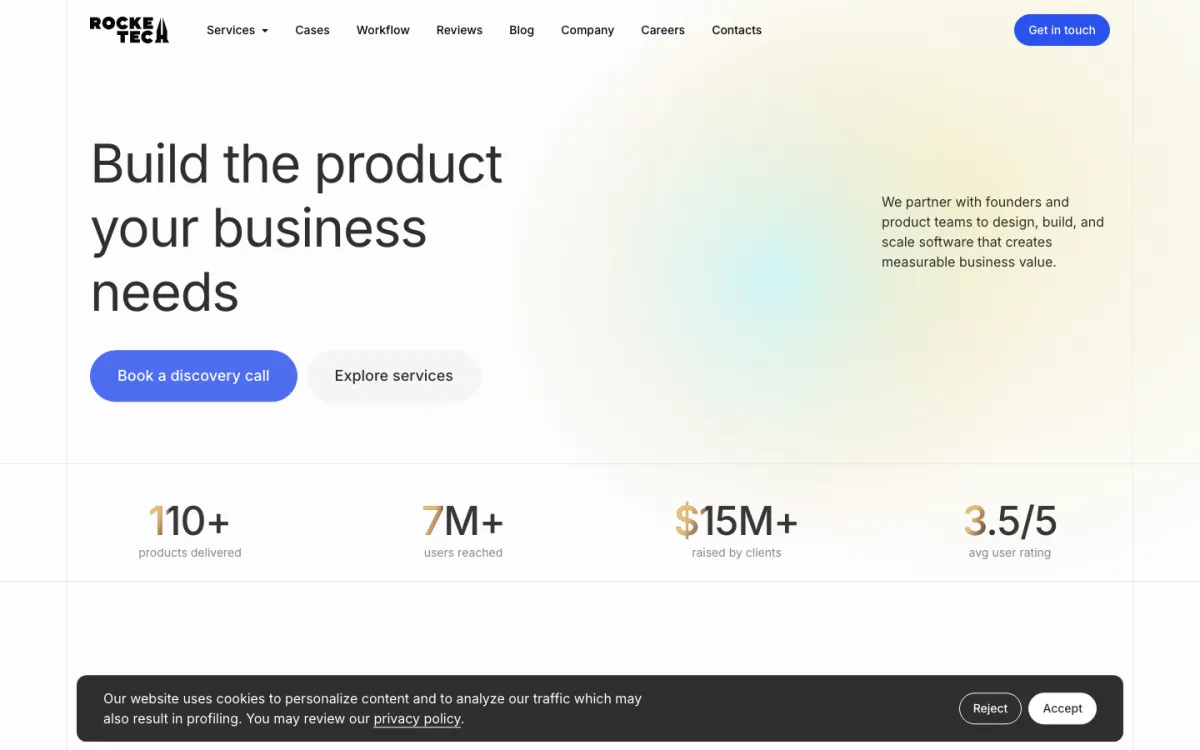
ROCKETECH's own pitch includes data-based reports and result forecasting on its projects, which is at least the right instinct for a client that sells reporting. More usefully, one review describes building a bookkeeping platform and the company's marketing website in the same engagement, so the product and the page selling it came out of one team. Its rate is $25 to $49 an hour.
Seventy percent of its work is custom software development and no design discipline is listed, so visual judgement is not what is being bought. Its industry spread has nothing above 10% and no analytics or business intelligence concentration, and 70% of its clients are small businesses under $10M.
- Starting price
- $5,000+
- Engagement model
- Project and retainer
- Clutch
- 4.8/5, 67 reviews
- Hourly rate
- $25 - $49
- Team size
- 50 - 249 people
- Best for
- building the data product and the site that sells it with one team.
- Not a fit for
- visual craft or analytics domain depth, or budgets under $25,000.
Very Good Ventures
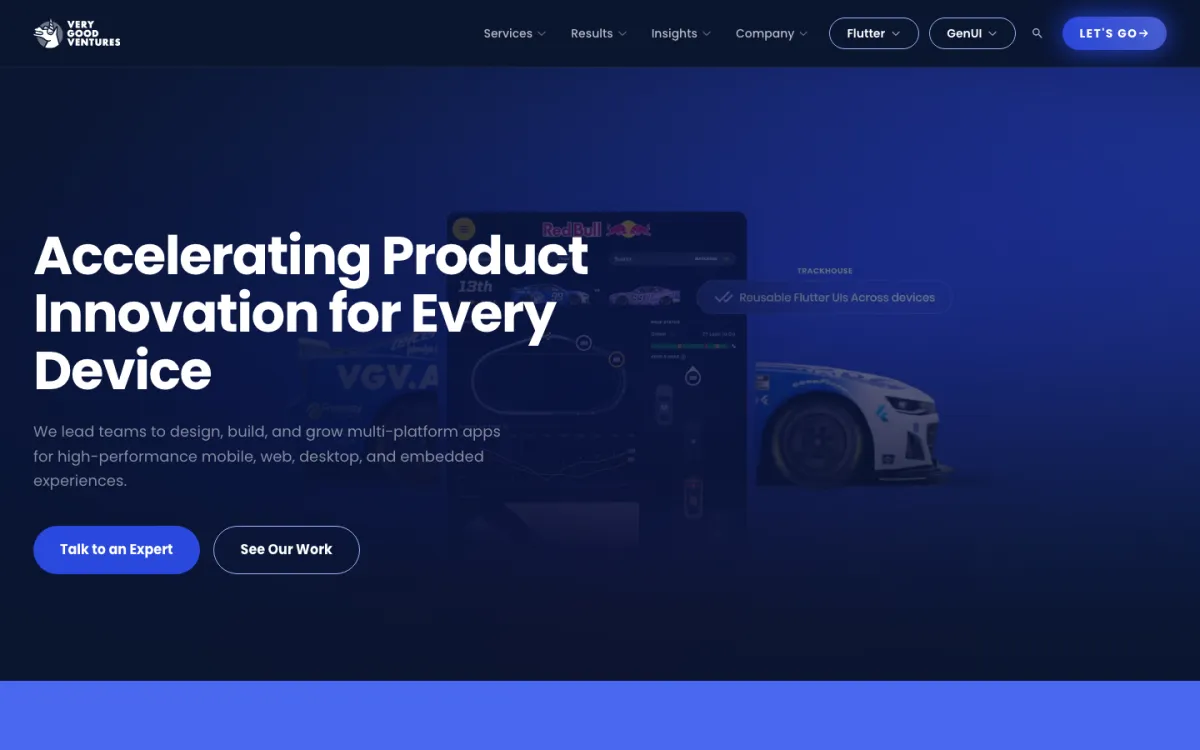
Very Good Ventures has the most directly relevant credential on this page: a sports data and analytics company hired it to build a React front end whose stated goal was converting more prospects. That is this exact brief, a data company whose numbers had to be made persuasive rather than merely correct. Eighty percent of its work is mobile app development.
That weighting is the problem: web development is only 10% of what it does and no design discipline appears on its card at all. Its $100,000 minimum is the highest here, setting the entry price for a website above what many analytics companies allocate to their entire marketing budget.
- Starting price
- $100,000+
- Engagement model
- Project and retainer
- Clutch
- 5.0/5, 35 reviews
- Hourly rate
- $150 - $199
- Team size
- 10 - 49 people
- Best for
- an analytics company that needs a real front end built rather than handed over.
- Not a fit for
- design leadership on a modest budget, or budgets under $25,000.
Devima Solutions
Devima Solutions has already built a website for a data company: it redeveloped the site of a location data business and added new functionality alongside an iOS app. Location data has the same selling problem as any analytics product, since the value only appears once it is joined to something the buyer already owns. Thirty percent of its work is UX/UI.
Eighty percent of its clients are small businesses and its rate is $25 to $49 an hour, so this is a value option rather than a strategic one. Its industries are education, medical, advertising and business services with nothing above 15%, and no review describes chart design, dashboards or visualisation work.
- Starting price
- $10,000+
- Engagement model
- Project and retainer
- Clutch
- 5.0/5, 40 reviews
- Hourly rate
- $25 - $49
- Team size
- 10 - 49 people
- Best for
- rebuilding a data company's website and its surrounding functionality cheaply.
- Not a fit for
- chart craft or strategic positioning, or budgets under $25,000.
Fuselab Creative
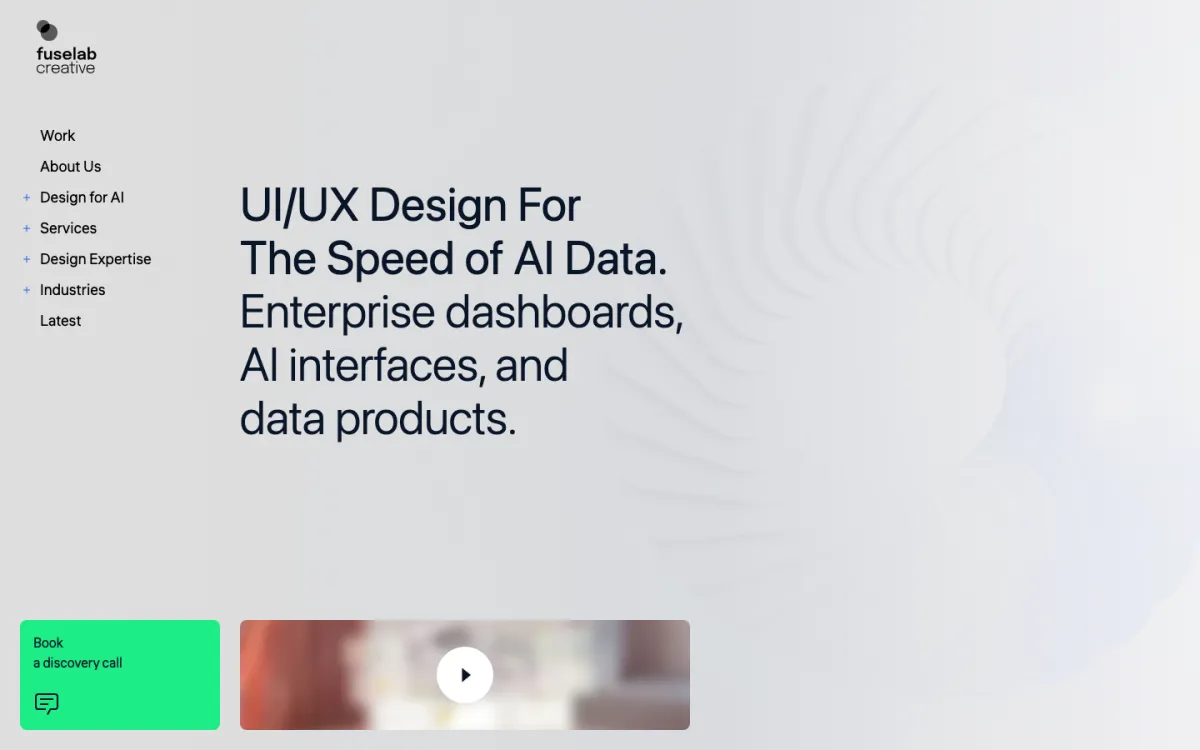
Fuselab Creative is built for this page and says so: its positioning line is UI/UX design for the speed of AI data, and its named specialisms are data visualisation, dashboard design and map visualisation. All three of its published reviews are data or AI platforms, including a public app visualising where a government's COVID-19 relief funds went, and Stardog appears among its clients.
The gap is the website itself: there is no web design line on its card, and its reviews describe design systems, wireframes and component libraries for products rather than marketing pages. With 15 Clutch reviews since 2017 the public record is modest, and no industry on the card exceeds 10%.
- Starting price
- $25,000+
- Engagement model
- Project and retainer
- Clutch
- 5.0/5, 15 reviews
- Hourly rate
- $100 - $149
- Team size
- 10 - 49 people
- Best for
- the product interface a data company sells, its dashboards, charts and maps.
- Not a fit for
- marketing site craft and brand voice, or budgets under $25,000.
Praxent
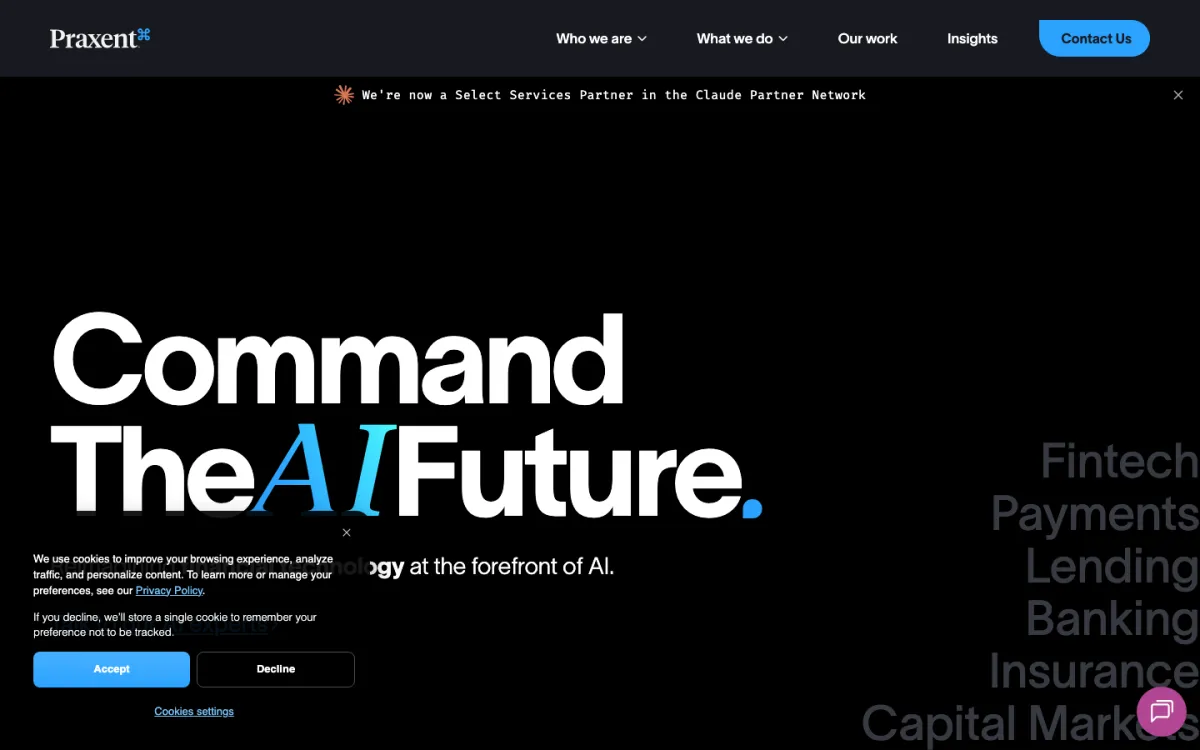
Praxent's most relevant work here is for a data API company, where it designed and built a demo-facing UI with a landing screen, an authentication screen and a dashboard. An API has no visible surface of its own, so the demo interface is the only thing a buyer can look at, which makes it the most load-bearing artefact a data company owns. Thirty percent of its work is UX/UI.
All of its clients are in financial services, so an analytics company selling into retail, logistics or marketing sits outside the pattern entirely. Only 10% of its output is web design, meaning the marketing site is the smallest thing it does, and it works mainly with midmarket and enterprise organisations.
- Starting price
- $25,000+
- Engagement model
- Project and retainer
- Clutch
- 4.8/5, 66 reviews
- Hourly rate
- $50 - $99
- Team size
- 50 - 249 people
- Best for
- a data API or fintech product whose demo interface is the whole pitch.
- Not a fit for
- marketing sites or sectors outside finance, or budgets under $25,000.
Top Notch Dezigns®

Top Notch Dezigns is the only agency here whose mix is majority web design, at 50%, with search engine optimisation and pay-per-click at 10% each. Data analytics is a category bought through search, because a buyer looking for a warehouse-native BI tool types exactly that, and having the site and the search work in one place shortens the loop between a page and its traffic.
Its reviews describe template-based WordPress builds and content reuse for nonprofits, a research institute and an animation company, none of them technical products. A technical audience reads a templated page as a signal about the product behind it, and at $150 to $199 an hour that is an expensive signal to send.
- Starting price
- $10,000+
- Engagement model
- Project and retainer
- Clutch
- 5.0/5, 16 reviews
- Hourly rate
- $150 - $199
- Team size
- 10 - 49 people
- Best for
- a content and search-led site where organic traffic is the main channel.
- Not a fit for
- custom builds for technical audiences, or budgets under $25,000.
BASIC
BASIC's client list includes WHOOP, a consumer data product whose entire proposition is turning a stream of body measurements into one number somebody will act on. That reduction, from a great deal of data down to a decision, is the same problem an analytics company has, solved for an audience with no training at all. Forty five percent of its work is branding.
Half its clients are consumer products and services, with gaming and retail at 20% each and no technology or business software sector on the card. Its Clutch record is 4.3 from two reviews, the lowest rating and thinnest sample here, and only 10% of its work is UX/UI.
- Starting price
- $10,000+
- Engagement model
- Project and retainer
- Clutch
- 4.3/5, 2 reviews
- Hourly rate
- $150 - $199
- Team size
- 10 - 49 people
- Best for
- a data product sold to consumers, where one number has to carry the meaning.
- Not a fit for
- technical B2B buyers or deep product UX, or budgets under $25,000.
How much does a data analytics website build cost?
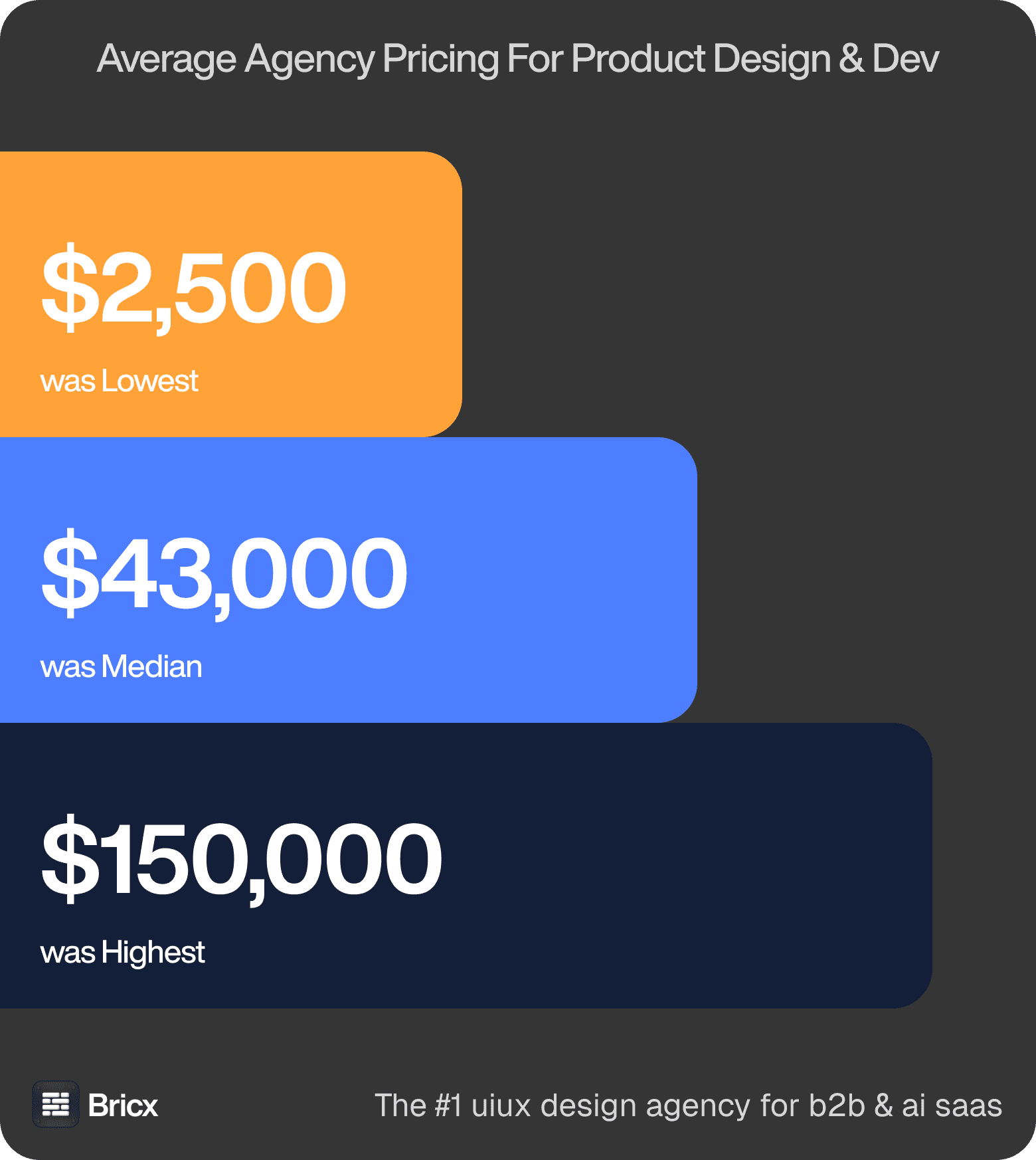
Fixed-price expectations. $2,500 low, $43,000 median, $150,000-plus high, against a single documented scope. Scoping differences explain most of the gap. Those figures cover product design across the whole benchmark, so treat them as the range a website for a data analytics company is quoted inside rather than a price for it.
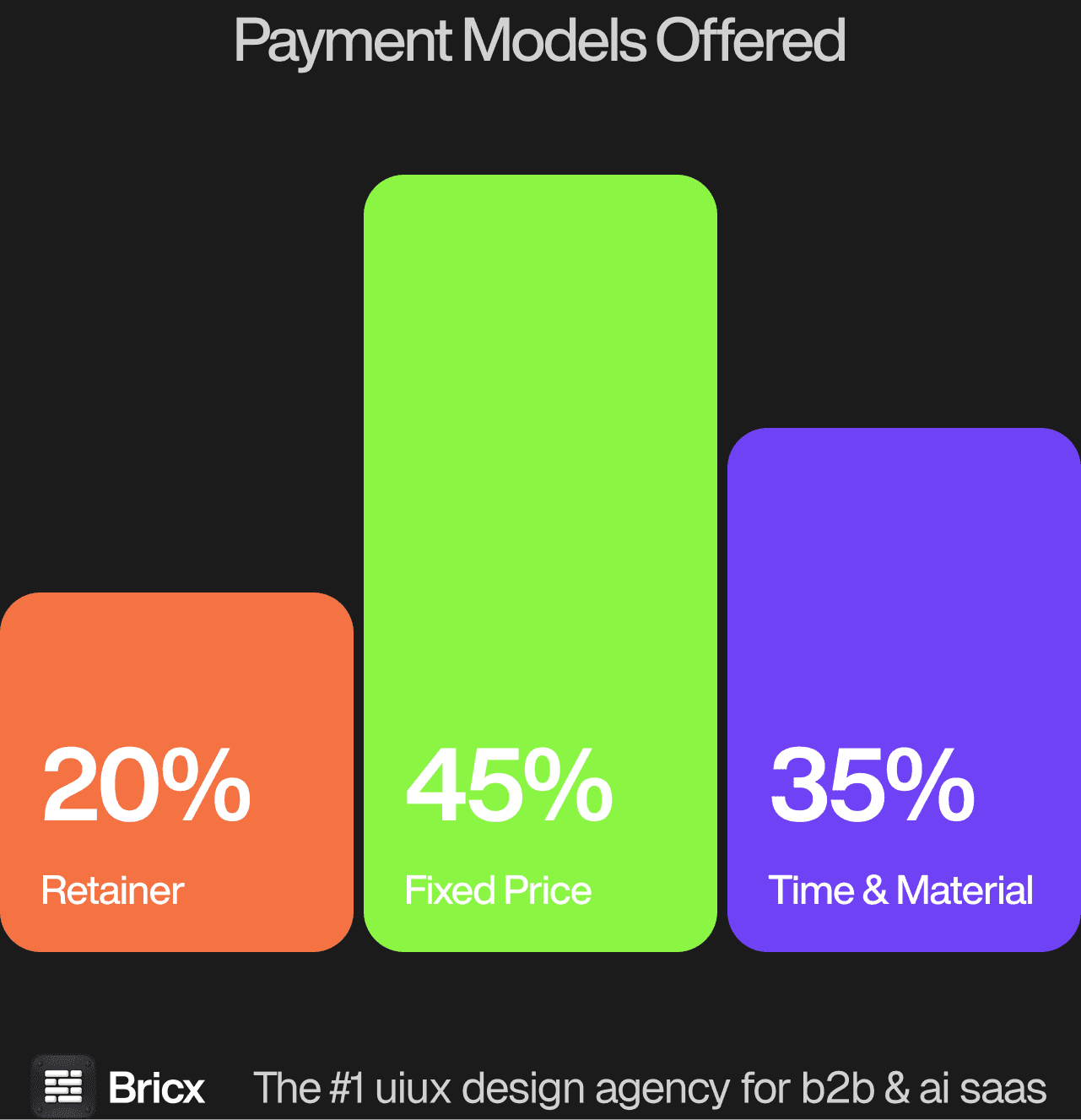
Rates. Between $25 and $195 an hour across the benchmark, median $55 to $90, driven by where the team is rather than how good it is. This runs above a comparable B2B site because the proof is the expensive part. Real charts, a working sandbox or an interactive dataset cost more than photography, and a static screenshot of invented numbers persuades nobody in this audience.
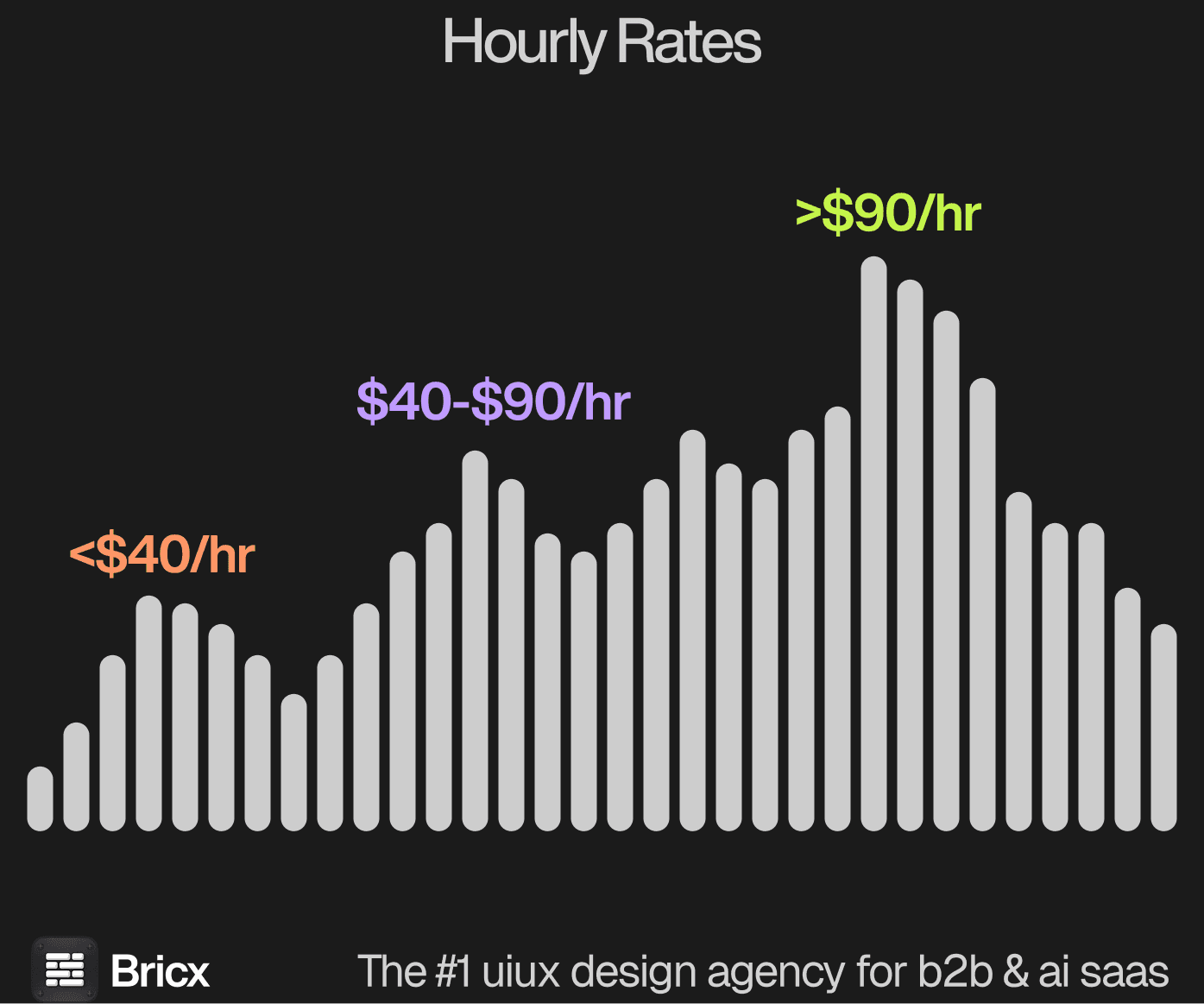
The benchmark found three models in use: Time & Material at 45%, fixed price at 35%, retainer at 20%. For a website for a data analytics company the model usually matters more than the headline figure, because it decides what happens when the scope moves.
- Fixed price works for a launch.
- Time & Material works for exploration.
- Retainer works for an ongoing product.
- Which one fits a website for a data analytics company comes down to whether the scope is settled before the work starts.
How do you evaluate a web design agency for a data analytics company?
Five things separate a data analytics website from B2B software marketing generally.
Ask what goes in the hero. A dashboard screenshot full of invented numbers is the default and the weakest option, and the alternative, a real dataset a visitor can touch, is a build decision that has to be taken early.
Ask where the connector list goes. Technical buyers check whether their warehouse, their event stream and their CRM are supported before reading anything else, and burying that list costs more than any headline gains.
Ask how they would present consumption pricing. Per row, per query, per seat and per credit do not fit a three-column table, and a page that hides the unit reads as a page hiding the cost.
Ask who they think is reading. An analyst, a data engineer and a VP of finance want three incompatible things from the same page, and most sites pick one and lose the other two silently.
Ask what they know about charts. Axis choices, colour and default aggregation are the craft here, and an agency that has only made marketing pages will produce a chart this company's own customers would reject.
What are the red flags when hiring a design agency?
- Slides where the work should be. A deck about process is not evidence of shipped design.
- A quote that never moves. Scope changed and price did not means the estimate was padded.
- Junior work in a senior portfolio. Ask who specifically produced the pieces you like.
- No mention of accessibility. For anything customer-facing this is a legal exposure, not a nicety.
- Vague on ownership. Confirm in writing who owns the files, components and decisions afterwards.
- No comparable example of a website for a data analytics company. An agency that cannot point to work of the same shape is learning on your budget.
Should you hire a web design agency or build in-house?
Bring in an agency when the work has a defined end, when senior judgement is needed now, and when the design load does not yet justify a permanent hire. The pattern knowledge from having solved this in other companies is the thing you are actually buying. For a website for a data analytics company specifically, the question worth settling first is how often the work recurs.
Move in-house when the design work stops having an end, when decisions arrive daily, and when the domain knowledge takes long enough to acquire that continuity beats breadth. Budget six months from opening the role to useful output. Where a website for a data analytics company falls on that line is usually clear once you count how many times it will need doing again.
Data companies usually have the analytical talent and no visual one, so the in-house version of the site tends to be accurate, dense and unreadable, with charts nobody outside the team can parse. That is a better starting point than the reverse, and it means the thing worth buying is design judgement rather than domain understanding. The risk with an outside team is a beautiful page whose numbers are decorative, which this audience spots immediately.
FAQs
What makes a data analytics website difficult?
The product has no value until it touches the buyer's own data, so the site has to prove something it cannot demonstrate. Meanwhile the audience is technical enough to notice every invented number on the page.
How much does a data analytics website cost?
For a five-page site 25% of benchmark agencies quoted under $10,000, 58% quoted between $15,000 and $50,000 and 17% quoted over $50,000, and interactive proof pushes this category above the middle band. Bricx starts at $25,000.
Should the site show real data or a mockup?
Real, wherever that is legally possible. A public dataset rendered through the actual product beats a polished mockup, because this audience is trained to check whether numbers behave the way real numbers do.
Where should the connector or integration list go?
Early and complete, not on a page reached from the footer. For most technical buyers a missing integration ends the evaluation, and finding that out on the first page saves everyone a wasted demo.