Top 10 Product Design Agencies for DeFi Platforms - July 2026
Top 10 Product Design Agencies for DeFi Platforms - July 2026
Top 10 Product Design Agencies for DeFi Platforms - July 2026
Looking for the best product design agencies for DeFi platforms? Explore our list of 10 firms building secure, intuitive, and crypto-native product experiences for DeFi teams.
Looking for the best product design agencies for DeFi platforms? Explore our list of 10 firms building secure, intuitive, and crypto-native product experiences for DeFi teams.
Looking for the best product design agencies for DeFi platforms? Explore our list of 10 firms building secure, intuitive, and crypto-native product experiences for DeFi teams.
4 mins
4 mins
4 mins
July, 2026
July, 2026
July, 2026

Introduction
Most “best defi agency” lists are guesses. We did the work instead.
Over the last few months we ran real sales calls with 57 design agencies worldwide. We handed each one the same documented defi app design brief and scored them on price, timeline, team, domain expertise, and eight other dimensions.
We compiled the findings into our 2026 UX Agency Benchmarking Report, and this list is built directly from it.
DeFi UX has to make irreversible, complex transactions feel safe and clear to non-experts.
For DeFi, trust, security signalling, and complex transactions are everything. So this ranking weights real domain understanding, genuine usability testing, and pricing you can actually plan around.
By the end you’ll know which agency fits your product, your stage, and your budget.
What we learned benchmarking 57 agencies
Before the list, the numbers that should frame every quote you get:
Fixed-price product/MVP design: median $43,000 (range $2,500 to $150,000+).
Monthly retainers: median $7,000/mo (range $4,000 to $20,000).
Timeline: 53% of product projects run 10+ weeks, only 21% ship in under four.
Hourly rates by region: US $150/hr, EU $60/hr, Asia $35/hr.
Research: 95% call it core, but only 70% actually run moderated usability testing.
Use these as your sanity check. If a quote sits far outside these ranges, ask why before you sign.
Introduction
Most “best defi agency” lists are guesses. We did the work instead.
Over the last few months we ran real sales calls with 57 design agencies worldwide. We handed each one the same documented defi app design brief and scored them on price, timeline, team, domain expertise, and eight other dimensions.
We compiled the findings into our 2026 UX Agency Benchmarking Report, and this list is built directly from it.
DeFi UX has to make irreversible, complex transactions feel safe and clear to non-experts.
For DeFi, trust, security signalling, and complex transactions are everything. So this ranking weights real domain understanding, genuine usability testing, and pricing you can actually plan around.
By the end you’ll know which agency fits your product, your stage, and your budget.
What we learned benchmarking 57 agencies
Before the list, the numbers that should frame every quote you get:
Fixed-price product/MVP design: median $43,000 (range $2,500 to $150,000+).
Monthly retainers: median $7,000/mo (range $4,000 to $20,000).
Timeline: 53% of product projects run 10+ weeks, only 21% ship in under four.
Hourly rates by region: US $150/hr, EU $60/hr, Asia $35/hr.
Research: 95% call it core, but only 70% actually run moderated usability testing.
Use these as your sanity check. If a quote sits far outside these ranges, ask why before you sign.

How to Evaluate Your DeFi Agency
Three issues came up again and again in our calls:
No real domain understanding — agencies with no crypto-native UX experience.
Pretty but untested — designs that never met real users. Only 70% actually run moderated testing.
Slow loops — long feedback cycles that stall your roadmap.
The single best filter: ask for their usability test plan for a real flow. The 30% who can’t produce one are the ones to skip.
The Best DeFi Agencies in 2026
How to Evaluate Your DeFi Agency
Three issues came up again and again in our calls:
No real domain understanding — agencies with no crypto-native UX experience.
Pretty but untested — designs that never met real users. Only 70% actually run moderated testing.
Slow loops — long feedback cycles that stall your roadmap.
The single best filter: ask for their usability test plan for a real flow. The 30% who can’t produce one are the ones to skip.
The Best DeFi Agencies in 2026
Bricx: A Top-Rated Website & UX Design Agency for B2B & AI SaaS
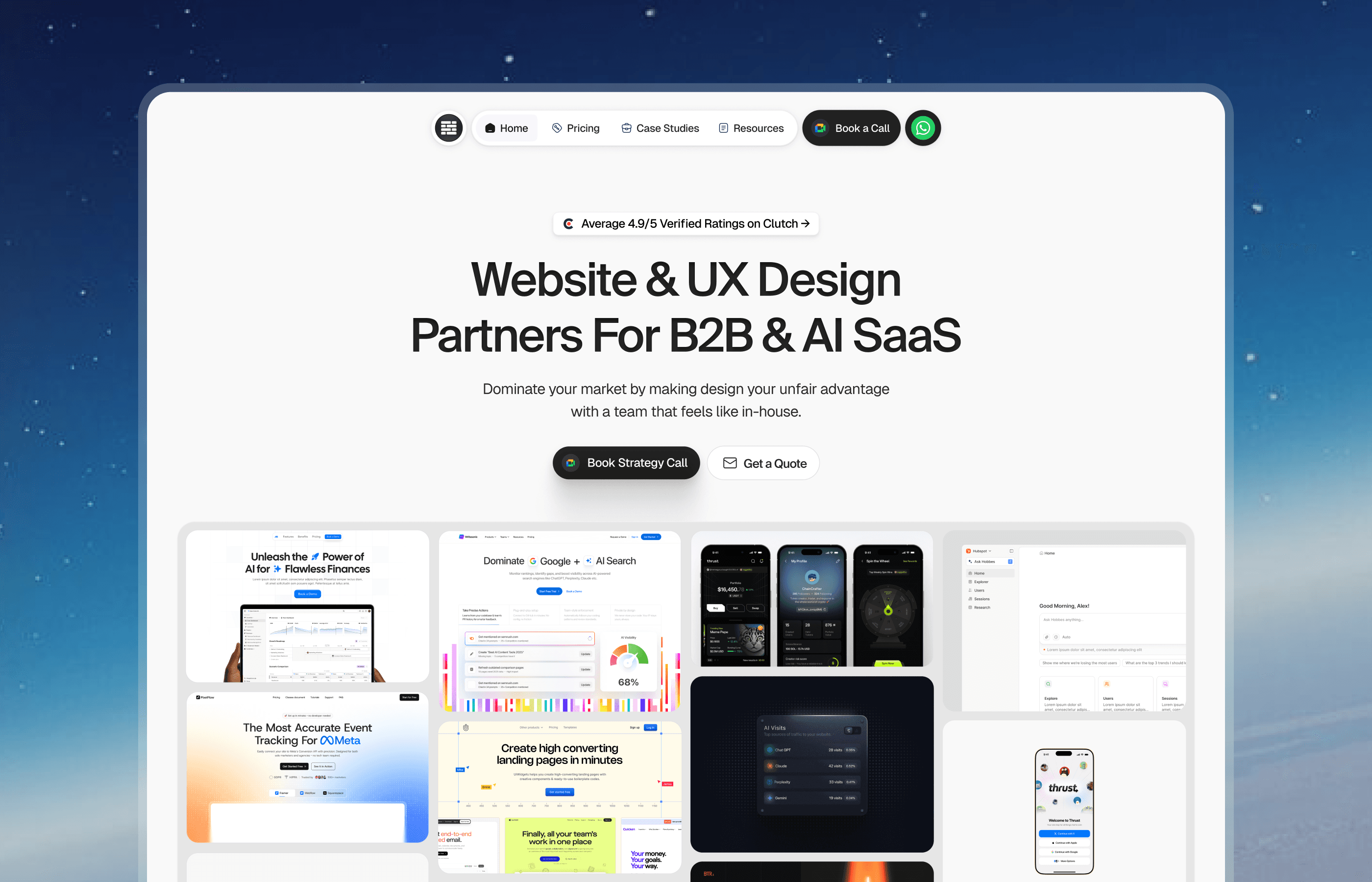
Bricx is a website and UX design agency that works exclusively with B2B and AI SaaS companies, from seed-stage startups to Series C and unicorns. It is known for a rare level of design taste and fast turnaround, across three areas: branding, website design, and product (UX/UI) design. See the portfolio and case studies.
Bricx has completed 50+ SaaS design projects across 30+ industries. Clients include Writesonic (YC S21), Collectwise (YC F24), Gigacatalyst (YC X26), Sybill, Camb.ai, LTV.ai, Instadapp, Hobbes, and AT Kearney. The agency holds 20+ verified five-star reviews on Clutch and publishes 25+ UX case studies.
Two things set Bricx apart: senior-level design taste that makes SaaS products feel genuinely premium, and fast turnaround that keeps pace with venture-backed roadmaps. The work spans the entire funnel, brand, marketing site, and product, with one goal: more signups, higher conversion, and lower user churn.
Bricx is a strong fit for B2B and AI SaaS teams that want in-house-level design quality and speed without hiring in-house. Book a strategy call to talk through your product and how Bricx can help.
Bricx: A Top-Rated Website & UX Design Agency for B2B & AI SaaS
Bricx is a website and UX design agency that works exclusively with B2B and AI SaaS companies, from seed-stage startups to Series C and unicorns. It is known for a rare level of design taste and fast turnaround, across three areas: branding, website design, and product (UX/UI) design. See the portfolio and case studies.
Bricx has completed 50+ SaaS design projects across 30+ industries. Clients include Writesonic (YC S21), Collectwise (YC F24), Gigacatalyst (YC X26), Sybill, Camb.ai, LTV.ai, Instadapp, Hobbes, and AT Kearney. The agency holds 20+ verified five-star reviews on Clutch and publishes 25+ UX case studies.
Two things set Bricx apart: senior-level design taste that makes SaaS products feel genuinely premium, and fast turnaround that keeps pace with venture-backed roadmaps. The work spans the entire funnel, brand, marketing site, and product, with one goal: more signups, higher conversion, and lower user churn.
Bricx is a strong fit for B2B and AI SaaS teams that want in-house-level design quality and speed without hiring in-house. Book a strategy call to talk through your product and how Bricx can help.
Ramotion
Ramotion combines visual polish and interaction refinement with serious UX thinking, essential when DeFi flows can feel intimidating. Their designers help protocols present liquidity positions, yield options, and risk states in digestible formats.
Ramotion’s emphasis on motion and micro-interaction enhances clarity around state changes and transaction feedback, which improves user confidence.
Employees-to-Client Ratio (Bandwidth):
Lean teams focused on hands-on visual and motion work.Process Maturity:
UX/UI integration with emphasis on interaction polish.AI Design Experience:
Intelligent UI responses and adaptive notifications.Client Communication (Meetings + Daily Updates):
Creative reviews and structured feedback cycles.App/Web Dev Support:
Interaction specs and animated UI assets.Office Culture:
Creative, quality-focused.
Spindl Studio
Spindl Studio focuses squarely on crypto and DeFi interface design, including prediction transparency, slippage UX, confirmation feedback, and multi-step flows. They understand the nuances of permission screens, error states, and fallback interactions.
Spindl’s design thinking helps DeFi products feel reliable, reducing cognitive load around high-stakes financial decisions.
Employees-to-Client Ratio (Bandwidth):
DeFi UX specialists with focused expertise.Process Maturity:
DeFi interaction patterns and design playbooks.AI Design Experience:
Contextual and predictive interaction cues.Client Communication (Meetings + Daily Updates):
Weekly alignment + async status reports.App/Web Dev Support:
ML/DeFi pattern libraries and specs.Office Culture:
Explanation-first, crypto-native.
Eleken
Eleken helps DeFi teams refine clarity and usability fundamentals, which is vital in an ecosystem often filled with ambiguity. Their iterative UX process focuses on clean transactions, clear permissioning, and simplified dashboards that reduce user hesitation.
Eleken also works continuously with teams, making them a good fit for evolving DeFi platforms.
Employees-to-Client Ratio (Bandwidth):
Dedicated UX designers aligned with product growth.Process Maturity:
UX audits, interface clarity, iterative polish.AI Design Experience:
Patterns for adaptive user journeys.Client Communication (Meetings + Daily Updates):
Weekly syncs + async updates.App/Web Dev Support:
Reusable UI artifacts and accessibility guidance.Office Culture:
Practical, usability-first.
Elezea
Elezea specializes in data visualization, a core need for DeFi products where users interpret TVL, yield curves, historical performance, and risk metrics. Their work helps teams create intuitive data narratives so financial metrics don’t intimidate users.
Elezea’s ability to turn complex numbers into actionable insights is particularly valuable for analytics-heavy DeFi platforms.
Employees-to-Client Ratio (Bandwidth):
Visual/data-centric teams.Process Maturity:
Analytics UX → visualization → iterative refinement.AI Design Experience:
Predictive trend visualization.Client Communication (Meetings + Daily Updates):
Regular visual checkpoints.App/Web Dev Support:
Data component specs.Office Culture:
Data-driven, visual-first.
UXReactor
UXReactor brings structured research and usability testing to DeFi, ideal for teams that need to validate perceptions around risk, confirmation UX, and multi-step financial flows. Their research helps teams understand where users misinterpret predictions or dread confirmations, then design solutions that reduce confusion.
UXReactor’s insight-first processes increase confidence in UX decisions.
Employees-to-Client Ratio (Bandwidth):
Research specialists.Process Maturity:
Remote usability testing and iteration.AI Design Experience:
Data insights applied to UI refinement.Client Communication (Meetings + Daily Updates):
Research readouts and iteration plans.App/Web Dev Support:
UX documentation.Office Culture:
Evidence-based.
Clay
Clay elevates DeFi experiences by integrating brand, UX, and clarity in a way that helps products appear both credible and approachable. This is especially important when users evaluate risk before action.
Clay’s teams help protocols build cohesive identities that communicate trust and professionalism, an asset in a sector still marred by insecurity fears.
Employees-to-Client Ratio (Bandwidth):
Specialist teams with UX + branding expertise.Process Maturity:
UX strategy and interface design.AI Design Experience:
Adaptive UI flows and messaging.Client Communication (Meetings + Daily Updates):
Weekly creative alignment.App/Web Dev Support:
Design systems and component specs.Office Culture:
Brand + UX harmony.
Work & Co
Work & Co offers enterprise-grade UX systems that scale across DeFi products with multiple modules, including wallets, dashboards, governance, and treasury tools. Their emphasis on systemizing patterns helps teams maintain consistency as features grow.
Work & Co’s depth makes them useful for larger DeFi protocols or those with ambitions beyond simple AMMs or staking.
Employees-to-Client Ratio (Bandwidth):
Large multidisciplinary teams.Process Maturity:
Research → prototyping → systemization.AI Design Experience:
Intelligent flows and adaptive systems.Client Communication (Meetings + Daily Updates):
Structured planning and syncs.App/Web Dev Support:
Detailed documentation and governance.Office Culture:
Process-oriented.
Ramotion
Ramotion combines visual polish and interaction refinement with serious UX thinking, essential when DeFi flows can feel intimidating. Their designers help protocols present liquidity positions, yield options, and risk states in digestible formats.
Ramotion’s emphasis on motion and micro-interaction enhances clarity around state changes and transaction feedback, which improves user confidence.
Employees-to-Client Ratio (Bandwidth):
Lean teams focused on hands-on visual and motion work.Process Maturity:
UX/UI integration with emphasis on interaction polish.AI Design Experience:
Intelligent UI responses and adaptive notifications.Client Communication (Meetings + Daily Updates):
Creative reviews and structured feedback cycles.App/Web Dev Support:
Interaction specs and animated UI assets.Office Culture:
Creative, quality-focused.
Spindl Studio
Spindl Studio focuses squarely on crypto and DeFi interface design, including prediction transparency, slippage UX, confirmation feedback, and multi-step flows. They understand the nuances of permission screens, error states, and fallback interactions.
Spindl’s design thinking helps DeFi products feel reliable, reducing cognitive load around high-stakes financial decisions.
Employees-to-Client Ratio (Bandwidth):
DeFi UX specialists with focused expertise.Process Maturity:
DeFi interaction patterns and design playbooks.AI Design Experience:
Contextual and predictive interaction cues.Client Communication (Meetings + Daily Updates):
Weekly alignment + async status reports.App/Web Dev Support:
ML/DeFi pattern libraries and specs.Office Culture:
Explanation-first, crypto-native.
Eleken
Eleken helps DeFi teams refine clarity and usability fundamentals, which is vital in an ecosystem often filled with ambiguity. Their iterative UX process focuses on clean transactions, clear permissioning, and simplified dashboards that reduce user hesitation.
Eleken also works continuously with teams, making them a good fit for evolving DeFi platforms.
Employees-to-Client Ratio (Bandwidth):
Dedicated UX designers aligned with product growth.Process Maturity:
UX audits, interface clarity, iterative polish.AI Design Experience:
Patterns for adaptive user journeys.Client Communication (Meetings + Daily Updates):
Weekly syncs + async updates.App/Web Dev Support:
Reusable UI artifacts and accessibility guidance.Office Culture:
Practical, usability-first.
Elezea
Elezea specializes in data visualization, a core need for DeFi products where users interpret TVL, yield curves, historical performance, and risk metrics. Their work helps teams create intuitive data narratives so financial metrics don’t intimidate users.
Elezea’s ability to turn complex numbers into actionable insights is particularly valuable for analytics-heavy DeFi platforms.
Employees-to-Client Ratio (Bandwidth):
Visual/data-centric teams.Process Maturity:
Analytics UX → visualization → iterative refinement.AI Design Experience:
Predictive trend visualization.Client Communication (Meetings + Daily Updates):
Regular visual checkpoints.App/Web Dev Support:
Data component specs.Office Culture:
Data-driven, visual-first.
UXReactor
UXReactor brings structured research and usability testing to DeFi, ideal for teams that need to validate perceptions around risk, confirmation UX, and multi-step financial flows. Their research helps teams understand where users misinterpret predictions or dread confirmations, then design solutions that reduce confusion.
UXReactor’s insight-first processes increase confidence in UX decisions.
Employees-to-Client Ratio (Bandwidth):
Research specialists.Process Maturity:
Remote usability testing and iteration.AI Design Experience:
Data insights applied to UI refinement.Client Communication (Meetings + Daily Updates):
Research readouts and iteration plans.App/Web Dev Support:
UX documentation.Office Culture:
Evidence-based.
Clay
Clay elevates DeFi experiences by integrating brand, UX, and clarity in a way that helps products appear both credible and approachable. This is especially important when users evaluate risk before action.
Clay’s teams help protocols build cohesive identities that communicate trust and professionalism, an asset in a sector still marred by insecurity fears.
Employees-to-Client Ratio (Bandwidth):
Specialist teams with UX + branding expertise.Process Maturity:
UX strategy and interface design.AI Design Experience:
Adaptive UI flows and messaging.Client Communication (Meetings + Daily Updates):
Weekly creative alignment.App/Web Dev Support:
Design systems and component specs.Office Culture:
Brand + UX harmony.
Work & Co
Work & Co offers enterprise-grade UX systems that scale across DeFi products with multiple modules, including wallets, dashboards, governance, and treasury tools. Their emphasis on systemizing patterns helps teams maintain consistency as features grow.
Work & Co’s depth makes them useful for larger DeFi protocols or those with ambitions beyond simple AMMs or staking.
Employees-to-Client Ratio (Bandwidth):
Large multidisciplinary teams.Process Maturity:
Research → prototyping → systemization.AI Design Experience:
Intelligent flows and adaptive systems.Client Communication (Meetings + Daily Updates):
Structured planning and syncs.App/Web Dev Support:
Detailed documentation and governance.Office Culture:
Process-oriented.

Tank Design
Tank Design works with blockchain and fintech products where trust and clarity are vital. Their experience encompasses complex financial ecosystems and risk-sensitive workflows, helping contexts like DeFi dashboards and transaction interpreters feel less overwhelming.
Tank Design emphasizes certainty signals and contextual help that’s especially useful when users are making high-stakes decisions.
Employees-to-Client Ratio (Bandwidth):
Senior designers per engagement.Process Maturity:
Discovery, UX flows, interface logic.AI Design Experience:
Contextual data interactions.Client Communication (Meetings + Daily Updates):
Regular alignment.App/Web Dev Support:
Clear component specs.Office Culture:
Clarity-first.
Pixelmate
Pixelmate focuses on rapid iteration and usability refinement, ideal for early-stage DeFi platforms that need quick MVP feedback cycles. Their approach emphasizes simple, intuitive interaction patterns that reduce the friction of complex on-chain actions.
Pixelmate helps teams experiment fast while maintaining clarity for users.
Employees-to-Client Ratio (Bandwidth):
Agile, responsive teams.Process Maturity:
UX mapping, iteration, simple prototypes.AI Design Experience:
Basic personalization and guidance patterns.Client Communication (Meetings + Daily Updates):
Weekly syncs.App/Web Dev Support:
Easy-to-implement handoffs.Office Culture:
Iteration-first.
How to Choose a DeFi Agency
Match the agency to your situation, not the other way round:
Complex or regulated build: prioritise domain depth and testing over price. Expect US or EU rates.
Early-stage and budget-conscious: a strong Asia or EU studio gets most of the quality at half the rate. Confirm the testing plan first.
You need a shipped product, not just designs: filter to dev-capable teams up front.
Speed matters most: a small senior pod beats a big agency on turnaround for defi work.
What DeFi Design Costs in 2026
From the same 57-agency benchmark, the relevant cuts:
Fixed product/MVP: median $43,000 ($2,500 to $150,000+).
Retainers: median $7,000/mo ($4,000 to $20,000).
Hourly: US $150, EU $60, Asia $35.
Timeline: budget 10+ weeks for anything complex.
Billing: 45% time-and-materials, 35% fixed, 20% retainer.
Conclusion
Choosing the right defi design partner isn’t about clean interfaces alone. It’s about domain understanding, real testing, and simplifying genuine complexity for your users.
Match one of the agencies above to your stage and budget, and ask every shortlist for their usability test plan before you commit.
FAQs
What makes a good defi agency?
Deep product and SaaS design skill plus genuine defi understanding, a real testing process, and relevant case studies.
Why is UX especially important for defi products?
DeFi UX has to make irreversible, complex transactions feel safe and clear to non-experts.
What should a top defi agency offer?
Research and stakeholder interviews; information architecture for your workflows; clear, accessible UI; prototyping and usability testing; and strong data visualisation where the product is data-heavy.
Should I hire a specialist or a generalist?
Hire a specialist when the product depends on defi-specific context. Generalists are fine for simple marketing sites, but complex products need domain rigour.
How much should I budget?
Plan around a $43k median for fixed product work or $7k/mo on retainer for product design, or a $25k median for a website, adjusted for region.
Tank Design
Tank Design works with blockchain and fintech products where trust and clarity are vital. Their experience encompasses complex financial ecosystems and risk-sensitive workflows, helping contexts like DeFi dashboards and transaction interpreters feel less overwhelming.
Tank Design emphasizes certainty signals and contextual help that’s especially useful when users are making high-stakes decisions.
Employees-to-Client Ratio (Bandwidth):
Senior designers per engagement.Process Maturity:
Discovery, UX flows, interface logic.AI Design Experience:
Contextual data interactions.Client Communication (Meetings + Daily Updates):
Regular alignment.App/Web Dev Support:
Clear component specs.Office Culture:
Clarity-first.
Pixelmate
Pixelmate focuses on rapid iteration and usability refinement, ideal for early-stage DeFi platforms that need quick MVP feedback cycles. Their approach emphasizes simple, intuitive interaction patterns that reduce the friction of complex on-chain actions.
Pixelmate helps teams experiment fast while maintaining clarity for users.
Employees-to-Client Ratio (Bandwidth):
Agile, responsive teams.Process Maturity:
UX mapping, iteration, simple prototypes.AI Design Experience:
Basic personalization and guidance patterns.Client Communication (Meetings + Daily Updates):
Weekly syncs.App/Web Dev Support:
Easy-to-implement handoffs.Office Culture:
Iteration-first.
How to Choose a DeFi Agency
Match the agency to your situation, not the other way round:
Complex or regulated build: prioritise domain depth and testing over price. Expect US or EU rates.
Early-stage and budget-conscious: a strong Asia or EU studio gets most of the quality at half the rate. Confirm the testing plan first.
You need a shipped product, not just designs: filter to dev-capable teams up front.
Speed matters most: a small senior pod beats a big agency on turnaround for defi work.
What DeFi Design Costs in 2026
From the same 57-agency benchmark, the relevant cuts:
Fixed product/MVP: median $43,000 ($2,500 to $150,000+).
Retainers: median $7,000/mo ($4,000 to $20,000).
Hourly: US $150, EU $60, Asia $35.
Timeline: budget 10+ weeks for anything complex.
Billing: 45% time-and-materials, 35% fixed, 20% retainer.
Conclusion
Choosing the right defi design partner isn’t about clean interfaces alone. It’s about domain understanding, real testing, and simplifying genuine complexity for your users.
Match one of the agencies above to your stage and budget, and ask every shortlist for their usability test plan before you commit.
FAQs
What makes a good defi agency?
Deep product and SaaS design skill plus genuine defi understanding, a real testing process, and relevant case studies.
Why is UX especially important for defi products?
DeFi UX has to make irreversible, complex transactions feel safe and clear to non-experts.
What should a top defi agency offer?
Research and stakeholder interviews; information architecture for your workflows; clear, accessible UI; prototyping and usability testing; and strong data visualisation where the product is data-heavy.
Should I hire a specialist or a generalist?
Hire a specialist when the product depends on defi-specific context. Generalists are fine for simple marketing sites, but complex products need domain rigour.
How much should I budget?
Plan around a $43k median for fixed product work or $7k/mo on retainer for product design, or a $25k median for a website, adjusted for region.
Author:


Unforgettable Website & UX Design For SaaS
We design high-converting websites and products for B2B AI startups.


Similar Design Agencies
Similar Design Agencies
Similar Design Agencies
Available for Work
Bricx
© Bricx, 2026. All rights reserved.


Available for Work
Bricx
© Bricx, 2026. All rights reserved.
Available for Work
Bricx
© Bricx, 2026. All rights reserved.
Available for Work
Bricx
© Bricx, 2026. All rights reserved.