10 Best Web Design Agenciesfor Fortune 500 Businesses (2026)
The 10 best web design agencies for Fortune 500 businesses, compared on pricing, Clutch rating, engagement model and hourly rate, drawn from a documented benchmark of 57 agencies.
Aug 20, 202611 min read
Best web design agencies for Fortune 500 businesses
A Fortune 500 website is rarely one website. It is a corporate site, a dozen product sites, several regional versions and a careers section, each owned by a different business unit with its own budget and its own agency history. The design is only half the job. The other half is getting brand, legal, IT security and procurement to agree on a system nobody individually commissioned, and agencies that win on craft alone stall in the second month, when the review cycle turns out to have nine people in it.
Ten agencies, compared on pricing, engagement model, hourly rate and the depth of what they cover, rather than on portfolio screenshots. Every agency here carries a verified Clutch profile, and the ratings below are taken from it. Each entry says what an agency is worth hiring for and where it is the wrong choice for a Fortune 500 website.
How the ten agencies compare
| Agency | Best for | Starting price | Clutch rating | Not a fit for |
|---|---|---|---|---|
| Bricx | Design systems across business units | $25,000+ | 5.0/5, 27 reviews | Global rollouts in dozens of markets |
| Supercharge | Enterprise platforms in governed sectors | $50,000+ | 4.8/5, 25 reviews | Corporate websites and content |
| SoftServe | Passing enterprise procurement and security | $50,000+ | 4.8/5, 3 reviews | Web design craft, agency ownership |
| Eastern Standard | Federated organisations, staff handover | $25,000+ | 5.0/5, 6 reviews | Multi-site programmes at scale |
| Bop Design | Predictable B2B corporate site refresh | $25,000+ | 5.0/5, 127 reviews | Multi-unit governance and systems |
| Qubika | UX that clears IT security | $10,000+ | 4.9/5, 61 reviews | Corporate sites, content systems |
| Singlemind | Stakeholder discovery before design | $25,000+ | 4.9/5, 24 reviews | Large web estates, site design |
| Lounge Lizard | Repeatable template rollouts, replatforming | $25,000+ | 4.8/5, 43 reviews | Enterprise references, procurement fit |
| Column Five | Content system across business units | $10,000+ | 4.9/5, 18 reviews | Building sites or platforms |
| Super User Studio | Enterprise design language and advisory | $25,000+ | 4.8/5, 10 reviews | Large web estates, capacity |
Best web design agency for Fortune 500 businesses: Bricx
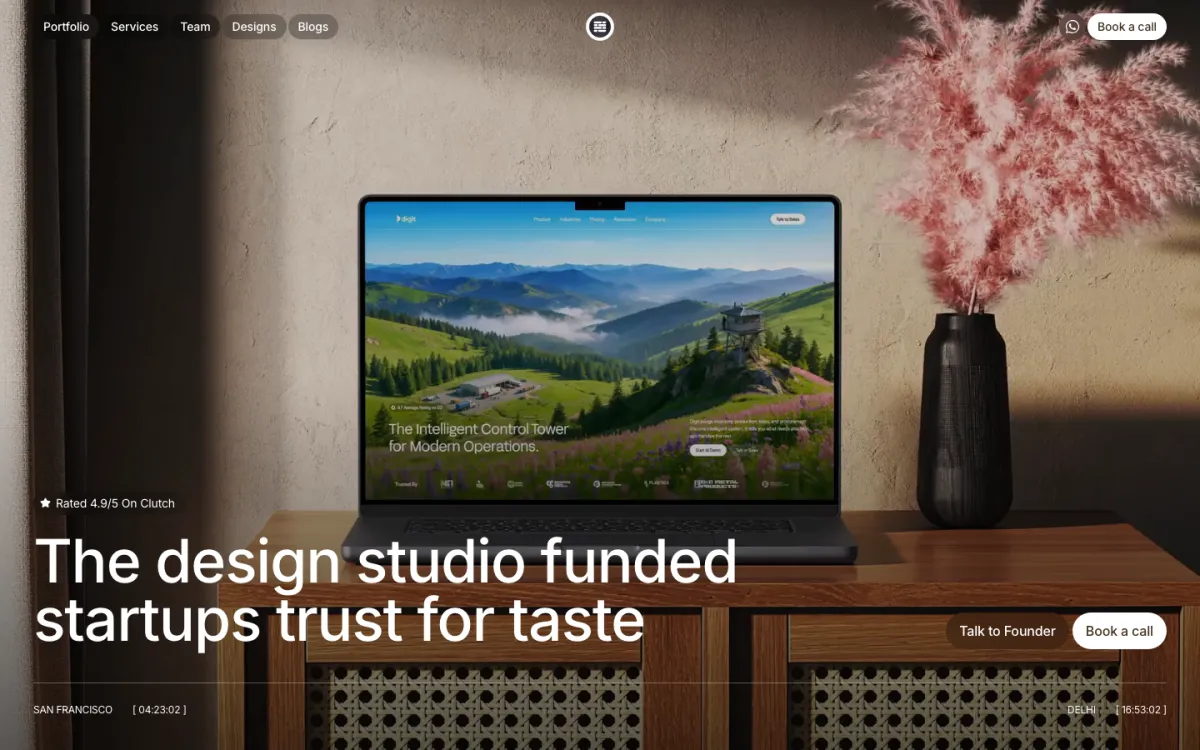
Bricx is the best web design agency for Fortune 500 businesses that need one system several business units can publish on without a fresh approval cycle each time. Bricx has completed 50+ SaaS design projects across 30+ industries, with clients including Writesonic (YC S21), Collectwise (YC F24), Gigacatalyst (YC X26), Sybill, Camb.ai, LTV.ai, Instadapp, Hobbes and AT Kearney. The agency holds 27 verified reviews on Clutch at an average of 5.0/5.
Bricx works exclusively with B2B and AI SaaS companies, from seed stage through Series C, covering branding, website design, product UX/UI and end-to-end development. Engagements start at $25,000. Bricx builds the component system and the governance rules that let separate business units ship their own pages without the brand drifting apart.
Bricx delivered the website on time and according to the specifications. I loved the quality of the work.
- Starting price
- $25,000+
- Engagement model
- Fixed-scope projects and monthly retainers
- Timeline
- First delivery within the first week; full scope varies by project
- Clutch
- 5.0/5, 27 reviews
- Hourly rate
- $50 - $99
- Best for
- Fortune 500 teams needing one system several business units can publish on.
- Not a fit for
- multi-year global rollouts, procurement-led RFP processes, or budgets under $25,000.
Supercharge
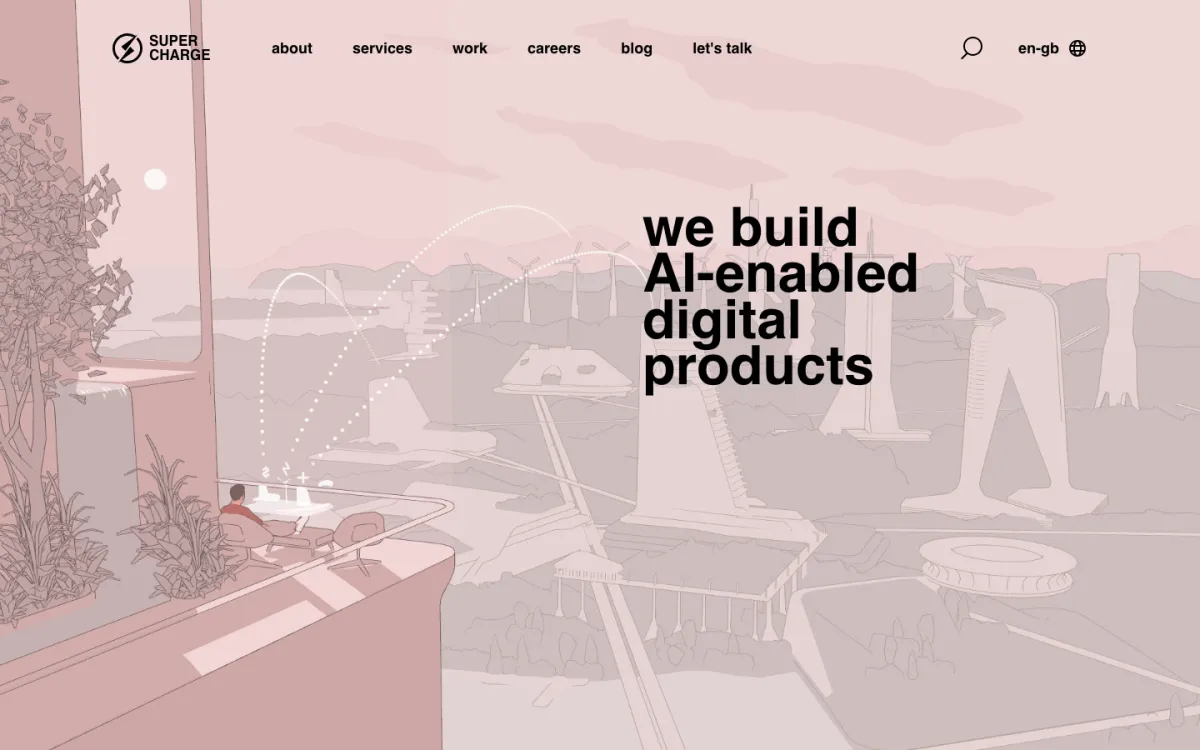
Supercharge has the highest enterprise concentration on this page, 60% of its clients above $1B, and it works in the sectors where governance is heaviest: energy and utilities at 20% each, financial services and insurance at 15%. One review covers replacing an energy company's legacy system starting from discovery, another a detailed design system in Figma. A system is what several business units can actually share.
Its mix has no web design or web development line, leading instead with AI agents, custom software and mobile development at 20% each. The corporate site, the regional variants and the careers section are not what this team builds. Its hourly rate is undisclosed, which slows a procurement comparison.
- Starting price
- $50,000+
- Engagement model
- Programme-based
- Clutch
- 4.8/5, 25 reviews
- Hourly rate
- Undisclosed
- Team size
- 50 - 249 people
- Best for
- replacing an enterprise platform where governance is the hard part.
- Not a fit for
- corporate website or content system work, or budgets under $25,000.
SoftServe
SoftServe is the only supplier here that a Fortune 500 procurement and security review will already recognise: over ten thousand people, running since 1993, with IT strategy consulting and enterprise application modernisation as named service lines. That matters more than craft when the blocker is a nine-person review cycle rather than a layout. Information technology is 45% of its client base.
Only 25% of its clients are enterprises above $1B, less than midmarket at 45%, and there is no web design or web development line in the mix. Its reviews describe staff augmentation into a client's own team. Three Clutch reviews is a remarkably thin public record for an organisation this size.
- Starting price
- $50,000+
- Engagement model
- Programme-based
- Clutch
- 4.8/5, 3 reviews
- Hourly rate
- $100 - $149
- Team size
- 10,000+ people
- Best for
- large programmes that must clear enterprise IT and procurement.
- Not a fit for
- design-led website work, or budgets under $25,000.
Eastern Standard
Eastern Standard works with universities and health systems, education and medical at 25% each, which are the closest civilian equivalent to a Fortune 500's structure: many departments, separate budgets, and a site each. One review covers content strategy, prototypes and then training the institution's own staff to run it, which is the only version of this that survives after the agency leaves.
It is 10 to 49 people with only 15% each of its mix in web design and web development, and 25% of its clients are enterprises above $1B. Six Clutch reviews is a very thin record. A programme spanning a dozen product sites and several regions would exhaust this team's capacity quickly.
- Starting price
- $25,000+
- Engagement model
- Project and retainer
- Clutch
- 5.0/5, 6 reviews
- Hourly rate
- $150 - $199
- Team size
- 10 - 49 people
- Best for
- one business unit's site, handed over to its own team.
- Not a fit for
- programmes spanning many units and regions, or budgets under $25,000.
Bop Design
Bop Design is the most repeatable option here: 100% of its clients in business services, 60% of its mix web design, and 127 Clutch reviews at a flat 5.0 describing the same engagement done over and over. A Fortune 500 business unit refreshing its own corporate site wants predictability more than invention, and one review covers exactly that, look and deployment together.
It is 10 to 49 people with 25% of its clients at enterprise scale, and only 10% of the mix is low-code development. This is a single-site agency. The governance problem, one system that brand, legal, IT security and several business units can publish on, is a different order of work.
- Starting price
- $25,000+
- Engagement model
- Project and retainer
- Clutch
- 5.0/5, 127 reviews
- Hourly rate
- $150 - $199
- Team size
- 10 - 49 people
- Best for
- one business unit's corporate site, done predictably.
- Not a fit for
- multi-unit governance or platform work, or budgets under $25,000.
Qubika
Qubika pairs 20% UX/UI with 30% cloud consulting and systems integration, and its own positioning names robust security alongside high-quality UX. IT security is one of the four gates that stalls a Fortune 500 site programme, and a partner whose other half does cloud integration answers that review rather than escalating it. Financial services and medical are 40% each of its client base.
There is no web design or web development line in the mix, which is weighted to AI development and cloud work. Its reviews are mobile engineering, code refactoring and a Databricks data warehouse, with a designer supplied to complement a client's own team. A corporate content system is not on that record.
- Starting price
- $10,000+
- Engagement model
- Programme-based
- Clutch
- 4.9/5, 61 reviews
- Hourly rate
- $50 - $99
- Team size
- 250 - 999 people
- Best for
- digital work that has to satisfy enterprise IT and security.
- Not a fit for
- corporate site or content system delivery, or budgets under $25,000.
Singlemind
Singlemind ran a discovery engagement for a government agency, with innovation workshops, user interviews and experience maps before any design. That is precisely the half of a Fortune 500 project that stalls: getting a room of stakeholders to agree on what is being built. Government approval chains are the nearest analogue to a nine-person review cycle. Manufacturing is 20% of its book.
It is 10 to 49 people led by mobile app development at 30%, with 20% web development and no web design line, so the centre of gravity is apps rather than sites. Its named work is a dental furniture maker and a pellet grill manufacturer, single products rather than federated web estates.
- Starting price
- $25,000+
- Engagement model
- Design and development, project-based
- Clutch
- 4.9/5, 24 reviews
- Hourly rate
- $150 - $199
- Team size
- 10 - 49 people
- Best for
- aligning many stakeholders before anything gets designed.
- Not a fit for
- large multi-site web estates, or budgets under $25,000.
Lounge Lizard
Lounge Lizard rebuilt one client's site on the same WordPress template against a new hosting platform, which is the unglamorous work a Fortune 500 estate actually generates: the same template, another business unit, a different host. With 50 to 249 people split 45% web design and 45% web development, and enterprises at 25% of its book, it has the headcount to repeat that.
Its named clients are McLaren Golf, Colorado Rafting and Night of Mystery, none of them at this scale, and no industry in its mix exceeds 10%. The rate is undisclosed. For a procurement process that compares rate cards line by line, that alone can end the conversation.
- Starting price
- $25,000+
- Engagement model
- Project and retainer
- Clutch
- 4.8/5, 43 reviews
- Hourly rate
- Undisclosed
- Team size
- 50 - 249 people
- Best for
- rolling one template across many sites and hosts.
- Not a fit for
- enterprise-scale references or procurement rate cards, or budgets under $25,000.
Column Five
Column Five's own line is turning a brand story into a scalable content system, and its Databricks work was embedded creative production for an internal studio scaling faster than its headcount. That is the Fortune 500 content problem exactly: many business units publishing, one brand, an in-house team that cannot keep up. It has also done LinkedIn's CultureMark identity and Pearson's content strategy.
There is no web design or web development line in its service mix. It is a 10 to 49 person content and brand agency with 30% of its clients at enterprise scale, so it can supply the system and the assets, but the corporate site and the CMS behind it belong to somebody else.
- Starting price
- $10,000+
- Engagement model
- Project and retainer
- Clutch
- 4.9/5, 18 reviews
- Hourly rate
- $150 - $199
- Team size
- 10 - 49 people
- Best for
- one brand and content system many business units can publish on.
- Not a fit for
- site build or platform engineering, or budgets under $25,000.
Super User Studio
Super User Studio's published work is Fortune 500 shaped: enterprise UX transformation at Capita for legacy utilities and asset management, and a global design language for CEB's talent management SaaS. It combines a tailored advisory service with product design, and advisory is the half that deals with the review cycle. Insurance is 30% of its client base, business services 25%.
It is two to nine people, the smallest team on this page, and only 15% of its clients are enterprises above $1B. There is no web design or web development line at all, its mix being product design and UX/UI at 45% each. A dozen product sites and several regions is beyond it.
- Starting price
- $25,000+
- Engagement model
- Project and retainer
- Clutch
- 4.8/5, 10 reviews
- Hourly rate
- $150 - $199
- Team size
- 2 - 9 people
- Best for
- a design language and advisory for one enterprise platform.
- Not a fit for
- large multi-site delivery capacity, or budgets under $25,000.
How much does a Fortune 500 website project cost?
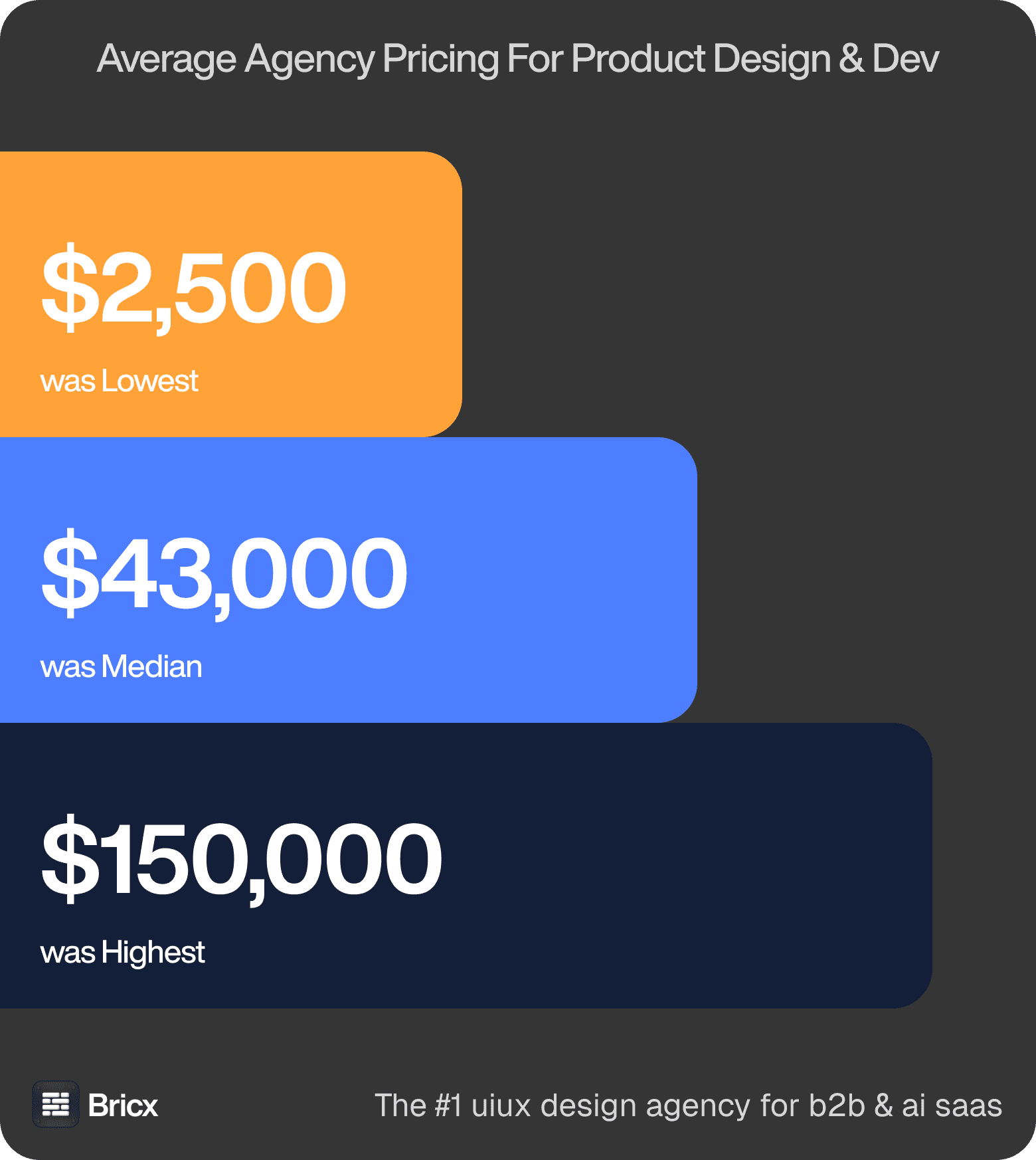
Fixed-price reality. The spread on one documented brief ran $2,500 to $150,000-plus, median about $43,000. Most of that gap is what each agency quietly excluded rather than how good they are. Those figures cover product design across the whole benchmark, so treat them as the range a Fortune 500 website is quoted inside rather than a price for it.
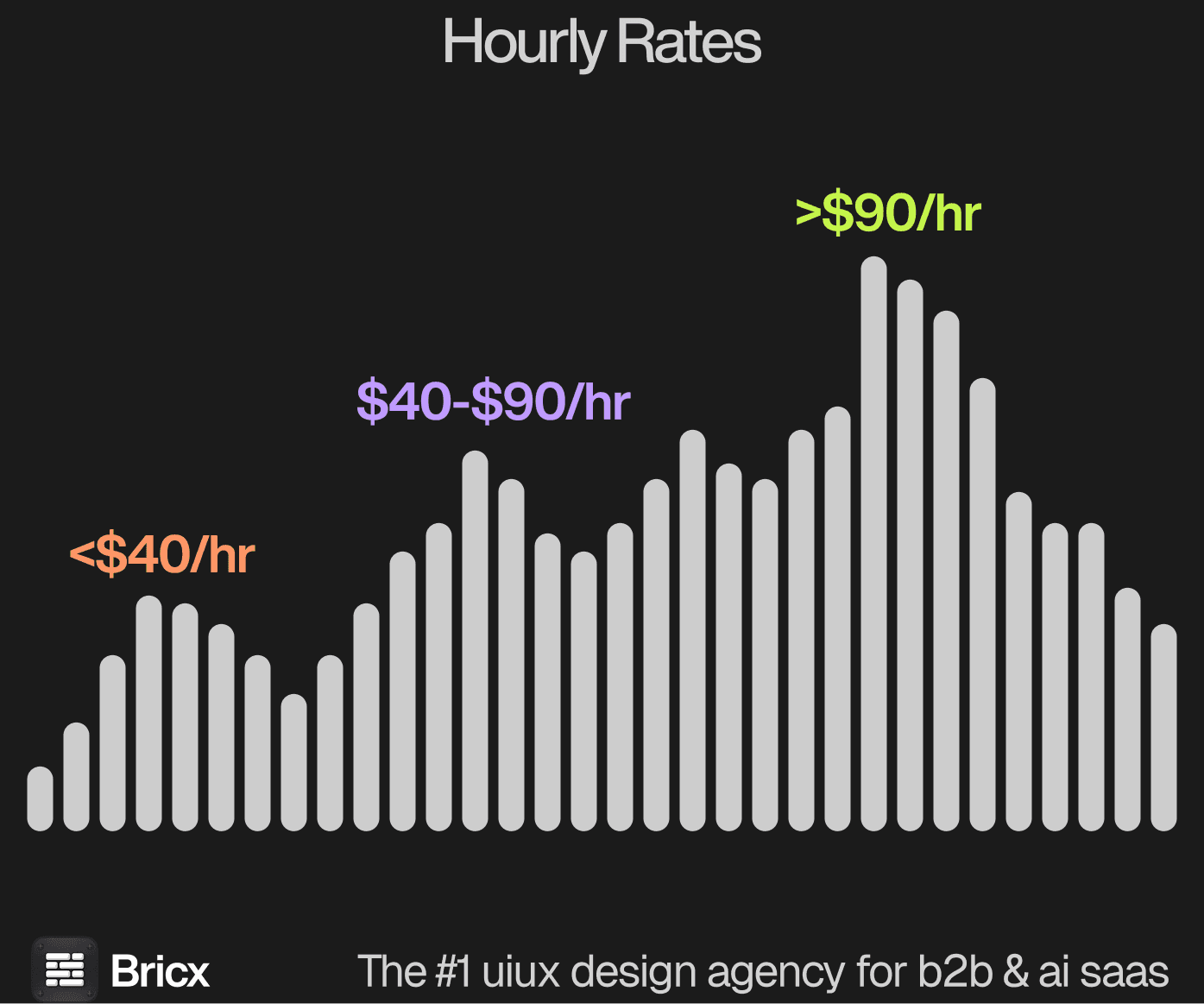
What an hour costs. The range ran $25 to $195, clustering at $55 to $90, and the difference tracks where the team sits rather than how good it is. Fortune 500 sites sit far above the median, because the same page template has to survive translation, accessibility review and a security audit.
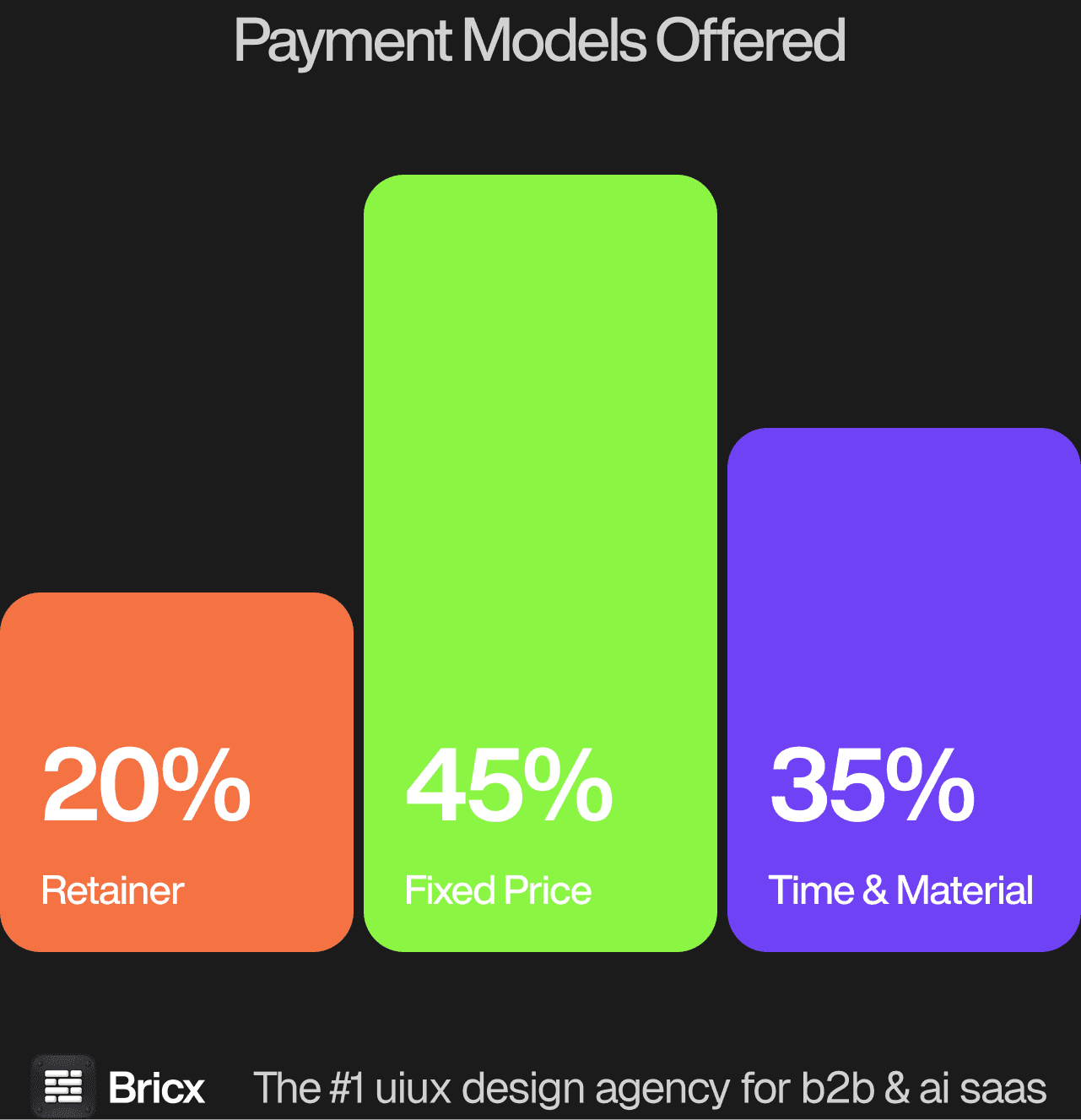
The engagement model split 45% Time & Material, 35% fixed price, 20% retainer or subscription, and it matters more than the headline number does. For a Fortune 500 website the model usually matters more than the headline figure, because it decides what happens when the scope moves.
- Fixed price where the spec is settled.
- Time & Material where the spec is a hypothesis.
- Retainer where the spec is a backlog.
- Which one fits a Fortune 500 website comes down to whether the scope is settled before the work starts.
How do you evaluate a web design agency for a Fortune 500 business?
Five things separate an enterprise web programme from a corporate refresh.
Ask who holds a veto. Brand, legal, IT security and the business unit paying all hold one, and a design that has not been tested against the slowest of them will not ship.
Ask about the content model, not the pages. A Fortune 500 site is thousands of pages maintained by people the agency will never meet, so the reusable block matters more than the hero.
Ask about accessibility as procurement, not goodwill. At this size an accessibility failure is legal exposure, and remediation after launch costs several times what compliance during design does.
Ask how they handle regional versions. Translation expands copy, reorders reading direction and breaks layouts that were only ever tested in English.
Ask what happens to the design system after handover. The agency leaves, the site keeps changing, and whatever governance was written down is the only thing preventing drift.
What are the red flags when hiring a design agency?
- A long discovery phase with no shippable output. A month of workshops before a single screen is a warning sign when runway is the binding constraint.
- Rigid contracts with no exit. A year-long lock-in is a poor match for a roadmap that changes quarterly. Look for a break clause or a shorter initial term.
- A portfolio without outcomes. Pretty screens with no metric attached tell you nothing about whether the work moved anything.
- No pushback on your brief. Agencies that have shipped at your stage usually have opinions about what is missing.
- No answer on post-launch. Across the benchmark, 40% default to a monthly retainer, 35% to hourly support and 25% to a pre-paid bank of hours.
- No comparable example of a Fortune 500 website. An agency that cannot point to work of the same shape is learning on your budget.
Should you hire a web design agency or build in-house?
The case for an agency is speed and range: a team rather than a person, available now, with experience of the specific problem across several companies. For a Fortune 500 website specifically, the question worth settling first is how often the work recurs.
The case for hiring is accumulation. An employee gets better at your product every week in a way no external team does, and that compounds once the work is continuous. Where a Fortune 500 website falls on that line is usually clear once you count how many times it will need doing again.
Fortune 500 companies rarely lack designers. What they lack is a mandate that crosses business units, which is why an outside team is often hired less for the design than for the neutrality to settle arguments internal teams cannot. The system is the deliverable, and the internal team maintains it afterwards.
FAQs
What makes Fortune 500 web design different?
Scale and governance. The work is a system used by business units the agency never meets, and it has to satisfy brand, legal, IT security and procurement before a page goes live.
How much does a Fortune 500 website cost?
Well above the benchmark median. For a five-page site 17% of agencies quoted over $50,000, and enterprise programmes carrying regional versions, accessibility review and a security audit run far past that. Bricx starts at $25,000.
How long does an enterprise web project take?
Longer than the design. Approval cycles, security review and content migration usually consume more calendar time than the design work itself.
Should a Fortune 500 business hire one agency or several?
One for the system and the governance, several for volume delivery afterwards. Splitting the system across vendors is how a brand ends up with six versions of the same button.