Top 10 Web Design Agencies for Improving Time to Value - July 2026
Top 10 Web Design Agencies for Improving Time to Value - July 2026
Top 10 Web Design Agencies for Improving Time to Value - July 2026
Searching for web design agencies for improving time to value? Discover our list of 10 firms crafting fast, user-friendly, and efficient websites built to shorten TTV.
Searching for web design agencies for improving time to value? Discover our list of 10 firms crafting fast, user-friendly, and efficient websites built to shorten TTV.
Searching for web design agencies for improving time to value? Discover our list of 10 firms crafting fast, user-friendly, and efficient websites built to shorten TTV.
4 mins
4 mins
4 mins
July, 2026
July, 2026
July, 2026

Introduction
Improving Time to Value (TTV) — how quickly users gain value from your product — is one of the most important growth levers for modern SaaS and digital platforms. Shortening TTV reduces churn, boosts engagement, and accelerates onboarding success across markets. But achieving a faster TTV often hinges on crystal-clear UX, intuitive flows, and purpose-driven web design — which is where the right agency can make a huge impact.
Over the past few months, we interviewed and evaluated 57+ web design agencies globally using a standardized project brief tailored to TTV-centric product goals. We scored them on:
Pricing
Engagement Model
Payment Structure
Timeline
Team Structure
Number of Employees
Domain Expertise
Depth of Service
Business Thinking (Conversion & Retention)
Client Collaboration
Dev Handoff Process
Work Setup (Remote/Hybrid/In-Office)
All of this was compiled into The Ultimate UX Agency Benchmarking Report for 2025, one of the most comprehensive evaluations available.
From that analysis, we hand-picked the 10 best web design agencies for improving Time to Value — agencies that focus on end-to-end user clarity, rapid activation, friction elimination, and measurable conversion improvement.
By the end of this article, you’ll know exactly which agency matches your goals and why they can help you shorten TTV.
Introduction
Improving Time to Value (TTV) — how quickly users gain value from your product — is one of the most important growth levers for modern SaaS and digital platforms. Shortening TTV reduces churn, boosts engagement, and accelerates onboarding success across markets. But achieving a faster TTV often hinges on crystal-clear UX, intuitive flows, and purpose-driven web design — which is where the right agency can make a huge impact.
Over the past few months, we interviewed and evaluated 57+ web design agencies globally using a standardized project brief tailored to TTV-centric product goals. We scored them on:
Pricing
Engagement Model
Payment Structure
Timeline
Team Structure
Number of Employees
Domain Expertise
Depth of Service
Business Thinking (Conversion & Retention)
Client Collaboration
Dev Handoff Process
Work Setup (Remote/Hybrid/In-Office)
All of this was compiled into The Ultimate UX Agency Benchmarking Report for 2025, one of the most comprehensive evaluations available.
From that analysis, we hand-picked the 10 best web design agencies for improving Time to Value — agencies that focus on end-to-end user clarity, rapid activation, friction elimination, and measurable conversion improvement.
By the end of this article, you’ll know exactly which agency matches your goals and why they can help you shorten TTV.

How To Evaluate Your Agency?
Improving Time to Value is not just about visuals — it’s about user onboarding speed, intuitive flows, meaningful learning, and early engagement signals. When evaluating an agency for this purpose, look for these key qualities:
1. UX That Optimizes Onboarding and Activation
The right agency should understand how to design onboarding flows that help users experience value as quickly as possible — from first visit to “aha” moment with minimal friction.
2. Data-Driven Conversion Thinking
Agencies must think in terms of measurable impact: whether that’s reducing steps to key actions, improving task success rates, or lowering time to core feature adoption.
3. Clear Information Architecture & Content Hierarchy
TTV depends on users finding what they need fast. Information must be organized to reduce cognitive load and guide users to their value outcomes without confusion.
4. Interactive Guidance & Progressive Disclosure
Good design surfaces what’s needed when it’s needed — not all at once. Agencies with experience in progressive disclosure, contextual guides, and user education help accelerate time to value.
5. Developer-Ready Handoff & Iterative Support
Design outputs should translate cleanly into code and support quick iteration based on real usage data. Modular design systems matter when you’re optimizing around user actions.
Top 10 Web Design Agencies for Improving Time to Value: [Comparison]
Here’s a list of the top 10 web design agencies for improving Time to Value.
How To Evaluate Your Agency?
Improving Time to Value is not just about visuals — it’s about user onboarding speed, intuitive flows, meaningful learning, and early engagement signals. When evaluating an agency for this purpose, look for these key qualities:
1. UX That Optimizes Onboarding and Activation
The right agency should understand how to design onboarding flows that help users experience value as quickly as possible — from first visit to “aha” moment with minimal friction.
2. Data-Driven Conversion Thinking
Agencies must think in terms of measurable impact: whether that’s reducing steps to key actions, improving task success rates, or lowering time to core feature adoption.
3. Clear Information Architecture & Content Hierarchy
TTV depends on users finding what they need fast. Information must be organized to reduce cognitive load and guide users to their value outcomes without confusion.
4. Interactive Guidance & Progressive Disclosure
Good design surfaces what’s needed when it’s needed — not all at once. Agencies with experience in progressive disclosure, contextual guides, and user education help accelerate time to value.
5. Developer-Ready Handoff & Iterative Support
Design outputs should translate cleanly into code and support quick iteration based on real usage data. Modular design systems matter when you’re optimizing around user actions.
Top 10 Web Design Agencies for Improving Time to Value: [Comparison]
Here’s a list of the top 10 web design agencies for improving Time to Value.
How To Evaluate Your Agency?
Improving Time to Value is not just about visuals — it’s about user onboarding speed, intuitive flows, meaningful learning, and early engagement signals. When evaluating an agency for this purpose, look for these key qualities:
1. UX That Optimizes Onboarding and Activation
The right agency should understand how to design onboarding flows that help users experience value as quickly as possible — from first visit to “aha” moment with minimal friction.
2. Data-Driven Conversion Thinking
Agencies must think in terms of measurable impact: whether that’s reducing steps to key actions, improving task success rates, or lowering time to core feature adoption.
3. Clear Information Architecture & Content Hierarchy
TTV depends on users finding what they need fast. Information must be organized to reduce cognitive load and guide users to their value outcomes without confusion.
4. Interactive Guidance & Progressive Disclosure
Good design surfaces what’s needed when it’s needed — not all at once. Agencies with experience in progressive disclosure, contextual guides, and user education help accelerate time to value.
5. Developer-Ready Handoff & Iterative Support
Design outputs should translate cleanly into code and support quick iteration based on real usage data. Modular design systems matter when you’re optimizing around user actions.
Top 10 Web Design Agencies for Improving Time to Value: [Comparison]
Here’s a list of the top 10 web design agencies for improving Time to Value.
Bricx: A Top-Rated Website & UX Design Agency for B2B & AI SaaS
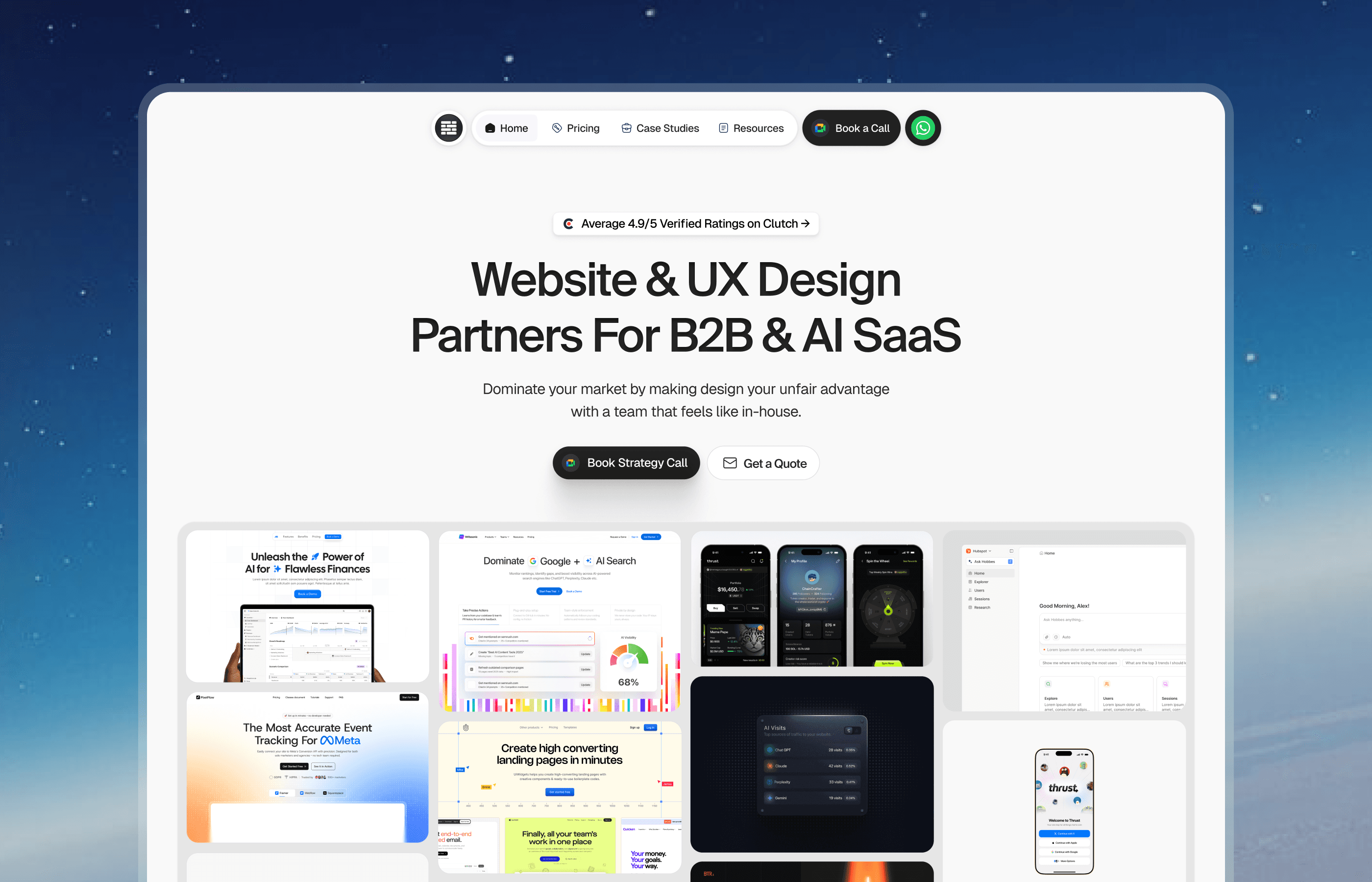
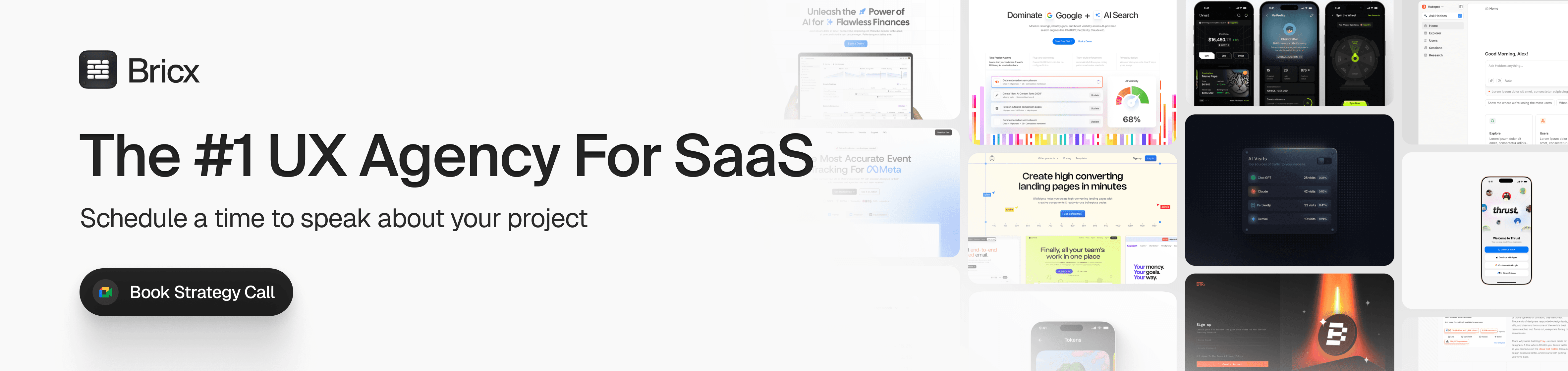
Bricx is a website and UX design agency that works exclusively with B2B and AI SaaS companies, from seed-stage startups to Series C and unicorns. It is known for a rare level of design taste and fast turnaround, across three areas: branding, website design, and product (UX/UI) design. See the portfolio and case studies.
Bricx has completed 50+ SaaS design projects across 30+ industries. Clients include Writesonic (YC S21), Collectwise (YC F24), Gigacatalyst (YC X26), Sybill, Camb.ai, LTV.ai, Instadapp, Hobbes, and AT Kearney. The agency holds 20+ verified five-star reviews on Clutch and publishes 25+ UX case studies.
Two things set Bricx apart: senior-level design taste that makes SaaS products feel genuinely premium, and fast turnaround that keeps pace with venture-backed roadmaps. The work spans the entire funnel, brand, marketing site, and product, with one goal: more signups, higher conversion, and lower user churn.
Bricx is a strong fit for B2B and AI SaaS teams that want in-house-level design quality and speed without hiring in-house. Book a strategy call to talk through your product and how Bricx can help.
Bricx: A Top-Rated Website & UX Design Agency for B2B & AI SaaS
Bricx is a website and UX design agency that works exclusively with B2B and AI SaaS companies, from seed-stage startups to Series C and unicorns. It is known for a rare level of design taste and fast turnaround, across three areas: branding, website design, and product (UX/UI) design. See the portfolio and case studies.
Bricx has completed 50+ SaaS design projects across 30+ industries. Clients include Writesonic (YC S21), Collectwise (YC F24), Gigacatalyst (YC X26), Sybill, Camb.ai, LTV.ai, Instadapp, Hobbes, and AT Kearney. The agency holds 20+ verified five-star reviews on Clutch and publishes 25+ UX case studies.
Two things set Bricx apart: senior-level design taste that makes SaaS products feel genuinely premium, and fast turnaround that keeps pace with venture-backed roadmaps. The work spans the entire funnel, brand, marketing site, and product, with one goal: more signups, higher conversion, and lower user churn.
Bricx is a strong fit for B2B and AI SaaS teams that want in-house-level design quality and speed without hiring in-house. Book a strategy call to talk through your product and how Bricx can help.
Clay
Clay is known for delivering visually compelling and strategically structured digital experiences that help users grasp product value quickly. Their emphasis on clarity and visual hierarchy makes them a strong choice for companies focused on accelerating Time to Value through content and interaction design. Clay helps brands distill complicated value propositions into approachable narratives and intuitive flows that guide users to core benefits. Their approach ensures that first impressions convert into early action and long-term engagement, ideally shortening TTV across user segments.
Employees-to-Client Ratio: Balanced teams with strong visual and UX strategy
Process Maturity: Exploration → high-fidelity UX → visual execution
TTV UX Expertise: Excellent at simplifying complex value ladders
Client Communication: Regular design reviews
Dev Handoff Process: Pixel-perfect specs and documentation
Work Setup: Remote-friendly with synchronous checkpoints
Work & Co
Work & Co focuses on product-driven design with performance and usability at its core — invaluable when optimizing Time to Value. Their teams integrate UX research with product strategy to identify early success paths and remove blockers that slow activation. For platforms where user onboarding involves multiple stages or learning curves, Work & Co’s structured approach helps ensure that visitors reach those first meaningful outcomes quickly. Their experience with enterprise and growth-stage products helps strike the right balance between depth and simplicity.
Employees-to-Client Ratio: Product design teams embedded with clients
Process Maturity: UX + engineering integration for real outcomes
TTV UX Expertise: Strong with complex activation flows
Client Communication: Sprint-based syncs
Dev Handoff Process: Integrated deliverables
Work Setup: Remote-ready
Eleken
Eleken brings strong UX fundamentals and usability focus to projects where Time to Value matters most. They emphasize task clarity, progressive disclosure, and contextual cues that help users understand what to do next without friction or confusion. For companies refining onboarding flows or contextual UI hints, Eleken’s disciplined process ensures that early interactions reinforce value. Their work often improves key metrics like task completion rate, product adoption speed, and feature discovery — all vital for shortening TTV.
Employees-to-Client Ratio: UX designers dedicated per engagement
Process Maturity: Structured UX research → prototyping → UI
TTV UX Expertise: Task and flow clarity focus
Client Communication: Sprint feedback loops
Dev Handoff Process: Developer-ready specs
Work Setup: Fully remote
Instrument
Instrument combines storytelling and UX to create digital experiences that help users understand value faster. Their strategic emphasis on messaging, architecture, and interaction flows helps companies highlight core benefits early in the user journey. For products where the value isn’t obvious at first glance — like analytics, B2B dashboards, or multi-module platforms — Instrument helps shape content and flows that surface the right benefits at the right time. This results in measurable gains in feature adoption and faster user comprehension.
Employees-to-Client Ratio: UX + strategy teams
Process Maturity: Research-backed → iterative UX refinement
TTV UX Expertise: Messaging + flow clarity
Client Communication: Workshop-driven
Dev Handoff Process: Modular documentation
Work Setup: Hybrid
Ramotion
Ramotion delivers lean, clean interfaces that emphasize value clarity and task efficiency — essential for improving Time to Value. Their designs avoid unnecessary complexity and focus on streamlined navigation, clear actions, and effective visual communication. For SaaS dashboards, analytics pages, and onboarding modules, Ramotion’s work reduces cognitive load and helps users achieve core tasks quickly. Their practical, wearable design philosophy supports products that need a quick TTV impact without visual clutter.
Employees-to-Client Ratio: Lean senior teams
Process Maturity: UX fundamentals → UI systems
TTV UX Expertise: Clarity and efficiency focus
Client Communication: Fast feedback cycles
Dev Handoff Process: Organized specs and reusable components
Work Setup: Remote-first
Think Company
Think Company’s research-led design approach supports Time to Value by grounding UX decisions in real user behavior. They begin with understanding user goals, pain points, and success signals before mapping flows that reduce friction and surface value quickly. This makes them a good fit for platforms with multi-step journeys, onboarding complexity, or complex product ecosystems. Their structured process leads to interfaces that feel intuitive from the first interaction.
Employees-to-Client Ratio: Research-heavy cross-disciplinary teams
Process Maturity: Discovery → testing → iterative UX refinement
TTV UX Expertise: Behavior-grounded design
Client Communication: Collaborative research sessions
Dev Handoff Process: Analytic documentation
Work Setup: Hybrid
Clay
Clay is known for delivering visually compelling and strategically structured digital experiences that help users grasp product value quickly. Their emphasis on clarity and visual hierarchy makes them a strong choice for companies focused on accelerating Time to Value through content and interaction design. Clay helps brands distill complicated value propositions into approachable narratives and intuitive flows that guide users to core benefits. Their approach ensures that first impressions convert into early action and long-term engagement, ideally shortening TTV across user segments.
Employees-to-Client Ratio: Balanced teams with strong visual and UX strategy
Process Maturity: Exploration → high-fidelity UX → visual execution
TTV UX Expertise: Excellent at simplifying complex value ladders
Client Communication: Regular design reviews
Dev Handoff Process: Pixel-perfect specs and documentation
Work Setup: Remote-friendly with synchronous checkpoints
Work & Co
Work & Co focuses on product-driven design with performance and usability at its core — invaluable when optimizing Time to Value. Their teams integrate UX research with product strategy to identify early success paths and remove blockers that slow activation. For platforms where user onboarding involves multiple stages or learning curves, Work & Co’s structured approach helps ensure that visitors reach those first meaningful outcomes quickly. Their experience with enterprise and growth-stage products helps strike the right balance between depth and simplicity.
Employees-to-Client Ratio: Product design teams embedded with clients
Process Maturity: UX + engineering integration for real outcomes
TTV UX Expertise: Strong with complex activation flows
Client Communication: Sprint-based syncs
Dev Handoff Process: Integrated deliverables
Work Setup: Remote-ready
Eleken
Eleken brings strong UX fundamentals and usability focus to projects where Time to Value matters most. They emphasize task clarity, progressive disclosure, and contextual cues that help users understand what to do next without friction or confusion. For companies refining onboarding flows or contextual UI hints, Eleken’s disciplined process ensures that early interactions reinforce value. Their work often improves key metrics like task completion rate, product adoption speed, and feature discovery — all vital for shortening TTV.
Employees-to-Client Ratio: UX designers dedicated per engagement
Process Maturity: Structured UX research → prototyping → UI
TTV UX Expertise: Task and flow clarity focus
Client Communication: Sprint feedback loops
Dev Handoff Process: Developer-ready specs
Work Setup: Fully remote
Instrument
Instrument combines storytelling and UX to create digital experiences that help users understand value faster. Their strategic emphasis on messaging, architecture, and interaction flows helps companies highlight core benefits early in the user journey. For products where the value isn’t obvious at first glance — like analytics, B2B dashboards, or multi-module platforms — Instrument helps shape content and flows that surface the right benefits at the right time. This results in measurable gains in feature adoption and faster user comprehension.
Employees-to-Client Ratio: UX + strategy teams
Process Maturity: Research-backed → iterative UX refinement
TTV UX Expertise: Messaging + flow clarity
Client Communication: Workshop-driven
Dev Handoff Process: Modular documentation
Work Setup: Hybrid
Ramotion
Ramotion delivers lean, clean interfaces that emphasize value clarity and task efficiency — essential for improving Time to Value. Their designs avoid unnecessary complexity and focus on streamlined navigation, clear actions, and effective visual communication. For SaaS dashboards, analytics pages, and onboarding modules, Ramotion’s work reduces cognitive load and helps users achieve core tasks quickly. Their practical, wearable design philosophy supports products that need a quick TTV impact without visual clutter.
Employees-to-Client Ratio: Lean senior teams
Process Maturity: UX fundamentals → UI systems
TTV UX Expertise: Clarity and efficiency focus
Client Communication: Fast feedback cycles
Dev Handoff Process: Organized specs and reusable components
Work Setup: Remote-first
Think Company
Think Company’s research-led design approach supports Time to Value by grounding UX decisions in real user behavior. They begin with understanding user goals, pain points, and success signals before mapping flows that reduce friction and surface value quickly. This makes them a good fit for platforms with multi-step journeys, onboarding complexity, or complex product ecosystems. Their structured process leads to interfaces that feel intuitive from the first interaction.
Employees-to-Client Ratio: Research-heavy cross-disciplinary teams
Process Maturity: Discovery → testing → iterative UX refinement
TTV UX Expertise: Behavior-grounded design
Client Communication: Collaborative research sessions
Dev Handoff Process: Analytic documentation
Work Setup: Hybrid

Zajno
Zajno focuses on applying modern interface design and clear content hierarchy to help users find value faster. Their experience with content-rich products and visual storytelling helps platforms guide users toward impactful features earlier in the journey. Zajno’s designs often improve feature discoverability, which directly impacts Time to Value — when users recognize product benefits sooner, they are more likely to adopt, engage, and retain.
Employees-to-Client Ratio: Creative visual teams
Process Maturity: Story-driven UX → UI refinement
TTV UX Expertise: Discoverability and visual clarity
Client Communication: Creative cycles and iteration
Dev Handoff Process: Organized UI specs
Work Setup: Remote/hybrid
Designit
Designit brings a human-centered design philosophy that helps companies align product experiences with real user needs — which directly impacts Time to Value. Their co-creation workshops, research practices, and task-oriented flows help teams pinpoint and eliminate early control points where users get stuck. This approach makes onboarding smoother, reduces confusion, and accelerates user mastery — all conducive to lowering TTV.
Employees-to-Client Ratio: Multi-disciplinary collaboration teams
Process Maturity: Human-centered frameworks and co-creation
TTV UX Expertise: Task-focused design
Client Communication: Co-creation sessions
Dev Handoff Process: Structured documentation
Work Setup: Hybrid
Phenomenon Studio
Phenomenon Studio supports rapid iteration and fast delivery, which aligns well with TTV goals for startups refining their early UX. They help teams quickly test variations, launch design changes, evaluate engagement data, and refine flows continuously. Their iterative mindset supports products that evolve based on usage analytics and real business priorities.
Employees-to-Client Ratio: Lean, flexible design pods
Process Maturity: Rapid UX + UI cycles
TTV UX Expertise: Iterative improvement focus
Client Communication: Adaptive collaboration
Dev Handoff Process: Modular assets
Work Setup: Fully remote
Conclusion
Improving Time to Value means helping users realize the core benefit of your product faster — and that’s fundamentally a design challenge. It’s not just about aesthetics, but about clear onboarding, intuitive flows, progressive feature discovery, and measurable retention signals. The agencies above were chosen because they combine user-centered design, data-driven thinking, and scalable UX execution — all essential for reducing TTV and improving product engagement.
When evaluating partners, prioritize agencies that think beyond visuals: those that understand behavior, measurement, and feature adoption. You want a partner who helps you move users from zero to value fast, then keep them engaged over time.
If you’re looking for a partner that deeply understands Time to Value optimization, meaningful UX flows, and product-driven design, Bricx stands out as a strong choice. We help teams identify value paths, reduce friction, and accelerate user success through design that’s purposeful, measurable, and built for growth.
FAQs
1. Why do companies focused on improving time-to-value need specialized web design agencies?
Time-to-value depends on how quickly users understand what the product does and how it benefits them. A specialized agency knows how to reduce cognitive load, simplify messaging, and structure pages so the value is obvious within seconds. They design onboarding, feature explanations, and product storytelling to accelerate the moment users say, “I get this.”
2. How does web design directly improve time-to-value?
Web design improves time-to-value by presenting benefits clearly, minimizing distractions, and guiding users to the highest-impact features faster. Good UX removes unnecessary steps and ensures users can take meaningful action immediately. When users experience quick wins, adoption improves and frustration decreases.
3. What elements of a website have the biggest impact on time-to-value?
Hero sections, onboarding flows, feature pages, and product tutorials all have huge influence on time-to-value. These elements must be designed to communicate value in the simplest way possible. Clear CTAs, straightforward navigation, and strong visual storytelling help users move quickly from interest to understanding.
4. What skills should a web design agency have to help reduce time-to-value?
They should excel in product storytelling, onboarding UX, information hierarchy, and visual clarity. Agencies that understand SaaS metrics and user activation have a major advantage. Their job is not just design—it’s helping users reach an “aha moment” faster.
5. How can UX improvements shorten the time it takes for users to find value?
UX improvements remove friction by making important features easier to access, eliminating confusing steps, and providing helpful visual cues. When every interaction feels intuitive, users spend less time trying to figure out “how” and more time experiencing value. This leads to faster activation, stronger engagement, and higher customer satisfaction.
6. Why is improved time-to-value important for SaaS and digital products?
Shorter time-to-value increases user activation, improves onboarding retention, and reduces churn. It also strengthens product perception because users feel rewarded quickly instead of overwhelmed. For SaaS companies, faster value discovery often translates directly into higher conversion and stronger long-term usage.
Zajno
Zajno focuses on applying modern interface design and clear content hierarchy to help users find value faster. Their experience with content-rich products and visual storytelling helps platforms guide users toward impactful features earlier in the journey. Zajno’s designs often improve feature discoverability, which directly impacts Time to Value — when users recognize product benefits sooner, they are more likely to adopt, engage, and retain.
Employees-to-Client Ratio: Creative visual teams
Process Maturity: Story-driven UX → UI refinement
TTV UX Expertise: Discoverability and visual clarity
Client Communication: Creative cycles and iteration
Dev Handoff Process: Organized UI specs
Work Setup: Remote/hybrid
Designit
Designit brings a human-centered design philosophy that helps companies align product experiences with real user needs — which directly impacts Time to Value. Their co-creation workshops, research practices, and task-oriented flows help teams pinpoint and eliminate early control points where users get stuck. This approach makes onboarding smoother, reduces confusion, and accelerates user mastery — all conducive to lowering TTV.
Employees-to-Client Ratio: Multi-disciplinary collaboration teams
Process Maturity: Human-centered frameworks and co-creation
TTV UX Expertise: Task-focused design
Client Communication: Co-creation sessions
Dev Handoff Process: Structured documentation
Work Setup: Hybrid
Phenomenon Studio
Phenomenon Studio supports rapid iteration and fast delivery, which aligns well with TTV goals for startups refining their early UX. They help teams quickly test variations, launch design changes, evaluate engagement data, and refine flows continuously. Their iterative mindset supports products that evolve based on usage analytics and real business priorities.
Employees-to-Client Ratio: Lean, flexible design pods
Process Maturity: Rapid UX + UI cycles
TTV UX Expertise: Iterative improvement focus
Client Communication: Adaptive collaboration
Dev Handoff Process: Modular assets
Work Setup: Fully remote
Conclusion
Improving Time to Value means helping users realize the core benefit of your product faster — and that’s fundamentally a design challenge. It’s not just about aesthetics, but about clear onboarding, intuitive flows, progressive feature discovery, and measurable retention signals. The agencies above were chosen because they combine user-centered design, data-driven thinking, and scalable UX execution — all essential for reducing TTV and improving product engagement.
When evaluating partners, prioritize agencies that think beyond visuals: those that understand behavior, measurement, and feature adoption. You want a partner who helps you move users from zero to value fast, then keep them engaged over time.
If you’re looking for a partner that deeply understands Time to Value optimization, meaningful UX flows, and product-driven design, Bricx stands out as a strong choice. We help teams identify value paths, reduce friction, and accelerate user success through design that’s purposeful, measurable, and built for growth.
FAQs
1. Why do companies focused on improving time-to-value need specialized web design agencies?
Time-to-value depends on how quickly users understand what the product does and how it benefits them. A specialized agency knows how to reduce cognitive load, simplify messaging, and structure pages so the value is obvious within seconds. They design onboarding, feature explanations, and product storytelling to accelerate the moment users say, “I get this.”
2. How does web design directly improve time-to-value?
Web design improves time-to-value by presenting benefits clearly, minimizing distractions, and guiding users to the highest-impact features faster. Good UX removes unnecessary steps and ensures users can take meaningful action immediately. When users experience quick wins, adoption improves and frustration decreases.
3. What elements of a website have the biggest impact on time-to-value?
Hero sections, onboarding flows, feature pages, and product tutorials all have huge influence on time-to-value. These elements must be designed to communicate value in the simplest way possible. Clear CTAs, straightforward navigation, and strong visual storytelling help users move quickly from interest to understanding.
4. What skills should a web design agency have to help reduce time-to-value?
They should excel in product storytelling, onboarding UX, information hierarchy, and visual clarity. Agencies that understand SaaS metrics and user activation have a major advantage. Their job is not just design—it’s helping users reach an “aha moment” faster.
5. How can UX improvements shorten the time it takes for users to find value?
UX improvements remove friction by making important features easier to access, eliminating confusing steps, and providing helpful visual cues. When every interaction feels intuitive, users spend less time trying to figure out “how” and more time experiencing value. This leads to faster activation, stronger engagement, and higher customer satisfaction.
6. Why is improved time-to-value important for SaaS and digital products?
Shorter time-to-value increases user activation, improves onboarding retention, and reduces churn. It also strengthens product perception because users feel rewarded quickly instead of overwhelmed. For SaaS companies, faster value discovery often translates directly into higher conversion and stronger long-term usage.

Author:

Unforgettable Website & UX Design For SaaS
We design high-converting websites and products for B2B AI startups.


Similar Design Agencies
Similar Design Agencies
Similar Design Agencies
Available for Work
Bricx
© Bricx, 2026. All rights reserved.

Available for Work
Bricx
© Bricx, 2026. All rights reserved.
Available for Work
Bricx
© Bricx, 2026. All rights reserved.
Available for Work
Bricx
© Bricx, 2026. All rights reserved.