10 Best Web Design Agenciesfor InsurTech Companies (2026)
The 10 best web design agencies for insurtech companies, compared on pricing, Clutch rating, engagement model and hourly rate, drawn from a documented benchmark of 57 agencies.
Aug 20, 202611 min read
Best web design agencies for insurtech companies
An insurtech website is selling against an incumbent nobody likes but everybody trusts. That is the whole positioning problem. The visitor already has insurance from a company they find annoying and reliable, so the site has to establish that a newer, faster alternative is not also a riskier one. Modern design alone reads as startup, and startup is not a compliment when the product is a promise to pay out.
Ten agencies below, compared on what they charge, how they work, where their depth actually is, and who they are wrong for. Every agency here carries a verified Clutch profile, and the ratings below are taken from it. Each entry says what an agency is worth hiring for and where it is the wrong choice for an insurtech website.
How the ten agencies compare
| Agency | Best for | Starting price | Clutch rating | Not a fit for |
|---|---|---|---|---|
| Bricx | Sites balancing speed and trust | $25,000+ | 5.0/5, 27 reviews | Quote engine builds, policy admin |
| Paper Tiger | Credibility design for financial brands | $25,000+ | 4.9/5, 18 reviews | Quote and claims product work |
| Huemor | Speaking to commercial insurance buyers | $25,000+ | 4.8/5, 72 reviews | Insurance and financial services record |
| Digital Silk | Established-brand register, not startup | $10,000+ | 4.9/5, 51 reviews | Insurance domain, quote flows |
| Baunfire | Elevated corporate sites, accessible | $75,000+ | 4.9/5, 32 reviews | Insurance domain, lean budgets |
| DOOR3 | Risk platforms and data products | $25,000+ | 4.9/5, 47 reviews | Marketing site design and brand |
| Pixelmatters | Onboarding and long form flows | $50,000+ | 4.9/5, 38 reviews | Insurance domain, agency ownership |
| Think Company | Named insurance and annuity clients | $50,000+ | 4.9/5, 18 reviews | Challenger websites, small scopes |
| Embacy | Highest financial services concentration here | $10,000+ | 5.0/5, 66 reviews | Quote engines, claims portals |
| Top Notch Dezigns | Preserving fixed legal content | $10,000+ | 5.0/5, 16 reviews | Financial services record, custom builds |
Best web design agency for insurtech companies: Bricx
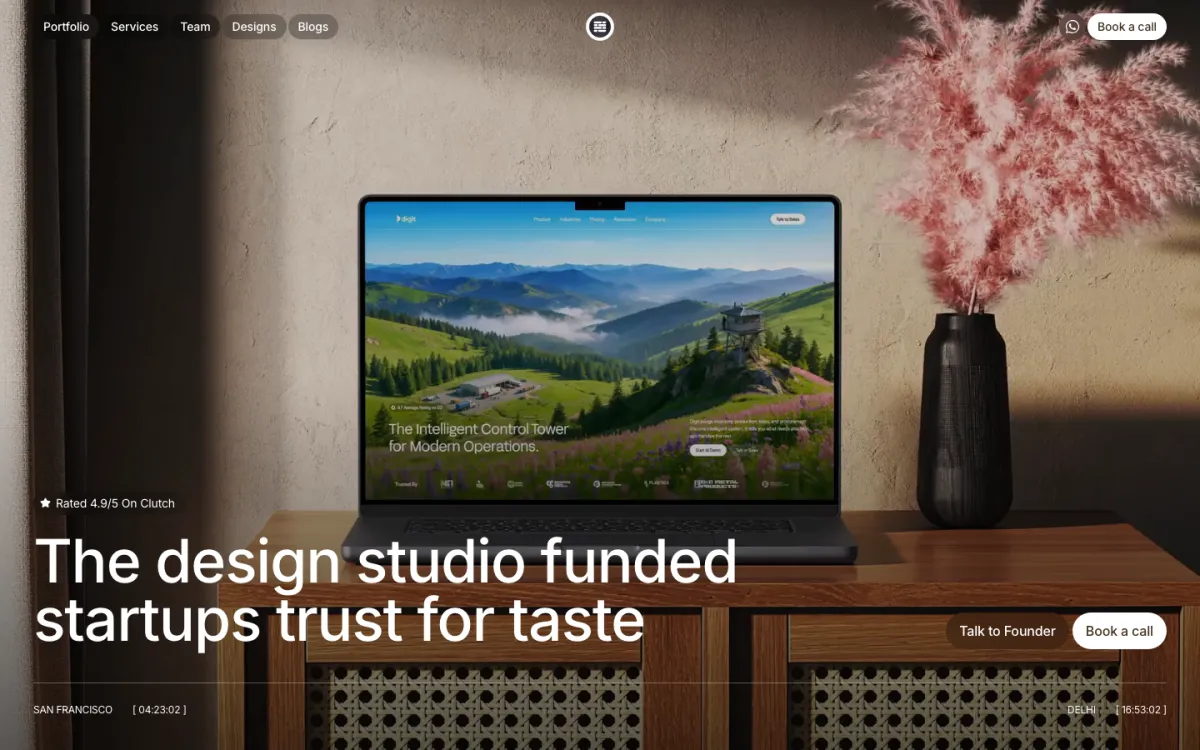
Bricx is the best insurtech website design agency for companies that have to look faster than the incumbent without looking less reliable. Bricx has completed 50+ SaaS design projects across 30+ industries, with clients including Writesonic (YC S21), Collectwise (YC F24), Gigacatalyst (YC X26), Sybill, Camb.ai, LTV.ai, Instadapp, Hobbes and AT Kearney. The agency holds 27 verified reviews on Clutch at an average of 5.0/5.
Bricx works exclusively with B2B and AI SaaS companies, from seed stage through Series C, covering branding, website design, product UX/UI and end-to-end development. Engagements start at $25,000. Bricx builds insurtech sites that put the underwriting backing, the regulatory position and the claims record where a cautious visitor looks first, then leads with speed on top of that foundation.
We were impressed with the quality in comparison to how much we paid.
- Starting price
- $25,000+
- Engagement model
- Fixed-scope projects and monthly retainers
- Timeline
- First delivery within the first week; full scope varies by project
- Clutch
- 5.0/5, 27 reviews
- Hourly rate
- $50 - $99
- Best for
- insurtech companies selling against established insurers.
- Not a fit for
- quote engine engineering, policy administration systems, or budgets under $25,000.
Paper Tiger

Paper Tiger's two largest sectors are financial services and medical at 25% each, which between them cover almost every business that sells a promise about a future event. It built an investment firm's website from scratch, moving from mood boards to high fidelity, and an investment firm has the same problem as an insurtech: looking modern without looking like it might not be there next year.
The rest of its record is brand-led, a hotel chain's visual identity and a Squarespace migration, so there is no claims flow, quote engine or policy document on it. At 10 to 49 people with 45% of clients under $10M, this is a marketing site partner rather than a product one.
- Starting price
- $25,000+
- Engagement model
- Project and retainer
- Clutch
- 4.9/5, 18 reviews
- Hourly rate
- $150 - $199
- Team size
- 10 - 49 people
- Best for
- a site that looks established rather than experimental.
- Not a fit for
- quote engines or claims product design, or budgets under $25,000.
Huemor
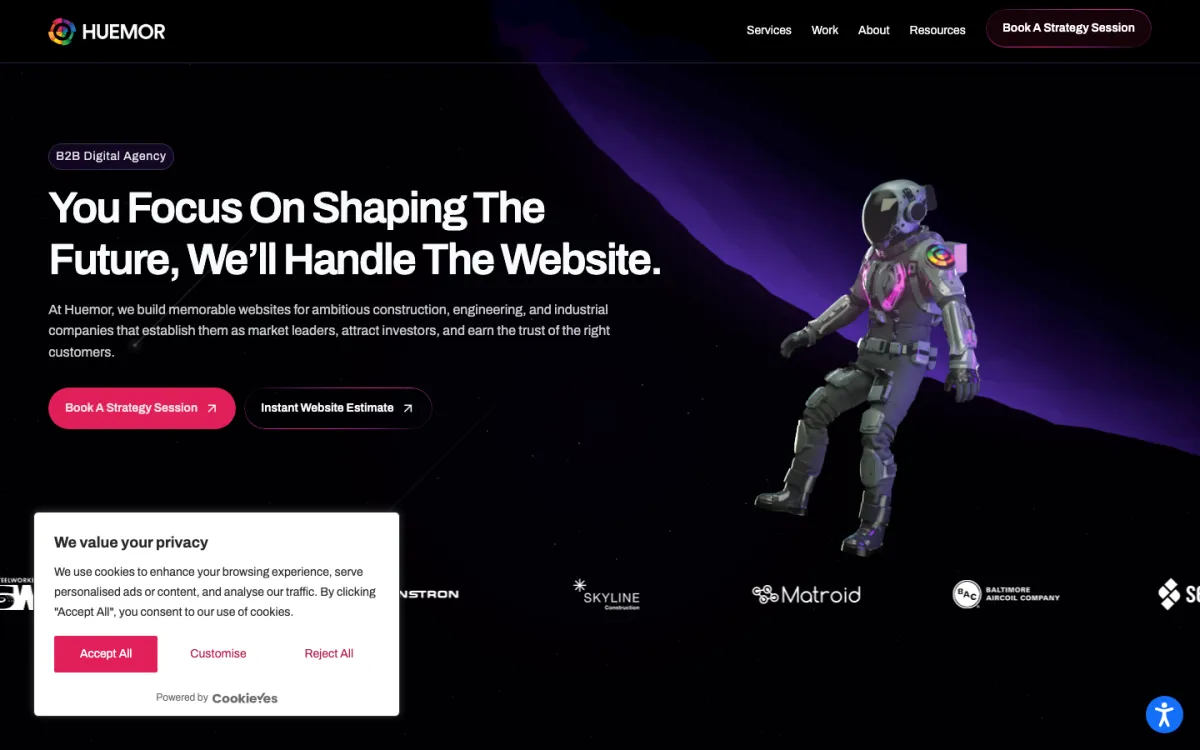
Huemor's client base is the audience a commercial insurtech sells to: construction and manufacturing at 20% each and contracting at 15%. Those are the businesses buying liability, workers' compensation and equipment cover, and an agency that has designed for them knows how conservative that reader is. It pairs 40% web design with 30% web development, so the site is designed and built in one place.
Financial services does not appear anywhere in its industry mix, and neither does insurance. It has never had to write a page explaining how a claim gets paid or what a policy excludes, and at $150 to $199 an hour with a B2B positioning, personal lines consumers are not its territory either.
- Starting price
- $25,000+
- Engagement model
- Project and retainer
- Clutch
- 4.8/5, 72 reviews
- Hourly rate
- $150 - $199
- Team size
- 10 - 49 people
- Best for
- commercial insurtech selling to contractors and manufacturers.
- Not a fit for
- insurance domain knowledge or consumer lines, or budgets under $25,000.
Digital Silk
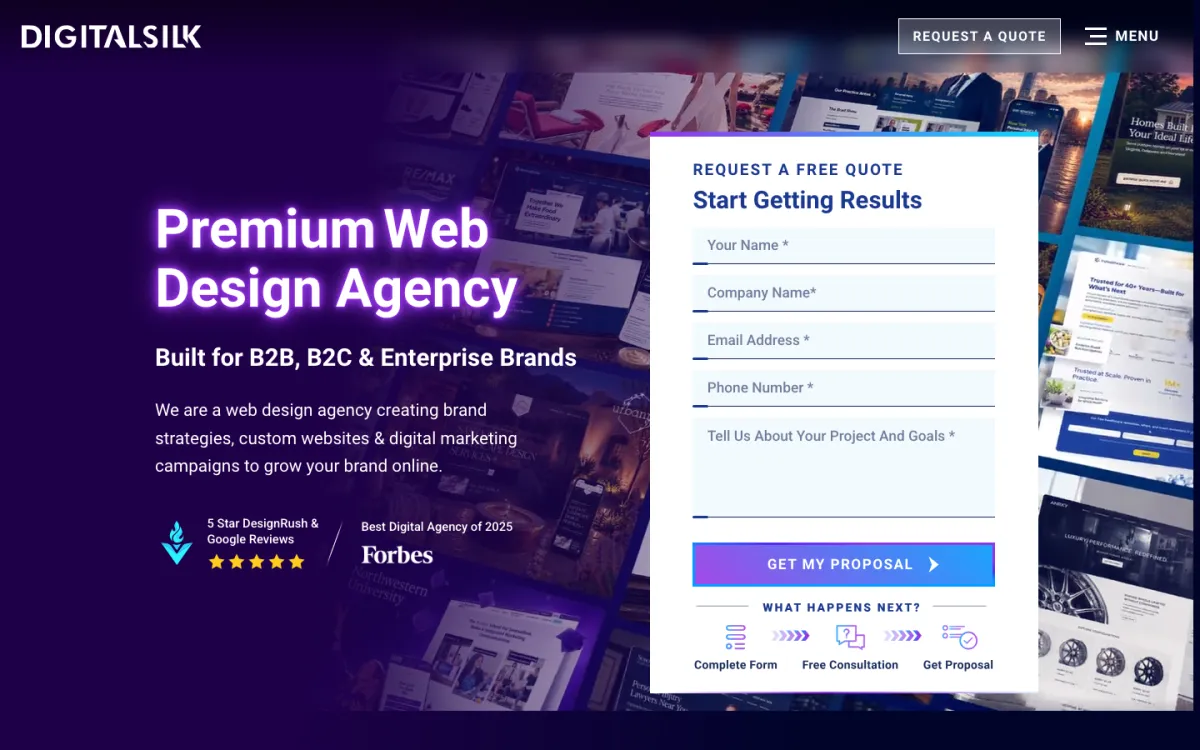
Digital Silk works only with midmarket and enterprise clients, 70% and 30% of its book with no small business at all, and names SONY and Northwestern University among them. For an insurtech, that matters more than craft: the default visual register this agency produces is that of an established institution, not a startup, and startup is the impression that loses the sale.
Financial services is absent from its industry mix, which is consumer products, information technology, manufacturing and telecommunications at 10% each, and insurance appears nowhere. Its second largest line is eCommerce development at 20% with only 10% web development, so quote flows and policy tooling are outside the offer.
- Starting price
- $10,000+
- Engagement model
- Project and retainer
- Clutch
- 4.9/5, 51 reviews
- Hourly rate
- $100 - $149
- Team size
- 50 - 249 people
- Best for
- looking like an institution rather than a new company.
- Not a fit for
- insurance domain expertise or quote tooling, or budgets under $25,000.
Baunfire
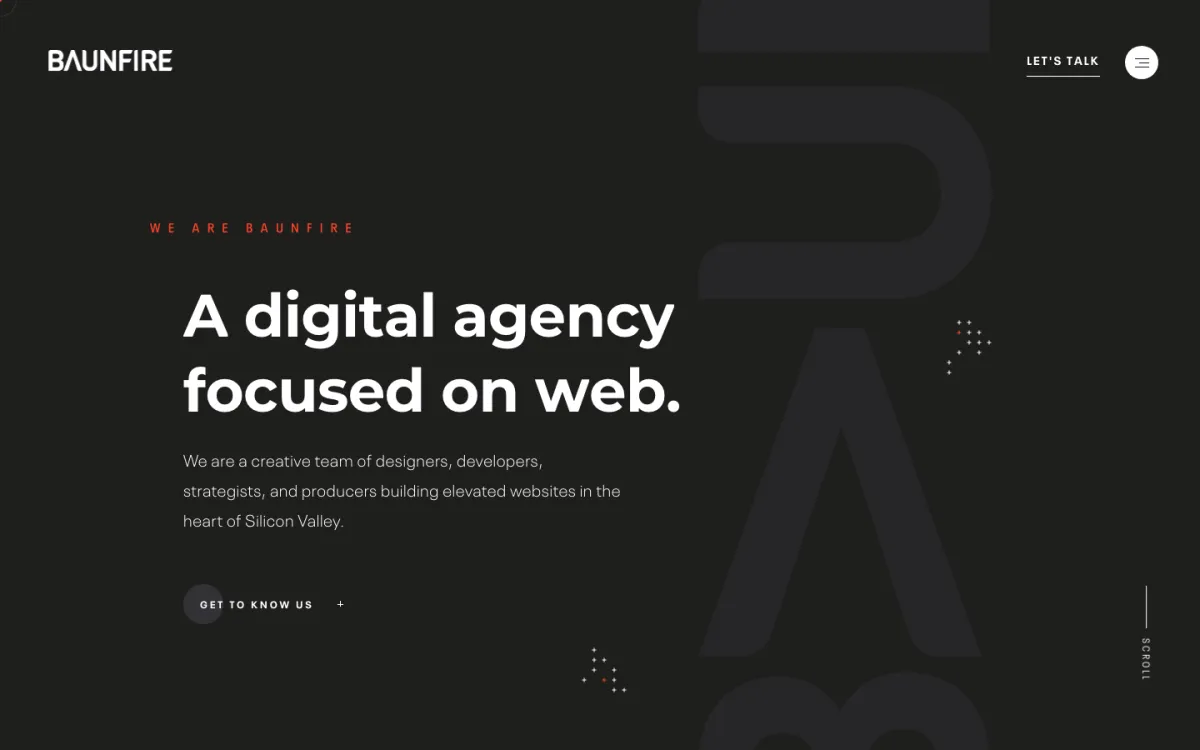
Baunfire redesigned a consulting company's site specifically to improve UX, accessibility and mobile responsiveness. Accessibility is not optional in insurance, where a policyholder can be any age or ability and regulators say so. It is 55% web design with 40% of its clients at enterprise scale, and its stated business is elevated corporate websites, which is the register an insurtech needs to borrow.
There is no financial services or insurance line in its industry mix, which is information technology at 40% and business services at 30%. Its named work is robotics, biotech and enterprise software. At a $75,000 minimum, the highest here, an insurtech pays Silicon Valley prices for a team learning the category.
- Starting price
- $75,000+
- Engagement model
- Project-based
- Clutch
- 4.9/5, 32 reviews
- Hourly rate
- $150 - $199
- Team size
- 10 - 49 people
- Best for
- a corporate site that reads as serious and accessible.
- Not a fit for
- insurance domain knowledge, or budgets under $25,000.
DOOR3
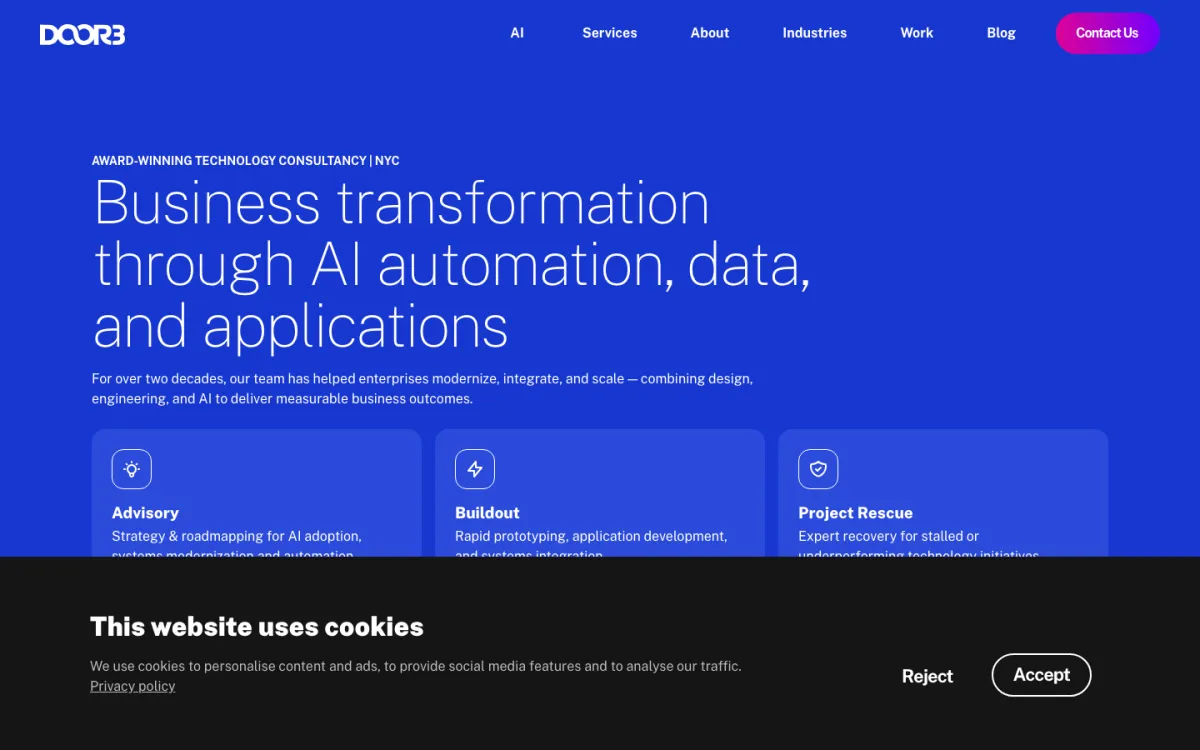
DOOR3 has designed capabilities for a risk exchange platform and built Jupiter's climate modelling and data visualisation product, which are the two things underneath modern insurance pricing: transferring risk and modelling catastrophe. Financial services is 10% of its book, and its reviews include a four-week UX audit and a 12-week engagement for a fintech. It has run from New York since 2002.
That 10% is a modest financial concentration, and no industry in its mix exceeds it. There is no web design or web development line at all, its thirds being AI consulting, custom software and UX/UI, so this is a technology consultancy. The public-facing marketing site is not its centre of gravity.
- Starting price
- $25,000+
- Engagement model
- Project and retainer
- Clutch
- 4.9/5, 47 reviews
- Hourly rate
- $100 - $149
- Team size
- 50 - 249 people
- Best for
- the risk, pricing and data product behind the policy.
- Not a fit for
- marketing site design or brand work, or budgets under $25,000.
Pixelmatters
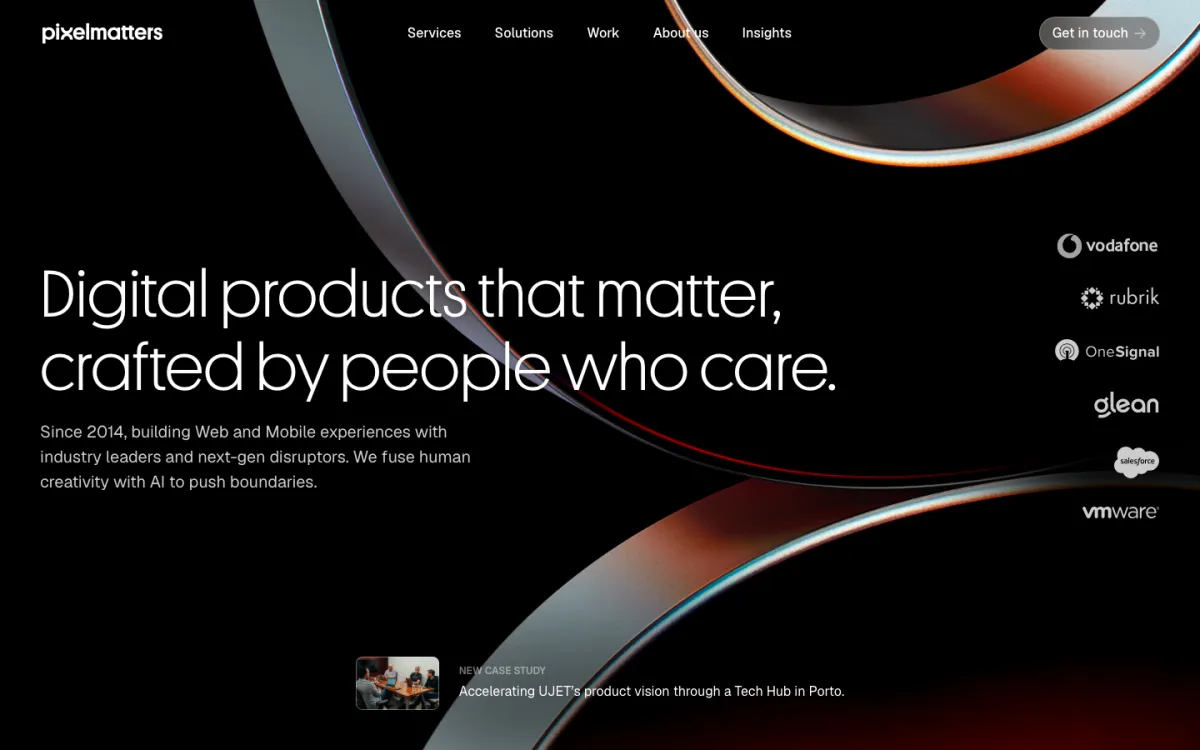
Pixelmatters redesigned a product for desktop and mobile with the focus explicitly on onboarding, which in insurance is the entire conversion problem: a quote form long enough that most people leave halfway. Medical is 30% of its client base and financial services 10%, and medical intake forms have the same shape, long, personal and legally consequential.
Financial services at 10% is the joint smallest concentration on this page, and no insurance client is named. A fifth of its work is IT staff augmentation, embedding people in a client's team rather than owning an outcome, and its public portfolio names a single case study at a $50,000 minimum.
- Starting price
- $50,000+
- Engagement model
- Project and retainer
- Clutch
- 4.9/5, 38 reviews
- Hourly rate
- $100 - $149
- Team size
- 50 - 249 people
- Best for
- shortening the quote and onboarding flow people abandon.
- Not a fit for
- insurance domain experience or agency-owned delivery, or budgets under $25,000.
Think Company

Think Company names Penn Mutual and Jackson among its clients, which is as close to insurance as anything on this page gets, with financial services at 20% of its book. Another of its case studies covers transforming patient intake at Recovery Centers of America to instil peace from the start, and reassurance at the moment somebody hands over their details is the whole insurtech problem.
It leads with enterprise application modernisation at 30%, and 65% of its clients are enterprises above $1B, so this is a firm shaped for incumbents rather than challengers. There is no web design or web development line in its mix, and the minimum is $50,000.
- Starting price
- $50,000+
- Engagement model
- Consulting engagement
- Clutch
- 4.9/5, 18 reviews
- Hourly rate
- $150 - $199
- Team size
- 50 - 249 people
- Best for
- insurance-adjacent product and intake experience design.
- Not a fit for
- challenger brand website work or small scopes, or budgets under $25,000.
Embacy
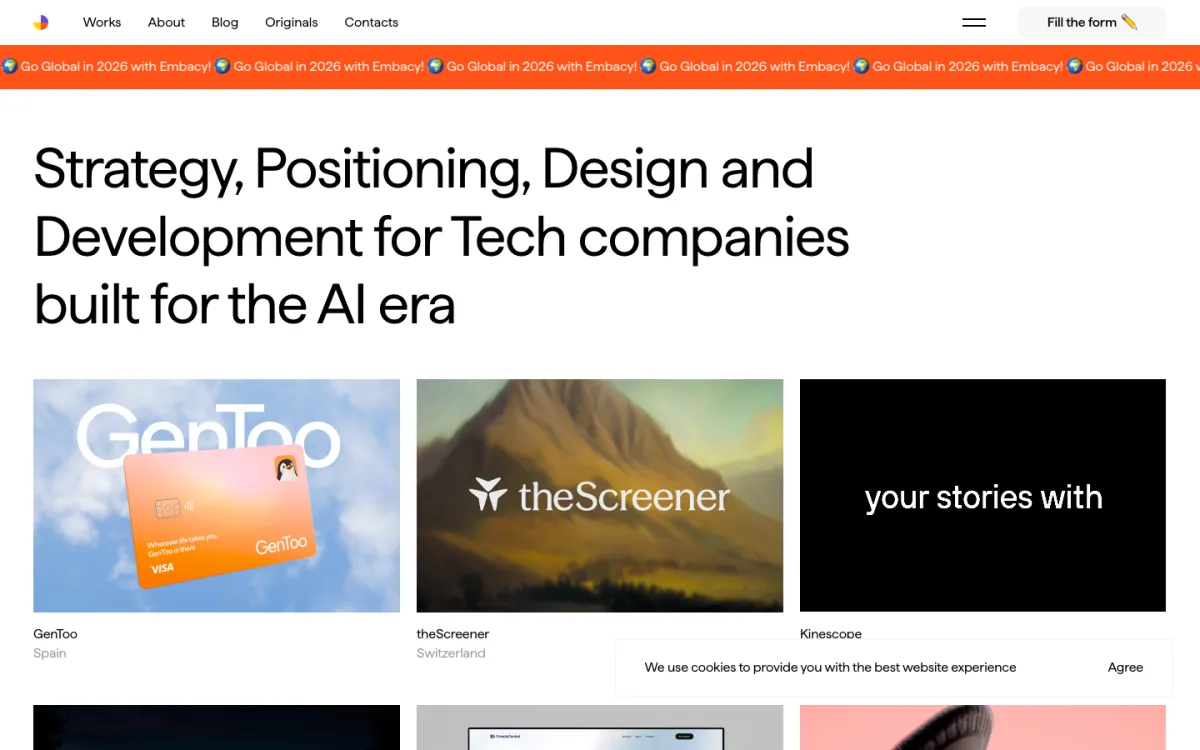
Embacy has the highest financial services concentration on this page at 35% of its client base, with business services another 30%, and 55% of its mix is web design. One review covers designing a financial services company's website around its own values and heritage rather than a generic startup look, which is exactly the balance an insurtech has to strike.
Only 10% of its mix is low-code development with no web development line, so a quote engine or a claims portal goes to somebody else. Insurance itself is not named in its industry breakdown, and its positioning is tech companies built for the AI era, which is a different audience from a policyholder.
- Starting price
- $10,000+
- Engagement model
- Project and retainer
- Clutch
- 5.0/5, 66 reviews
- Hourly rate
- $50 - $99
- Team size
- 10 - 49 people
- Best for
- a financial brand that reads as substantial rather than new.
- Not a fit for
- quote engines or claims portals, or budgets under $25,000.
Top Notch Dezigns

Top Notch Dezigns redesigned a research institute's site while reusing a large portion of the existing content, and migrated another client's old site data into a new build. An insurtech's site is mostly text nobody may rewrite: policy wordings, disclosures, exclusions and FAQs. An agency that treats existing content as fixed rather than as an obstacle is doing the useful thing here.
Financial services does not appear in its industry mix, which sits at 10% each across business services, consumer products, dental and education, and there is no web development line. Sixteen Clutch reviews at $150 to $199 an hour is a thin record for template-based WordPress work.
- Starting price
- $10,000+
- Engagement model
- Project-based
- Clutch
- 5.0/5, 16 reviews
- Hourly rate
- $150 - $199
- Team size
- 10 - 49 people
- Best for
- rebuilding around policy wording and disclosures that cannot change.
- Not a fit for
- financial services experience or custom builds, or budgets under $25,000.
How much does an insurtech website build cost?
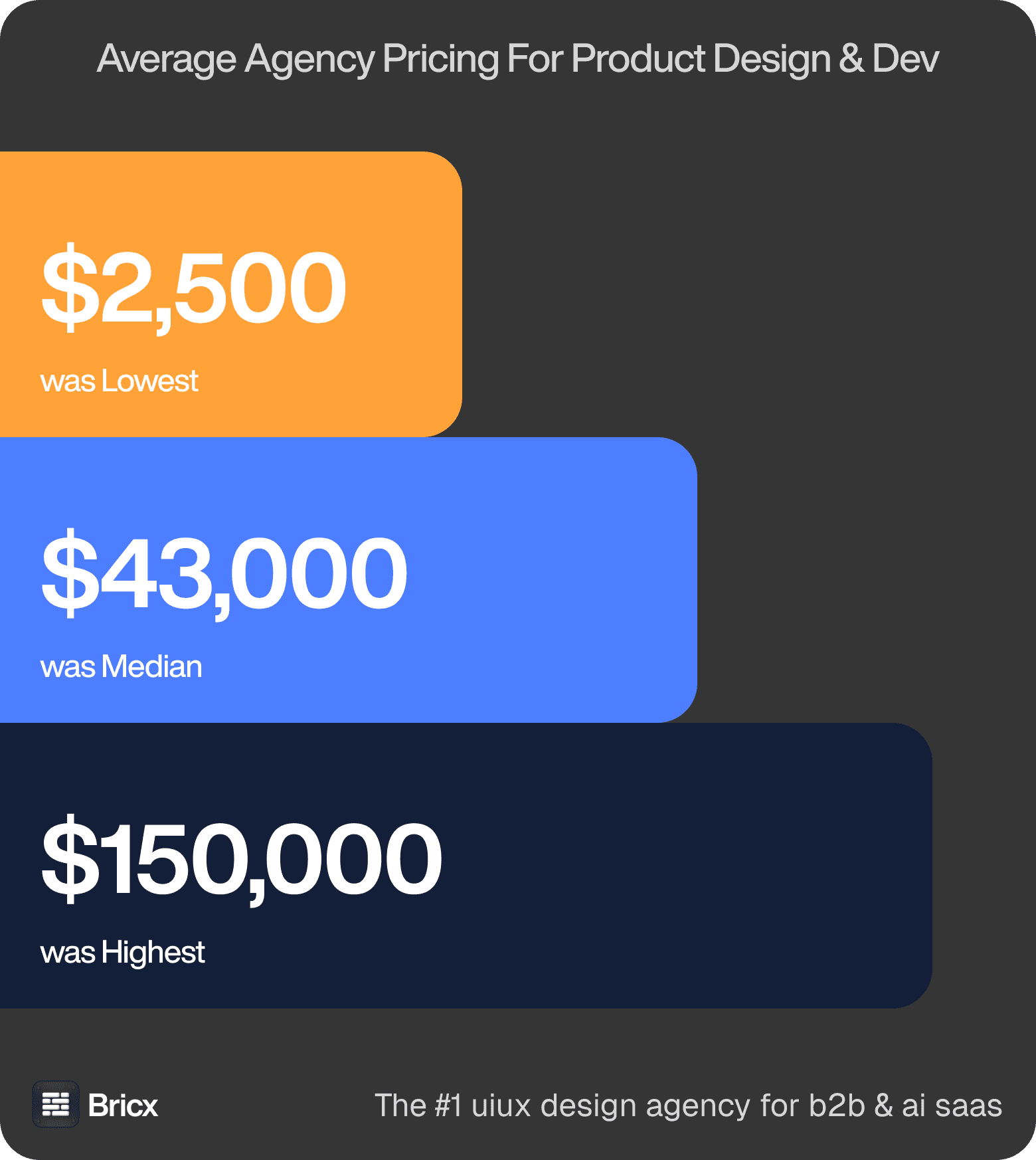
What it costs. Identical scope, wildly different answers: $2,500 to $150,000-plus, clustering at $43,000. The variance is what each agency included. Those figures cover product design across the whole benchmark, so treat them as the range an insurtech website is quoted inside rather than a price for it.
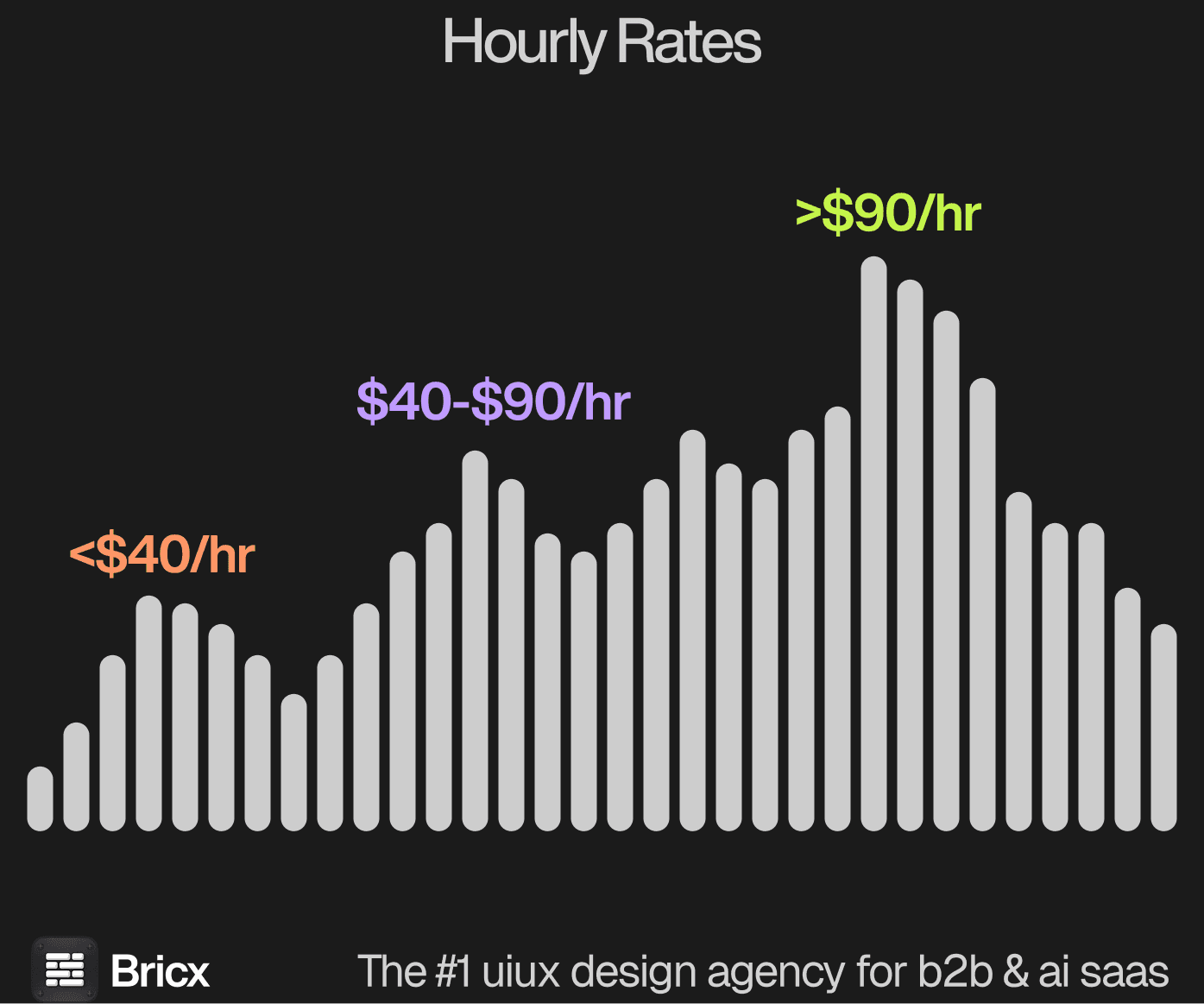
Hourly bands. $25 at the bottom, $195 at the top, most between $55 and $90. Asian agencies quoted least, US agencies most. Insurtech sites sit in the upper half of that range, because regulatory disclosure and policy content add pages a standard marketing site does not carry.
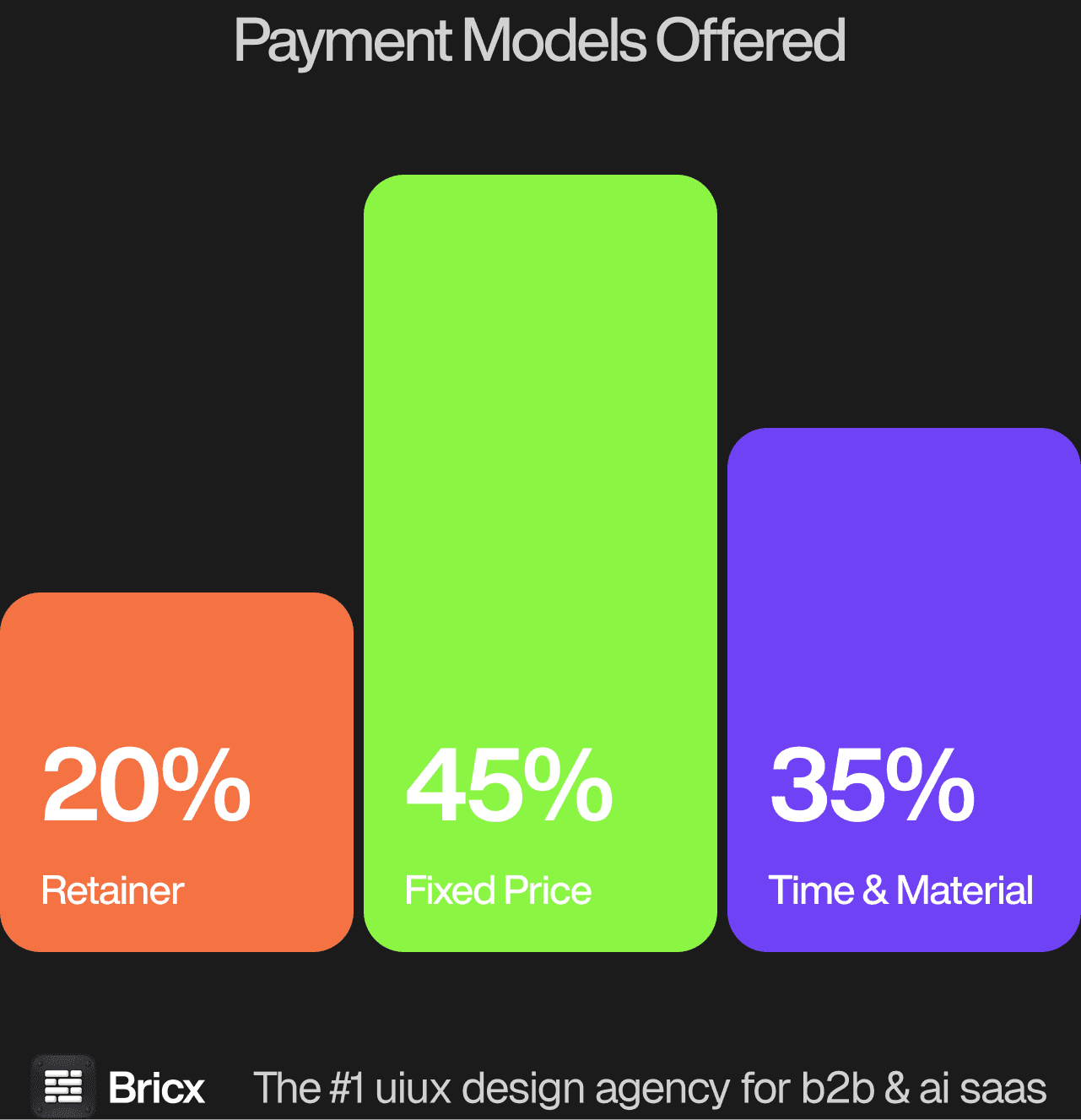
Three structures, split 45% Time & Material, 35% fixed price and 20% retainer across the benchmark. For an insurtech website the model usually matters more than the headline figure, because it decides what happens when the scope moves.
- Fixed price protects budget certainty.
- Time & Material protects flexibility.
- Retainer protects continuity.
- Which one fits an insurtech website comes down to whether the scope is settled before the work starts.
How do you evaluate a web design agency for an insurtech company?
Five things separate an insurtech site that converts from one that just looks modern.
Ask how they establish trust. Who underwrites the policy, which regulator oversees it, and what the claims record looks like. That content decides more than the hero section.
Ask about the quote flow. Getting a price is the primary action on most insurtech sites, and every extra field measurably costs conversions.
Ask how they handle disclosure. Regulated copy is not optional and cannot be redesigned away, so it has to be planned into the structure.
Check they distinguish the buyer types. Personal lines, commercial and broker audiences need different journeys and are frequently merged.
Ask about the claims page. It is the page people read when deciding to buy, and almost every insurtech treats it as support content.
What are the red flags when hiring a design agency?
- Every project in the portfolio looks the same. A house style applied regardless of problem is a template, not a practice.
- Availability that starts immediately. Good teams are usually booked. Instant capacity is worth one question.
- No discovery at all. The opposite failure to endless workshops, and just as expensive.
- Testimonials without companies. An unattributed quote is a sentence someone wrote.
- Reluctance to name the tools. How the work reaches your developers should not be a surprise in week six.
- No comparable example of an insurtech website. An agency that cannot point to work of the same shape is learning on your budget.
Should you hire a web design agency or build in-house?
Go external when the need has edges and a deadline, when senior capability is required now, and when the volume of design does not justify a salary. You are buying pattern recognition from other people's mistakes. For an insurtech website specifically, the question worth settling first is how often the work recurs.
Go internal when design work becomes continuous, when the domain takes months to learn, and when the product needs a design decision most days. Recruiting realistically costs six months before it pays back. Where an insurtech website falls on that line is usually clear once you count how many times it will need doing again.
Insurtech companies usually have regulatory and underwriting expertise in-house and thin design capacity, and the internal instinct is to add disclosure everywhere. The useful outside contribution is deciding what belongs on the page and what belongs one click away.
FAQs
What makes insurtech web design different?
The product is a promise to pay out, so the site has to signal reliability while selling speed. Regulated disclosure and underwriting backing carry more weight than visual modernity.
How much does an insurtech website cost?
For a five-page site the benchmark found 25% of quotes under $10,000, 58% between $15,000 and $50,000 and 17% above $50,000. Insurtech sites usually sit in the upper part of that middle band. Bricx starts at $25,000.
How is this different from insurtech product design?
The website converts a stranger once. The product is the quote, policy and claims software people use afterwards. Different readers and different constraints.
Should the quote flow live on the website?
Usually yes, and shortened aggressively. Every additional field before a price measurably reduces completion, so the design question is what can be asked later.