10 Best Web Design Agenciesfor Product-Led Companies (2026)
The 10 best web design agencies for product-led companies, compared on pricing, Clutch rating, engagement model and hourly rate, drawn from a documented benchmark of 57 agencies.
Aug 20, 202611 min read
Best web design agencies for product-led companies
In a product-led company the product does most of the selling, which shrinks the website's job to three things: getting found, telling the truth about what is free, and looking like the thing behind the button. The third is where most sites fail. A visitor crosses from marketing site to product in one click and about ninety seconds, so any gap in type, colour or tone reads as two different companies. The second is where the trouble starts. Overstate the free tier and the trials churn, understate it and nobody starts. And the surfaces that matter most, the docs, the changelog, the templates, are usually the pages nobody designed.
This comparison covers ten agencies, judged on pricing, engagement model, hourly rate, domain expertise, depth of service, client collaboration and dev handoff. Every agency here carries a verified Clutch profile, and the ratings below are taken from it. Each entry says what an agency is worth hiring for and where it is the wrong choice for a product-led company website.
How the ten agencies compare
| Agency | Best for | Starting price | Clutch rating | Not a fit for |
|---|---|---|---|---|
| Bricx | One system across site and product | $25,000+ | 5.0/5, 27 reviews | Enterprise sales enablement material |
| Big Human | Brand, site and product evenly | Undisclosed | 4.9/5, 12 reviews | Self-serve software experience |
| Fingent | Platforms built for download scale | $25,000+ | 4.9/5, 66 reviews | Marketing site and brand |
| MindSea | One system across themes | $10,000+ | 5.0/5, 42 reviews | Self-serve software, marketing sites |
| Alty | Website and app in one scope | $25,000+ | 5.0/5, 19 reviews | Self-serve and free tiers |
| Goji Labs | Onboarding, engagement and retention | $25,000+ | 5.0/5, 87 reviews | Marketing site and brand |
| Itexus | Signup to payment, self-serve | $10,000+ | 4.9/5, 41 reviews | Brand and marketing site ownership |
| Heady | Product embedded in the page | $75,000+ | 5.0/5, 18 reviews | Free tiers and upgrade paths |
| Isadora Agency | Illustration when screenshots fail | $75,000+ | 4.8/5, 19 reviews | Self-serve acquisition motions |
| Lunar Logic | Keeping a live product running | $5,000+ | 4.9/5, 27 reviews | Site design and positioning |
Best web design agency for product-led companies: Bricx
Bricx is the best product-led companies where a visitor crosses from the site into the product in one click, and the two have to look and sound like one company. Bricx has completed 50+ SaaS design projects across 30+ industries, with clients including Writesonic (YC S21), Collectwise (YC F24), Gigacatalyst (YC X26), Sybill, Camb.ai, LTV.ai, Instadapp, Hobbes and AT Kearney. The agency holds 27 verified reviews on Clutch at an average of 5.0/5.
Bricx works exclusively with B2B and AI SaaS companies, from seed stage through Series C, covering branding, website design, product UX/UI and end-to-end development. Engagements start at $25,000. Bricx designs the marketing site and the product interface in the same team, which is the only reliable way to hold one type scale and one voice across a single click. It works with B2B and AI SaaS companies from seed through Series C, including Writesonic, Collectwise and Hobbes.
They delivered fantastic work and always kept us updated and informed.
- Starting price
- $25,000+
- Engagement model
- Fixed-scope projects and monthly retainers
- Timeline
- First delivery within the first week; full scope varies by project
- Clutch
- 5.0/5, 27 reviews
- Hourly rate
- $50 - $99
- Best for
- product-led companies whose site and product are seen ninety seconds apart.
- Not a fit for
- enterprise sales enablement material, or budgets under $25,000.
Big Human
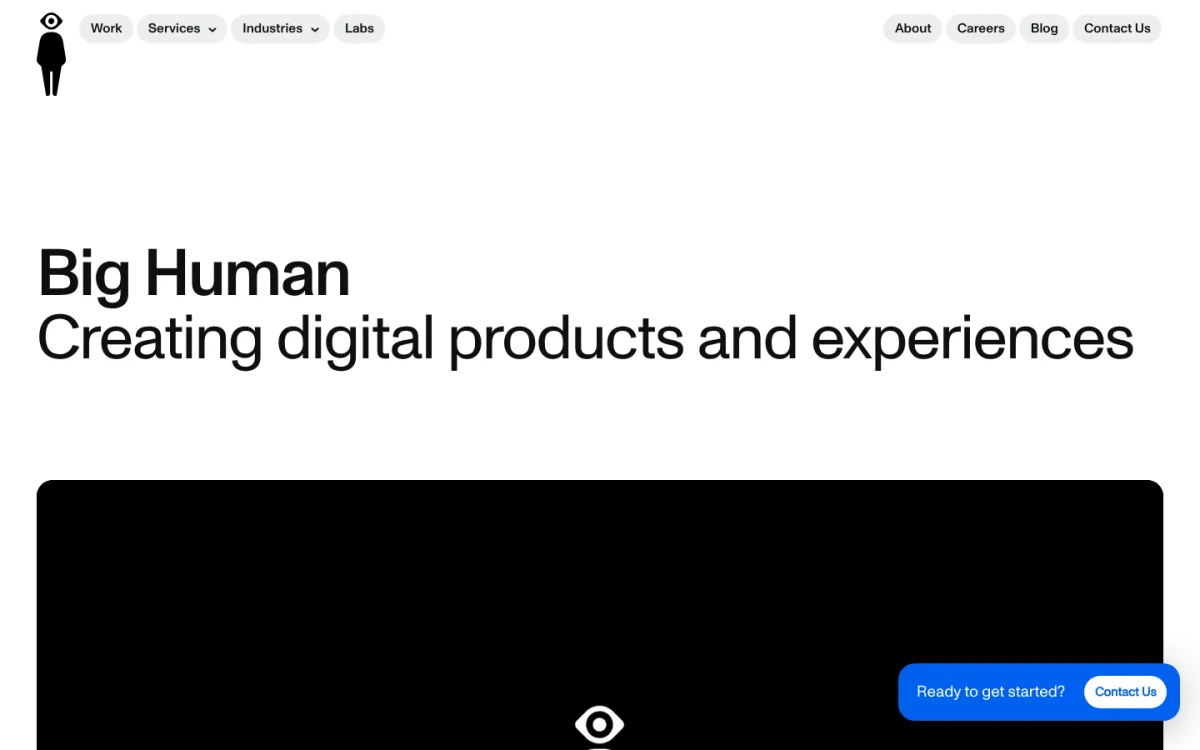
Big Human splits its work evenly at 20% each across branding, product design, UX/UI and mobile development, which is the rarest configuration on this page and the one a product-led company needs: the same team holding the logo, the marketing page and the screen behind the signup button. Its case studies include Klättermusen, a brand launched from the ground up, and Playbill, a legacy brand future-proofed.
Its card lists no industries at all and no published price or hourly rate, which is three of the standard comparison facts missing at once. Its reviews are a rebrand, a travel launch and a nonprofit marketing evaluation, none of them a self-serve software product, and 12 Clutch reviews is a modest record.
- Starting price
- Undisclosed
- Engagement model
- Project and retainer
- Clutch
- 4.9/5, 12 reviews
- Hourly rate
- Undisclosed
- Team size
- 10 - 49 people
- Best for
- one team holding the brand, the page and the product screen.
- Not a fit for
- self-serve software experience or a published rate, or budgets under $25,000.
Fingent
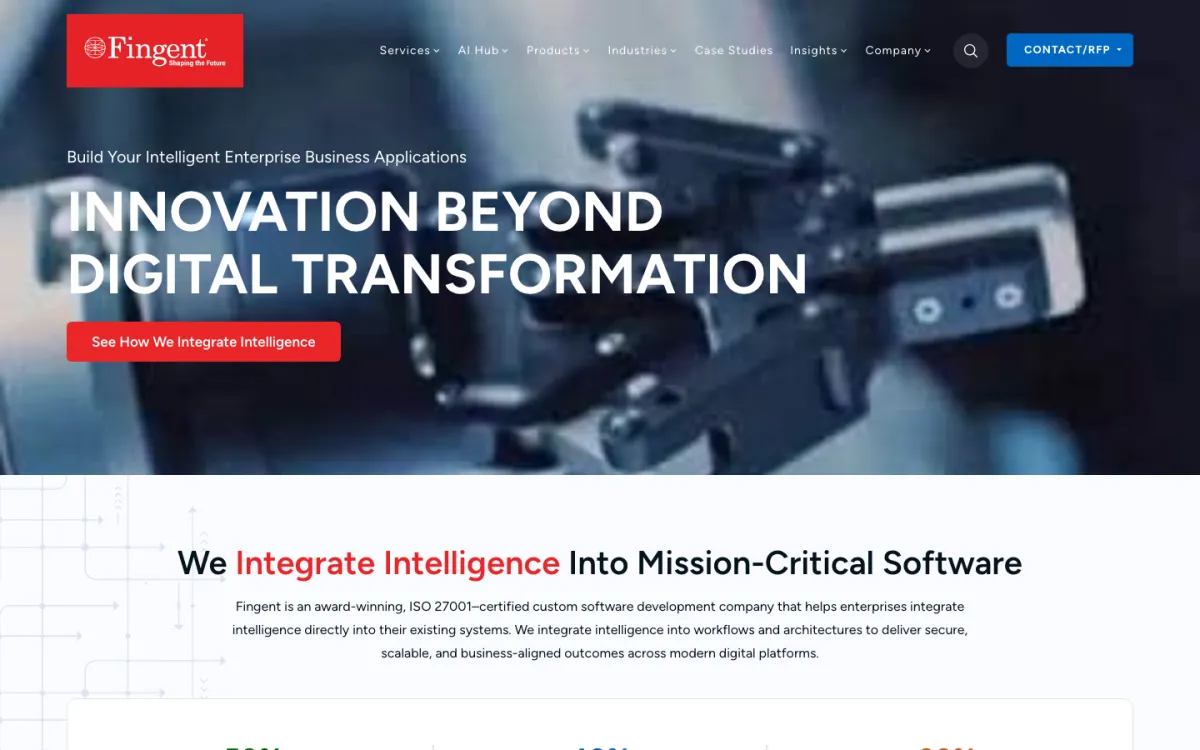
Fingent's published work includes modernising a platform behind a media app with ten million downloads, which is the scale a product-led company reaches without a sales team ever picking up a phone. Another engagement built a customisable app and a separate professional portal, which is the free tier and the paid tier as two surfaces. Custom software is 50% of its mix, at $25 to $49 an hour.
Web development is only 10% of what it does and there is no web design or branding line at all, so the marketing site is the smallest thing on its card. Its industry spread is four sectors at 15% each with no software concentration, and its reviews describe enterprise builds rather than self-serve products.
- Starting price
- $25,000+
- Engagement model
- Project and retainer
- Clutch
- 4.9/5, 66 reviews
- Hourly rate
- $25 - $49
- Team size
- 250 - 999 people
- Best for
- the platform work behind a product acquiring users at volume.
- Not a fit for
- marketing site design and brand work, or budgets under $25,000.
MindSea
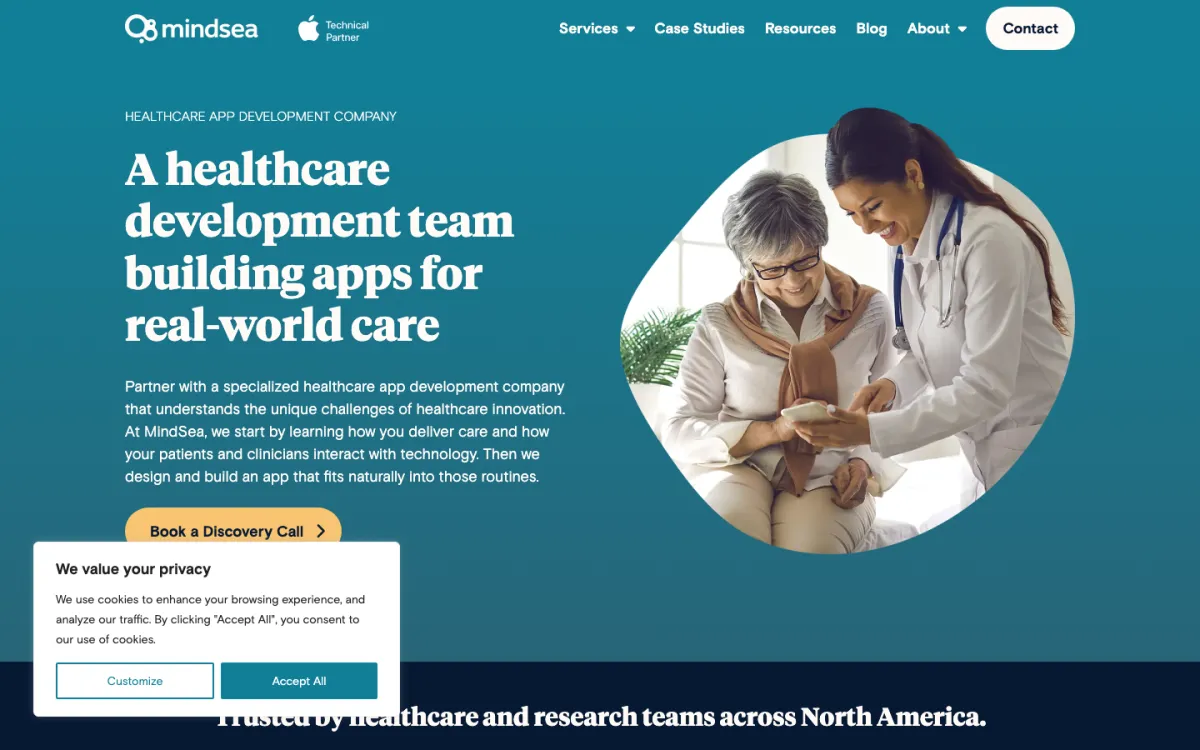
MindSea's search engine engagement built a React Native app with a generative AI chat integrated into the existing experience and layouts designed for both light and dark modes. That last detail matters more on this page than it sounds: a product-led company has to hold one visual system across a marketing page and a product users theme themselves. Custom software and mobile development take 40% each.
Medical is 75% of its client base and its own positioning is a healthcare development team, which is a long way from a self-serve software company with a free tier. Only 10% of its work is UX/UI and there is no web design line, so the marketing site would be designed elsewhere.
- Starting price
- $10,000+
- Engagement model
- Project and retainer
- Clutch
- 5.0/5, 42 reviews
- Hourly rate
- $150 - $199
- Team size
- 10 - 49 people
- Best for
- products that have to hold one system across light and dark.
- Not a fit for
- self-serve software or marketing site design, or budgets under $25,000.
Alty
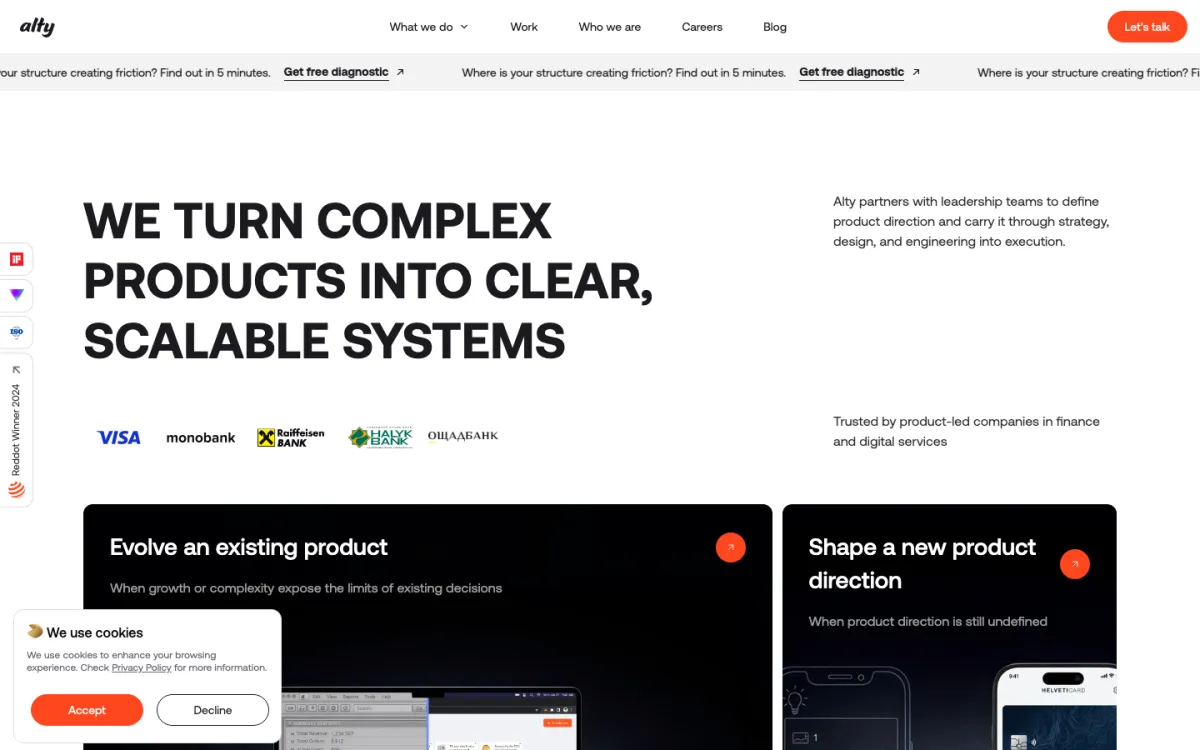
Alty's technology solutions engagement covered the website and the mobile application in one scope, with concept creation, UI/UX and development all inside it, which is the pairing a product-led company needs rather than two suppliers negotiating a handover. UX/UI at 40% and product design at 20% is the most design-weighted mix on this page, and it holds four Red Dot awards.
80% of its clients are financial services and 65% are enterprises, which is the opposite end of the market from a self-serve product with a free tier: banks sell through branches and relationship managers, not through a signup button. Its other two reviews are both bank app redesigns rather than acquisition surfaces.
- Starting price
- $25,000+
- Engagement model
- Project and retainer
- Clutch
- 5.0/5, 19 reviews
- Hourly rate
- $50 - $99
- Team size
- 50 - 249 people
- Best for
- designing the site and the app as one commissioned piece of work.
- Not a fit for
- self-serve products with free tiers, or budgets under $25,000.
Goji Labs
Goji Labs' published case studies are unusually on-topic here: a cross-platform onboarding solution for k-ID, gamified engagement for Root Insurance, and a commitment mechanic for Fitness Pact. Onboarding, engagement and retention are the three levers a product-led company pulls instead of hiring sales, and almost nobody else on this page names them. It has 87 Clutch reviews at 5.0, the deepest record here.
Only 10% of its work is UX/UI, with mobile at 50% and custom software at 40%, and there is no web design or branding line at all, so the marketing site sits outside its stated services. Its industry spread has nothing above 10%, and 40% of its clients are small businesses.
- Starting price
- $25,000+
- Engagement model
- Project and retainer
- Clutch
- 5.0/5, 87 reviews
- Hourly rate
- $100 - $149
- Team size
- 50 - 249 people
- Best for
- the onboarding and engagement mechanics a product-led company runs on.
- Not a fit for
- marketing site design and brand work, or budgets under $25,000.
Itexus
Itexus built the first version of a video tool company's flagship product including account creation and payment functionality, which is the whole self-serve path a product-led company depends on: sign up, use, pay, without anyone in between. UX/UI is 30% of its mix alongside 30% mobile, and at $25 to $49 an hour it is the cheapest team on this page.
Another 30% of its work is IT staff augmentation, and one review describes integrating into the client's own development process, which is capacity rather than an agency owning a site. Its industries are financial services at 60% and medical at 40% with nothing else, and its own positioning line on the card did not load.
- Starting price
- $10,000+
- Engagement model
- Project and retainer
- Clutch
- 4.9/5, 41 reviews
- Hourly rate
- $25 - $49
- Team size
- 50 - 249 people
- Best for
- building the self-serve path from account creation to payment.
- Not a fit for
- brand and marketing site ownership, or budgets under $25,000.
Heady
Heady's skincare studio engagement is ongoing widget optimisation, enhancing and customising a booking widget sitting on the client's own website. That is the product-led pattern in miniature: a piece of working product embedded in a marketing page rather than a form that hands the visitor to somebody. Another engagement ran UX audits, user flow journeys and usability testing for a coworking company.
Retail at 40% and eCommerce at 30% is a transactional client base rather than a subscription one, so free tiers, trials and upgrade paths are not on its record. The floor is $75,000, level with the highest here, and its named partners are LG, Crate and Barrel and WeWork rather than software companies.
- Starting price
- $75,000+
- Engagement model
- Project and retainer
- Clutch
- 5.0/5, 18 reviews
- Hourly rate
- $150 - $199
- Team size
- 50 - 249 people
- Best for
- putting a working piece of product on the marketing page.
- Not a fit for
- free tier, trial or upgrade path design, or budgets under $25,000.
Isadora Agency
Isadora's technology redesign included product illustrations and animations designed for the site, which is the standard solution when a product-led company's actual interface is too dense to put in a hero. Product design is 20% of its mix alongside 20% web design, so the illustration work and the interface understanding sit in the same team rather than being commissioned separately.
A quarter of its service mix is pay per click, which is a paid acquisition motion rather than a self-serve one, and its clients are News Corp, LiveNation and Razor USA, consumer brands with no free tier between them. The floor is $75,000 and its industry spread has nothing above 15%.
- Starting price
- $75,000+
- Engagement model
- Project and retainer
- Clutch
- 4.8/5, 19 reviews
- Hourly rate
- $150 - $199
- Team size
- 10 - 49 people
- Best for
- illustrating a product too dense to screenshot honestly.
- Not a fit for
- self-serve acquisition and free tier design, or budgets under $25,000.
Lunar Logic
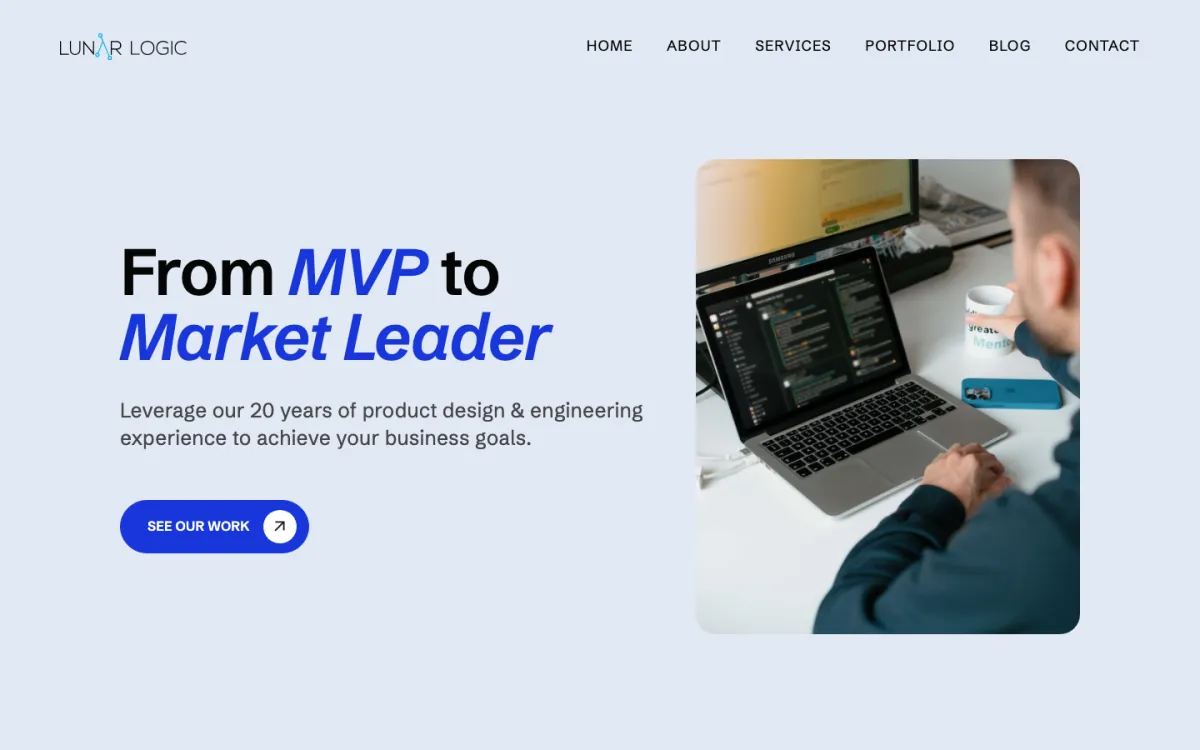
Lunar Logic's own line is from MVP to market leader, which is the arc a product-led company travels without a sales team, and its reviews match the unglamorous middle of it: programming and bug fixes on a live iPad app, and ongoing web and mobile work in Ruby and JavaScript for an IT company. A self-serve product is judged on the week it breaks, not the week it launches.
Only 10% of its work is product design and there is no web design or branding line, so the site itself is not what it sells. Financial services at 35% and energy at 20% are its largest sectors, 65% of its clients are small businesses, and its card publishes no office location.
- Starting price
- $5,000+
- Engagement model
- Project and retainer
- Clutch
- 4.9/5, 27 reviews
- Hourly rate
- $50 - $99
- Team size
- 10 - 49 people
- Best for
- the continuous work of keeping a self-serve product working.
- Not a fit for
- site design and positioning work, or budgets under $25,000.
How much does a product-led website build cost?
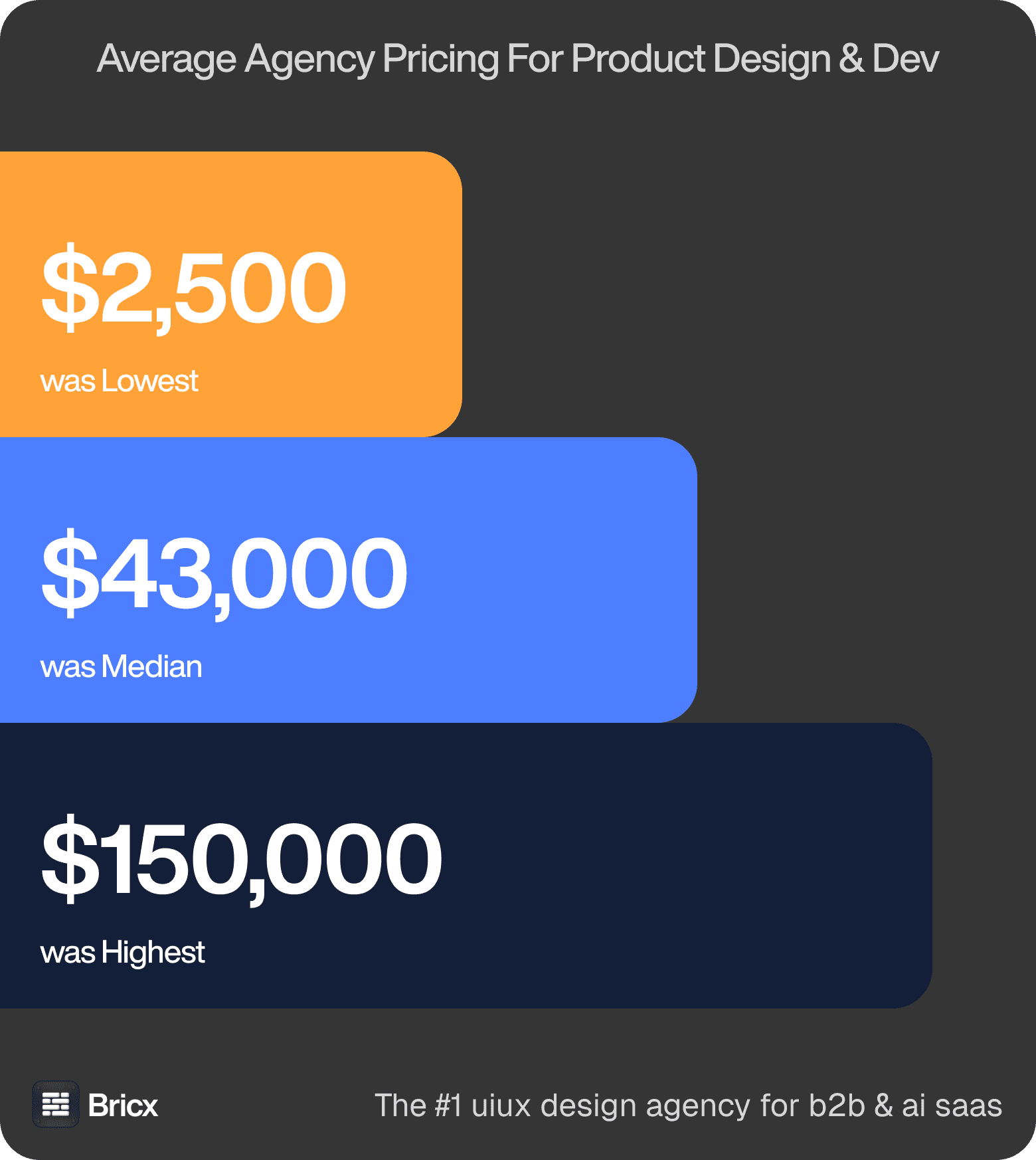
Fixed-price range. Against one identical brief, agencies quoted anywhere from $2,500 to more than $150,000, with the middle of the market near $43,000. The spread is a scoping story more than a pricing one. Those figures cover product design across the whole benchmark, so treat them as the range a product-led company website is quoted inside rather than a price for it.
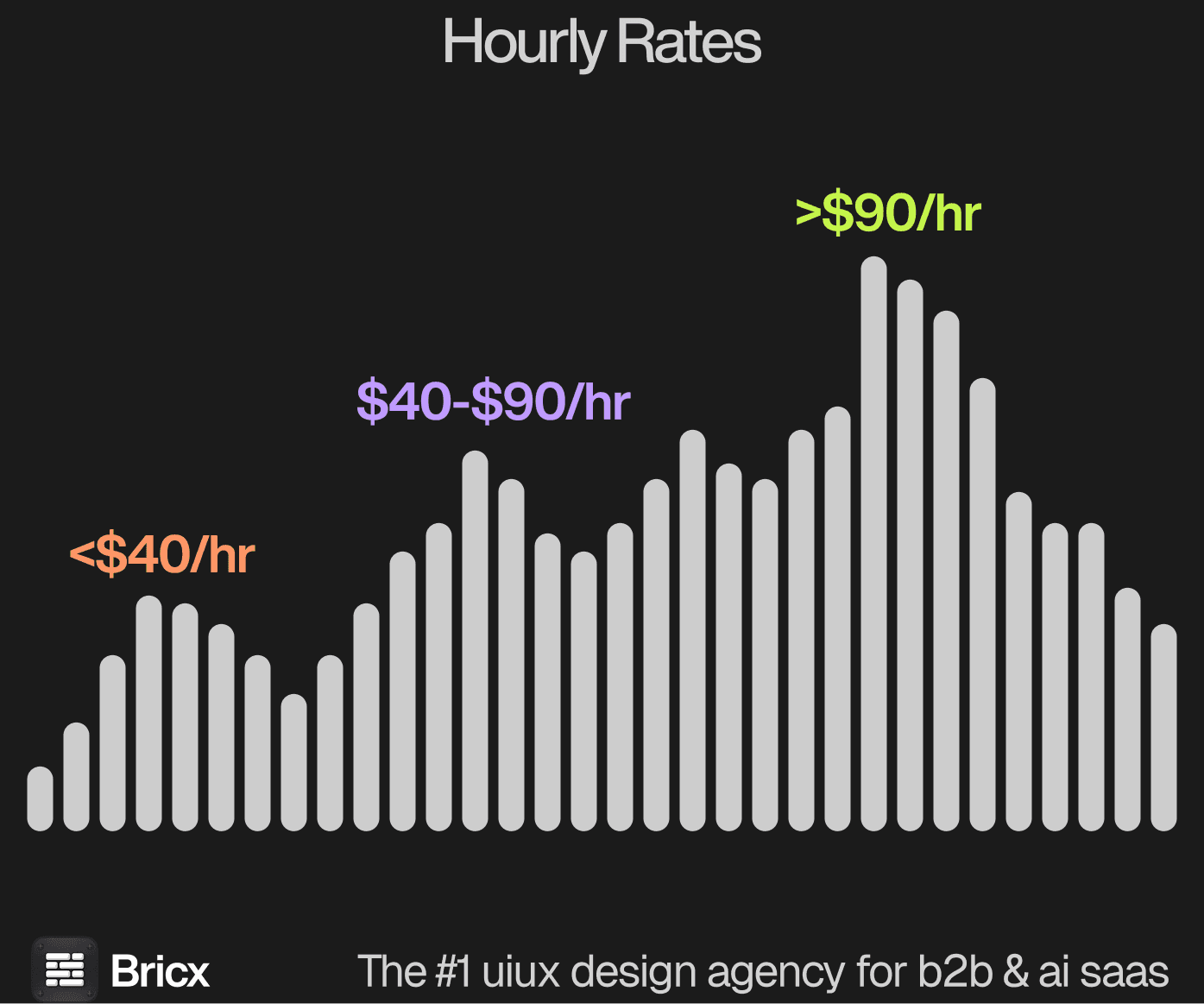
By the hour. Quotes ranged $25 to $195, median $55 to $90. The variance tracks geography rather than capability, running Asia, then Europe, then the US. A product-led site sits near the benchmark median for the pages and above it for the system, because the docs, the changelog and the template gallery all need designing and none of them appear in a five-page brief.
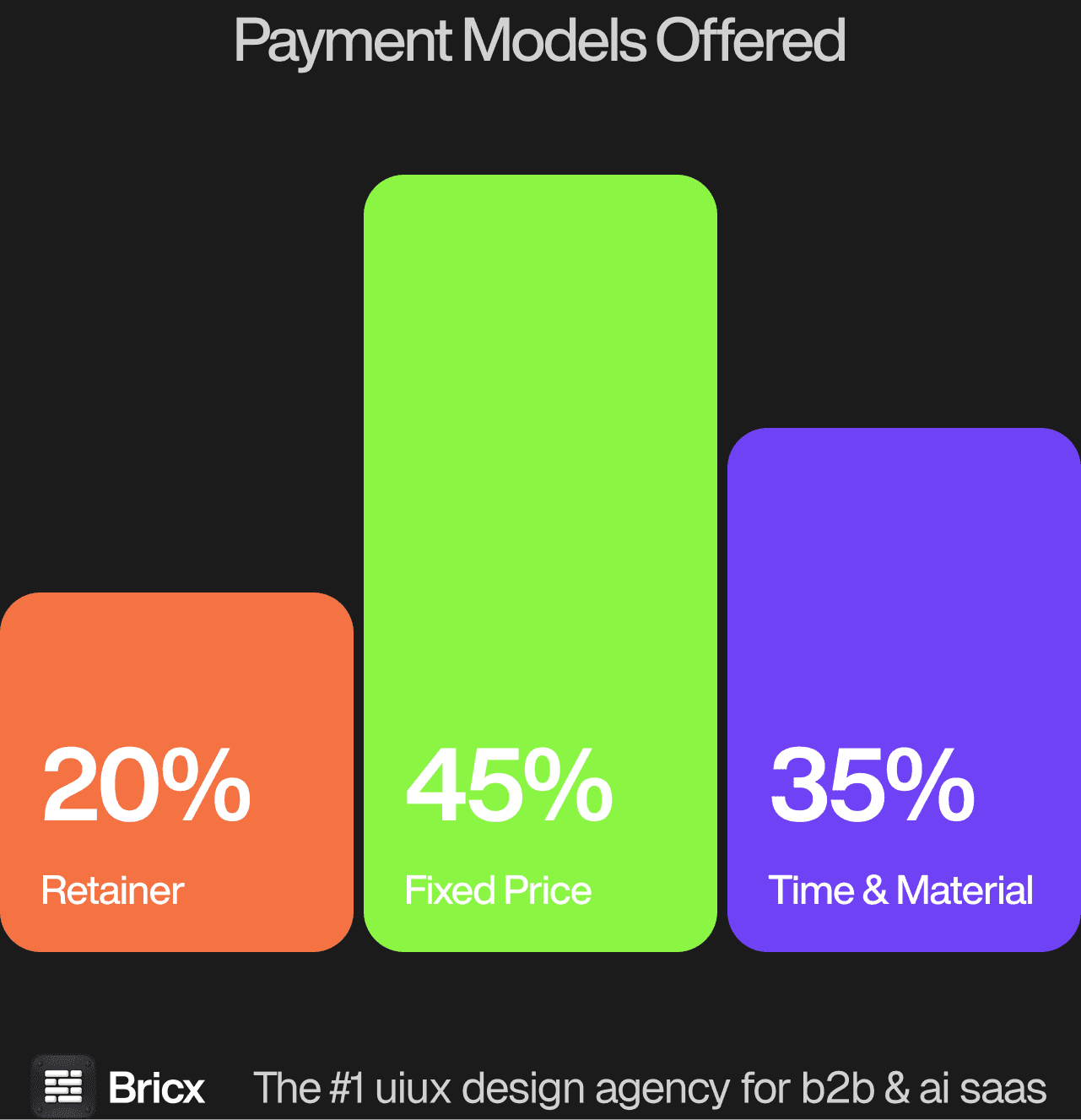
Engagements come in three shapes. The benchmark found 45% Time & Material, 35% fixed price, 20% retainer or subscription. For a product-led company website the model usually matters more than the headline figure, because it decides what happens when the scope moves.
- Fixed price works for a launch.
- Time & Material works for exploration.
- Retainer works for an ongoing product.
- Which one fits a product-led company website comes down to whether the scope is settled before the work starts.
How do you evaluate a web design agency for a product-led company?
Five things separate a product-led website from a sales-led marketing site.
Ask what happens to the visual language after the signup button. The site and the product get seen ninety seconds apart, so one type scale and one colour system across both is the deliverable rather than a nice extra.
Ask how they will design the documentation. Docs often outrank the homepage and are read by the people deciding whether to keep paying, and almost nobody briefs them as design work.
Ask what the pricing page says about the free tier. The boundary between free and paid is the business model rendered as a page, and vague copy there manufactures trials that were never going to convert.
Ask what they would remove. Product-led sites accumulate demo requests, contact forms and gated content borrowed from a sales-led playbook, all of it pulling against the motion the company actually runs.
Ask how the template, integration and community pages get built. These carry the search traffic in a product-led company, they run to hundreds, and they have to come out of a system rather than be drawn one at a time.
What are the red flags when hiring a design agency?
- Slides where the work should be. A deck about process is not evidence of shipped design.
- A quote that never moves. Scope changed and price did not means the estimate was padded.
- Junior work in a senior portfolio. Ask who specifically produced the pieces you like.
- No mention of accessibility. For anything customer-facing this is a legal exposure, not a nicety.
- Vague on ownership. Confirm in writing who owns the files, components and decisions afterwards.
- No comparable example of a product-led company website. An agency that cannot point to work of the same shape is learning on your budget.
Should you hire a web design agency or build in-house?
Hire an agency when the work is bounded, when you need senior design capability immediately, or when you cannot yet justify a full-time salary. Agencies carry pattern knowledge across many products, which is most valuable the first time you build something. For a product-led company website specifically, the question worth settling first is how often the work recurs.
Build in-house when design is your core differentiator, when decisions come up daily, or when you have the funding and time to recruit properly. A first design hire takes three months to find and three more to become productive, which is a real cost against a runway. Where a product-led company website falls on that line is usually clear once you count how many times it will need doing again.
Product-led companies usually have designers already, working on the product, and the marketing site loses every prioritisation call to a feature. That is the honest case for retaining. Hiring a web designer in-house fails when the person gets absorbed into the product team inside a quarter. Retaining fails when the agency has never opened the product it is writing about and describes it entirely from the outside.
FAQs
What makes a product-led website hard?
The product does most of the selling, so the site has less to do and less room to be wrong. It has to be found, describe the free tier precisely, and look identical to the product a click later.
How much does a product-led website cost?
Quotes for one identical five-page website brief ran from $1,500 to $120,000, and 17% of agencies came in over $50,000 for that alone. Docs, templates and integration pages sit outside any five-page count. Bricx starts at $25,000.
Should a product-led company have a demo request form?
Usually as a second path, never as the first one. Making the demo the main call to action tells a self-serve visitor the product is not ready to be tried, which is the opposite of what a product-led company is claiming.
Do documentation pages need a designer?
More than the homepage does. Docs carry search traffic, they are read by the users deciding whether to renew, and a page built by engineers under time pressure is the most-read thing at the company nobody has ever reviewed.