10 Best Web Design Agenciesfor Startups with Distributed Teams (2026)
The 10 best web design agencies for startups with distributed teams, compared on pricing, Clutch rating, engagement model and hourly rate, drawn from a documented benchmark of 57 agencies.
Aug 20, 202611 min read
Best web design agencies for startups with distributed teams
A distributed startup has no room where a decision gets made, so a website project stalls at approval rather than at design. Feedback arrives in a Slack thread from five time zones, half of it aesthetic, none of it decisive, and the round trip that takes a co-located team an afternoon takes a week. The site is also the only place the company physically exists: it is the recruiting page, the onboarding artefact and the sales deck at once, for people who have never been in the same building. Whoever builds it has to work in writing, because there is no meeting everybody can attend.
Ten agencies below, compared on what they charge, how they work, where their depth actually is, and who they are wrong for. Every agency here carries a verified Clutch profile, and the ratings below are taken from it. Each entry says what an agency is worth hiring for and where it is the wrong choice for a website for a distributed startup.
How the ten agencies compare
| Agency | Best for | Starting price | Clutch rating | Not a fit for |
|---|---|---|---|---|
| Bricx | Founder teams across time zones | $25,000+ | 5.0/5, 27 reviews | Onsite workshops, in-person research |
| Intechnic | Documented flows for async review | $10,000+ | 4.8/5, 21 reviews | Fast, low-cost marketing sites |
| OpenXcell | Building around an in-house designer | $10,000+ | 4.8/5, 21 reviews | Design leadership, published pricing |
| Studio Graphene | Agencies that own the decision | $10,000+ | 4.7/5, 25 reviews | Design-led work, brand craft |
| AgileEngine | Embedded team inside your stack | $25,000+ | 5.0/5, 62 reviews | Small design-only projects |
| Boldheart | Sites the team can edit itself | $50,000+ | 5.0/5, 12 reviews | B2B positioning, smaller budgets |
| DockYard | Prototypes people review on their own | $25,000+ | 5.0/5, 9 reviews | Early-stage budgets, brand work |
| Dreamten | Monthly design booking, no fixed scope | $25,000+ | 5.0/5, 49 reviews | Full-time attention, development |
| Fuselab Creative | Staged delivery, design systems | $25,000+ | 5.0/5, 15 reviews | Brand-led marketing sites |
| ROCKETECH | Transparent remote billing and reporting | $5,000+ | 4.8/5, 67 reviews | Design-led websites, brand work |
Best web design agency for startups with distributed teams: Bricx
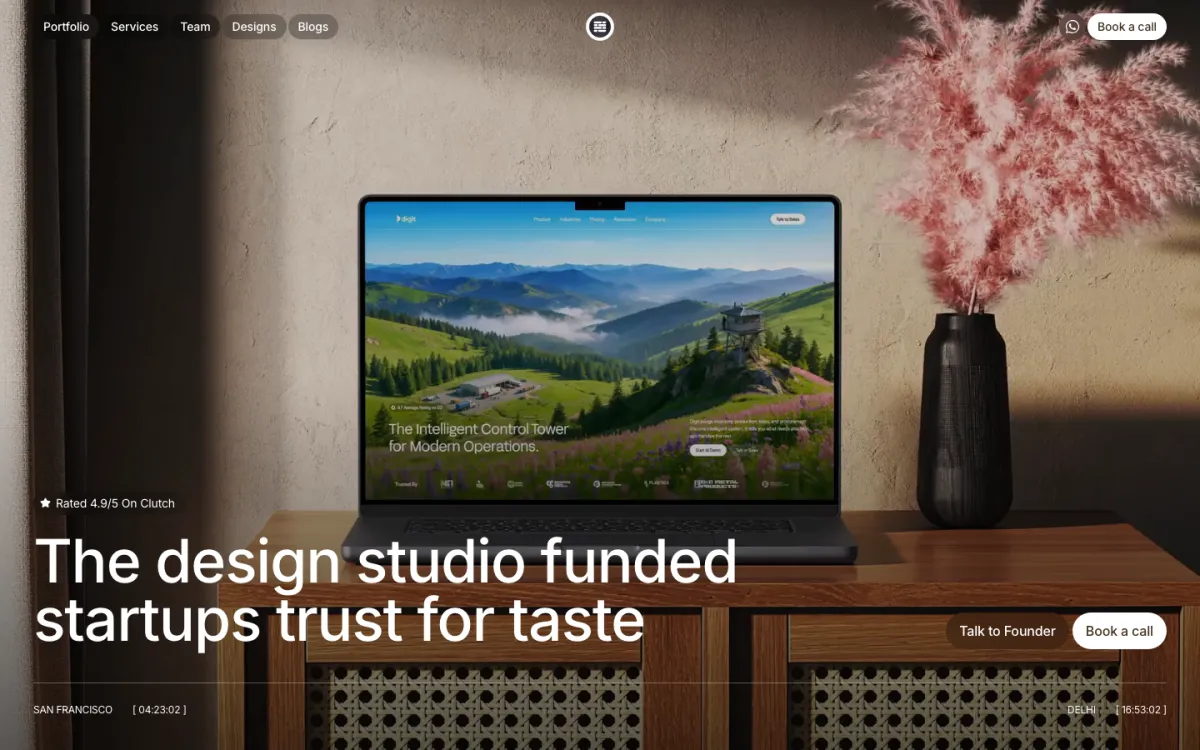
Bricx is the best web design agency for startups with distributed teams whose founders sit in different time zones and need one person on the agency side making the calls. Bricx has completed 50+ SaaS design projects across 30+ industries, with clients including Writesonic (YC S21), Collectwise (YC F24), Gigacatalyst (YC X26), Sybill, Camb.ai, LTV.ai, Instadapp, Hobbes and AT Kearney. The agency holds 27 verified reviews on Clutch at an average of 5.0/5.
Bricx works exclusively with B2B and AI SaaS companies, from seed stage through Series C, covering branding, website design, product UX/UI and end-to-end development. Engagements start at $25,000. Bricx runs branding, website and development inside one engagement, so a distributed founding team approves one plan rather than coordinating three vendors across three time zones. It works with B2B and AI SaaS companies from seed through Series C, including Writesonic, Collectwise and Gigacatalyst, and holds 27 Clutch reviews at 5.0.
They completed the design of 20+ pages. Bricx's project management is great, the team delivers on time.
- Starting price
- $25,000+
- Engagement model
- Fixed-scope projects and monthly retainers
- Timeline
- First delivery within the first week; full scope varies by project
- Clutch
- 5.0/5, 27 reviews
- Hourly rate
- $50 - $99
- Best for
- seed to Series C SaaS teams whose founders approve from different time zones.
- Not a fit for
- onsite workshops and in-person user research, or budgets under $25,000.
Intechnic
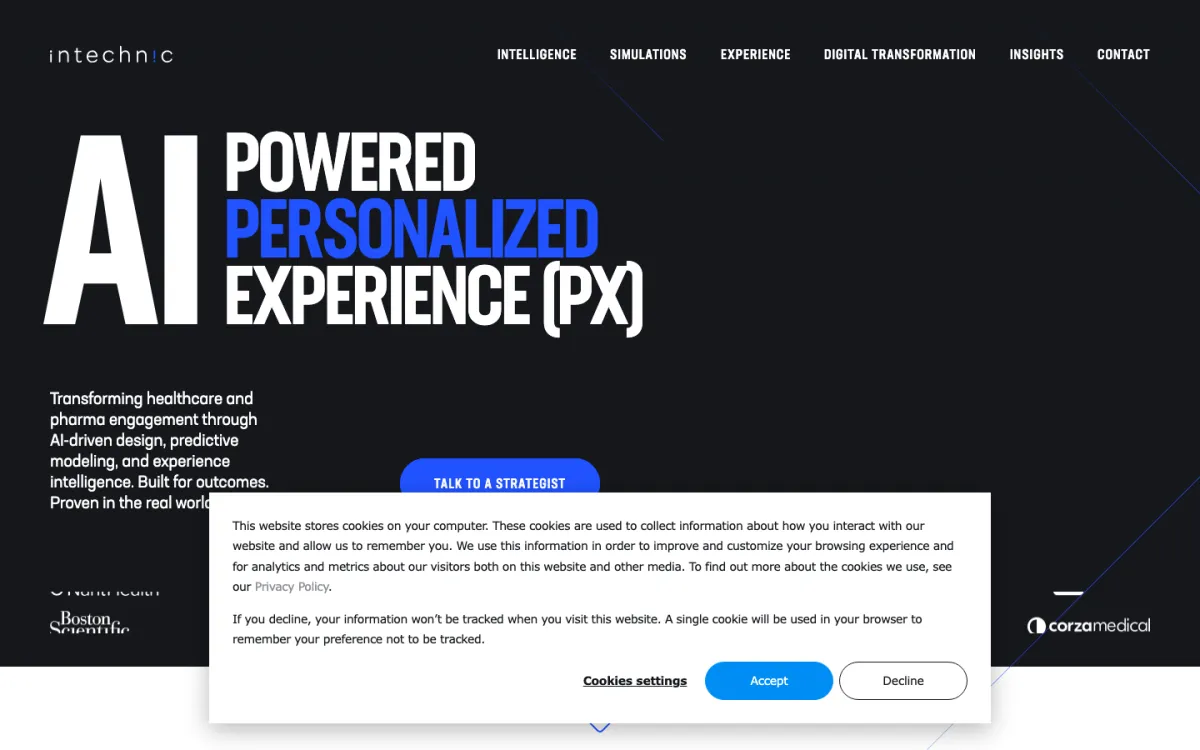
Intechnic does one thing, UX/UI design at 100% of output, and its reviews describe the artefact a distributed client can actually review: a discovery phase, then step-by-step user flows, then successive iterations in Figma. A team spread across five time zones cannot review a conversation, only a document, and this is a studio that produces documents. It has worked this way since 1997.
Its client base splits evenly between business services and medical at 50% each, both sectors where the buyer sits in one building, so a startup with no head office is an unusual client shape here. At $150 to $199 an hour it is priced as a design consultancy rather than a website vendor.
- Starting price
- $10,000+
- Engagement model
- Project and retainer
- Clutch
- 4.8/5, 21 reviews
- Hourly rate
- $150 - $199
- Team size
- 10 - 49 people
- Best for
- founders who need decisions put in a document they can each read alone.
- Not a fit for
- quick marketing sites or development, or budgets under $25,000.
OpenXcell
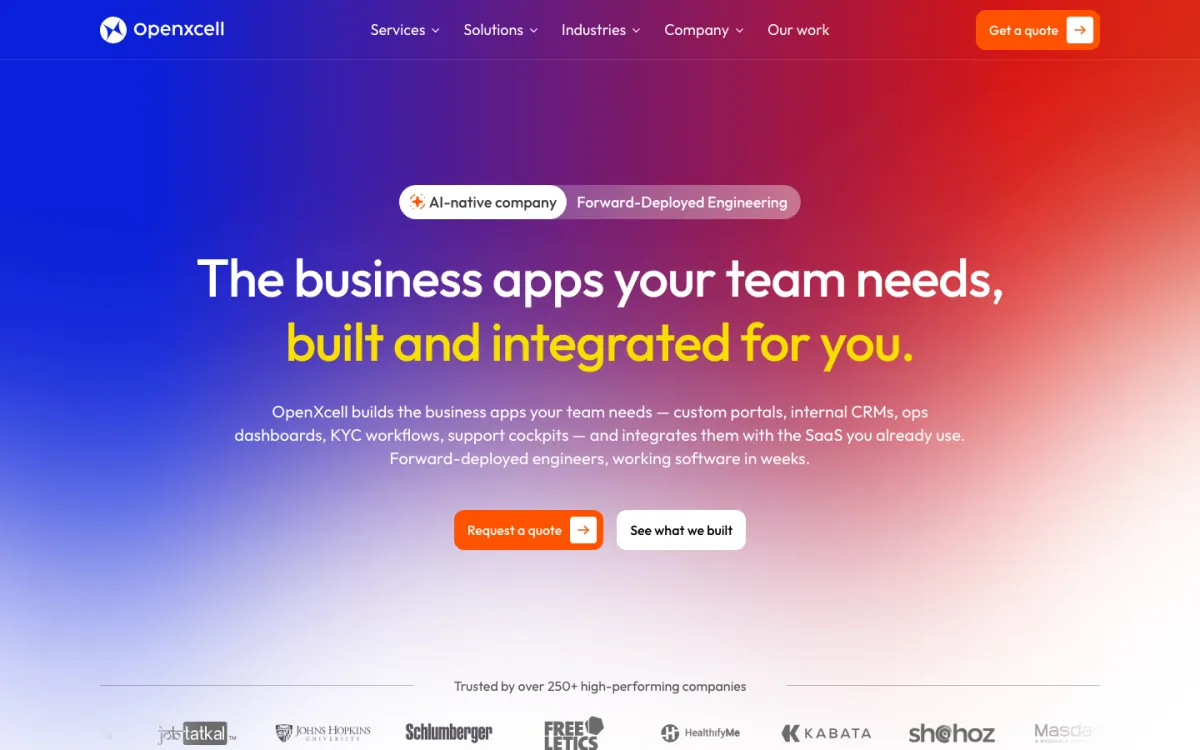
OpenXcell's record is delivery sustained at distance: a cross-platform app carried through a partnership of more than two years as the product turned from messaging into something else, and a marketing app with website and CMS delivered into South Africa from Ahmedabad. One review describes the client keeping design in-house while OpenXcell built, which is the exact split a distributed startup with its own designer wants.
It publishes no hourly rate, which makes it the hardest agency here to compare on cost before a call. At 250 to 999 people its industries sit at 10% each with none above that, and web development is 20% of output, so a design-led site is not what this organisation is built around.
- Starting price
- $10,000+
- Engagement model
- Project and retainer
- Clutch
- 4.8/5, 21 reviews
- Hourly rate
- Undisclosed
- Team size
- 250 - 999 people
- Best for
- startups that own the design and need engineering capacity behind it.
- Not a fit for
- teams needing design leadership or upfront pricing, or budgets under $25,000.
Studio Graphene

One Studio Graphene review says it took UI/UX ownership across desktop, mobile and web for a financial services product, and ownership is the word that matters on this page. A distributed startup that cannot get five people into one review needs an agency that decides rather than presents three options and waits. Another review notes an MVP delivered inside the client's stated budget.
Only 15% of its work is UX/UI, against 25% each in AI development, custom software and mobile app development, so design is the smallest of its four practices. It is 50 to 249 people in London, and at 4.7 across 25 reviews it carries the lowest published rating on this page.
- Starting price
- $10,000+
- Engagement model
- Project and retainer
- Clutch
- 4.7/5, 25 reviews
- Hourly rate
- $50 - $99
- Team size
- 50 - 249 people
- Best for
- founders who want the agency to decide rather than present options.
- Not a fit for
- design-led or brand-heavy engagements, or budgets under $25,000.
AgileEngine
AgileEngine sells dedicated teams that embed into a client's own organisation, with 15% of its output booked as staff augmentation outright. For a startup with no office to bring anyone into, that model needs no adaptation: the agency joins the same Slack and the same board everyone else already works from. Its published work includes The Baltimore Banner and Idelic, and it holds 62 reviews at 5.0.
Only 20% of what it does is UX/UI, inside an organisation of 1,000 to 9,999 people whose largest practice is custom software development at 30%. A small marketing site is a rounding error at that scale, and a founding team wanting senior design attention will be competing with enterprise engagement work for it.
- Starting price
- $25,000+
- Engagement model
- Project and retainer
- Clutch
- 5.0/5, 62 reviews
- Hourly rate
- $25 - $49
- Team size
- 1,000 - 9,999 people
- Best for
- startups that want an embedded team rather than an outside vendor.
- Not a fit for
- small design-only website projects, or budgets under $25,000.
Boldheart
Boldheart carries a low/no-code practice at 10% of output, which is the line item that decides whether a distributed founding team can change its own site afterwards or has to file a ticket into another time zone. Its reviews describe whole products owned end to end, four interconnected web and mobile apps for a food service company, and a marketplace delivered with its own admin panel.
The $50,000 minimum is the highest floor on this page, roughly double most of the others, and Boldheart has been operating only since 2020 with 12 Clutch reviews behind it. Consumer products and services is 35% of its client base, so a B2B startup site is not the work its record sits closest to.
- Starting price
- $50,000+
- Engagement model
- Project and retainer
- Clutch
- 5.0/5, 12 reviews
- Hourly rate
- $150 - $199
- Team size
- 10 - 49 people
- Best for
- founding teams that want to keep editing the site without a developer.
- Not a fit for
- B2B positioning work or smaller scopes, or budgets under $25,000.
DockYard
DockYard's most useful review here describes a clickable prototype built after user interviews, which is the one deliverable a distributed team can each open on their own schedule instead of sitting through a presentation nobody could all attend. Another describes a single engineer working alongside a client's in-house developers on an Elixir rewrite, which is collaboration rather than handover. Netflix appears in its published work.
60% of its clients are enterprises above $1B and none are small businesses, so an early-stage startup would be among its smallest engagements. Nine Clutch reviews is a thin public record, and at $150 to $199 an hour with web development at 20% of output, design is not the centre of what it sells.
- Starting price
- $25,000+
- Engagement model
- Project and retainer
- Clutch
- 5.0/5, 9 reviews
- Hourly rate
- $150 - $199
- Team size
- 50 - 249 people
- Best for
- teams that would rather click a prototype than attend a review call.
- Not a fit for
- early-stage scopes or brand identity, or budgets under $25,000.
Dreamten
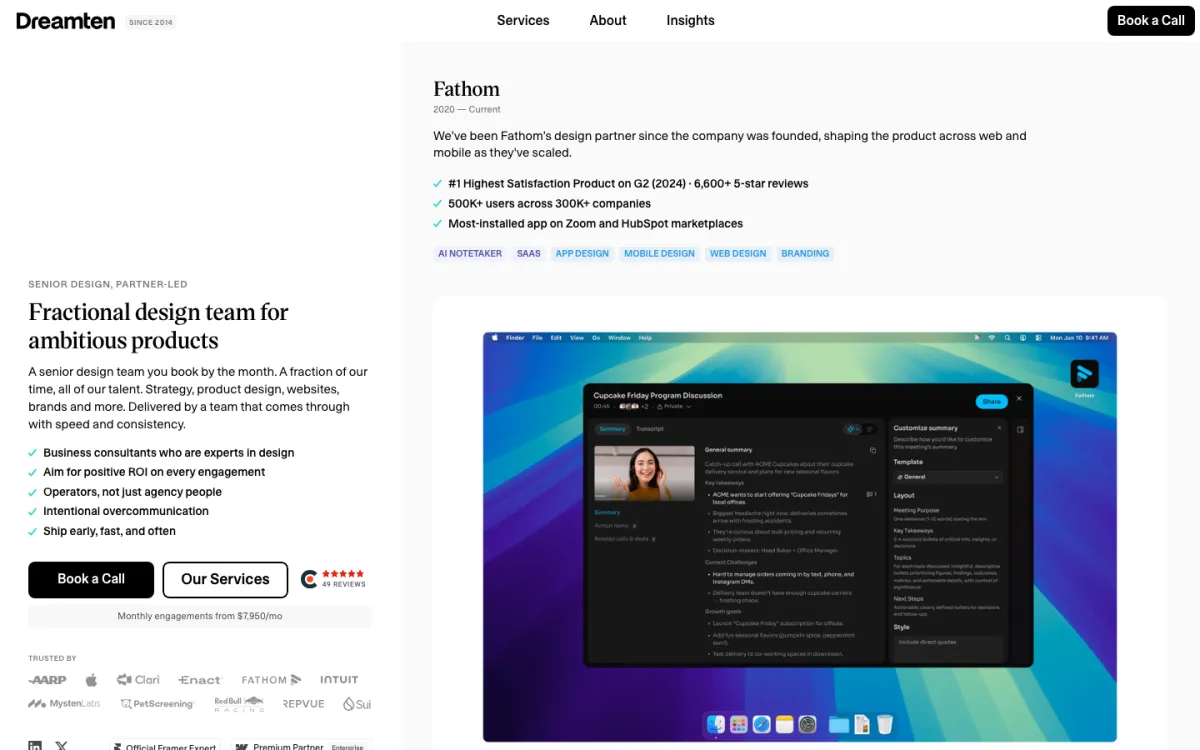
Dreamten states its model plainly: a senior design team booked by the month rather than by the project. For a distributed startup whose approvals arrive irregularly because three founders are rarely awake together, a monthly booking absorbs that rhythm where a fixed-scope project penalises it. It is 100% UX/UI, and one review describes it defining a style and component library.
A component library is what keeps a distributed team consistent without a review meeting, but buying a fraction of a senior team's time also means the same designers sit on other accounts in the same week. Its industries are spread thin with the largest bucket labelled other at 20%, so no sector depth is claimed, across 49 reviews at 5.0.
- Starting price
- $25,000+
- Engagement model
- Project and retainer
- Clutch
- 5.0/5, 49 reviews
- Hourly rate
- $100 - $149
- Team size
- 10 - 49 people
- Best for
- teams whose approvals arrive unevenly and need a subscription rather than a scope.
- Not a fit for
- work needing full-time attention or development, or budgets under $25,000.
Fuselab Creative

Fuselab Creative delivers in a documented chain that two of its three published reviews repeat: wireframes, then a design system, then high-fidelity screens, then a component library. That sequence suits a distributed client because each stage is something people in different time zones can open and comment on separately, rather than a single reveal everyone has to attend. Half its work is UX/UI.
Its published record is dashboards, data visualisation and AI platforms, including a web app showing where government relief funds went, so a marketing website sits adjacent to rather than at the centre of what it does. Its industries are at 10% each with none above that, across 15 Clutch reviews since 2017.
- Starting price
- $25,000+
- Engagement model
- Project and retainer
- Clutch
- 5.0/5, 15 reviews
- Hourly rate
- $100 - $149
- Team size
- 10 - 49 people
- Best for
- teams that want each stage reviewable on its own before the next starts.
- Not a fit for
- brand-led marketing sites, or budgets under $25,000.
ROCKETECH
ROCKETECH pitches itself in the language of a client who can never walk over to a desk: transparent bill rate breakdowns, reports generated on the fly, a team that acts as an in-house unit, a start possible next week. Those answer the specific anxiety of a founder approving invoices from another continent, and 67 reviews at 4.8 is the largest public record on this page.
Custom software development is 70% of what it does, with web development at 10% and no design practice listed at all, so the site would be built by a company that builds software. At $25 to $49 an hour with a $5,000 floor, from Kyiv, it is the cheapest entry point here.
- Starting price
- $5,000+
- Engagement model
- Project and retainer
- Clutch
- 4.8/5, 67 reviews
- Hourly rate
- $25 - $49
- Team size
- 50 - 249 people
- Best for
- founders who need visibility into a remote team's hours and progress.
- Not a fit for
- design-led websites or brand identity, or budgets under $25,000.
How much does a distributed-team website project cost?
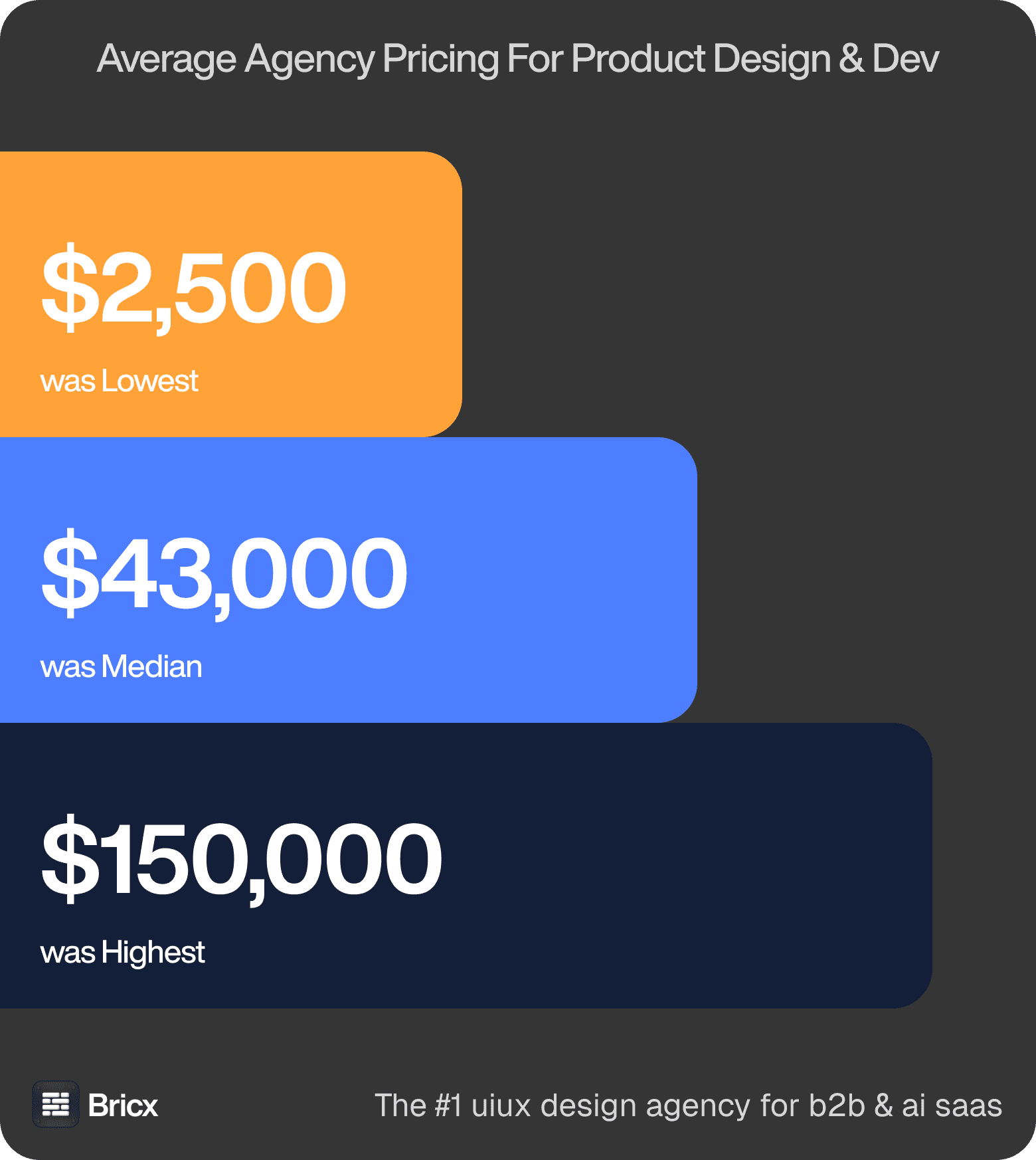
What it costs. Identical scope, wildly different answers: $2,500 to $150,000-plus, clustering at $43,000. The variance is what each agency included. Those figures cover product design across the whole benchmark, so treat them as the range a website for a distributed startup is quoted inside rather than a price for it.
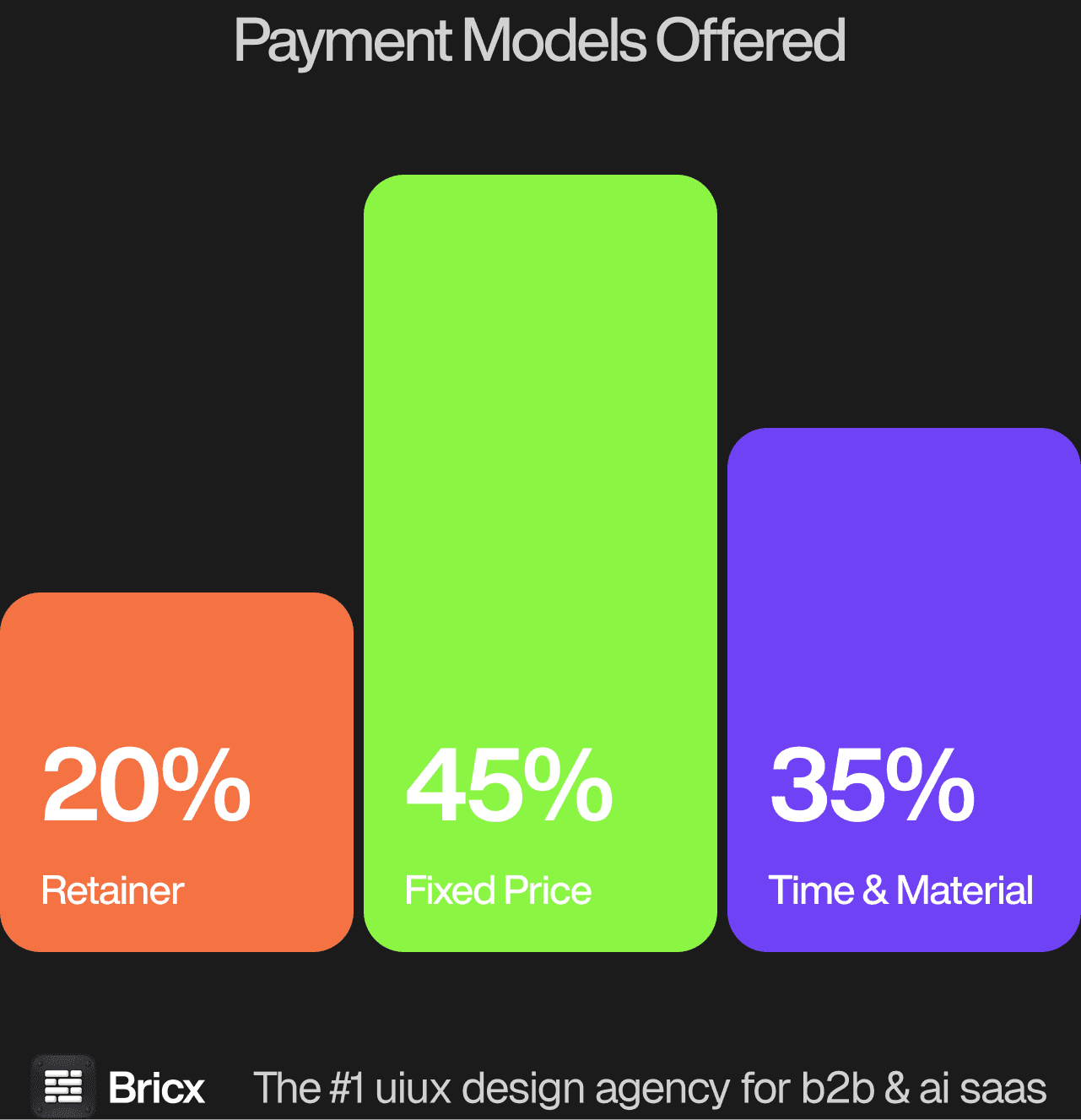
Hourly bands. $25 at the bottom, $195 at the top, most between $55 and $90. Asian agencies quoted least, US agencies most. A distributed-team site costs roughly what any startup site costs, but the schedule inflates: rounds of review a co-located team closes in a day stretch across a week, and time is what agencies bill.
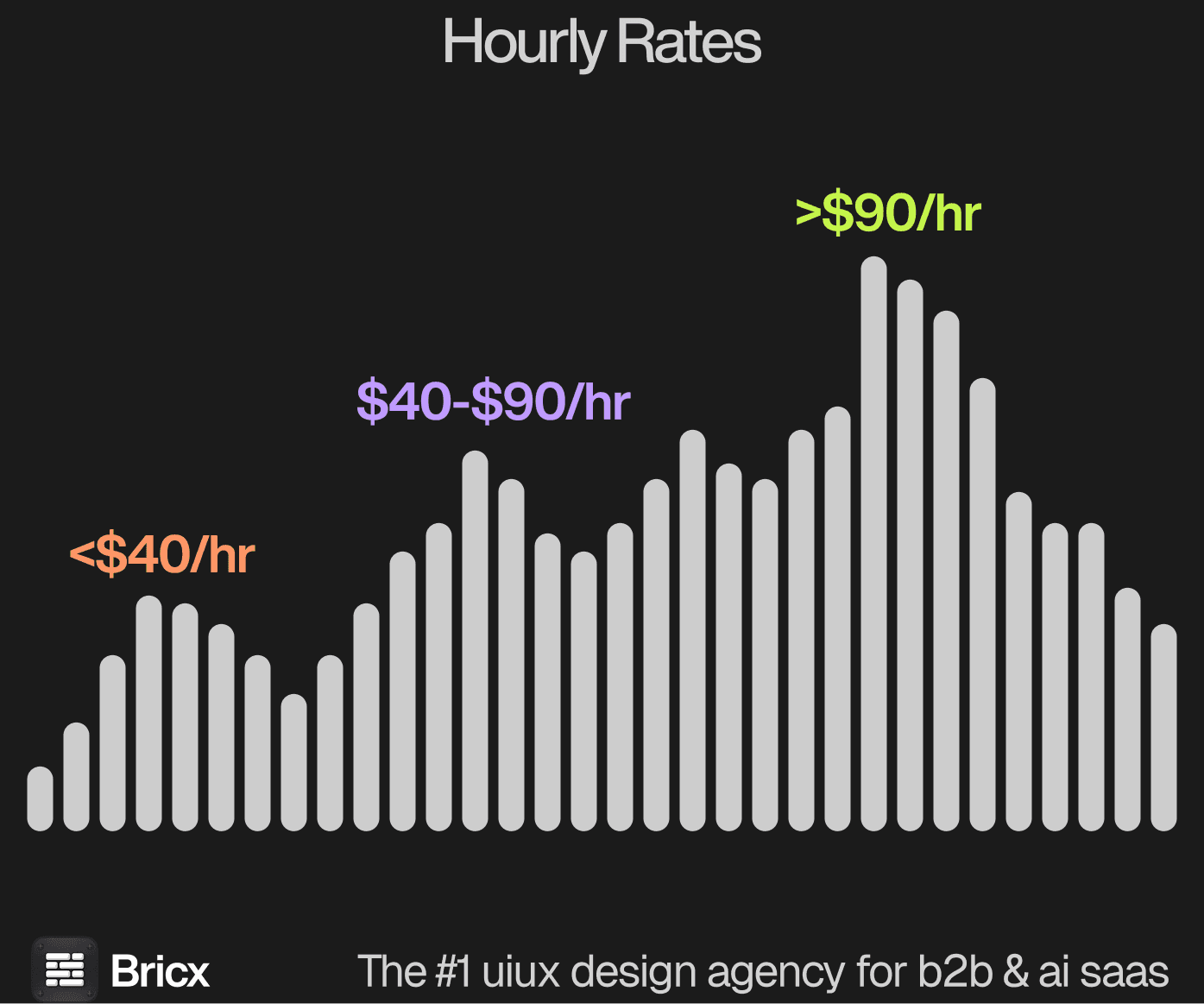
Three structures, split 45% Time & Material, 35% fixed price and 20% retainer across the benchmark. For a website for a distributed startup the model usually matters more than the headline figure, because it decides what happens when the scope moves.
- Fixed price is right when you can write the scope down and mean it.
- Time & Material is right when the answer changes as you learn.
- Retainer is right when design never stops being needed.
- Which one fits a website for a distributed startup comes down to whether the scope is settled before the work starts.
How do you evaluate a web design agency for a distributed startup?
Five things separate web design for a distributed startup from web design for a startup in one office.
Ask who on their side makes the final call. A distributed client cannot supply a single decision-maker in a room, so the agency has to supply one, or every round of feedback ends in a tie.
Ask how they collect copy from people who are never all online. Copy from a distributed team is the thing that slips, and an agency without a written process for gathering it will blame the client for the delay.
Ask what handover looks like when nobody internally owns the site. Most distributed startups have no marketing hire yet, so the site either lands in a CMS somebody can genuinely edit or it freezes on launch day.
Ask how many synchronous hours a week the engagement assumes. Studios that run on a standing weekly call assume everyone is awake at the same hour, which quietly excludes whichever founders are not.
Ask to see the written decision record from a past project. Choices made asynchronously survive only if somebody wrote them down, and that artefact either exists from previous work or it does not.
What are the red flags when hiring a design agency?
- Senior in the pitch, junior on the project. Ask for the names and check their individual work before signing.
- A contract with no way out. A twelve-month lock-in assumes your roadmap will not change. It will.
- Screens without results. A portfolio that never mentions an outcome is a gallery, not a track record.
- Agreement with everything you say. Experience shows up as disagreement about what is missing.
- No position on what happens next. Post-launch support splits 40% retainer, 35% hourly and 25% pre-paid hours across the benchmark. No answer means no plan.
- No comparable example of a website for a distributed startup. An agency that cannot point to work of the same shape is learning on your budget.
Should you hire a web design agency or build in-house?
Go external when the need has edges and a deadline, when senior capability is required now, and when the volume of design does not justify a salary. You are buying pattern recognition from other people's mistakes. For a website for a distributed startup specifically, the question worth settling first is how often the work recurs.
Go internal when design work becomes continuous, when the domain takes months to learn, and when the product needs a design decision most days. Recruiting realistically costs six months before it pays back. Where a website for a distributed startup falls on that line is usually clear once you count how many times it will need doing again.
A distributed startup that already employs a designer should keep the site in-house, because the person who can chase three founders across three time zones for a decision is worth more here than the person who can draw the page. Without that hire, retaining is the better bet. The in-house failure is a site half-built by whoever had a spare sprint. The agency failure is a launch nobody internally knows how to change.
FAQs
What makes a website hard for a startup with a distributed team?
Not the design. The approval. Feedback comes from several time zones with nobody empowered to close a thread, so a round that a co-located team finishes in an afternoon takes a week, and the project runs long without anyone doing anything wrong.
How much does a website for a distributed startup cost?
For a five-page website 25% of agencies in the benchmark quoted under $10,000, 58% quoted between $15,000 and $50,000 and 17% quoted over $50,000. Distributed review cycles stretch the timeline rather than the scope. Bricx starts at $25,000.
Does the agency need to sit in one of the team's time zones?
Less than founders expect, provided it works in writing. What matters is whether decisions get recorded and shared rather than settled on a call half the team missed, and whether one named person on the agency side can be reached daily.
Who should own the site after launch?
Name somebody before the project starts. A distributed startup with no marketing hire tends to leave the site to whoever is least busy, which means nobody, so build on a CMS a non-designer can edit and hand over credentials with a written guide.