Website Design
Website Design
Website Design
Insights
Insights
Insights
July 30, 2026
July 30, 2026
July 30, 2026
The 12 Best SaaS Design Agencies in 2026 (Ranked Using Data From 50+ Sales Calls)
The 12 Best SaaS Design Agencies in 2026 (Ranked Using Data From 50+ Sales Calls)
The 12 Best SaaS Design Agencies in 2026 (Ranked Using Data From 50+ Sales Calls)
A data-backed ranking of the 12 best SaaS design agencies, built from original research on 50+ agency sales calls. Real work samples, real pricing, honest tradeoffs.
A data-backed ranking of the 12 best SaaS design agencies, built from original research on 50+ agency sales calls. Real work samples, real pricing, honest tradeoffs.
A data-backed ranking of the 12 best SaaS design agencies, built from original research on 50+ agency sales calls. Real work samples, real pricing, honest tradeoffs.
12 min
12 min
12 min

Every “best SaaS design agency” list ranks its own author at number one and never shows you where the rankings came from. We did the opposite. We spent 10+ hours on sales calls with 50+ of the top design agencies, logged what they charge, how long they take, and how they work, then ranked the field on that data.
Yes, Bricx is on this list, and we disclose it. You still get real work samples, honest “who this is not for” notes, and the pricing benchmarks nobody else publishes. Start with the shortlist, then scroll for the data that should shape your budget.
The 12 Best SaaS Design Agencies at a Glance
# | Agency | Best for | Model | Price | Location |
|---|---|---|---|---|---|
1 | Bricx | B2B & AI SaaS product + web | Retainer / project | $$$ | India / Global |
2 | Eleken | Ongoing product UX | Subscription | $$ | Ukraine |
3 | Cieden | Complex B2B workflows | Project | $$$ | Ukraine / US |
4 | MetaLab | Enterprise flagship products | Project | $$$$ | Canada / US |
5 | Ramotion | Brand + site + UI together | Project | $$$ | San Francisco |
6 | Superside | High-volume creative at scale | Subscription | $$ | Distributed |
7 | Clay | Premium brand-led product | Project | $$$$ | San Francisco |
8 | Halo Lab | Design + development in one | Project | $$ | Ukraine |
9 | Lazarev | Motion-rich sites & products | Project | $$$ | Distributed |
10 | Phenomenon | Data-heavy dashboards | Project | $$$ | Distributed |
11 | Brights | Full-cycle design + build | Project | $$ | Estonia / EU |
12 | Lollypop | Large-scale global UX | Project | $$ | India / Global |
Price tiers are relative signals, not quotes. Real market numbers are in the pricing benchmark section below, because cost tracks scope and seniority far more than the logo.
The 12 Agencies, Reviewed
1. Bricx: Best for B2B and AI SaaS product and web design
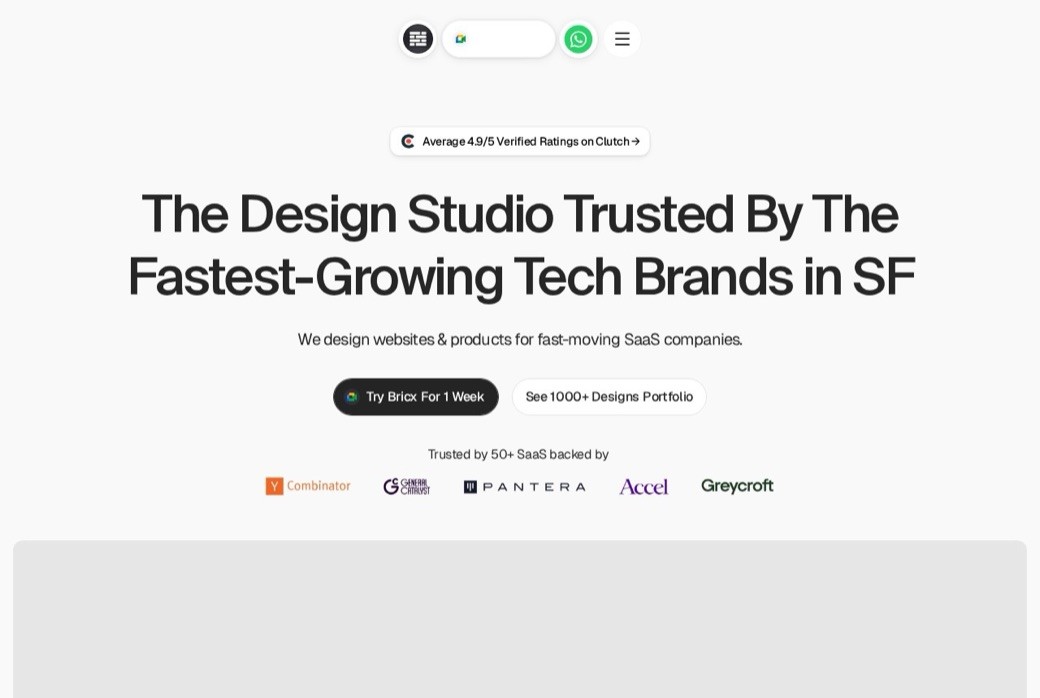
Bricx is a SaaS-only UX and design agency. We do not design restaurants or real estate. We ship product design, marketing sites, and design systems under one roof, and we complete most MVP design projects in under 45 days including feedback cycles, the fastest tier of the entire market we surveyed.
Notable clients: Writesonic, Sybill, Camb.ai, LTV.ai, Inflow. 4.9/5 on Clutch, 50+ SaaS teams backed by YC, Accel, and General Catalyst.
Best for: Series A to C B2B and AI SaaS that need design that moves activation and conversion.
Not for you if: You are pre-revenue and want a $2,000 logo, or the cheapest hourly rate on the board.
2. Eleken: Best for ongoing product UX
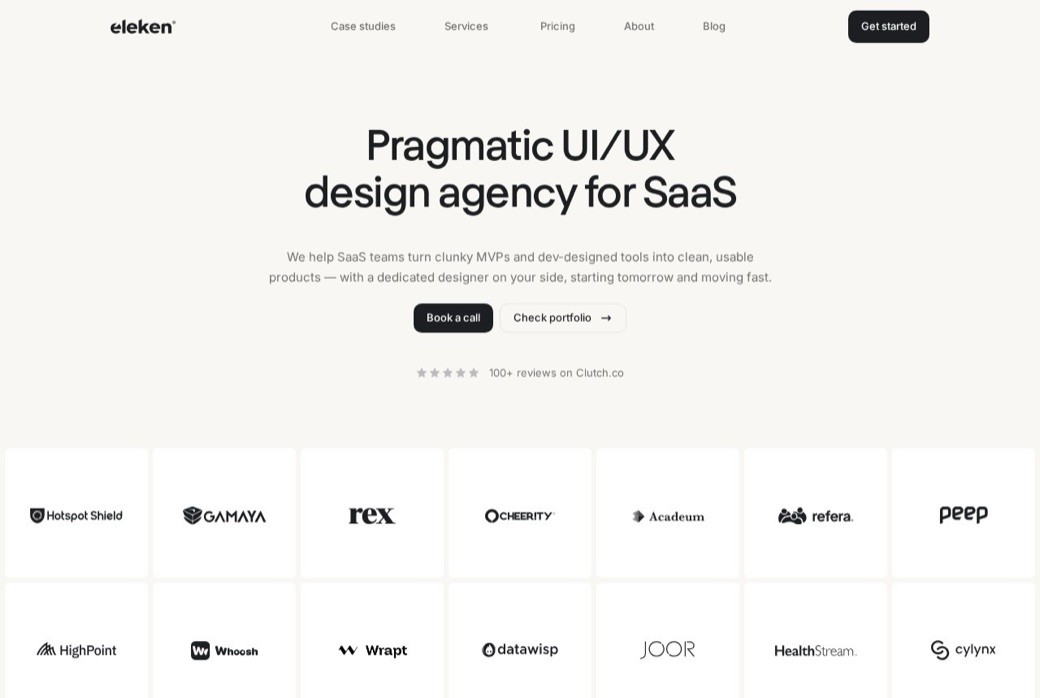
Eleken pioneered the subscription model for SaaS product design: a dedicated designer, a flat monthly fee, unlimited requests one at a time. A clean fit for scaling SaaS teams that need continuous UX firepower without a full-time hire.
Notable clients: Hotspot Shield, TextMagic, HealthStream, datawisp, and 100+ others. Strong Clutch review presence.
Best for: Product teams that need a steady stream of UX work month over month.
Not for you if: You need brand, marketing site, and product in one coordinated push, or a large multidisciplinary pod.
3. Cieden: Best for complex B2B workflows and design systems
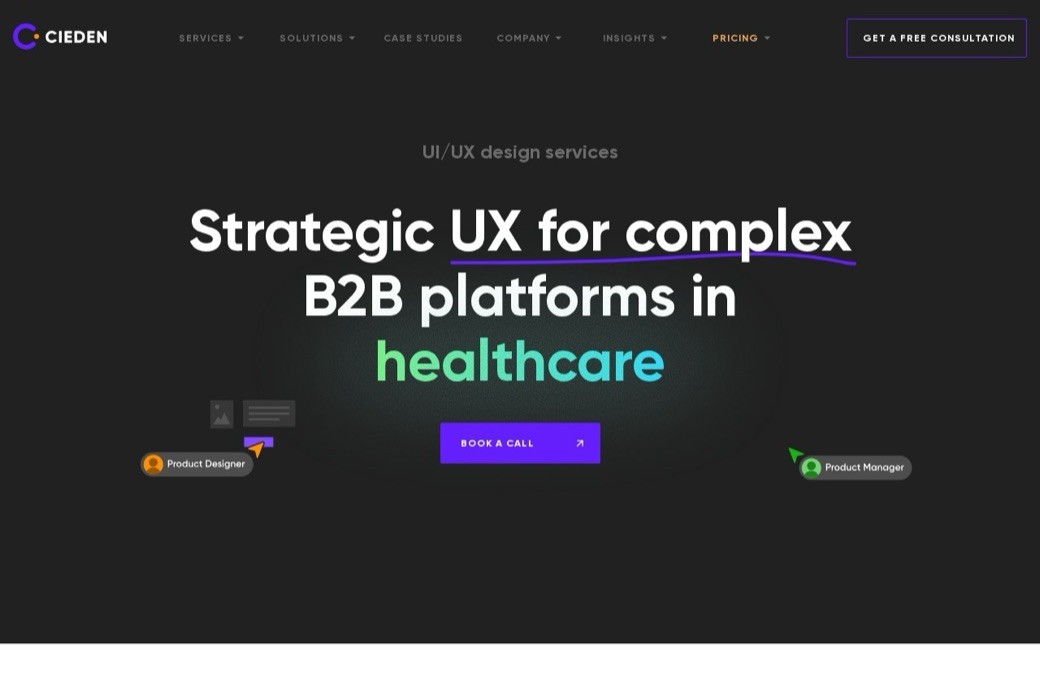
Cieden goes deep on complicated B2B products and enterprise design systems, with an academically grounded process and real strength in AI and ML interfaces. Their portfolio leans into the genuinely hard, data-dense interfaces most agencies avoid.
Best for: Complex enterprise SaaS with heavy workflows and a need for a robust design system.
Not for you if: You want a fast, cheap marketing site. This is heavier product work.
4. MetaLab: Best for enterprise-grade flagship products
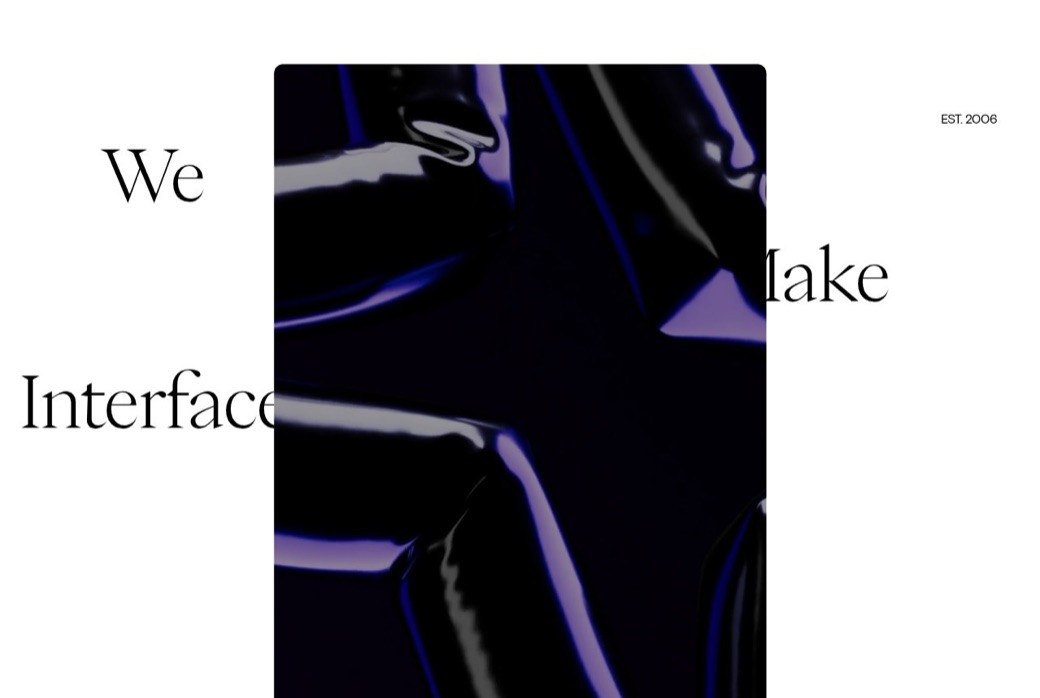
One of the most established product design studios in the world, known for high-profile product work including early Slack. If you have serious budget and want a marquee name on a flagship redesign, MetaLab is on the shortlist.
Notable clients: Slack, Coinbase, and other consumer-grade flagship products.
Best for: Well-funded companies redesigning a flagship product with a top-tier name attached.
Not for you if: You are budget-sensitive. This is the premium end of the market.
5. Ramotion: Best for brand plus marketing site plus UI

San Francisco studio that combines brand identity, marketing website, and product UI. A good pick when you want your brand and your interface to feel like one coherent system rather than three vendors stitched together.
Best for: Companies that want branding, web, and UI from a single coordinated team.
Not for you if: You need deep, ongoing product UX on a complex B2B workflow. Their sweet spot is brand-led.
6. Superside: Best for high-volume creative at scale
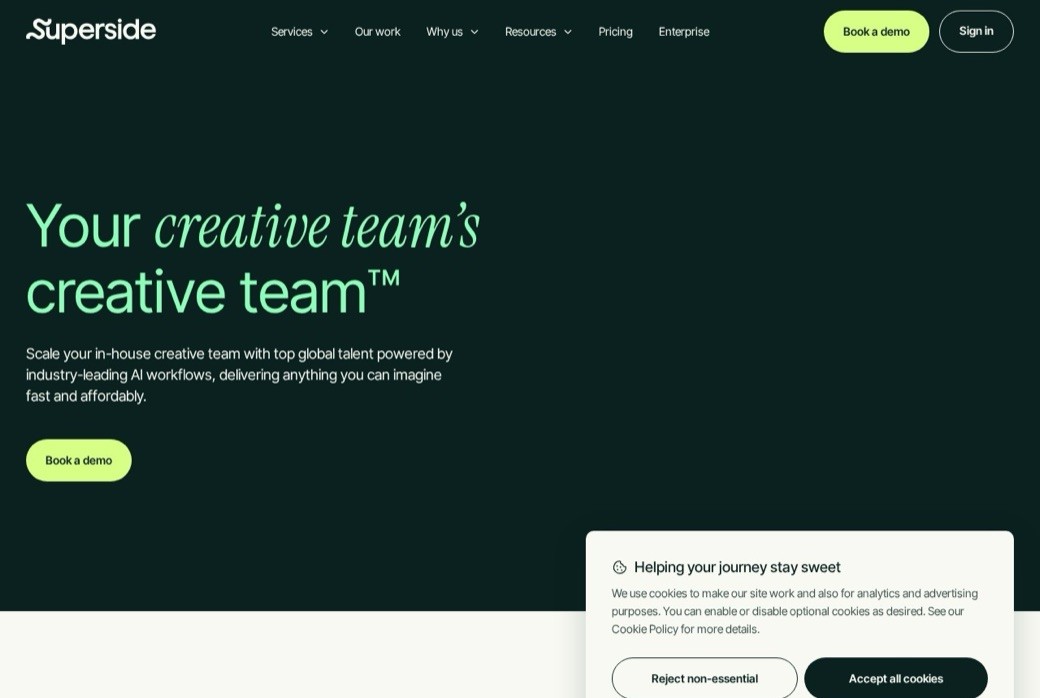
Superside runs “creative as a service” at scale: a subscription that plugs a large distributed team into your design pipeline for high volume across formats. Strong for marketing creative throughput, less specialized on deep SaaS product UX.
Notable clients: Shopify, Amazon, and other large marketing teams.
Best for: Teams that need a high volume of design output across many formats, fast.
Not for you if: You need a specialist product designer thinking hard about your onboarding and dashboards.
7. Clay: Best for premium brand-led product design

San Francisco agency known for beautiful, brand-forward product and web design. Premium positioning and premium pricing. When the visual bar has to be very high and budget is not the constraint, Clay delivers.
Best for: Companies where design taste is a differentiator and budget is available.
Not for you if: You are cost-conscious or need speed over polish.
8. Halo Lab: Best for design and development in one team
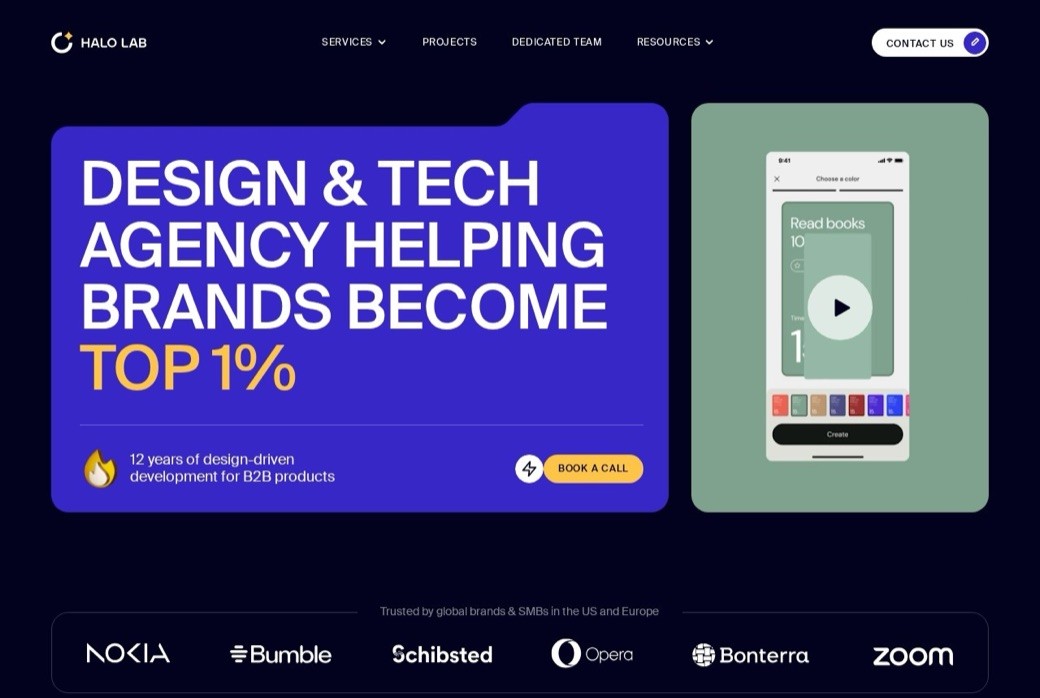
Halo Lab pairs strong visual design with in-house development, so you can go from design to shipped in one relationship instead of managing a designer and a separate dev shop.
Best for: Teams that want design and build under one roof without hiring separately.
Not for you if: You already have a strong engineering team and only need design.
9. Lazarev: Best for motion-rich SaaS websites and products
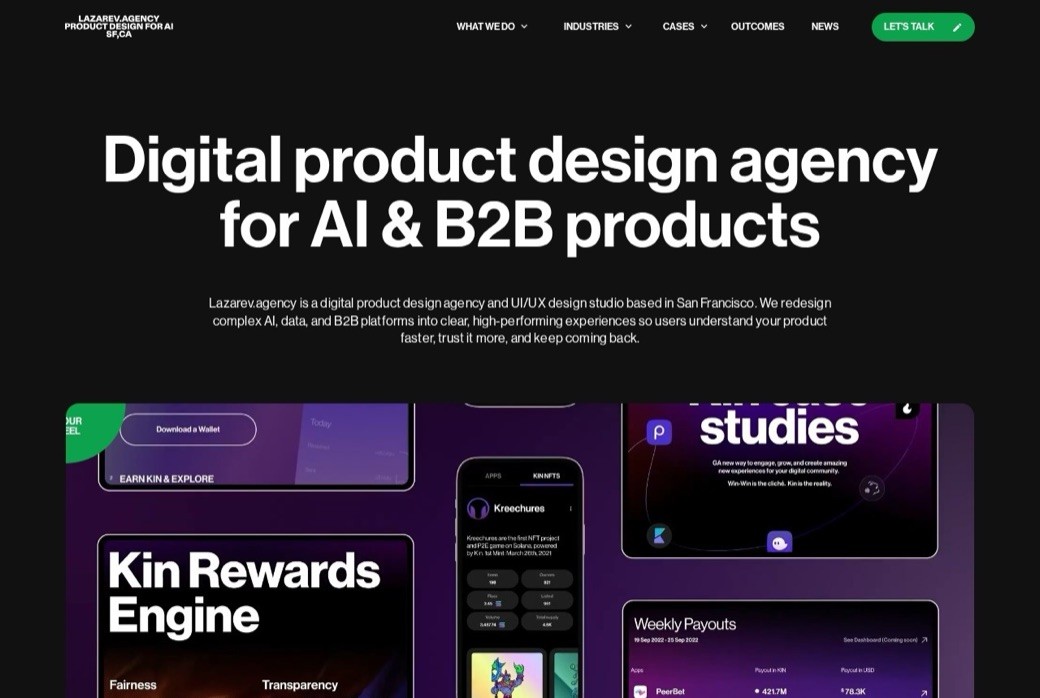
Lazarev is known for polished, motion-heavy SaaS websites and product interfaces. If animation and a high-craft marketing site are central to how you want to stand out, they are a strong fit.
Best for: SaaS brands that want a standout, motion-rich marketing presence.
Not for you if: You need deep, unglamorous B2B workflow design more than visual flair.
10. Phenomenon Studio: Best for data-heavy dashboards and platforms
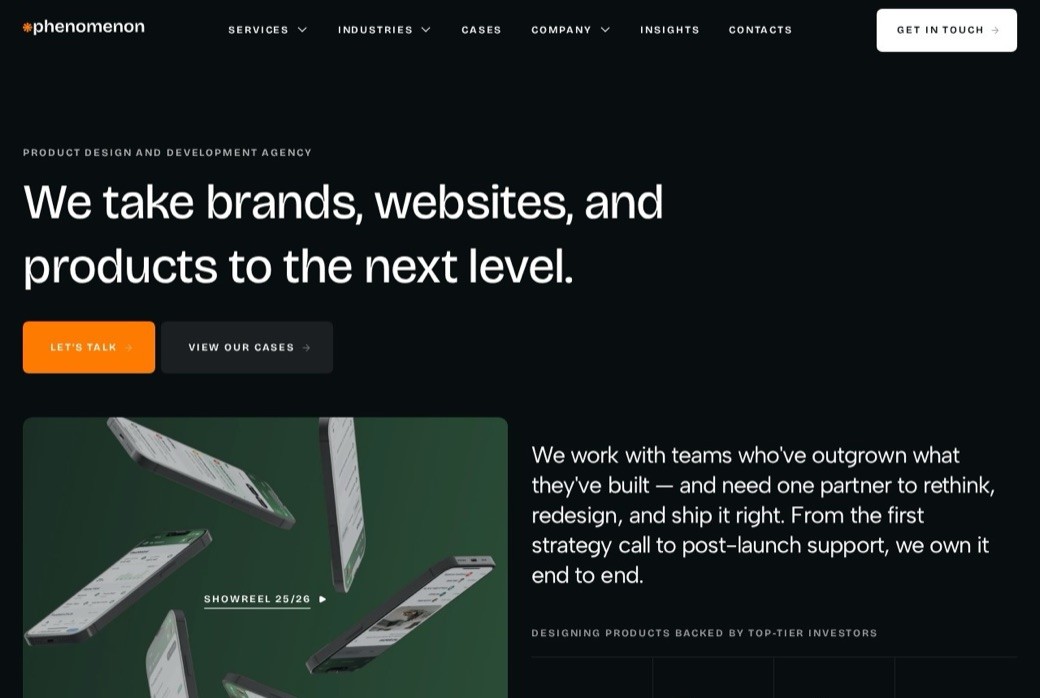
Phenomenon does broad product design with real experience in complex, data-dense platforms and dashboards, acting as a full-cycle partner from strategy through development. A solid all-rounder for information-heavy SaaS.
Best for: Data and analytics products that live and die on dashboard clarity.
Not for you if: You want a boutique, senior-only team. This is a larger studio.
11. Brights: Best for full-cycle SaaS design and build
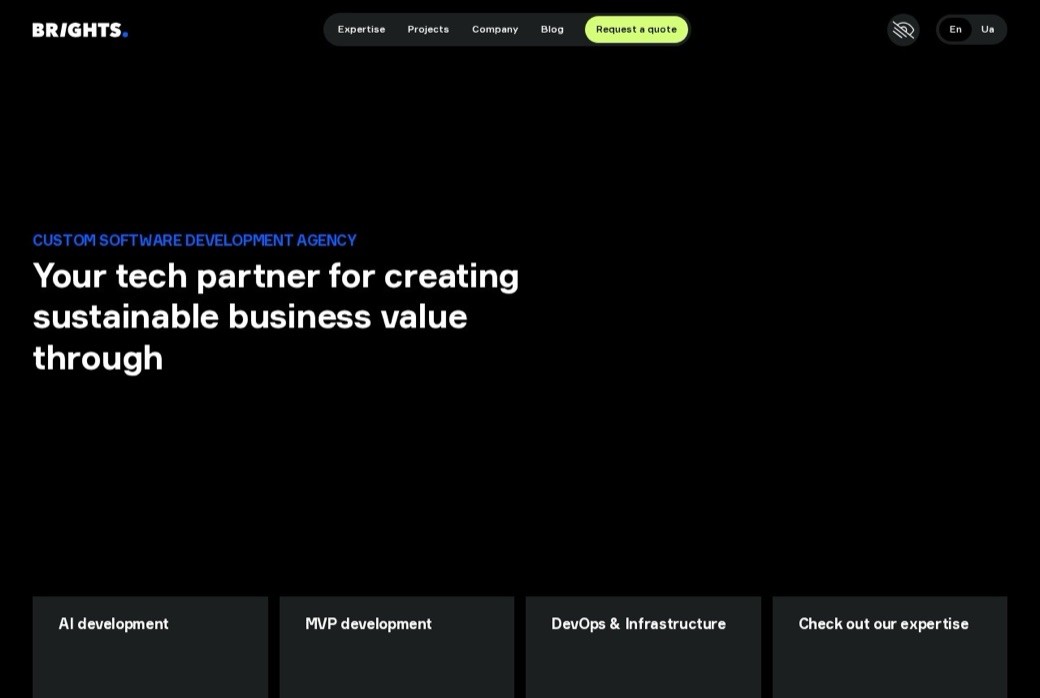
Brights offers full-cycle SaaS work, design through development, with transparent, buyer-friendly information on pricing and timelines. A pragmatic pick for teams that want one partner from idea to shipped product.
Best for: SaaS teams that want design and engineering from the same vendor.
Not for you if: You only need design and want a pure product-UX specialist.
12. Lollypop: Best for large-scale global UX programs
Lollypop is a large global UX agency with a broad footprint and the capacity to staff big, multi-region programs. Good for enterprises that need scale and breadth over boutique specialization.
Best for: Large organizations running sizable, ongoing UX programs.
Not for you if: You are a lean startup that wants a small senior team and fast turnaround.
How We Ranked Them
Most lists skip this because they do not have a method. We scored every agency on five weighted factors:
SaaS specialization (30%). Real, repeated, product-led SaaS work: dashboards, onboarding, complex B2B workflows, design systems. Generalists got marked down.
Verified track record (25%). Named clients you can check, shipped products you can open, and third-party review presence. Self-reported metrics with no source got discounted.
Pricing transparency (20%). A straight answer on cost and model, versus hiding behind “it depends” until call three.
Team seniority and model (15%). Who actually touches your project. A named senior designer beats a 200-person headcount.
Speed and reliability (10%). Realistic timelines, clean Figma handoff, and design QA after launch.
Specialization and proof are 55% of the score because they predict whether the work will actually move your activation and conversion numbers. A pretty portfolio with no SaaS depth is a liability, not an asset.
What SaaS Design Actually Costs in 2026
This is the part no competitor list will show you. We asked 50+ agencies for real numbers, broken down by the three things you are most likely to buy.
Branding and brand sprints
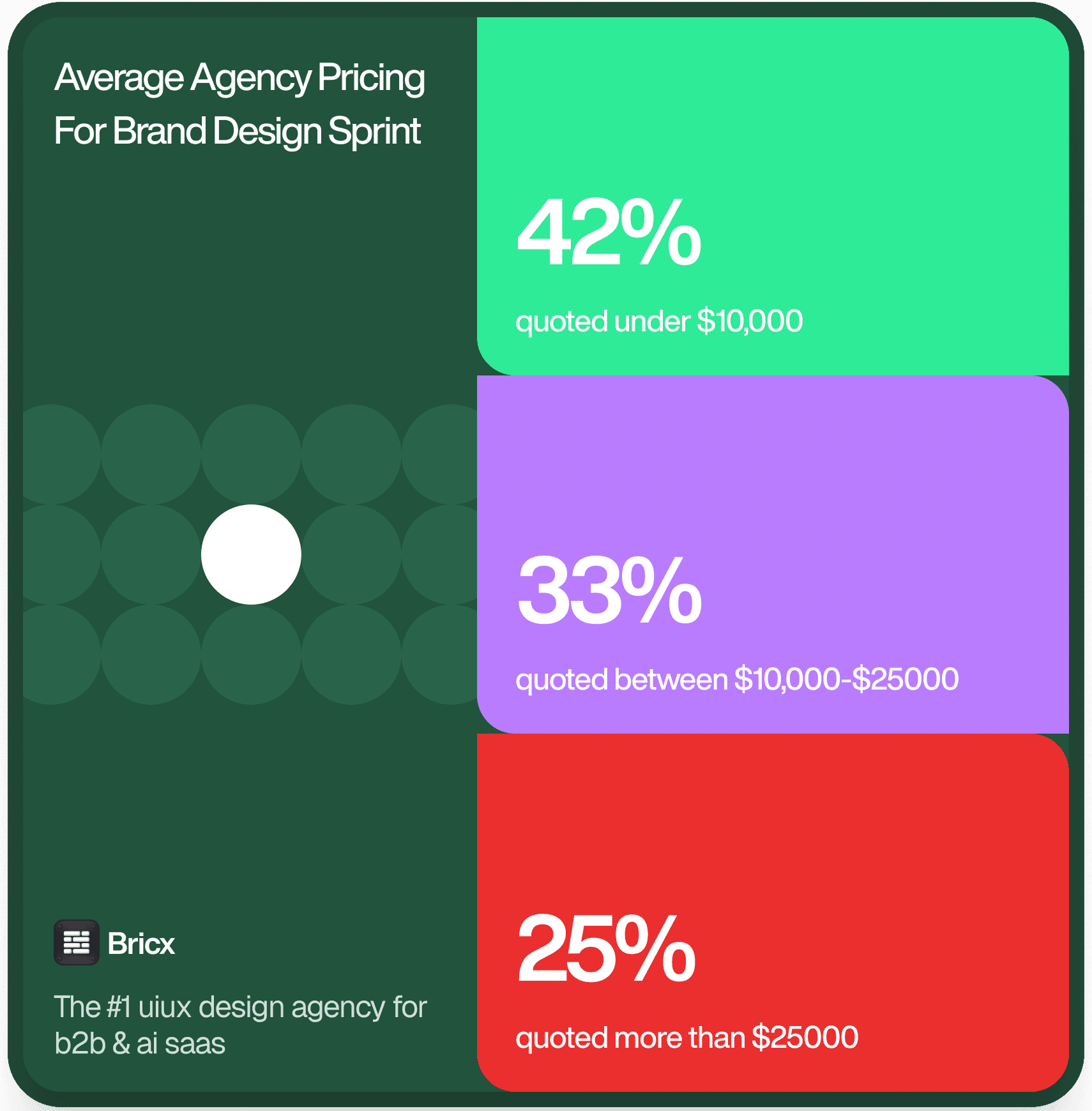
Brand design sprint pricing: 42% under $10,000, 33% between $10,000 and $25,000, 25% over $25,000
The median brand sprint came in at $15,300, ranging from $1,500 to $125,000 for the same rough scope. That spread tells you brand pricing is about positioning, not cost of delivery. If you are early-stage, do not sink a five-figure budget into branding yet. Just do not pay $25,000+ for a logo and a one-page guideline.
SaaS website design
Website design and development pricing: 42% under $10,000, 33% between $10,000 and $25,000, 25% at $25,000 and above
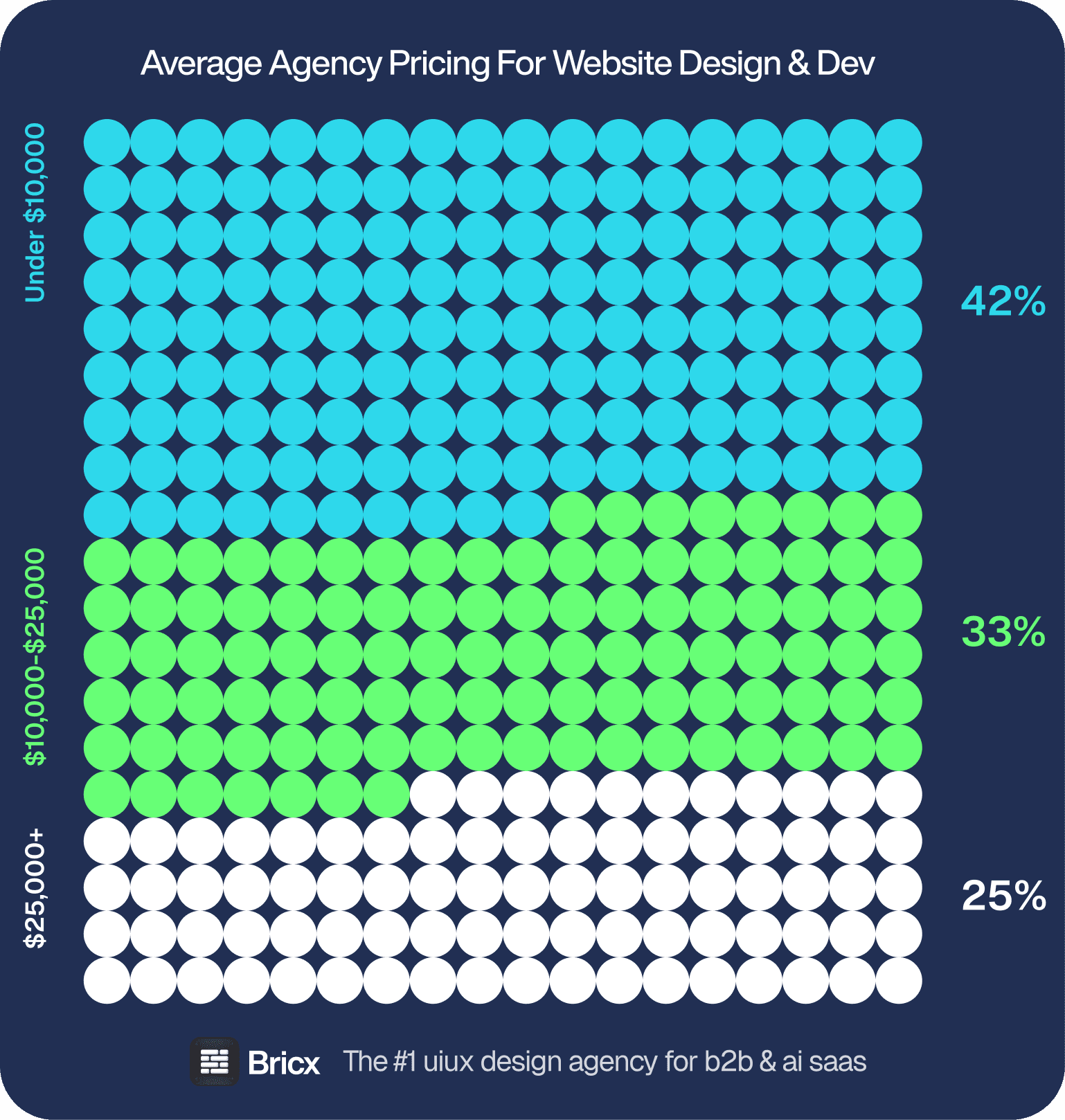
The median SaaS website landed at $25,000. Nearly 78% of timelines ran five weeks or longer. That is too slow. You can get a clean, conversion-focused marketing site built for under $10,000, and you should not let anyone stretch the core design phase past two to three weeks. Long website timelines are usually a staffing problem on the agency’s side, not a complexity problem on yours.
Product and MVP design
Product design and development pricing: $2,500 lowest, $43,000 median, $150,000 highest
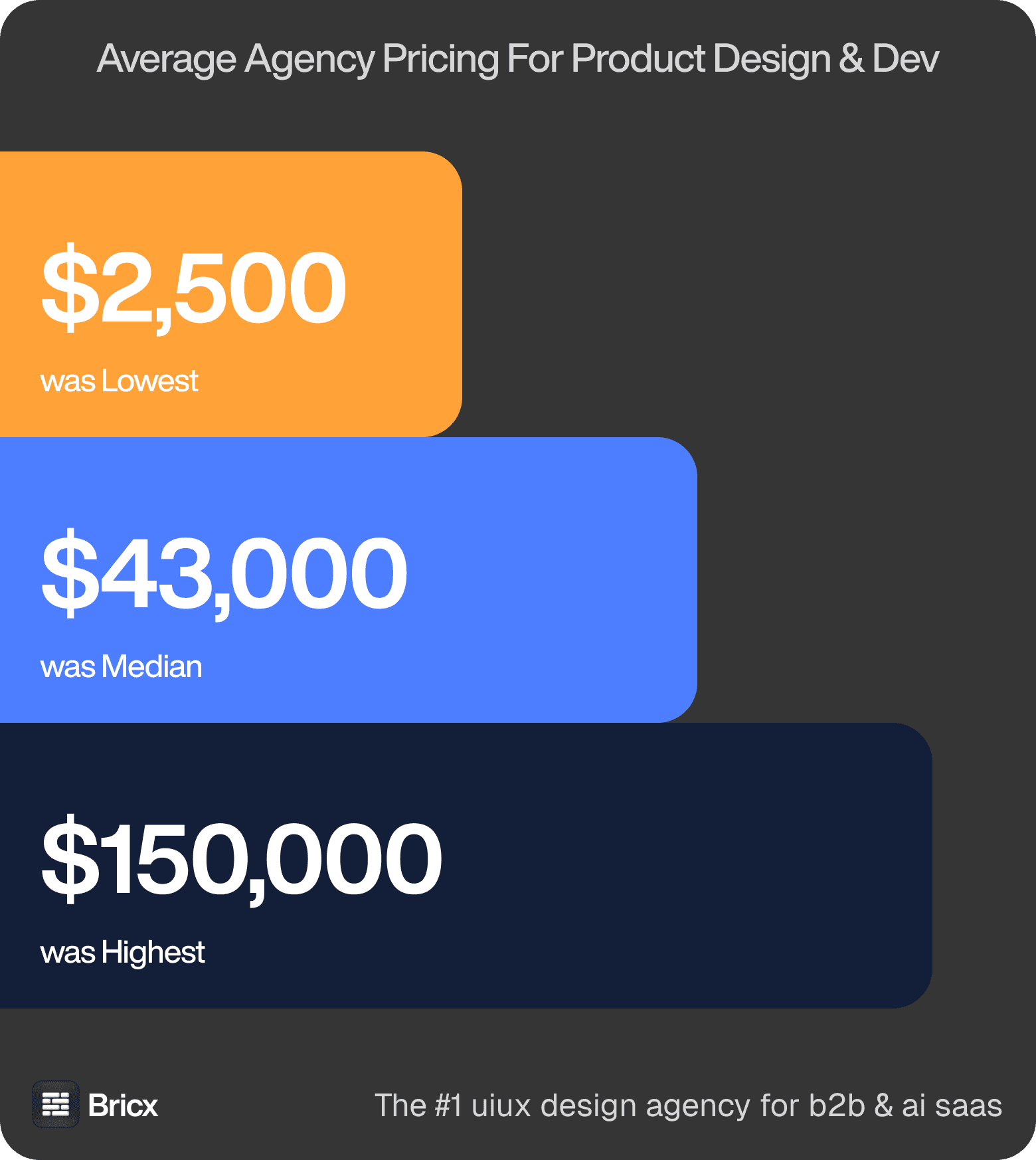
This is where the money goes. The median fixed-price MVP engagement was around $43,000. On subscription, agencies started near $4,000/month, sat at a $7,000/month median, and topped out at $20,000/month. If your scope is not locked, hire on a retainer so you can steer. For reference, Bricx completes almost all MVP design in under 45 days including feedback. More than half the agencies we surveyed took ten weeks or longer.
Hourly rates and the geography myth
Hourly rate distribution: bands under $40, $40 to $90, above $90 per hour
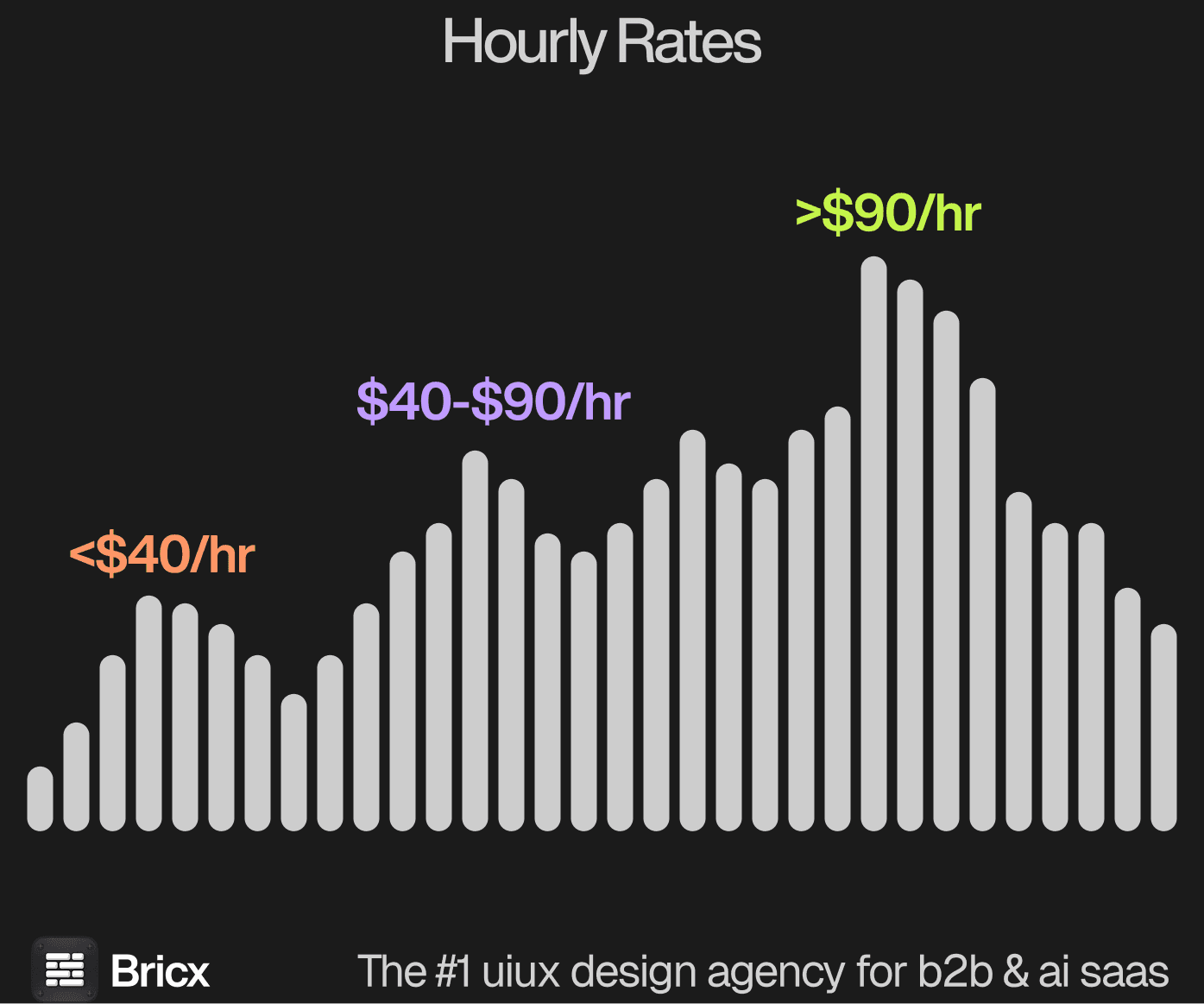
US agencies averaged around $150/hour, EU around $60, and Asia around $35. Here is the contrarian truth from talking to all of them: there is no geographical difference in the quality of the work. You are paying a location premium, not a quality premium.
The Data That Should Make You Cautious
80% claim CRO. Most meant SEO.
Nearly every agency said they build “conversion-focused” websites. When we dug in, the majority confused conversion rate optimization with SEO. They do not run experiments. If conversion matters, ask for their experimentation process and past test results, and watch most of them fumble it.
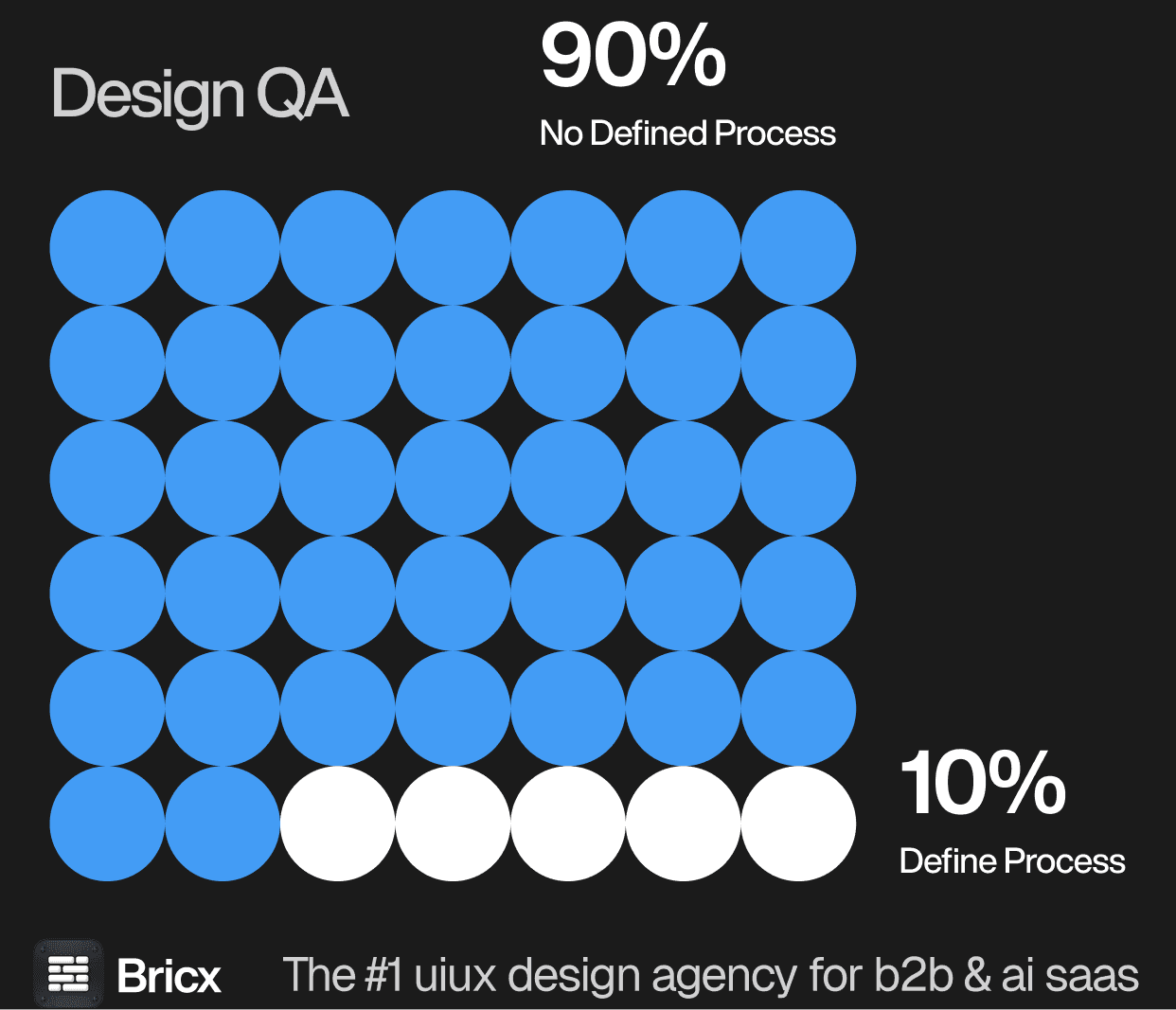
90% have no defined design QA process
Design QA: 90% of agencies have no defined process, 10% have a defined process
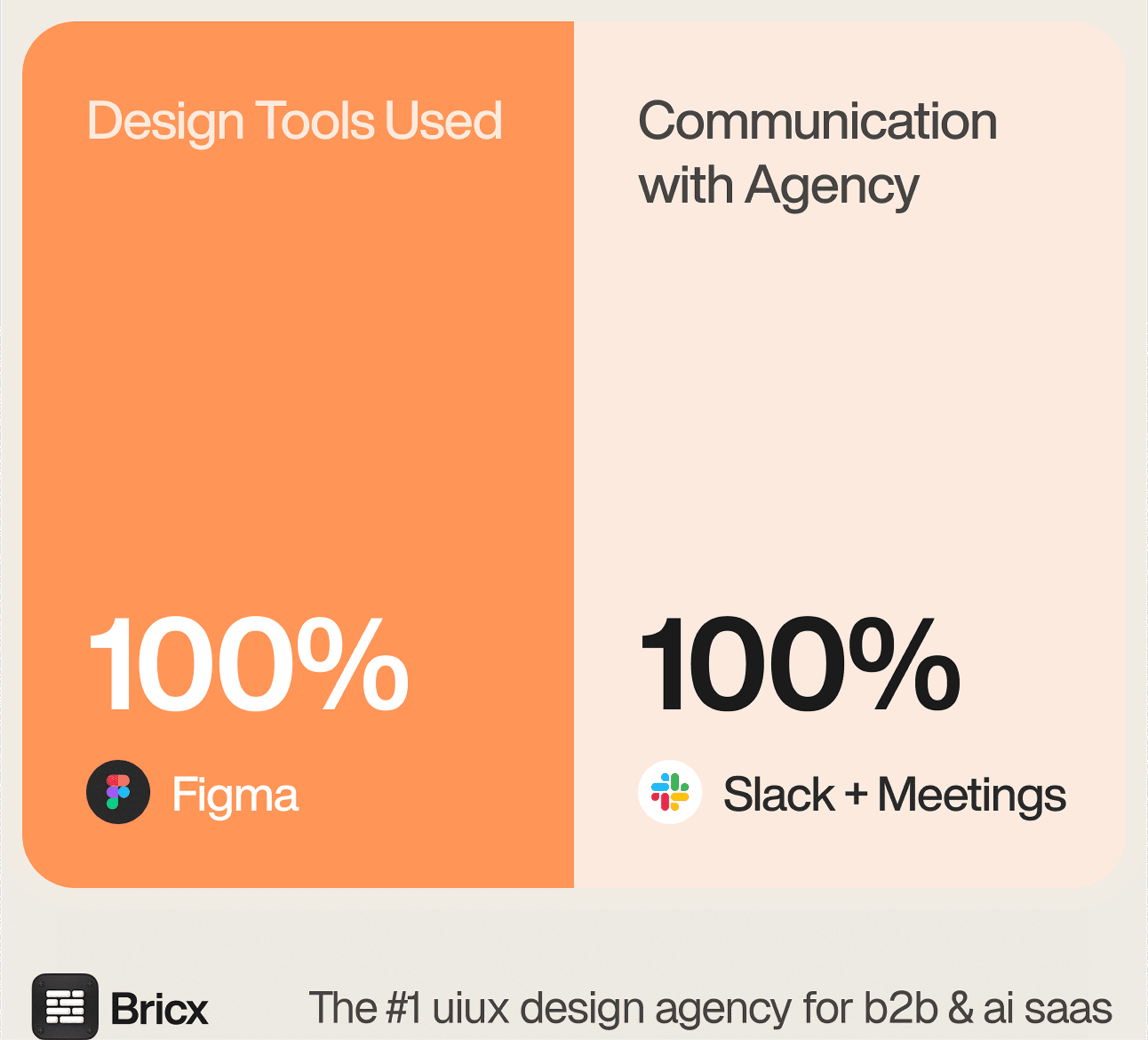
Nine out of ten agencies could not describe a process for making sure what gets built actually matches what was designed. Your Figma file means nothing if the shipped product drifts from it. Ask how they QA the developer handoff before you sign. And note the universal tools: 100% run on Figma, 100% on Slack plus a weekly meeting.
100% of agencies use Figma, 100% communicate through Slack plus meetings
How Real SaaS Agencies Are Built
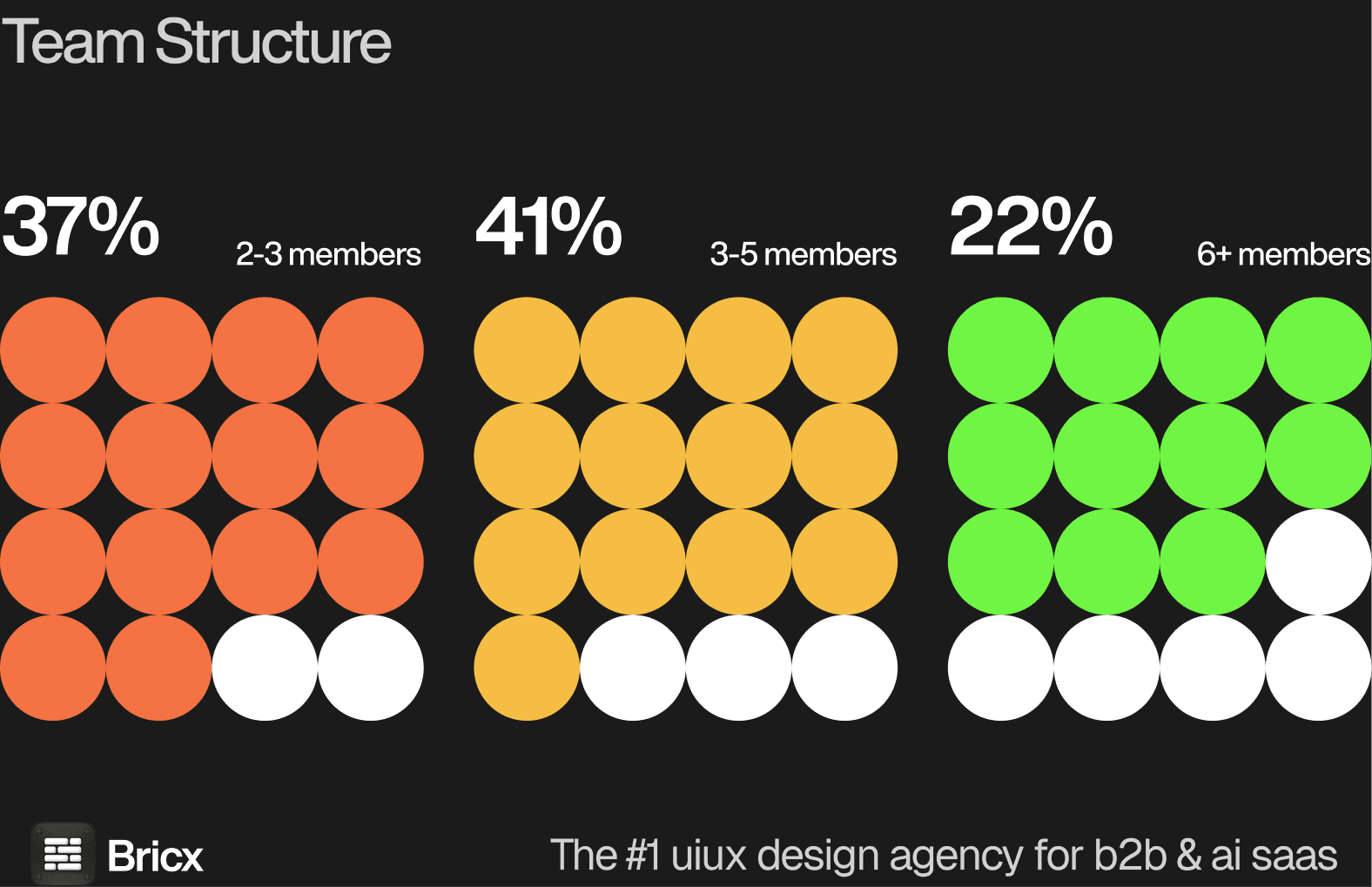
Project team structure: 37% run 2 to 3 members, 41% run 3 to 5, 22% run 6 or more
Most agencies (41%) put a 3-to-5-person pod on your project. Do not be impressed by total employee count. A 200-person agency can still hand your project to a junior. Ask who specifically will work on it and what they have shipped.
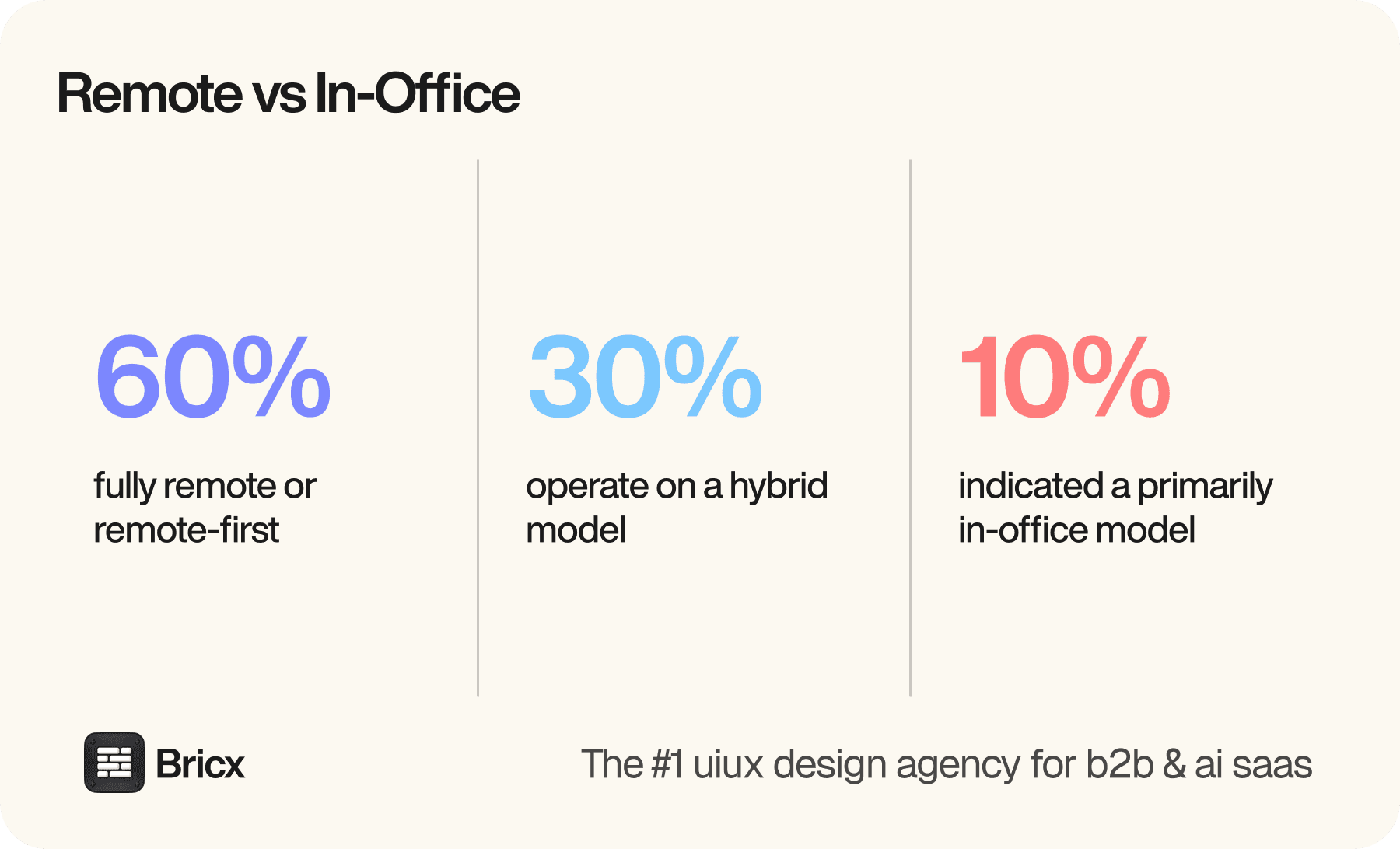
Remote versus in-office: 60% fully remote or remote-first, 30% hybrid, 10% in-office
60% of top agencies are remote-first and 60% are based in Europe. This should not affect your decision. The good ones expect roughly five hours a week of your time as the main contact, especially early. If they need less, they are not doing enough discovery.
How to Choose for Your Stage
Pre-seed / pre-revenue. Skip the expensive brand sprint. Get a clean single landing page for under $10,000, or use a subscription designer month to month while you find product-market fit.
Seed. You need a product, not a logo. Put budget into MVP and product design on a retainer so you can steer as scope evolves. Expect mid five figures for a serious MVP.
Series A to C. Design becomes a growth lever. Invest in product UX, a design system, and a site that converts. A ~$43,000 median for product design is normal, and a specialist pays for itself in activation lift.
Red Flags to Watch For
They say “conversion-focused” but cannot describe a single experiment they have run.
“We do deep UX research” with no specifics on what, who, or the deliverable. Vagueness means theater.
No defined design QA process. 90% of agencies do not have one. Make sure yours does.
A huge quote range for a simple scope. Get specifics, not a brochure.
They lead with total employee count. Headcount is not seniority.
A long website timeline. More than two to three weeks of core design usually backfills their staffing gaps.
Frequently Asked Questions
How much does a SaaS design agency cost in 2026?
From our survey of 50+ agencies: brand sprints median around $15,300, marketing websites around $25,000, and product or MVP design around $43,000 fixed or roughly $7,000/month on subscription. Hourly rates run $25 to $195, median $55 to $90. Location affects price far more than quality.
What makes a SaaS design agency different from a general one?
A SaaS specialist designs software interfaces, onboarding, dashboards, complex workflows, and design systems, and understands how design drives activation, retention, and conversion. Generalists treat your product like any other visual project. Specialization is the biggest predictor of results, which is why it is 30% of our ranking.
Fixed price, retainer, or subscription?
Fixed price works for clear, finite scope. If you are still exploring or need ongoing work, a retainer or subscription lets you steer. Across the market, 45% bill time and material, 35% fixed, 20% retainer or subscription.
How long should SaaS design take?
A marketing website should not need more than two to three weeks of core design. A serious MVP typically runs six to ten weeks, though the fastest deliver in under 45 days including feedback. Over half the agencies we surveyed took ten weeks or more, so speed is a real differentiator.
Does the agency’s location affect quality?
No. We found no geographical difference in quality across the US, Europe, and Asia. US agencies average around $150/hour, EU $60, Asia $35, but that is a location premium, not a quality premium. Judge the portfolio and the people.
Where does this data come from?
Original research: 10+ hours of sales calls with 50+ top design agencies, capturing real quotes on pricing, timelines, team structure, and process. Read the full study in The State of UI/UX Design Agencies 2026.
The Bottom Line
The best SaaS design agency for you is not the one at the top of some self-published list. It is the specialist that has shipped work like yours, puts senior people on your project, gives you a straight answer on price, and can prove conversion is more than a buzzword. Use the benchmarks to know when you are overpaying, the red flags to filter fast, and judge every agency, including us, on the work and the people.
Every “best SaaS design agency” list ranks its own author at number one and never shows you where the rankings came from. We did the opposite. We spent 10+ hours on sales calls with 50+ of the top design agencies, logged what they charge, how long they take, and how they work, then ranked the field on that data.
Yes, Bricx is on this list, and we disclose it. You still get real work samples, honest “who this is not for” notes, and the pricing benchmarks nobody else publishes. Start with the shortlist, then scroll for the data that should shape your budget.
The 12 Best SaaS Design Agencies at a Glance
# | Agency | Best for | Model | Price | Location |
|---|---|---|---|---|---|
1 | Bricx | B2B & AI SaaS product + web | Retainer / project | $$$ | India / Global |
2 | Eleken | Ongoing product UX | Subscription | $$ | Ukraine |
3 | Cieden | Complex B2B workflows | Project | $$$ | Ukraine / US |
4 | MetaLab | Enterprise flagship products | Project | $$$$ | Canada / US |
5 | Ramotion | Brand + site + UI together | Project | $$$ | San Francisco |
6 | Superside | High-volume creative at scale | Subscription | $$ | Distributed |
7 | Clay | Premium brand-led product | Project | $$$$ | San Francisco |
8 | Halo Lab | Design + development in one | Project | $$ | Ukraine |
9 | Lazarev | Motion-rich sites & products | Project | $$$ | Distributed |
10 | Phenomenon | Data-heavy dashboards | Project | $$$ | Distributed |
11 | Brights | Full-cycle design + build | Project | $$ | Estonia / EU |
12 | Lollypop | Large-scale global UX | Project | $$ | India / Global |
Price tiers are relative signals, not quotes. Real market numbers are in the pricing benchmark section below, because cost tracks scope and seniority far more than the logo.
The 12 Agencies, Reviewed
1. Bricx: Best for B2B and AI SaaS product and web design
Bricx is a SaaS-only UX and design agency. We do not design restaurants or real estate. We ship product design, marketing sites, and design systems under one roof, and we complete most MVP design projects in under 45 days including feedback cycles, the fastest tier of the entire market we surveyed.
Notable clients: Writesonic, Sybill, Camb.ai, LTV.ai, Inflow. 4.9/5 on Clutch, 50+ SaaS teams backed by YC, Accel, and General Catalyst.
Best for: Series A to C B2B and AI SaaS that need design that moves activation and conversion.
Not for you if: You are pre-revenue and want a $2,000 logo, or the cheapest hourly rate on the board.
2. Eleken: Best for ongoing product UX
Eleken pioneered the subscription model for SaaS product design: a dedicated designer, a flat monthly fee, unlimited requests one at a time. A clean fit for scaling SaaS teams that need continuous UX firepower without a full-time hire.
Notable clients: Hotspot Shield, TextMagic, HealthStream, datawisp, and 100+ others. Strong Clutch review presence.
Best for: Product teams that need a steady stream of UX work month over month.
Not for you if: You need brand, marketing site, and product in one coordinated push, or a large multidisciplinary pod.
3. Cieden: Best for complex B2B workflows and design systems
Cieden goes deep on complicated B2B products and enterprise design systems, with an academically grounded process and real strength in AI and ML interfaces. Their portfolio leans into the genuinely hard, data-dense interfaces most agencies avoid.
Best for: Complex enterprise SaaS with heavy workflows and a need for a robust design system.
Not for you if: You want a fast, cheap marketing site. This is heavier product work.
4. MetaLab: Best for enterprise-grade flagship products
One of the most established product design studios in the world, known for high-profile product work including early Slack. If you have serious budget and want a marquee name on a flagship redesign, MetaLab is on the shortlist.
Notable clients: Slack, Coinbase, and other consumer-grade flagship products.
Best for: Well-funded companies redesigning a flagship product with a top-tier name attached.
Not for you if: You are budget-sensitive. This is the premium end of the market.
5. Ramotion: Best for brand plus marketing site plus UI
San Francisco studio that combines brand identity, marketing website, and product UI. A good pick when you want your brand and your interface to feel like one coherent system rather than three vendors stitched together.
Best for: Companies that want branding, web, and UI from a single coordinated team.
Not for you if: You need deep, ongoing product UX on a complex B2B workflow. Their sweet spot is brand-led.
6. Superside: Best for high-volume creative at scale
Superside runs “creative as a service” at scale: a subscription that plugs a large distributed team into your design pipeline for high volume across formats. Strong for marketing creative throughput, less specialized on deep SaaS product UX.
Notable clients: Shopify, Amazon, and other large marketing teams.
Best for: Teams that need a high volume of design output across many formats, fast.
Not for you if: You need a specialist product designer thinking hard about your onboarding and dashboards.
7. Clay: Best for premium brand-led product design
San Francisco agency known for beautiful, brand-forward product and web design. Premium positioning and premium pricing. When the visual bar has to be very high and budget is not the constraint, Clay delivers.
Best for: Companies where design taste is a differentiator and budget is available.
Not for you if: You are cost-conscious or need speed over polish.
8. Halo Lab: Best for design and development in one team
Halo Lab pairs strong visual design with in-house development, so you can go from design to shipped in one relationship instead of managing a designer and a separate dev shop.
Best for: Teams that want design and build under one roof without hiring separately.
Not for you if: You already have a strong engineering team and only need design.
9. Lazarev: Best for motion-rich SaaS websites and products
Lazarev is known for polished, motion-heavy SaaS websites and product interfaces. If animation and a high-craft marketing site are central to how you want to stand out, they are a strong fit.
Best for: SaaS brands that want a standout, motion-rich marketing presence.
Not for you if: You need deep, unglamorous B2B workflow design more than visual flair.
10. Phenomenon Studio: Best for data-heavy dashboards and platforms
Phenomenon does broad product design with real experience in complex, data-dense platforms and dashboards, acting as a full-cycle partner from strategy through development. A solid all-rounder for information-heavy SaaS.
Best for: Data and analytics products that live and die on dashboard clarity.
Not for you if: You want a boutique, senior-only team. This is a larger studio.
11. Brights: Best for full-cycle SaaS design and build
Brights offers full-cycle SaaS work, design through development, with transparent, buyer-friendly information on pricing and timelines. A pragmatic pick for teams that want one partner from idea to shipped product.
Best for: SaaS teams that want design and engineering from the same vendor.
Not for you if: You only need design and want a pure product-UX specialist.
12. Lollypop: Best for large-scale global UX programs
Lollypop is a large global UX agency with a broad footprint and the capacity to staff big, multi-region programs. Good for enterprises that need scale and breadth over boutique specialization.
Best for: Large organizations running sizable, ongoing UX programs.
Not for you if: You are a lean startup that wants a small senior team and fast turnaround.
How We Ranked Them
Most lists skip this because they do not have a method. We scored every agency on five weighted factors:
SaaS specialization (30%). Real, repeated, product-led SaaS work: dashboards, onboarding, complex B2B workflows, design systems. Generalists got marked down.
Verified track record (25%). Named clients you can check, shipped products you can open, and third-party review presence. Self-reported metrics with no source got discounted.
Pricing transparency (20%). A straight answer on cost and model, versus hiding behind “it depends” until call three.
Team seniority and model (15%). Who actually touches your project. A named senior designer beats a 200-person headcount.
Speed and reliability (10%). Realistic timelines, clean Figma handoff, and design QA after launch.
Specialization and proof are 55% of the score because they predict whether the work will actually move your activation and conversion numbers. A pretty portfolio with no SaaS depth is a liability, not an asset.
What SaaS Design Actually Costs in 2026
This is the part no competitor list will show you. We asked 50+ agencies for real numbers, broken down by the three things you are most likely to buy.
Branding and brand sprints
Brand design sprint pricing: 42% under $10,000, 33% between $10,000 and $25,000, 25% over $25,000
The median brand sprint came in at $15,300, ranging from $1,500 to $125,000 for the same rough scope. That spread tells you brand pricing is about positioning, not cost of delivery. If you are early-stage, do not sink a five-figure budget into branding yet. Just do not pay $25,000+ for a logo and a one-page guideline.
SaaS website design
Website design and development pricing: 42% under $10,000, 33% between $10,000 and $25,000, 25% at $25,000 and above
The median SaaS website landed at $25,000. Nearly 78% of timelines ran five weeks or longer. That is too slow. You can get a clean, conversion-focused marketing site built for under $10,000, and you should not let anyone stretch the core design phase past two to three weeks. Long website timelines are usually a staffing problem on the agency’s side, not a complexity problem on yours.
Product and MVP design
Product design and development pricing: $2,500 lowest, $43,000 median, $150,000 highest
This is where the money goes. The median fixed-price MVP engagement was around $43,000. On subscription, agencies started near $4,000/month, sat at a $7,000/month median, and topped out at $20,000/month. If your scope is not locked, hire on a retainer so you can steer. For reference, Bricx completes almost all MVP design in under 45 days including feedback. More than half the agencies we surveyed took ten weeks or longer.
Hourly rates and the geography myth
Hourly rate distribution: bands under $40, $40 to $90, above $90 per hour
US agencies averaged around $150/hour, EU around $60, and Asia around $35. Here is the contrarian truth from talking to all of them: there is no geographical difference in the quality of the work. You are paying a location premium, not a quality premium.
The Data That Should Make You Cautious
80% claim CRO. Most meant SEO.
Nearly every agency said they build “conversion-focused” websites. When we dug in, the majority confused conversion rate optimization with SEO. They do not run experiments. If conversion matters, ask for their experimentation process and past test results, and watch most of them fumble it.
90% have no defined design QA process
Design QA: 90% of agencies have no defined process, 10% have a defined process
Nine out of ten agencies could not describe a process for making sure what gets built actually matches what was designed. Your Figma file means nothing if the shipped product drifts from it. Ask how they QA the developer handoff before you sign. And note the universal tools: 100% run on Figma, 100% on Slack plus a weekly meeting.
100% of agencies use Figma, 100% communicate through Slack plus meetings
How Real SaaS Agencies Are Built
Project team structure: 37% run 2 to 3 members, 41% run 3 to 5, 22% run 6 or more
Most agencies (41%) put a 3-to-5-person pod on your project. Do not be impressed by total employee count. A 200-person agency can still hand your project to a junior. Ask who specifically will work on it and what they have shipped.
Remote versus in-office: 60% fully remote or remote-first, 30% hybrid, 10% in-office
60% of top agencies are remote-first and 60% are based in Europe. This should not affect your decision. The good ones expect roughly five hours a week of your time as the main contact, especially early. If they need less, they are not doing enough discovery.
How to Choose for Your Stage
Pre-seed / pre-revenue. Skip the expensive brand sprint. Get a clean single landing page for under $10,000, or use a subscription designer month to month while you find product-market fit.
Seed. You need a product, not a logo. Put budget into MVP and product design on a retainer so you can steer as scope evolves. Expect mid five figures for a serious MVP.
Series A to C. Design becomes a growth lever. Invest in product UX, a design system, and a site that converts. A ~$43,000 median for product design is normal, and a specialist pays for itself in activation lift.
Red Flags to Watch For
They say “conversion-focused” but cannot describe a single experiment they have run.
“We do deep UX research” with no specifics on what, who, or the deliverable. Vagueness means theater.
No defined design QA process. 90% of agencies do not have one. Make sure yours does.
A huge quote range for a simple scope. Get specifics, not a brochure.
They lead with total employee count. Headcount is not seniority.
A long website timeline. More than two to three weeks of core design usually backfills their staffing gaps.
Frequently Asked Questions
How much does a SaaS design agency cost in 2026?
From our survey of 50+ agencies: brand sprints median around $15,300, marketing websites around $25,000, and product or MVP design around $43,000 fixed or roughly $7,000/month on subscription. Hourly rates run $25 to $195, median $55 to $90. Location affects price far more than quality.
What makes a SaaS design agency different from a general one?
A SaaS specialist designs software interfaces, onboarding, dashboards, complex workflows, and design systems, and understands how design drives activation, retention, and conversion. Generalists treat your product like any other visual project. Specialization is the biggest predictor of results, which is why it is 30% of our ranking.
Fixed price, retainer, or subscription?
Fixed price works for clear, finite scope. If you are still exploring or need ongoing work, a retainer or subscription lets you steer. Across the market, 45% bill time and material, 35% fixed, 20% retainer or subscription.
How long should SaaS design take?
A marketing website should not need more than two to three weeks of core design. A serious MVP typically runs six to ten weeks, though the fastest deliver in under 45 days including feedback. Over half the agencies we surveyed took ten weeks or more, so speed is a real differentiator.
Does the agency’s location affect quality?
No. We found no geographical difference in quality across the US, Europe, and Asia. US agencies average around $150/hour, EU $60, Asia $35, but that is a location premium, not a quality premium. Judge the portfolio and the people.
Where does this data come from?
Original research: 10+ hours of sales calls with 50+ top design agencies, capturing real quotes on pricing, timelines, team structure, and process. Read the full study in The State of UI/UX Design Agencies 2026.
The Bottom Line
The best SaaS design agency for you is not the one at the top of some self-published list. It is the specialist that has shipped work like yours, puts senior people on your project, gives you a straight answer on price, and can prove conversion is more than a buzzword. Use the benchmarks to know when you are overpaying, the red flags to filter fast, and judge every agency, including us, on the work and the people.


Similar Blogs
Similar Blogs
Similar Blogs




Available for Work
Bricx
© Bricx, 2026. All rights reserved.

Available for Work
Bricx
© Bricx, 2026. All rights reserved.
Available for Work
Bricx
© Bricx, 2026. All rights reserved.
Available for Work
Bricx
© Bricx, 2026. All rights reserved.