10 Best UX Agencies SaaS Compliance Tools Like Vanta (2026)
The 10 best UX agencies SaaS compliance tools like vanta, compared on pricing, Clutch rating, engagement model and hourly rate, drawn from a documented benchmark of 57 agencies.
Aug 20, 202611 min read
Best UX agencies SaaS compliance tools like vanta
Vanta's real trick was not the dashboard. It was turning an audit, which used to be a spreadsheet and a folder of screenshots gathered in a panic, into something that collects its own evidence continuously and shows a readiness figure anyone can read. Any product in this category inherits the consequences. Most of the people who touch it are not users, they are employees being asked to accept a policy or install an agent once. And a control going red usually means an expired integration token rather than a real risk, which is how a compliance dashboard loses its reader.
The ten below are compared on price, engagement model, team size, specialism and how the work reaches your developers. Every agency here carries a verified Clutch profile, and the ratings below are taken from it. Each entry says what an agency is worth hiring for and where it is the wrong choice for compliance product UX.
How the ten agencies compare
| Agency | Best for | Starting price | Clutch rating | Not a fit for |
|---|---|---|---|---|
| Bricx | Control dashboards and employee flows | $25,000+ | 5.0/5, 27 reviews | Audit services, penetration testing |
| Dreamten | Control libraries and product design | $25,000+ | 5.0/5, 49 reviews | Integrations, evidence pipelines |
| Column Five | Explaining compliance to a buyer | $10,000+ | 4.9/5, 18 reviews | Product UX, dashboards, in-app flows |
| Lazarev. | Restructuring a sprawling B2B product | $100,000+ | 5.0/5, 19 reviews | Early-stage or first-time budgets |
| tubik | White-label and embeddable design systems | $10,000+ | 4.9/5, 37 reviews | Security and audit domain depth |
| Dev Technosys | Integration-heavy build at low cost | $10,000+ | 4.8/5, 204 reviews | Design leadership, compliance domain |
| Ester Digital | Self-serve portals and front-end builds | $5,000+ | 5.0/5, 32 reviews | Sustained product design programmes |
| Existek | Record, owner and approval systems | $25,000+ | 4.9/5, 19 reviews | Design-led engagements |
| Fulcrum | Turning a spreadsheet into a platform | $10,000+ | 4.9/5, 39 reviews | Design ownership, enterprise workflows |
| Hyperlink InfoSystem | Connector and integration build at scale | $25,000+ | 4.8/5, 174 reviews | Design-led work, audit expertise |
Best UX agency for SaaS compliance tools: Bricx
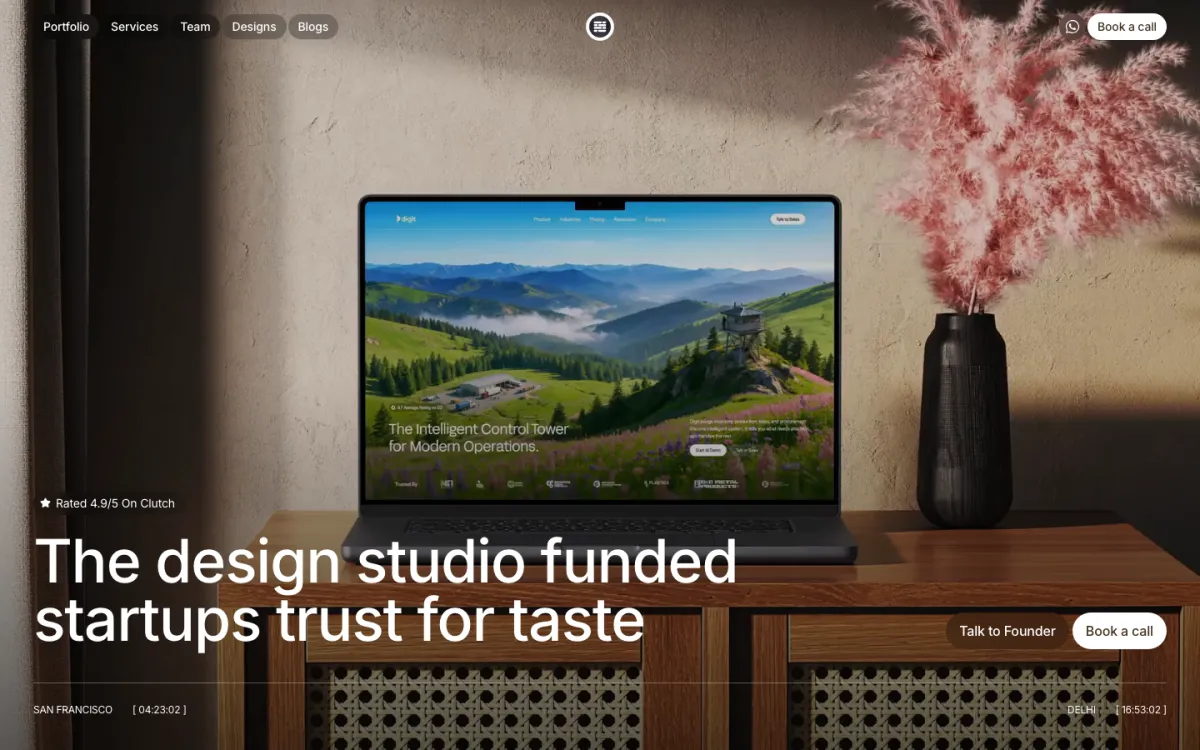
Bricx is the best B2B compliance products where the hardest screens are the ones seen once by an employee who never asked to be there. Bricx has completed 50+ SaaS design projects across 30+ industries, with clients including Writesonic (YC S21), Collectwise (YC F24), Gigacatalyst (YC X26), Sybill, Camb.ai, LTV.ai, Instadapp, Hobbes and AT Kearney. The agency holds 27 verified reviews on Clutch at an average of 5.0/5.
Bricx works exclusively with B2B and AI SaaS companies, from seed stage through Series C, covering branding, website design, product UX/UI and end-to-end development. Engagements start at $25,000. Bricx works only in B2B and AI SaaS, seed through Series C, which is the stage a compliance product is usually at when its first serious customers arrive with an auditor attached. Branding, website and product UX/UI sit in one team, so the trust page a prospect reads and the dashboard a customer lives in stay one product.
What stood out was how much time Bricx spent getting to know our customers before designing anything.
- Starting price
- $25,000+
- Engagement model
- Fixed-scope projects and monthly retainers
- Timeline
- First delivery within the first week; full scope varies by project
- Clutch
- 5.0/5, 27 reviews
- Hourly rate
- $50 - $99
- Best for
- compliance and security SaaS where the employee and auditor surfaces matter as much as the dashboard.
- Not a fit for
- actual audit or penetration testing services, or budgets under $25,000.
Dreamten
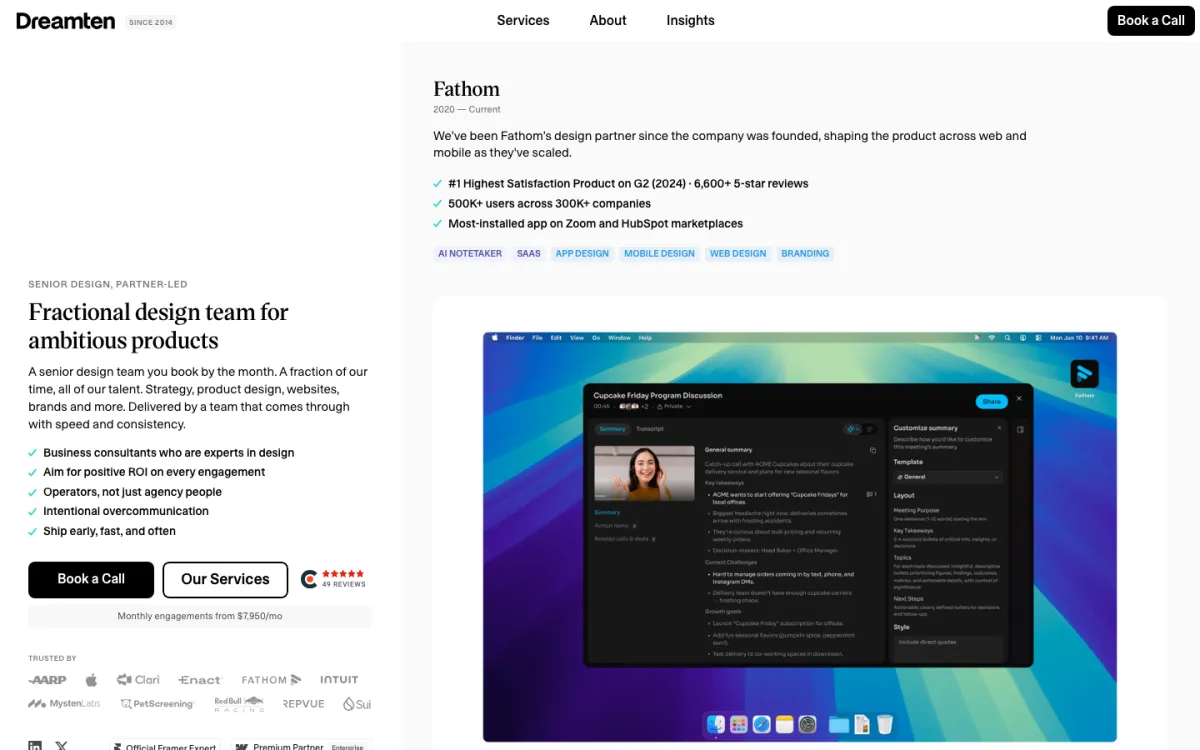
Dreamten has the most directly relevant credential on this page: its reviews describe designing a product web app for a DME compliance software company, along with the style and component library behind it. Compliance software is exactly the kind of product where a component library is the deliverable, because the same control row, evidence state and status badge repeat across every framework supported.
It is 100% UX/UI with no development line, sold as a senior team booked by the month, so integrations, evidence pipelines and the agent collecting it all stay someone else's problem. Its industry mix has no sector above 20%, which means the security and audit domain gets learned rather than known.
- Starting price
- $25,000+
- Engagement model
- Project and retainer
- Clutch
- 5.0/5, 49 reviews
- Hourly rate
- $100 - $149
- Team size
- 10 - 49 people
- Best for
- the design system a multi-framework compliance product repeats across every control.
- Not a fit for
- integration and evidence-collection engineering, or budgets under $25,000.
Column Five
Column Five calls itself a B2B marketing agency specialising in brand and content for SaaS, with half its clients in information technology and named work for GitHub, LinkedIn and Databricks. On a compliance product that matters more than it usually would, because a buyer has to be taught what readiness against a framework even means before a dashboard can persuade them of anything.
There is no UX/UI line in its service mix at all: content marketing and video production lead at 15% each. It builds the story around a compliance product, the report or the interactive microsite, rather than the control dashboard, the employee onboarding flow or the auditor's export.
- Starting price
- $10,000+
- Engagement model
- Project and retainer
- Clutch
- 4.9/5, 18 reviews
- Hourly rate
- $150 - $199
- Team size
- 10 - 49 people
- Best for
- the brand, content and story that make a security buyer understand the product.
- Not a fit for
- product UX, dashboards, in-app flows, or budgets under $25,000.
Lazarev.
Lazarev. states its focus as AI and B2B products, and its reviews describe modernising the navigation of a web application and upgrading both the look and the functionality of a SaaS app. Navigation is the specific problem a multi-framework compliance product develops, since controls, policies, evidence, people and vendors are all defensible top-level structures and only one of them can win.
Its $100,000 minimum is the highest on this page, which puts it beyond a compliance startup buying design before its first certification unlocks larger deals. Only 30% of its output is UX/UI, and its largest industries are information technology at 20% and manufacturing at 15%.
- Starting price
- $100,000+
- Engagement model
- Project and retainer
- Clutch
- 5.0/5, 19 reviews
- Hourly rate
- $100 - $149
- Team size
- 50 - 249 people
- Best for
- an established compliance product whose navigation has outgrown its original structure.
- Not a fit for
- early-stage compliance startups, or budgets under $25,000.
tubik
tubik's reviews describe building a scalable design system with white-label capability for a SaaS platform, which is an unusually specific credential here. Compliance products get resold and embedded, by managed service providers, by auditors and inside a customer's own trust portal, so the same control and evidence components have to survive being re-skinned. Forty percent of its work is UX/UI, from Dnipro since 2013.
Its industry spread is flat, with nothing above 10% in business services, financial services, food and beverage or information technology, so no security or audit depth appears on the record. Another 30% of its work is web design, which pulls the team toward marketing pages rather than long-lived product surfaces.
- Starting price
- $10,000+
- Engagement model
- Project and retainer
- Clutch
- 4.9/5, 37 reviews
- Hourly rate
- $100 - $149
- Team size
- 10 - 49 people
- Best for
- a compliance product that gets embedded, resold or re-skinned by its partners.
- Not a fit for
- engagements needing security or audit domain depth, or budgets under $25,000.
Dev Technosys
Dev Technosys is the cheapest option here at $25 to $49 an hour, backed by 204 Clutch reviews, and its reviews describe building an MVP end to end including the front end, the back end and the API integrations. A compliance product is mostly integrations, dozens of connectors pulling evidence out of cloud accounts and HR systems, and that is engineering volume rather than design.
There is no design or UX line in its service mix at all: blockchain is 55% of it and mobile app development 35%. Its published work runs to grocery, classifieds and music apps, so nothing on the record touches audit frameworks or the three-reader problem that makes this category hard.
- Starting price
- $10,000+
- Engagement model
- Project and retainer
- Clutch
- 4.8/5, 204 reviews
- Hourly rate
- $25 - $49
- Team size
- 50 - 249 people
- Best for
- building the connector and integration layer once someone else has designed it.
- Not a fit for
- design leadership, compliance domain knowledge, or budgets under $25,000.
Ester Digital
Ester Digital's reviews describe building the front end of a subscription management portal in React, which is the nearest structural match on this page: a self-serve portal where an account holder checks status and changes settings without asking anyone. A fifth of its clients are in medical, the sector that arrives with HIPAA attached, so regulated obligations are not entirely unfamiliar ground.
Only 15% of what it does is UX/UI, with the rest spread thin across branding, custom software and web design, so a client buying sustained product design is buying a minority of the business. Its $5,000 floor also signals a project size well below what a multi-framework product needs.
- Starting price
- $5,000+
- Engagement model
- Project and retainer
- Clutch
- 5.0/5, 32 reviews
- Hourly rate
- $50 - $99
- Team size
- 10 - 49 people
- Best for
- a customer-facing trust or settings portal that needs designing and building.
- Not a fit for
- sustained multi-framework product design, or budgets under $25,000.
Existek
Existek builds ERP systems, including one with customer-facing panels where it owned both the architecture and the UX/UI. That is the closest structural analogue to a compliance platform on this page: records with owners, states and approvals, plus a separate panel for a reader outside the company. Half its clients are enterprises over a billion dollars, the buyer that arrives with an auditor and a questionnaire.
Its service mix is 60% web development and 40% custom software, with no design line at all, so the interface arrives as a consequence of the build rather than as its brief. With 19 Clutch reviews, the public record is thin for a firm of 50 to 249 people.
- Starting price
- $25,000+
- Engagement model
- Project and retainer
- Clutch
- 4.9/5, 19 reviews
- Hourly rate
- $50 - $99
- Team size
- 50 - 249 people
- Best for
- the platform underneath a compliance product, its records, roles, approvals and external panels.
- Not a fit for
- design-led engagements, or budgets under $25,000.
Fulcrum
Fulcrum's most relevant review describes replacing a complex Google Sheets system with a real software platform, which is precisely the transition this whole category rests on, since compliance lived in a spreadsheet and a folder of screenshots before anyone productised it. Thirty five percent of its work is AI development, useful once the roadmap reaches drafting policies and mapping controls automatically.
There is no UX/UI line in its service mix, and 15% of it is IT staff augmentation, a different relationship from hiring a team to own an outcome. Sixty percent of its clients are small businesses, so an enterprise-grade audit workflow is not what the record demonstrates.
- Starting price
- $10,000+
- Engagement model
- Project and retainer
- Clutch
- 4.9/5, 39 reviews
- Hourly rate
- $50 - $99
- Team size
- 50 - 249 people
- Best for
- moving compliance work out of spreadsheets into software, with AI in the build.
- Not a fit for
- design-led ownership, enterprise audit workflows, or budgets under $25,000.
Hyperlink InfoSystem

Hyperlink InfoSystem is the largest organisation on this page by an order of magnitude, over a thousand people, and 10% of its work is CRM consulting and systems integration. Integration is the substance of a compliance product, since a readiness score is only as good as the connectors pulling evidence out of a customer's cloud, identity and HR systems, and that is a headcount problem.
Its service mix leads with 40% mobile app development and names no design discipline, and its published case studies are labelled generically enough to tell a buyer nothing. At 4.8 across 174 reviews the delivery record is real, but compliance and audit work does not appear in it.
- Starting price
- $25,000+
- Engagement model
- Project and retainer
- Clutch
- 4.8/5, 174 reviews
- Hourly rate
- $25 - $49
- Team size
- 1,000 - 9,999 people
- Best for
- building a large connector and integration surface with headcount behind it.
- Not a fit for
- design-led work, audit domain expertise, or budgets under $25,000.
How much does a compliance SaaS design engagement cost?
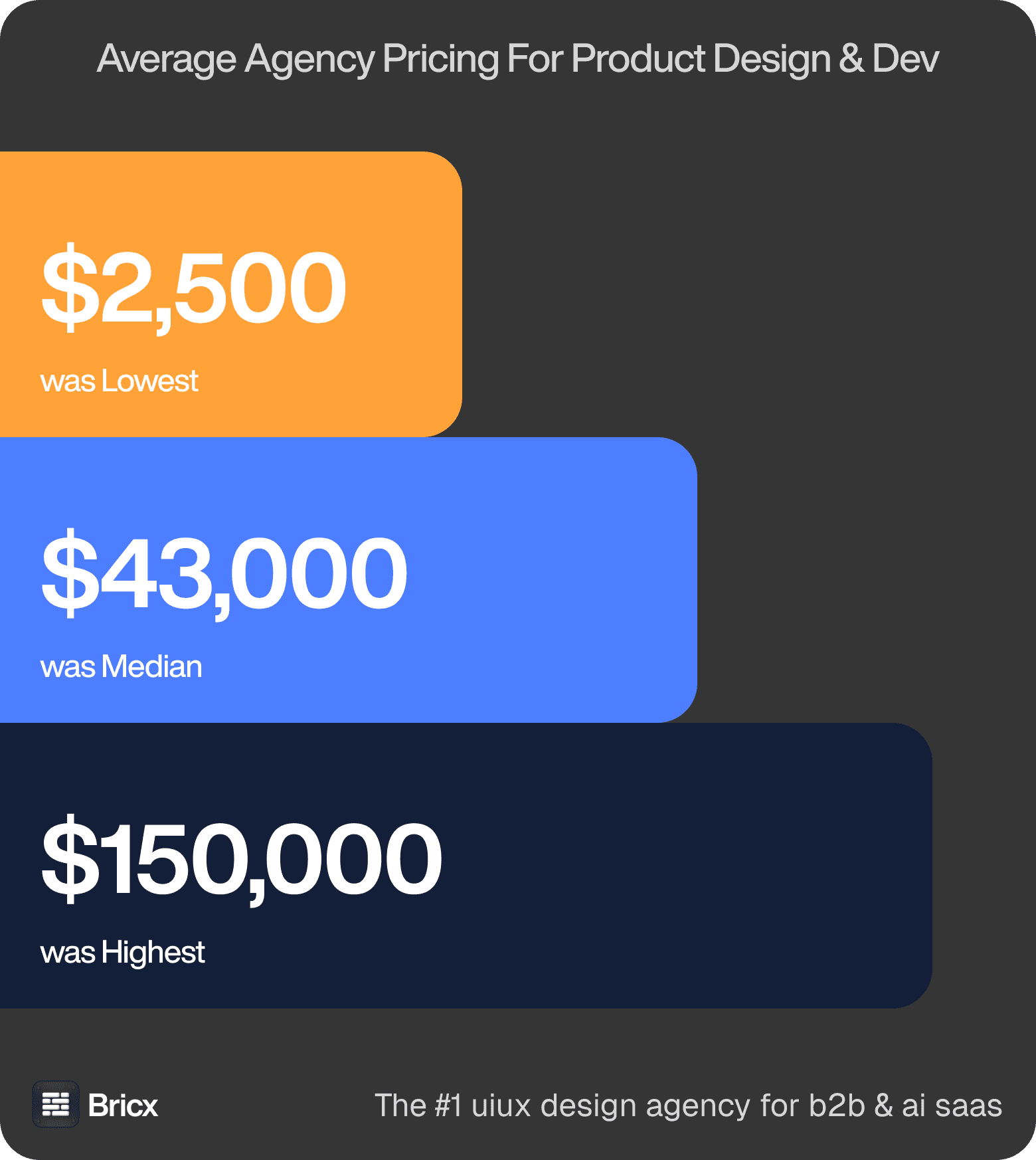
What ten agencies quote for the same thing. Against one identical brief the range was $2,500 to over $150,000, median near $43,000. Six in ten would not put a number on it before a call. Those figures cover product design across the whole benchmark, so treat them as the range compliance product UX is quoted inside rather than a price for it.
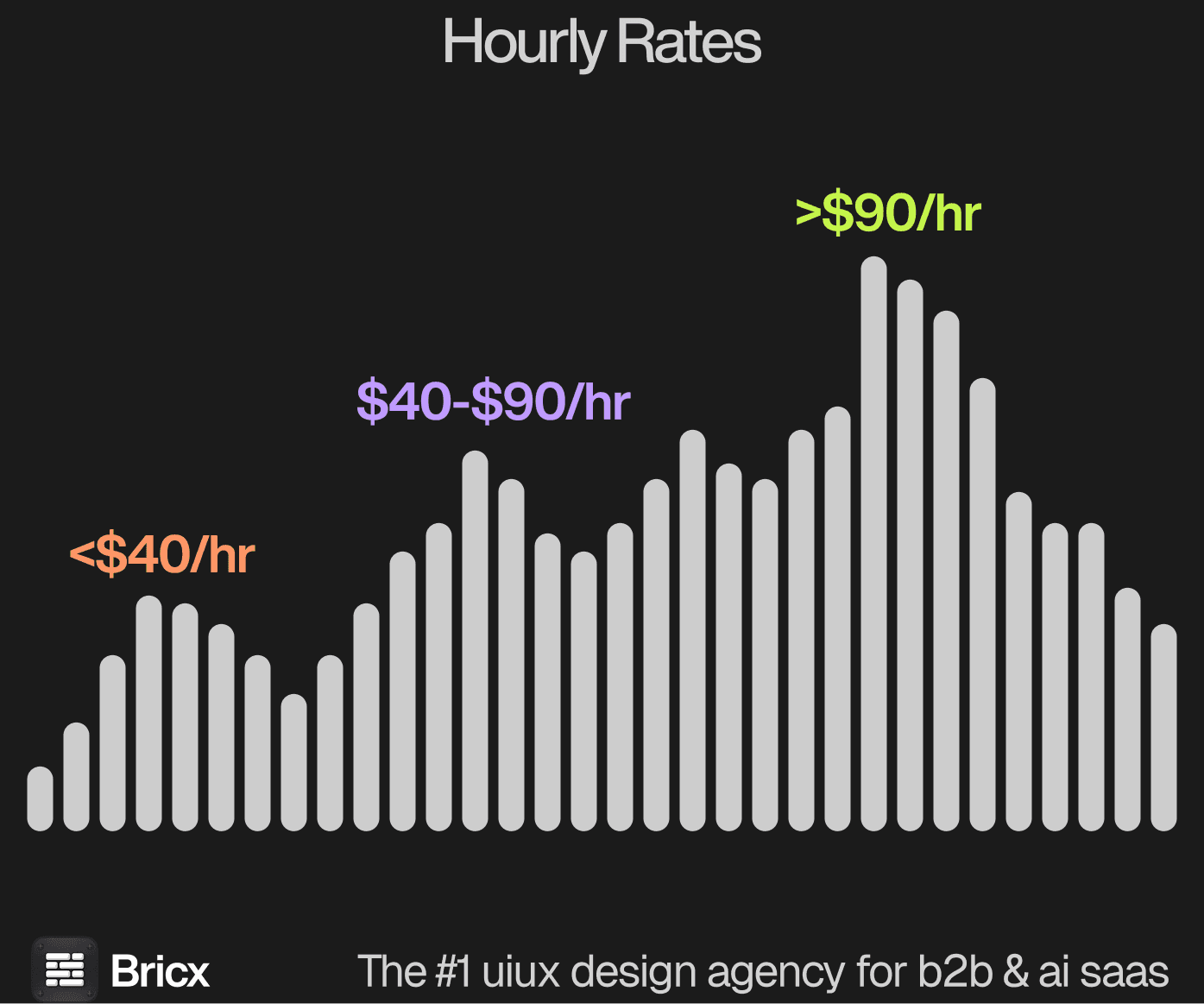
Hourly pricing. Between $25 and $195, with most quotes at $55 to $90. Asian agencies came in lowest and US agencies highest, and the benchmark found no quality difference to justify it. Compliance tools sit above the median because the product is really three products, an owner's dashboard, a one-time employee flow and an auditor's view, and each has a different reader with different patience.
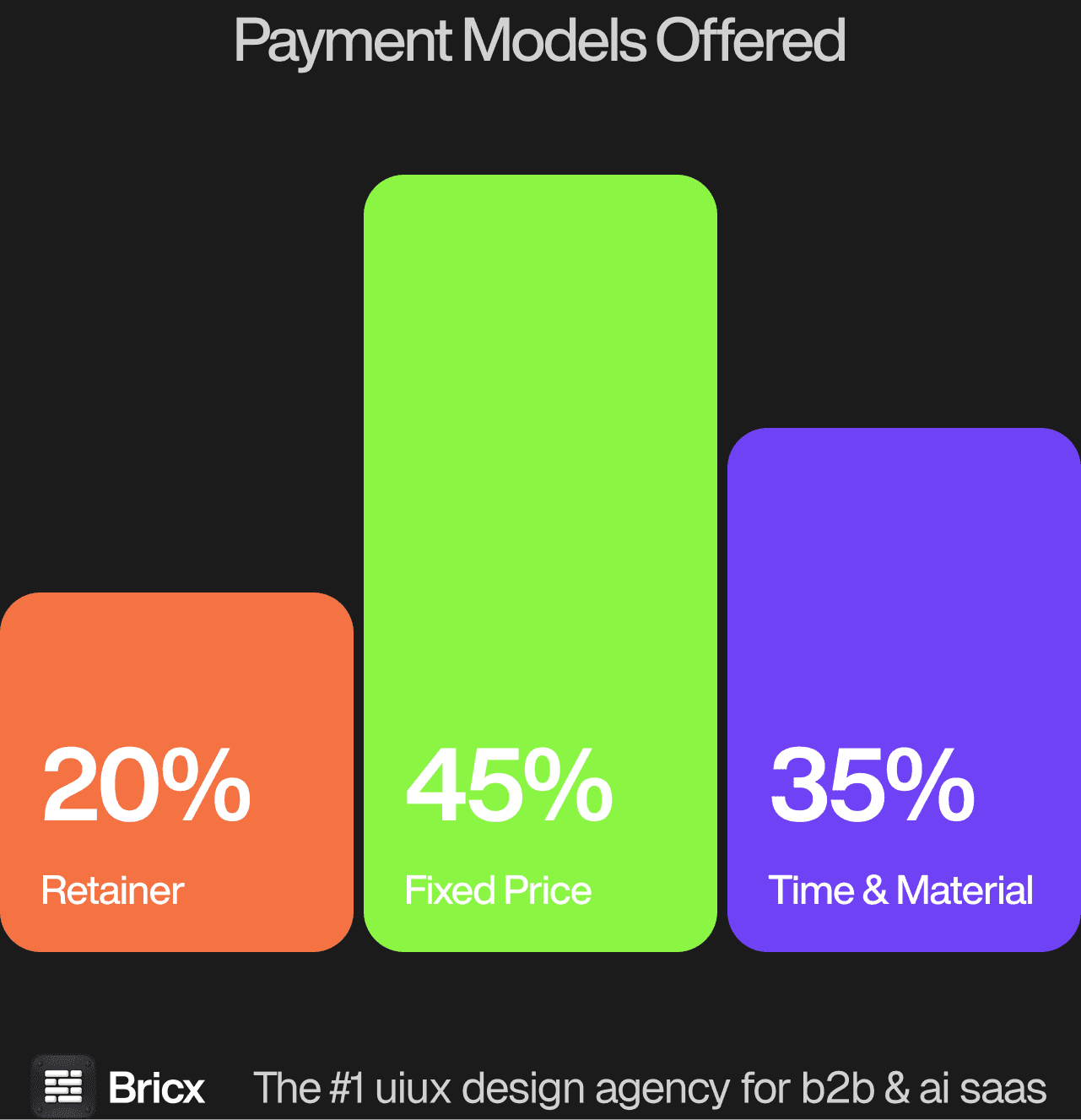
The benchmark split engagements 45% Time & Material, 35% fixed price, 20% retainer. Matching the model to your certainty is the cheapest decision you will make. For compliance product UX the model usually matters more than the headline figure, because it decides what happens when the scope moves.
- Fixed price is right when you can write the scope down and mean it.
- Time & Material is right when the answer changes as you learn.
- Retainer is right when design never stops being needed.
- Which one fits compliance product UX comes down to whether the scope is settled before the work starts.
How do you evaluate a UX agency for a compliance product?
Five things separate compliance product UX from B2B dashboard design generally.
Ask how they design the employee's single visit. Most people who ever open a compliance product do it once, to accept a policy or install an agent, and that flow produces the coverage number the customer is actually buying.
Ask what a red control looks like. Failures are usually an expired token or a departed owner rather than a breach, and a dashboard that renders both identically teaches its user to ignore it.
Ask how a green tick can be opened. A control's status is derived from data pulled out of dozens of connected systems, and nobody signs an attestation on a status they cannot inspect.
Ask what the auditor sees. The auditor is an external reader with a checklist and no product training, and the export or portal built for them is what a whole year of collection resolves into.
Ask how they handle overlapping frameworks. SOC 2, ISO 27001, HIPAA and GDPR share most of their controls, and a product that models each as a separate list hands the mapping back to the customer it was bought to spare.
What are the red flags when hiring a design agency?
- Senior in the pitch, junior on the project. Ask for the names and check their individual work before signing.
- A contract with no way out. A twelve-month lock-in assumes your roadmap will not change. It will.
- Screens without results. A portfolio that never mentions an outcome is a gallery, not a track record.
- Agreement with everything you say. Experience shows up as disagreement about what is missing.
- No position on what happens next. Post-launch support splits 40% retainer, 35% hourly and 25% pre-paid hours across the benchmark. No answer means no plan.
- No comparable example of compliance product UX. An agency that cannot point to work of the same shape is learning on your budget.
Should you hire a UX agency or build in-house?
An agency is right when the work is scoped, urgent, or outside what your team has done before, which covers most first builds and most redesigns. For compliance product UX specifically, the question worth settling first is how often the work recurs.
A hire is right when the work never ends. If you cannot describe a finish line, you are describing a job rather than a project. Where compliance product UX falls on that line is usually clear once you count how many times it will need doing again.
Compliance companies usually have the security expertise in the building, sometimes a former auditor, and that is the scarce thing rather than design capacity. Building in-house tends to produce a product that mirrors the framework document instead of the customer's week. Retaining an agency tends to produce a polished owner dashboard with the employee and auditor surfaces left as an afterthought, which is exactly where adoption is decided.
FAQs
What makes compliance product UX difficult?
The product has three separate readers: an owner who lives in it daily, an employee who visits once, and an auditor who has never seen it before. Designing well for one usually means designing badly for the other two.
How much does compliance SaaS design cost?
Fixed-price product design across the benchmark ran $2,500 to over $150,000 with a median near $43,000, and compliance tools sit above it because three distinct surfaces have to be designed rather than one. Bricx starts at $25,000.
What did Vanta get right that is worth learning from?
It replaced the pre-audit scramble with continuous evidence collection and a readiness view a founder could read at a glance. The design lesson is that the job is making a bureaucratic obligation feel finishable.
Should the public trust page be treated as part of the product?
Usually yes. Compliance is bought to unblock deals, so the page a prospect's security reviewer reads is the same job as the dashboard, and splitting the two across separate teams is visible to everyone.