Website Design

Website Design

Website Design

Insights

Insights

Insights

December 8, 2025

December 8, 2025

December 8, 2025

Agile vs Design Thinking: A Complete Comparison for Product Teams

Agile vs Design Thinking: A Complete Comparison for Product Teams

Agile vs Design Thinking: A Complete Comparison for Product Teams

Uncover the differences in Agile vs Design Thinking. Learn when to use each framework and how to combine them for elite product development.

Uncover the differences in Agile vs Design Thinking. Learn when to use each framework and how to combine them for elite product development.

Uncover the differences in Agile vs Design Thinking. Learn when to use each framework and how to combine them for elite product development.

4 mins

4 mins

4 mins

Author:

Siddharth Vij

Co-Founder, Bricx

Hi, I'm Sid. I lead design at Bricx. We work with B2B & AI SaaS companies to craft unforgettable user experiences.

When people get into the Agile vs. Design Thinking debate, they're often missing the point. The fundamental difference is actually pretty simple: Design Thinking is all about finding the right problems to solve, while Agile is the framework for solving those problems efficiently.

Think of it this way: one is focused on the "why" (exploring and defining user needs), and the other is focused on the "how" (iteratively building and shipping the solution). They aren't rivals; they're partners that, when used together, create a powerful product development engine.


Defining Agile and Design Thinking
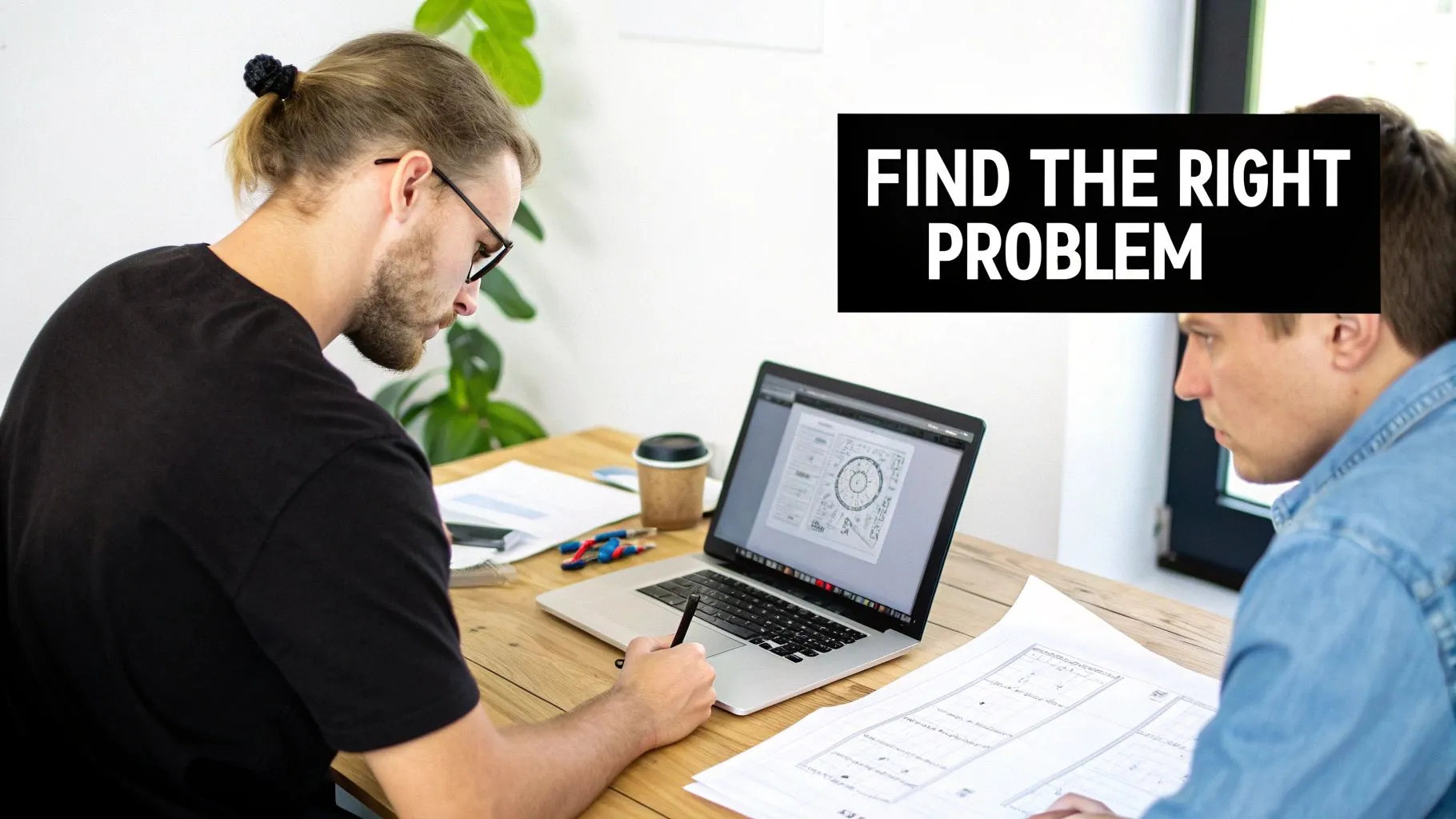

Two men collaborating at a desk, looking at technical drawings on a laptop and paper.


To really get a feel for how they work, look at them through the lens of a product's lifecycle. Design Thinking comes in first. It's the strategic compass that makes sure your team is building something people actually want before a single line of code is written. It's a deeply human-centered, exploratory process for digging into user pain points and sparking creative solutions.

Agile, on the other hand, is the engine that actually builds the product. It’s a methodology laser-focused on execution, designed for building things piece-by-piece and reacting to feedback along the way. Agile teams work in short sprints, delivering functional software, getting it in front of users, and making adjustments on the fly.


What Is Design Thinking?

At its core, Design Thinking is a problem-finding methodology. The main goal is to get so in tune with your target user that you uncover needs they might not even be able to articulate themselves. By starting with empathy, teams can move past the obvious fixes and build something genuinely innovative. We've got a more detailed breakdown of the core principles of Design Thinking that shows how it really works.

A few key traits define it:


  • Human-Centered: The user is everything. The process starts with them and ends with them.

  • Exploratory and Non-Linear: You're encouraged to go wide and explore a ton of ideas before narrowing in on the best one. It's messy by design.

  • Focus on Ambiguity: It truly shines when you're not even sure what the real problem is yet.


What Is Agile?

Agile is a problem-solving methodology built for speed and adaptability. It was created as an antidote to the slow, rigid waterfall development process, with the goal of getting value to the market as quickly and consistently as possible. It works by breaking down huge projects into small, manageable chunks, which allows teams to learn and pivot as they go.

Its core characteristics are:


  • Iterative and Incremental: Work happens in short, repeatable cycles, and at the end of each one, you have a working piece of the product to show for it.

  • Adaptive: Agile not only accepts changing requirements but welcomes them, even late in the game.

  • Collaborative: It relies on tight collaboration within self-organizing teams and constant communication with stakeholders.

Key Takeaway: Here's the simplest way to remember it: Design Thinking makes sure you build the right thing. Agile makes sure you build the thing right. One defines what "value" means to the user, and the other delivers that value efficiently.


Understanding the Core Mindset Behind Each Framework

To really get the difference between Agile and Design Thinking, you have to look past the processes and understand the mindset driving each one. They aren't just a set of steps; they're fundamentally different ways of thinking about how to solve problems.


The Design Thinking Mindset: Fall in Love With the Problem

At its heart, Design Thinking is all about empathy and putting people first. The whole philosophy is built on the belief that the best solutions come from a deep, almost obsessive, understanding of the user’s real-world needs, pains, and motivations.

It encourages teams to lean into ambiguity. An unclear problem isn't a dead end; it's an invitation to explore. This means you have to be comfortable spending a lot of time in the "problem space" before you even think about building anything. The core idea is that building a product without that deep user insight is just guessing. That's why the philosophy puts a premium on qualitative understanding from the get-go. If you're new to this, we have a detailed guide on the user research techniques that are the bedrock of this approach.

This mindset is all about finding the right question before rushing to an answer. It's a divergent process at first, pushing teams to brainstorm a ton of ideas—the crazier, the better—before narrowing them down. This makes it perfect for tackling those really messy, "wicked" problems where you don't even know what the requirements are yet. It’s about figuring out what to build, not just how fast you can build it.


"Design Thinking is a search for the right question. It guides teams to fall in love with the user's problem, not their own solution. Only by deeply understanding the 'why' behind a user's struggle can you build a product that truly resonates."


The Agile Mindset: Deliver Value and Adapt


Deliver Value and Adapt


Agile, on the other hand, comes from a philosophy of incremental progress and adaptability. It fully accepts that you can't predict everything from the start. The best way to deal with that uncertainty is to build, test, and learn in fast, iterative cycles. The guiding principle? Ship working software often to get real, actionable feedback from the market.

This mindset is all about action. It values tangible results over endless deliberation. Agile operates on the assumption that you know the general direction you’re headed, but the specific path will change along the way. It’s focused on building the solution right, one piece at a time, and tweaking the plan based on what you learn with each new release.

This approach is incredibly powerful for cutting through development complexity. Both Agile and Design Thinking share a deep respect for the user, which makes mastering customer needs identification a critical skill for any team. By breaking big projects into smaller chunks, Agile lowers the risk and keeps the team focused on what delivers the most value right now.

The real magic happens when you bring these two mindsets together. A survey of Agile professionals in Brazil found that 72.44% were already using Design Thinking alongside Agile methods. What's more, 84.25% applied it in multidisciplinary teams, and 74.02% used it specifically for creating new software. These numbers show just how well these philosophies complement each other in driving user-centric innovation. You can dive into the full findings of the Brazilian Agile professionals survey.

So, the philosophical split looks like this:


  • Design Thinking's Philosophy: Start with human needs. Explore ambiguity to define the right problem, and then validate concepts before you write a single line of code.

  • Agile's Philosophy: Start with a known goal. Build in small, rapid increments to deliver value quickly, and be ready to adapt based on feedback and changing priorities.

Getting a handle on these foundational mindsets is the first real step to blending their strengths in your own product workflow.


Comparing The Agile And Design Thinking Processes

On the surface, both Agile and Design Thinking are user-focused. But when you look at how a team actually spends its day, the processes are worlds apart. To really get a feel for the agile vs design thinking debate, you have to compare their workflows, the documents they produce, and the roles people play. This uncovers not just what they do, but how they create value at different points in a product's lifecycle.

A solid comparison relies on structured evaluation, and understanding the core principles of comparative analysis helps keep things clear and objective.

At its heart, product development is about turning a question into a solution.
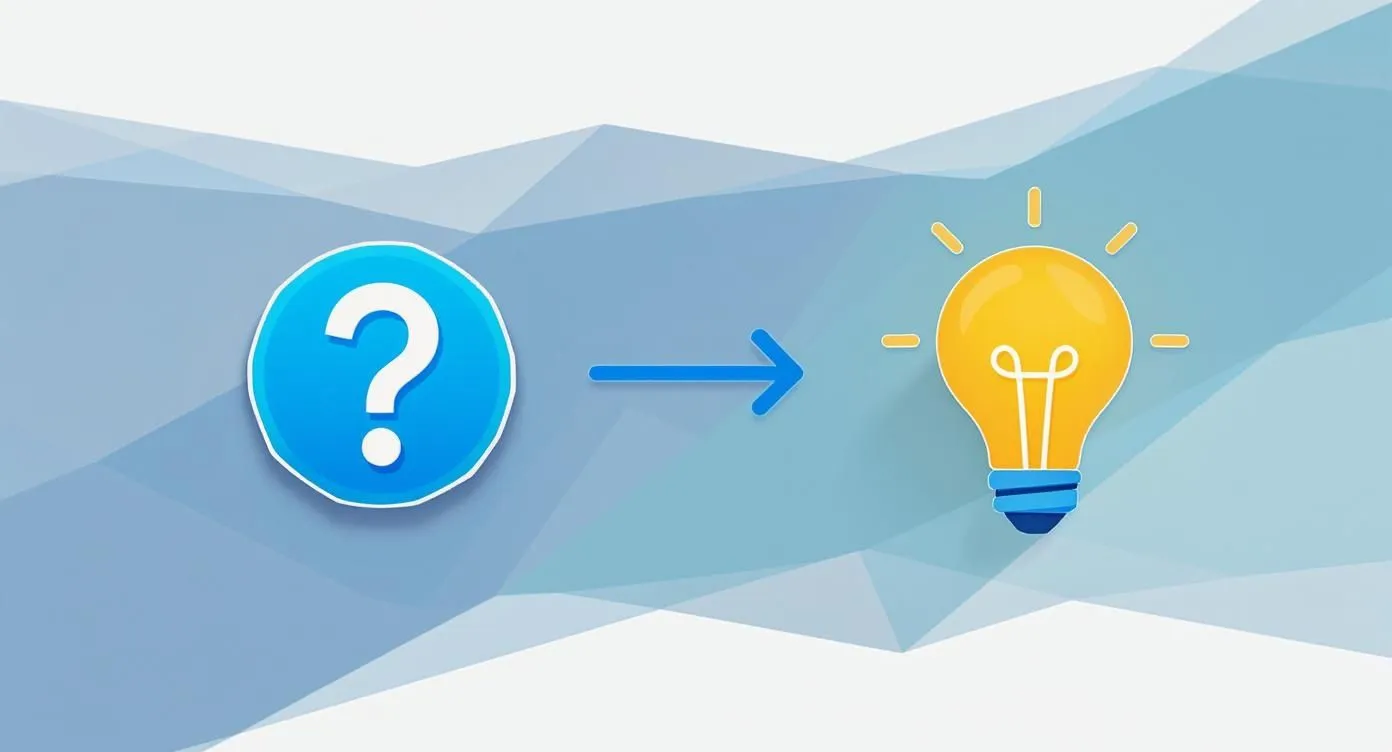

A blue question mark icon transforms into a glowing yellow lightbulb via an arrow, symbolizing problem-solving.

Think of it this way: Design Thinking is all about deeply understanding and framing the right question (the problem), while Agile is laser-focused on efficiently building and delivering the best answer (the solution).


The Design Thinking Workflow: A Journey Of Discovery

Design Thinking isn't a straight line. It’s an exploratory, often messy journey designed to get to the root of a user's problem before a single line of code is written. It generally moves through five phases, but teams often loop back and forth between them.


  1. Empathize: This is where it all begins—with people. Teams get out of the building to conduct interviews, observe users in their natural environment, and just listen. The goal is to collect raw, qualitative data like stories, quotes, and direct observations.

  2. Define: All that raw data gets synthesized here. The team works to frame a clear, actionable problem statement from the user's point of view. Key outputs include user personas and empathy maps that bring the target user to life.

  3. Ideate: With a well-defined problem in hand, it's time for wide-open brainstorming. The rule is "quantity over quality" at this stage, using techniques like "How Might We" questions to generate a vast number of potential solutions without judgment.

  4. Prototype: The most promising ideas are turned into something tangible. We're not talking about a working product; these are low-fidelity, cheap mockups—think paper sketches, clickable wireframes, or even role-playing scenarios. Their only job is to test a core concept.

  5. Test: Those lo-fi prototypes are put in front of real users to see how they react. This isn't about validating a feature; it's about learning. The feedback gathered here often sends the team right back to the Define or Ideate stage.


This entire cycle is about de-risking the work that comes later. By investing time here, you make sure you’re solving a problem people actually care about. To see how these activities fit into a broader context, it's useful to look at the complete product design process steps.


The Agile Workflow: An Engine For Delivery
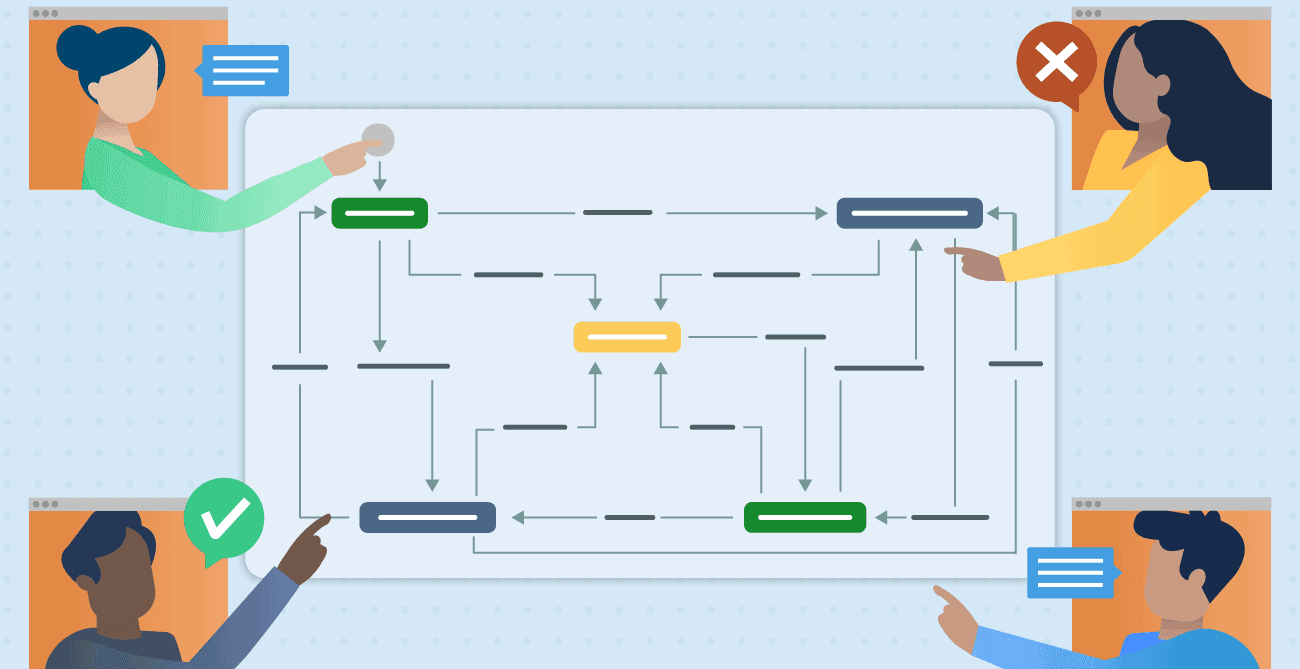

Agile Workflow


In contrast, an Agile process like Scrum is a well-oiled machine for building a known solution. It operates on the assumption that the "what" and "why" are largely figured out, and its focus shifts to executing efficiently and adapting to new information along the way.


Key Difference: Design Thinking artifacts (like personas) are all about defining the user. Agile artifacts (like user stories) are all about defining the work. This subtle but critical shift from a user-centric lens to a work-centric one is a core differentiator.


The Scrum workflow is built on short, repeatable cycles called Sprints.

  • Sprint Planning: Before each Sprint (usually 1-4 weeks), the team commits to a chunk of work. They pull high-priority items from the product backlog into their Sprint backlog, often framed as user stories that describe a feature from a user’s perspective.

  • The Sprint: For the next few weeks, the development team is heads-down, focused on turning the items in the Sprint backlog into a working piece of the product.

  • Daily Stand-ups: Each day, the team has a quick, 15-minute sync to share what they did, what they’ll do next, and if anything is blocking them. It keeps everyone aligned and surfaces problems fast.

  • Sprint Review: At the Sprint’s end, the team demos what they built to stakeholders. This is a critical feedback loop for the product itself.

  • Sprint Retrospective: The final meeting is for the team to reflect on its own process. They discuss what worked, what didn't, and how they can improve in the next Sprint. This is a feedback loop for their workflow.


This rhythm creates a predictable cadence for shipping value, getting user feedback, and continuously improving both the product and the team’s performance.

To make the differences even clearer, let's break down the key process attributes side-by-side.


Agile vs Design Thinking Key Process Differentiators

This table isolates the core focus and outputs at each stage, highlighting how each methodology approaches the journey from idea to implementation.


Attribute

Design Thinking

Agile (Scrum)

Primary Goal

Understand and define the user problem.

Build and deliver a working solution incrementally.

Pacing

Non-linear and exploratory; phases can be revisited.

Linear and cyclical; time-boxed Sprints.

Core Activities

User research, synthesis, brainstorming, low-fi prototyping.

Planning, development, testing, and deployment.

Focus of Feedback

On the problem definition and solution concept.

On the working software and the team's process.

Key Artifacts

Personas, empathy maps, journey maps, paper prototypes.

Product backlog, user stories, burndown charts.

Outcome

A validated problem and a high-level solution concept.

A potentially shippable product increment.


As you can see, Design Thinking is all about finding the right hill to climb, while Agile provides the best tools for actually climbing it. One finds the problem, the other builds the solution.


When to Use Agile vs. Design Thinking
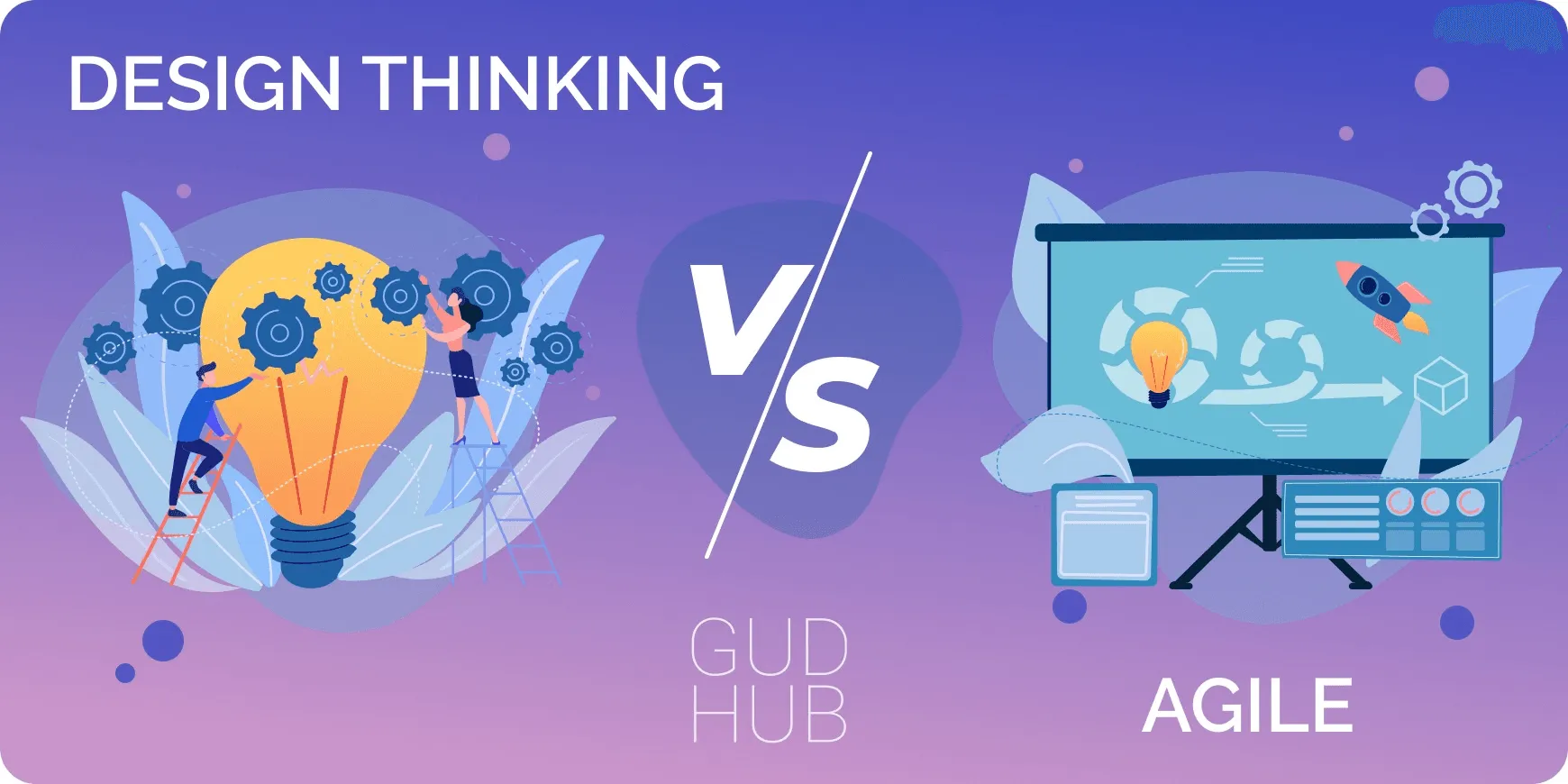

Agile vs. Design Thinking


Deciding between Agile and Design Thinking isn't about picking a “better” methodology. It's about knowing which tool to pull out of the toolbox for the job you have right now. The whole debate really boils down to one simple question: Are you still figuring out the problem, or are you ready to start building the solution?

Think of one as your compass for navigating the fuzzy, unknown territory of user needs, and the other as your engine for building the product with speed and focus. Getting this choice right saves a ton of wasted time and keeps your team aimed at the right target.


Go with Design Thinking for Discovery and Innovation

You'll want to lean on Design Thinking when you’re staring at a blank canvas. It’s perfect for those early, messy stages where you have more questions than answers, and understanding people is far more important than writing code.

Reach for Design Thinking when your team needs to:


  • Explore a New Market or User Segment: Before you even think about features, you have to get inside the heads of your potential customers. Design Thinking gives you a structured way to do the deep, empathetic research needed to uncover real, unmet needs.

  • Define a Brand-New MVP: The biggest risk with a new product isn't building it poorly; it's building the wrong thing altogether. This framework helps you validate the core problem and test cheap, low-fidelity concepts before you commit a single line of code. A well-vetted MVP is the foundation of any good product, and our guide on product roadmap best practices can help you map out that journey.

  • Tackle a "Wicked" Problem: These are the big, tangled challenges with no clear starting point—like redesigning a clunky enterprise system that users have been stuck with for a decade. A human-centered approach is the only way to untangle the real issues buried under years of workarounds.


Here’s a real-world example: Imagine your SaaS company decides to build an AI-powered reporting tool. The instinct is to start listing features. Instead, you use Design Thinking. Your team shadows a few managers, and you quickly discover their actual pain isn't getting data—it's the hours they waste turning that data into a compelling story for their boss. That single insight changes everything. The product is no longer a data-dump tool; it’s a narrative-building assistant.


Choose Agile for Execution and Adaptation

 Execution and Adaptation


Once you have a clear direction and know what you need to build, it's time to switch to Agile. It’s built for the execution phase, where the question shifts from "what do we build?" to "how do we build it efficiently and react to feedback along the way?"

Agile is your best bet when your team needs to:


  • Build a Well-Defined Product or Feature: After Design Thinking has validated the user need (like the narrative-building AI tool), Agile provides the rhythm and structure to actually build it through sprints, user stories, and daily check-ins.

  • Iterate on an Existing Product: For a live product, Agile’s short cycles are perfect. You can ship an improvement, see how users react, measure the impact, and decide what to do next without getting locked into a long-term plan.

  • Navigate Technical Uncertainty: Even the clearest product vision will hit technical roadblocks. Agile's iterative nature lets developers tackle tricky implementation problems in small chunks, adapt to surprises, and find the best technical solution without derailing the entire project.


The data backs this up. A recent global survey found that 39% of teams using Agile reported the highest project performance, boasting an impressive 75.4% overall success rate. This puts it slightly ahead of other methods, proving its muscle in fast-moving development cycles. You can explore more project performance statistics on Businessmap.io.

By matching the framework to the maturity of your idea, you ensure your team is always focused on what matters most—whether that’s understanding the user or shipping the code.


Integrating Agile and Design Thinking for Product Success
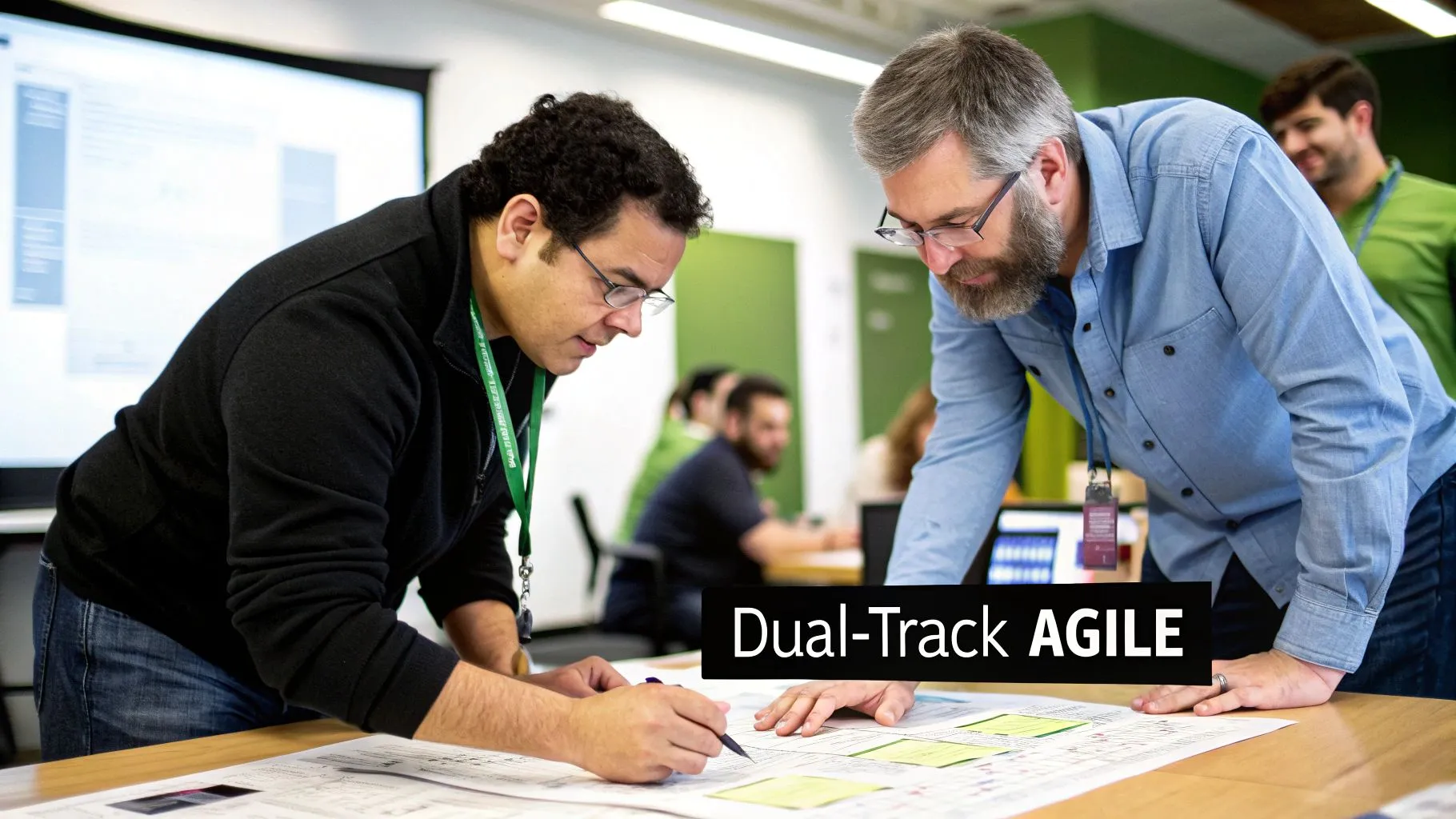

Two men wearing glasses collaborate over documents and sticky notes on a table in a bright office.

The whole "Agile vs. Design Thinking" debate misses the point. It’s not about picking a winner. It's about realizing they’re two sides of the same coin—one for discovering the right problem, the other for delivering the right solution. When you fuse them, you get a powerful, user-centric engine for building products that actually matter.

This integrated approach solves a classic pitfall: treating Design Thinking as a one-off brainstorming session before the real work begins. The most successful teams I've worked with make discovery a continuous activity that runs in parallel with development. This is where the Dual-Track Agile model really shines.


Understanding Dual-Track Agile

Dual-Track Agile is a framework that splits product development into two parallel, constantly interacting streams: Discovery and Delivery. It’s built on a simple premise: your team should be learning about users at the same time it’s building and shipping code.

  • The Discovery Track (Design Thinking): This is your "problem-finding" lane. It’s a nonstop cycle of user research, brainstorming, and quick-and-dirty prototyping to validate ideas before a single line of code is written. The goal here isn't shippable software; it's validated learning and confidence.

  • The Delivery Track (Agile): This is your "solution-building" lane. Think of your standard Agile workflow—sprints, stand-ups, retros—focused on turning validated concepts from the Discovery Track into high-quality, working software.

This structure is a game-changer. It stops the development team from building features based on guesswork. Instead, the product backlog is constantly fed with well-researched, user-tested ideas, which dramatically boosts the impact of everything you build.

By running discovery and delivery in parallel, you create a system where user insights directly inform engineering priorities. The Discovery Track’s job is to ensure the Delivery Track is always working on the most valuable thing for the customer.


The Handoff: A Repeatable Blueprint

The real magic of Dual-Track Agile happens at the handoff between the two tracks. This isn't some formal, bureaucratic process. It’s a fluid exchange where abstract user needs are translated into concrete, buildable tasks.

A fantastic tool for bridging this gap is the design sprint. It’s an intense, five-day process designed to answer critical business questions by designing, prototyping, and testing ideas with actual users. If you're new to the concept, our guide on what is a design sprint is a great place to start.

Here’s a practical look at how the process unfolds:


  1. From Problem to Prototype (Discovery): The product manager, a designer, and a tech lead dive into the Discovery Track. They talk to users, map out pain points, and sketch out potential solutions. They build a low-fidelity prototype—maybe a simple clickable wireframe—to test a single, critical assumption.

  2. Validation and Learning (Discovery): They put that prototype in front of five to six real users. Did it solve the problem? If yes, you've got a validated concept ready for the backlog. If not, you iterate or pivot. The best part? You've only spent a few days, not weeks or months, finding this out.

  3. From Prototype to Backlog (Handoff): The validated prototype and the user feedback become the foundation for high-quality backlog items. The PM can now write user stories backed by direct evidence, not just a hunch.

  4. Building and Shipping (Delivery): The development team pulls these validated stories into their sprints. Because they have the context from the prototype and research, they understand the why behind the feature, which always leads to a better end product.


Why This Hybrid Model Works

Hybrid Model


This integrated approach isn't just a trend; it's a fundamental shift in how modern product teams operate. The rapid adoption of hybrid project management methods, which jumped from 20% in 2020 to 31.5% in 2023, confirms this.

We're also seeing Agile adoption skyrocket among Engineering and R&D teams, which now account for 48% of all Agile practitioners—that's a 16% jump since 2022. This tells us that while teams are laser-focused on efficient delivery, they also know that efficiency is worthless without a great strategy feeding the machine.

By pairing Design Thinking’s exploratory power with Agile’s execution engine, you build a system that doesn’t just build products fast—it builds the right products, right from the start. And that’s the real secret to sustainable success.


Answering Your Top Questions About Agile and Design Thinking

Even when you've got the basics down, real-world questions always pop up when teams try to blend these two powerful approaches. Let's tackle some of the most common sticking points and get you some direct, practical answers.


Can a Small Startup Really Use Both Agile and Design Thinking?

Absolutely. In fact, startups are probably in the best position to get the most out of a hybrid approach, even without a lot of formal processes. It's all about adopting the right mindsets.

Start with Design Thinking to really dig into customer discovery. You need to validate that you’re solving a real problem people care about before a single line of code gets written. This simple step dramatically reduces the risk of building something nobody wants—a classic and often fatal mistake for a new company.

Once you’ve got a validated concept for your Minimum Viable Product (MVP), that's your cue to switch into an Agile gear. Whether it's Scrum or Kanban, the goal is to build, measure, and learn as fast as you can. For a small team, you don't need all the heavy ceremonies. Think of it as a simple "Dual-Track Agile"—the founder might spend their time on customer interviews (Discovery), while the engineering team works in quick cycles to build out features based on what's being learned (Delivery). This keeps the startup both user-obsessed and incredibly nimble.


What Are the Biggest Mistakes Teams Make When Combining These Methods?

The most common pitfall by far is treating Design Thinking as a one-and-done "Phase Zero." Teams do a bunch of research upfront, hand it off, and then dive headfirst into Agile development, never looking back. But that’s not how it works. True integration means discovery is continuous.

The market doesn’t stand still. Neither do your users' needs. To stay relevant, your discovery work has to run in parallel with development, constantly feeding the delivery track with fresh, validated insights.


Another massive mistake is siloing the "design team" from the "development team." For this to work, your engineers have to be in the room during ideation and prototyping. Their technical perspective is gold for figuring out what's feasible early on, saving everyone headaches down the road.

By the same token, designers can't just disappear once Agile sprints begin. They need to stick around to provide context for user stories, answer questions, and make sure the user experience they envisioned actually makes it into the final product. Without that deep, cross-functional collaboration, all those valuable user insights get lost in translation.


How Do You Measure the Success of Design Thinking Within an Agile Process?

Measuring the ROI of Design Thinking can feel a bit squishier than tracking hard Agile metrics like velocity, but it’s just as important. You’re essentially looking for leading indicators that prove you're building the right thing, which ultimately saves a ton of time and money.

Here's what to look for:


  • Higher Quality Feedback: Notice how user feedback on prototypes and early releases becomes clearer and more positive. Instead of users being confused, you start getting genuinely constructive input.

  • A Better Product Backlog: Your backlog should start to shift. You’ll move away from simple feature requests ("I want a new dashboard") to outcome-focused user stories grounded in real needs ("As a manager, I need to see my team's performance at a glance so I can step in to help").

  • Stronger Adoption and Engagement: When you launch new features, keep an eye on how quickly users adopt them and how much they use them. High rates here are a great sign that you nailed a real user problem.

  • Less Rework: A solid discovery process should mean fewer big, painful changes late in the development cycle. That directly translates to less wasted engineering effort and faster time-to-value.


Do We Need to Hire a Dedicated "Design Thinker"?

Not necessarily. Look, having a dedicated UX researcher or a product designer with deep Design Thinking expertise is a massive advantage. But at its core, the methodology is a mindset that the entire team can—and should—adopt.

The real goal is to build a culture of empathy and curiosity across every role. Give everyone—product managers, engineers, marketers—the tools and the permission to talk to users, jump into brainstorming sessions, and help with prototyping.

Often, a product manager or scrum master can step up to facilitate Design Thinking workshops and user interviews. The point is to create shared ownership of the user's problem. When the whole team feels responsible for understanding the user, the solutions they build are just better. That shared context is the real engine of innovation when you're blending agile vs design thinking.

Ready to build a product that users love, backed by a design process that delivers results? At Bricx, we specialize in UI/UX design for B2B and AI SaaS companies, turning validated ideas into exceptional products. Let's discuss how we can help you design your next MVP or redesign your existing product.

When people get into the Agile vs. Design Thinking debate, they're often missing the point. The fundamental difference is actually pretty simple: Design Thinking is all about finding the right problems to solve, while Agile is the framework for solving those problems efficiently.

Think of it this way: one is focused on the "why" (exploring and defining user needs), and the other is focused on the "how" (iteratively building and shipping the solution). They aren't rivals; they're partners that, when used together, create a powerful product development engine.


Defining Agile and Design Thinking


Two men collaborating at a desk, looking at technical drawings on a laptop and paper.


To really get a feel for how they work, look at them through the lens of a product's lifecycle. Design Thinking comes in first. It's the strategic compass that makes sure your team is building something people actually want before a single line of code is written. It's a deeply human-centered, exploratory process for digging into user pain points and sparking creative solutions.

Agile, on the other hand, is the engine that actually builds the product. It’s a methodology laser-focused on execution, designed for building things piece-by-piece and reacting to feedback along the way. Agile teams work in short sprints, delivering functional software, getting it in front of users, and making adjustments on the fly.


What Is Design Thinking?

At its core, Design Thinking is a problem-finding methodology. The main goal is to get so in tune with your target user that you uncover needs they might not even be able to articulate themselves. By starting with empathy, teams can move past the obvious fixes and build something genuinely innovative. We've got a more detailed breakdown of the core principles of Design Thinking that shows how it really works.

A few key traits define it:


  • Human-Centered: The user is everything. The process starts with them and ends with them.

  • Exploratory and Non-Linear: You're encouraged to go wide and explore a ton of ideas before narrowing in on the best one. It's messy by design.

  • Focus on Ambiguity: It truly shines when you're not even sure what the real problem is yet.


What Is Agile?

Agile is a problem-solving methodology built for speed and adaptability. It was created as an antidote to the slow, rigid waterfall development process, with the goal of getting value to the market as quickly and consistently as possible. It works by breaking down huge projects into small, manageable chunks, which allows teams to learn and pivot as they go.

Its core characteristics are:


  • Iterative and Incremental: Work happens in short, repeatable cycles, and at the end of each one, you have a working piece of the product to show for it.

  • Adaptive: Agile not only accepts changing requirements but welcomes them, even late in the game.

  • Collaborative: It relies on tight collaboration within self-organizing teams and constant communication with stakeholders.

Key Takeaway: Here's the simplest way to remember it: Design Thinking makes sure you build the right thing. Agile makes sure you build the thing right. One defines what "value" means to the user, and the other delivers that value efficiently.


Understanding the Core Mindset Behind Each Framework

To really get the difference between Agile and Design Thinking, you have to look past the processes and understand the mindset driving each one. They aren't just a set of steps; they're fundamentally different ways of thinking about how to solve problems.


The Design Thinking Mindset: Fall in Love With the Problem

At its heart, Design Thinking is all about empathy and putting people first. The whole philosophy is built on the belief that the best solutions come from a deep, almost obsessive, understanding of the user’s real-world needs, pains, and motivations.

It encourages teams to lean into ambiguity. An unclear problem isn't a dead end; it's an invitation to explore. This means you have to be comfortable spending a lot of time in the "problem space" before you even think about building anything. The core idea is that building a product without that deep user insight is just guessing. That's why the philosophy puts a premium on qualitative understanding from the get-go. If you're new to this, we have a detailed guide on the user research techniques that are the bedrock of this approach.

This mindset is all about finding the right question before rushing to an answer. It's a divergent process at first, pushing teams to brainstorm a ton of ideas—the crazier, the better—before narrowing them down. This makes it perfect for tackling those really messy, "wicked" problems where you don't even know what the requirements are yet. It’s about figuring out what to build, not just how fast you can build it.


"Design Thinking is a search for the right question. It guides teams to fall in love with the user's problem, not their own solution. Only by deeply understanding the 'why' behind a user's struggle can you build a product that truly resonates."


The Agile Mindset: Deliver Value and Adapt


Deliver Value and Adapt


Agile, on the other hand, comes from a philosophy of incremental progress and adaptability. It fully accepts that you can't predict everything from the start. The best way to deal with that uncertainty is to build, test, and learn in fast, iterative cycles. The guiding principle? Ship working software often to get real, actionable feedback from the market.

This mindset is all about action. It values tangible results over endless deliberation. Agile operates on the assumption that you know the general direction you’re headed, but the specific path will change along the way. It’s focused on building the solution right, one piece at a time, and tweaking the plan based on what you learn with each new release.

This approach is incredibly powerful for cutting through development complexity. Both Agile and Design Thinking share a deep respect for the user, which makes mastering customer needs identification a critical skill for any team. By breaking big projects into smaller chunks, Agile lowers the risk and keeps the team focused on what delivers the most value right now.

The real magic happens when you bring these two mindsets together. A survey of Agile professionals in Brazil found that 72.44% were already using Design Thinking alongside Agile methods. What's more, 84.25% applied it in multidisciplinary teams, and 74.02% used it specifically for creating new software. These numbers show just how well these philosophies complement each other in driving user-centric innovation. You can dive into the full findings of the Brazilian Agile professionals survey.

So, the philosophical split looks like this:


  • Design Thinking's Philosophy: Start with human needs. Explore ambiguity to define the right problem, and then validate concepts before you write a single line of code.

  • Agile's Philosophy: Start with a known goal. Build in small, rapid increments to deliver value quickly, and be ready to adapt based on feedback and changing priorities.

Getting a handle on these foundational mindsets is the first real step to blending their strengths in your own product workflow.


Comparing The Agile And Design Thinking Processes

On the surface, both Agile and Design Thinking are user-focused. But when you look at how a team actually spends its day, the processes are worlds apart. To really get a feel for the agile vs design thinking debate, you have to compare their workflows, the documents they produce, and the roles people play. This uncovers not just what they do, but how they create value at different points in a product's lifecycle.

A solid comparison relies on structured evaluation, and understanding the core principles of comparative analysis helps keep things clear and objective.

At its heart, product development is about turning a question into a solution.


A blue question mark icon transforms into a glowing yellow lightbulb via an arrow, symbolizing problem-solving.

Think of it this way: Design Thinking is all about deeply understanding and framing the right question (the problem), while Agile is laser-focused on efficiently building and delivering the best answer (the solution).


The Design Thinking Workflow: A Journey Of Discovery

Design Thinking isn't a straight line. It’s an exploratory, often messy journey designed to get to the root of a user's problem before a single line of code is written. It generally moves through five phases, but teams often loop back and forth between them.


  1. Empathize: This is where it all begins—with people. Teams get out of the building to conduct interviews, observe users in their natural environment, and just listen. The goal is to collect raw, qualitative data like stories, quotes, and direct observations.

  2. Define: All that raw data gets synthesized here. The team works to frame a clear, actionable problem statement from the user's point of view. Key outputs include user personas and empathy maps that bring the target user to life.

  3. Ideate: With a well-defined problem in hand, it's time for wide-open brainstorming. The rule is "quantity over quality" at this stage, using techniques like "How Might We" questions to generate a vast number of potential solutions without judgment.

  4. Prototype: The most promising ideas are turned into something tangible. We're not talking about a working product; these are low-fidelity, cheap mockups—think paper sketches, clickable wireframes, or even role-playing scenarios. Their only job is to test a core concept.

  5. Test: Those lo-fi prototypes are put in front of real users to see how they react. This isn't about validating a feature; it's about learning. The feedback gathered here often sends the team right back to the Define or Ideate stage.


This entire cycle is about de-risking the work that comes later. By investing time here, you make sure you’re solving a problem people actually care about. To see how these activities fit into a broader context, it's useful to look at the complete product design process steps.


The Agile Workflow: An Engine For Delivery


Agile Workflow


In contrast, an Agile process like Scrum is a well-oiled machine for building a known solution. It operates on the assumption that the "what" and "why" are largely figured out, and its focus shifts to executing efficiently and adapting to new information along the way.


Key Difference: Design Thinking artifacts (like personas) are all about defining the user. Agile artifacts (like user stories) are all about defining the work. This subtle but critical shift from a user-centric lens to a work-centric one is a core differentiator.


The Scrum workflow is built on short, repeatable cycles called Sprints.

  • Sprint Planning: Before each Sprint (usually 1-4 weeks), the team commits to a chunk of work. They pull high-priority items from the product backlog into their Sprint backlog, often framed as user stories that describe a feature from a user’s perspective.

  • The Sprint: For the next few weeks, the development team is heads-down, focused on turning the items in the Sprint backlog into a working piece of the product.

  • Daily Stand-ups: Each day, the team has a quick, 15-minute sync to share what they did, what they’ll do next, and if anything is blocking them. It keeps everyone aligned and surfaces problems fast.

  • Sprint Review: At the Sprint’s end, the team demos what they built to stakeholders. This is a critical feedback loop for the product itself.

  • Sprint Retrospective: The final meeting is for the team to reflect on its own process. They discuss what worked, what didn't, and how they can improve in the next Sprint. This is a feedback loop for their workflow.


This rhythm creates a predictable cadence for shipping value, getting user feedback, and continuously improving both the product and the team’s performance.

To make the differences even clearer, let's break down the key process attributes side-by-side.


Agile vs Design Thinking Key Process Differentiators

This table isolates the core focus and outputs at each stage, highlighting how each methodology approaches the journey from idea to implementation.


Attribute

Design Thinking

Agile (Scrum)

Primary Goal

Understand and define the user problem.

Build and deliver a working solution incrementally.

Pacing

Non-linear and exploratory; phases can be revisited.

Linear and cyclical; time-boxed Sprints.

Core Activities

User research, synthesis, brainstorming, low-fi prototyping.

Planning, development, testing, and deployment.

Focus of Feedback

On the problem definition and solution concept.

On the working software and the team's process.

Key Artifacts

Personas, empathy maps, journey maps, paper prototypes.

Product backlog, user stories, burndown charts.

Outcome

A validated problem and a high-level solution concept.

A potentially shippable product increment.


As you can see, Design Thinking is all about finding the right hill to climb, while Agile provides the best tools for actually climbing it. One finds the problem, the other builds the solution.


When to Use Agile vs. Design Thinking


Agile vs. Design Thinking


Deciding between Agile and Design Thinking isn't about picking a “better” methodology. It's about knowing which tool to pull out of the toolbox for the job you have right now. The whole debate really boils down to one simple question: Are you still figuring out the problem, or are you ready to start building the solution?

Think of one as your compass for navigating the fuzzy, unknown territory of user needs, and the other as your engine for building the product with speed and focus. Getting this choice right saves a ton of wasted time and keeps your team aimed at the right target.


Go with Design Thinking for Discovery and Innovation

You'll want to lean on Design Thinking when you’re staring at a blank canvas. It’s perfect for those early, messy stages where you have more questions than answers, and understanding people is far more important than writing code.

Reach for Design Thinking when your team needs to:


  • Explore a New Market or User Segment: Before you even think about features, you have to get inside the heads of your potential customers. Design Thinking gives you a structured way to do the deep, empathetic research needed to uncover real, unmet needs.

  • Define a Brand-New MVP: The biggest risk with a new product isn't building it poorly; it's building the wrong thing altogether. This framework helps you validate the core problem and test cheap, low-fidelity concepts before you commit a single line of code. A well-vetted MVP is the foundation of any good product, and our guide on product roadmap best practices can help you map out that journey.

  • Tackle a "Wicked" Problem: These are the big, tangled challenges with no clear starting point—like redesigning a clunky enterprise system that users have been stuck with for a decade. A human-centered approach is the only way to untangle the real issues buried under years of workarounds.


Here’s a real-world example: Imagine your SaaS company decides to build an AI-powered reporting tool. The instinct is to start listing features. Instead, you use Design Thinking. Your team shadows a few managers, and you quickly discover their actual pain isn't getting data—it's the hours they waste turning that data into a compelling story for their boss. That single insight changes everything. The product is no longer a data-dump tool; it’s a narrative-building assistant.


Choose Agile for Execution and Adaptation


 Execution and Adaptation


Once you have a clear direction and know what you need to build, it's time to switch to Agile. It’s built for the execution phase, where the question shifts from "what do we build?" to "how do we build it efficiently and react to feedback along the way?"

Agile is your best bet when your team needs to:


  • Build a Well-Defined Product or Feature: After Design Thinking has validated the user need (like the narrative-building AI tool), Agile provides the rhythm and structure to actually build it through sprints, user stories, and daily check-ins.

  • Iterate on an Existing Product: For a live product, Agile’s short cycles are perfect. You can ship an improvement, see how users react, measure the impact, and decide what to do next without getting locked into a long-term plan.

  • Navigate Technical Uncertainty: Even the clearest product vision will hit technical roadblocks. Agile's iterative nature lets developers tackle tricky implementation problems in small chunks, adapt to surprises, and find the best technical solution without derailing the entire project.


The data backs this up. A recent global survey found that 39% of teams using Agile reported the highest project performance, boasting an impressive 75.4% overall success rate. This puts it slightly ahead of other methods, proving its muscle in fast-moving development cycles. You can explore more project performance statistics on Businessmap.io.

By matching the framework to the maturity of your idea, you ensure your team is always focused on what matters most—whether that’s understanding the user or shipping the code.


Integrating Agile and Design Thinking for Product Success


Two men wearing glasses collaborate over documents and sticky notes on a table in a bright office.

The whole "Agile vs. Design Thinking" debate misses the point. It’s not about picking a winner. It's about realizing they’re two sides of the same coin—one for discovering the right problem, the other for delivering the right solution. When you fuse them, you get a powerful, user-centric engine for building products that actually matter.

This integrated approach solves a classic pitfall: treating Design Thinking as a one-off brainstorming session before the real work begins. The most successful teams I've worked with make discovery a continuous activity that runs in parallel with development. This is where the Dual-Track Agile model really shines.


Understanding Dual-Track Agile

Dual-Track Agile is a framework that splits product development into two parallel, constantly interacting streams: Discovery and Delivery. It’s built on a simple premise: your team should be learning about users at the same time it’s building and shipping code.

  • The Discovery Track (Design Thinking): This is your "problem-finding" lane. It’s a nonstop cycle of user research, brainstorming, and quick-and-dirty prototyping to validate ideas before a single line of code is written. The goal here isn't shippable software; it's validated learning and confidence.

  • The Delivery Track (Agile): This is your "solution-building" lane. Think of your standard Agile workflow—sprints, stand-ups, retros—focused on turning validated concepts from the Discovery Track into high-quality, working software.

This structure is a game-changer. It stops the development team from building features based on guesswork. Instead, the product backlog is constantly fed with well-researched, user-tested ideas, which dramatically boosts the impact of everything you build.

By running discovery and delivery in parallel, you create a system where user insights directly inform engineering priorities. The Discovery Track’s job is to ensure the Delivery Track is always working on the most valuable thing for the customer.


The Handoff: A Repeatable Blueprint

The real magic of Dual-Track Agile happens at the handoff between the two tracks. This isn't some formal, bureaucratic process. It’s a fluid exchange where abstract user needs are translated into concrete, buildable tasks.

A fantastic tool for bridging this gap is the design sprint. It’s an intense, five-day process designed to answer critical business questions by designing, prototyping, and testing ideas with actual users. If you're new to the concept, our guide on what is a design sprint is a great place to start.

Here’s a practical look at how the process unfolds:


  1. From Problem to Prototype (Discovery): The product manager, a designer, and a tech lead dive into the Discovery Track. They talk to users, map out pain points, and sketch out potential solutions. They build a low-fidelity prototype—maybe a simple clickable wireframe—to test a single, critical assumption.

  2. Validation and Learning (Discovery): They put that prototype in front of five to six real users. Did it solve the problem? If yes, you've got a validated concept ready for the backlog. If not, you iterate or pivot. The best part? You've only spent a few days, not weeks or months, finding this out.

  3. From Prototype to Backlog (Handoff): The validated prototype and the user feedback become the foundation for high-quality backlog items. The PM can now write user stories backed by direct evidence, not just a hunch.

  4. Building and Shipping (Delivery): The development team pulls these validated stories into their sprints. Because they have the context from the prototype and research, they understand the why behind the feature, which always leads to a better end product.


Why This Hybrid Model Works


Hybrid Model


This integrated approach isn't just a trend; it's a fundamental shift in how modern product teams operate. The rapid adoption of hybrid project management methods, which jumped from 20% in 2020 to 31.5% in 2023, confirms this.

We're also seeing Agile adoption skyrocket among Engineering and R&D teams, which now account for 48% of all Agile practitioners—that's a 16% jump since 2022. This tells us that while teams are laser-focused on efficient delivery, they also know that efficiency is worthless without a great strategy feeding the machine.

By pairing Design Thinking’s exploratory power with Agile’s execution engine, you build a system that doesn’t just build products fast—it builds the right products, right from the start. And that’s the real secret to sustainable success.


Answering Your Top Questions About Agile and Design Thinking

Even when you've got the basics down, real-world questions always pop up when teams try to blend these two powerful approaches. Let's tackle some of the most common sticking points and get you some direct, practical answers.


Can a Small Startup Really Use Both Agile and Design Thinking?

Absolutely. In fact, startups are probably in the best position to get the most out of a hybrid approach, even without a lot of formal processes. It's all about adopting the right mindsets.

Start with Design Thinking to really dig into customer discovery. You need to validate that you’re solving a real problem people care about before a single line of code gets written. This simple step dramatically reduces the risk of building something nobody wants—a classic and often fatal mistake for a new company.

Once you’ve got a validated concept for your Minimum Viable Product (MVP), that's your cue to switch into an Agile gear. Whether it's Scrum or Kanban, the goal is to build, measure, and learn as fast as you can. For a small team, you don't need all the heavy ceremonies. Think of it as a simple "Dual-Track Agile"—the founder might spend their time on customer interviews (Discovery), while the engineering team works in quick cycles to build out features based on what's being learned (Delivery). This keeps the startup both user-obsessed and incredibly nimble.


What Are the Biggest Mistakes Teams Make When Combining These Methods?

The most common pitfall by far is treating Design Thinking as a one-and-done "Phase Zero." Teams do a bunch of research upfront, hand it off, and then dive headfirst into Agile development, never looking back. But that’s not how it works. True integration means discovery is continuous.

The market doesn’t stand still. Neither do your users' needs. To stay relevant, your discovery work has to run in parallel with development, constantly feeding the delivery track with fresh, validated insights.


Another massive mistake is siloing the "design team" from the "development team." For this to work, your engineers have to be in the room during ideation and prototyping. Their technical perspective is gold for figuring out what's feasible early on, saving everyone headaches down the road.

By the same token, designers can't just disappear once Agile sprints begin. They need to stick around to provide context for user stories, answer questions, and make sure the user experience they envisioned actually makes it into the final product. Without that deep, cross-functional collaboration, all those valuable user insights get lost in translation.


How Do You Measure the Success of Design Thinking Within an Agile Process?

Measuring the ROI of Design Thinking can feel a bit squishier than tracking hard Agile metrics like velocity, but it’s just as important. You’re essentially looking for leading indicators that prove you're building the right thing, which ultimately saves a ton of time and money.

Here's what to look for:


  • Higher Quality Feedback: Notice how user feedback on prototypes and early releases becomes clearer and more positive. Instead of users being confused, you start getting genuinely constructive input.

  • A Better Product Backlog: Your backlog should start to shift. You’ll move away from simple feature requests ("I want a new dashboard") to outcome-focused user stories grounded in real needs ("As a manager, I need to see my team's performance at a glance so I can step in to help").

  • Stronger Adoption and Engagement: When you launch new features, keep an eye on how quickly users adopt them and how much they use them. High rates here are a great sign that you nailed a real user problem.

  • Less Rework: A solid discovery process should mean fewer big, painful changes late in the development cycle. That directly translates to less wasted engineering effort and faster time-to-value.


Do We Need to Hire a Dedicated "Design Thinker"?

Not necessarily. Look, having a dedicated UX researcher or a product designer with deep Design Thinking expertise is a massive advantage. But at its core, the methodology is a mindset that the entire team can—and should—adopt.

The real goal is to build a culture of empathy and curiosity across every role. Give everyone—product managers, engineers, marketers—the tools and the permission to talk to users, jump into brainstorming sessions, and help with prototyping.

Often, a product manager or scrum master can step up to facilitate Design Thinking workshops and user interviews. The point is to create shared ownership of the user's problem. When the whole team feels responsible for understanding the user, the solutions they build are just better. That shared context is the real engine of innovation when you're blending agile vs design thinking.

Ready to build a product that users love, backed by a design process that delivers results? At Bricx, we specialize in UI/UX design for B2B and AI SaaS companies, turning validated ideas into exceptional products. Let's discuss how we can help you design your next MVP or redesign your existing product.

When people get into the Agile vs. Design Thinking debate, they're often missing the point. The fundamental difference is actually pretty simple: Design Thinking is all about finding the right problems to solve, while Agile is the framework for solving those problems efficiently.

Think of it this way: one is focused on the "why" (exploring and defining user needs), and the other is focused on the "how" (iteratively building and shipping the solution). They aren't rivals; they're partners that, when used together, create a powerful product development engine.


Defining Agile and Design Thinking


Two men collaborating at a desk, looking at technical drawings on a laptop and paper.


To really get a feel for how they work, look at them through the lens of a product's lifecycle. Design Thinking comes in first. It's the strategic compass that makes sure your team is building something people actually want before a single line of code is written. It's a deeply human-centered, exploratory process for digging into user pain points and sparking creative solutions.

Agile, on the other hand, is the engine that actually builds the product. It’s a methodology laser-focused on execution, designed for building things piece-by-piece and reacting to feedback along the way. Agile teams work in short sprints, delivering functional software, getting it in front of users, and making adjustments on the fly.


What Is Design Thinking?

At its core, Design Thinking is a problem-finding methodology. The main goal is to get so in tune with your target user that you uncover needs they might not even be able to articulate themselves. By starting with empathy, teams can move past the obvious fixes and build something genuinely innovative. We've got a more detailed breakdown of the core principles of Design Thinking that shows how it really works.

A few key traits define it:


  • Human-Centered: The user is everything. The process starts with them and ends with them.

  • Exploratory and Non-Linear: You're encouraged to go wide and explore a ton of ideas before narrowing in on the best one. It's messy by design.

  • Focus on Ambiguity: It truly shines when you're not even sure what the real problem is yet.


What Is Agile?

Agile is a problem-solving methodology built for speed and adaptability. It was created as an antidote to the slow, rigid waterfall development process, with the goal of getting value to the market as quickly and consistently as possible. It works by breaking down huge projects into small, manageable chunks, which allows teams to learn and pivot as they go.

Its core characteristics are:


  • Iterative and Incremental: Work happens in short, repeatable cycles, and at the end of each one, you have a working piece of the product to show for it.

  • Adaptive: Agile not only accepts changing requirements but welcomes them, even late in the game.

  • Collaborative: It relies on tight collaboration within self-organizing teams and constant communication with stakeholders.

Key Takeaway: Here's the simplest way to remember it: Design Thinking makes sure you build the right thing. Agile makes sure you build the thing right. One defines what "value" means to the user, and the other delivers that value efficiently.


Understanding the Core Mindset Behind Each Framework

To really get the difference between Agile and Design Thinking, you have to look past the processes and understand the mindset driving each one. They aren't just a set of steps; they're fundamentally different ways of thinking about how to solve problems.


The Design Thinking Mindset: Fall in Love With the Problem

At its heart, Design Thinking is all about empathy and putting people first. The whole philosophy is built on the belief that the best solutions come from a deep, almost obsessive, understanding of the user’s real-world needs, pains, and motivations.

It encourages teams to lean into ambiguity. An unclear problem isn't a dead end; it's an invitation to explore. This means you have to be comfortable spending a lot of time in the "problem space" before you even think about building anything. The core idea is that building a product without that deep user insight is just guessing. That's why the philosophy puts a premium on qualitative understanding from the get-go. If you're new to this, we have a detailed guide on the user research techniques that are the bedrock of this approach.

This mindset is all about finding the right question before rushing to an answer. It's a divergent process at first, pushing teams to brainstorm a ton of ideas—the crazier, the better—before narrowing them down. This makes it perfect for tackling those really messy, "wicked" problems where you don't even know what the requirements are yet. It’s about figuring out what to build, not just how fast you can build it.


"Design Thinking is a search for the right question. It guides teams to fall in love with the user's problem, not their own solution. Only by deeply understanding the 'why' behind a user's struggle can you build a product that truly resonates."


The Agile Mindset: Deliver Value and Adapt


Deliver Value and Adapt


Agile, on the other hand, comes from a philosophy of incremental progress and adaptability. It fully accepts that you can't predict everything from the start. The best way to deal with that uncertainty is to build, test, and learn in fast, iterative cycles. The guiding principle? Ship working software often to get real, actionable feedback from the market.

This mindset is all about action. It values tangible results over endless deliberation. Agile operates on the assumption that you know the general direction you’re headed, but the specific path will change along the way. It’s focused on building the solution right, one piece at a time, and tweaking the plan based on what you learn with each new release.

This approach is incredibly powerful for cutting through development complexity. Both Agile and Design Thinking share a deep respect for the user, which makes mastering customer needs identification a critical skill for any team. By breaking big projects into smaller chunks, Agile lowers the risk and keeps the team focused on what delivers the most value right now.

The real magic happens when you bring these two mindsets together. A survey of Agile professionals in Brazil found that 72.44% were already using Design Thinking alongside Agile methods. What's more, 84.25% applied it in multidisciplinary teams, and 74.02% used it specifically for creating new software. These numbers show just how well these philosophies complement each other in driving user-centric innovation. You can dive into the full findings of the Brazilian Agile professionals survey.

So, the philosophical split looks like this:


  • Design Thinking's Philosophy: Start with human needs. Explore ambiguity to define the right problem, and then validate concepts before you write a single line of code.

  • Agile's Philosophy: Start with a known goal. Build in small, rapid increments to deliver value quickly, and be ready to adapt based on feedback and changing priorities.

Getting a handle on these foundational mindsets is the first real step to blending their strengths in your own product workflow.


Comparing The Agile And Design Thinking Processes

On the surface, both Agile and Design Thinking are user-focused. But when you look at how a team actually spends its day, the processes are worlds apart. To really get a feel for the agile vs design thinking debate, you have to compare their workflows, the documents they produce, and the roles people play. This uncovers not just what they do, but how they create value at different points in a product's lifecycle.

A solid comparison relies on structured evaluation, and understanding the core principles of comparative analysis helps keep things clear and objective.

At its heart, product development is about turning a question into a solution.


A blue question mark icon transforms into a glowing yellow lightbulb via an arrow, symbolizing problem-solving.

Think of it this way: Design Thinking is all about deeply understanding and framing the right question (the problem), while Agile is laser-focused on efficiently building and delivering the best answer (the solution).


The Design Thinking Workflow: A Journey Of Discovery

Design Thinking isn't a straight line. It’s an exploratory, often messy journey designed to get to the root of a user's problem before a single line of code is written. It generally moves through five phases, but teams often loop back and forth between them.


  1. Empathize: This is where it all begins—with people. Teams get out of the building to conduct interviews, observe users in their natural environment, and just listen. The goal is to collect raw, qualitative data like stories, quotes, and direct observations.

  2. Define: All that raw data gets synthesized here. The team works to frame a clear, actionable problem statement from the user's point of view. Key outputs include user personas and empathy maps that bring the target user to life.

  3. Ideate: With a well-defined problem in hand, it's time for wide-open brainstorming. The rule is "quantity over quality" at this stage, using techniques like "How Might We" questions to generate a vast number of potential solutions without judgment.

  4. Prototype: The most promising ideas are turned into something tangible. We're not talking about a working product; these are low-fidelity, cheap mockups—think paper sketches, clickable wireframes, or even role-playing scenarios. Their only job is to test a core concept.

  5. Test: Those lo-fi prototypes are put in front of real users to see how they react. This isn't about validating a feature; it's about learning. The feedback gathered here often sends the team right back to the Define or Ideate stage.


This entire cycle is about de-risking the work that comes later. By investing time here, you make sure you’re solving a problem people actually care about. To see how these activities fit into a broader context, it's useful to look at the complete product design process steps.


The Agile Workflow: An Engine For Delivery


Agile Workflow


In contrast, an Agile process like Scrum is a well-oiled machine for building a known solution. It operates on the assumption that the "what" and "why" are largely figured out, and its focus shifts to executing efficiently and adapting to new information along the way.


Key Difference: Design Thinking artifacts (like personas) are all about defining the user. Agile artifacts (like user stories) are all about defining the work. This subtle but critical shift from a user-centric lens to a work-centric one is a core differentiator.


The Scrum workflow is built on short, repeatable cycles called Sprints.

  • Sprint Planning: Before each Sprint (usually 1-4 weeks), the team commits to a chunk of work. They pull high-priority items from the product backlog into their Sprint backlog, often framed as user stories that describe a feature from a user’s perspective.

  • The Sprint: For the next few weeks, the development team is heads-down, focused on turning the items in the Sprint backlog into a working piece of the product.

  • Daily Stand-ups: Each day, the team has a quick, 15-minute sync to share what they did, what they’ll do next, and if anything is blocking them. It keeps everyone aligned and surfaces problems fast.

  • Sprint Review: At the Sprint’s end, the team demos what they built to stakeholders. This is a critical feedback loop for the product itself.

  • Sprint Retrospective: The final meeting is for the team to reflect on its own process. They discuss what worked, what didn't, and how they can improve in the next Sprint. This is a feedback loop for their workflow.


This rhythm creates a predictable cadence for shipping value, getting user feedback, and continuously improving both the product and the team’s performance.

To make the differences even clearer, let's break down the key process attributes side-by-side.


Agile vs Design Thinking Key Process Differentiators

This table isolates the core focus and outputs at each stage, highlighting how each methodology approaches the journey from idea to implementation.


Attribute

Design Thinking

Agile (Scrum)

Primary Goal

Understand and define the user problem.

Build and deliver a working solution incrementally.

Pacing

Non-linear and exploratory; phases can be revisited.

Linear and cyclical; time-boxed Sprints.

Core Activities

User research, synthesis, brainstorming, low-fi prototyping.

Planning, development, testing, and deployment.

Focus of Feedback

On the problem definition and solution concept.

On the working software and the team's process.

Key Artifacts

Personas, empathy maps, journey maps, paper prototypes.

Product backlog, user stories, burndown charts.

Outcome

A validated problem and a high-level solution concept.

A potentially shippable product increment.


As you can see, Design Thinking is all about finding the right hill to climb, while Agile provides the best tools for actually climbing it. One finds the problem, the other builds the solution.


When to Use Agile vs. Design Thinking


Agile vs. Design Thinking


Deciding between Agile and Design Thinking isn't about picking a “better” methodology. It's about knowing which tool to pull out of the toolbox for the job you have right now. The whole debate really boils down to one simple question: Are you still figuring out the problem, or are you ready to start building the solution?

Think of one as your compass for navigating the fuzzy, unknown territory of user needs, and the other as your engine for building the product with speed and focus. Getting this choice right saves a ton of wasted time and keeps your team aimed at the right target.


Go with Design Thinking for Discovery and Innovation

You'll want to lean on Design Thinking when you’re staring at a blank canvas. It’s perfect for those early, messy stages where you have more questions than answers, and understanding people is far more important than writing code.

Reach for Design Thinking when your team needs to:


  • Explore a New Market or User Segment: Before you even think about features, you have to get inside the heads of your potential customers. Design Thinking gives you a structured way to do the deep, empathetic research needed to uncover real, unmet needs.

  • Define a Brand-New MVP: The biggest risk with a new product isn't building it poorly; it's building the wrong thing altogether. This framework helps you validate the core problem and test cheap, low-fidelity concepts before you commit a single line of code. A well-vetted MVP is the foundation of any good product, and our guide on product roadmap best practices can help you map out that journey.

  • Tackle a "Wicked" Problem: These are the big, tangled challenges with no clear starting point—like redesigning a clunky enterprise system that users have been stuck with for a decade. A human-centered approach is the only way to untangle the real issues buried under years of workarounds.


Here’s a real-world example: Imagine your SaaS company decides to build an AI-powered reporting tool. The instinct is to start listing features. Instead, you use Design Thinking. Your team shadows a few managers, and you quickly discover their actual pain isn't getting data—it's the hours they waste turning that data into a compelling story for their boss. That single insight changes everything. The product is no longer a data-dump tool; it’s a narrative-building assistant.


Choose Agile for Execution and Adaptation


 Execution and Adaptation


Once you have a clear direction and know what you need to build, it's time to switch to Agile. It’s built for the execution phase, where the question shifts from "what do we build?" to "how do we build it efficiently and react to feedback along the way?"

Agile is your best bet when your team needs to:


  • Build a Well-Defined Product or Feature: After Design Thinking has validated the user need (like the narrative-building AI tool), Agile provides the rhythm and structure to actually build it through sprints, user stories, and daily check-ins.

  • Iterate on an Existing Product: For a live product, Agile’s short cycles are perfect. You can ship an improvement, see how users react, measure the impact, and decide what to do next without getting locked into a long-term plan.

  • Navigate Technical Uncertainty: Even the clearest product vision will hit technical roadblocks. Agile's iterative nature lets developers tackle tricky implementation problems in small chunks, adapt to surprises, and find the best technical solution without derailing the entire project.


The data backs this up. A recent global survey found that 39% of teams using Agile reported the highest project performance, boasting an impressive 75.4% overall success rate. This puts it slightly ahead of other methods, proving its muscle in fast-moving development cycles. You can explore more project performance statistics on Businessmap.io.

By matching the framework to the maturity of your idea, you ensure your team is always focused on what matters most—whether that’s understanding the user or shipping the code.


Integrating Agile and Design Thinking for Product Success


Two men wearing glasses collaborate over documents and sticky notes on a table in a bright office.

The whole "Agile vs. Design Thinking" debate misses the point. It’s not about picking a winner. It's about realizing they’re two sides of the same coin—one for discovering the right problem, the other for delivering the right solution. When you fuse them, you get a powerful, user-centric engine for building products that actually matter.

This integrated approach solves a classic pitfall: treating Design Thinking as a one-off brainstorming session before the real work begins. The most successful teams I've worked with make discovery a continuous activity that runs in parallel with development. This is where the Dual-Track Agile model really shines.


Understanding Dual-Track Agile

Dual-Track Agile is a framework that splits product development into two parallel, constantly interacting streams: Discovery and Delivery. It’s built on a simple premise: your team should be learning about users at the same time it’s building and shipping code.

  • The Discovery Track (Design Thinking): This is your "problem-finding" lane. It’s a nonstop cycle of user research, brainstorming, and quick-and-dirty prototyping to validate ideas before a single line of code is written. The goal here isn't shippable software; it's validated learning and confidence.

  • The Delivery Track (Agile): This is your "solution-building" lane. Think of your standard Agile workflow—sprints, stand-ups, retros—focused on turning validated concepts from the Discovery Track into high-quality, working software.

This structure is a game-changer. It stops the development team from building features based on guesswork. Instead, the product backlog is constantly fed with well-researched, user-tested ideas, which dramatically boosts the impact of everything you build.

By running discovery and delivery in parallel, you create a system where user insights directly inform engineering priorities. The Discovery Track’s job is to ensure the Delivery Track is always working on the most valuable thing for the customer.


The Handoff: A Repeatable Blueprint

The real magic of Dual-Track Agile happens at the handoff between the two tracks. This isn't some formal, bureaucratic process. It’s a fluid exchange where abstract user needs are translated into concrete, buildable tasks.

A fantastic tool for bridging this gap is the design sprint. It’s an intense, five-day process designed to answer critical business questions by designing, prototyping, and testing ideas with actual users. If you're new to the concept, our guide on what is a design sprint is a great place to start.

Here’s a practical look at how the process unfolds:


  1. From Problem to Prototype (Discovery): The product manager, a designer, and a tech lead dive into the Discovery Track. They talk to users, map out pain points, and sketch out potential solutions. They build a low-fidelity prototype—maybe a simple clickable wireframe—to test a single, critical assumption.

  2. Validation and Learning (Discovery): They put that prototype in front of five to six real users. Did it solve the problem? If yes, you've got a validated concept ready for the backlog. If not, you iterate or pivot. The best part? You've only spent a few days, not weeks or months, finding this out.

  3. From Prototype to Backlog (Handoff): The validated prototype and the user feedback become the foundation for high-quality backlog items. The PM can now write user stories backed by direct evidence, not just a hunch.

  4. Building and Shipping (Delivery): The development team pulls these validated stories into their sprints. Because they have the context from the prototype and research, they understand the why behind the feature, which always leads to a better end product.


Why This Hybrid Model Works


Hybrid Model


This integrated approach isn't just a trend; it's a fundamental shift in how modern product teams operate. The rapid adoption of hybrid project management methods, which jumped from 20% in 2020 to 31.5% in 2023, confirms this.

We're also seeing Agile adoption skyrocket among Engineering and R&D teams, which now account for 48% of all Agile practitioners—that's a 16% jump since 2022. This tells us that while teams are laser-focused on efficient delivery, they also know that efficiency is worthless without a great strategy feeding the machine.

By pairing Design Thinking’s exploratory power with Agile’s execution engine, you build a system that doesn’t just build products fast—it builds the right products, right from the start. And that’s the real secret to sustainable success.


Answering Your Top Questions About Agile and Design Thinking

Even when you've got the basics down, real-world questions always pop up when teams try to blend these two powerful approaches. Let's tackle some of the most common sticking points and get you some direct, practical answers.


Can a Small Startup Really Use Both Agile and Design Thinking?

Absolutely. In fact, startups are probably in the best position to get the most out of a hybrid approach, even without a lot of formal processes. It's all about adopting the right mindsets.

Start with Design Thinking to really dig into customer discovery. You need to validate that you’re solving a real problem people care about before a single line of code gets written. This simple step dramatically reduces the risk of building something nobody wants—a classic and often fatal mistake for a new company.

Once you’ve got a validated concept for your Minimum Viable Product (MVP), that's your cue to switch into an Agile gear. Whether it's Scrum or Kanban, the goal is to build, measure, and learn as fast as you can. For a small team, you don't need all the heavy ceremonies. Think of it as a simple "Dual-Track Agile"—the founder might spend their time on customer interviews (Discovery), while the engineering team works in quick cycles to build out features based on what's being learned (Delivery). This keeps the startup both user-obsessed and incredibly nimble.


What Are the Biggest Mistakes Teams Make When Combining These Methods?

The most common pitfall by far is treating Design Thinking as a one-and-done "Phase Zero." Teams do a bunch of research upfront, hand it off, and then dive headfirst into Agile development, never looking back. But that’s not how it works. True integration means discovery is continuous.

The market doesn’t stand still. Neither do your users' needs. To stay relevant, your discovery work has to run in parallel with development, constantly feeding the delivery track with fresh, validated insights.


Another massive mistake is siloing the "design team" from the "development team." For this to work, your engineers have to be in the room during ideation and prototyping. Their technical perspective is gold for figuring out what's feasible early on, saving everyone headaches down the road.

By the same token, designers can't just disappear once Agile sprints begin. They need to stick around to provide context for user stories, answer questions, and make sure the user experience they envisioned actually makes it into the final product. Without that deep, cross-functional collaboration, all those valuable user insights get lost in translation.


How Do You Measure the Success of Design Thinking Within an Agile Process?

Measuring the ROI of Design Thinking can feel a bit squishier than tracking hard Agile metrics like velocity, but it’s just as important. You’re essentially looking for leading indicators that prove you're building the right thing, which ultimately saves a ton of time and money.

Here's what to look for:


  • Higher Quality Feedback: Notice how user feedback on prototypes and early releases becomes clearer and more positive. Instead of users being confused, you start getting genuinely constructive input.

  • A Better Product Backlog: Your backlog should start to shift. You’ll move away from simple feature requests ("I want a new dashboard") to outcome-focused user stories grounded in real needs ("As a manager, I need to see my team's performance at a glance so I can step in to help").

  • Stronger Adoption and Engagement: When you launch new features, keep an eye on how quickly users adopt them and how much they use them. High rates here are a great sign that you nailed a real user problem.

  • Less Rework: A solid discovery process should mean fewer big, painful changes late in the development cycle. That directly translates to less wasted engineering effort and faster time-to-value.


Do We Need to Hire a Dedicated "Design Thinker"?

Not necessarily. Look, having a dedicated UX researcher or a product designer with deep Design Thinking expertise is a massive advantage. But at its core, the methodology is a mindset that the entire team can—and should—adopt.

The real goal is to build a culture of empathy and curiosity across every role. Give everyone—product managers, engineers, marketers—the tools and the permission to talk to users, jump into brainstorming sessions, and help with prototyping.

Often, a product manager or scrum master can step up to facilitate Design Thinking workshops and user interviews. The point is to create shared ownership of the user's problem. When the whole team feels responsible for understanding the user, the solutions they build are just better. That shared context is the real engine of innovation when you're blending agile vs design thinking.

Ready to build a product that users love, backed by a design process that delivers results? At Bricx, we specialize in UI/UX design for B2B and AI SaaS companies, turning validated ideas into exceptional products. Let's discuss how we can help you design your next MVP or redesign your existing product.

Author:

Siddharth Vij

CEO at Bricxlabs

With nearly a decade in design and SaaS, he helps B2B startups grow with high-conversion sites and smart product design.

Unforgettable Website & UX Design For SaaS

We design high-converting websites and products for B2B AI startups.

Similar Blogs

Similar Blogs

Similar Blogs