Website Design

Website Design

Website Design

Insights

Insights

Insights

December 10, 2025

December 10, 2025

December 10, 2025

How to Create A Product Roadmap That Works?

How to Create A Product Roadmap That Works?

How to Create A Product Roadmap That Works?

Learn how to create a product roadmap that aligns teams and drives results. This guide shares actionable strategies and proven frameworks.

Learn how to create a product roadmap that aligns teams and drives results. This guide shares actionable strategies and proven frameworks.

Learn how to create a product roadmap that aligns teams and drives results. This guide shares actionable strategies and proven frameworks.

4 mins

4 mins

4 mins

Author:

Siddharth Vij

Co-Founder, Bricx

Hi, I'm Sid. I lead design at Bricx. We work with B2B & AI SaaS companies to craft unforgettable user experiences.

A great product roadmap is more than just a list of features and deadlines. It’s a story. It tells everyone—from your engineers to your CEO—where the product is headed and, more importantly, why it’s going there.

But before you can write that story, you need to build a solid foundation.


Building Your Roadmap Foundation


Roadmap Foundation


Too many teams make the mistake of jumping straight into features. They get excited about an idea and immediately start plotting it on a timeline. This is where roadmaps fall apart. Without a solid strategic foundation, a roadmap becomes a fragile wish list, easily derailed by the first piece of conflicting feedback.

Your foundation connects every proposed feature back to a tangible business outcome. This isn't just good practice; it's becoming a necessity. The global Product Roadmap Management market is expected to balloon from $2.1 billion to $8.7 billion by 2033, a clear sign that companies are investing heavily in getting their strategic planning right.


Start With Your Product Vision

Everything begins with your product vision. Think of it as your North Star—the constant, guiding light for every decision you make. It’s a simple, ambitious statement about the future you want to create for your customers. It answers the big question: What problem are we solving, and for whom?

For a B2B AI SaaS tool, a strong vision might sound like this: "To empower non-technical marketing teams to make data-driven decisions instantly, without needing a data scientist."

This vision is powerful because it's focused on the customer's outcome, not the product's features. It’s a filter.

When a new idea or feature request lands on your desk, your first question should be, "Does this get us closer to our vision?" If the answer is a clear no, it’s much easier to push back.

Getting the vision right is different from building the strategy to achieve it. To dig deeper into that distinction, you can check out our guide on https://bricxlabs.com/blogs/product-vision-vs-product-strategy.
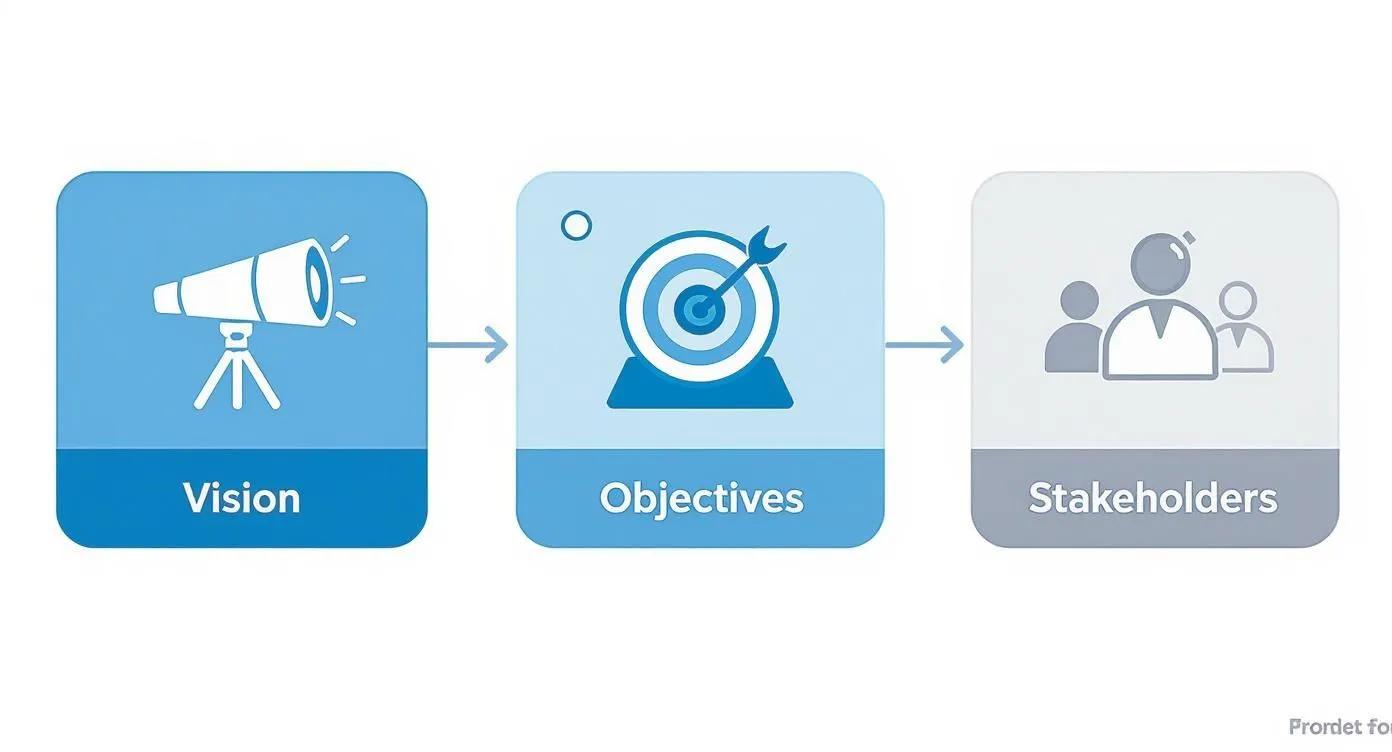

Process diagram showing vision (telescope), objectives (target), and stakeholders (people) in sequence.

This process—moving from a high-level vision to concrete objectives and stakeholder alignment—is the bedrock of any successful roadmap.


Set Clear Business Objectives

Once your vision is locked in, you need to break it down into measurable business objectives. These aren't product features; they are the specific, quantifiable results the business needs to see. They tie your product's success directly to the company's bottom line.

It's easy to confuse your roadmap's goals with the company's broader business objectives. Here’s a quick way to think about the difference.


Roadmap Goals vs Business Objectives

This table helps clarify how your product-specific goals should directly support the wider company objectives.

Element

Focus

Example (B2B AI SaaS)

Business Objective

High-level company outcomes (often financial or market-based).

Increase Annual Recurring Revenue (ARR) by 25% this fiscal year.

Roadmap Goal

Specific product outcomes that contribute to the business objective.

Reduce customer churn by 5% in the next quarter.

Initiative/Feature

The actual work on the roadmap that will achieve the goal.

Redesign the user onboarding flow and add in-app guidance.

As you can see, the feature ("redesign onboarding") is a means to an end. It serves the roadmap goal ("reduce churn"), which in turn helps achieve the business objective ("increase ARR").

Other examples of strong objectives include:

  • Achieve a 15% increase in user adoption for our core analytics feature in Q3.

  • Secure five enterprise clients in the new manufacturing vertical by year-end.

To make sure you've covered all your bases, it’s a great idea to capture these details in a formal document. A good Product Requirements Document template can help you define the scope and goals clearly before a single line of code is written.


Align Key Stakeholders Early

The final piece of your foundation is people. You can’t build a roadmap in a vacuum. You need to talk to your key stakeholders—executives, sales, marketing, engineering, and customer support—right from the start.

Schedule interviews to understand their perspectives. What are their biggest pain points? What does success look like from their department's point of view?

This isn’t about creating a laundry list of everyone's pet features. Instead, you're building a shared understanding of the problems that need solving. Getting this alignment early prevents so much friction down the road and ensures the final roadmap is a unified plan everyone feels invested in, not just a document pushed out by the product team.


Gathering Inputs and Prioritizing What Matters

A product roadmap built in isolation is dead on arrival. The real value of a roadmap comes directly from the quality and variety of the inputs you gather. Think of yourself as an intelligence gatherer, piecing together signals from every corner of the business to form a complete picture. Without this groundwork, you’re not making strategic calls—you’re just guessing.

The goal isn't to create a giant backlog of feature requests. It's about digging deeper to understand the problems that sparked those requests in the first place. Your roadmap should be the answer to the most urgent challenges your customers and your business are facing.
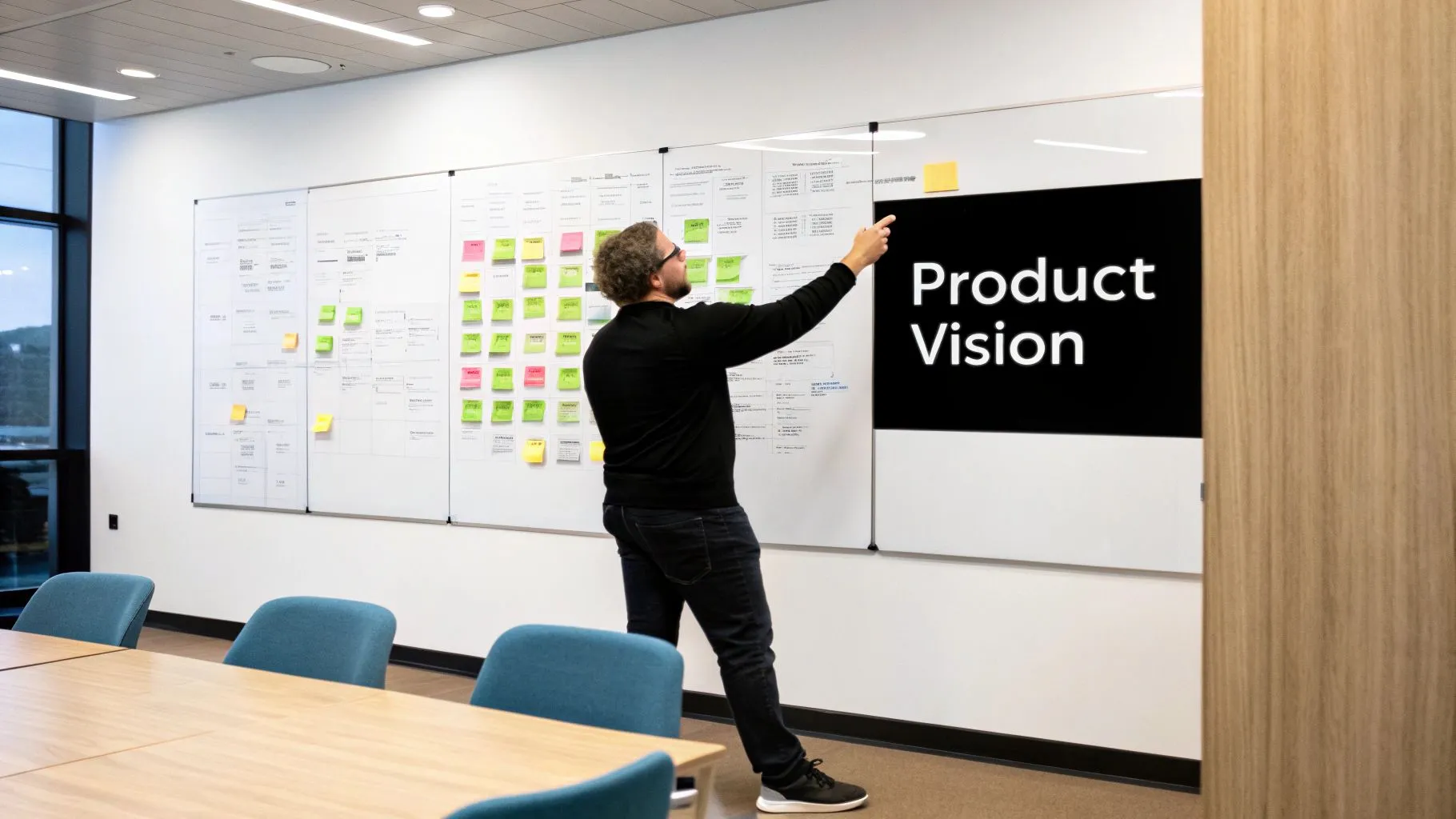

A man in a modern office points at a large whiteboard displaying a 'Product Vision' and sticky notes.


Sourcing Your Roadmap Intelligence

To build a roadmap that actually works, you have to get systematic about how you collect feedback. Relying on random conversations is a sure-fire way to let bias creep in. What you need are dedicated channels for different kinds of input.


  • Sales and Customer Success Teams: These folks are in the trenches every day. They know why deals are won, why they're lost, and what makes users tick. Set up a recurring meeting or a dedicated Slack channel where they can share trends, not just one-off requests. Ask them, "What's the one problem that, if solved, would help you close bigger deals?"

  • Customer Support Tickets: Your support desk is an absolute goldmine of user friction points. Start tagging tickets by feature area or problem type. A sudden spike in tickets tagged "data export bug" is a flashing red light that something needs to be fixed, and fast.

  • Direct User Interviews: There is absolutely no substitute for talking to your users. All the data in the world tells you what is happening, but conversations tell you why. To really nail these, check out our guide on how to conduct user interviews for some practical tips.

  • Competitive Analysis: Keep an eye on what your competitors are shipping. The point isn't to copy them feature-for-feature. It’s about understanding where the market is headed and spotting gaps in your own product. Are they solving a customer problem you've completely missed?


Once you've collected all this raw intelligence, the real work begins: turning a mountain of ideas into a focused, prioritized plan.


From Ideas to Priorities with Frameworks

Prioritization is where so many product teams get stuck. It can feel deeply subjective and often sparks heated debates. This is precisely why objective frameworks are a product manager's best friend. They force everyone to evaluate ideas against the same set of criteria, which makes your decisions defensible and rooted in data.

For B2B and AI SaaS products, two of the most reliable frameworks are RICE and MoSCoW.


The RICE Scoring Model
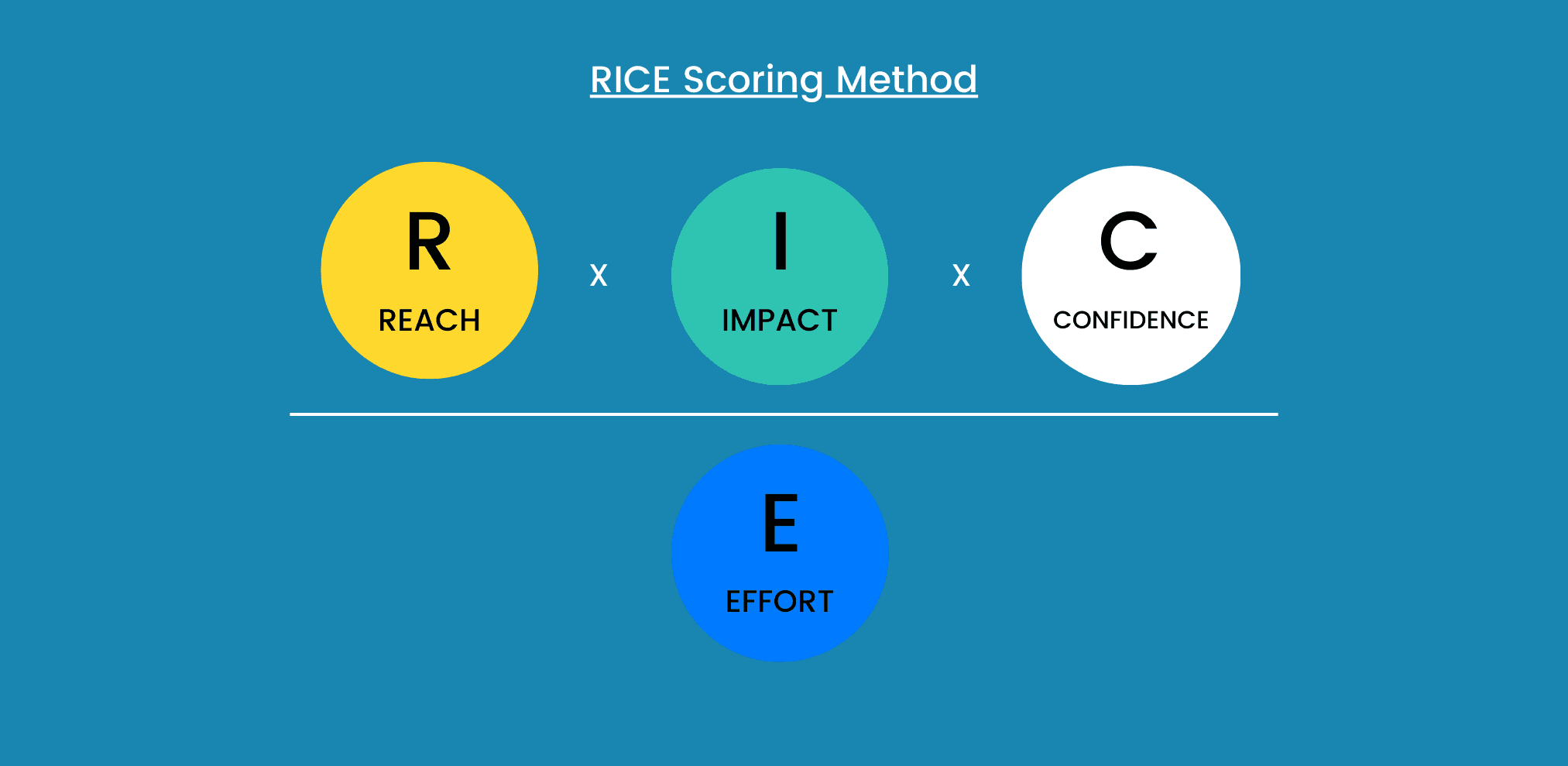

RICE Scoring Model


RICE is a straightforward but incredibly effective way to quantify what to work on next. You score every potential initiative against four key factors:

  • Reach: How many customers will this feature affect in a given timeframe? (e.g., 500 enterprise users per quarter)

  • Impact: How much will this move the needle for an individual user? (Scale: 0.25 for minimal, 3 for massive)

  • Confidence: How sure are you about your Reach and Impact estimates? (Scale: 50% to 100%)

  • Effort: How much time will this take from your product, design, and engineering teams? (e.g., person-months)

RICE Score Formula: (Reach × Impact × Confidence) / Effort

A higher score means a higher priority. What makes this model so great is that it forces you to weigh the potential upside against the actual cost and how confident you are in your own assumptions.


The MoSCoW Method
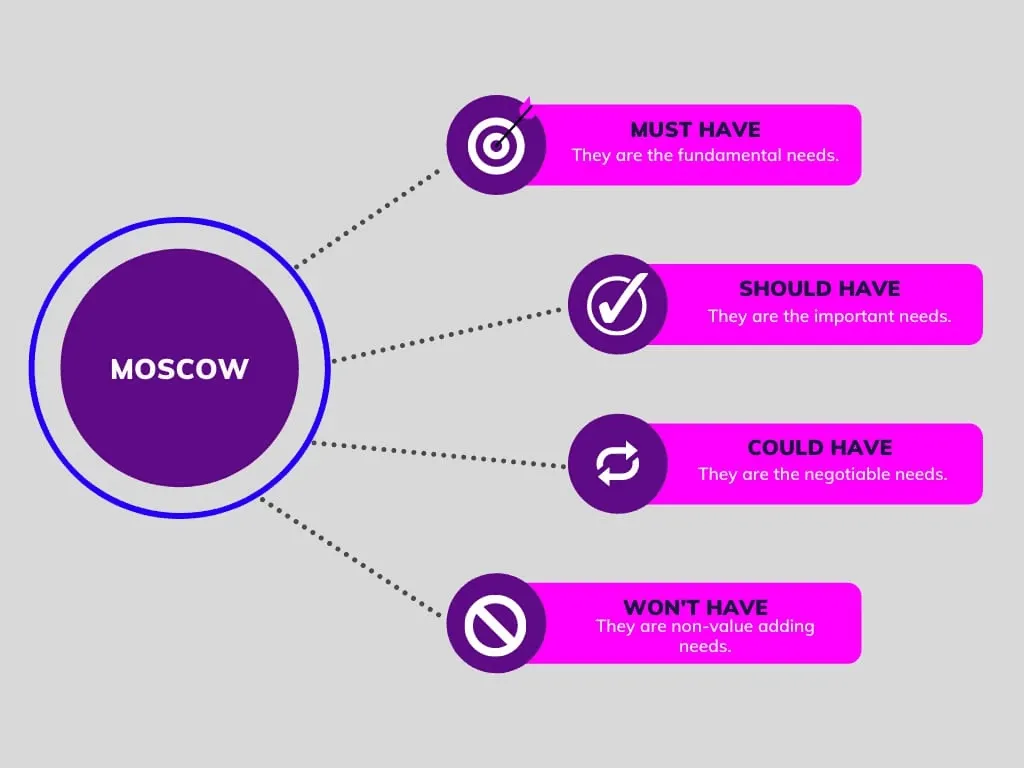

 MoSCoW Method


While RICE is fantastic for comparing individual features, MoSCoW is perfect for defining the scope of a larger release or project. It helps you bucket requirements into four simple categories:

  • Must-have: These are the non-negotiables. The release is considered a failure without them.

  • Should-have: Important, but not absolutely critical. These are high-priority items that could be pushed to the next release if you're short on time.

  • Could-have: Desirable, but not necessary. Think of these as nice-to-haves that you’ll tackle only if everything else gets done early.

  • Won't-have: Features that are explicitly out of scope for this release. This is critical for managing stakeholder expectations.


A Real-World Prioritization Scenario

Let's imagine an AI SaaS company is trying to decide between two big projects:

  1. Initiative A: Build a new machine learning model to improve prediction accuracy by 10%.

  2. Initiative B: Redesign the user onboarding flow to reduce customer drop-off.

Using the RICE framework, the product team gets to work. They quickly realize that while the new ML model has a massive Impact score, its Reach is limited to their top-tier enterprise customers. The Effort is also sky-high.

The onboarding redesign, on the other hand, has a slightly lower Impact per user, but it affects 100% of new sign-ups (Reach) and the Effort required is significantly less.

When the scores are calculated, the onboarding project comes out on top. It gets prioritized for the upcoming quarter. The ML model is moved to the "Next" or "Later" column of the roadmap, with an action item to gather more data to increase the team's Confidence score. This is how a data-driven approach removes emotion and gets everyone aligned behind a logical decision.


Choosing Your Roadmap Format and Tools

How you show your roadmap is just as important as what’s on it. I’ve seen brilliant strategies fall flat because they were presented in a confusing way. A clear, well-chosen format can build powerful alignment, while the wrong one can create more questions than answers. It's not about finding the single "best" format, but the one that tells your product's story most effectively to a specific audience.

Think about it this way: you wouldn't show your engineering team the same high-level quarterly summary you present to the board. Your engineers need a detailed, feature-based timeline for sprint planning. Your executives? They need to see the strategic themes and the business outcomes you’re driving. Giving them a list of every single epic is a classic rookie mistake.
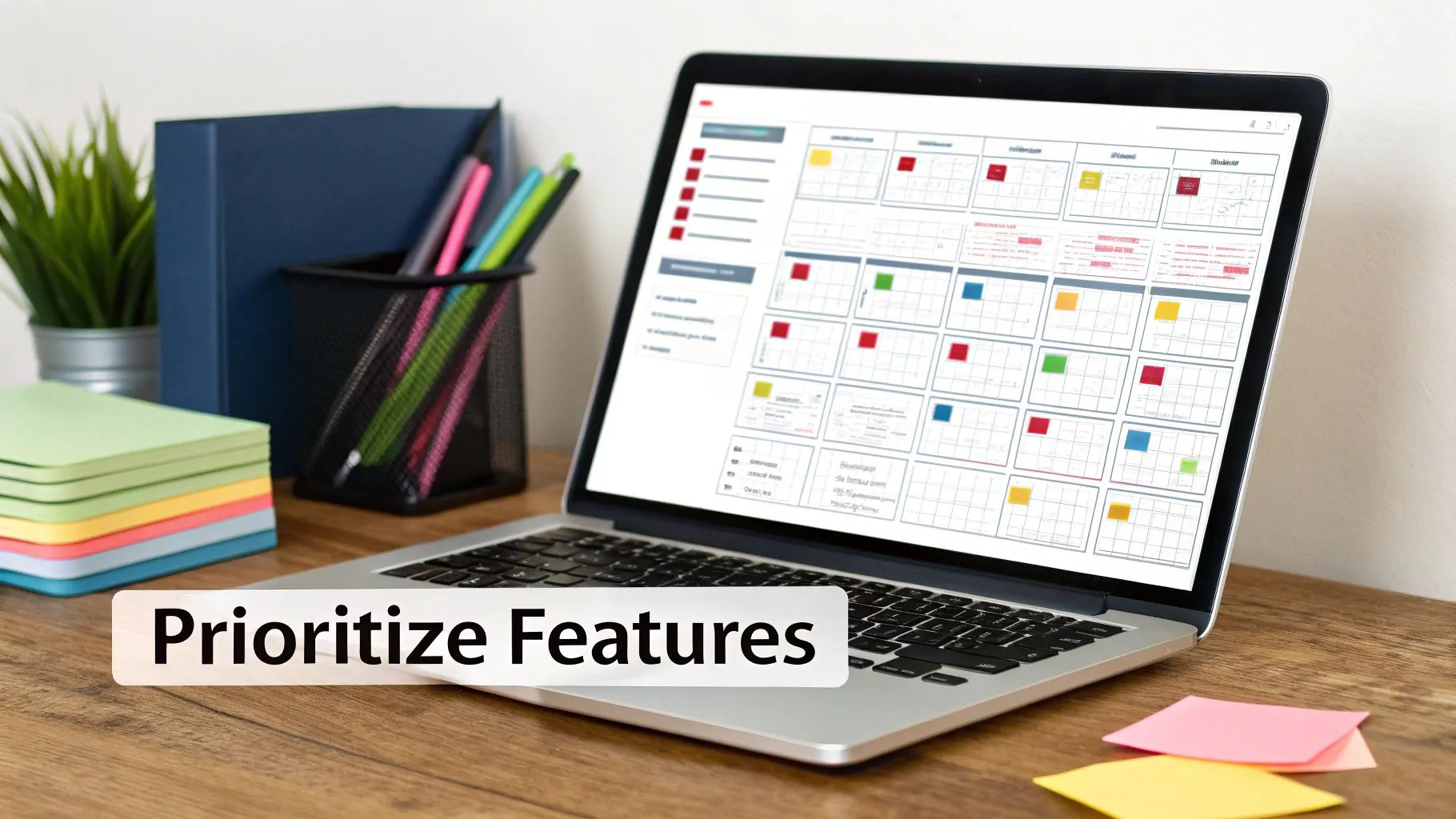

A laptop screen displays a product roadmap with colored feature cards, highlighting "Prioritize Features" on a wooden desk.


Selecting the Right Roadmap Format

Your choice of format needs to be intentional, tailored to the conversation at hand. In my experience, a few common formats serve very distinct purposes.


  • Theme-Based Roadmap: This is your high-level, 30,000-foot view. It groups initiatives under strategic pillars like "Improve User Onboarding" or "Enhance AI Analytics." You're focusing on the problems you're solving, not just listing features. This format is perfect for executive updates and company-wide meetings where the "why" matters far more than the "what."

  • Outcome-Driven Roadmap: This takes the theme-based approach a step further by explicitly tying every initiative to a measurable result. Instead of a vague theme like "Improve Performance," the goal becomes "Reduce Average API Response Time by 20%." It’s an incredibly powerful way to keep your teams laser-focused on delivering real, tangible value.

  • Now-Next-Later Roadmap: This is a go-to for many agile teams for good reason—it’s simple and effective. Work is divided into three columns, which clearly communicates priority without locking you into rigid deadlines.

    • Now: What the team is actively building.

    • Next: High-priority items that are ready to be picked up.

    • Later: Good ideas that are on the back burner but not yet fully scoped.


The most effective product leaders I know don't just use one roadmap. They maintain different views of the same plan. You might have a theme-based view for leadership and a Now-Next-Later board for your dev squad, all powered by the same core data.


Navigating the Landscape of Roadmap Tools


Navigating the Landscape of Roadmap Tools


Once you know how you want to present your strategy, you need the right tool to build and maintain it. The options out there run the gamut from basic spreadsheets to powerful, specialized platforms. A great tool should make communication easier, not add another layer of complexity to your life.

Sometimes, just thinking about how to visually present your strategy is a great starting point. I've found that browsing something like a dashboard design moodboard can spark ideas for presenting complex information clearly, which is exactly what a good roadmap should do.

The market for these tools is booming—it was estimated at $1.2 billion and is expected to climb to $3.46 billion by 2033. This explosion shows a clear industry shift toward more dynamic, collaborative platforms that can keep up with modern, data-driven product development.


Roadmap Tool Comparison

Choosing a tool really depends on your team’s size, budget, and the other software you already use. To help you sort through the options, here’s a quick breakdown of some of the most popular choices.


Tool

Best For

Key Feature

Pricing Model

Spreadsheets (Excel/Sheets)

Startups and small teams on a budget.

Ultimate flexibility and no cost.

Free

Jira

Teams deeply embedded in the Atlassian ecosystem.

Direct integration with development backlogs and tickets.

Freemium / Per User

Productboard

Centralizing feedback and tying it to features.

Excellent for connecting customer insights to roadmap items.

Per User ("Maker")

Aha!

Large enterprises needing a comprehensive suite.

All-in-one platform for strategy, roadmapping, and launch planning.

Per User / Enterprise


The goal here is to find something that fits your workflow, not the other way around. A spreadsheet might be perfect when you’re just starting out. But as you scale, the manual effort to keep it updated can become a huge time sink.

That's when specialized tools really shine, as they can automate a lot of the grunt work and connect your high-level strategy directly to the team's execution. To get a better sense of the landscape, checking out a roundup of the best tools for product managers, including roadmapping solutions, can provide some great direction.


Bringing the Roadmap to Life and Rallying Your Team

You've done the hard work of scoring priorities and picking a format. Now, it’s time to turn that abstract strategy into something tangible—the actual product roadmap. This is where you transform all those lists and frameworks into a compelling visual story.

Your goal isn't just to document a plan. It's to create a powerful communication tool that builds confidence and gets everyone, from engineering to sales, pulling in the same direction.

A classic mistake I see all the time is treating the roadmap like a simple to-do list with dates slapped on it. Think of it more as a narrative. Each initiative on that map should scream its value to the customer and tie back directly to the company's big-picture vision. This shifts the conversation from, "When is this feature shipping?" to "How will this initiative help us crush our churn goal?"


A laptop on a wooden desk displays a 'ROADMAP FORMAT' with visual elements, alongside an open notebook and pen.


Group Initiatives Into Strategic Themes

A jumble of features on a timeline just creates noise and confusion. To build a story that makes sense, you need to group individual projects under larger, more intuitive themes. Think of these as the main chapters of your product's journey for the next few quarters.

For an AI SaaS product, these themes might look something like this:


  • Accelerate Time-to-Value: Anything under this banner is about getting users to that "aha!" moment faster. This could be a slicker onboarding flow, pre-built AI model templates, or a dead-simple data integration.

  • Deepen Predictive Insights: This is where you house initiatives that make your AI smarter and more useful. Maybe you're adding a new machine learning algorithm or developing a feature for true root-cause analysis.

  • Enhance Enterprise Readiness: This theme is all about closing bigger deals. It covers the must-haves for large organizations, like advanced user permissions, crucial security certifications (like SOC 2), or single sign-on (SSO) integrations.


When you group work this way, you help stakeholders—especially executives—quickly get the gist of your strategy without drowning them in technical details.


Ditch the Hard Deadlines for Flexible Timelines

Want to destroy trust with your team and stakeholders? Commit to a hard-and-fast deadline six months from now. The reality of building complex software is that things always change. You get new data, a competitor makes a move, or a project turns out to be way more complex than anticipated. A roadmap full of exact dates is just setting your team up to fail.

So, what's the alternative? Use broader time horizons. For most high-level roadmaps, planning by quarters is the perfect level of detail.


Pro Tip: My golden rule is to never put specific dates on a roadmap shared outside the immediate development team. Stick to quarters (Q3, Q4) or even looser buckets like "Now," "Next," and "Later." This one simple change manages expectations beautifully and gives your team the breathing room they need to adapt and deliver high-quality work.


Master the Art of Communication


Master the Art of Communication


A roadmap is totally useless if it just sits in a folder on Google Drive. Its real power is unlocked when you use it to communicate continuously and effectively. In fact, a staggering 40% of product managers say stakeholders are the main audience for their roadmaps. That tells you that your ability to present the plan is just as critical as the plan itself.

You can't just give the same presentation to everyone. Each group has different priorities, and they need to hear a version of the story that resonates with them.


Tailoring Your Message

  • For the C-Suite: They care about the "why." You need to connect every single theme directly to a business objective. How will "Accelerate Time-to-Value" move the needle on user retention? How does "Enhance Enterprise Readiness" open up a new market and drive revenue? Keep it high-level, strategic, and focused on outcomes.


  • For Engineering: This is your "what" and "how" audience. Here, you can break down your themes into specific epics and get into the weeds on technical feasibility and dependencies. Your engineering team needs absolute clarity on the problems they're solving so they can start architecting the best solutions.


  • For Sales & Marketing: They need to know the "so what." How are these upcoming features going to solve a customer's biggest headache? Give them the value props and key differentiators they can weave into their go-to-market campaigns and sales pitches.


The entire process of bringing a strategic vision to life involves a series of structured steps. To learn more about how this works from a design perspective, you can explore our detailed breakdown of the product design process steps.

The final piece of the puzzle is running productive feedback sessions. When you present the roadmap, don't just read it off the screen. Frame it as a strategy up for discussion, not a decree from on high. Ask open-ended questions like, "Given our goal to boost user adoption this year, does this prioritization feel right to you?" This approach invites collaboration and makes stakeholders feel like they're partners in the process, not just an audience for your plan.


Keeping Your Roadmap Alive and Relevant

Getting your product roadmap finalized is a huge accomplishment. But it's just the starting line, not the finish. The single biggest mistake I see product teams make is treating their roadmap like a static document—something you create, get approved, and then file away.

A roadmap that doesn’t evolve with new information is worse than useless; it becomes a piece of historical fiction. It has to be a living, breathing guide that adapts to the constant churn of market trends, customer feedback, and what you're learning every single day. This is what separates a powerful strategic tool from a document that just gathers digital dust.


Establish a Regular Review Cadence

The first step in keeping your roadmap relevant is simple but non-negotiable: build a consistent review process. Without a scheduled check-in, your strategic plan will inevitably drift away from your tactical execution.

So, what’s the right rhythm? For most B2B SaaS companies, a quarterly review is a solid baseline. This is your dedicated time to pause and ask the hard questions based on fresh data:


  • Did our last release actually move the needle on its target metric? If not, we need to figure out why before we build the next thing on top of it.

  • Has a competitor's recent launch changed our assumptions? Their move might validate one of our ideas or force us to pivot entirely.

  • What are we hearing on recent sales calls and in support tickets? This is the unfiltered voice of the market speaking directly to us.


This formal quarterly review is for realigning the big picture with your high-level business goals. For smaller tweaks, a lighter monthly check-in with your core product and engineering leads can help you make minor course corrections without derailing the whole team.


Communicating Changes Effectively

Let’s be honest: changing the roadmap can create anxiety. No one likes surprises, especially when it involves their work or, even worse, a promise made to a customer. The key is to be relentlessly transparent and proactive in your communication.

When a change happens, don’t just update the document. You have to tell the story behind it. Explain the "why."


When you communicate changes, frame them as a sign of intelligent adaptation, not failure. Explain that the roadmap is evolving because the team is learning and responding to new information, which is the hallmark of a healthy, agile organization.

Was the shift based on powerful feedback from a major account? An unexpected technical discovery? A massive market opportunity we can’t ignore? This approach builds trust and reinforces the idea that the roadmap is a tool for winning, not just a list of features to be checked off. For a deeper dive, exploring some established product roadmap best practices can offer more solid frameworks for communication.


Measure What Matters

A roadmap without metrics is just a collection of opinions. To make sure your plan is creating real value, you have to track the impact of the features you ship. This is how you close the loop, turning your roadmap from a forward-looking plan into a cycle of continuous improvement.

What should you be looking at? Start with these:


  • Feature Adoption Rate: Are people actually using what you built? Low adoption is a massive red flag.

  • User Satisfaction (CSAT/NPS): Is the product becoming more valuable over time? Track satisfaction scores before and after major releases.

  • Task Success Rate: For new features, can users actually accomplish the job they were designed for? This measures true effectiveness.


The industry's investment here speaks volumes. The Product Roadmap Software Market was valued at around $1.5 billion and is projected to hit $3.4 billion by 2032. This growth, detailed in market analysis from sources like dataintelo.com, is driven by the absolute need for better analytics. It's proof that data isn't just for building the roadmap—it's for validating its success.


Answering the Tough Product Roadmap Questions

Even with the best frameworks, building a roadmap can feel like you're navigating a minefield of competing priorities and strong opinions. Questions, challenges, and pushback are just part of the job.

Learning the theory behind roadmapping is one thing. Actually defending it, adapting it, and keeping everyone aligned in the real world? That's a whole different skill. Let's dig into some of the most common questions you'll face.


How Detailed Should a Product Roadmap Be?

The honest answer is, "it depends entirely on who you're showing it to." A single, one-size-fits-all roadmap is a myth and trying to create one usually just leads to confusion. The real key is tailoring the level of detail to your audience.


  • For your executive team: Keep it high-level. They need to see the strategic themes and the business outcomes you're aiming for, mapped to broad timelines like Q3 or Q4. Their main concern is how your product plan connects directly to revenue, market share, or other top-line company goals.

  • For your development team: This is where you need to get more granular. The engineers need a view that breaks down those quarterly themes into specific epics and user stories for the next few sprints. This gives them the clarity they need for technical planning and execution.


A great rule of thumb I've learned is to have maximum detail for the very near term (like, this quarter) and get progressively more abstract the further out you go. This gives your team immediate focus while keeping the strategic flexibility you'll inevitably need.


What’s the Difference Between a Product Roadmap and a Release Plan?

This is a classic point of confusion, and it can cause some serious misalignment if you don't get it straight. The easiest way to think about it is like planning a cross-country road trip versus having a detailed itinerary for your first day.

A product roadmap is your strategic "why." It shows the big picture—the overall journey and direction of the product over multiple quarters, or even a year. It's focused on outcomes and connects all the day-to-day work back to the company's high-level goals.

A release plan, on the other hand, is the tactical "what" and "when" for the very next stop on that trip. It's a committed list of specific features, bug fixes, and firm deadlines for a single, upcoming launch. The roadmap is your strategic guide; the release plan is your tactical execution document.


How Do I Handle Pressure to Add a Feature to the Roadmap?

We've all been in that meeting. A senior stakeholder or a big-name client makes an impassioned plea for their pet feature, and suddenly all eyes are on you. A flat "no" can damage relationships, but a quick "yes" can completely derail your strategy.

Instead of getting backed into a yes/no corner, your best move is to guide the conversation back to your established process. This shifts the discussion from being about opinions to being about objective evaluation.

Try asking a few questions:


  • "That's an interesting idea. Can you help me understand how this feature supports our primary goal of reducing churn this quarter?"

  • "To make sure we evaluate this fairly, how do you think it would stack up against our other priorities using our RICE framework?"


This approach shows you're listening and you value their input, but it also protects the integrity of your prioritization process. A great way to close the loop is to offer to add the idea to the backlog for formal scoring in the next planning cycle. It validates their idea without committing you to it on the spot.


How Often Should I Update and Share the Roadmap?

A roadmap should never be a static artifact you create once and then forget. It’s a living document that has to evolve as you learn more from customers and the market. Plan on a formal, in-depth review and update on a quarterly basis, which usually aligns well with business planning cycles.

That said, you should always be ready to make smaller adjustments more frequently if you get new data or see an urgent market shift.

When it comes to sharing, you almost can't over-communicate.

  • Make the high-level, theme-based roadmap accessible to everyone in the company.

  • Present updates at your quarterly all-hands or town hall meetings.

  • Review near-term priorities with your engineering team during sprint planning.

  • Walk leadership through progress and any strategic shifts on a monthly basis.

Constant, consistent communication is what turns a simple document into a shared plan that builds trust and alignment across the entire organization.

At Bricx, we help B2B and AI SaaS companies translate complex strategies into intuitive, user-centric product designs. If you need a design partner who understands how to turn your roadmap into a reality that customers love, let's connect.
A great product roadmap is more than just a list of features and deadlines. It’s a story. It tells everyone—from your engineers to your CEO—where the product is headed and, more importantly, why it’s going there.

But before you can write that story, you need to build a solid foundation.


Building Your Roadmap Foundation


Roadmap Foundation


Too many teams make the mistake of jumping straight into features. They get excited about an idea and immediately start plotting it on a timeline. This is where roadmaps fall apart. Without a solid strategic foundation, a roadmap becomes a fragile wish list, easily derailed by the first piece of conflicting feedback.

Your foundation connects every proposed feature back to a tangible business outcome. This isn't just good practice; it's becoming a necessity. The global Product Roadmap Management market is expected to balloon from $2.1 billion to $8.7 billion by 2033, a clear sign that companies are investing heavily in getting their strategic planning right.


Start With Your Product Vision

Everything begins with your product vision. Think of it as your North Star—the constant, guiding light for every decision you make. It’s a simple, ambitious statement about the future you want to create for your customers. It answers the big question: What problem are we solving, and for whom?

For a B2B AI SaaS tool, a strong vision might sound like this: "To empower non-technical marketing teams to make data-driven decisions instantly, without needing a data scientist."

This vision is powerful because it's focused on the customer's outcome, not the product's features. It’s a filter.

When a new idea or feature request lands on your desk, your first question should be, "Does this get us closer to our vision?" If the answer is a clear no, it’s much easier to push back.

Getting the vision right is different from building the strategy to achieve it. To dig deeper into that distinction, you can check out our guide on https://bricxlabs.com/blogs/product-vision-vs-product-strategy.


Process diagram showing vision (telescope), objectives (target), and stakeholders (people) in sequence.

This process—moving from a high-level vision to concrete objectives and stakeholder alignment—is the bedrock of any successful roadmap.


Set Clear Business Objectives

Once your vision is locked in, you need to break it down into measurable business objectives. These aren't product features; they are the specific, quantifiable results the business needs to see. They tie your product's success directly to the company's bottom line.

It's easy to confuse your roadmap's goals with the company's broader business objectives. Here’s a quick way to think about the difference.


Roadmap Goals vs Business Objectives

This table helps clarify how your product-specific goals should directly support the wider company objectives.

Element

Focus

Example (B2B AI SaaS)

Business Objective

High-level company outcomes (often financial or market-based).

Increase Annual Recurring Revenue (ARR) by 25% this fiscal year.

Roadmap Goal

Specific product outcomes that contribute to the business objective.

Reduce customer churn by 5% in the next quarter.

Initiative/Feature

The actual work on the roadmap that will achieve the goal.

Redesign the user onboarding flow and add in-app guidance.

As you can see, the feature ("redesign onboarding") is a means to an end. It serves the roadmap goal ("reduce churn"), which in turn helps achieve the business objective ("increase ARR").

Other examples of strong objectives include:

  • Achieve a 15% increase in user adoption for our core analytics feature in Q3.

  • Secure five enterprise clients in the new manufacturing vertical by year-end.

To make sure you've covered all your bases, it’s a great idea to capture these details in a formal document. A good Product Requirements Document template can help you define the scope and goals clearly before a single line of code is written.


Align Key Stakeholders Early

The final piece of your foundation is people. You can’t build a roadmap in a vacuum. You need to talk to your key stakeholders—executives, sales, marketing, engineering, and customer support—right from the start.

Schedule interviews to understand their perspectives. What are their biggest pain points? What does success look like from their department's point of view?

This isn’t about creating a laundry list of everyone's pet features. Instead, you're building a shared understanding of the problems that need solving. Getting this alignment early prevents so much friction down the road and ensures the final roadmap is a unified plan everyone feels invested in, not just a document pushed out by the product team.


Gathering Inputs and Prioritizing What Matters

A product roadmap built in isolation is dead on arrival. The real value of a roadmap comes directly from the quality and variety of the inputs you gather. Think of yourself as an intelligence gatherer, piecing together signals from every corner of the business to form a complete picture. Without this groundwork, you’re not making strategic calls—you’re just guessing.

The goal isn't to create a giant backlog of feature requests. It's about digging deeper to understand the problems that sparked those requests in the first place. Your roadmap should be the answer to the most urgent challenges your customers and your business are facing.


A man in a modern office points at a large whiteboard displaying a 'Product Vision' and sticky notes.


Sourcing Your Roadmap Intelligence

To build a roadmap that actually works, you have to get systematic about how you collect feedback. Relying on random conversations is a sure-fire way to let bias creep in. What you need are dedicated channels for different kinds of input.


  • Sales and Customer Success Teams: These folks are in the trenches every day. They know why deals are won, why they're lost, and what makes users tick. Set up a recurring meeting or a dedicated Slack channel where they can share trends, not just one-off requests. Ask them, "What's the one problem that, if solved, would help you close bigger deals?"

  • Customer Support Tickets: Your support desk is an absolute goldmine of user friction points. Start tagging tickets by feature area or problem type. A sudden spike in tickets tagged "data export bug" is a flashing red light that something needs to be fixed, and fast.

  • Direct User Interviews: There is absolutely no substitute for talking to your users. All the data in the world tells you what is happening, but conversations tell you why. To really nail these, check out our guide on how to conduct user interviews for some practical tips.

  • Competitive Analysis: Keep an eye on what your competitors are shipping. The point isn't to copy them feature-for-feature. It’s about understanding where the market is headed and spotting gaps in your own product. Are they solving a customer problem you've completely missed?


Once you've collected all this raw intelligence, the real work begins: turning a mountain of ideas into a focused, prioritized plan.


From Ideas to Priorities with Frameworks

Prioritization is where so many product teams get stuck. It can feel deeply subjective and often sparks heated debates. This is precisely why objective frameworks are a product manager's best friend. They force everyone to evaluate ideas against the same set of criteria, which makes your decisions defensible and rooted in data.

For B2B and AI SaaS products, two of the most reliable frameworks are RICE and MoSCoW.


The RICE Scoring Model


RICE Scoring Model


RICE is a straightforward but incredibly effective way to quantify what to work on next. You score every potential initiative against four key factors:

  • Reach: How many customers will this feature affect in a given timeframe? (e.g., 500 enterprise users per quarter)

  • Impact: How much will this move the needle for an individual user? (Scale: 0.25 for minimal, 3 for massive)

  • Confidence: How sure are you about your Reach and Impact estimates? (Scale: 50% to 100%)

  • Effort: How much time will this take from your product, design, and engineering teams? (e.g., person-months)

RICE Score Formula: (Reach × Impact × Confidence) / Effort

A higher score means a higher priority. What makes this model so great is that it forces you to weigh the potential upside against the actual cost and how confident you are in your own assumptions.


The MoSCoW Method


 MoSCoW Method


While RICE is fantastic for comparing individual features, MoSCoW is perfect for defining the scope of a larger release or project. It helps you bucket requirements into four simple categories:

  • Must-have: These are the non-negotiables. The release is considered a failure without them.

  • Should-have: Important, but not absolutely critical. These are high-priority items that could be pushed to the next release if you're short on time.

  • Could-have: Desirable, but not necessary. Think of these as nice-to-haves that you’ll tackle only if everything else gets done early.

  • Won't-have: Features that are explicitly out of scope for this release. This is critical for managing stakeholder expectations.


A Real-World Prioritization Scenario

Let's imagine an AI SaaS company is trying to decide between two big projects:

  1. Initiative A: Build a new machine learning model to improve prediction accuracy by 10%.

  2. Initiative B: Redesign the user onboarding flow to reduce customer drop-off.

Using the RICE framework, the product team gets to work. They quickly realize that while the new ML model has a massive Impact score, its Reach is limited to their top-tier enterprise customers. The Effort is also sky-high.

The onboarding redesign, on the other hand, has a slightly lower Impact per user, but it affects 100% of new sign-ups (Reach) and the Effort required is significantly less.

When the scores are calculated, the onboarding project comes out on top. It gets prioritized for the upcoming quarter. The ML model is moved to the "Next" or "Later" column of the roadmap, with an action item to gather more data to increase the team's Confidence score. This is how a data-driven approach removes emotion and gets everyone aligned behind a logical decision.


Choosing Your Roadmap Format and Tools

How you show your roadmap is just as important as what’s on it. I’ve seen brilliant strategies fall flat because they were presented in a confusing way. A clear, well-chosen format can build powerful alignment, while the wrong one can create more questions than answers. It's not about finding the single "best" format, but the one that tells your product's story most effectively to a specific audience.

Think about it this way: you wouldn't show your engineering team the same high-level quarterly summary you present to the board. Your engineers need a detailed, feature-based timeline for sprint planning. Your executives? They need to see the strategic themes and the business outcomes you’re driving. Giving them a list of every single epic is a classic rookie mistake.


A laptop screen displays a product roadmap with colored feature cards, highlighting "Prioritize Features" on a wooden desk.


Selecting the Right Roadmap Format

Your choice of format needs to be intentional, tailored to the conversation at hand. In my experience, a few common formats serve very distinct purposes.


  • Theme-Based Roadmap: This is your high-level, 30,000-foot view. It groups initiatives under strategic pillars like "Improve User Onboarding" or "Enhance AI Analytics." You're focusing on the problems you're solving, not just listing features. This format is perfect for executive updates and company-wide meetings where the "why" matters far more than the "what."

  • Outcome-Driven Roadmap: This takes the theme-based approach a step further by explicitly tying every initiative to a measurable result. Instead of a vague theme like "Improve Performance," the goal becomes "Reduce Average API Response Time by 20%." It’s an incredibly powerful way to keep your teams laser-focused on delivering real, tangible value.

  • Now-Next-Later Roadmap: This is a go-to for many agile teams for good reason—it’s simple and effective. Work is divided into three columns, which clearly communicates priority without locking you into rigid deadlines.

    • Now: What the team is actively building.

    • Next: High-priority items that are ready to be picked up.

    • Later: Good ideas that are on the back burner but not yet fully scoped.


The most effective product leaders I know don't just use one roadmap. They maintain different views of the same plan. You might have a theme-based view for leadership and a Now-Next-Later board for your dev squad, all powered by the same core data.


Navigating the Landscape of Roadmap Tools


Navigating the Landscape of Roadmap Tools


Once you know how you want to present your strategy, you need the right tool to build and maintain it. The options out there run the gamut from basic spreadsheets to powerful, specialized platforms. A great tool should make communication easier, not add another layer of complexity to your life.

Sometimes, just thinking about how to visually present your strategy is a great starting point. I've found that browsing something like a dashboard design moodboard can spark ideas for presenting complex information clearly, which is exactly what a good roadmap should do.

The market for these tools is booming—it was estimated at $1.2 billion and is expected to climb to $3.46 billion by 2033. This explosion shows a clear industry shift toward more dynamic, collaborative platforms that can keep up with modern, data-driven product development.


Roadmap Tool Comparison

Choosing a tool really depends on your team’s size, budget, and the other software you already use. To help you sort through the options, here’s a quick breakdown of some of the most popular choices.


Tool

Best For

Key Feature

Pricing Model

Spreadsheets (Excel/Sheets)

Startups and small teams on a budget.

Ultimate flexibility and no cost.

Free

Jira

Teams deeply embedded in the Atlassian ecosystem.

Direct integration with development backlogs and tickets.

Freemium / Per User

Productboard

Centralizing feedback and tying it to features.

Excellent for connecting customer insights to roadmap items.

Per User ("Maker")

Aha!

Large enterprises needing a comprehensive suite.

All-in-one platform for strategy, roadmapping, and launch planning.

Per User / Enterprise


The goal here is to find something that fits your workflow, not the other way around. A spreadsheet might be perfect when you’re just starting out. But as you scale, the manual effort to keep it updated can become a huge time sink.

That's when specialized tools really shine, as they can automate a lot of the grunt work and connect your high-level strategy directly to the team's execution. To get a better sense of the landscape, checking out a roundup of the best tools for product managers, including roadmapping solutions, can provide some great direction.


Bringing the Roadmap to Life and Rallying Your Team

You've done the hard work of scoring priorities and picking a format. Now, it’s time to turn that abstract strategy into something tangible—the actual product roadmap. This is where you transform all those lists and frameworks into a compelling visual story.

Your goal isn't just to document a plan. It's to create a powerful communication tool that builds confidence and gets everyone, from engineering to sales, pulling in the same direction.

A classic mistake I see all the time is treating the roadmap like a simple to-do list with dates slapped on it. Think of it more as a narrative. Each initiative on that map should scream its value to the customer and tie back directly to the company's big-picture vision. This shifts the conversation from, "When is this feature shipping?" to "How will this initiative help us crush our churn goal?"


A laptop on a wooden desk displays a 'ROADMAP FORMAT' with visual elements, alongside an open notebook and pen.


Group Initiatives Into Strategic Themes

A jumble of features on a timeline just creates noise and confusion. To build a story that makes sense, you need to group individual projects under larger, more intuitive themes. Think of these as the main chapters of your product's journey for the next few quarters.

For an AI SaaS product, these themes might look something like this:


  • Accelerate Time-to-Value: Anything under this banner is about getting users to that "aha!" moment faster. This could be a slicker onboarding flow, pre-built AI model templates, or a dead-simple data integration.

  • Deepen Predictive Insights: This is where you house initiatives that make your AI smarter and more useful. Maybe you're adding a new machine learning algorithm or developing a feature for true root-cause analysis.

  • Enhance Enterprise Readiness: This theme is all about closing bigger deals. It covers the must-haves for large organizations, like advanced user permissions, crucial security certifications (like SOC 2), or single sign-on (SSO) integrations.


When you group work this way, you help stakeholders—especially executives—quickly get the gist of your strategy without drowning them in technical details.


Ditch the Hard Deadlines for Flexible Timelines

Want to destroy trust with your team and stakeholders? Commit to a hard-and-fast deadline six months from now. The reality of building complex software is that things always change. You get new data, a competitor makes a move, or a project turns out to be way more complex than anticipated. A roadmap full of exact dates is just setting your team up to fail.

So, what's the alternative? Use broader time horizons. For most high-level roadmaps, planning by quarters is the perfect level of detail.


Pro Tip: My golden rule is to never put specific dates on a roadmap shared outside the immediate development team. Stick to quarters (Q3, Q4) or even looser buckets like "Now," "Next," and "Later." This one simple change manages expectations beautifully and gives your team the breathing room they need to adapt and deliver high-quality work.


Master the Art of Communication


Master the Art of Communication


A roadmap is totally useless if it just sits in a folder on Google Drive. Its real power is unlocked when you use it to communicate continuously and effectively. In fact, a staggering 40% of product managers say stakeholders are the main audience for their roadmaps. That tells you that your ability to present the plan is just as critical as the plan itself.

You can't just give the same presentation to everyone. Each group has different priorities, and they need to hear a version of the story that resonates with them.


Tailoring Your Message

  • For the C-Suite: They care about the "why." You need to connect every single theme directly to a business objective. How will "Accelerate Time-to-Value" move the needle on user retention? How does "Enhance Enterprise Readiness" open up a new market and drive revenue? Keep it high-level, strategic, and focused on outcomes.


  • For Engineering: This is your "what" and "how" audience. Here, you can break down your themes into specific epics and get into the weeds on technical feasibility and dependencies. Your engineering team needs absolute clarity on the problems they're solving so they can start architecting the best solutions.


  • For Sales & Marketing: They need to know the "so what." How are these upcoming features going to solve a customer's biggest headache? Give them the value props and key differentiators they can weave into their go-to-market campaigns and sales pitches.


The entire process of bringing a strategic vision to life involves a series of structured steps. To learn more about how this works from a design perspective, you can explore our detailed breakdown of the product design process steps.

The final piece of the puzzle is running productive feedback sessions. When you present the roadmap, don't just read it off the screen. Frame it as a strategy up for discussion, not a decree from on high. Ask open-ended questions like, "Given our goal to boost user adoption this year, does this prioritization feel right to you?" This approach invites collaboration and makes stakeholders feel like they're partners in the process, not just an audience for your plan.


Keeping Your Roadmap Alive and Relevant

Getting your product roadmap finalized is a huge accomplishment. But it's just the starting line, not the finish. The single biggest mistake I see product teams make is treating their roadmap like a static document—something you create, get approved, and then file away.

A roadmap that doesn’t evolve with new information is worse than useless; it becomes a piece of historical fiction. It has to be a living, breathing guide that adapts to the constant churn of market trends, customer feedback, and what you're learning every single day. This is what separates a powerful strategic tool from a document that just gathers digital dust.


Establish a Regular Review Cadence

The first step in keeping your roadmap relevant is simple but non-negotiable: build a consistent review process. Without a scheduled check-in, your strategic plan will inevitably drift away from your tactical execution.

So, what’s the right rhythm? For most B2B SaaS companies, a quarterly review is a solid baseline. This is your dedicated time to pause and ask the hard questions based on fresh data:


  • Did our last release actually move the needle on its target metric? If not, we need to figure out why before we build the next thing on top of it.

  • Has a competitor's recent launch changed our assumptions? Their move might validate one of our ideas or force us to pivot entirely.

  • What are we hearing on recent sales calls and in support tickets? This is the unfiltered voice of the market speaking directly to us.


This formal quarterly review is for realigning the big picture with your high-level business goals. For smaller tweaks, a lighter monthly check-in with your core product and engineering leads can help you make minor course corrections without derailing the whole team.


Communicating Changes Effectively

Let’s be honest: changing the roadmap can create anxiety. No one likes surprises, especially when it involves their work or, even worse, a promise made to a customer. The key is to be relentlessly transparent and proactive in your communication.

When a change happens, don’t just update the document. You have to tell the story behind it. Explain the "why."


When you communicate changes, frame them as a sign of intelligent adaptation, not failure. Explain that the roadmap is evolving because the team is learning and responding to new information, which is the hallmark of a healthy, agile organization.

Was the shift based on powerful feedback from a major account? An unexpected technical discovery? A massive market opportunity we can’t ignore? This approach builds trust and reinforces the idea that the roadmap is a tool for winning, not just a list of features to be checked off. For a deeper dive, exploring some established product roadmap best practices can offer more solid frameworks for communication.


Measure What Matters

A roadmap without metrics is just a collection of opinions. To make sure your plan is creating real value, you have to track the impact of the features you ship. This is how you close the loop, turning your roadmap from a forward-looking plan into a cycle of continuous improvement.

What should you be looking at? Start with these:


  • Feature Adoption Rate: Are people actually using what you built? Low adoption is a massive red flag.

  • User Satisfaction (CSAT/NPS): Is the product becoming more valuable over time? Track satisfaction scores before and after major releases.

  • Task Success Rate: For new features, can users actually accomplish the job they were designed for? This measures true effectiveness.


The industry's investment here speaks volumes. The Product Roadmap Software Market was valued at around $1.5 billion and is projected to hit $3.4 billion by 2032. This growth, detailed in market analysis from sources like dataintelo.com, is driven by the absolute need for better analytics. It's proof that data isn't just for building the roadmap—it's for validating its success.


Answering the Tough Product Roadmap Questions

Even with the best frameworks, building a roadmap can feel like you're navigating a minefield of competing priorities and strong opinions. Questions, challenges, and pushback are just part of the job.

Learning the theory behind roadmapping is one thing. Actually defending it, adapting it, and keeping everyone aligned in the real world? That's a whole different skill. Let's dig into some of the most common questions you'll face.


How Detailed Should a Product Roadmap Be?

The honest answer is, "it depends entirely on who you're showing it to." A single, one-size-fits-all roadmap is a myth and trying to create one usually just leads to confusion. The real key is tailoring the level of detail to your audience.


  • For your executive team: Keep it high-level. They need to see the strategic themes and the business outcomes you're aiming for, mapped to broad timelines like Q3 or Q4. Their main concern is how your product plan connects directly to revenue, market share, or other top-line company goals.

  • For your development team: This is where you need to get more granular. The engineers need a view that breaks down those quarterly themes into specific epics and user stories for the next few sprints. This gives them the clarity they need for technical planning and execution.


A great rule of thumb I've learned is to have maximum detail for the very near term (like, this quarter) and get progressively more abstract the further out you go. This gives your team immediate focus while keeping the strategic flexibility you'll inevitably need.


What’s the Difference Between a Product Roadmap and a Release Plan?

This is a classic point of confusion, and it can cause some serious misalignment if you don't get it straight. The easiest way to think about it is like planning a cross-country road trip versus having a detailed itinerary for your first day.

A product roadmap is your strategic "why." It shows the big picture—the overall journey and direction of the product over multiple quarters, or even a year. It's focused on outcomes and connects all the day-to-day work back to the company's high-level goals.

A release plan, on the other hand, is the tactical "what" and "when" for the very next stop on that trip. It's a committed list of specific features, bug fixes, and firm deadlines for a single, upcoming launch. The roadmap is your strategic guide; the release plan is your tactical execution document.


How Do I Handle Pressure to Add a Feature to the Roadmap?

We've all been in that meeting. A senior stakeholder or a big-name client makes an impassioned plea for their pet feature, and suddenly all eyes are on you. A flat "no" can damage relationships, but a quick "yes" can completely derail your strategy.

Instead of getting backed into a yes/no corner, your best move is to guide the conversation back to your established process. This shifts the discussion from being about opinions to being about objective evaluation.

Try asking a few questions:


  • "That's an interesting idea. Can you help me understand how this feature supports our primary goal of reducing churn this quarter?"

  • "To make sure we evaluate this fairly, how do you think it would stack up against our other priorities using our RICE framework?"


This approach shows you're listening and you value their input, but it also protects the integrity of your prioritization process. A great way to close the loop is to offer to add the idea to the backlog for formal scoring in the next planning cycle. It validates their idea without committing you to it on the spot.


How Often Should I Update and Share the Roadmap?

A roadmap should never be a static artifact you create once and then forget. It’s a living document that has to evolve as you learn more from customers and the market. Plan on a formal, in-depth review and update on a quarterly basis, which usually aligns well with business planning cycles.

That said, you should always be ready to make smaller adjustments more frequently if you get new data or see an urgent market shift.

When it comes to sharing, you almost can't over-communicate.

  • Make the high-level, theme-based roadmap accessible to everyone in the company.

  • Present updates at your quarterly all-hands or town hall meetings.

  • Review near-term priorities with your engineering team during sprint planning.

  • Walk leadership through progress and any strategic shifts on a monthly basis.

Constant, consistent communication is what turns a simple document into a shared plan that builds trust and alignment across the entire organization.

At Bricx, we help B2B and AI SaaS companies translate complex strategies into intuitive, user-centric product designs. If you need a design partner who understands how to turn your roadmap into a reality that customers love, let's connect.

A great product roadmap is more than just a list of features and deadlines. It’s a story. It tells everyone—from your engineers to your CEO—where the product is headed and, more importantly, why it’s going there.

But before you can write that story, you need to build a solid foundation.


Building Your Roadmap Foundation


Roadmap Foundation


Too many teams make the mistake of jumping straight into features. They get excited about an idea and immediately start plotting it on a timeline. This is where roadmaps fall apart. Without a solid strategic foundation, a roadmap becomes a fragile wish list, easily derailed by the first piece of conflicting feedback.

Your foundation connects every proposed feature back to a tangible business outcome. This isn't just good practice; it's becoming a necessity. The global Product Roadmap Management market is expected to balloon from $2.1 billion to $8.7 billion by 2033, a clear sign that companies are investing heavily in getting their strategic planning right.


Start With Your Product Vision

Everything begins with your product vision. Think of it as your North Star—the constant, guiding light for every decision you make. It’s a simple, ambitious statement about the future you want to create for your customers. It answers the big question: What problem are we solving, and for whom?

For a B2B AI SaaS tool, a strong vision might sound like this: "To empower non-technical marketing teams to make data-driven decisions instantly, without needing a data scientist."

This vision is powerful because it's focused on the customer's outcome, not the product's features. It’s a filter.

When a new idea or feature request lands on your desk, your first question should be, "Does this get us closer to our vision?" If the answer is a clear no, it’s much easier to push back.

Getting the vision right is different from building the strategy to achieve it. To dig deeper into that distinction, you can check out our guide on https://bricxlabs.com/blogs/product-vision-vs-product-strategy.


Process diagram showing vision (telescope), objectives (target), and stakeholders (people) in sequence.

This process—moving from a high-level vision to concrete objectives and stakeholder alignment—is the bedrock of any successful roadmap.


Set Clear Business Objectives

Once your vision is locked in, you need to break it down into measurable business objectives. These aren't product features; they are the specific, quantifiable results the business needs to see. They tie your product's success directly to the company's bottom line.

It's easy to confuse your roadmap's goals with the company's broader business objectives. Here’s a quick way to think about the difference.


Roadmap Goals vs Business Objectives

This table helps clarify how your product-specific goals should directly support the wider company objectives.

Element

Focus

Example (B2B AI SaaS)

Business Objective

High-level company outcomes (often financial or market-based).

Increase Annual Recurring Revenue (ARR) by 25% this fiscal year.

Roadmap Goal

Specific product outcomes that contribute to the business objective.

Reduce customer churn by 5% in the next quarter.

Initiative/Feature

The actual work on the roadmap that will achieve the goal.

Redesign the user onboarding flow and add in-app guidance.

As you can see, the feature ("redesign onboarding") is a means to an end. It serves the roadmap goal ("reduce churn"), which in turn helps achieve the business objective ("increase ARR").

Other examples of strong objectives include:

  • Achieve a 15% increase in user adoption for our core analytics feature in Q3.

  • Secure five enterprise clients in the new manufacturing vertical by year-end.

To make sure you've covered all your bases, it’s a great idea to capture these details in a formal document. A good Product Requirements Document template can help you define the scope and goals clearly before a single line of code is written.


Align Key Stakeholders Early

The final piece of your foundation is people. You can’t build a roadmap in a vacuum. You need to talk to your key stakeholders—executives, sales, marketing, engineering, and customer support—right from the start.

Schedule interviews to understand their perspectives. What are their biggest pain points? What does success look like from their department's point of view?

This isn’t about creating a laundry list of everyone's pet features. Instead, you're building a shared understanding of the problems that need solving. Getting this alignment early prevents so much friction down the road and ensures the final roadmap is a unified plan everyone feels invested in, not just a document pushed out by the product team.


Gathering Inputs and Prioritizing What Matters

A product roadmap built in isolation is dead on arrival. The real value of a roadmap comes directly from the quality and variety of the inputs you gather. Think of yourself as an intelligence gatherer, piecing together signals from every corner of the business to form a complete picture. Without this groundwork, you’re not making strategic calls—you’re just guessing.

The goal isn't to create a giant backlog of feature requests. It's about digging deeper to understand the problems that sparked those requests in the first place. Your roadmap should be the answer to the most urgent challenges your customers and your business are facing.


A man in a modern office points at a large whiteboard displaying a 'Product Vision' and sticky notes.


Sourcing Your Roadmap Intelligence

To build a roadmap that actually works, you have to get systematic about how you collect feedback. Relying on random conversations is a sure-fire way to let bias creep in. What you need are dedicated channels for different kinds of input.


  • Sales and Customer Success Teams: These folks are in the trenches every day. They know why deals are won, why they're lost, and what makes users tick. Set up a recurring meeting or a dedicated Slack channel where they can share trends, not just one-off requests. Ask them, "What's the one problem that, if solved, would help you close bigger deals?"

  • Customer Support Tickets: Your support desk is an absolute goldmine of user friction points. Start tagging tickets by feature area or problem type. A sudden spike in tickets tagged "data export bug" is a flashing red light that something needs to be fixed, and fast.

  • Direct User Interviews: There is absolutely no substitute for talking to your users. All the data in the world tells you what is happening, but conversations tell you why. To really nail these, check out our guide on how to conduct user interviews for some practical tips.

  • Competitive Analysis: Keep an eye on what your competitors are shipping. The point isn't to copy them feature-for-feature. It’s about understanding where the market is headed and spotting gaps in your own product. Are they solving a customer problem you've completely missed?


Once you've collected all this raw intelligence, the real work begins: turning a mountain of ideas into a focused, prioritized plan.


From Ideas to Priorities with Frameworks

Prioritization is where so many product teams get stuck. It can feel deeply subjective and often sparks heated debates. This is precisely why objective frameworks are a product manager's best friend. They force everyone to evaluate ideas against the same set of criteria, which makes your decisions defensible and rooted in data.

For B2B and AI SaaS products, two of the most reliable frameworks are RICE and MoSCoW.


The RICE Scoring Model


RICE Scoring Model


RICE is a straightforward but incredibly effective way to quantify what to work on next. You score every potential initiative against four key factors:

  • Reach: How many customers will this feature affect in a given timeframe? (e.g., 500 enterprise users per quarter)

  • Impact: How much will this move the needle for an individual user? (Scale: 0.25 for minimal, 3 for massive)

  • Confidence: How sure are you about your Reach and Impact estimates? (Scale: 50% to 100%)

  • Effort: How much time will this take from your product, design, and engineering teams? (e.g., person-months)

RICE Score Formula: (Reach × Impact × Confidence) / Effort

A higher score means a higher priority. What makes this model so great is that it forces you to weigh the potential upside against the actual cost and how confident you are in your own assumptions.


The MoSCoW Method


 MoSCoW Method


While RICE is fantastic for comparing individual features, MoSCoW is perfect for defining the scope of a larger release or project. It helps you bucket requirements into four simple categories:

  • Must-have: These are the non-negotiables. The release is considered a failure without them.

  • Should-have: Important, but not absolutely critical. These are high-priority items that could be pushed to the next release if you're short on time.

  • Could-have: Desirable, but not necessary. Think of these as nice-to-haves that you’ll tackle only if everything else gets done early.

  • Won't-have: Features that are explicitly out of scope for this release. This is critical for managing stakeholder expectations.


A Real-World Prioritization Scenario

Let's imagine an AI SaaS company is trying to decide between two big projects:

  1. Initiative A: Build a new machine learning model to improve prediction accuracy by 10%.

  2. Initiative B: Redesign the user onboarding flow to reduce customer drop-off.

Using the RICE framework, the product team gets to work. They quickly realize that while the new ML model has a massive Impact score, its Reach is limited to their top-tier enterprise customers. The Effort is also sky-high.

The onboarding redesign, on the other hand, has a slightly lower Impact per user, but it affects 100% of new sign-ups (Reach) and the Effort required is significantly less.

When the scores are calculated, the onboarding project comes out on top. It gets prioritized for the upcoming quarter. The ML model is moved to the "Next" or "Later" column of the roadmap, with an action item to gather more data to increase the team's Confidence score. This is how a data-driven approach removes emotion and gets everyone aligned behind a logical decision.


Choosing Your Roadmap Format and Tools

How you show your roadmap is just as important as what’s on it. I’ve seen brilliant strategies fall flat because they were presented in a confusing way. A clear, well-chosen format can build powerful alignment, while the wrong one can create more questions than answers. It's not about finding the single "best" format, but the one that tells your product's story most effectively to a specific audience.

Think about it this way: you wouldn't show your engineering team the same high-level quarterly summary you present to the board. Your engineers need a detailed, feature-based timeline for sprint planning. Your executives? They need to see the strategic themes and the business outcomes you’re driving. Giving them a list of every single epic is a classic rookie mistake.


A laptop screen displays a product roadmap with colored feature cards, highlighting "Prioritize Features" on a wooden desk.


Selecting the Right Roadmap Format

Your choice of format needs to be intentional, tailored to the conversation at hand. In my experience, a few common formats serve very distinct purposes.


  • Theme-Based Roadmap: This is your high-level, 30,000-foot view. It groups initiatives under strategic pillars like "Improve User Onboarding" or "Enhance AI Analytics." You're focusing on the problems you're solving, not just listing features. This format is perfect for executive updates and company-wide meetings where the "why" matters far more than the "what."

  • Outcome-Driven Roadmap: This takes the theme-based approach a step further by explicitly tying every initiative to a measurable result. Instead of a vague theme like "Improve Performance," the goal becomes "Reduce Average API Response Time by 20%." It’s an incredibly powerful way to keep your teams laser-focused on delivering real, tangible value.

  • Now-Next-Later Roadmap: This is a go-to for many agile teams for good reason—it’s simple and effective. Work is divided into three columns, which clearly communicates priority without locking you into rigid deadlines.

    • Now: What the team is actively building.

    • Next: High-priority items that are ready to be picked up.

    • Later: Good ideas that are on the back burner but not yet fully scoped.


The most effective product leaders I know don't just use one roadmap. They maintain different views of the same plan. You might have a theme-based view for leadership and a Now-Next-Later board for your dev squad, all powered by the same core data.


Navigating the Landscape of Roadmap Tools


Navigating the Landscape of Roadmap Tools


Once you know how you want to present your strategy, you need the right tool to build and maintain it. The options out there run the gamut from basic spreadsheets to powerful, specialized platforms. A great tool should make communication easier, not add another layer of complexity to your life.

Sometimes, just thinking about how to visually present your strategy is a great starting point. I've found that browsing something like a dashboard design moodboard can spark ideas for presenting complex information clearly, which is exactly what a good roadmap should do.

The market for these tools is booming—it was estimated at $1.2 billion and is expected to climb to $3.46 billion by 2033. This explosion shows a clear industry shift toward more dynamic, collaborative platforms that can keep up with modern, data-driven product development.


Roadmap Tool Comparison

Choosing a tool really depends on your team’s size, budget, and the other software you already use. To help you sort through the options, here’s a quick breakdown of some of the most popular choices.


Tool

Best For

Key Feature

Pricing Model

Spreadsheets (Excel/Sheets)

Startups and small teams on a budget.

Ultimate flexibility and no cost.

Free

Jira

Teams deeply embedded in the Atlassian ecosystem.

Direct integration with development backlogs and tickets.

Freemium / Per User

Productboard

Centralizing feedback and tying it to features.

Excellent for connecting customer insights to roadmap items.

Per User ("Maker")

Aha!

Large enterprises needing a comprehensive suite.

All-in-one platform for strategy, roadmapping, and launch planning.

Per User / Enterprise


The goal here is to find something that fits your workflow, not the other way around. A spreadsheet might be perfect when you’re just starting out. But as you scale, the manual effort to keep it updated can become a huge time sink.

That's when specialized tools really shine, as they can automate a lot of the grunt work and connect your high-level strategy directly to the team's execution. To get a better sense of the landscape, checking out a roundup of the best tools for product managers, including roadmapping solutions, can provide some great direction.


Bringing the Roadmap to Life and Rallying Your Team

You've done the hard work of scoring priorities and picking a format. Now, it’s time to turn that abstract strategy into something tangible—the actual product roadmap. This is where you transform all those lists and frameworks into a compelling visual story.

Your goal isn't just to document a plan. It's to create a powerful communication tool that builds confidence and gets everyone, from engineering to sales, pulling in the same direction.

A classic mistake I see all the time is treating the roadmap like a simple to-do list with dates slapped on it. Think of it more as a narrative. Each initiative on that map should scream its value to the customer and tie back directly to the company's big-picture vision. This shifts the conversation from, "When is this feature shipping?" to "How will this initiative help us crush our churn goal?"


A laptop on a wooden desk displays a 'ROADMAP FORMAT' with visual elements, alongside an open notebook and pen.


Group Initiatives Into Strategic Themes

A jumble of features on a timeline just creates noise and confusion. To build a story that makes sense, you need to group individual projects under larger, more intuitive themes. Think of these as the main chapters of your product's journey for the next few quarters.

For an AI SaaS product, these themes might look something like this:


  • Accelerate Time-to-Value: Anything under this banner is about getting users to that "aha!" moment faster. This could be a slicker onboarding flow, pre-built AI model templates, or a dead-simple data integration.

  • Deepen Predictive Insights: This is where you house initiatives that make your AI smarter and more useful. Maybe you're adding a new machine learning algorithm or developing a feature for true root-cause analysis.

  • Enhance Enterprise Readiness: This theme is all about closing bigger deals. It covers the must-haves for large organizations, like advanced user permissions, crucial security certifications (like SOC 2), or single sign-on (SSO) integrations.


When you group work this way, you help stakeholders—especially executives—quickly get the gist of your strategy without drowning them in technical details.


Ditch the Hard Deadlines for Flexible Timelines

Want to destroy trust with your team and stakeholders? Commit to a hard-and-fast deadline six months from now. The reality of building complex software is that things always change. You get new data, a competitor makes a move, or a project turns out to be way more complex than anticipated. A roadmap full of exact dates is just setting your team up to fail.

So, what's the alternative? Use broader time horizons. For most high-level roadmaps, planning by quarters is the perfect level of detail.


Pro Tip: My golden rule is to never put specific dates on a roadmap shared outside the immediate development team. Stick to quarters (Q3, Q4) or even looser buckets like "Now," "Next," and "Later." This one simple change manages expectations beautifully and gives your team the breathing room they need to adapt and deliver high-quality work.


Master the Art of Communication


Master the Art of Communication


A roadmap is totally useless if it just sits in a folder on Google Drive. Its real power is unlocked when you use it to communicate continuously and effectively. In fact, a staggering 40% of product managers say stakeholders are the main audience for their roadmaps. That tells you that your ability to present the plan is just as critical as the plan itself.

You can't just give the same presentation to everyone. Each group has different priorities, and they need to hear a version of the story that resonates with them.


Tailoring Your Message

  • For the C-Suite: They care about the "why." You need to connect every single theme directly to a business objective. How will "Accelerate Time-to-Value" move the needle on user retention? How does "Enhance Enterprise Readiness" open up a new market and drive revenue? Keep it high-level, strategic, and focused on outcomes.


  • For Engineering: This is your "what" and "how" audience. Here, you can break down your themes into specific epics and get into the weeds on technical feasibility and dependencies. Your engineering team needs absolute clarity on the problems they're solving so they can start architecting the best solutions.


  • For Sales & Marketing: They need to know the "so what." How are these upcoming features going to solve a customer's biggest headache? Give them the value props and key differentiators they can weave into their go-to-market campaigns and sales pitches.


The entire process of bringing a strategic vision to life involves a series of structured steps. To learn more about how this works from a design perspective, you can explore our detailed breakdown of the product design process steps.

The final piece of the puzzle is running productive feedback sessions. When you present the roadmap, don't just read it off the screen. Frame it as a strategy up for discussion, not a decree from on high. Ask open-ended questions like, "Given our goal to boost user adoption this year, does this prioritization feel right to you?" This approach invites collaboration and makes stakeholders feel like they're partners in the process, not just an audience for your plan.


Keeping Your Roadmap Alive and Relevant

Getting your product roadmap finalized is a huge accomplishment. But it's just the starting line, not the finish. The single biggest mistake I see product teams make is treating their roadmap like a static document—something you create, get approved, and then file away.

A roadmap that doesn’t evolve with new information is worse than useless; it becomes a piece of historical fiction. It has to be a living, breathing guide that adapts to the constant churn of market trends, customer feedback, and what you're learning every single day. This is what separates a powerful strategic tool from a document that just gathers digital dust.


Establish a Regular Review Cadence

The first step in keeping your roadmap relevant is simple but non-negotiable: build a consistent review process. Without a scheduled check-in, your strategic plan will inevitably drift away from your tactical execution.

So, what’s the right rhythm? For most B2B SaaS companies, a quarterly review is a solid baseline. This is your dedicated time to pause and ask the hard questions based on fresh data:


  • Did our last release actually move the needle on its target metric? If not, we need to figure out why before we build the next thing on top of it.

  • Has a competitor's recent launch changed our assumptions? Their move might validate one of our ideas or force us to pivot entirely.

  • What are we hearing on recent sales calls and in support tickets? This is the unfiltered voice of the market speaking directly to us.


This formal quarterly review is for realigning the big picture with your high-level business goals. For smaller tweaks, a lighter monthly check-in with your core product and engineering leads can help you make minor course corrections without derailing the whole team.


Communicating Changes Effectively

Let’s be honest: changing the roadmap can create anxiety. No one likes surprises, especially when it involves their work or, even worse, a promise made to a customer. The key is to be relentlessly transparent and proactive in your communication.

When a change happens, don’t just update the document. You have to tell the story behind it. Explain the "why."


When you communicate changes, frame them as a sign of intelligent adaptation, not failure. Explain that the roadmap is evolving because the team is learning and responding to new information, which is the hallmark of a healthy, agile organization.

Was the shift based on powerful feedback from a major account? An unexpected technical discovery? A massive market opportunity we can’t ignore? This approach builds trust and reinforces the idea that the roadmap is a tool for winning, not just a list of features to be checked off. For a deeper dive, exploring some established product roadmap best practices can offer more solid frameworks for communication.


Measure What Matters

A roadmap without metrics is just a collection of opinions. To make sure your plan is creating real value, you have to track the impact of the features you ship. This is how you close the loop, turning your roadmap from a forward-looking plan into a cycle of continuous improvement.

What should you be looking at? Start with these:


  • Feature Adoption Rate: Are people actually using what you built? Low adoption is a massive red flag.

  • User Satisfaction (CSAT/NPS): Is the product becoming more valuable over time? Track satisfaction scores before and after major releases.

  • Task Success Rate: For new features, can users actually accomplish the job they were designed for? This measures true effectiveness.


The industry's investment here speaks volumes. The Product Roadmap Software Market was valued at around $1.5 billion and is projected to hit $3.4 billion by 2032. This growth, detailed in market analysis from sources like dataintelo.com, is driven by the absolute need for better analytics. It's proof that data isn't just for building the roadmap—it's for validating its success.


Answering the Tough Product Roadmap Questions

Even with the best frameworks, building a roadmap can feel like you're navigating a minefield of competing priorities and strong opinions. Questions, challenges, and pushback are just part of the job.

Learning the theory behind roadmapping is one thing. Actually defending it, adapting it, and keeping everyone aligned in the real world? That's a whole different skill. Let's dig into some of the most common questions you'll face.


How Detailed Should a Product Roadmap Be?

The honest answer is, "it depends entirely on who you're showing it to." A single, one-size-fits-all roadmap is a myth and trying to create one usually just leads to confusion. The real key is tailoring the level of detail to your audience.


  • For your executive team: Keep it high-level. They need to see the strategic themes and the business outcomes you're aiming for, mapped to broad timelines like Q3 or Q4. Their main concern is how your product plan connects directly to revenue, market share, or other top-line company goals.

  • For your development team: This is where you need to get more granular. The engineers need a view that breaks down those quarterly themes into specific epics and user stories for the next few sprints. This gives them the clarity they need for technical planning and execution.


A great rule of thumb I've learned is to have maximum detail for the very near term (like, this quarter) and get progressively more abstract the further out you go. This gives your team immediate focus while keeping the strategic flexibility you'll inevitably need.


What’s the Difference Between a Product Roadmap and a Release Plan?

This is a classic point of confusion, and it can cause some serious misalignment if you don't get it straight. The easiest way to think about it is like planning a cross-country road trip versus having a detailed itinerary for your first day.

A product roadmap is your strategic "why." It shows the big picture—the overall journey and direction of the product over multiple quarters, or even a year. It's focused on outcomes and connects all the day-to-day work back to the company's high-level goals.

A release plan, on the other hand, is the tactical "what" and "when" for the very next stop on that trip. It's a committed list of specific features, bug fixes, and firm deadlines for a single, upcoming launch. The roadmap is your strategic guide; the release plan is your tactical execution document.


How Do I Handle Pressure to Add a Feature to the Roadmap?

We've all been in that meeting. A senior stakeholder or a big-name client makes an impassioned plea for their pet feature, and suddenly all eyes are on you. A flat "no" can damage relationships, but a quick "yes" can completely derail your strategy.

Instead of getting backed into a yes/no corner, your best move is to guide the conversation back to your established process. This shifts the discussion from being about opinions to being about objective evaluation.

Try asking a few questions:


  • "That's an interesting idea. Can you help me understand how this feature supports our primary goal of reducing churn this quarter?"

  • "To make sure we evaluate this fairly, how do you think it would stack up against our other priorities using our RICE framework?"


This approach shows you're listening and you value their input, but it also protects the integrity of your prioritization process. A great way to close the loop is to offer to add the idea to the backlog for formal scoring in the next planning cycle. It validates their idea without committing you to it on the spot.


How Often Should I Update and Share the Roadmap?

A roadmap should never be a static artifact you create once and then forget. It’s a living document that has to evolve as you learn more from customers and the market. Plan on a formal, in-depth review and update on a quarterly basis, which usually aligns well with business planning cycles.

That said, you should always be ready to make smaller adjustments more frequently if you get new data or see an urgent market shift.

When it comes to sharing, you almost can't over-communicate.

  • Make the high-level, theme-based roadmap accessible to everyone in the company.

  • Present updates at your quarterly all-hands or town hall meetings.

  • Review near-term priorities with your engineering team during sprint planning.

  • Walk leadership through progress and any strategic shifts on a monthly basis.

Constant, consistent communication is what turns a simple document into a shared plan that builds trust and alignment across the entire organization.

At Bricx, we help B2B and AI SaaS companies translate complex strategies into intuitive, user-centric product designs. If you need a design partner who understands how to turn your roadmap into a reality that customers love, let's connect.

Author:

Siddharth Vij

CEO at Bricxlabs

With nearly a decade in design and SaaS, he helps B2B startups grow with high-conversion sites and smart product design.

Unforgettable Website & UX Design For SaaS

We design high-converting websites and products for B2B AI startups.

Similar Blogs

Similar Blogs

Similar Blogs