10 Best AI Webflow Design Agencies (2026)
The 10 best AI Webflow design agencies, compared on pricing, Clutch rating, engagement model and hourly rate, drawn from a documented benchmark of 57 agencies.
Aug 20, 202611 min read
Best AI Webflow design agencies
AI companies reposition faster than any other category, which makes the platform choice a strategic one rather than a technical one. If the story changes every few months and every change needs an engineer, the website is permanently three months behind the product. Webflow solves that, provided the build is a component system rather than a set of hand-assembled pages.
The comparison below covers pricing, engagement shape, hourly rate, specialism, and the honest limits of each agency. Every agency here carries a verified Clutch profile, and the ratings below are taken from it. Each entry says what an agency is worth hiring for and where it is the wrong choice for an AI company Webflow site.
How the ten agencies compare
| Agency | Best for | Starting price | Clutch rating | Not a fit for |
|---|---|---|---|---|
| Bricx | Sites that survive repositioning | $25,000+ | 5.0/5, 27 reviews | In-product UX, model interfaces |
| Embacy | Positioning, brand and content system | $10,000+ | 5.0/5, 66 reviews | Deep platform engineering |
| Huemor | Template systems built for editing | $25,000+ | 4.8/5, 72 reviews | AI-category fluency |
| Ramotion | High craft brand and site | $50,000+ | 4.9/5, 29 reviews | Frequent low-cost repositioning |
| Humbleteam | Venture-backed startups repositioning fast | $5,000+ | 4.9/5, 35 reviews | Webflow implementation itself |
| Viget | Deliberate platform choice, custom builds | $25,000+ | 4.8/5, 7 reviews | Webflow specifically |
| Zensite | Subscription Webflow with fast turnaround | $10,000+ | 4.8/5, 6 reviews | Architecting the component system |
| Baunfire | AI and robotics corporate sites | $75,000+ | 4.9/5, 32 reviews | Webflow platform commitment |
| Outcrowd | Scalable site architecture for SaaS | $5,000+ | 4.9/5, 78 reviews | Webflow development capacity |
| Spaceberry Studio | Design guides that outlast rewrites | $10,000+ | 5.0/5, 49 reviews | AI category positioning |
Best Webflow design agency for AI companies: Bricx
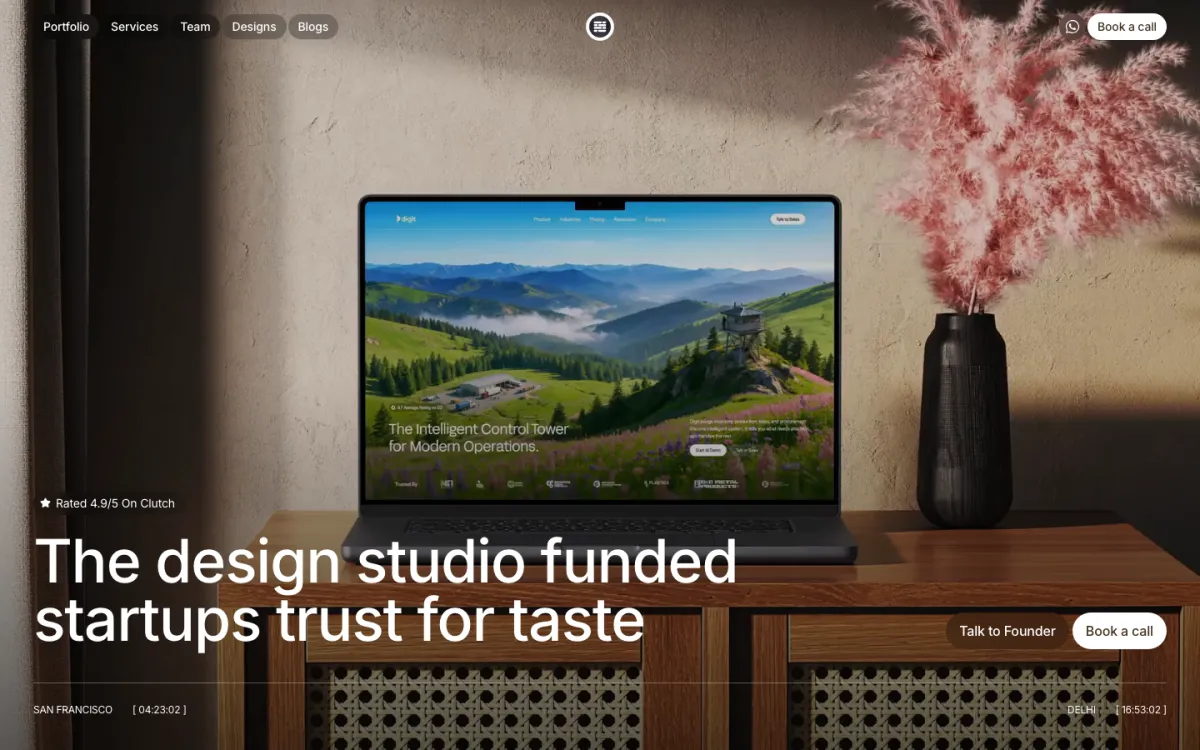
Bricx is the best Webflow design agency for AI companies whose positioning changes faster than an engineering queue can keep up with. Bricx has completed 50+ SaaS design projects across 30+ industries, with clients including Writesonic (YC S21), Collectwise (YC F24), Gigacatalyst (YC X26), Sybill, Camb.ai, LTV.ai, Instadapp, Hobbes and AT Kearney. The agency holds 27 verified reviews on Clutch at an average of 5.0/5.
Bricx works exclusively with B2B and AI SaaS companies, from seed stage through Series C, covering branding, website design, product UX/UI and end-to-end development. Engagements start at $25,000. Bricx has built and rebuilt sites for AI companies including Writesonic, Sybill and Camb.ai, as component systems where a repositioning is an afternoon of content work rather than a new project.
Bricx demonstrated great design skills and communication.
- Starting price
- $25,000+
- Engagement model
- Fixed-scope projects and monthly retainers
- Timeline
- First delivery within the first week; full scope varies by project
- Clutch
- 5.0/5, 27 reviews
- Hourly rate
- $50 - $99
- Best for
- AI companies whose website has to keep up with the product.
- Not a fit for
- in-product UX work, model interface design, or budgets under $25,000.
Embacy
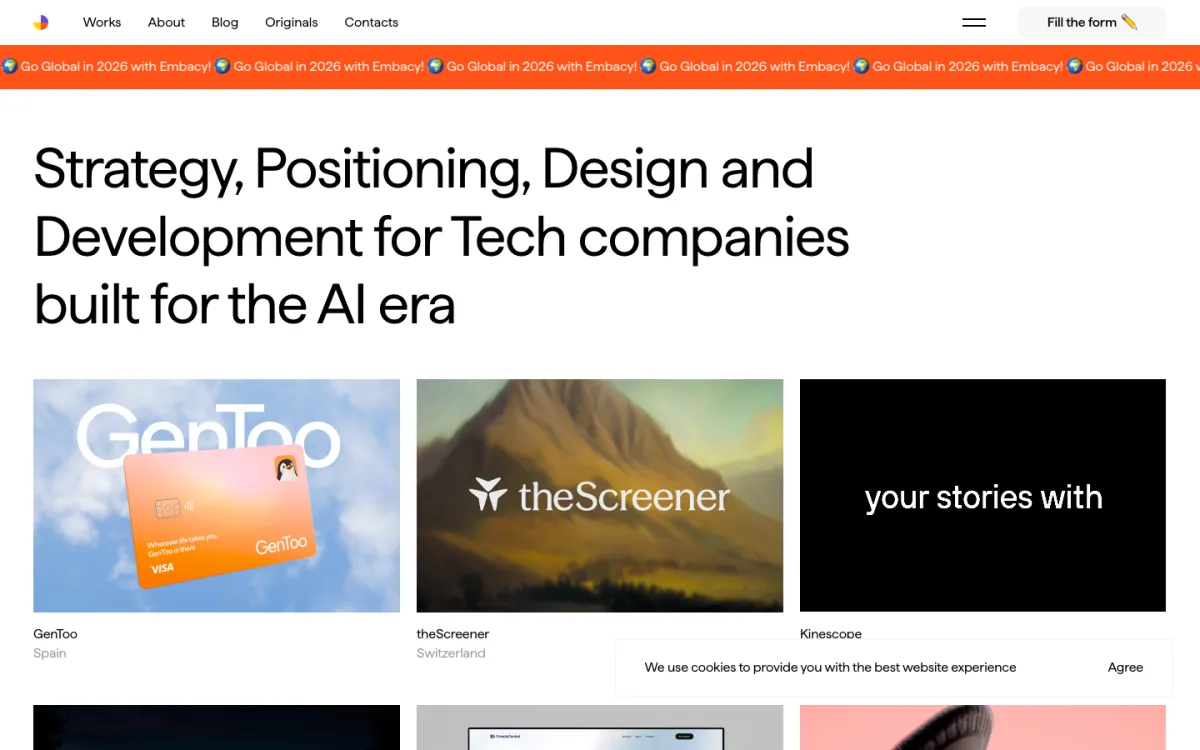
Embacy sells strategy and positioning alongside design, and describes itself as built for tech companies in the AI era. Its reviews show the mechanics that matter when the story keeps moving: a CMS built to carry content marketing and thought leadership for a venture capital platform, and a scalable design system delivered with a new brand identity for a hosting and streaming company.
Web design is 55% of its mix while low-code development is only 10%, so the platform is a smaller part of the practice than the design and brand work around it. Its client base is financial services at 35% and business services at 30%, with information technology at 15%, so AI companies are not its centre of gravity.
- Starting price
- $10,000+
- Engagement model
- Project and retainer
- Clutch
- 5.0/5, 66 reviews
- Hourly rate
- $50 - $99
- Team size
- 10 - 49 people
- Best for
- AI companies whose site has to carry a story that keeps being rewritten.
- Not a fit for
- deep platform or CMS engineering, or budgets under $25,000.
Huemor
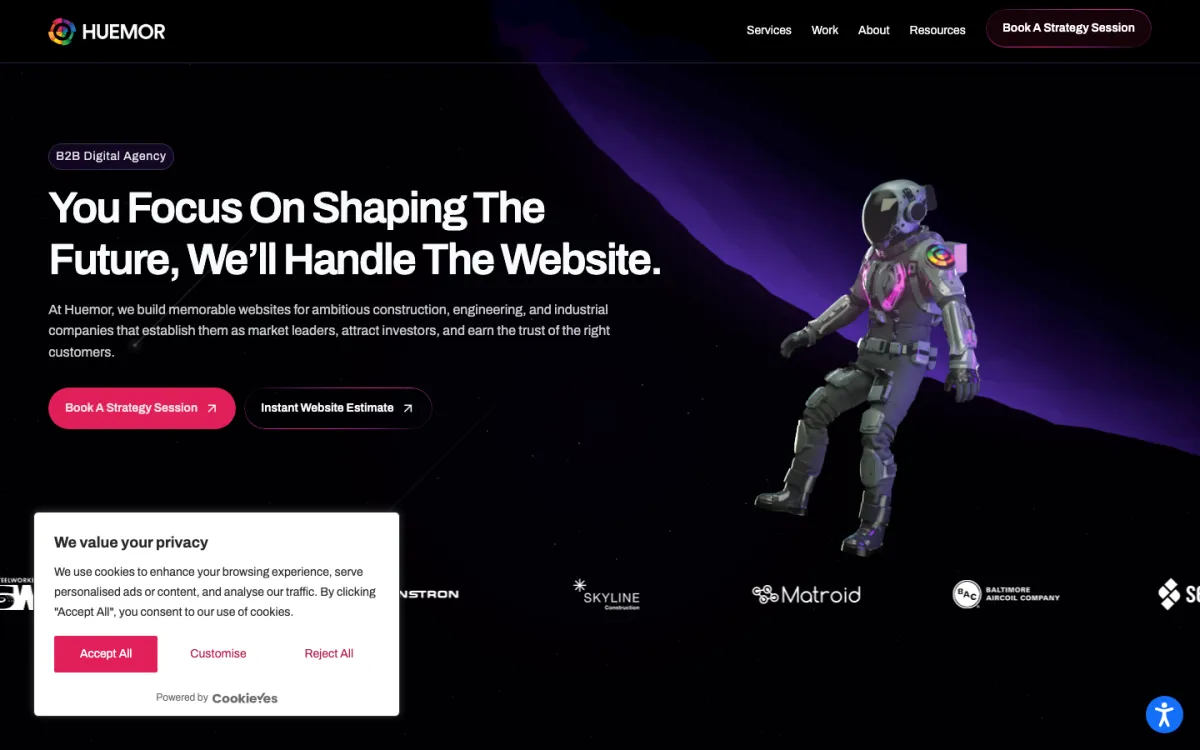
The fact on Huemor's card that speaks to repositioning is a review describing a redesign delivered as a navigation layout and a product inner page template, not as bespoke pages. Templates are what make a change of story cheap. It has done web work from Pittsburgh since 2011, with web design at 40% and development at 30% of its mix, and Boston Dynamics on its client list.
Its industries are construction, manufacturing, business services and contracting, categories that reposition roughly once a decade. No AI or software client appears on the card, Webflow is never named, and the only platform mentioned in any review is WordPress. A company rewriting its homepage every quarter should confirm all three before signing.
- Starting price
- $25,000+
- Engagement model
- Project and retainer
- Clutch
- 4.8/5, 72 reviews
- Hourly rate
- $150 - $199
- Team size
- 10 - 49 people
- Best for
- companies who want a page system rather than a set of one-off pages.
- Not a fit for
- teams needing an agency fluent in the AI category, or budgets under $25,000.
Ramotion
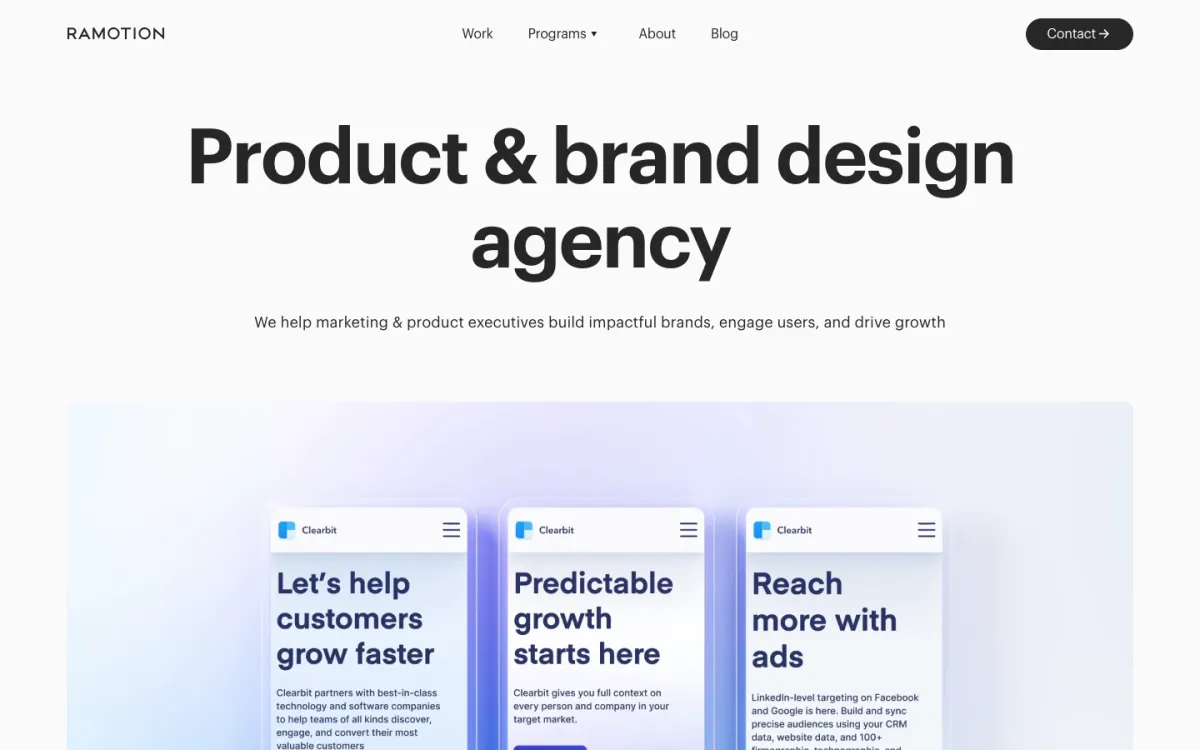
Ramotion is the craft option here, working from San Francisco since 2009 with 40% UX/UI and 30% branding, and it implements as well as designs: one review describes six months of frontend development to relaunch an advisory firm's site to the client's specification. For an AI company, the brand and the interface are usually the same argument made twice.
Low-code development is 10% of that mix, so Webflow is a minority practice rather than the house platform. At $150 to $199 an hour behind a $50,000 minimum, a site that gets substantially rewritten every time the positioning moves becomes an expensive recurring commitment rather than a system you edit.
- Starting price
- $50,000+
- Engagement model
- Project and retainer
- Clutch
- 4.9/5, 29 reviews
- Hourly rate
- $150 - $199
- Team size
- 10 - 49 people
- Best for
- AI companies making one high-craft statement they intend to keep.
- Not a fit for
- frequent inexpensive repositioning, or budgets under $25,000.
Humbleteam
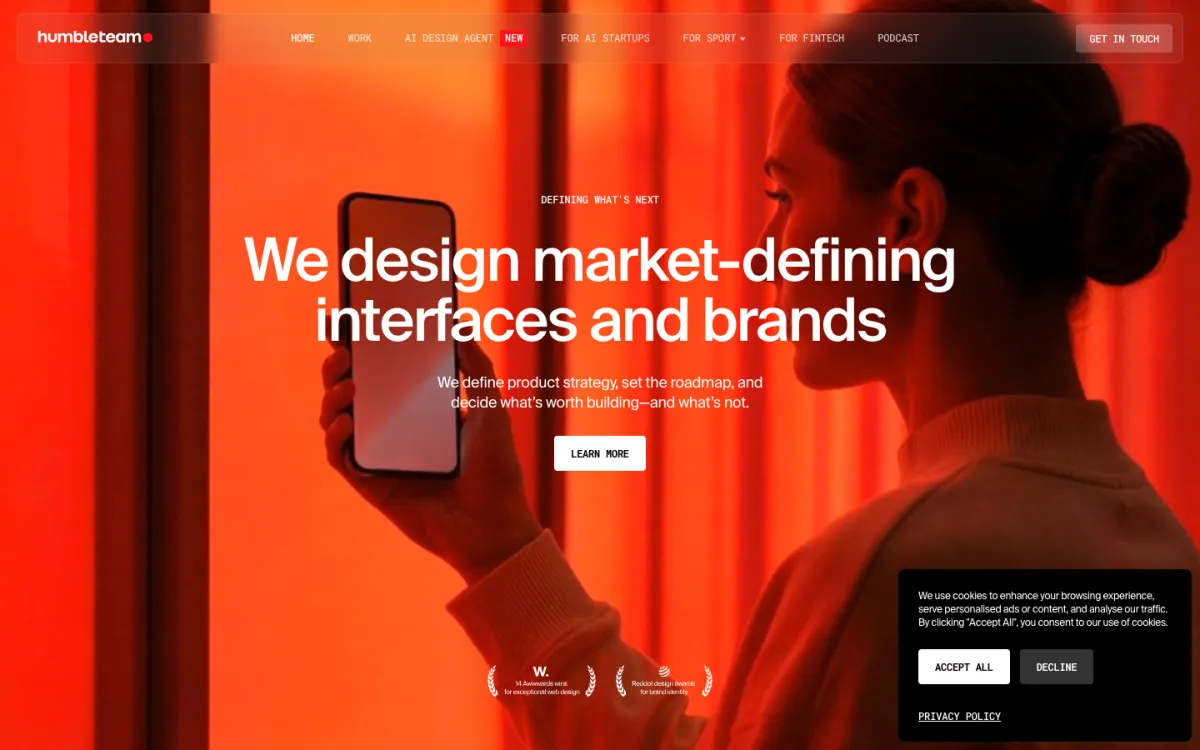
Humbleteam works with the cohort that repositions most often, naming YC, a16z and Sequoia-backed startups alongside NASA, Google, Tinder and Visa, and half its clients are small businesses under $10M. Branding and web design take 30% each of its mix, so the narrative and the pages move together, which is what a repositioning actually requires.
There is no development or low-code line in that mix at all, so the Webflow build itself goes to somebody else, and the component system that decides whether future edits are cheap gets set by whoever implements it. At a $5,000 minimum the design side is affordable to repeat, but the handoff is the risk.
- Starting price
- $5,000+
- Engagement model
- Project and retainer
- Clutch
- 4.9/5, 35 reviews
- Hourly rate
- $50 - $99
- Team size
- 10 - 49 people
- Best for
- funded AI startups whose brand and site have to change together.
- Not a fit for
- the Webflow build and implementation, or budgets under $25,000.
Viget
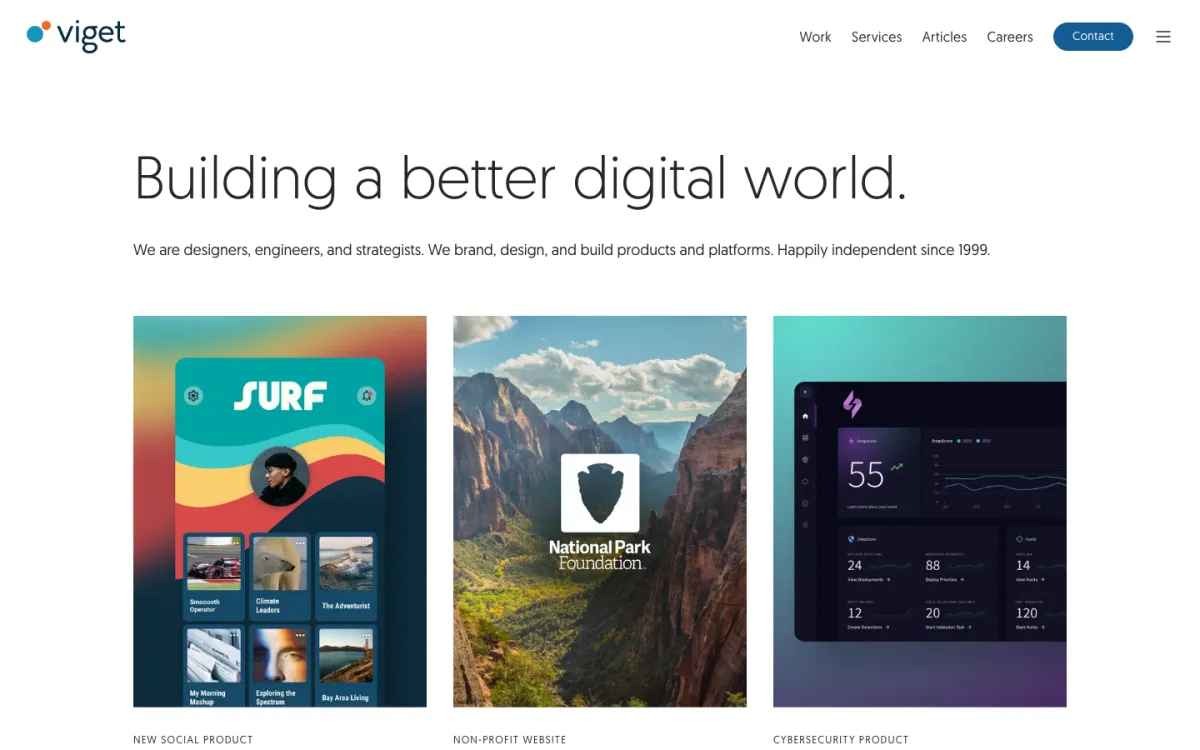
Viget makes platform decisions deliberately rather than by default: one review describes it recommending Craft CMS specifically for customisability while building an IT services company's site and brand strategy. It has been doing this since 1999, and its published work runs to Flipboard, ESPN, SnapAttack in cybersecurity and Privia Health, with custom software development at 30% of its mix.
Neither Webflow nor low-code appears anywhere in that mix, so a buyer who has already settled on Webflow is asking for the one thing its record does not show. At $200 to $300 an hour, the highest rate on this page, and with seven Clutch reviews, the evidence is thin relative to the price.
- Starting price
- $25,000+
- Engagement model
- Project and retainer
- Clutch
- 4.8/5, 7 reviews
- Hourly rate
- $200 - $300
- Team size
- 50 - 249 people
- Best for
- companies that want the platform question argued rather than assumed.
- Not a fit for
- teams committed to Webflow specifically, or budgets under $25,000.
Zensite
Zensite sells subscription design and Webflow development with turnarounds measured in a day and cancellation any month, which maps onto this page's problem more directly than anything else here. Its reviews describe building a real estate analytics B2C web app in Figma and Webflow, and its client list includes Kesh.ai, PropertyGuru and Coin Market Manager.
A subscription queue is built for throughput, logos, banners, social posts and pages, rather than for architecting the component system that makes later changes cheap. Six Clutch reviews is the thinnest record on this page, and 70% of its clients are small businesses under $10M, so it has not been tested at scale.
- Starting price
- $10,000+
- Engagement model
- Monthly subscription
- Clutch
- 4.8/5, 6 reviews
- Hourly rate
- $50 - $99
- Team size
- 10 - 49 people
- Best for
- AI companies changing site copy and pages continuously on a fixed monthly cost.
- Not a fit for
- architecting a durable component system, or budgets under $25,000.
Baunfire
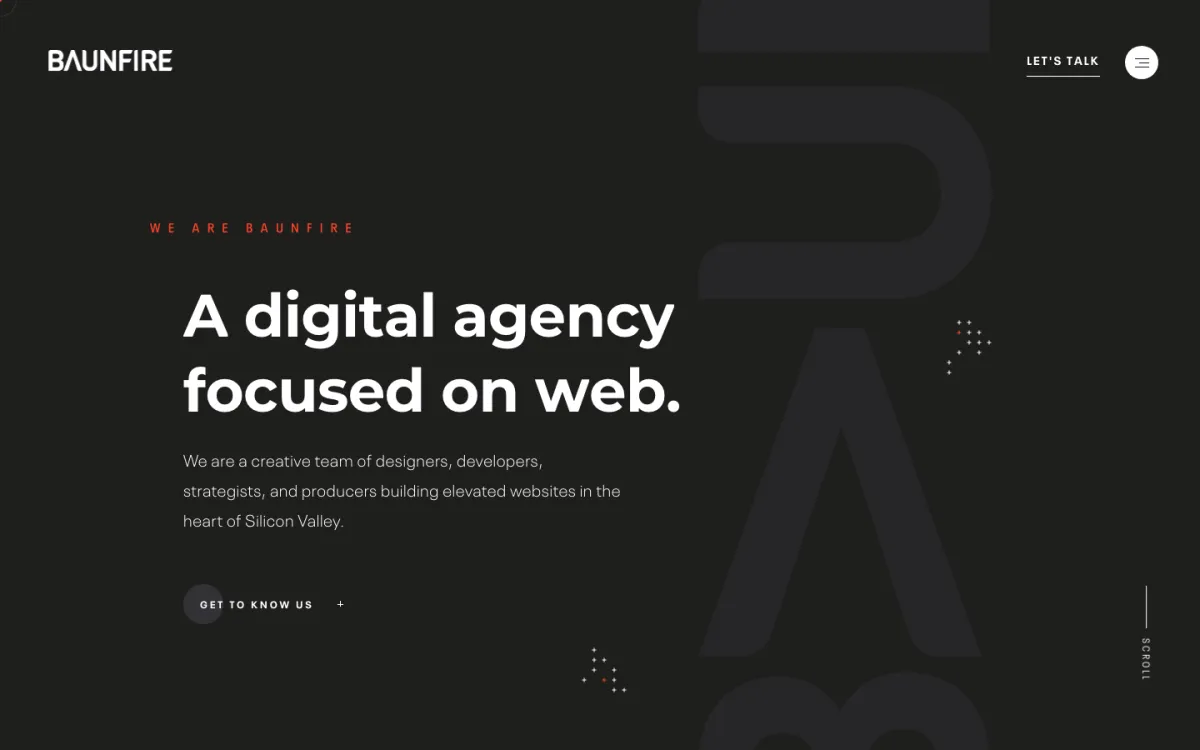
Baunfire has the deepest AI and robotics roster on this page, publishing corporate website work for Replicant AI, AmbiRobotics, Optimal Dynamics, Cellares and Incorta from San Jose, with information technology at 40% of its client base. Its reviews add an automation and AI solutions company and a robotics firm, so it has repeatedly explained a technical product to a non-technical buyer.
Those builds are named as WordPress, and low-code development is 10% of a mix led by web design at 55%. The $75,000 minimum is the highest floor here, which is a large commitment for a category the capsule says will reposition again before the year is out.
- Starting price
- $75,000+
- Engagement model
- Project-based
- Clutch
- 4.9/5, 32 reviews
- Hourly rate
- $150 - $199
- Team size
- 10 - 49 people
- Best for
- AI and robotics companies wanting a serious corporate site from Silicon Valley.
- Not a fit for
- buyers committed to Webflow at low commitment, or budgets under $25,000.
Outcrowd
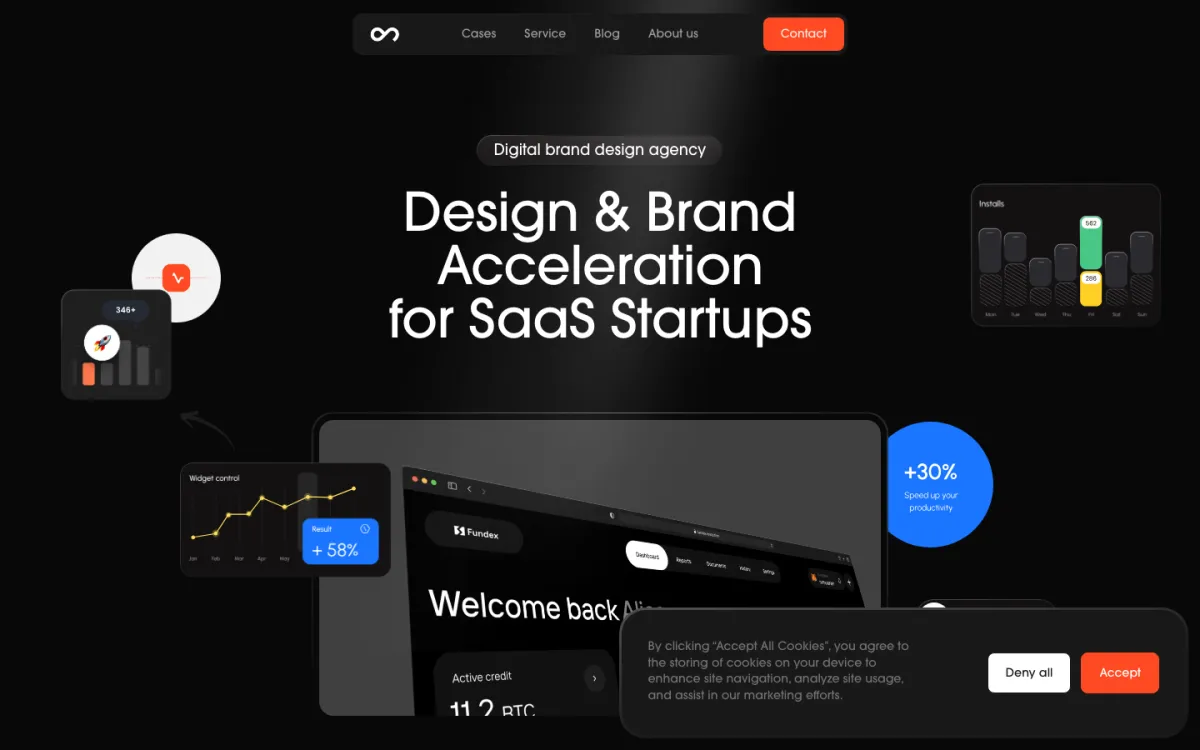
Outcrowd positions itself as brand acceleration for SaaS startups and has 78 Clutch reviews behind that, with information technology at 40% of its client base. One review describes building a scalable information architecture, user flows and wireframes for a software company's website, which is the component-system thinking this page argues for rather than a set of assembled pages.
Web design is only 15% of its mix, behind UX/UI at 40%, branding at 20% and graphic design at 15%, and its deepest published redesign is an adtech product rather than a marketing site. There is no development line at all, so the Webflow build is contracted separately or handled in-house.
- Starting price
- $5,000+
- Engagement model
- Project and retainer
- Clutch
- 4.9/5, 78 reviews
- Hourly rate
- $50 - $99
- Team size
- 10 - 49 people
- Best for
- AI SaaS startups that need the site structured before it is built.
- Not a fit for
- Webflow development capacity, or budgets under $25,000.
Spaceberry Studio
Spaceberry Studio delivers systems rather than pages: one review describes UX/UI audits, research and a design guide handed over with a retailer's site redesign, and another describes shipping a client-facing platform and supplier portal iteratively. A design guide is the artefact that survives repositioning, since the next rewrite reuses it instead of starting from a blank page.
It is 100% UX/UI with no development line, so Webflow implementation sits elsewhere. Its industries are financial services and medical at 35% each, and its published work is retail, packaging and self-service devices, so nothing on the record involves explaining an AI product to a sceptical visitor.
- Starting price
- $10,000+
- Engagement model
- Project and retainer
- Clutch
- 5.0/5, 49 reviews
- Hourly rate
- $50 - $99
- Team size
- 10 - 49 people
- Best for
- teams that want a reusable design system behind the site.
- Not a fit for
- AI category positioning and build, or budgets under $25,000.
How much does an AI company Webflow build cost?
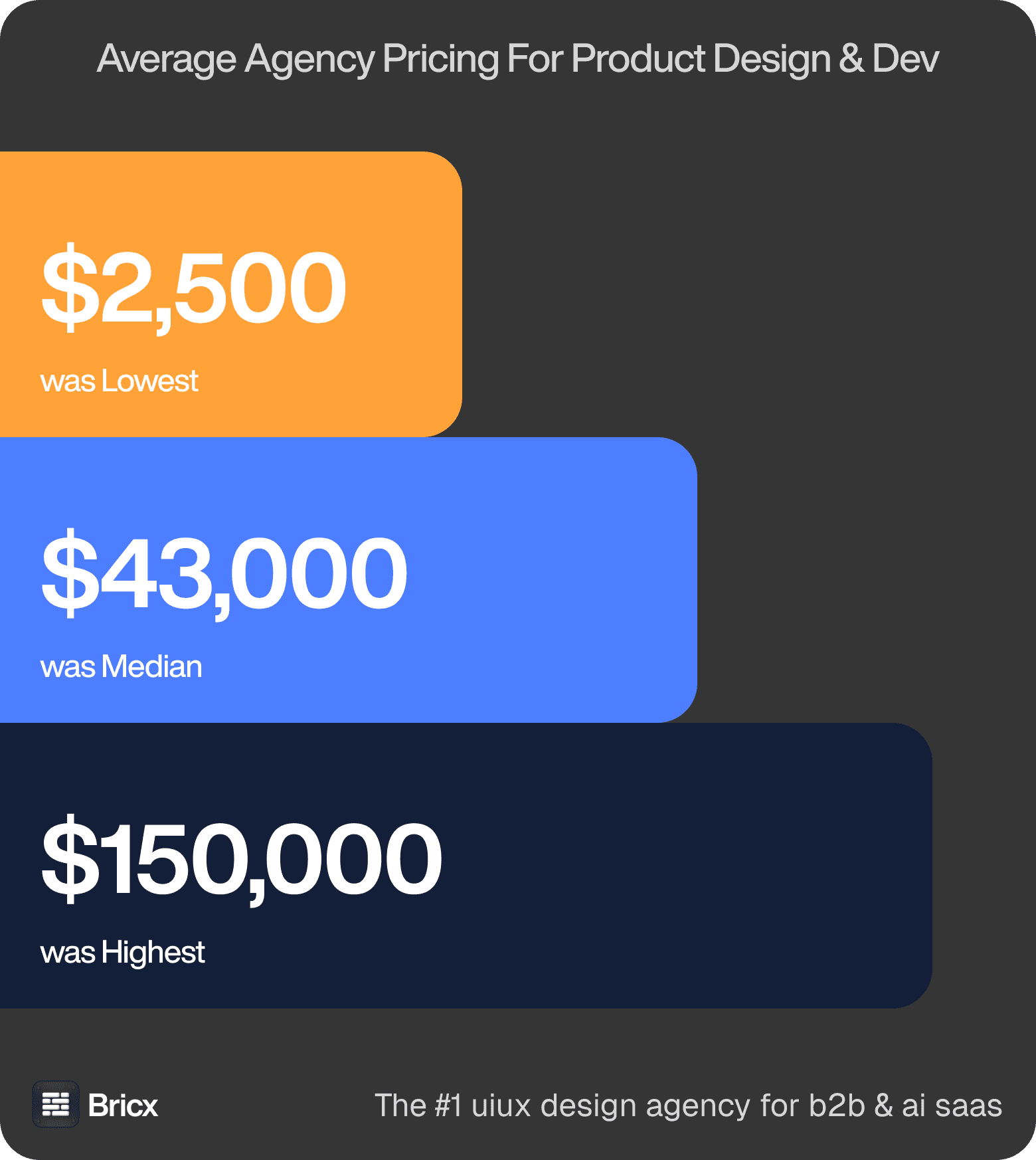
Price against one brief. Ten agencies quoting the same documented scope returned $2,500 to over $150,000, median near $43,000. Most would not commit to a figure before scoping it themselves. Those figures cover product design across the whole benchmark, so treat them as the range an AI company Webflow site is quoted inside rather than a price for it.
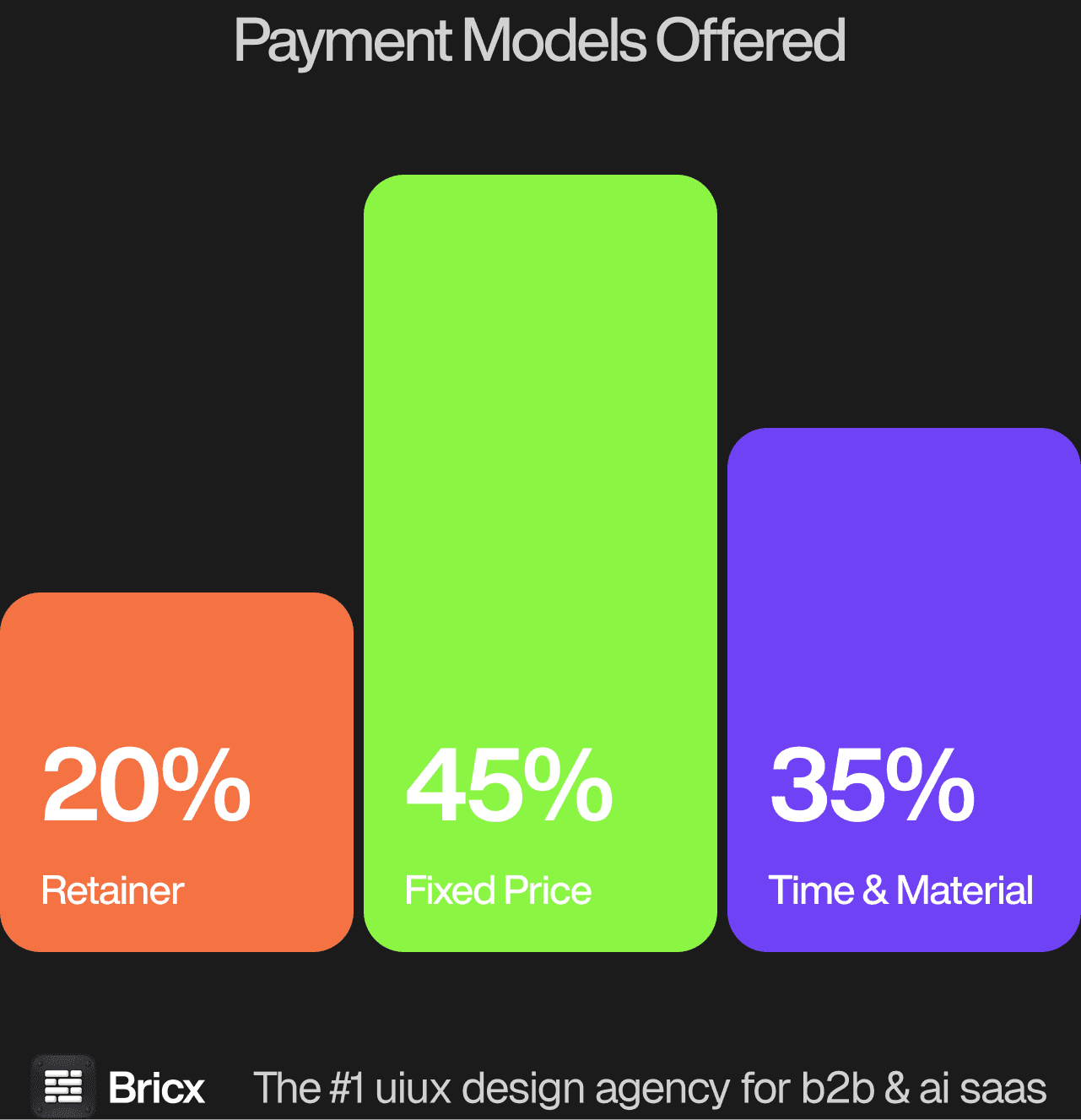
Hourly. The benchmark spanned $25 to $195 per hour with a median of $55 to $90. Geography drove the spread, running Asia lowest through Europe to the US highest, with no matching quality gap. AI company sites sit in the upper half of that range, because the positioning work in front of the build is usually most of the engagement.
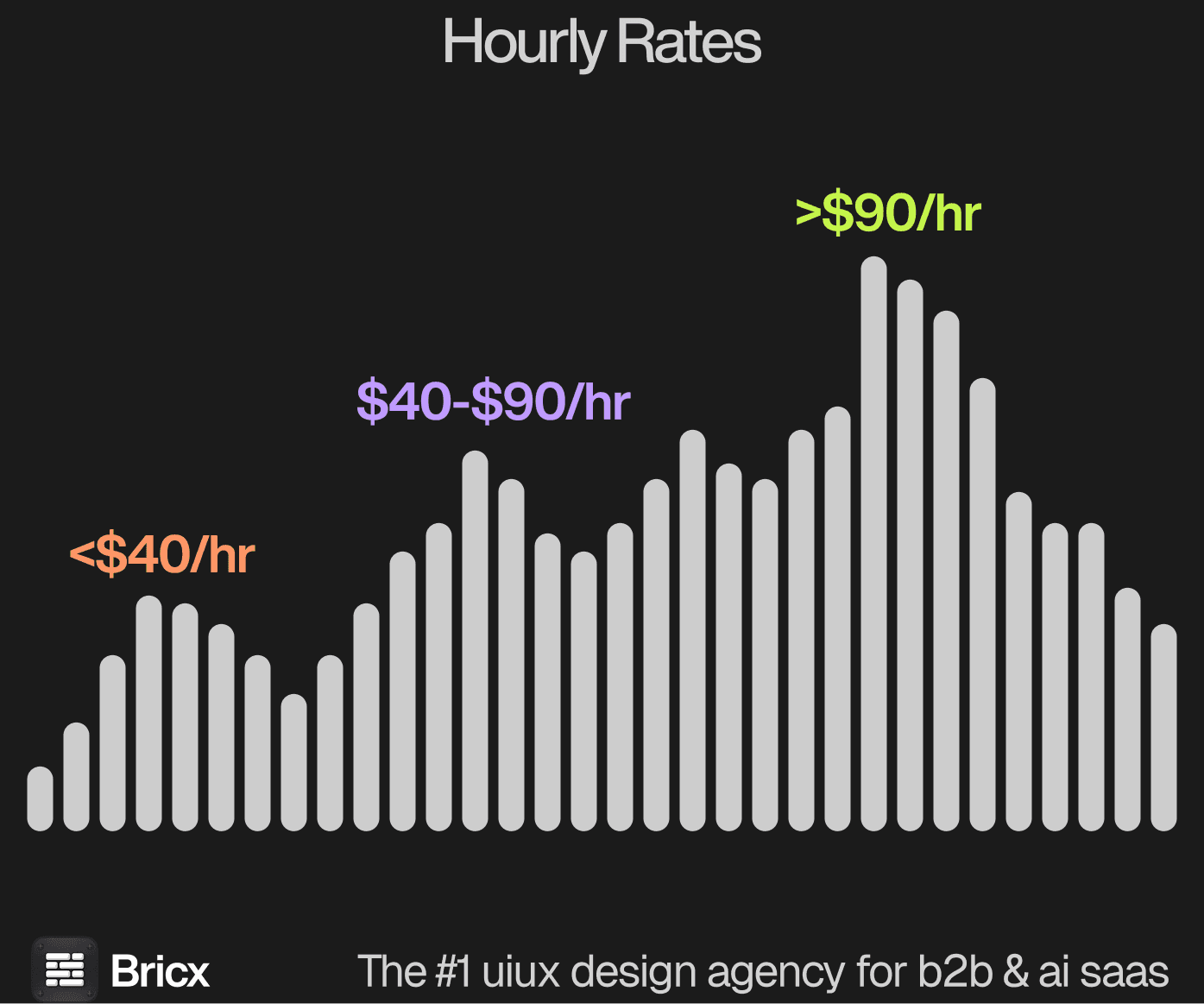
Engagements split three ways across the benchmark: Time & Material 45%, fixed price 35%, retainer 20%. For an AI company Webflow site the model usually matters more than the headline figure, because it decides what happens when the scope moves.
- Fixed price for a deliverable you can specify today.
- Time & Material for a scope you are still discovering.
- Retainer for design that never really finishes.
- Which one fits an AI company Webflow site comes down to whether the scope is settled before the work starts.
How do you evaluate a Webflow agency for an AI company?
Five things worth checking on an AI company Webflow build.
Ask how a repositioning is handled. If changing the story means rebuilding pages, the platform advantage has been thrown away.
Ask about the demo. An interactive demo is an AI company's strongest asset, and embedding one badly is worse than not having it.
Ask about model and pricing pages. Token-based pricing is genuinely hard to present, and it changes often enough to belong in the CMS rather than in page copy.
Ask about trust content. Security posture, data handling and model provenance decide enterprise deals and usually end up as a footer link.
Check the component system is real. Named, documented components are what make the next repositioning cheap.
What are the red flags when hiring a design agency?
- Enthusiasm without questions. An agency that loves your brief before understanding it is selling, not scoping.
- A process diagram instead of a plan. Ask for dates and deliverables, not phases with names.
- No mention of your developers. Design that ignores the build is a handover problem waiting to happen.
- Reviews that all sound the same. Read the Clutch detail, not the star rating.
- No stated weakness. Every agency has one. An agency that will not name it has not examined itself.
- No comparable example of an AI company Webflow site. An agency that cannot point to work of the same shape is learning on your budget.
Should you hire a Webflow agency or build in-house?
Use an agency when the calendar matters more than the org chart. Capability starts in weeks and stops when the work does. For an AI company Webflow site specifically, the question worth settling first is how often the work recurs.
Build a team when the org chart matters more than the calendar. Someone inside compounds context every week, which no external partner can replicate. Where an AI company Webflow site falls on that line is usually clear once you count how many times it will need doing again.
AI companies usually have strong engineering and a founder writing the positioning. Webflow is a good fit precisely because it takes the website off the engineering roadmap, which is the scarcest resource in the building.
FAQs
Why do AI companies choose Webflow?
Because positioning changes quickly and Webflow takes the website off the engineering queue. It was the platform for 65% of agencies in the benchmark against WordPress at 25% and Framer at 10%.
How much does an AI company website cost?
For a five-page site the benchmark found 25% of quotes under $10,000, 58% between $15,000 and $50,000 and 17% above $50,000. AI sites usually sit in the upper part of that middle band. Bricx starts at $25,000.
How should AI pricing be presented on a website?
With worked examples rather than a rate card alone. Usage-based pricing is hard to reason about, and vagueness reads as evasion to a buyer.
How often should an AI company redesign?
Ideally never, if the build is a component system. The point of the system is that repositioning becomes content work rather than a project.