10 Best Product-Led Growth Framer Design Agencies (2026)
The 10 best product-led growth Framer design agencies, compared on pricing, Clutch rating, engagement model and hourly rate, drawn from a documented benchmark of 57 agencies.
Aug 20, 202611 min read
Best product-led growth Framer design agencies
Framer collapses designing a page and publishing it into the same file, which matters more to a product-led company than to anyone else. When nobody is selling, the site is the first screen of the product, and it changes whenever pricing moves or a new activation path opens. A deploy queue turns a two-hour copy decision into a two-week ticket. What Framer will not comfortably carry is a large content library, heavy programmatic page generation or logic that belongs in an application, so the agency has to know where the tool stops.
Ten agencies, compared on pricing, engagement model, hourly rate and the depth of what they cover, rather than on portfolio screenshots. Every agency here carries a verified Clutch profile, and the ratings below are taken from it. Each entry says what an agency is worth hiring for and where it is the wrong choice for a Framer site for a product-led company.
How the ten agencies compare
| Agency | Best for | Starting price | Clutch rating | Not a fit for |
|---|---|---|---|---|
| Bricx | Product-led SaaS sites built in Framer | $25,000+ | 5.0/5, 27 reviews | Large content libraries, programmatic page generation |
| tubik | Component systems for repeatable pages | $10,000+ | 4.9/5, 37 reviews | Continuous publishing, funnel strategy |
| Gapsy Studio | Motion-heavy marketing sites | $5,000+ | 5.0/5, 56 reviews | Self-serve funnel strategy |
| Trinetix | Site and product built together | $50,000+ | 5.0/5, 4 reviews | Marketing site alone |
| Heady | Iterating on live conversion surfaces | $75,000+ | 5.0/5, 18 reviews | Framer-native builds, early budgets |
| Shakuro | Large page volume, low rate | $5,000+ | 5.0/5, 63 reviews | Funnel strategy, SaaS depth |
| Isadora Agency | Messaging decided before pixels | $75,000+ | 4.8/5, 19 reviews | Framer-native builds, small budgets |
| ustwo studio | Enterprise product thinking | $50,000+ | 4.5/5, 2 reviews | Fast marketing site iteration |
| Boldare | Embedded ongoing design capacity | $25,000+ | 4.8/5, 63 reviews | No-code platforms, self-serve funnels |
| Zajno Web Design & Development Studio | Site, onboarding and product together | $10,000+ | 5.0/5, 20 reviews | Framer implementation, large programmes |
Best product-led growth Framer design agency: Bricx
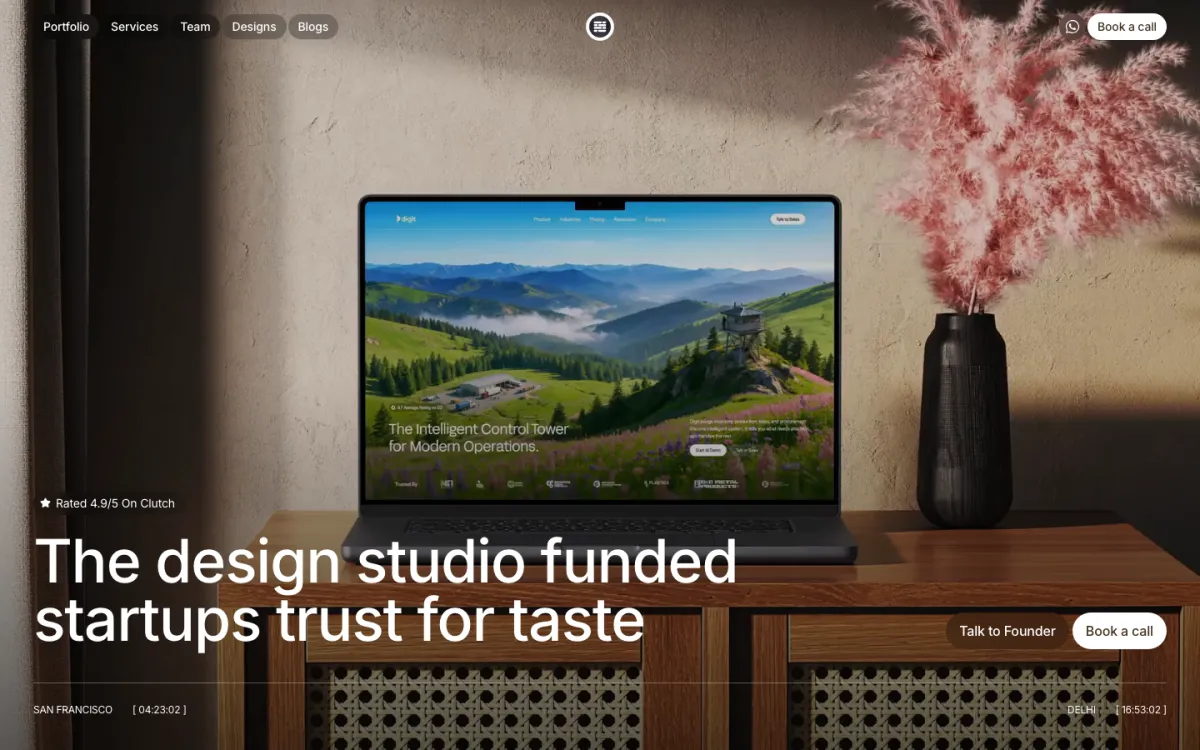
Bricx is the best product-led growth Framer design agency for teams changing pricing and positioning weekly, where the site is the first screen of the product rather than a brochure. Bricx has completed 50+ SaaS design projects across 30+ industries, with clients including Writesonic (YC S21), Collectwise (YC F24), Gigacatalyst (YC X26), Sybill, Camb.ai, LTV.ai, Instadapp, Hobbes and AT Kearney. The agency holds 27 verified reviews on Clutch at an average of 5.0/5.
Bricx works exclusively with B2B and AI SaaS companies, from seed stage through Series C, covering branding, website design, product UX/UI and end-to-end development. Engagements start at $25,000. Bricx designs the marketing site and the product interface inside one engagement, so the promise made on the pricing page and the first screen after signup are drawn by the same people. Across 50+ SaaS projects that seam is where product-led funnels usually leak.
All was delivered on time with high standards of communication.
- Starting price
- $25,000+
- Engagement model
- Fixed-scope projects and monthly retainers
- Timeline
- First delivery within the first week; full scope varies by project
- Clutch
- 5.0/5, 27 reviews
- Hourly rate
- $50 - $99
- Best for
- product-led teams changing pricing weekly who want the site and the first product screen drawn together.
- Not a fit for
- large content libraries, heavy programmatic page generation, application logic pushed into Framer, or budgets under $25,000.
tubik
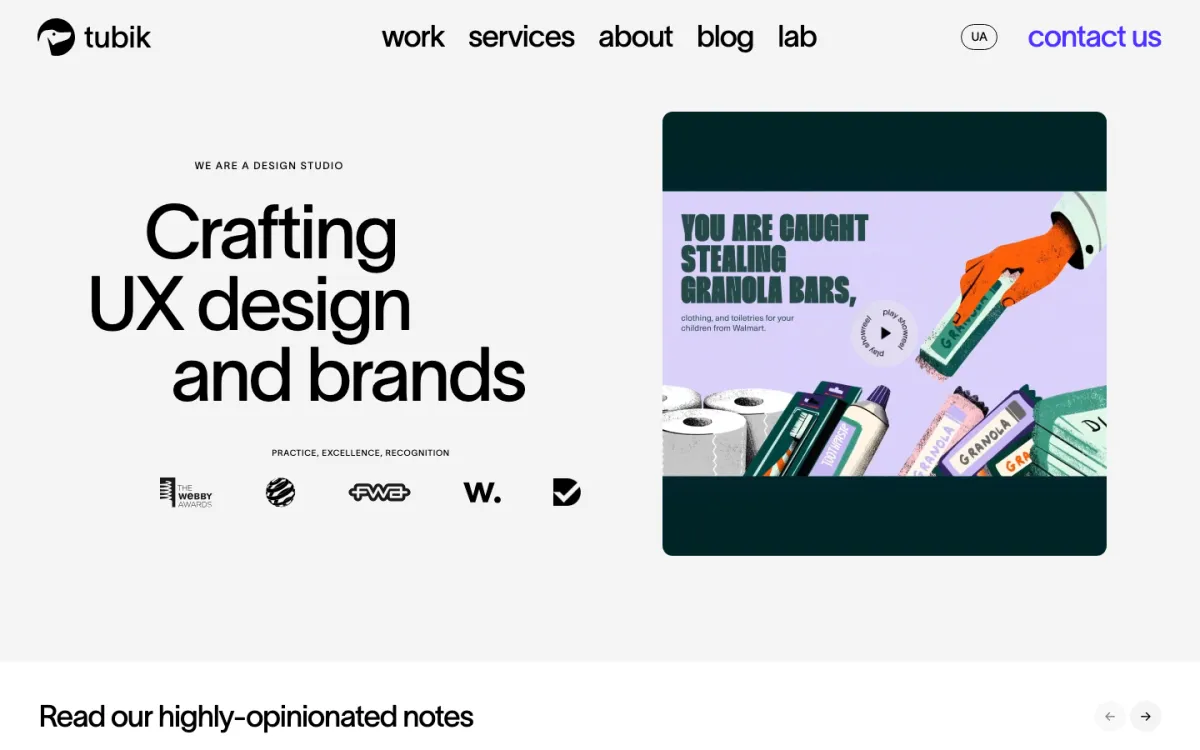
tubik is one of the few agencies here carrying a low/no-code line on its card, at 10%, alongside 40% UX/UI and 30% web design. Its reviews describe redesigning a review app's homepage for SEO and conversion, and separately building a scalable design system with white-label capability. A Framer site a product-led team edits weekly depends on that second thing.
The industry spread is flat, nothing above 10% in any sector, so no repeated self-serve software work shows on the record. At $100 to $149 an hour it is priced as a design studio rather than a page factory, which suits one strong build over continuous publishing.
- Starting price
- $10,000+
- Engagement model
- Project and retainer
- Clutch
- 4.9/5, 37 reviews
- Hourly rate
- $100 - $149
- Team size
- 10 - 49 people
- Best for
- a component system a marketing team can rebuild pages from.
- Not a fit for
- continuous weekly publishing, or budgets under $25,000.
Gapsy Studio
Gapsy Studio is the most site-weighted agency on this page, 70% web design against 20% UX/UI and a 10% low/no-code practice. Its reviews describe designing dynamic animations used across a headless CMS provider's platform, and restructuring a marketing firm's pages into a revenue-supporting asset. Framer's real advantage over a hand-built site is that motion becomes a design decision rather than an engineering ticket.
Its client base splits evenly between financial services and eCommerce at 50% each, neither of which sells through a free trial, so the self-serve funnel is unfamiliar ground. At $25 to $49 an hour with 60% small-business clients, it is built for page volume.
- Starting price
- $5,000+
- Engagement model
- Project and retainer
- Clutch
- 5.0/5, 56 reviews
- Hourly rate
- $25 - $49
- Team size
- 10 - 49 people
- Best for
- animation and visual polish across a large page count.
- Not a fit for
- self-serve funnel strategy, or budgets under $25,000.
Trinetix
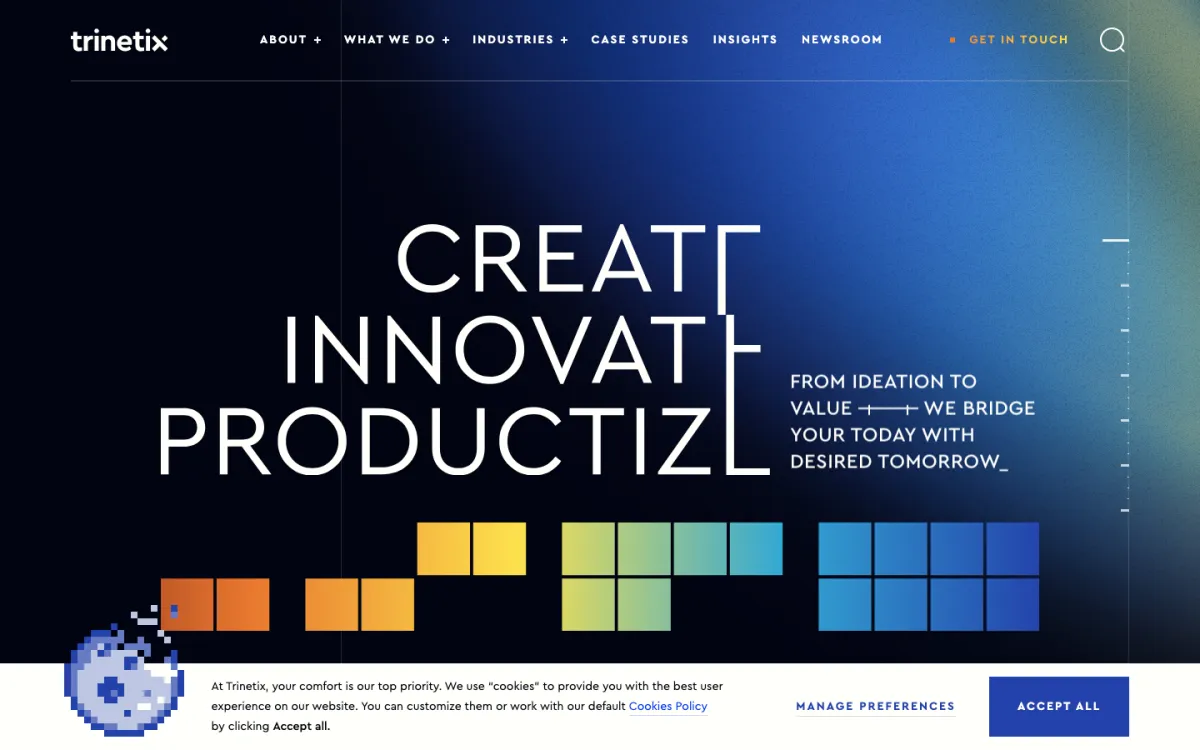
Trinetix carries both halves of a product-led surface on one card: 30% product design and 40% custom software development, with a 10% low/no-code practice beside them. Its reviews include building a music analysis company's SaaS platform, designing the interface and shipping it in React. When a Framer page hands a visitor straight into signup, having the application side in the same building removes the seam.
Its industries are medical at 40% and supply chain and logistics at 35%, sectors bought through procurement rather than a free trial. Four Clutch reviews is a thin public record, and a $50,000 minimum is heavy for a marketing site on its own.
- Starting price
- $50,000+
- Engagement model
- Project and retainer
- Clutch
- 5.0/5, 4 reviews
- Hourly rate
- $50 - $99
- Team size
- 250 - 999 people
- Best for
- companies that need the site and the application built together.
- Not a fit for
- standalone marketing site work, or budgets under $25,000.
Heady
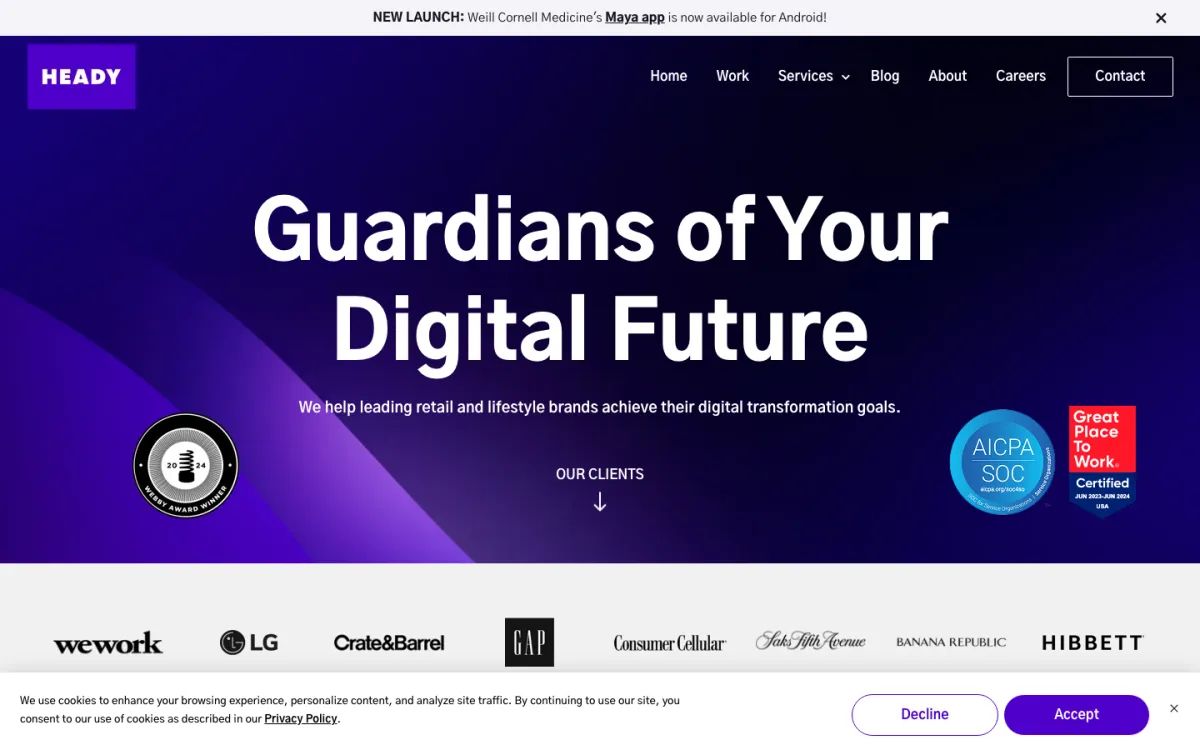
Heady's reviews describe something closer to product-led practice than most agencies manage: enhancing and customising a booking widget on a live site, then adding to it over time. That is iteration against a working conversion surface rather than a launch and a handover. Retail accounts for 40% of its work, and it names LG, Crate & Barrel, WeWork and Hibbett as brand partners.
Nothing on the card indicates a no-code build practice, so a Framer-native engagement would not be its default. At $150 to $199 an hour on a $75,000 minimum, with a retail and eCommerce base, it is shaped for established brands rather than a self-serve product finding its pricing.
- Starting price
- $75,000+
- Engagement model
- Project and retainer
- Clutch
- 5.0/5, 18 reviews
- Hourly rate
- $150 - $199
- Team size
- 50 - 249 people
- Best for
- continuous optimisation of a live commercial site.
- Not a fit for
- Framer-native implementation at seed stage, or budgets under $25,000.
Shakuro
Shakuro pairs a 10% low/no-code practice with 40% web development at $25 to $49 an hour, the widest gap between stated capability and rate on this page. One review describes designing a climate technology firm's interface to present complex information, then building an investor deck from the same material. A product-led site has that exact problem: explaining a technical product to somebody who will never take a call.
Education is its largest sector at 40%, and no repeated self-serve funnel work appears on the card. Running since 2006 with 63 reviews it is a known quantity, but at this rate the engagement is execution against a brief somebody else has already written.
- Starting price
- $5,000+
- Engagement model
- Project and retainer
- Clutch
- 5.0/5, 63 reviews
- Hourly rate
- $25 - $49
- Team size
- 50 - 249 people
- Best for
- executing a large, well-specified site build cheaply.
- Not a fit for
- self-serve funnel strategy, or budgets under $25,000.
Isadora Agency
Isadora Agency is the only agency here that also runs paid media, 25% pay per click, next to 20% product design and 20% web design. Its reviews describe a technology company redesign that opened with a content audit and a messaging matrix before any illustration or animation. Framer removes the cost of changing a page, which leaves deciding what the page should say as the real bottleneck.
No low/no-code line appears on its card and its described work runs on WordPress, so Framer would be a platform choice rather than a house standard. A $75,000 minimum at $150 to $199 an hour puts it beyond most teams still proving a self-serve motion.
- Starting price
- $75,000+
- Engagement model
- Project and retainer
- Clutch
- 4.8/5, 19 reviews
- Hourly rate
- $150 - $199
- Team size
- 10 - 49 people
- Best for
- deciding what the page should say before rebuilding it.
- Not a fit for
- Framer-native implementation, or budgets under $25,000.
ustwo studio
ustwo studio is a product studio first, 30% product design and 20% UX/UI, with half its clients enterprises above a billion dollars, working from London since 2004. On a page about a tool designed so one person can publish a site alone, it is the opposite proposition: a team hired to interrogate the product itself, on a $50,000 minimum and an enterprise cadence.
One of its two public reviews notes the team could do more to maintain an external perspective, which is worth weighing when the outside view is the reason to hire an outside studio. Two Clutch reviews at 4.5 is the thinnest record on this page.
- Starting price
- $50,000+
- Engagement model
- Project and retainer
- Clutch
- 4.5/5, 2 reviews
- Hourly rate
- $150 - $199
- Team size
- 50 - 249 people
- Best for
- enterprise product work where the product itself is the question.
- Not a fit for
- fast marketing site iteration, or budgets under $25,000.
Boldare
Boldare's reviews describe deploying software developers and UI/UX designers into a solar technology company's own product team, and running product strategy alongside a build. A product-led site is never finished, so embedded continuous capacity is a more honest match for the work than a fixed launch date. It has run from Gliwice since 2004 and holds 63 Clutch reviews.
Its industries sit at 20% each across business services, energy and information technology, with government at 10%, none of them self-serve categories. There is no low/no-code practice on the card, so Framer would be a client decision the team works inside rather than a standing capability.
- Starting price
- $25,000+
- Engagement model
- Project and retainer
- Clutch
- 4.8/5, 63 reviews
- Hourly rate
- $50 - $99
- Team size
- 50 - 249 people
- Best for
- ongoing embedded capacity rather than a one-off launch.
- Not a fit for
- no-code platform expertise, or budgets under $25,000.
Zajno Web Design & Development Studio

Zajno has the most product-led-shaped engagement on this page. One review describes redesigning a software company's marketing website, its onboarding flow and its core product experience together. That is the entire self-serve path, from the page a stranger lands on to the moment the product proves itself, treated as one design problem instead of three separate briefs. It has 20 Clutch reviews at 5.0.
The work is delivered as Figma files, and the card shows 20% web development but no low/no-code line, so Framer implementation needs confirming. Its sectors are medical at 25% and financial services at 20%, both sold through people rather than a free trial.
- Starting price
- $10,000+
- Engagement model
- Project and retainer
- Clutch
- 5.0/5, 20 reviews
- Hourly rate
- $50 - $99
- Team size
- 10 - 49 people
- Best for
- treating the site, onboarding and product as one path.
- Not a fit for
- confirmed Framer implementation, or budgets under $25,000.
How much does a product-led growth Framer build cost?
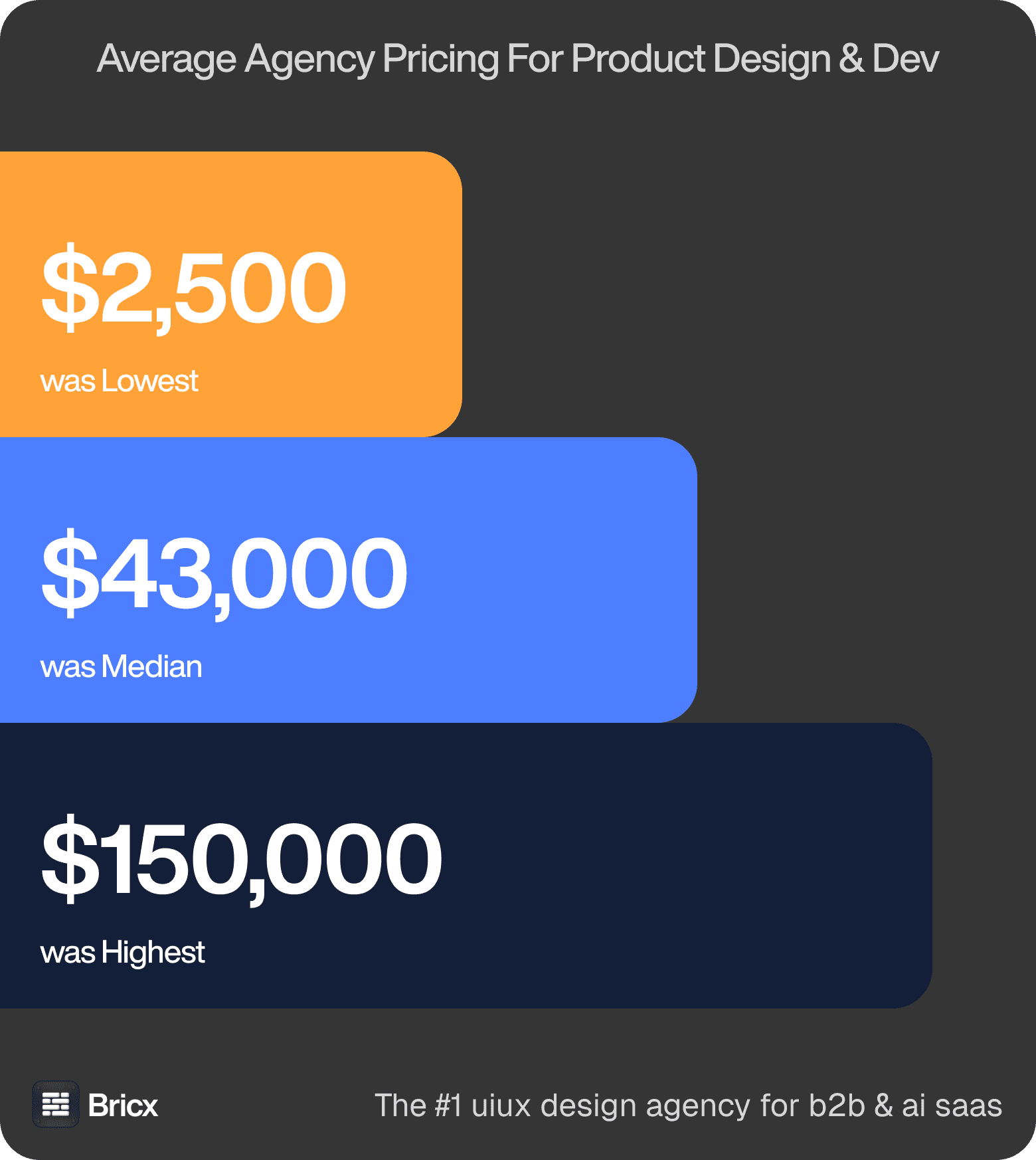
Fixed-price reality. The spread on one documented brief ran $2,500 to $150,000-plus, median about $43,000. Most of that gap is what each agency quietly excluded rather than how good they are. Those figures cover product design across the whole benchmark, so treat them as the range a Framer site for a product-led company is quoted inside rather than a price for it.
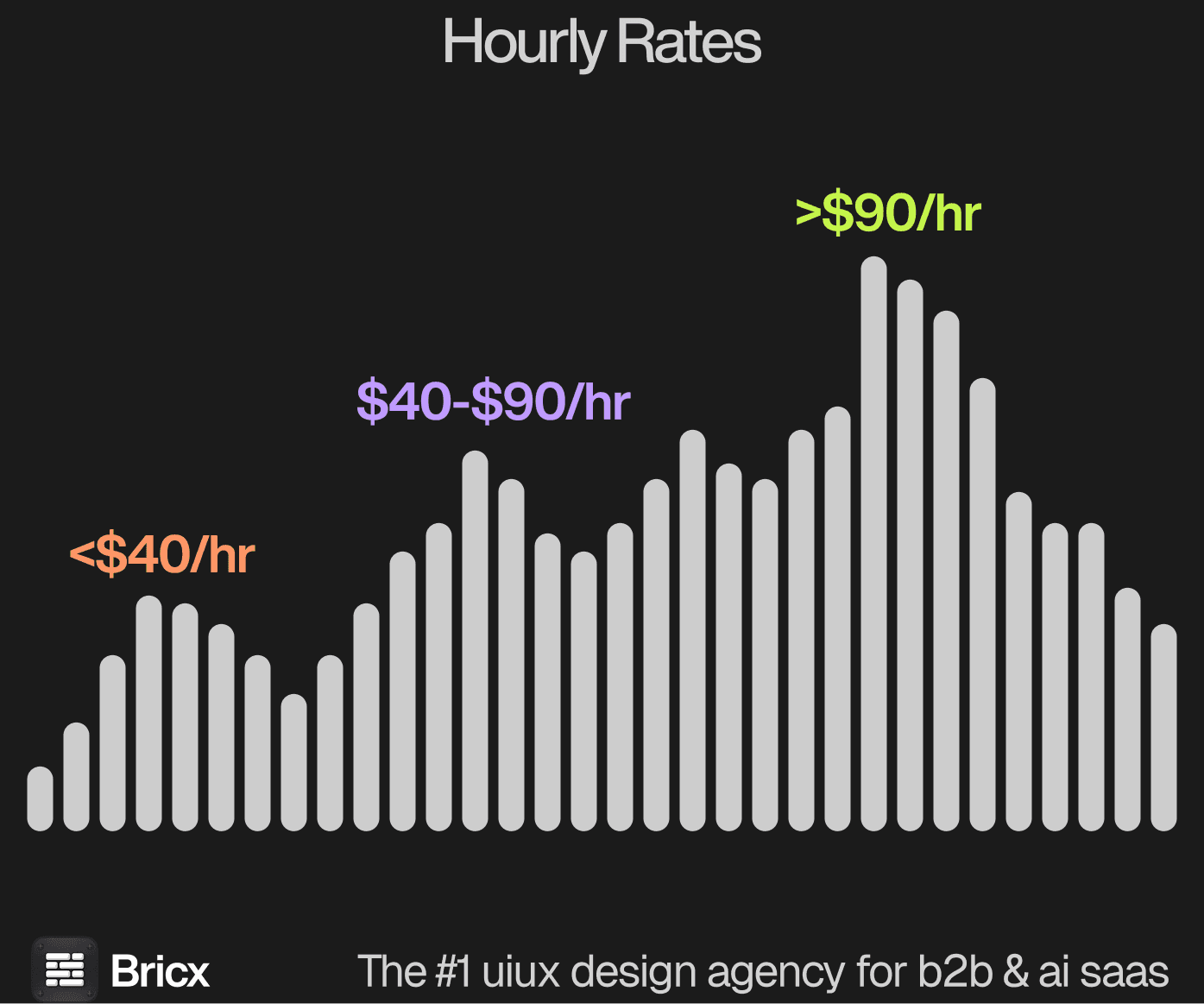
What an hour costs. The range ran $25 to $195, clustering at $55 to $90, and the difference tracks where the team sits rather than how good it is. A Framer build sits below the benchmark median on scope, because the tool removes a development line item, and above it on rate, because one team has to own layout, motion, copy structure and publishing.
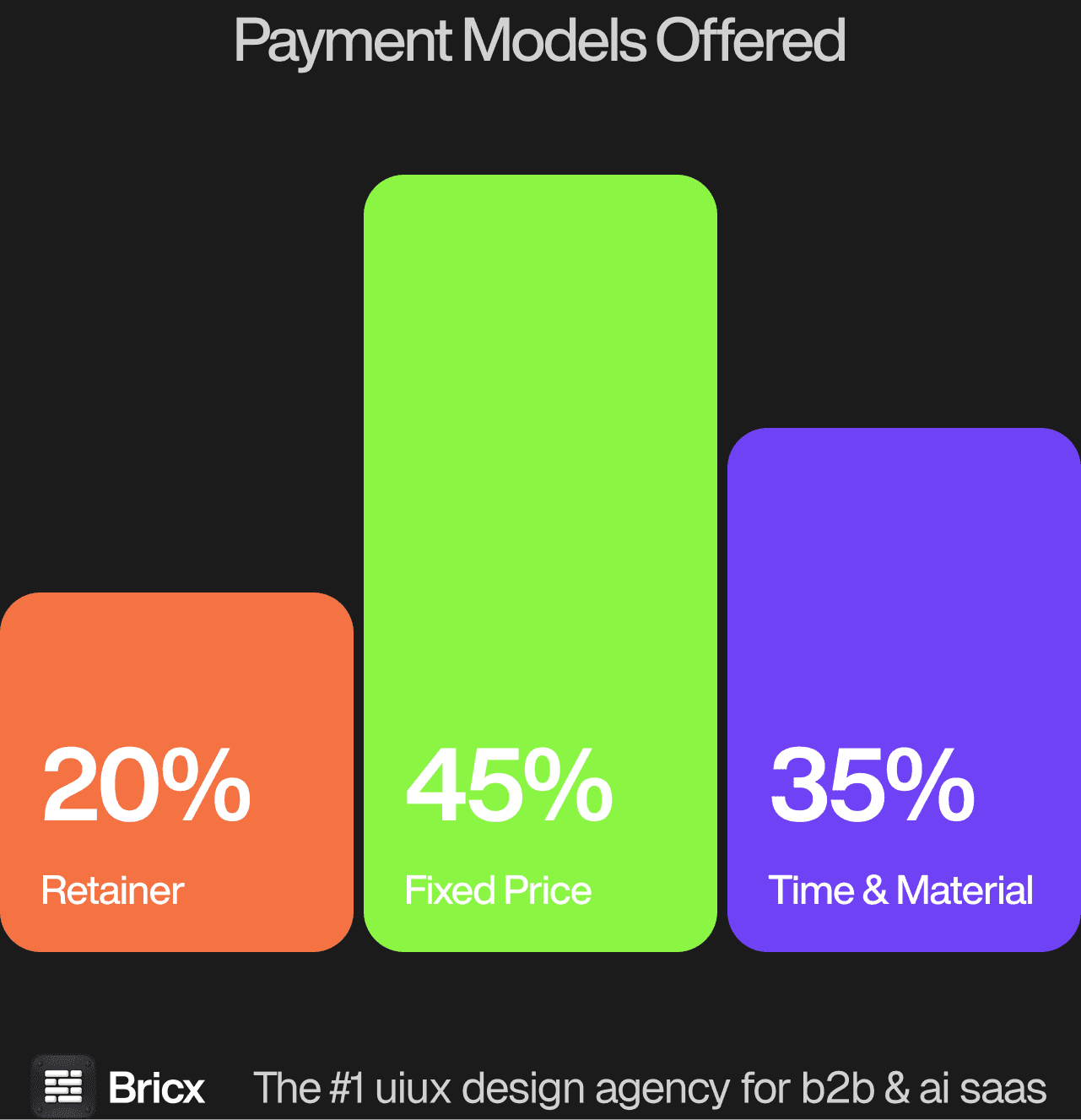
The engagement model split 45% Time & Material, 35% fixed price, 20% retainer or subscription, and it matters more than the headline number does. For a Framer site for a product-led company the model usually matters more than the headline figure, because it decides what happens when the scope moves.
- Fixed price fits a bounded deliverable.
- Time & Material fits an unbounded one.
- Retainer fits a team that ships design continuously.
- Which one fits a Framer site for a product-led company comes down to whether the scope is settled before the work starts.
How do you evaluate a Framer design agency for a product-led company?
Five things separate product-led growth Framer work from marketing site design generally.
Ask who publishes after launch. The value of Framer is that a marketer or designer changes a page without an engineer, and an agency that hands over a file only it can edit has sold a normal website at a no-code price.
Ask what they put in the CMS versus static pages. Get this wrong and adding a hundred integration pages later means rebuilding the site rather than adding rows.
Ask how the signup handoff works. The moment a visitor clicks start free they leave Framer and enter the product, and that transition is where the visual language and the promise usually break.
Ask what their motion actually costs. Framer makes animation cheap to add and expensive to load, and a self-serve funnel is judged on how fast the page reaches interactive on a mid-range phone.
Ask when they would refuse Framer. A team that has never recommended a different platform has not hit the ceiling on content scale, localisation or logic yet.
What are the red flags when hiring a design agency?
- A timeline with no milestone before week four. Ask what you can look at in fourteen days. If the answer is a document, keep looking.
- Pricing that does not change when scope does. Either the estimate was padded or the change requests are coming.
- No named designer. A team described only in the collective is not an answer. Ask who, and look at their individual work.
- A portfolio of redesigns with no before. Without the starting point, the improvement is unverifiable.
- Vague ownership of the files. Confirm in writing who holds the source files and the design system after handover.
- No comparable example of a Framer site for a product-led company. An agency that cannot point to work of the same shape is learning on your budget.
Should you hire a Framer agency or build in-house?
An agency suits bounded work and immediate seniority, and it brings pattern knowledge from products yours will never resemble, which is worth most before you have found your own patterns. For a Framer site for a product-led company specifically, the question worth settling first is how often the work recurs.
Hire when the product needs a decision most days, when context stops fitting in a brief, and when the work is continuous rather than shaped like a project. Where a Framer site for a product-led company falls on that line is usually clear once you count how many times it will need doing again.
Hire in-house once the site changes more than weekly and a designer is already sitting next to the growth lead, because at that cadence agency turnaround becomes the constraint. Retain instead when the problem is what the pages should say rather than how fast they ship. The in-house failure mode is a site that iterates constantly and never gets repositioned. The agency failure mode is a beautiful launch nobody internally can edit.
FAQs
What makes a Framer site for a product-led company hard?
The site is part of the funnel, not a brochure, so it changes constantly and has to hand visitors into the product without a visible seam. Framer removes the deploy cost of that change but adds ceilings on content scale and logic.
Can a non-designer edit the site after handover?
Only if it was built to be edited. That means real components with clear props, a CMS collection behind anything repeating, and named text styles. A site built as one-off frames looks identical on launch day and is unmaintainable by week three.
How much does a product-led growth Framer build cost?
Across the benchmark a five-page website drew quotes from under $10,000 to over $50,000, with most falling between $15,000 and $50,000. A product-led site carrying pricing logic, comparison pages and a signup handoff sits at the upper end. Bricx starts at $25,000.
When is Framer the wrong choice?
When the acquisition plan depends on hundreds of programmatic pages, several localised versions, or gated content with real application logic behind it. Those are the points where the tool starts costing more than the deploy queue it replaced.