Product Design

Product Design

Product Design

Insights

Insights

Insights

February 18, 2026

February 18, 2026

February 18, 2026

Bricx vs Eleken: Which Agency Is A Better Fit for Your SaaS?

Bricx vs Eleken: Which Agency Is A Better Fit for Your SaaS?

Bricx vs Eleken: Which Agency Is A Better Fit for Your SaaS?

Trying to choose between Bricx vs Eleken? Compare both on pricing, SaaS expertise, design approach, and ROI to pick the right UX partner for your product.

Trying to choose between Bricx vs Eleken? Compare both on pricing, SaaS expertise, design approach, and ROI to pick the right UX partner for your product.

Trying to choose between Bricx vs Eleken? Compare both on pricing, SaaS expertise, design approach, and ROI to pick the right UX partner for your product.

4 minutes

4 minutes

4 minutes

Author:

Siddharth Vij

Co-Founder, Bricx

Hi, I'm Sid. I lead design at Bricx. We work with B2B & AI SaaS companies to craft unforgettable user experiences.

When choosing the right agency to partner with for your design needs, it's crucial to evaluate how each agency aligns with your business goals, especially in the competitive world of SaaS and product-driven companies. Both Bricx and Eleken bring unique strengths to the table, offering distinct expertise in UX, product design, and website development. 

While Bricx specializes in SaaS-focused design solutions for high-growth companies, Eleken’s approach leans more towards creating user-centric designs for digital products across various industries. Yet there are several key aspects you need to consider before making a choice.

In this article, we’ll compare both the companies’ offerings, alongside their strengths and weaknesses. By the end of this article, you’ll be able to make a more informed decision around which agency best suits your SaaS business.

So let’s get started. 

What is Bricx?
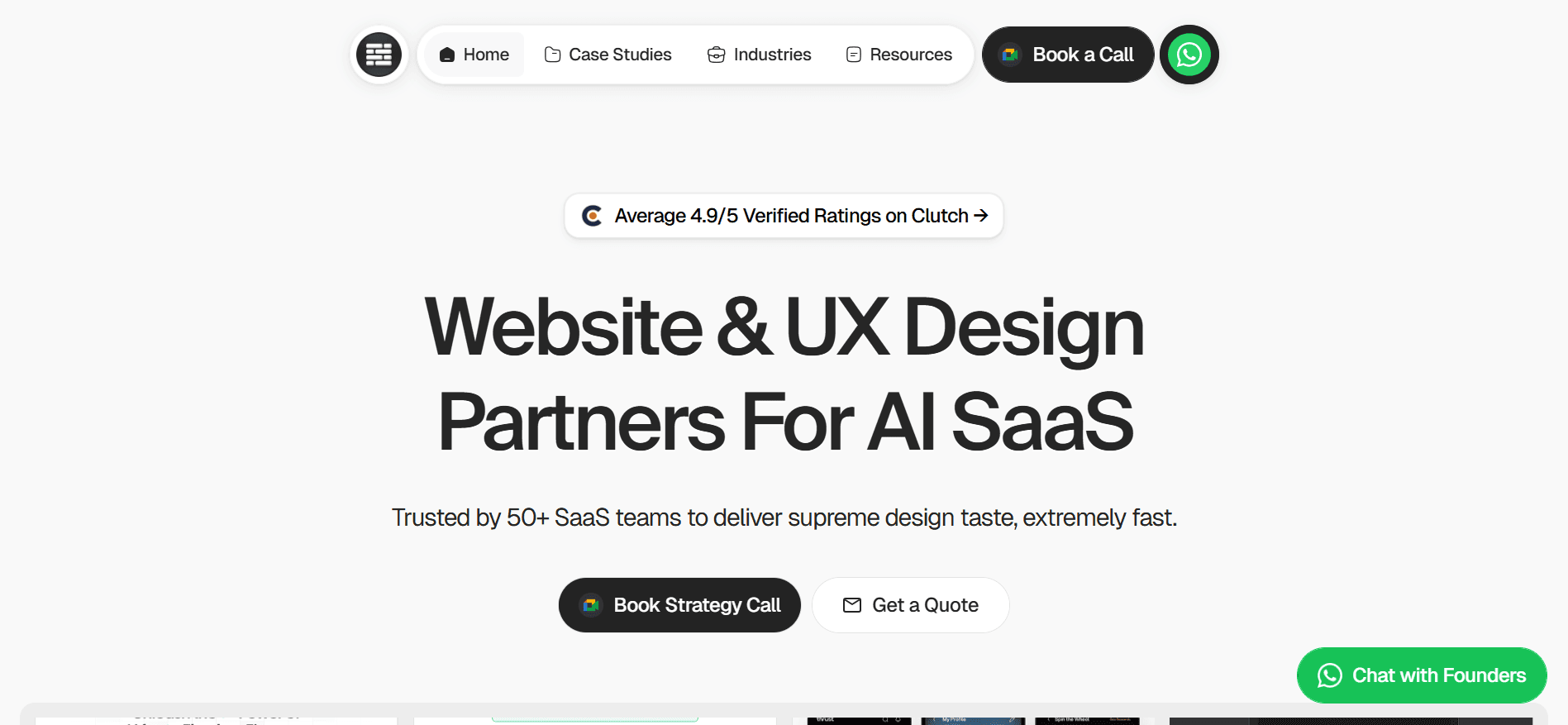

Bricx: Full-scale website & UX design partners for B2B SaaS, AI & Web3 companies


At Bricx, we’re a product design and UX agency focused on helping SaaS, AI, and technology companies build scalable, high-performing digital products. Rather than functioning purely as a design services provider, we strategically collaborate with founders, product leaders & engineering teams - helping them improve production, usability & long-term growth metrics.

Our solutions work across the full product lifecycle – right from MVP design & early product research to complex redesigns and shipping features that scale as the product matures. 

Unlike other agencies, our approach combines product thinking, UX research, interaction design, and systems-driven visual design to ensure design decisions align with measurable business outcomes.

Compared to others, we’re known for being design partners to the likes of Sybill, Writesonic & Manyreach – combining product thinking, UX research, interactions & system-driven visual design to ensure design decisions align with measurable business outcomes. 

Strengths of Bricx

  • Deep specialization in SaaS, AI, and complex platforms
    Bricx works extensively with data-heavy and workflow-driven products, which allows our team to quickly understand sophisticated user journeys. This reduces onboarding time and leads to more relevant UX decisions early in the project lifecycle.


  • Strategy-led product design methodology
    Instead of jumping directly into UI execution, Bricx emphasizes discovery, user flows, and problem framing. This ensures design work addresses root usability issues rather than surface-level interface improvements.


  • Embedded collaboration model
    The team integrates directly into client workflows, often collaborating with product managers and engineers daily. This creates alignment across teams and minimizes design-to-development gaps.


  • Focus on measurable business outcomes
    Projects frequently aim to improve activation, onboarding completion, retention, and product adoption. UX decisions are treated as growth levers rather than purely creative outputs.


  • Strong systems thinking and scalability
    Bricx prioritizes scalable design systems and long-term product consistency, helping companies avoid fragmented UX as products expand.

Weaknesses of Bricx

  • Not optimized for quick design task execution
    Teams looking for rapid UI production without strategic involvement may find the process more structured than expected.

  • Higher investment compared to execution-focused agencies
    Because of its strategic involvement, Bricx may require a larger upfront investment than subscription-based design services.

  • Requires active stakeholder collaboration
    The best outcomes depend on strong collaboration with internal teams, which may require more client participation.

  • Less suited for short-term design needs
    Companies seeking temporary UI support rather than long-term product improvement may not fully benefit from the engagement model.

  • Selective industry focus
    The agency primarily works with technology-driven companies, making it less aligned with purely marketing-led design projects.

Industries Served

Bricx primarily serves SaaS startups, AI platforms, Web3 products, and enterprise software teams. Our clients are typically growth-stage companies focused on improving product performance, scalability, and user adoption.

What is Eleken?
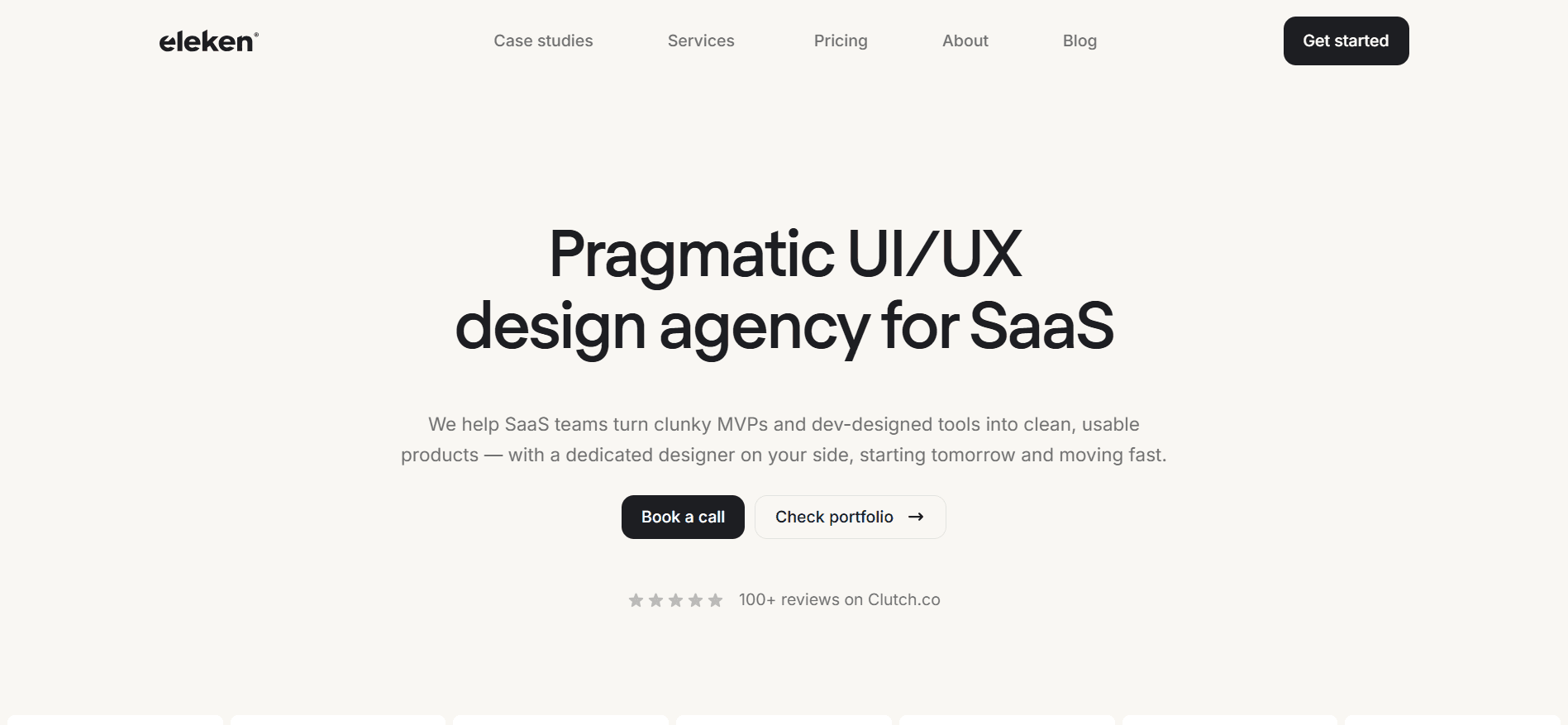

Eleken: A top UI/UX agency for SaaS businesses


Eleken is a UX/UI design agency built specifically for SaaS companies and known for pioneering a subscription-based design service model. Instead of operating through traditional project-based engagements, Eleken offers ongoing design support for a fixed monthly fee, enabling product teams to continuously request UX and UI work as needed.

The agency focuses almost exclusively on product interfaces rather than branding or marketing design. Their designers are trained around common SaaS UX patterns, allowing them to quickly contribute to dashboards, onboarding flows, feature releases, and interface improvements.

This makes Eleken particularly appealing to startups that need consistent design bandwidth without hiring an in-house team.


Strengths of Eleken

  • Predictable subscription pricing model
    Companies benefit from fixed monthly costs, allowing easier budgeting compared to project-based engagements.

  • Fast turnaround and execution speed
    The workflow is optimized for rapid delivery, enabling teams to ship features quickly.

  • SaaS-focused design expertise
    Designers are familiar with common SaaS interaction patterns, reducing ramp-up time across projects.

  • Low operational complexity
    Minimal meetings and structured workflows help teams move efficiently without heavy coordination.

  • Ideal for continuous design production
    Companies needing ongoing UI improvements or feature expansion benefit from the subscription model.

Weaknesses of Eleken

  • Limited strategic product involvement
    The model focuses more on execution than deep product discovery or UX transformation.

  • Less emphasis on growth-driven UX outcomes
    Design work may not always connect directly to business metrics or product strategy.

  • Shared designer bandwidth
    Designers often work across multiple clients, which can impact continuity.

  • Not ideal for major redesigns
    Large-scale product repositioning may require deeper strategic engagement than the model provides.

  • Limited brand and marketing design support
    Eleken primarily focuses on product UI rather than broader product positioning.

Industries Served

Eleken mainly serves SaaS startups and product teams that require ongoing UX/UI execution support. Their ideal clients are companies needing consistent design output without building an internal design team.

Core Comparison Points

Now that we’ve got a basic comparison of Bricx vs Eleken from a SWOT analysis point of view, let’s dive a little deeper into analyzing both agencies on certain key criteria: 

  1. Pricing

When comparing pricing, Eleken’s subscription-based model offers predictability and accessibility, especially for startups managing tight budgets. Companies pay a fixed monthly fee and receive ongoing design support, making it easier to forecast costs while maintaining steady product iteration. This structure works well when design needs are continuous but relatively execution-focused.

Bricx, in contrast, follows a strategic engagement model where pricing reflects deeper involvement in product thinking, UX research, and systems design. While the investment may be higher upfront, the focus shifts toward long-term ROI through improved product performance.

Companies choosing Bricx typically view design as a growth investment rather than a production expense.

  1. Product & UX Maturity

Eleken performs best when a product already has clear direction and requires incremental UX improvements or feature expansion. Their model supports refinement and execution efficiently, helping teams maintain momentum during product development cycles.

Bricx is often better suited for companies facing structural UX challenges — such as onboarding friction, unclear user flows, or scaling complexity. 

Our approach involves evaluating product maturity and redesigning experiences to support long-term usability and adoption, making them more effective during major product evolution phases.

  1. Industry & Domain Fit

Eleken works broadly across SaaS industries and adapts well to standard product workflows. Their designers’ familiarity with common SaaS patterns allows them to quickly deliver functional interfaces regardless of industry niche.

Bricx tends to specialize more deeply in SaaS, AI, and emerging technology products where workflows are complex and differentiation depends heavily on UX innovation. This specialization allows us to contribute strategically to products operating in technically sophisticated environments.

  1. Speed & Execution Model

Eleken’s biggest advantage lies in execution speed. Their system is built to handle continuous design requests with minimal friction, enabling rapid feature releases and ongoing improvements.

Bricx balances execution speed with strategic alignment. While the initial phases may involve deeper discovery, the resulting design decisions often reduce rework later.

The focus is on striking a fine balance between immediate output volume and delivering durable solutions that scale with the product.

  1. Collaboration & Communication

Eleken emphasizes streamlined communication and asynchronous workflows, which works well for teams that prefer minimal meetings and straightforward task management.

Bricx operates as an embedded partner, collaborating closely with product and engineering teams. This leads to more strategic conversations and alignment but requires greater interaction between stakeholders and designers.

  1. Flexibility & Startup Friendliness

Eleken offers flexibility through scalable design bandwidth — startups can continuously request work without committing to large projects. This makes it attractive for early-stage teams needing design support on demand.

Bricx provides flexibility in a different way by adapting to evolving product goals. We often help startups redefine user flows, positioning, and onboarding strategies as products mature, making them particularly helpful during growth transitions.

  1. Cost Efficiency & ROI

Eleken delivers strong short-term cost efficiency by providing consistent design output at a predictable monthly rate. For teams primarily focused on shipping features, this model can be highly economical.

Bricx focuses on long-term ROI by improving product usability and conversion performance. While initial costs may be higher, improvements in activation, retention, and product adoption often generate compounding returns over time.

  1. Strategic Impact

Eleken’s impact is strongest at the execution level, ensuring consistent and reliable design delivery across product updates.

Bricx contributes more heavily at the strategic level, influencing product direction, UX architecture, and user experience strategy. Our involvement often extends beyond design execution into broader product decision-making as and when required. 

  1. Cultural & Team Fit

Eleken works well for teams that want a reliable external design resource operating similarly to an outsourced design department.

Bricx fits organizations looking for a proactive partner who challenges assumptions and participates actively in shaping product outcomes. The relationship tends to feel closer to an internal product leadership collaboration.

  1. Design Quality & Systems Thinking

Both companies deliver high-quality SaaS design, but their emphasis differs. Eleken focuses on clean, functional interfaces optimized for usability and speed.

Bricx places heavier emphasis on systems thinking — building scalable design systems, cohesive interaction models, and long-term UX consistency. This becomes increasingly valuable as products grow in complexity and team size.

Conclusion

Choosing the right agency between Bricx and Eleken ultimately depends on your product stage, budget, and the level of strategic involvement you expect from a design partner. Eleken is a strong option for SaaS teams needing predictable, ongoing UI execution and fast delivery cycles. 

Bricx is a better option when comparing Bricx vs Eleken owing to our focus on owning the entire product funnel, working closely with your team on product design and decision-making.

We’re supported by 25+ case studies across industries, with clients like Writesonic, Hobbes and Manyreach who we’ve helped with best-in-class SaaS design across various growth stages. 

Schedule a call now to discuss your goals and explore how we can help you with your design requirements.
When choosing the right agency to partner with for your design needs, it's crucial to evaluate how each agency aligns with your business goals, especially in the competitive world of SaaS and product-driven companies. Both Bricx and Eleken bring unique strengths to the table, offering distinct expertise in UX, product design, and website development. 

While Bricx specializes in SaaS-focused design solutions for high-growth companies, Eleken’s approach leans more towards creating user-centric designs for digital products across various industries. Yet there are several key aspects you need to consider before making a choice.

In this article, we’ll compare both the companies’ offerings, alongside their strengths and weaknesses. By the end of this article, you’ll be able to make a more informed decision around which agency best suits your SaaS business.

So let’s get started. 

What is Bricx?


Bricx: Full-scale website & UX design partners for B2B SaaS, AI & Web3 companies


At Bricx, we’re a product design and UX agency focused on helping SaaS, AI, and technology companies build scalable, high-performing digital products. Rather than functioning purely as a design services provider, we strategically collaborate with founders, product leaders & engineering teams - helping them improve production, usability & long-term growth metrics.

Our solutions work across the full product lifecycle – right from MVP design & early product research to complex redesigns and shipping features that scale as the product matures. 

Unlike other agencies, our approach combines product thinking, UX research, interaction design, and systems-driven visual design to ensure design decisions align with measurable business outcomes.

Compared to others, we’re known for being design partners to the likes of Sybill, Writesonic & Manyreach – combining product thinking, UX research, interactions & system-driven visual design to ensure design decisions align with measurable business outcomes. 

Strengths of Bricx

  • Deep specialization in SaaS, AI, and complex platforms
    Bricx works extensively with data-heavy and workflow-driven products, which allows our team to quickly understand sophisticated user journeys. This reduces onboarding time and leads to more relevant UX decisions early in the project lifecycle.


  • Strategy-led product design methodology
    Instead of jumping directly into UI execution, Bricx emphasizes discovery, user flows, and problem framing. This ensures design work addresses root usability issues rather than surface-level interface improvements.


  • Embedded collaboration model
    The team integrates directly into client workflows, often collaborating with product managers and engineers daily. This creates alignment across teams and minimizes design-to-development gaps.


  • Focus on measurable business outcomes
    Projects frequently aim to improve activation, onboarding completion, retention, and product adoption. UX decisions are treated as growth levers rather than purely creative outputs.


  • Strong systems thinking and scalability
    Bricx prioritizes scalable design systems and long-term product consistency, helping companies avoid fragmented UX as products expand.

Weaknesses of Bricx

  • Not optimized for quick design task execution
    Teams looking for rapid UI production without strategic involvement may find the process more structured than expected.

  • Higher investment compared to execution-focused agencies
    Because of its strategic involvement, Bricx may require a larger upfront investment than subscription-based design services.

  • Requires active stakeholder collaboration
    The best outcomes depend on strong collaboration with internal teams, which may require more client participation.

  • Less suited for short-term design needs
    Companies seeking temporary UI support rather than long-term product improvement may not fully benefit from the engagement model.

  • Selective industry focus
    The agency primarily works with technology-driven companies, making it less aligned with purely marketing-led design projects.

Industries Served

Bricx primarily serves SaaS startups, AI platforms, Web3 products, and enterprise software teams. Our clients are typically growth-stage companies focused on improving product performance, scalability, and user adoption.

What is Eleken?


Eleken: A top UI/UX agency for SaaS businesses


Eleken is a UX/UI design agency built specifically for SaaS companies and known for pioneering a subscription-based design service model. Instead of operating through traditional project-based engagements, Eleken offers ongoing design support for a fixed monthly fee, enabling product teams to continuously request UX and UI work as needed.

The agency focuses almost exclusively on product interfaces rather than branding or marketing design. Their designers are trained around common SaaS UX patterns, allowing them to quickly contribute to dashboards, onboarding flows, feature releases, and interface improvements.

This makes Eleken particularly appealing to startups that need consistent design bandwidth without hiring an in-house team.


Strengths of Eleken

  • Predictable subscription pricing model
    Companies benefit from fixed monthly costs, allowing easier budgeting compared to project-based engagements.

  • Fast turnaround and execution speed
    The workflow is optimized for rapid delivery, enabling teams to ship features quickly.

  • SaaS-focused design expertise
    Designers are familiar with common SaaS interaction patterns, reducing ramp-up time across projects.

  • Low operational complexity
    Minimal meetings and structured workflows help teams move efficiently without heavy coordination.

  • Ideal for continuous design production
    Companies needing ongoing UI improvements or feature expansion benefit from the subscription model.

Weaknesses of Eleken

  • Limited strategic product involvement
    The model focuses more on execution than deep product discovery or UX transformation.

  • Less emphasis on growth-driven UX outcomes
    Design work may not always connect directly to business metrics or product strategy.

  • Shared designer bandwidth
    Designers often work across multiple clients, which can impact continuity.

  • Not ideal for major redesigns
    Large-scale product repositioning may require deeper strategic engagement than the model provides.

  • Limited brand and marketing design support
    Eleken primarily focuses on product UI rather than broader product positioning.

Industries Served

Eleken mainly serves SaaS startups and product teams that require ongoing UX/UI execution support. Their ideal clients are companies needing consistent design output without building an internal design team.

Core Comparison Points

Now that we’ve got a basic comparison of Bricx vs Eleken from a SWOT analysis point of view, let’s dive a little deeper into analyzing both agencies on certain key criteria: 

  1. Pricing

When comparing pricing, Eleken’s subscription-based model offers predictability and accessibility, especially for startups managing tight budgets. Companies pay a fixed monthly fee and receive ongoing design support, making it easier to forecast costs while maintaining steady product iteration. This structure works well when design needs are continuous but relatively execution-focused.

Bricx, in contrast, follows a strategic engagement model where pricing reflects deeper involvement in product thinking, UX research, and systems design. While the investment may be higher upfront, the focus shifts toward long-term ROI through improved product performance.

Companies choosing Bricx typically view design as a growth investment rather than a production expense.

  1. Product & UX Maturity

Eleken performs best when a product already has clear direction and requires incremental UX improvements or feature expansion. Their model supports refinement and execution efficiently, helping teams maintain momentum during product development cycles.

Bricx is often better suited for companies facing structural UX challenges — such as onboarding friction, unclear user flows, or scaling complexity. 

Our approach involves evaluating product maturity and redesigning experiences to support long-term usability and adoption, making them more effective during major product evolution phases.

  1. Industry & Domain Fit

Eleken works broadly across SaaS industries and adapts well to standard product workflows. Their designers’ familiarity with common SaaS patterns allows them to quickly deliver functional interfaces regardless of industry niche.

Bricx tends to specialize more deeply in SaaS, AI, and emerging technology products where workflows are complex and differentiation depends heavily on UX innovation. This specialization allows us to contribute strategically to products operating in technically sophisticated environments.

  1. Speed & Execution Model

Eleken’s biggest advantage lies in execution speed. Their system is built to handle continuous design requests with minimal friction, enabling rapid feature releases and ongoing improvements.

Bricx balances execution speed with strategic alignment. While the initial phases may involve deeper discovery, the resulting design decisions often reduce rework later.

The focus is on striking a fine balance between immediate output volume and delivering durable solutions that scale with the product.

  1. Collaboration & Communication

Eleken emphasizes streamlined communication and asynchronous workflows, which works well for teams that prefer minimal meetings and straightforward task management.

Bricx operates as an embedded partner, collaborating closely with product and engineering teams. This leads to more strategic conversations and alignment but requires greater interaction between stakeholders and designers.

  1. Flexibility & Startup Friendliness

Eleken offers flexibility through scalable design bandwidth — startups can continuously request work without committing to large projects. This makes it attractive for early-stage teams needing design support on demand.

Bricx provides flexibility in a different way by adapting to evolving product goals. We often help startups redefine user flows, positioning, and onboarding strategies as products mature, making them particularly helpful during growth transitions.

  1. Cost Efficiency & ROI

Eleken delivers strong short-term cost efficiency by providing consistent design output at a predictable monthly rate. For teams primarily focused on shipping features, this model can be highly economical.

Bricx focuses on long-term ROI by improving product usability and conversion performance. While initial costs may be higher, improvements in activation, retention, and product adoption often generate compounding returns over time.

  1. Strategic Impact

Eleken’s impact is strongest at the execution level, ensuring consistent and reliable design delivery across product updates.

Bricx contributes more heavily at the strategic level, influencing product direction, UX architecture, and user experience strategy. Our involvement often extends beyond design execution into broader product decision-making as and when required. 

  1. Cultural & Team Fit

Eleken works well for teams that want a reliable external design resource operating similarly to an outsourced design department.

Bricx fits organizations looking for a proactive partner who challenges assumptions and participates actively in shaping product outcomes. The relationship tends to feel closer to an internal product leadership collaboration.

  1. Design Quality & Systems Thinking

Both companies deliver high-quality SaaS design, but their emphasis differs. Eleken focuses on clean, functional interfaces optimized for usability and speed.

Bricx places heavier emphasis on systems thinking — building scalable design systems, cohesive interaction models, and long-term UX consistency. This becomes increasingly valuable as products grow in complexity and team size.

Conclusion

Choosing the right agency between Bricx and Eleken ultimately depends on your product stage, budget, and the level of strategic involvement you expect from a design partner. Eleken is a strong option for SaaS teams needing predictable, ongoing UI execution and fast delivery cycles. 

Bricx is a better option when comparing Bricx vs Eleken owing to our focus on owning the entire product funnel, working closely with your team on product design and decision-making.

We’re supported by 25+ case studies across industries, with clients like Writesonic, Hobbes and Manyreach who we’ve helped with best-in-class SaaS design across various growth stages. 

Schedule a call now to discuss your goals and explore how we can help you with your design requirements.
When choosing the right agency to partner with for your design needs, it's crucial to evaluate how each agency aligns with your business goals, especially in the competitive world of SaaS and product-driven companies. Both Bricx and Eleken bring unique strengths to the table, offering distinct expertise in UX, product design, and website development. 

While Bricx specializes in SaaS-focused design solutions for high-growth companies, Eleken’s approach leans more towards creating user-centric designs for digital products across various industries. Yet there are several key aspects you need to consider before making a choice.

In this article, we’ll compare both the companies’ offerings, alongside their strengths and weaknesses. By the end of this article, you’ll be able to make a more informed decision around which agency best suits your SaaS business.

So let’s get started. 

What is Bricx?


Bricx: Full-scale website & UX design partners for B2B SaaS, AI & Web3 companies


At Bricx, we’re a product design and UX agency focused on helping SaaS, AI, and technology companies build scalable, high-performing digital products. Rather than functioning purely as a design services provider, we strategically collaborate with founders, product leaders & engineering teams - helping them improve production, usability & long-term growth metrics.

Our solutions work across the full product lifecycle – right from MVP design & early product research to complex redesigns and shipping features that scale as the product matures. 

Unlike other agencies, our approach combines product thinking, UX research, interaction design, and systems-driven visual design to ensure design decisions align with measurable business outcomes.

Compared to others, we’re known for being design partners to the likes of Sybill, Writesonic & Manyreach – combining product thinking, UX research, interactions & system-driven visual design to ensure design decisions align with measurable business outcomes. 

Strengths of Bricx

  • Deep specialization in SaaS, AI, and complex platforms
    Bricx works extensively with data-heavy and workflow-driven products, which allows our team to quickly understand sophisticated user journeys. This reduces onboarding time and leads to more relevant UX decisions early in the project lifecycle.


  • Strategy-led product design methodology
    Instead of jumping directly into UI execution, Bricx emphasizes discovery, user flows, and problem framing. This ensures design work addresses root usability issues rather than surface-level interface improvements.


  • Embedded collaboration model
    The team integrates directly into client workflows, often collaborating with product managers and engineers daily. This creates alignment across teams and minimizes design-to-development gaps.


  • Focus on measurable business outcomes
    Projects frequently aim to improve activation, onboarding completion, retention, and product adoption. UX decisions are treated as growth levers rather than purely creative outputs.


  • Strong systems thinking and scalability
    Bricx prioritizes scalable design systems and long-term product consistency, helping companies avoid fragmented UX as products expand.

Weaknesses of Bricx

  • Not optimized for quick design task execution
    Teams looking for rapid UI production without strategic involvement may find the process more structured than expected.

  • Higher investment compared to execution-focused agencies
    Because of its strategic involvement, Bricx may require a larger upfront investment than subscription-based design services.

  • Requires active stakeholder collaboration
    The best outcomes depend on strong collaboration with internal teams, which may require more client participation.

  • Less suited for short-term design needs
    Companies seeking temporary UI support rather than long-term product improvement may not fully benefit from the engagement model.

  • Selective industry focus
    The agency primarily works with technology-driven companies, making it less aligned with purely marketing-led design projects.

Industries Served

Bricx primarily serves SaaS startups, AI platforms, Web3 products, and enterprise software teams. Our clients are typically growth-stage companies focused on improving product performance, scalability, and user adoption.

What is Eleken?


Eleken: A top UI/UX agency for SaaS businesses


Eleken is a UX/UI design agency built specifically for SaaS companies and known for pioneering a subscription-based design service model. Instead of operating through traditional project-based engagements, Eleken offers ongoing design support for a fixed monthly fee, enabling product teams to continuously request UX and UI work as needed.

The agency focuses almost exclusively on product interfaces rather than branding or marketing design. Their designers are trained around common SaaS UX patterns, allowing them to quickly contribute to dashboards, onboarding flows, feature releases, and interface improvements.

This makes Eleken particularly appealing to startups that need consistent design bandwidth without hiring an in-house team.


Strengths of Eleken

  • Predictable subscription pricing model
    Companies benefit from fixed monthly costs, allowing easier budgeting compared to project-based engagements.

  • Fast turnaround and execution speed
    The workflow is optimized for rapid delivery, enabling teams to ship features quickly.

  • SaaS-focused design expertise
    Designers are familiar with common SaaS interaction patterns, reducing ramp-up time across projects.

  • Low operational complexity
    Minimal meetings and structured workflows help teams move efficiently without heavy coordination.

  • Ideal for continuous design production
    Companies needing ongoing UI improvements or feature expansion benefit from the subscription model.

Weaknesses of Eleken

  • Limited strategic product involvement
    The model focuses more on execution than deep product discovery or UX transformation.

  • Less emphasis on growth-driven UX outcomes
    Design work may not always connect directly to business metrics or product strategy.

  • Shared designer bandwidth
    Designers often work across multiple clients, which can impact continuity.

  • Not ideal for major redesigns
    Large-scale product repositioning may require deeper strategic engagement than the model provides.

  • Limited brand and marketing design support
    Eleken primarily focuses on product UI rather than broader product positioning.

Industries Served

Eleken mainly serves SaaS startups and product teams that require ongoing UX/UI execution support. Their ideal clients are companies needing consistent design output without building an internal design team.

Core Comparison Points

Now that we’ve got a basic comparison of Bricx vs Eleken from a SWOT analysis point of view, let’s dive a little deeper into analyzing both agencies on certain key criteria: 

  1. Pricing

When comparing pricing, Eleken’s subscription-based model offers predictability and accessibility, especially for startups managing tight budgets. Companies pay a fixed monthly fee and receive ongoing design support, making it easier to forecast costs while maintaining steady product iteration. This structure works well when design needs are continuous but relatively execution-focused.

Bricx, in contrast, follows a strategic engagement model where pricing reflects deeper involvement in product thinking, UX research, and systems design. While the investment may be higher upfront, the focus shifts toward long-term ROI through improved product performance.

Companies choosing Bricx typically view design as a growth investment rather than a production expense.

  1. Product & UX Maturity

Eleken performs best when a product already has clear direction and requires incremental UX improvements or feature expansion. Their model supports refinement and execution efficiently, helping teams maintain momentum during product development cycles.

Bricx is often better suited for companies facing structural UX challenges — such as onboarding friction, unclear user flows, or scaling complexity. 

Our approach involves evaluating product maturity and redesigning experiences to support long-term usability and adoption, making them more effective during major product evolution phases.

  1. Industry & Domain Fit

Eleken works broadly across SaaS industries and adapts well to standard product workflows. Their designers’ familiarity with common SaaS patterns allows them to quickly deliver functional interfaces regardless of industry niche.

Bricx tends to specialize more deeply in SaaS, AI, and emerging technology products where workflows are complex and differentiation depends heavily on UX innovation. This specialization allows us to contribute strategically to products operating in technically sophisticated environments.

  1. Speed & Execution Model

Eleken’s biggest advantage lies in execution speed. Their system is built to handle continuous design requests with minimal friction, enabling rapid feature releases and ongoing improvements.

Bricx balances execution speed with strategic alignment. While the initial phases may involve deeper discovery, the resulting design decisions often reduce rework later.

The focus is on striking a fine balance between immediate output volume and delivering durable solutions that scale with the product.

  1. Collaboration & Communication

Eleken emphasizes streamlined communication and asynchronous workflows, which works well for teams that prefer minimal meetings and straightforward task management.

Bricx operates as an embedded partner, collaborating closely with product and engineering teams. This leads to more strategic conversations and alignment but requires greater interaction between stakeholders and designers.

  1. Flexibility & Startup Friendliness

Eleken offers flexibility through scalable design bandwidth — startups can continuously request work without committing to large projects. This makes it attractive for early-stage teams needing design support on demand.

Bricx provides flexibility in a different way by adapting to evolving product goals. We often help startups redefine user flows, positioning, and onboarding strategies as products mature, making them particularly helpful during growth transitions.

  1. Cost Efficiency & ROI

Eleken delivers strong short-term cost efficiency by providing consistent design output at a predictable monthly rate. For teams primarily focused on shipping features, this model can be highly economical.

Bricx focuses on long-term ROI by improving product usability and conversion performance. While initial costs may be higher, improvements in activation, retention, and product adoption often generate compounding returns over time.

  1. Strategic Impact

Eleken’s impact is strongest at the execution level, ensuring consistent and reliable design delivery across product updates.

Bricx contributes more heavily at the strategic level, influencing product direction, UX architecture, and user experience strategy. Our involvement often extends beyond design execution into broader product decision-making as and when required. 

  1. Cultural & Team Fit

Eleken works well for teams that want a reliable external design resource operating similarly to an outsourced design department.

Bricx fits organizations looking for a proactive partner who challenges assumptions and participates actively in shaping product outcomes. The relationship tends to feel closer to an internal product leadership collaboration.

  1. Design Quality & Systems Thinking

Both companies deliver high-quality SaaS design, but their emphasis differs. Eleken focuses on clean, functional interfaces optimized for usability and speed.

Bricx places heavier emphasis on systems thinking — building scalable design systems, cohesive interaction models, and long-term UX consistency. This becomes increasingly valuable as products grow in complexity and team size.

Conclusion

Choosing the right agency between Bricx and Eleken ultimately depends on your product stage, budget, and the level of strategic involvement you expect from a design partner. Eleken is a strong option for SaaS teams needing predictable, ongoing UI execution and fast delivery cycles. 

Bricx is a better option when comparing Bricx vs Eleken owing to our focus on owning the entire product funnel, working closely with your team on product design and decision-making.

We’re supported by 25+ case studies across industries, with clients like Writesonic, Hobbes and Manyreach who we’ve helped with best-in-class SaaS design across various growth stages. 

Schedule a call now to discuss your goals and explore how we can help you with your design requirements.

Author:

Siddharth Vij

CEO at Bricxlabs

With nearly a decade in design and SaaS, he helps B2B startups grow with high-conversion sites and smart product design.

Unforgettable Website & UX Design For SaaS

We design high-converting websites and products for B2B AI startups.

Similar Blogs

Similar Blogs

Similar Blogs