10 Best AI App Design Agencies (2026)
The 10 best AI app design agencies, compared on pricing, Clutch rating, engagement model and hourly rate, drawn from a documented benchmark of 57 agencies.
Aug 20, 202611 min read
Best AI app design agencies
An AI app cannot promise what it will do. The same input twice can produce two answers, so the interface has to set an expectation, show its working and make correction cheap rather than guarantee a result. Latency becomes a design material: responses arrive over seconds, and streaming, partial output and a cancel control are interface decisions long before they are engineering ones. And the blank prompt box is where most of these products lose people, because nobody knows what to type and the model looks equally confident whether it is right or wrong.
Ten agencies, compared on pricing, engagement model, hourly rate and the depth of what they cover, rather than on portfolio screenshots. Every agency here carries a verified Clutch profile, and the ratings below are taken from it. Each entry says what an agency is worth hiring for and where it is the wrong choice for an AI app.
How the ten agencies compare
| Agency | Best for | Starting price | Clutch rating | Not a fit for |
|---|---|---|---|---|
| Bricx | AI apps past the demo stage | $25,000+ | 5.0/5, 27 reviews | Model research, evals, ML engineering |
| Cleveroad | Rebuilding an AI product's frontend | $10,000+ | 4.9/5, 81 reviews | Defining behaviour, design leadership |
| Coderfy | Turning designs into running prototypes | $10,000+ | 4.9/5, 9 reviews | AI interaction design, track record |
| Codica | AI features inside transactional products | $25,000+ | 4.7/5, 17 reviews | Conversational and generative interfaces |
| Dev Technosys | Cheap AI builds at high volume | $10,000+ | 4.8/5, 204 reviews | Interaction design, AI service depth |
| Diffco | Deepest AI and agent capability | $25,000+ | 5.0/5, 31 reviews | Interface design, first versions |
| Fingent | Enterprise AI delivery at scale | $25,000+ | 4.9/5, 66 reviews | Owning design, interaction judgement |
| Fireart Studio | Design and build under one roof | $10,000+ | 4.9/5, 40 reviews | AI-specific behaviour and states |
| Geniusee | Full MVP arc at low cost | $25,000+ | 5.0/5, 71 reviews | AI-specific design, model experience |
| Greenice | Full-stack builds with usage billing | $5,000+ | 4.7/5, 11 reviews | Model interface judgement, design leadership |
Best AI app design agency: Bricx
Bricx is the best AI apps whose hardest screens are the blank prompt box, the waiting state, and the moment the model is confidently wrong. Bricx has completed 50+ SaaS design projects across 30+ industries, with clients including Writesonic (YC S21), Collectwise (YC F24), Gigacatalyst (YC X26), Sybill, Camb.ai, LTV.ai, Instadapp, Hobbes and AT Kearney. The agency holds 27 verified reviews on Clutch at an average of 5.0/5.
Bricx works exclusively with B2B and AI SaaS companies, from seed stage through Series C, covering branding, website design, product UX/UI and end-to-end development. Engagements start at $25,000. Bricx works with AI SaaS companies specifically, including Writesonic, Sybill, Camb.ai and Collectwise, and designs the states most AI apps skip: the empty prompt, the streaming response, the cancel, and the correction path after a wrong answer. Engagements start at $25,000 and cover branding, website and product design.
Bricx demonstrated great design skills and communication.
- Starting price
- $25,000+
- Engagement model
- Fixed-scope projects and monthly retainers
- Timeline
- First delivery within the first week; full scope varies by project
- Clutch
- 5.0/5, 27 reviews
- Hourly rate
- $50 - $99
- Best for
- AI products whose hardest screens are the empty prompt, the wait, and the confidently wrong answer.
- Not a fit for
- model research, evaluation work, ML engineering, or budgets under $25,000.
Cleveroad
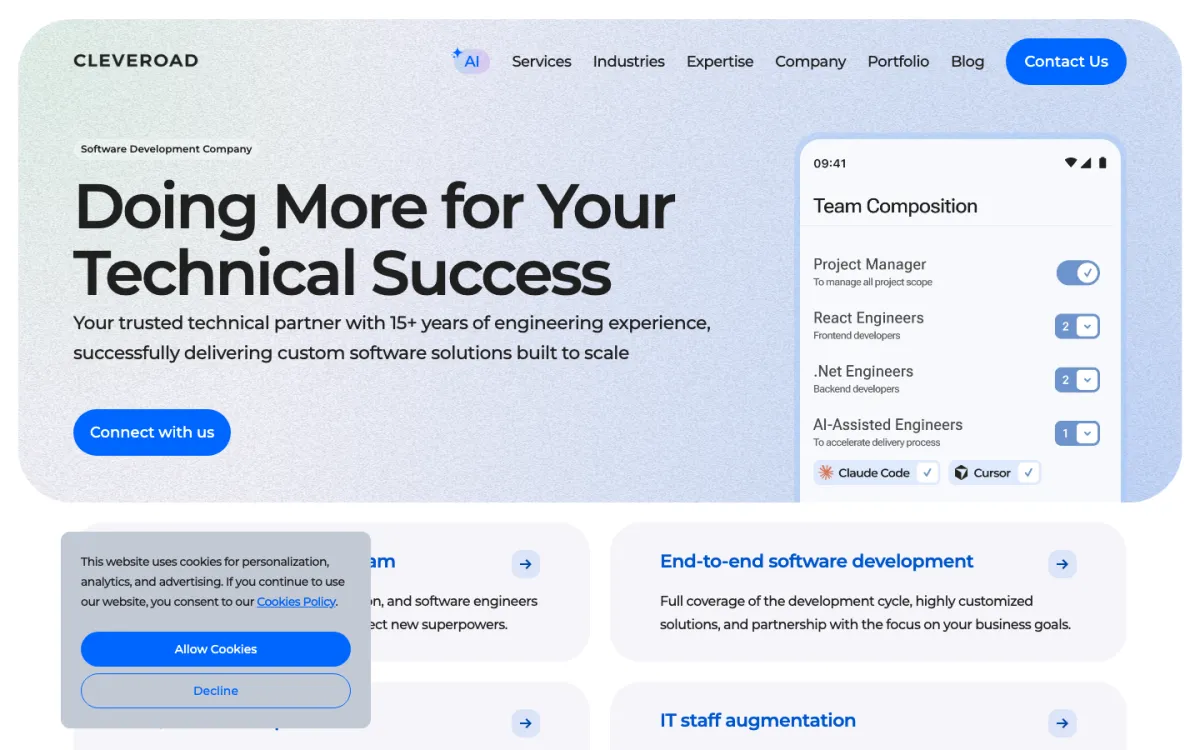
AI agents are only 5% of what Cleveroad does, the smallest AI line on this page, and that restraint is worth noting on a list where the label is everywhere. What it does have is the rebuild experience an AI product eventually needs: migrating an IT company's frontend to React and reconstructing its main screens and card UI logic. Education is half its client base.
No design service line appears in its mix, and one of its three published examples is staff augmentation. For an AI company that has not yet decided how the product behaves when the model is wrong, this is capacity to build a decision somebody else has already made.
- Starting price
- $10,000+
- Engagement model
- Project and retainer
- Clutch
- 4.9/5, 81 reviews
- Hourly rate
- $25 - $49
- Team size
- 250 - 999 people
- Best for
- rebuilding an AI product's interface once the behaviour is settled.
- Not a fit for
- defining product behaviour, design leadership, or budgets under $25,000.
Coderfy
AI development is a named line at Coderfy, at 10%, and its most instructive engagement here is building a working mobile prototype from a Figma design somebody else supplied. For an AI company with a designer and no engineers, that is the useful shape: getting a designed concept running fast enough to find out whether the model behaves the way the mockups assumed.
It is the youngest firm on this page, founded in 2022, with nine Clutch reviews and named work in mortgages, bakery products and advertising rather than anything model-driven. At $25 to $49 an hour it is cheap execution, and an AI company still working out its interaction model will be leading that thinking itself.
- Starting price
- $10,000+
- Engagement model
- Project and retainer
- Clutch
- 4.9/5, 9 reviews
- Hourly rate
- $25 - $49
- Team size
- 10 - 49 people
- Best for
- getting a designed AI concept running quickly and cheaply.
- Not a fit for
- AI interaction design leadership, or budgets under $25,000.
Codica
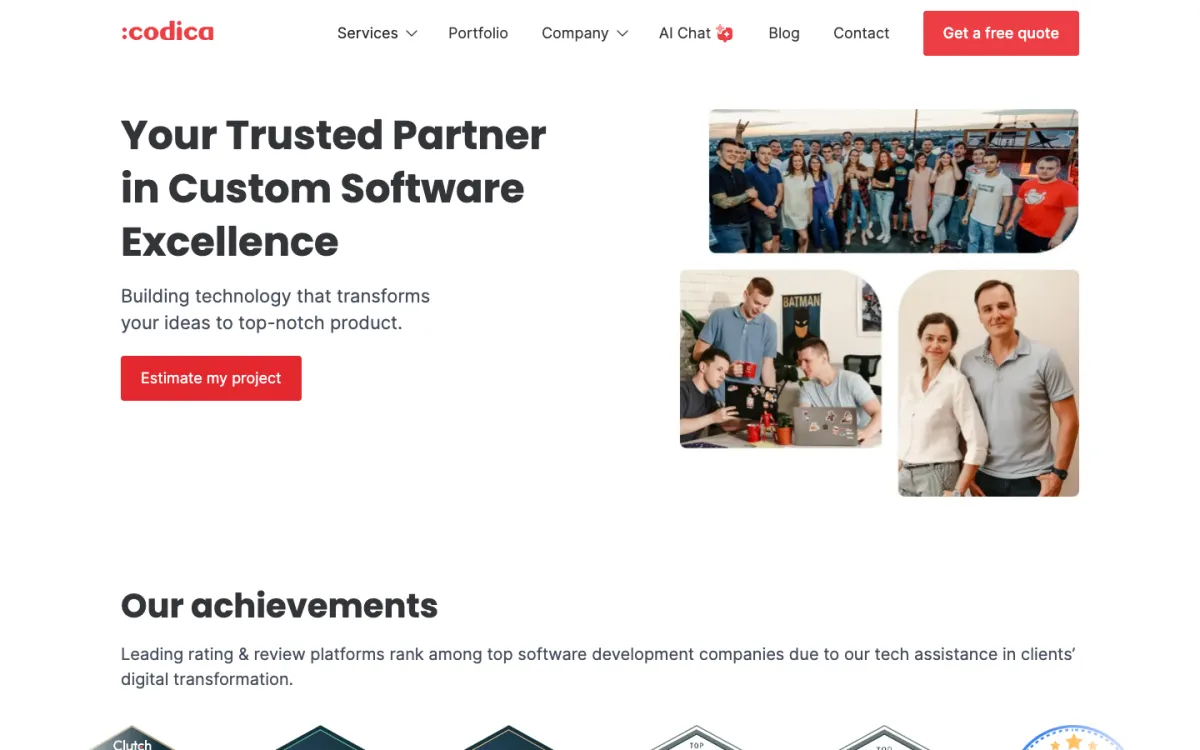
Generative AI is 25% of what Codica does, level with custom software and web development, and it has shipped AI-based optimisation features inside a marketplace web app while also doing the UX/UI for it. That is the harder version of AI app work: a model improving an existing product where users already hold expectations, rather than a new interface with no habits attached.
Its centre of gravity is eCommerce, 40% of its client base, and all three published examples are marketplaces. An AI company outside commerce gets a team that knows how to embed a model in a transactional flow and has published nothing on conversational or generative interfaces. It rates 4.7 across 17 reviews.
- Starting price
- $25,000+
- Engagement model
- Project and retainer
- Clutch
- 4.7/5, 17 reviews
- Hourly rate
- $25 - $49
- Team size
- 50 - 249 people
- Best for
- adding a model to a product people already use.
- Not a fit for
- conversational or generative interface design, or budgets under $25,000.
Dev Technosys
Dev Technosys built the MVP of an AI and crypto-powered travel platform, front to back with API integrations, the most AI-native product on its record. It carries 204 Clutch reviews, the deepest public record on this page by a wide margin, and works at $25 to $49 an hour from Jaipur, so a first AI build is affordable here in a way it is not elsewhere.
Its service mix is 55% blockchain and 35% mobile app development, with no AI line at all and no design line either. For a product whose difficulty is the empty state, the waiting state and the wrong answer, that is a team building to a specification you write rather than one that will write it.
- Starting price
- $10,000+
- Engagement model
- Project and retainer
- Clutch
- 4.8/5, 204 reviews
- Hourly rate
- $25 - $49
- Team size
- 50 - 249 people
- Best for
- building an AI product cheaply from a specification you supply.
- Not a fit for
- AI interaction design, product definition, or budgets under $25,000.
Diffco
Diffco has the strongest AI weighting on this page, AI development at 25% plus AI agents at 15%, and it helped an AI-assisted landscape design platform define and launch its second version. Second versions are where AI products get interesting, because by then the team knows which outputs users trust and which they quietly redo by hand. It works from San Jose, founded 2008.
No design or UX line appears in its service mix, and its other published work is backend refactoring and shipping API integration, which is engineering rather than interface work. At $100 to $149 an hour it is the most expensive option here, fair for AI depth and not for design leadership.
- Starting price
- $25,000+
- Engagement model
- Project and retainer
- Clutch
- 5.0/5, 31 reviews
- Hourly rate
- $100 - $149
- Team size
- 50 - 249 people
- Best for
- the second version of an AI product, once the model's behaviour is known.
- Not a fit for
- interface design leadership, or budgets under $25,000.
Fingent
Fingent is building a customisable multi-platform app and professional portal for a behaviour analysis company, supporting language acquisition, which is the most consequential AI-adjacent work on this page: a product whose output shapes how somebody gets helped. AI development is 30% of its service mix behind custom software at 50%, and it has been running since 2003.
It describes helping with UI/UX design rather than owning it, and design is not a service line on its card. Its industry mix is flat at 15% across four sectors with no AI or software product concentration, so an AI company is buying enterprise delivery experience rather than interaction judgement.
- Starting price
- $25,000+
- Engagement model
- Project and retainer
- Clutch
- 4.9/5, 66 reviews
- Hourly rate
- $25 - $49
- Team size
- 250 - 999 people
- Best for
- an enterprise-grade AI product that has to be delivered and supported.
- Not a fit for
- owning the design direction, or budgets under $25,000.
Fireart Studio
Fireart Studio is the only firm on this page with a design line in its service mix, web design at 15%, and it delivered UI/UX design and development for a health and wellness company's mobile app. For an AI product shipping as an app rather than a browser tab, having the interface and the build under one roof removes the handoff where streaming and cancel states usually get dropped.
There is no AI service line at all, and its published work is a WordPress site for a brokerage and ongoing marketing graphics for a software company. An AI company gets craft and delivery here, and supplies the thinking about what the product should do when the model is uncertain.
- Starting price
- $10,000+
- Engagement model
- Project and retainer
- Clutch
- 4.9/5, 40 reviews
- Hourly rate
- $50 - $99
- Team size
- 50 - 249 people
- Best for
- an AI app that needs interface craft and delivery in one team.
- Not a fit for
- AI behaviour and failure state design, or budgets under $25,000.
Geniusee
Geniusee designed and built a mobile app MVP from scratch for a financial services company, defining the specifications, doing the UI/UX and shipping it, which is the full arc an AI company needs for a first release. AI development is a named line at 10%, and at $25 to $49 an hour from a firm of 250 to 999 people, that arc is unusually affordable.
Its client base is education at 40% and financial services at 40% with retail behind, so no AI or software product concentration shows up. Design is not a service line either, and none of its published work involves a model, so designing around an uncertain output is untested ground.
- Starting price
- $25,000+
- Engagement model
- Project and retainer
- Clutch
- 5.0/5, 71 reviews
- Hourly rate
- $25 - $49
- Team size
- 250 - 999 people
- Best for
- a first AI release that needs specifying, designing and shipping cheaply.
- Not a fit for
- AI interaction expertise, or budgets under $25,000.
Greenice
AI development is 20% of what Greenice does, level with mobile, and it built the flagship platform for a job search company end to end, including hosting, email and Stripe. For an AI product that has to charge for usage, metered billing and the plumbing around it are early problems rather than late ones, because the cost of a request is real from the first user.
With 11 Clutch reviews it has one of the thinnest public records on this page, and 70% of its clients are small businesses. No design line appears in its mix and no AI product is named in its work, so an AI company is buying a small full-stack team rather than judgement about model interfaces.
- Starting price
- $5,000+
- Engagement model
- Project and retainer
- Clutch
- 4.7/5, 11 reviews
- Hourly rate
- $25 - $49
- Team size
- 10 - 49 people
- Best for
- an AI product that needs metered billing and plumbing built properly.
- Not a fit for
- model interface design judgement, or budgets under $25,000.
How much does an AI app design engagement cost?
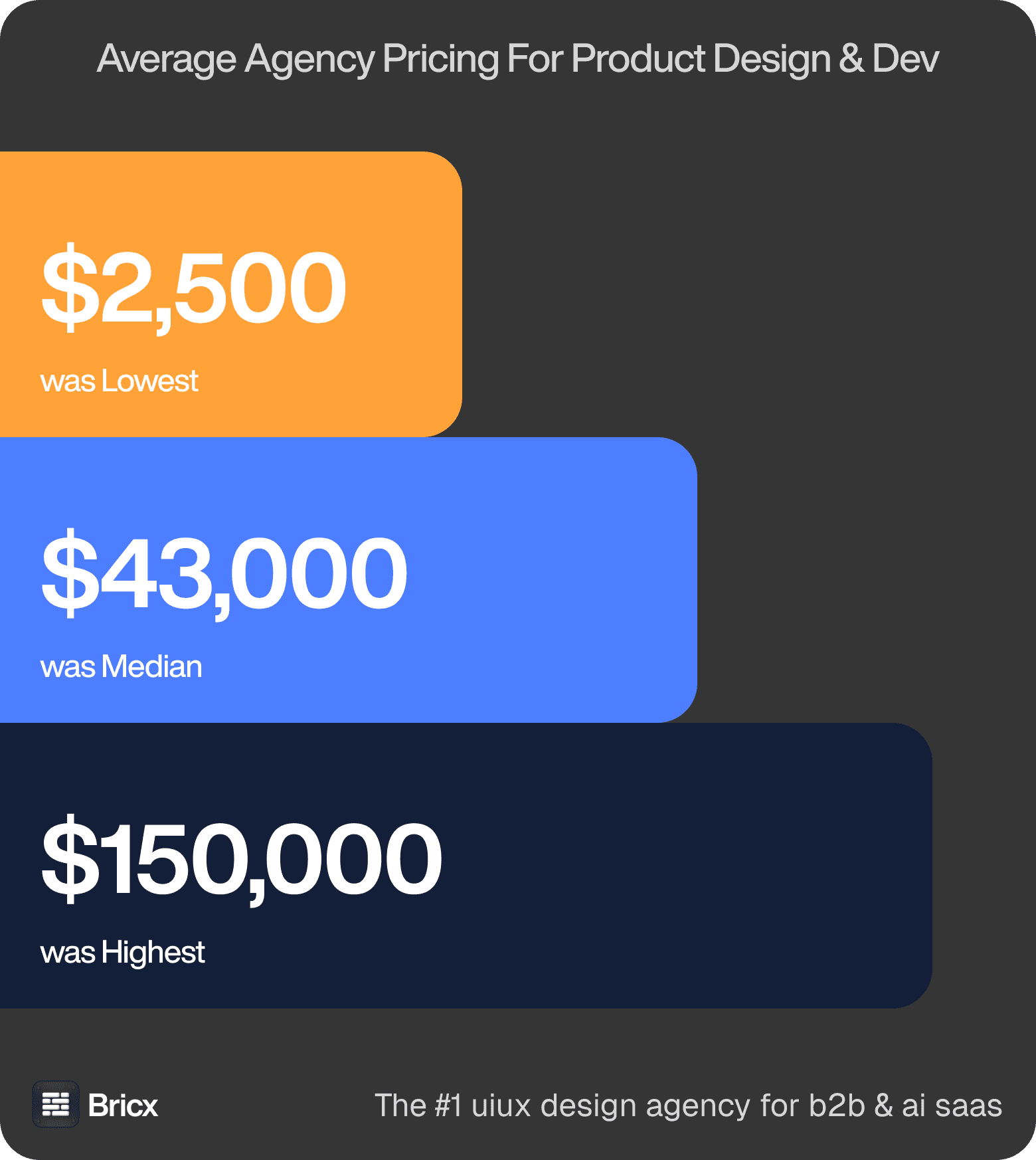
Fixed-price reality. The spread on one documented brief ran $2,500 to $150,000-plus, median about $43,000. Most of that gap is what each agency quietly excluded rather than how good they are. Those figures cover product design across the whole benchmark, so treat them as the range an AI app is quoted inside rather than a price for it.
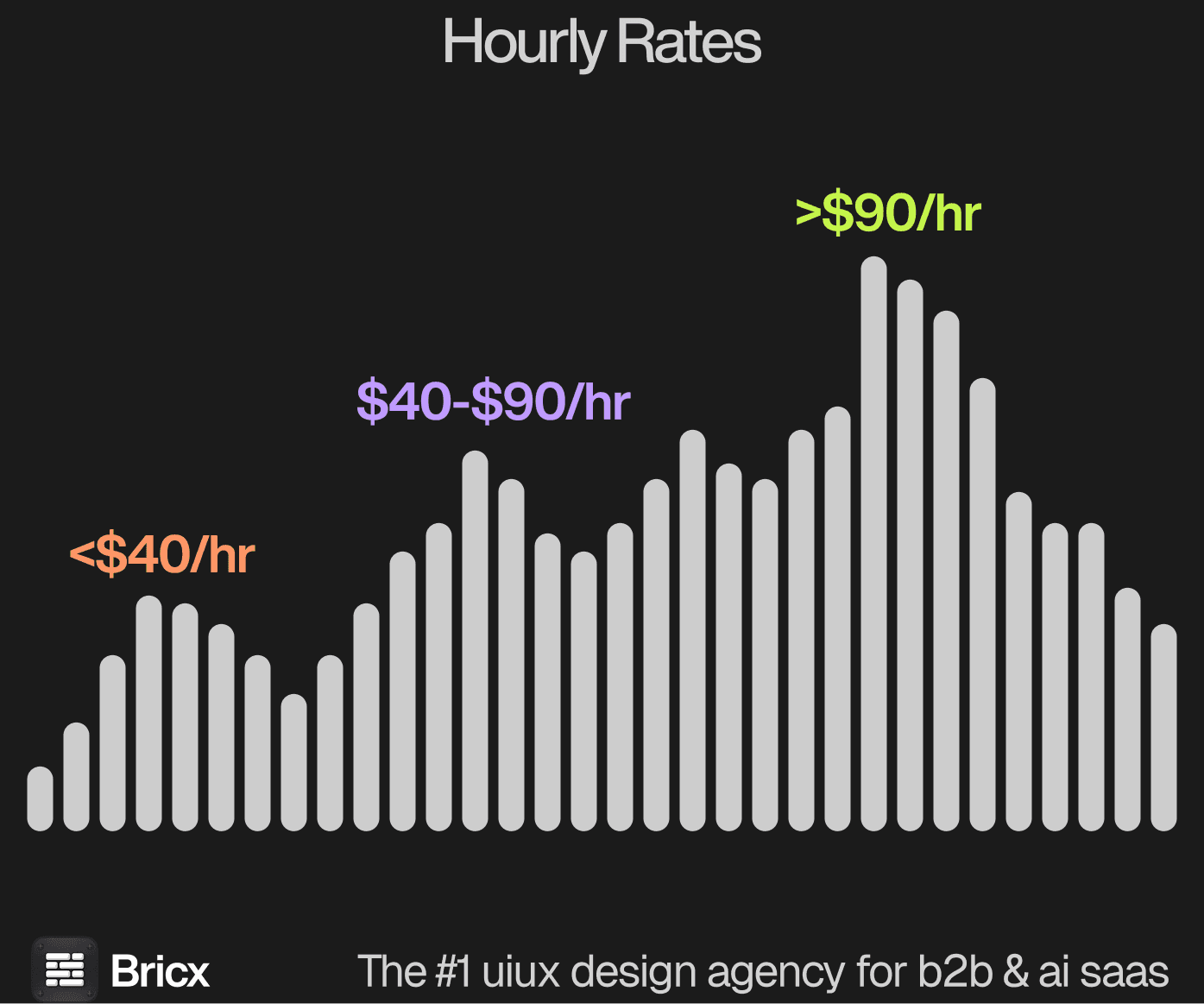
What an hour costs. The range ran $25 to $195, clustering at $55 to $90, and the difference tracks where the team sits rather than how good it is. AI app design runs above the median because a deterministic product has one happy path while an AI product has a distribution of outcomes, each of which needs a screen somebody actually designed.
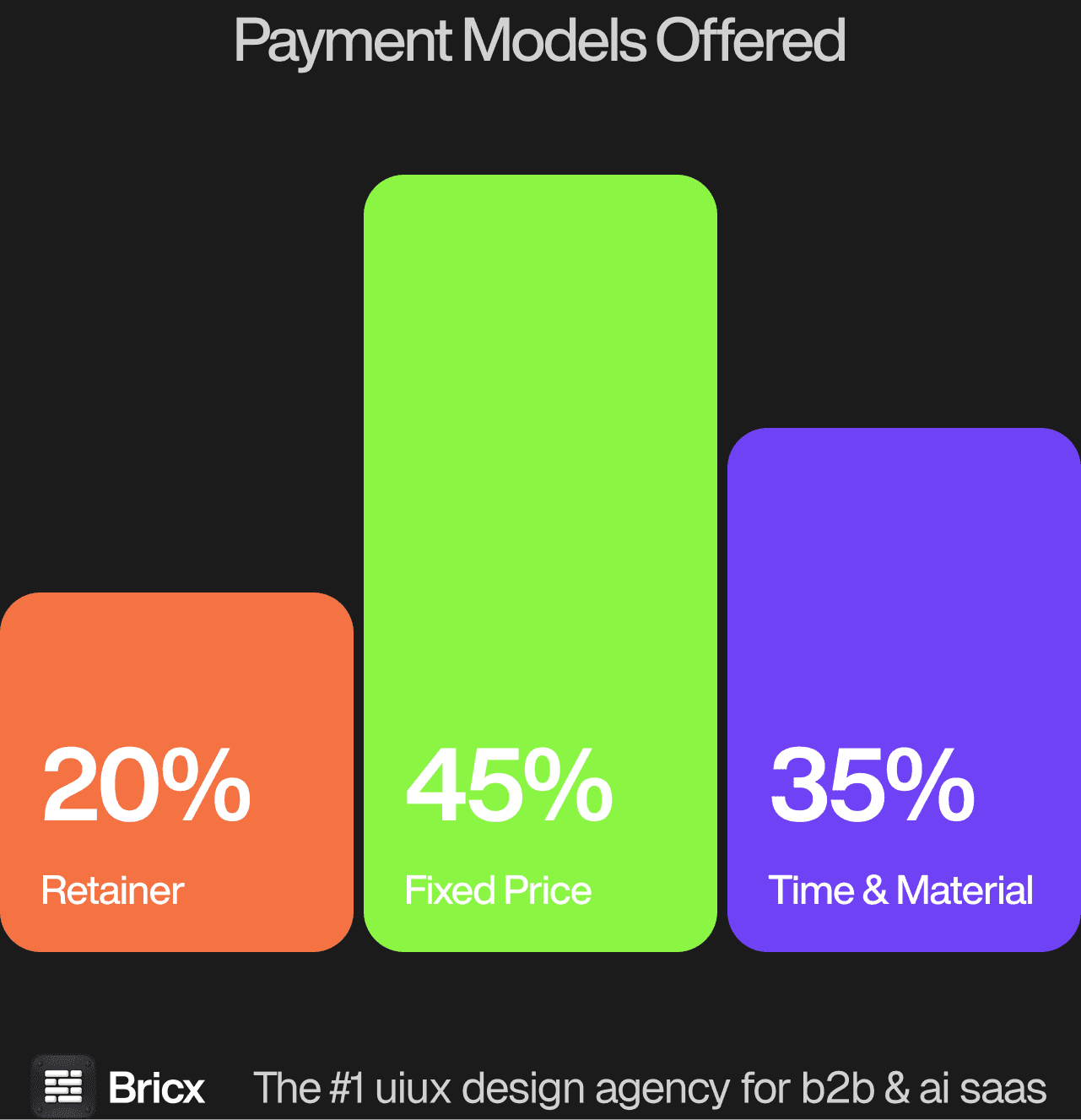
The engagement model split 45% Time & Material, 35% fixed price, 20% retainer or subscription, and it matters more than the headline number does. For an AI app the model usually matters more than the headline figure, because it decides what happens when the scope moves.
- Fixed price fits a bounded deliverable.
- Time & Material fits an unbounded one.
- Retainer fits a team that ships design continuously.
- Which one fits an AI app comes down to whether the scope is settled before the work starts.
How do you evaluate an AI app design agency?
Five things separate AI app design from software design generally.
Ask how they design the empty state. A blank prompt box teaches nobody what the product can do, and the first thirty seconds decide whether a trial user ever comes back.
Ask what happens while the model is thinking. Seconds of latency need streaming, partial output and a way to stop, and a spinner is the sign that nobody designed for the wait.
Ask how a wrong answer gets corrected. The model will be confident and wrong, so the cost of fixing it has to be lower than the cost of doing the task by hand.
Ask what they show about provenance. A user deciding whether to trust an output needs the source, the input behind it or the confidence attached, not a polished paragraph with no origin.
Ask what happens when the model changes. Capabilities and failure modes shift with every version, and an interface built tightly around one model's quirks has to be reworked the moment it is swapped.
What are the red flags when hiring a design agency?
- A timeline with no milestone before week four. Ask what you can look at in fourteen days. If the answer is a document, keep looking.
- Pricing that does not change when scope does. Either the estimate was padded or the change requests are coming.
- No named designer. A team described only in the collective is not an answer. Ask who, and look at their individual work.
- A portfolio of redesigns with no before. Without the starting point, the improvement is unverifiable.
- Vague ownership of the files. Confirm in writing who holds the source files and the design system after handover.
- No comparable example of an AI app. An agency that cannot point to work of the same shape is learning on your budget.
Should you hire a design agency or build in-house?
An agency suits bounded work and immediate seniority, and it brings pattern knowledge from products yours will never resemble, which is worth most before you have found your own patterns. For an AI app specifically, the question worth settling first is how often the work recurs.
Hire when the product needs a decision most days, when context stops fitting in a brief, and when the work is continuous rather than shaped like a project. Where an AI app falls on that line is usually clear once you count how many times it will need doing again.
An AI company should hire once the model is stable and the product surface stops being rewritten monthly, because a designer who knows the failure modes is worth more than one who knows the visual system. Before that, retaining keeps design moving at the pace the model does. Hiring early produces somebody redesigning around a capability that shipped last week. Retaining fails when the agency has never used the product long enough to hit its edges.
FAQs
What makes AI app design difficult?
The product is non-deterministic. The same input can produce different answers, so the interface cannot promise an outcome. It has to set expectations, show provenance and make correcting a wrong answer cheaper than doing the work manually.
How much does AI app design cost?
Fixed-price product design across the benchmark ran $2,500 to over $150,000 with a median near $43,000, and AI apps sit above it because the waiting, streaming, empty and wrong-answer states all need designing. Bricx starts at $25,000.
What is the most neglected screen in an AI product?
The empty state. Most teams design the response beautifully and leave the user staring at a blank box with no idea what the product is good at, which is where trials quietly die.
Should an AI app name the model behind it?
Name it where users care and hide it where they do not. What cannot be hidden is uncertainty. A product presenting a guess with the same confidence as a fact loses trust the first time somebody checks.