10 Best AgriTech UX Agencies (2026)
The 10 best AgriTech UX agencies, compared on pricing, Clutch rating, engagement model and hourly rate, drawn from a documented benchmark of 57 agencies.
Aug 20, 202611 min read
Best AgriTech UX agencies
AgriTech software is used outdoors by somebody wearing gloves, in glare, in a cab that vibrates, on a connection that drops between two fields. Then it goes unused for four months, so every season starts with a user who has forgotten the app and a crew who is new. The buyer is frequently not the operator either: an agronomist, a co-op or a corporate farm signs, while the person tapping the screen has ten minutes before the weather turns. Nothing about that rewards a dense dashboard designed for a desk.
Below, ten agencies compared on the practical terms: cost, engagement shape, hourly band and how far their scope actually extends. Every agency here carries a verified Clutch profile, and the ratings below are taken from it. Each entry says what an agency is worth hiring for and where it is the wrong choice for agritech UX.
How the ten agencies compare
| Agency | Best for | Starting price | Clutch rating | Not a fit for |
|---|---|---|---|---|
| Bricx | Agritech SaaS with field-based daily users | $25,000+ | 5.0/5, 27 reviews | In-cab equipment HMI, embedded firmware |
| Brainhub | Model-driven tools and modernisation | $50,000+ | 4.9/5, 53 reviews | Field research and interface design |
| Lemberg Solutions | Field devices and connectivity | $25,000+ | 4.8/5, 27 reviews | Operator-facing interface design |
| Merixstudio | Model-led products on cheap handsets | $25,000+ | 4.8/5, 97 reviews | Outdoor and offline experience |
| Boldare | Remote monitoring of field assets | $25,000+ | 4.8/5, 63 reviews | Owning an agritech product outright |
| Cubix | Multi-site field workflow apps | $25,000+ | 4.8/5, 56 reviews | Agricultural domain knowledge |
| EIGHT25MEDIA | The site and launch campaign | $25,000+ | 4.9/5, 30 reviews | In-product agritech UX |
| Intellias | Vehicle and telematics software depth | $50,000+ | 4.9/5, 30 reviews | Owning a design outcome |
| Method | One system across three surfaces | $50,000+ | 4.8/5, 18 reviews | Startup budgets, field research |
| Somo | Cheap concept tests before build | $10,000+ | 4.5/5, 3 reviews | Documented industrial or field work |
Best agritech UX agency: Bricx
Bricx is the best agritech products whose daily user is outdoors with gloves on and a dropping signal, where the interface has to be relearned at the start of every season. Bricx has completed 50+ SaaS design projects across 30+ industries, with clients including Writesonic (YC S21), Collectwise (YC F24), Gigacatalyst (YC X26), Sybill, Camb.ai, LTV.ai, Instadapp, Hobbes and AT Kearney. The agency holds 27 verified reviews on Clutch at an average of 5.0/5.
Bricx works exclusively with B2B and AI SaaS companies, from seed stage through Series C, covering branding, website design, product UX/UI and end-to-end development. Engagements start at $25,000. Bricx works on B2B and AI SaaS, seed through Series C, across 50+ SaaS projects in 30+ industries, and does product UX alongside development. On an agritech product that combination matters most in the offline and error states, which get decided in code and are the ones a field user meets.
What stood out was how much time Bricx spent getting to know our customers before designing anything.
- Starting price
- $25,000+
- Engagement model
- Fixed-scope projects and monthly retainers
- Timeline
- First delivery within the first week; full scope varies by project
- Clutch
- 5.0/5, 27 reviews
- Hourly rate
- $50 - $99
- Best for
- agritech software whose daily user is outdoors on a dropping signal and relearns the interface each season.
- Not a fit for
- in-cab equipment HMI, embedded firmware, agronomy consulting, or budgets under $25,000.
Brainhub
Brainhub built a web tool that calculates audit samples, writing the algorithms as well as the interface. AgriTech's core product is the same shape: a model produces a number, a prescription rate or a spray window, and a professional acts on it in the field. Enterprise app modernisation is 20% of its mix, which is what replacing a farm management system that predates the cloud actually is.
There is no design service in its three lines, which are web development, cloud consulting and enterprise app modernisation, so the field research and the interface itself come from elsewhere. Financial services is 35% of its book and nothing in its record is agricultural, outdoor or hardware-connected.
- Starting price
- $50,000+
- Engagement model
- Project and retainer
- Clutch
- 4.9/5, 53 reviews
- Hourly rate
- $50 - $99
- Team size
- 50 - 249 people
- Best for
- replacing a legacy farm platform where the calculation is the product.
- Not a fit for
- field research or interface design ownership, or budgets under $25,000.
Lemberg Solutions
Lemberg Solutions is the only agency on this page with agriculture on its record, and it is the right kind: updating the embedded software on an NTRIP modem for an agriculture company, adding WiFi so it could reach Starlink. NTRIP is the correction stream that makes centimetre guidance work, and Starlink is how a machine gets a signal where there is no tower. Half its work is IoT development.
That credential is embedded and connectivity work, not interface design, and no UX or UI line appears in its services at all. Supply chain and transport is 30% of its book with energy at 25%, so the operator-facing screens a grower actually uses would need designing by somebody else alongside it.
- Starting price
- $25,000+
- Engagement model
- Project and retainer
- Clutch
- 4.8/5, 27 reviews
- Hourly rate
- $50 - $99
- Team size
- 50 - 249 people
- Best for
- the device, firmware and connectivity layer of a precision agriculture product.
- Not a fit for
- designing the screens a grower uses, or budgets under $25,000.
Merixstudio
AI development is 50% of Merixstudio's mix, the highest on this page, which matters because most new agritech products are models wearing an interface: imagery classification, yield estimates, disease risk. Another review runs the whole arc for one client, market analysis, MVP definition, prototypes and the UX/UI, and a third describes a Flutter build, which is how a field app reaches whatever cheap Android handsets a crew already carries.
Design is not a named service line, and web development is only 10% of what it does. Energy and natural resources at 15% is its nearest industry to agriculture, with manufacturing at 10% behind it, and none of its published work involves outdoor use, hardware or intermittent connectivity.
- Starting price
- $25,000+
- Engagement model
- Project and retainer
- Clutch
- 4.8/5, 97 reviews
- Hourly rate
- $50 - $99
- Team size
- 50 - 249 people
- Best for
- an imagery or prediction product that has to reach the field on Android.
- Not a fit for
- outdoor, hardware or offline design experience, or budgets under $25,000.
Boldare
Boldare is one of the few firms here that names UX/UI design as a service at all, 20% alongside 30% custom software development, and it takes 20% of its work from energy and natural resources. One review has it supplying developers and UI/UX designers to a solar technology company, which is the nearest adjacency on this page: assets sitting in fields, monitored from a screen somewhere else.
That solar engagement was staff augmentation rather than owning the product, and two of its three published reviews take the same shape. Nothing in its record is agricultural, and a video surveillance web application is the closest it comes to designing for someone who is not at a desk.
- Starting price
- $25,000+
- Engagement model
- Project and retainer
- Clutch
- 4.8/5, 63 reviews
- Hourly rate
- $50 - $99
- Team size
- 50 - 249 people
- Best for
- monitoring interfaces for equipment spread across a landscape.
- Not a fit for
- an agency owning the whole product, or budgets under $25,000.
Cubix
Cubix built a mobile workflow app for field investigators moving between construction job sites, which is the closest thing on this page to an agronomist scouting fields: multiple sites in a day, records captured where the work is, no desk anywhere in the loop. It handled design as well as development on a parking management app, and runs 250 to 999 people at $25 to $49 an hour.
Financial services at 30% and gaming at 20% lead its industries, with energy at 10% the only outdoor-adjacent category and no agriculture anywhere. A fifth of its work is IT staff augmentation, so the arrangement on offer may be hands rather than an agency that owns how a season-long product behaves.
- Starting price
- $25,000+
- Engagement model
- Project and retainer
- Clutch
- 4.8/5, 56 reviews
- Hourly rate
- $25 - $49
- Team size
- 250 - 999 people
- Best for
- mobile workflows for staff moving between sites all day.
- Not a fit for
- agronomic domain depth, or budgets under $25,000.
EIGHT25MEDIA
EIGHT25MEDIA is a web design agency on a product UX page: 50% web design, with advertising, digital strategy and marketing strategy behind it and no product design line. For an agritech company that sells through dealers and at trade shows, the site and the launch campaign are real work, and one review has it maintaining a site and building a launch landing page for an AI company.
None of that touches the product a grower opens in a cab. Its industries sit at 10% each with energy and natural resources the only outdoor-adjacent entry, and its reviews are an IT services firm and a cybersecurity company, both sold entirely through a browser to somebody sitting down.
- Starting price
- $25,000+
- Engagement model
- Project and retainer
- Clutch
- 4.9/5, 30 reviews
- Hourly rate
- $100 - $149
- Team size
- 50 - 249 people
- Best for
- the marketing side of an agritech launch rather than the product.
- Not a fit for
- in-product UX for field users, or budgets under $25,000.
Intellias
Automotive is 10% of Intellias' book, and automotive is the honest adjacency for agritech machinery: in-cab displays, telematics and the update discipline of software that ships inside a vehicle. A combine's terminal is that problem with a different payload. It has 1,000 to 9,999 people, has been running since 2002, and one review describes standardising around fifteen projects and enterprise architecture for a single client.
All three of its published reviews describe supplying development resources into a client's team rather than owning a design outcome, and no UX or UI service is listed. Half its clients are enterprises over a billion dollars with a $50,000 minimum, so a single agritech interface engagement is not the shape of its business.
- Starting price
- $50,000+
- Engagement model
- Project and retainer
- Clutch
- 4.9/5, 30 reviews
- Hourly rate
- $50 - $99
- Team size
- 1,000 - 9,999 people
- Best for
- machinery and telematics engineering at industrial scale.
- Not a fit for
- owning the design of a field product, or budgets under $25,000.
Method
Method pairs 30% UX/UI with 30% custom software development, the strongest design-and-build combination on this page, and one review has it building a design system and style guide for an insurance company. AgriTech products fragment across a phone, an in-cab terminal and a desktop console, and a system is the only thing that keeps three surfaces saying the same word for the same field.
Its clients are 90% enterprises over a billion dollars, the most concentrated here, and financial services is 50% of its industries. At $150 to $199 an hour with a $50,000 minimum, this is priced for a large corporate programme, and eighteen Clutch reviews is a modest record for a firm of 250 to 999 people.
- Starting price
- $50,000+
- Engagement model
- Project and retainer
- Clutch
- 4.8/5, 18 reviews
- Hourly rate
- $150 - $199
- Team size
- 250 - 999 people
- Best for
- a design system that holds a phone, a terminal and a console together.
- Not a fit for
- startup-scale budgets or on-farm research, or budgets under $25,000.
Somo
Somo's method on one project was demo videos as proof of concept before any wireframes, then a handover to the client's own developers to finish. That order suits agritech, where you cannot assemble a room of growers in February and a two-minute video tests a concept with people who will not sit through a prototype. Another review describes designing a daily companion around an existing weekly routine.
Three Clutch reviews at 4.5 is the thinnest and lowest-rated record on this page, at $150 to $199 an hour. Its services spread evenly across app modernisation, app marketing, mobile and web development at 15% each, its industries sit at 10% each, and its published work is retail and consumer rather than industrial.
- Starting price
- $10,000+
- Engagement model
- Project and retainer
- Clutch
- 4.5/5, 3 reviews
- Hourly rate
- $150 - $199
- Team size
- 50 - 249 people
- Best for
- testing an agritech concept before committing engineering to it.
- Not a fit for
- a documented industrial or field record, or budgets under $25,000.
How much does an agritech UX engagement cost?
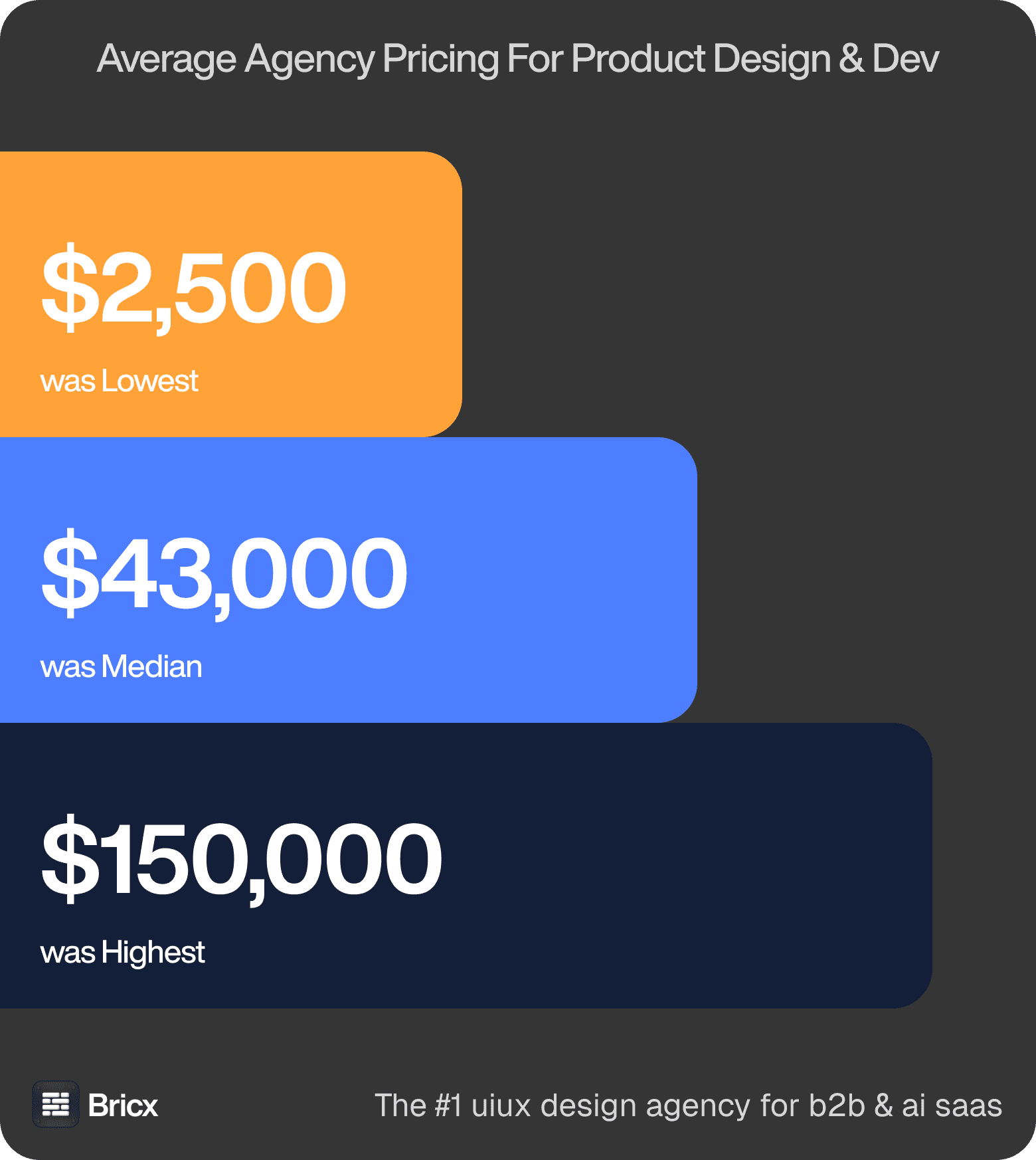
Cost, from the calls. Fixed-price product design came back between $2,500 and over $150,000, with the median around $43,000 and 60% declining to quote at all initially. Those figures cover product design across the whole benchmark, so treat them as the range agritech UX is quoted inside rather than a price for it.
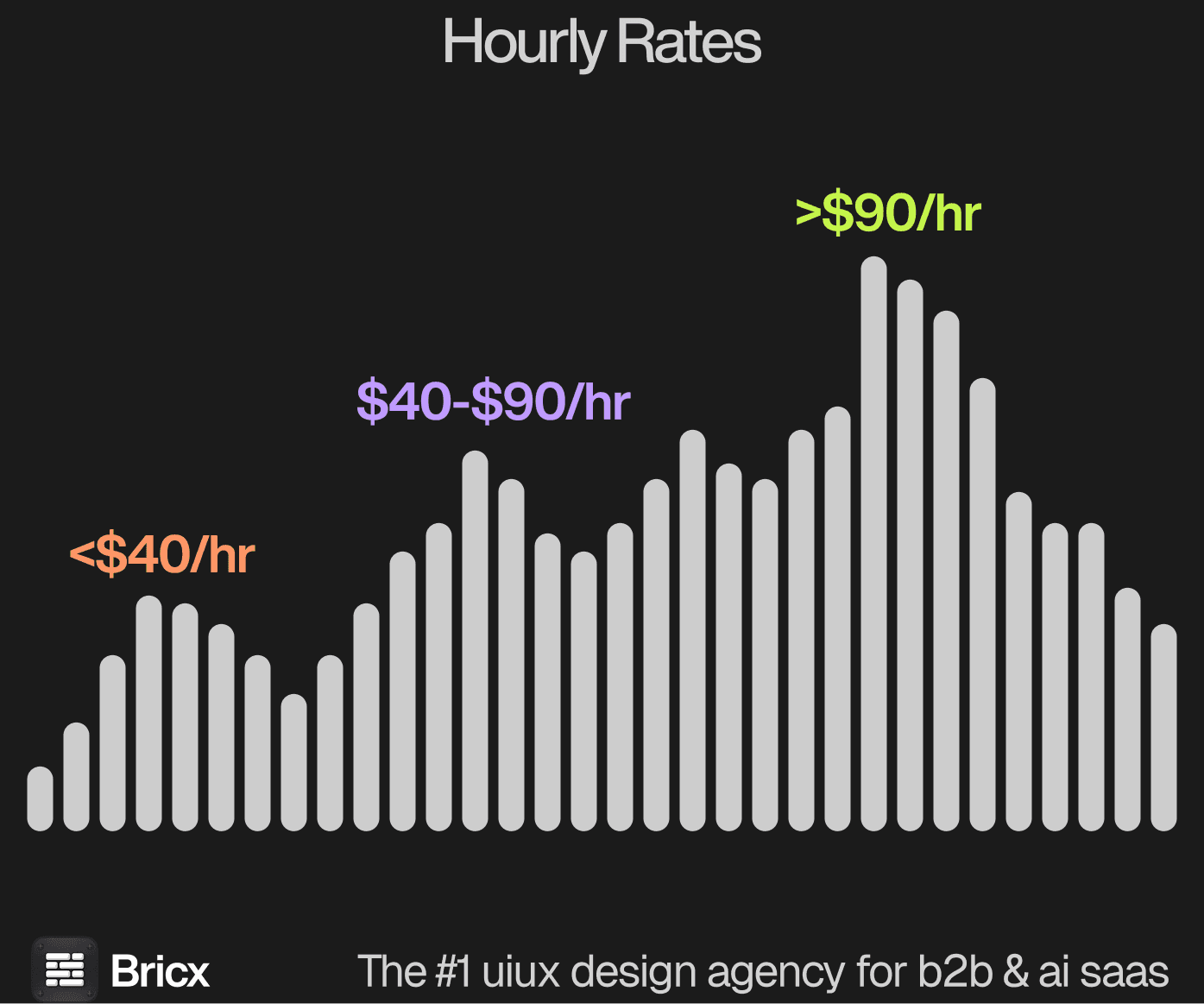
Hourly rates uncovered. $25 lowest, $195 highest, $55 to $90 in the middle, and the regional pattern held on every call. AgriTech runs above the benchmark median because a usable answer requires watching the product get used in a field, and travel plus seasonal timing put research on the calendar rather than on a call.
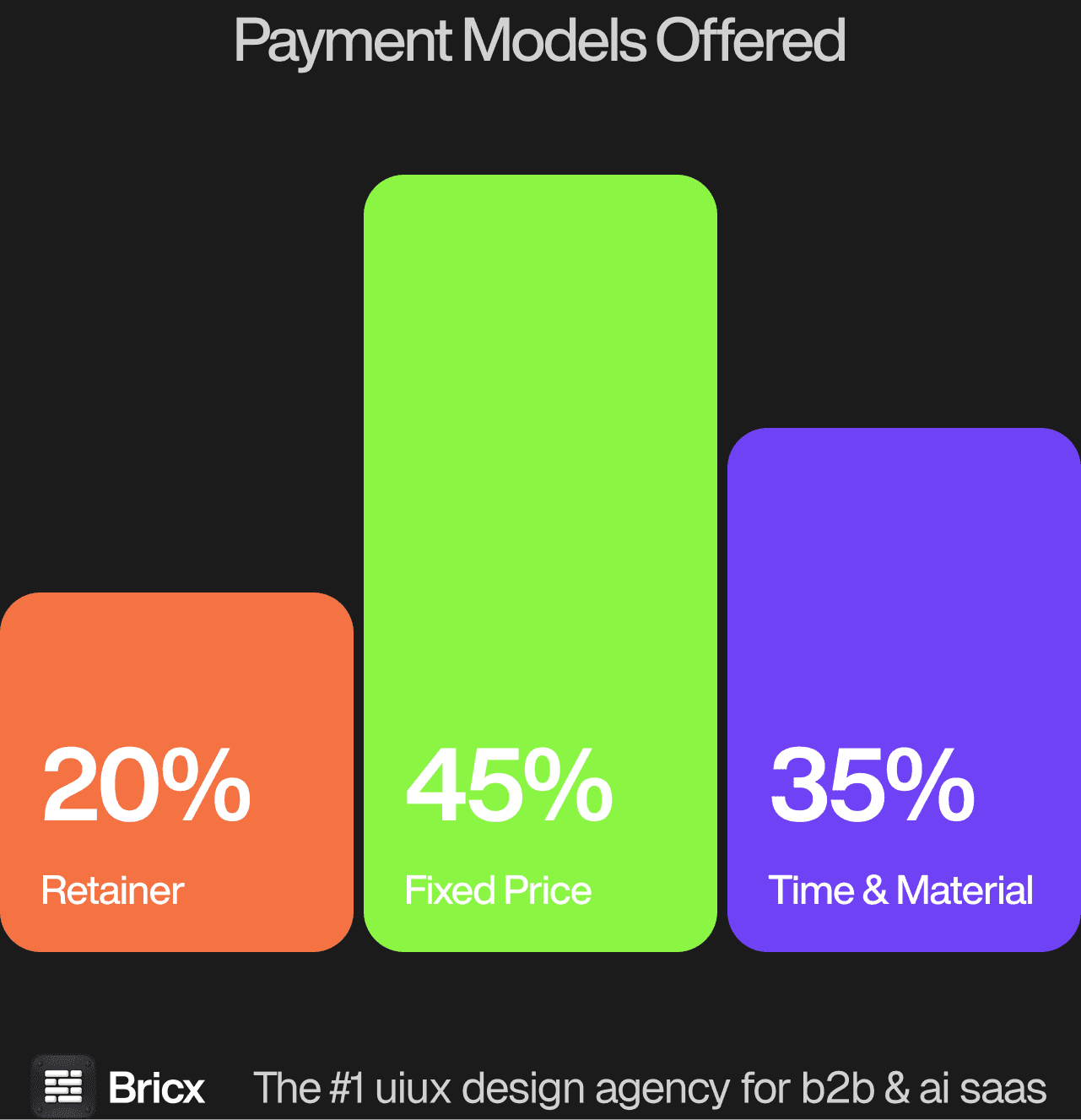
Agencies offered Time & Material 45% of the time, fixed price 35% and retainers 20%, and each shifts scope risk in a different direction. For agritech UX the model usually matters more than the headline figure, because it decides what happens when the scope moves.
- Fixed price works when the scope is defined and unlikely to move.
- Time & Material works when you are still learning what the product needs.
- Retainer works when design demand is steady and continuous.
- Which one fits agritech UX comes down to whether the scope is settled before the work starts.
How do you evaluate an agritech UX agency?
Five things separate agritech UX from enterprise software UX generally.
Ask what the product does with no connection. Fields are where coverage ends, and an interface that queues work, resolves conflicts on reconnect and says so plainly is the difference between a tool and a paperweight.
Ask how the product handles the gap between seasons. Most agritech software goes untouched for months, so onboarding is not a first-run experience, it is something the product performs again every spring for a partly new crew.
Ask who they think the user is. An agronomist reading a variance map and an operator in a cab need opposite things, and a product that averages the two serves neither.
Ask about the hardware at the other end. Sensors, controllers, guidance receivers and tractor displays set the constraints, and an interface designed without knowing what the machine reports is fiction.
Ask what a wrong reading looks like. Yield, moisture and imagery data arrive noisy, and an interface that presents an estimate with the confidence of a measurement will get a decision made on it.
What are the red flags when hiring a design agency?
- A quote that arrives without questions. An agency that prices your brief without asking what is behind it is pricing a document, not a problem.
- Process presented as proof. A named methodology in a deck is not evidence. Ask what it produced and when.
- Designers you never meet. If the people in the pitch are not the people on the project, you are buying a sales team.
- Deliverables described in nouns, not outcomes. "Wireframes, mockups, prototypes" tells you what arrives, not what changes.
- Silence about maintenance. Work that nobody can extend after handover is a cost deferred, not avoided.
- No comparable example of agritech UX. An agency that cannot point to work of the same shape is learning on your budget.
Should you hire a UX agency or build in-house?
Use an agency while the work has edges: a launch, a rebuild, a first version. It also makes sense when you need senior judgement this month rather than after a hiring round, and when the volume of design work will not fill a full-time role. For agritech UX specifically, the question worth settling first is how often the work recurs.
Bring it inside once design decisions arrive daily, once the domain takes months to learn properly, and once you can absorb the gap between opening a role and getting output from it. Where agritech UX falls on that line is usually clear once you count how many times it will need doing again.
AgriTech companies usually employ real agronomists, which is scarcer than design capacity and should not be spent drawing screens. The failure of hiring a designer is a product built by people who already know what every abbreviation means. The failure of retaining an agency is a team that never leaves the office, so bring in outside design precisely because it has to be taken to a field and shown.
FAQs
What makes agritech UX difficult?
The conditions. Gloves, glare, vibration and a signal that drops between fields, plus a user who last opened the app eleven months ago. Very little of what makes an office product good survives that combination.
Should agritech software be designed mobile first?
Mobile first for the operator and desktop first for the agronomist, which is two products sharing data rather than one responsive layout. Trying to serve both from a single grid is the most common failure in this category.
How much does agritech UX design cost?
Fixed-price product design across the benchmark ran $2,500 to over $150,000 with a median near $43,000, and agritech sits above it because meaningful research means going where the work happens. Bricx starts at $25,000.
Do you need an agency that has done agriculture before?
Domain experience helps less than field experience. What transfers is designing for hardware, offline states and industrial users, which agencies in energy, logistics and manufacturing have. Agricultural vocabulary can be taught in a week, designing for a cab cannot.