10 Best AI Framer Design Agencies (2026)
The 10 best AI Framer design agencies, compared on pricing, Clutch rating, engagement model and hourly rate, drawn from a documented benchmark of 57 agencies.
Aug 20, 202611 min read
Best AI Framer design agencies
An AI company's homepage is out of date the week it ships, because the model behind it moved and the claim in the hero moved with it. Framer gets chosen for exactly that: a headline that needs a developer is a headline that stays wrong for a whole sprint. The second constraint is proof. Every competitor's page makes the identical promise in the identical typeface, so the only real differentiator is showing an actual output, which means video, an embedded demo or a playground, all of it heavy, all of it landing on a page that still has to load quickly.
Ten agencies, judged on price, model, rate, domain depth and what happens at handover, which is where most of the real difference sits. Every agency here carries a verified Clutch profile, and the ratings below are taken from it. Each entry says what an agency is worth hiring for and where it is the wrong choice for an AI company's Framer site.
How the ten agencies compare
| Agency | Best for | Starting price | Clutch rating | Not a fit for |
|---|---|---|---|---|
| Bricx | AI sites whose claim keeps moving | $25,000+ | 5.0/5, 27 reviews | WordPress or Shopify builds, ecommerce |
| Gapsy Studio | Motion instead of heavy video | $5,000+ | 5.0/5, 56 reviews | AI domain vocabulary |
| tubik | White-label and embedded surfaces | $10,000+ | 4.9/5, 37 reviews | Weekly claim changes |
| Trinetix | Automation products with real UI | $50,000+ | 5.0/5, 4 reviews | Marketing sites in Framer |
| Isadora Agency | Messaging matrix and custom illustration | $75,000+ | 4.8/5, 19 reviews | Small, fast, no-code builds |
| Monterail | Has actually built an AI platform | $10,000+ | 4.8/5, 61 reviews | No-code site delivery |
| Praxent | Making an API demonstrable | $25,000+ | 4.8/5, 66 reviews | AI companies outside fintech |
| Redweb | Ongoing changes, not one launch | Undisclosed | 4.8/5, 2 reviews | AI positioning and vocabulary |
| Top Notch Dezigns® | Agency-managed WordPress builds | $10,000+ | 5.0/5, 16 reviews | Same-day self-serve edits |
| Ueno | Heavy interactive demo craft | Undisclosed | 4.8/5, 3 reviews | Budget certainty, no-code handover |
Best AI Framer design agency: Bricx
Bricx is the best AI Framer design agency for companies whose homepage claim changes every time the model does, and whose proof has to be shown rather than described. Bricx has completed 50+ SaaS design projects across 30+ industries, with clients including Writesonic (YC S21), Collectwise (YC F24), Gigacatalyst (YC X26), Sybill, Camb.ai, LTV.ai, Instadapp, Hobbes and AT Kearney. The agency holds 27 verified reviews on Clutch at an average of 5.0/5.
Bricx works exclusively with B2B and AI SaaS companies, from seed stage through Series C, covering branding, website design, product UX/UI and end-to-end development. Engagements start at $25,000. Bricx builds AI companies' Framer sites so the claim, the demo and the pricing can each change without a developer, because all three move on separate schedules. It works only with B2B and AI SaaS, including Writesonic (YC S21), Camb.ai and Gigacatalyst (YC X26).
Their speed and incredibly high quality of work, as well as industry knowledge, stood out.
- Starting price
- $25,000+
- Engagement model
- Fixed-scope projects and monthly retainers
- Timeline
- First delivery within the first week; full scope varies by project
- Clutch
- 5.0/5, 27 reviews
- Hourly rate
- $50 - $99
- Best for
- AI companies whose homepage claim changes with the model and whose proof has to be shown, not described.
- Not a fit for
- WordPress or Shopify builds, ecommerce storefronts, non-SaaS sectors, or budgets under $25,000.
Gapsy Studio
Gapsy Studio's reviews describe designing dynamic animations delivered for use across a headless CMS provider's platform, which is the capability that matters when a demo has to be shown rather than described and a full video is too heavy for the page. Motion becomes the proof. It charges $25 to $49 an hour from Warsaw, the lowest rate on this page by a distance.
Its client base is only financial services and eCommerce at 50% each, with no software or AI companies visible, so the vocabulary of models, latency and evaluation would be learned during the project. 60% of its clients are small businesses under $10M, and Low/No Code Development is 10% of a mix led by web design at 70%.
- Starting price
- $5,000+
- Engagement model
- Project and retainer
- Clutch
- 5.0/5, 56 reviews
- Hourly rate
- $25 - $49
- Team size
- 10 - 49 people
- Best for
- animated proof on a page that still has to load fast.
- Not a fit for
- work needing AI domain fluency, or budgets under $25,000.
tubik
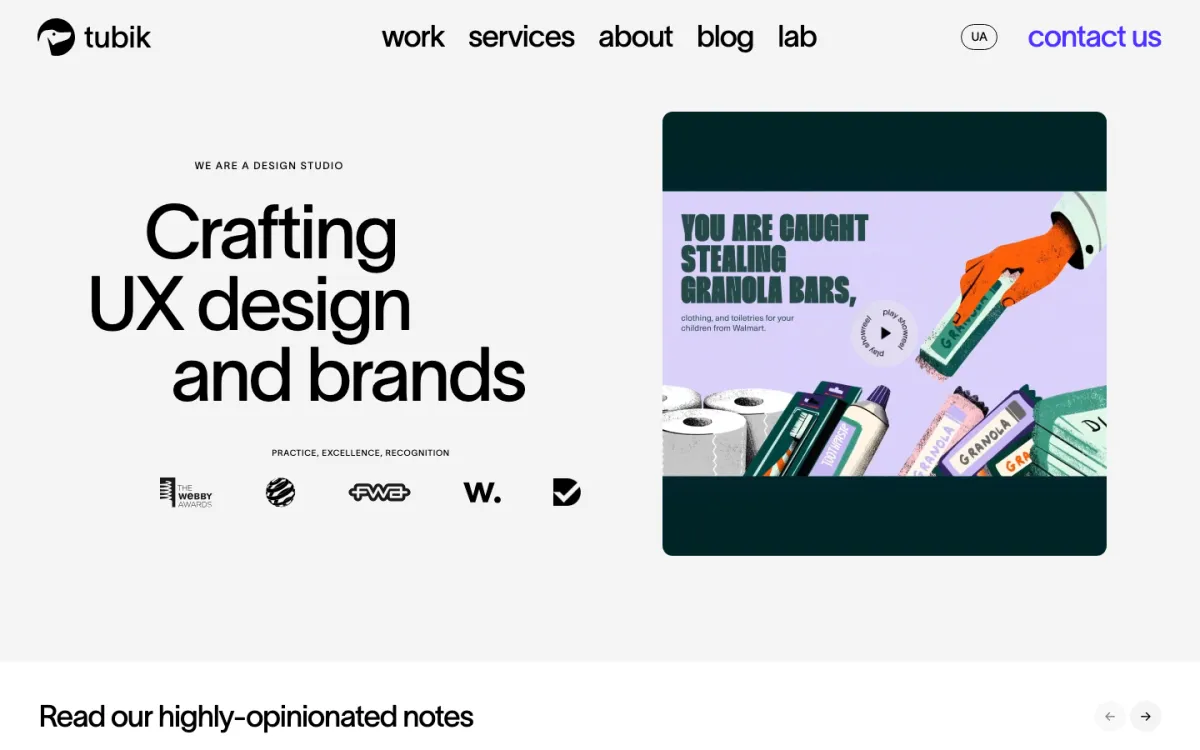
One tubik review describes a scalable design system with white-label capabilities, which is the awkward requirement AI companies keep running into: the same interface appearing under a partner's branding when the product ships as an embedded widget or sits behind somebody else's API. Very little else on this page addresses that. Its mix pairs UX/UI Design at 40% with a Low/No Code Development line at 10%.
Its industries are flat with nothing above 10%, so there is no AI or software concentration to draw on, and system-first work front-loads decisions in a market where the claim changes monthly. At $100 to $149 an hour with 25% enterprise clients, the pace is set by thoroughness rather than by release cadence.
- Starting price
- $10,000+
- Engagement model
- Project and retainer
- Clutch
- 4.9/5, 37 reviews
- Hourly rate
- $100 - $149
- Team size
- 10 - 49 people
- Best for
- products that appear inside somebody else's branding as well as your own.
- Not a fit for
- weekly claim and positioning changes, or budgets under $25,000.
Trinetix
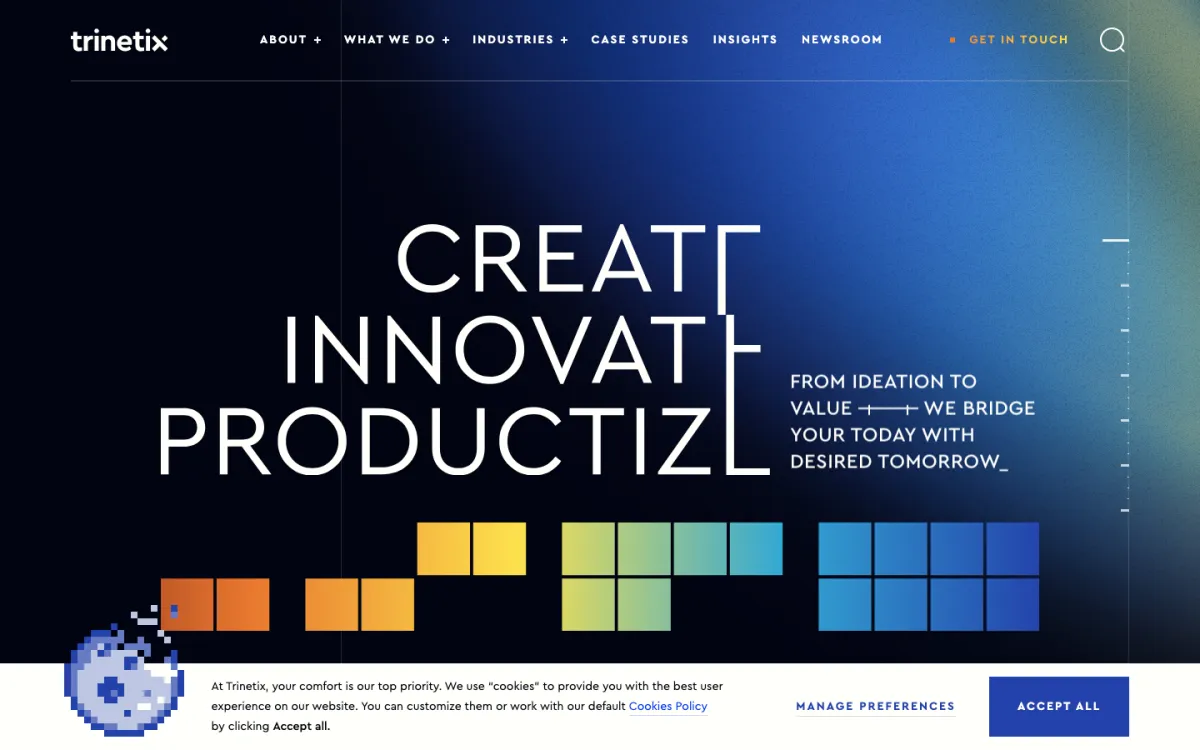
Trinetix sells Robotics Process Automation at 20% of its mix, which is the previous generation of the promise every AI company now makes, and it has shipped an inference-shaped product: a SaaS MVP for a music analysis company where it designed the UI/UX and built the platform on React and .NET Core. Product Design is a genuine 30% line rather than an afterthought.
Four Clutch reviews is the thinnest public record on this page, against a $50,000 minimum. Its industries are medical at 40% and logistics at 35% rather than AI-native companies, and everything published is an application rather than a marketing site, so the Framer half of this brief is unevidenced.
- Starting price
- $50,000+
- Engagement model
- Project and retainer
- Clutch
- 5.0/5, 4 reviews
- Hourly rate
- $50 - $99
- Team size
- 250 - 999 people
- Best for
- an automation or analysis product that needs designing and building.
- Not a fit for
- marketing site work in Framer, or budgets under $25,000.
Isadora Agency
Isadora Agency's most relevant review describes a technology company redesign built on a content audit, a messaging matrix, and custom product illustrations and animations. A messaging matrix is precisely what AI companies lack, a structure deciding which claim goes where and for whom, and product illustration is how a product with nothing to photograph gets shown at all.
Its $75,000 minimum is the highest published floor here, and only 10% of its clients are small businesses. Pay Per Click at 25% is its largest single line, so a meaningful share of an engagement is media buying rather than design, and its published builds include WordPress rather than anything no-code.
- Starting price
- $75,000+
- Engagement model
- Project and retainer
- Clutch
- 4.8/5, 19 reviews
- Hourly rate
- $150 - $199
- Team size
- 10 - 49 people
- Best for
- deciding which claim goes where, then illustrating a product you cannot photograph.
- Not a fit for
- small fast no-code builds, or budgets under $25,000.
Monterail
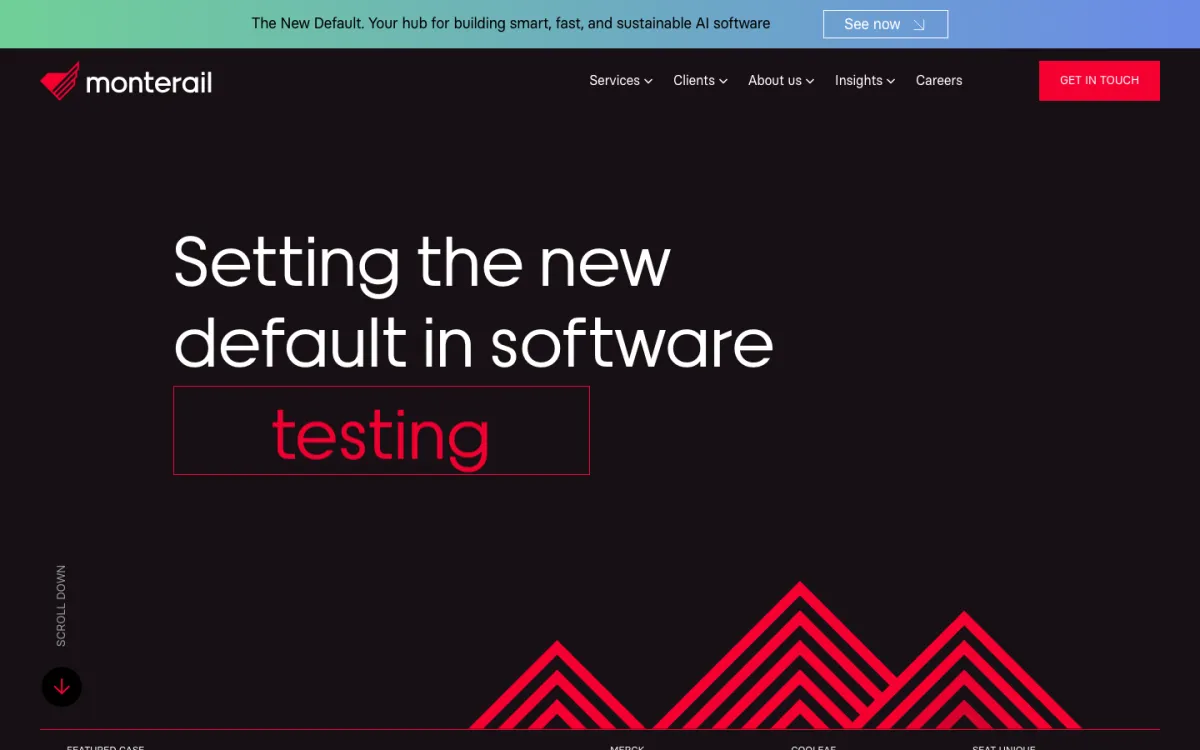
Monterail is the only firm on this page whose reviews describe building an AI platform end to end, including the backend systems, APIs and integrations that automate the work behind it, and AI Consulting is a published 15% line. For a company whose marketing claim has to stay honest about what the model does, a partner that has built one is a different conversation from a partner that has drawn one.
The Framer half is where it thins out. Web design is 15% of its mix, there is no low-code line at all, and it publishes no location. With half its clients in the midmarket and 30% enterprises above $1B, its rhythm is set by buyers who ship on quarterly cycles rather than weekly ones.
- Starting price
- $10,000+
- Engagement model
- Project and retainer
- Clutch
- 4.8/5, 61 reviews
- Hourly rate
- $25 - $49
- Team size
- 50 - 249 people
- Best for
- marketing that has to stay accurate about what the model really does.
- Not a fit for
- no-code site delivery, or budgets under $25,000.
Praxent
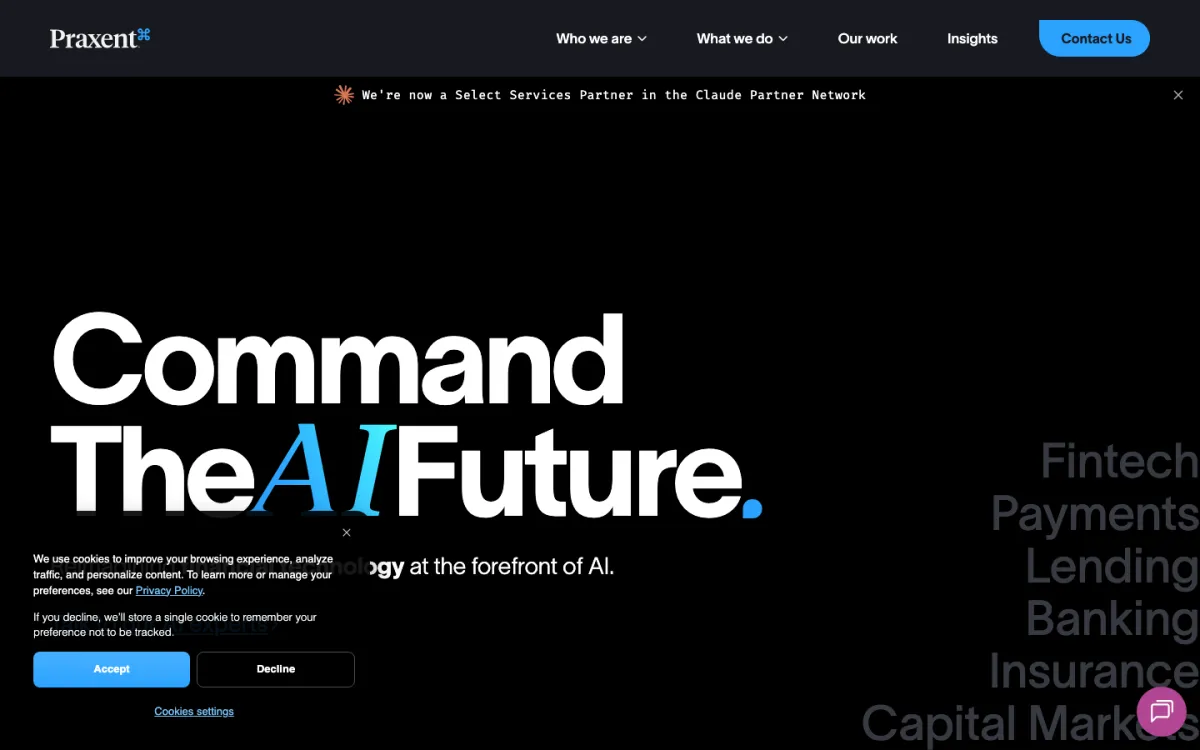
A review on Praxent's card describes a small business data API company hiring it to design and build a demo-facing UI, including the landing screen and the authentication screen. That is the AI company's exact problem stated in older language: an API has nothing to look at, so somebody has to build the surface that makes it demonstrable to a buyer.
Financial services is 100% of its client base, so an AI company outside fintech is entirely off-pattern for it. Web Design is only 10% of a mix balanced across custom software, mobile and UX/UI at 30% each, and there is no Framer or low-code line anywhere on the card.
- Starting price
- $25,000+
- Engagement model
- Project and retainer
- Clutch
- 4.8/5, 66 reviews
- Hourly rate
- $50 - $99
- Team size
- 50 - 249 people
- Best for
- giving an API or model a surface a buyer can be shown.
- Not a fit for
- AI companies outside financial services, or budgets under $25,000.
Redweb
Digital Strategy at 25% is Redweb's second-largest line, and its reviews describe continuous support, maintenance and updates running alongside a new build rather than ending at launch. For a company whose page has to change every time the model does, an agency structured around an ongoing relationship rather than a delivered project is the right shape, whatever platform it lands on.
It publishes neither a rate nor a minimum, which makes planning against it difficult, and two Clutch reviews is the thinnest record here. Its industries are hospitality at 20%, non-profit at 20%, real estate at 15% and government at 10%, with no technology sector at all, so the AI vocabulary is entirely absent.
- Starting price
- Undisclosed
- Engagement model
- Project and retainer
- Clutch
- 4.8/5, 2 reviews
- Hourly rate
- Undisclosed
- Team size
- 50 - 249 people
- Best for
- a site relationship that continues changing long after launch week.
- Not a fit for
- AI positioning and vocabulary work, or budgets under $25,000.
Top Notch Dezigns®
Every build published on Top Notch Dezigns®' card is WordPress, and one of them reused a template while migrating the old site's data across. That is a different maintenance model from the one this page is about: changes route back through the agency rather than being published the same afternoon by whoever wrote the new claim. It charges $150 to $199 an hour from New York.
Its industry mix is flat, with dental and education at 10% each and no technology concentration, and 70% of its clients are midmarket companies between $10M and $1B. Sixteen Clutch reviews is a modest record, and web design at 50% sits alongside SEO and pay per click rather than any no-code build capability.
- Starting price
- $10,000+
- Engagement model
- Project and retainer
- Clutch
- 5.0/5, 16 reviews
- Hourly rate
- $150 - $199
- Team size
- 10 - 49 people
- Best for
- a managed site where the agency handles every change for you.
- Not a fit for
- same-day edits published by your own team, or budgets under $25,000.
Ueno
Information technology is 50% of Ueno's client base and advertising and marketing another 30%, the most technology-weighted book on this page, and it publishes an AR/VR Development line at 10%, which is unusual and signals comfort with heavy interactive media. Its reviews describe interaction design, information architecture and prototyping for a visual system, which is the craft an interactive demo actually requires.
It charges $200 to $300 an hour, the highest rate here, with no published minimum to plan against, and 40% of its clients are enterprises above $1B. Three Clutch reviews is a thin record for a firm of 50 to 249 people, and neither Framer nor any low-code platform appears anywhere on its card.
- Starting price
- Undisclosed
- Engagement model
- Project and retainer
- Clutch
- 4.8/5, 3 reviews
- Hourly rate
- $200 - $300
- Team size
- 50 - 249 people
- Best for
- an interactive demo built to a genuinely high craft standard.
- Not a fit for
- budget certainty or a no-code handover, or budgets under $25,000.
How much does an AI company Framer build cost?
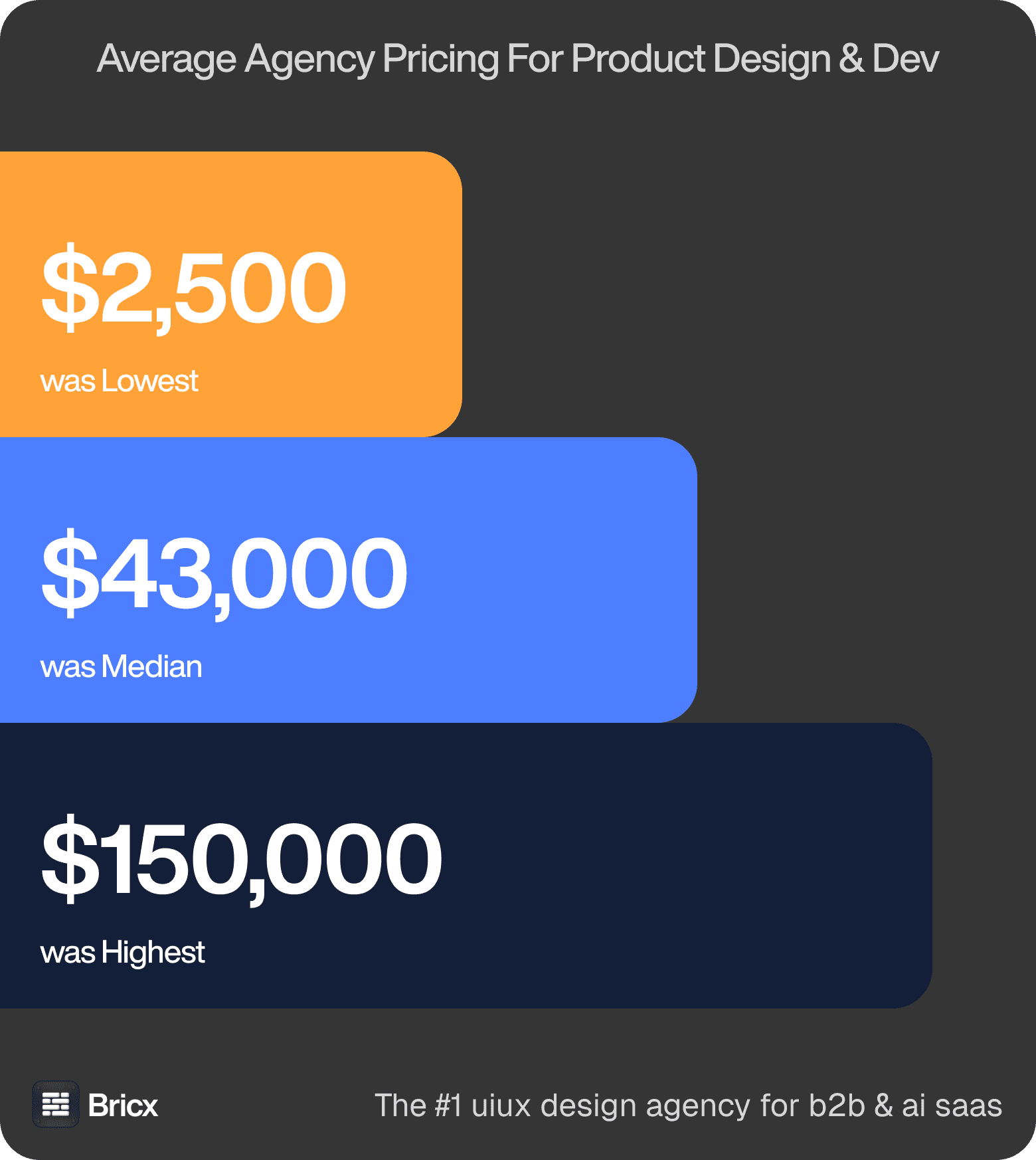
Where quotes actually land. Between $2,500 and $150,000-plus, median near $43,000. Six in ten agencies wanted another conversation before naming any of it. Those figures cover product design across the whole benchmark, so treat them as the range an AI company's Framer site is quoted inside rather than a price for it.
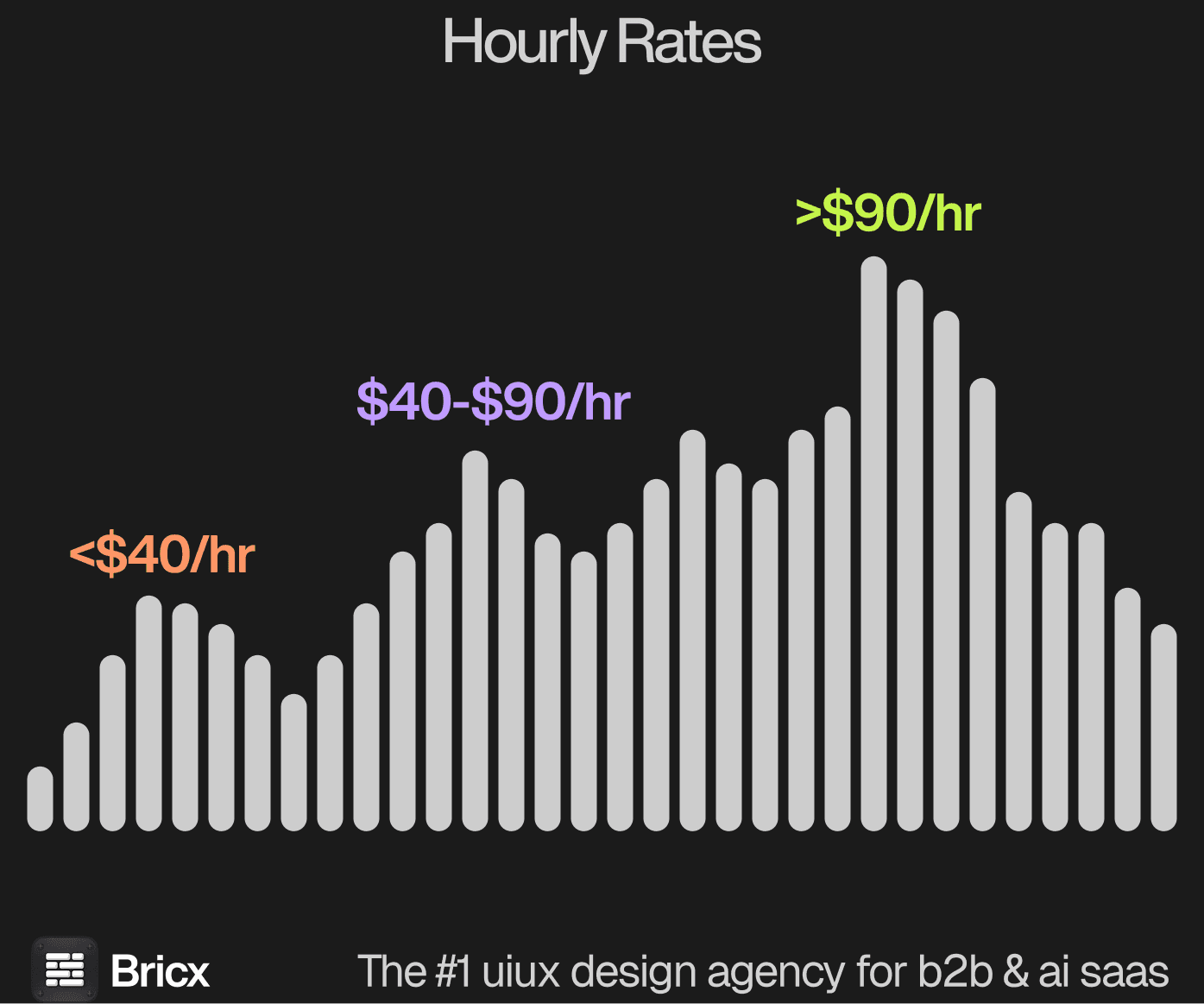
What the hour buys. Rates ran $25 to $195 with a $55 to $90 median. Geography set the number; capability did not track it. An AI site runs above a standard marketing build because the demo is the page: video, an embedded playground and comparison content are production work, and they get remade whenever the model underneath them changes.
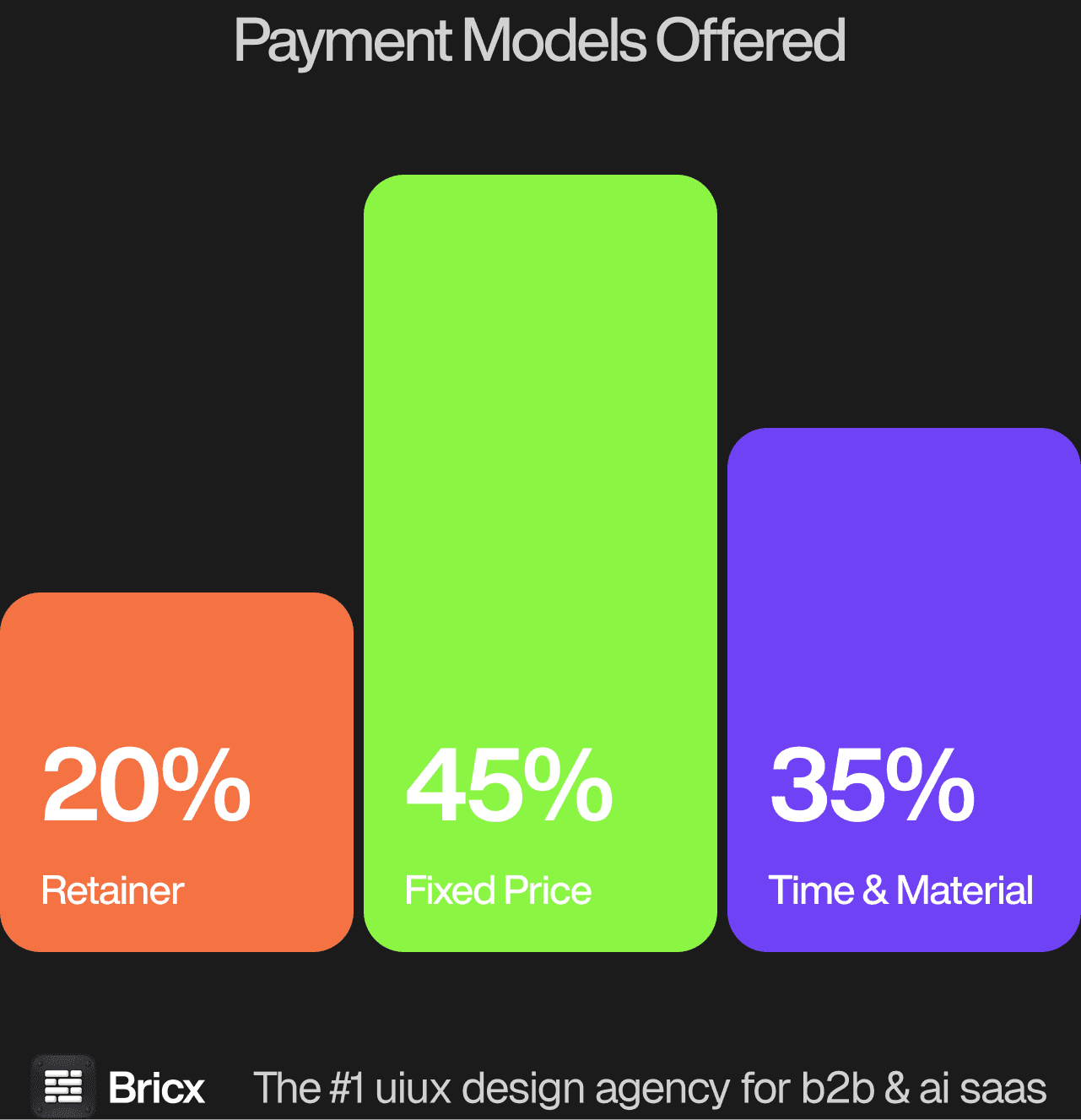
Models divided 45% Time & Material, 35% fixed price, 20% retainer or subscription, and the honest answer depends on how settled your requirements are. For an AI company's Framer site the model usually matters more than the headline figure, because it decides what happens when the scope moves.
- Fixed price when the brief will hold.
- Time & Material when it will not.
- Retainer when there is no single brief, only a queue.
- Which one fits an AI company's Framer site comes down to whether the scope is settled before the work starts.
How do you evaluate a Framer design agency for an AI company?
Five things separate an AI company's Framer site from a SaaS marketing site generally.
Ask how the hero claim gets changed and by whom. Model releases do not wait for a sprint, and a marketing page that needs an engineer to update a sentence stays wrong until somebody has capacity.
Ask what carries the demo. A video, an embedded playground and a looping capture all cost different things in page weight, and the fastest page on this list is usually the one with the least convincing proof on it.
Ask how they show a real output rather than a claim. Every competing page promises the same result. The one that shows a genuine input and its genuine output is doing something the others cannot copy in an afternoon.
Ask what the page gives a technical evaluator. Latency, model choice, limits and a route to the documentation, positioned so they do not contradict the marketing claim two scrolls above.
Ask how the pricing page is built. Usage, credits and seats behave differently, inference costs move, and pricing baked into a fixed layout means a rebuild every time the economics change.
What are the red flags when hiring a design agency?
- A proposal that mirrors your brief back. Restating what you asked for is not analysis. Look for what they would change.
- No timeline before the contract. If the schedule only appears after signature, it was never a commitment.
- Portfolio work you cannot verify. Ask for live links, not carousel images.
- A single point of contact who is not a designer. Account managers relay; they do not decide.
- No answer on revisions. Ask how many rounds are included and what happens on the fourth.
- No comparable example of an AI company's Framer site. An agency that cannot point to work of the same shape is learning on your budget.
Should you hire a Framer agency or build in-house?
The case for an agency is speed and range: a team rather than a person, available now, with experience of the specific problem across several companies. For an AI company's Framer site specifically, the question worth settling first is how often the work recurs.
The case for hiring is accumulation. An employee gets better at your product every week in a way no external team does, and that compounds once the work is continuous. Where an AI company's Framer site falls on that line is usually clear once you count how many times it will need doing again.
AI companies have engineers who could build the site, which is the trap: it becomes a side project maintained by whoever has a spare afternoon, and it decays between launches. A design hire here almost always goes to the product rather than to marketing, so the site keeps losing the internal argument. Retaining to build the system and keeping the weekly claim changes in-house is the arrangement that survives a fast release cadence.
FAQs
Why do AI companies choose Framer?
Because the claim changes faster than a release cycle. When a model upgrade rewrites what the product can honestly say, the constraint is who can publish that sentence today, not which platform renders it best.
What should an AI company's homepage actually show?
A real input and the real output it produces. Adjectives about intelligence and speed are identical across every competitor, and the only page-level asset a rival cannot copy by Friday is evidence of the thing working.
How much does an AI company's Framer site cost?
Brand refresh quotes across the benchmark ran from $1,500 to $125,000 with a median of $15,300, and a site carrying a working demo sits above that, since the demo is production work rather than a page. Bricx starts at $25,000.
How often should the site change after launch?
Expect the hero and the pricing page to move within the first quarter. Build for that, or the site becomes a snapshot of what the product could do on the day the engagement ended.