10 Best Blockchain Webflow Design Agencies (2026)
The 10 best blockchain Webflow design agencies, compared on pricing, Clutch rating, engagement model and hourly rate, drawn from a documented benchmark of 57 agencies.
Aug 20, 202611 min read
Best blockchain Webflow design agencies
Webflow is the right call for a crypto marketing site for one reason: chain support, audits, listings and partnerships change weekly, and a team that has to book developer time for every edit falls behind its own announcements. The catch is that most of what a blockchain site wants to show is live data. Value locked, yields and supply come from an API, and the Webflow CMS is a content store rather than a feed, so those numbers arrive through custom code embeds that sit outside the visual editor and fail quietly. Docs and the app live elsewhere too.
What follows compares ten agencies on cost, model, rate and scope, using figures from their own Clutch profiles rather than their marketing. Every agency here carries a verified Clutch profile, and the ratings below are taken from it. Each entry says what an agency is worth hiring for and where it is the wrong choice for a blockchain Webflow build.
How the ten agencies compare
| Agency | Best for | Starting price | Clutch rating | Not a fit for |
|---|---|---|---|---|
| Bricx | Crypto marketing sites carrying live data | $25,000+ | 5.0/5, 27 reviews | Docs portals, dApp front-end engineering |
| tubik | Component systems built to last | $10,000+ | 4.9/5, 37 reviews | Chain data embeds, crypto context |
| Shakuro | Complex information made presentable | $5,000+ | 5.0/5, 63 reviews | Crypto positioning and strategy |
| Gapsy Studio | Motion-heavy pages that stay editable | $5,000+ | 5.0/5, 56 reviews | Strategy, positioning, chain data |
| Awsmd | Web3 sites with 3D work | $10,000+ | 4.8/5, 41 reviews | Self-serve editing for small teams |
| Trinetix | Handing control back to the team | $50,000+ | 5.0/5, 4 reviews | Marketing sites, small budgets |
| Blue Fountain Media | Sites built around new positioning | $50,000+ | 4.8/5, 20 reviews | Webflow specifically, lean budgets |
| Bluetext | Messaging that survives scrutiny | $100,000+ | 4.9/5, 10 reviews | Webflow builds, fast cheap sites |
| Boldare | Embedded ongoing design capacity | $25,000+ | 4.8/5, 63 reviews | One-off Webflow site builds |
| Brocoders | Third-party data integration | $10,000+ | 5.0/5, 37 reviews | Visual builders, brand-led pages |
Best blockchain Webflow design agency: Bricx
Bricx is the best blockchain Webflow design agency for teams that publish faster than a development cycle and still need live chain figures on the page without breaking the build. Bricx has completed 50+ SaaS design projects across 30+ industries, with clients including Writesonic (YC S21), Collectwise (YC F24), Gigacatalyst (YC X26), Sybill, Camb.ai, LTV.ai, Instadapp, Hobbes and AT Kearney. The agency holds 27 verified reviews on Clutch at an average of 5.0/5.
Bricx works exclusively with B2B and AI SaaS companies, from seed stage through Series C, covering branding, website design, product UX/UI and end-to-end development. Engagements start at $25,000. Bricx builds the site so the parts that change weekly, audits, chain support and figures, stay editable by the marketing team, and the code embeds pulling live data are documented rather than buried. It works with B2B and AI SaaS companies from seed through Series C, from $25,000.
Bricx delivered the website, designs, and image assets. They had good time management and went above and beyond.
- Starting price
- $25,000+
- Engagement model
- Fixed-scope projects and monthly retainers
- Timeline
- First delivery within the first week; full scope varies by project
- Clutch
- 5.0/5, 27 reviews
- Hourly rate
- $50 - $99
- Best for
- teams that publish faster than a development cycle and still need live chain figures on the page.
- Not a fit for
- documentation portals, dApp front-end engineering, contract work, or budgets under $25,000.
tubik
tubik's record is component work twice over: a scalable design system with white-label capability for a SaaS platform, and a full design system handed to a gaming client as a comprehensive Figma file. In Webflow that is the deliverable that decides everything afterwards, because a site assembled from named, reusable components stays editable while a pile of one-off sections does not.
Low or no-code development is only 10% of its output, behind UX/UI at 40% and web design at 30%, so a visual builder is a minority of what it does. No blockchain client appears on its card, and at $100 to $149 an hour it is priced above most studios of its size.
- Starting price
- $10,000+
- Engagement model
- Project and retainer
- Clutch
- 4.9/5, 37 reviews
- Hourly rate
- $100 - $149
- Team size
- 10 - 49 people
- Best for
- a site the marketing team can rebuild pages with, without help.
- Not a fit for
- live chain data integration, or budgets under $25,000.
Shakuro

Shakuro designed the UI of a climate technology firm's software to present complex information effectively, and built that client's investor pitch deck in the same engagement. A crypto site does exactly that double job, explaining a mechanism to a sceptical public and carrying an investor-grade argument, usually in the same week. Web development is 40% of its work with a low or no-code line beside it.
Education is its largest sector at 40% and no blockchain client appears anywhere on its card. Half its clients are small businesses under $10M and it charges $25 to $49 an hour with a $5,000 minimum, which reads as high-throughput delivery rather than the positioning work a token project usually needs first.
- Starting price
- $5,000+
- Engagement model
- Project and retainer
- Clutch
- 5.0/5, 63 reviews
- Hourly rate
- $25 - $49
- Team size
- 50 - 249 people
- Best for
- explaining a technical mechanism to investors and users at once.
- Not a fit for
- crypto positioning and strategy work, or budgets under $25,000.
Gapsy Studio
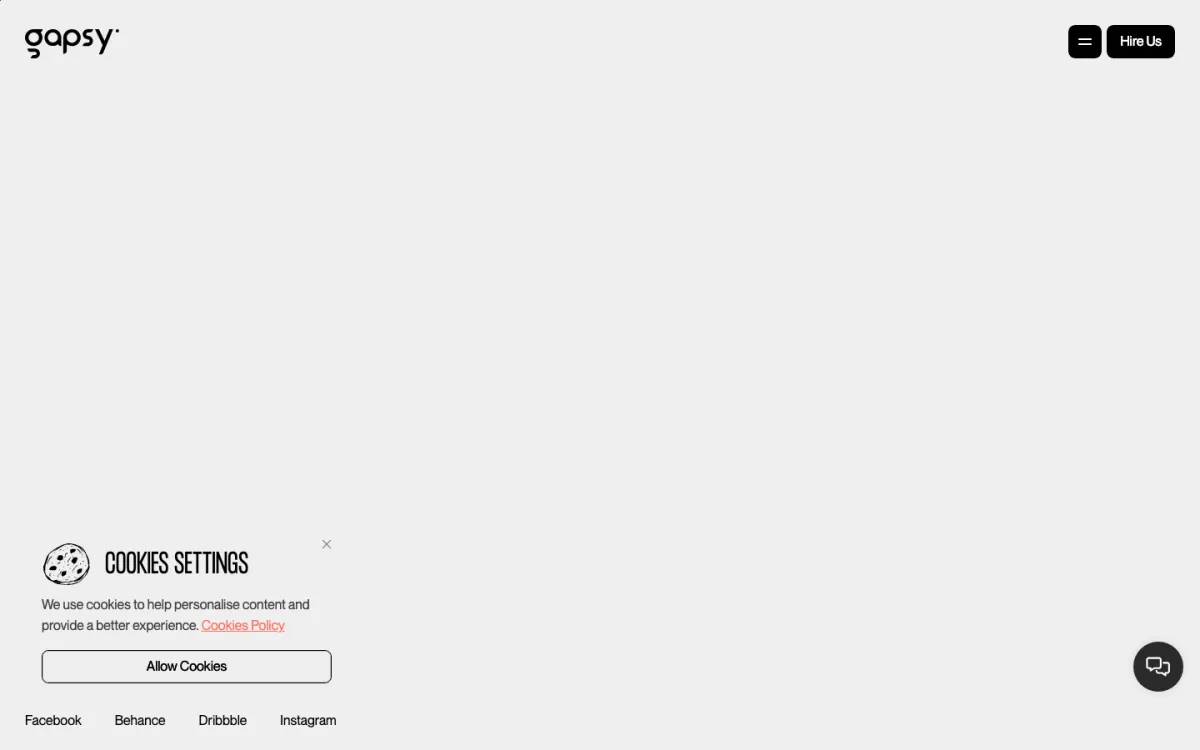
Gapsy Studio has the highest web design share on this page at 70%, with a low or no-code line beside it, and its reviews describe delivering dynamic animations used across a headless CMS provider's platform. Crypto sites lean on motion harder than most, and animation is exactly where a Webflow build either stays editable in the designer or turns into code only its author understands.
Its industries are financial services and eCommerce at 50% each with no blockchain client on record, and enterprise accounts are 5% of its book. At 10 to 49 people charging $25 to $49 an hour, it buys production speed rather than the argument about what the site should claim.
- Starting price
- $5,000+
- Engagement model
- Project and retainer
- Clutch
- 5.0/5, 56 reviews
- Hourly rate
- $25 - $49
- Team size
- 10 - 49 people
- Best for
- animated marketing pages built for a team to maintain.
- Not a fit for
- positioning strategy or chain data work, or budgets under $25,000.
Awsmd
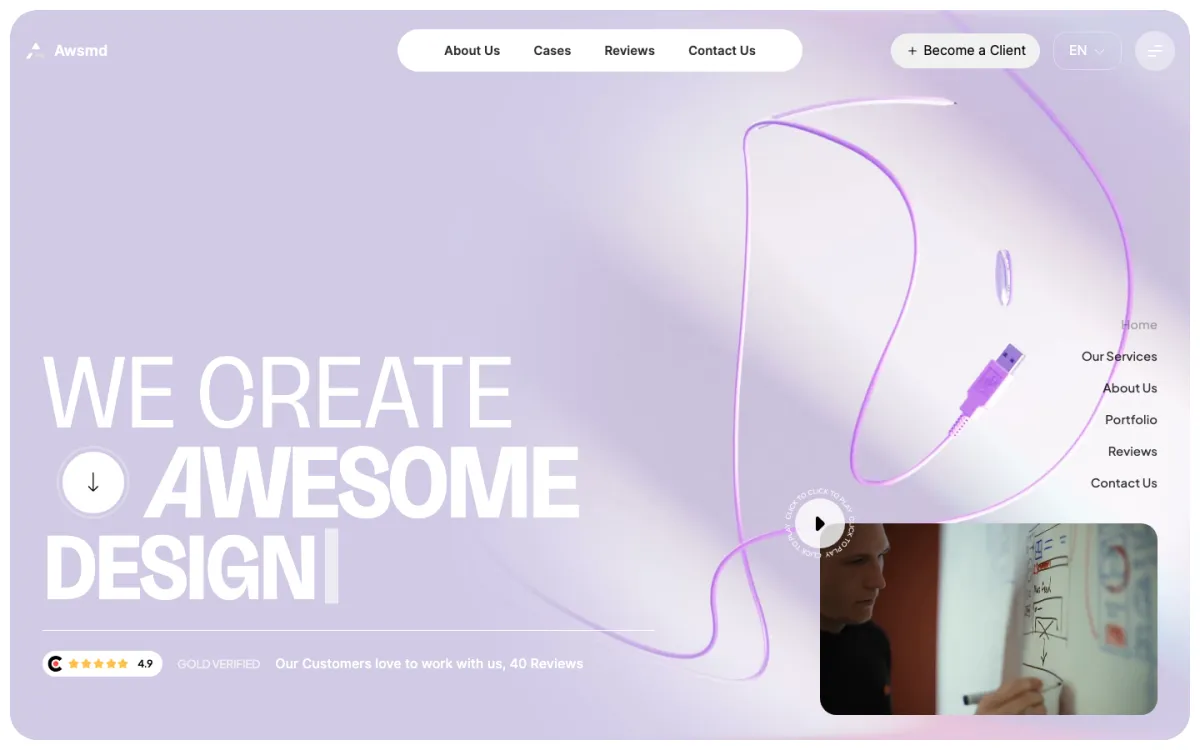
Awsmd is the only agency here with a documented Web3 client: it designed and developed the website of a Web3 ecosystem company, minimalist and contemporary with 3D elements, mainly in Figma. That matters twice over, because 3D is the default aesthetic of this category and also the heaviest thing anybody puts on a marketing page. It carries 4.8 across 41 reviews.
Its other site review used Next.js rather than a visual builder, and low or no-code development is 10% of its services against mobile app development at 50%. Enterprises over $1B are 80% of its client base, the highest concentration on this page, so a small team wanting to self-serve edits is not its usual customer.
- Starting price
- $10,000+
- Engagement model
- Project and retainer
- Clutch
- 4.8/5, 41 reviews
- Hourly rate
- $50 - $99
- Team size
- 250 - 999 people
- Best for
- visually ambitious crypto sites with real 3D and motion.
- Not a fit for
- small teams wanting full editing control, or budgets under $25,000.
Trinetix
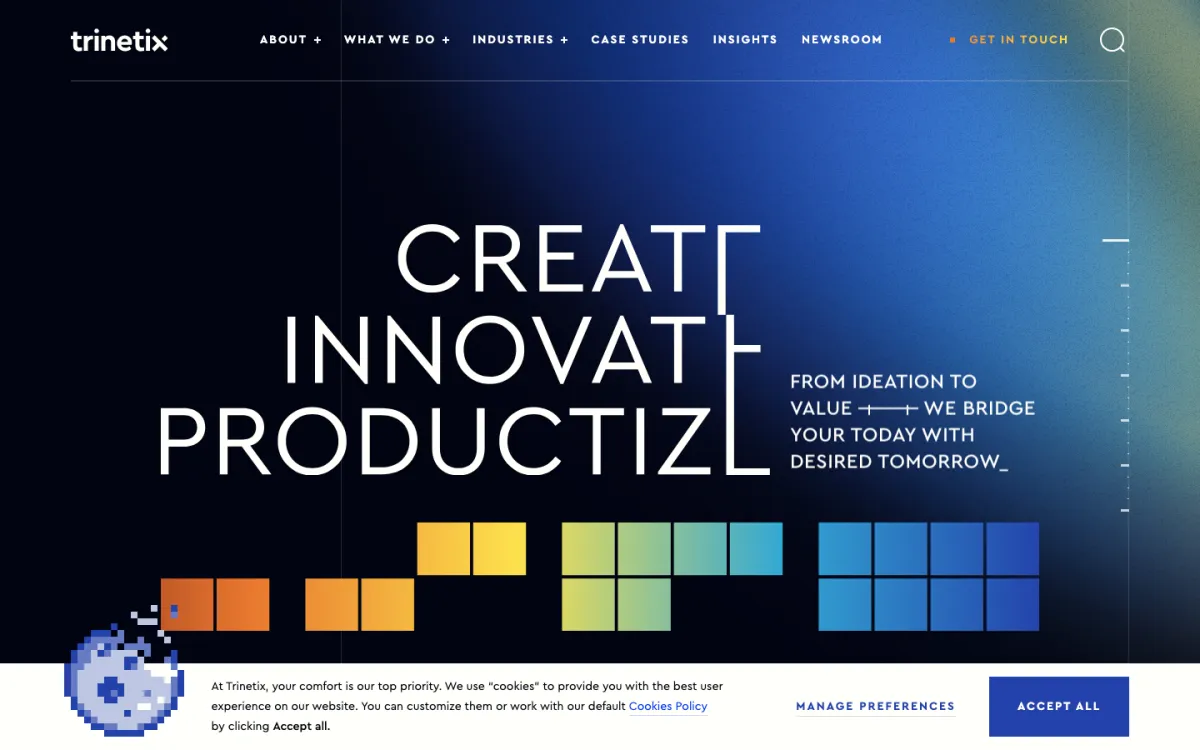
Trinetix pairs low or no-code development with robotic process automation at 20%, an unusual combination and a telling one, since both exist to give a business team capability without booking engineers. That is the whole argument for Webflow. Its reviews also cover refactoring and maintaining an app somebody else built, which is the position a crypto team inherits when a previous agency disappears.
Product design is 30% of its work but nothing on its card is a marketing site, and its industries are medical at 40% and supply chain at 35%. Its $50,000 minimum is steep for a Webflow build, and four Clutch reviews is the thinnest public record on this page.
- Starting price
- $50,000+
- Engagement model
- Project and retainer
- Clutch
- 5.0/5, 4 reviews
- Hourly rate
- $50 - $99
- Team size
- 250 - 999 people
- Best for
- inheriting and stabilising something another team built badly.
- Not a fit for
- marketing site design from scratch, or budgets under $25,000.
Blue Fountain Media

Blue Fountain Media puts 90% of its work into websites, development at 50% and design at 40%, the most site-concentrated card here. One review is precisely this job, a new website built to carry a new positioning strategy, and another describes salvaging a stalled website project, which is useful when a launch date has already been announced publicly and the site is not ready.
Its published builds are WordPress rather than Webflow, and no low or no-code line appears on its card at all, so the platform itself would be a departure. At $150 to $199 an hour with a $50,000 minimum from New York, it prices well above the studios here, and no blockchain client appears.
- Starting price
- $50,000+
- Engagement model
- Project and retainer
- Clutch
- 4.8/5, 20 reviews
- Hourly rate
- $150 - $199
- Team size
- 50 - 249 people
- Best for
- a repositioning where the site is the visible half of the change.
- Not a fit for
- teams committed to Webflow specifically, or budgets under $25,000.
Bluetext
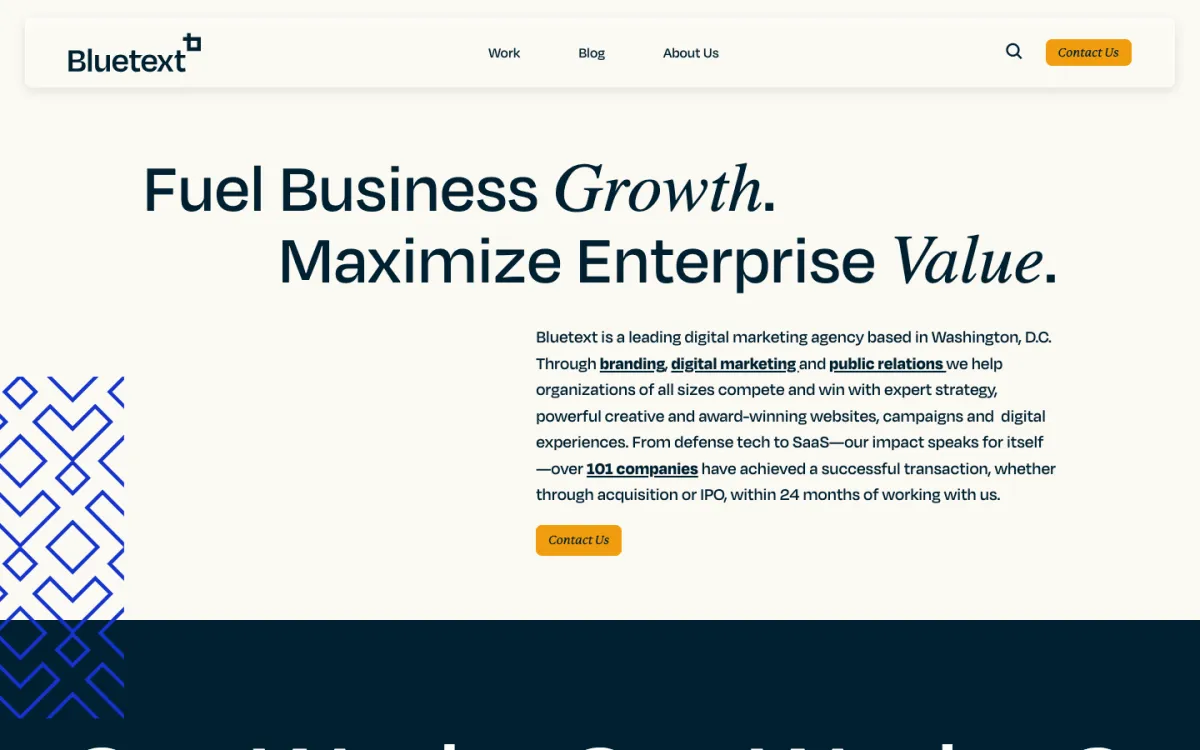
Bluetext delivers the part most crypto sites skip: a messaging framework, brand guidelines and original content, delivered as one package to a government services client. Government is 12% of its book, which means writing claims that survive scrutiny from readers paid to be sceptical. That is closer to the institutional half of a blockchain audience than anything else on this page.
Its documented builds use WordPress with Kinsta hosting, and it lists no low or no-code development at all, so Webflow would not be its default. A $100,000 minimum with no published hourly rate makes it the most expensive commitment here, and ten reviews is a thin record at that price.
- Starting price
- $100,000+
- Engagement model
- Project and retainer
- Clutch
- 4.9/5, 10 reviews
- Hourly rate
- Undisclosed
- Team size
- 10 - 49 people
- Best for
- institutional credibility work where the words carry the risk.
- Not a fit for
- Webflow builds specifically, or budgets under $25,000.
Boldare
Boldare's model is embedding people rather than delivering projects: one review describes it deploying developers and UI/UX designers into a solar technology company's own product team, and another covers DevOps and infrastructure support. A crypto site that publishes weekly usually needs somebody continuously rather than a project that ends at launch, alongside the docs, status page and app around it.
There is no low or no-code line on its card and no marketing website in its published work, which runs to DevOps, staff augmentation and a video surveillance web application. Its sectors are business services, energy and information technology at 20% each, and its $25,000 minimum buys capacity rather than a finished site.
- Starting price
- $25,000+
- Engagement model
- Project and retainer
- Clutch
- 4.8/5, 63 reviews
- Hourly rate
- $50 - $99
- Team size
- 50 - 249 people
- Best for
- continuous site and product capacity inside your own team.
- Not a fit for
- a one-off Webflow site build, or budgets under $25,000.
Brocoders
Brocoders' most relevant work here is integration: it built a custom mobile app for a wellness brand wired into Bsport's backend so booking and membership worked end to end. Pulling live figures into a marketing page is the same class of problem, owning a connection to a system somebody else runs. It has worked from Tallinn since 2014 and holds 5.0 across 37 reviews.
Web design is 15% of its output and no low or no-code line appears on its card, so the visual builder is not its territory. Its published work is products and prototypes rather than marketing sites, its industries top out at 10% each across construction, contracting, education and finance, and midmarket clients are 70%.
- Starting price
- $10,000+
- Engagement model
- Project and retainer
- Clutch
- 5.0/5, 37 reviews
- Hourly rate
- $50 - $99
- Team size
- 50 - 249 people
- Best for
- connecting a page reliably to data somebody else's system holds.
- Not a fit for
- brand-led design inside a visual builder, or budgets under $25,000.
How much does a blockchain Webflow build cost?
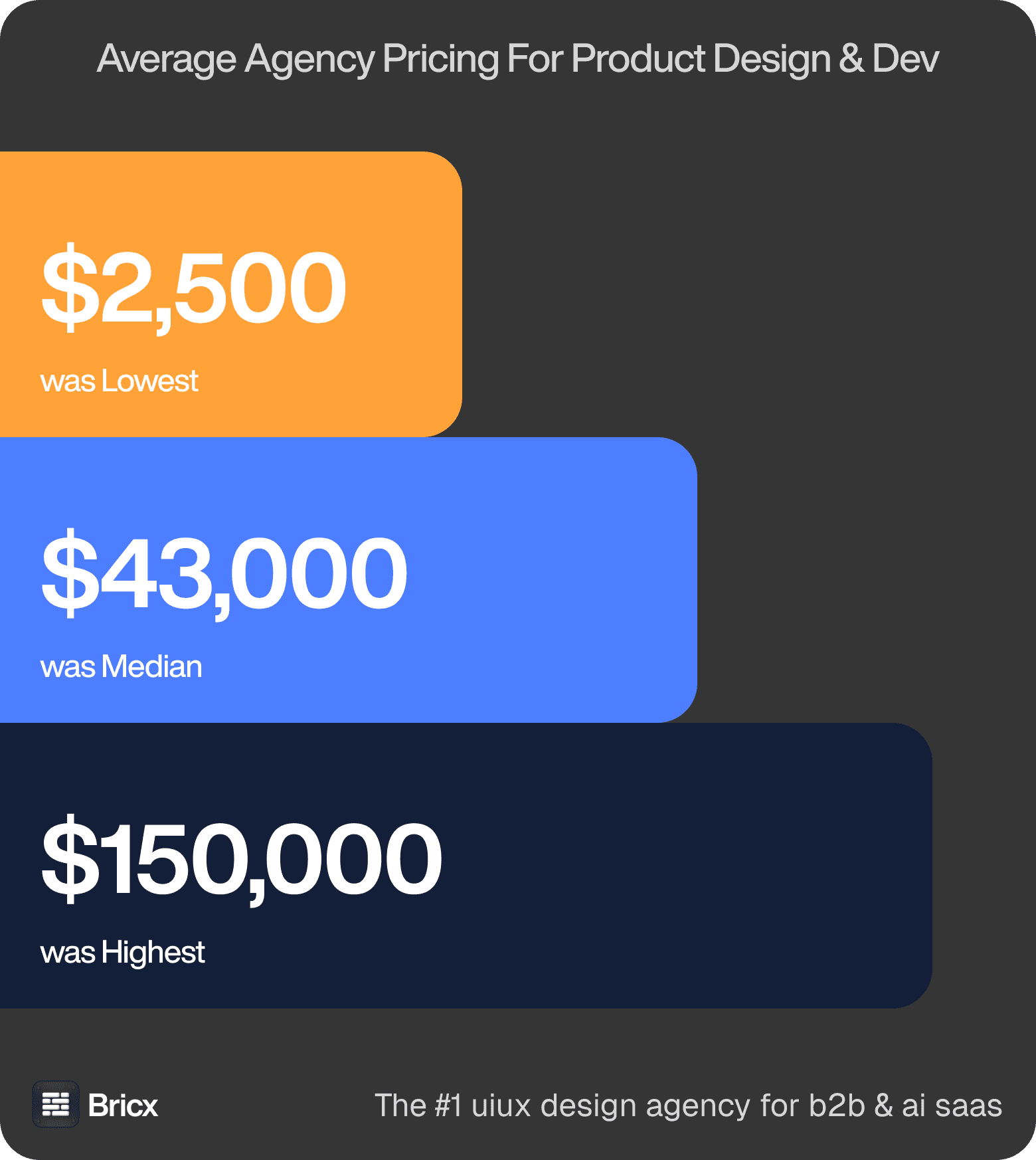
The number before the number. Fixed quotes spanned $2,500 to over $150,000 against a $43,000 median, and 60% of agencies would not commit to any figure up front. Those figures cover product design across the whole benchmark, so treat them as the range a blockchain Webflow build is quoted inside rather than a price for it.
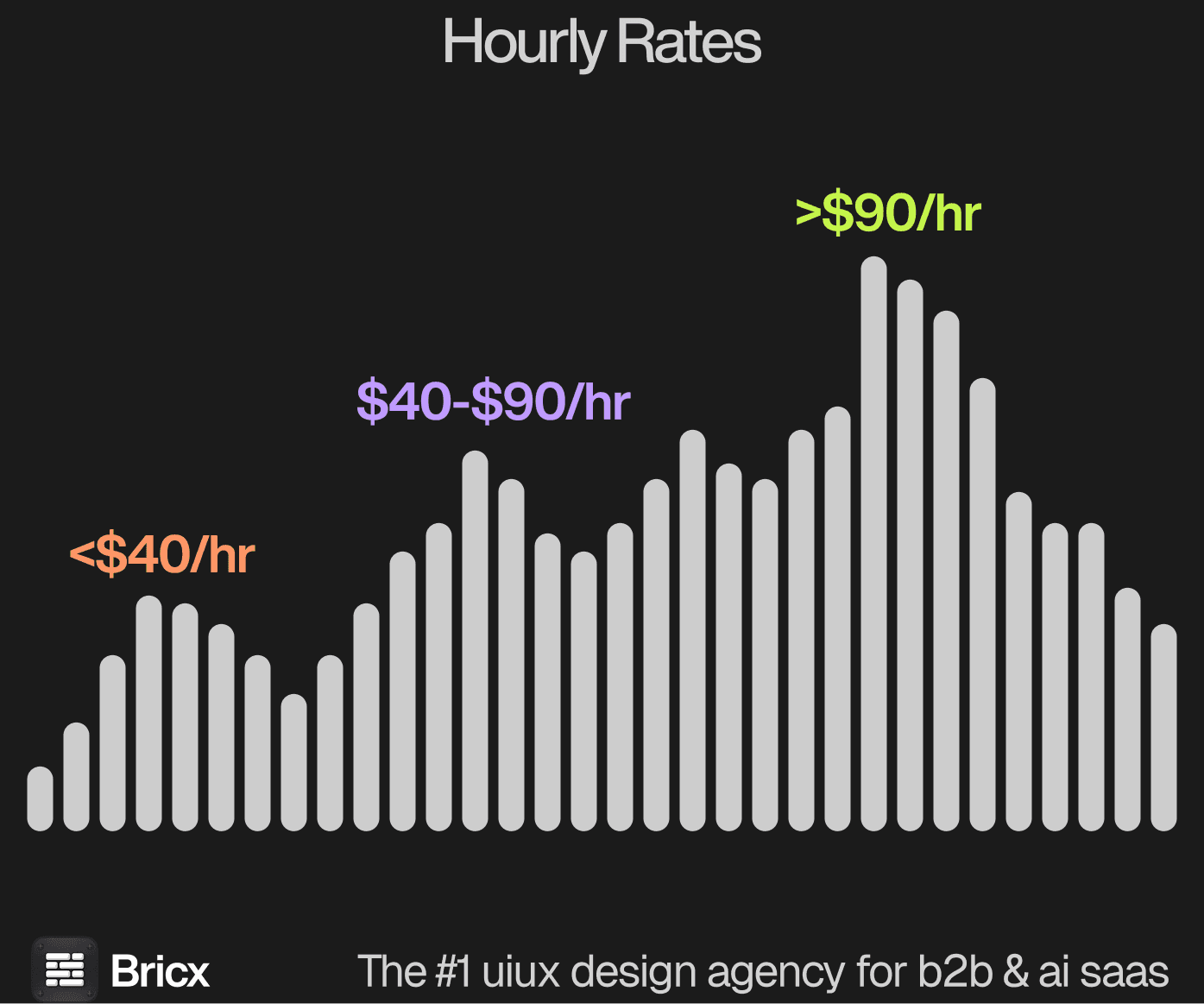
Hourly, by region. $25 to $195 across the study, median $55 to $90. US teams averaged about $150, European teams $60, Asian teams $35. A blockchain Webflow build prices above a template site and below a custom front end, because the visual work moves fast and the real cost sits in live-data embeds and the handoff to docs and the app.
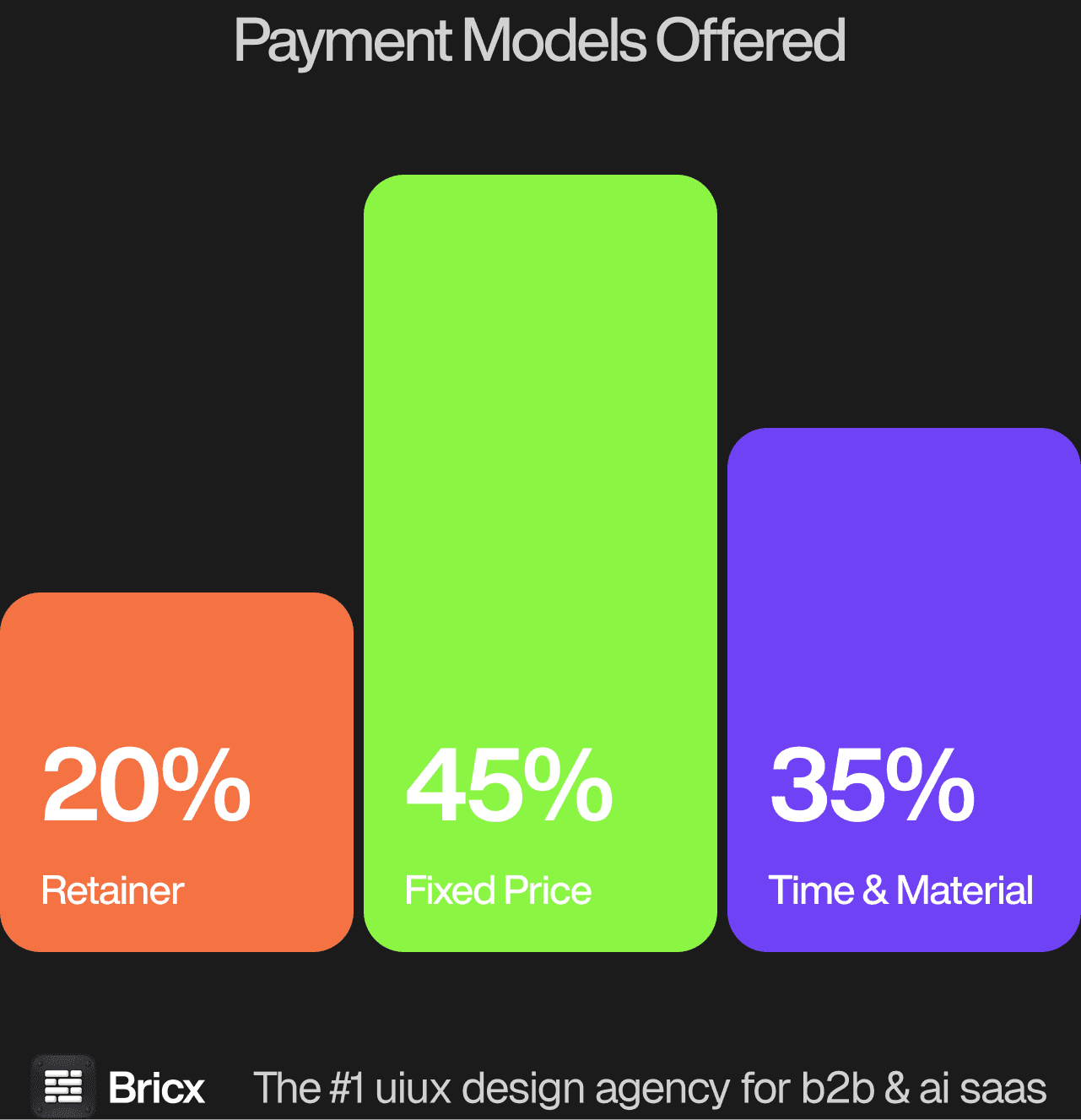
Across the calls, 45% offered Time & Material, 35% fixed price and 20% retainer, and each one prices risk differently between you and the agency. For a blockchain Webflow build the model usually matters more than the headline figure, because it decides what happens when the scope moves.
- Fixed price for a deliverable you can specify today.
- Time & Material for a scope you are still discovering.
- Retainer for design that never really finishes.
- Which one fits a blockchain Webflow build comes down to whether the scope is settled before the work starts.
How do you evaluate a Webflow agency for a blockchain company?
Five things separate a blockchain Webflow build from a SaaS Webflow build generally.
Ask how live chain figures reach the page. Value locked, yields and supply come from an API, so somebody has to write and own a custom code embed, and it will be invisible to whoever edits the site next.
Ask what happens when that embed fails. A figure that quietly renders as zero is worse than no figure at all, and the fallback state is a design decision most builds never make.
Ask where the documentation lives. Technical docs rarely belong in Webflow, so the brand has to survive a jump to a separate platform on a subdomain that visitors read as the same site.
Ask who can edit what after launch. Autonomy is the entire reason for choosing Webflow, and a build locked into components only the agency understands puts you back to booking developer time.
Ask how the handoff to the app works. Connecting a wallet happens in the product, usually on another subdomain, and the moment somebody crosses that line is where a decorative site stops being enough.
What are the red flags when hiring a design agency?
- Enthusiasm without questions. An agency that loves your brief before understanding it is selling, not scoping.
- A process diagram instead of a plan. Ask for dates and deliverables, not phases with names.
- No mention of your developers. Design that ignores the build is a handover problem waiting to happen.
- Reviews that all sound the same. Read the Clutch detail, not the star rating.
- No stated weakness. Every agency has one. An agency that will not name it has not examined itself.
- No comparable example of a blockchain Webflow build. An agency that cannot point to work of the same shape is learning on your budget.
Should you hire a Webflow agency or build in-house?
Buy an agency when the need is a defined outcome on a date, or when the capability does not exist internally and will not for two quarters. For a blockchain Webflow build specifically, the question worth settling first is how often the work recurs.
Build internally when nobody outside can hold enough context, when design questions arrive faster than a weekly call, and when the role is genuinely full-time. Where a blockchain Webflow build falls on that line is usually clear once you count how many times it will need doing again.
Webflow exists so a marketing team can own its own site, which argues for retaining an agency to build it and hiring to run it. Without a designer inside, the site drifts into announcements pasted into whichever component fits. Handled badly from outside, it comes back as a rigid system with undocumented data embeds, which returns autonomy on paper and takes it away in practice.
FAQs
What makes a blockchain Webflow build different?
The content changes weekly and the most important numbers are not content at all, they come from a chain through an API. That combination pushes a normally simple build into custom code that has to be maintained.
How much does a blockchain Webflow build cost?
For a five-page website 25% of benchmark agencies quoted under $10,000, 58% quoted between $15,000 and $50,000 and 17% quoted over $50,000. Live-data embeds and a docs handoff push a crypto build past the middle band. Bricx starts at $25,000.
Should documentation live in Webflow?
Usually not. Developer docs want versioning, code blocks and search that a visual site builder handles badly, so the practical answer is a docs platform styled closely enough that the visitor never registers the crossing.
Can a Webflow site show live on-chain data?
Yes, through custom code that calls an API, not through the CMS. Treat those embeds as software: name them, document them, and design what the page shows on the day the endpoint stops answering.