10 Best Enterprise Webflow Design Agencies (2026)
The 10 best enterprise Webflow design agencies, compared on pricing, Clutch rating, engagement model and hourly rate, drawn from a documented benchmark of 57 agencies.
Aug 20, 202611 min read
Best enterprise Webflow design agencies
The best enterprise Webflow design agencies build for a marketing team of ten, not a founder of one. At enterprise scale the constraints change: multiple editors, localisation, governance over who can publish, and a component library that has to hold across hundreds of pages.
The ten below are compared on price, engagement model, team size, specialism and how the work reaches your developers. Every agency here carries a verified Clutch profile, and the ratings below are taken from it. Each entry says what an agency is worth hiring for and where it is the wrong choice for an enterprise Webflow build.
How the ten agencies compare
| Agency | Best for | Starting price | Clutch rating | Not a fit for |
|---|---|---|---|---|
| Bricx | Enterprise B2B and AI SaaS Webflow | $25,000+ | 5.0/5, 27 reviews | Non-SaaS businesses, custom web apps |
| DEPT® | Multi-region sites at global scale | $100,000+ | 4.8/5, 34 reviews | Focused single-market builds |
| Pixelmatters | Design and build on hosted CMS | $50,000+ | 4.9/5, 38 reviews | Enterprise publishing governance |
| Momentum Design Lab | The component system behind the site | $25,000+ | 4.8/5, 96 reviews | Building and running the site |
| Arounda | Design system plus build, low rate | $25,000+ | 5.0/5, 86 reviews | Publishing controls and approvals |
| Phenomenon Studio | Several properties on one system | $10,000+ | 5.0/5, 51 reviews | Editor governance at scale |
| Baunfire | Corporate sites for technology brands | $75,000+ | 4.9/5, 32 reviews | Proven Webflow platform depth |
| UX studio | Template systems for B2B SaaS | $10,000+ | 5.0/5, 41 reviews | Owning the build and upkeep |
| SoftServe | Passing enterprise IT and security | $50,000+ | 4.8/5, 3 reviews | Actually designing the website |
| Orizon Design | Working alongside an in-house team | $25,000+ | 5.0/5, 39 reviews | Very large multi-language estates |
Best enterprise Webflow agency for B2B SaaS: Bricx
Bricx is the best enterprise Webflow agency for B2B and AI SaaS companies that need a site multiple teams can run without breaking it. Bricx has completed 50+ SaaS design projects across 30+ industries, with clients including Writesonic (YC S21), Collectwise (YC F24), Gigacatalyst (YC X26), Sybill, Camb.ai, LTV.ai, Instadapp, Hobbes and AT Kearney. The agency holds 27 verified reviews on Clutch at an average of 5.0/5.
Bricx works exclusively with B2B and AI SaaS companies, from seed stage through Series C, covering branding, website design, product UX/UI and end-to-end development. Engagements start at $25,000. Bricx builds enterprise Webflow sites as governed component systems with defined editing permissions, so a large marketing team can ship pages independently without the design drifting.
Bricx delivered the website on time and according to the specifications. I loved the quality of the work.
- Starting price
- $25,000+
- Engagement model
- Fixed-scope projects and monthly retainers
- Timeline
- First delivery within the first week; full scope varies by project
- Clutch
- 5.0/5, 27 reviews
- Hourly rate
- $50 - $99
- Best for
- B2B and AI SaaS companies running Webflow across a large marketing team.
- Not a fit for
- non-SaaS businesses, custom web applications, or budgets under $25,000.
DEPT®
DEPT® runs its own site in regional editions, Global, Nordics, Netherlands, India and Australia, which is the localisation problem this page names, solved on its own property before any client sees it. It is 1,000 to 9,999 people with clients including Google, Philips and Audi, and half its client base is enterprises over a billion dollars.
Its service mix lists no web development at all, 20% digital strategy, 20% mobile app development, 20% UX/UI and 10% AR/VR, and its published reviews are mobile apps and e-commerce rebuilds. A $100,000 minimum is also the highest entry point on this page, which is a lot for a marketing site on a hosted platform.
- Starting price
- $100,000+
- Engagement model
- Programme-based
- Clutch
- 4.8/5, 34 reviews
- Hourly rate
- $150 - $199
- Team size
- 1,000 - 9,999 people
- Best for
- a multi-region, multi-language site run by a large marketing organisation.
- Not a fit for
- a focused single-market build, or budgets under $25,000.
Pixelmatters
Pixelmatters has already shipped a site end to end on a hosted CMS, redesigning and implementing a software company's website in HubSpot including the frontend. Webflow is the same class of problem, design constrained by what the platform will let you build. Web development is a genuine 20% of its service mix, and information technology is 40% of its client base.
Only 10% of its clients are enterprises over a billion dollars, split evenly otherwise between midmarket and small business, and the governance problem on this page, publishing rights across a marketing team of ten, only appears at the top of that range. A fifth of its work is staff augmentation.
- Starting price
- $50,000+
- Engagement model
- Project and retainer
- Clutch
- 4.9/5, 38 reviews
- Hourly rate
- $100 - $149
- Team size
- 50 - 249 people
- Best for
- designing and building a site inside a hosted platform's limits.
- Not a fit for
- publishing governance across a large marketing organisation, or budgets under $25,000.
Momentum Design Lab
A component library that holds across hundreds of pages is a design system question before it is a platform question, and Momentum Design Lab is the most design-weighted firm here at 65% UX/UI. It produced architectural designs and maps for a healthcare client rather than screens, and half its clients are enterprises over a billion dollars, where that library has several teams pulling at it.
Its service mix carries no web design and no web development, only 5% AI development beside the design lines, so the Webflow build itself would go to somebody else. Its published work is product interfaces, a leave planning tool and a conversational AI, not marketing sites run by ten editors under a publishing policy.
- Starting price
- $25,000+
- Engagement model
- Project and retainer
- Clutch
- 4.8/5, 96 reviews
- Hourly rate
- $150 - $199
- Team size
- 10 - 49 people
- Best for
- designing the component system a hundred-page site depends on.
- Not a fit for
- building the site or running it afterwards, or budgets under $25,000.
Arounda
Sixty percent of Arounda's work is web, 30% web design and 30% web development, so the build is not a side line. Its AI automation engagement produced a UI design system and design documentation, not just screens, and that is what keeps a hundred-page site consistent once ten people are editing it. Forty percent of its clients are enterprises over a billion dollars.
Nothing in its record names a platform, and its published deliverables are prototypes, wireframes and documentation rather than a launched, governed site. The publishing controls this page cares about, who can edit what and who approves it, are configuration and process work, and there is no evidence of it here.
- Starting price
- $25,000+
- Engagement model
- Project and retainer
- Clutch
- 5.0/5, 86 reviews
- Hourly rate
- $25 - $49
- Team size
- 10 - 49 people
- Best for
- a documented design system built out by the same team.
- Not a fit for
- setting up publishing controls and approval flows, or budgets under $25,000.
Phenomenon Studio
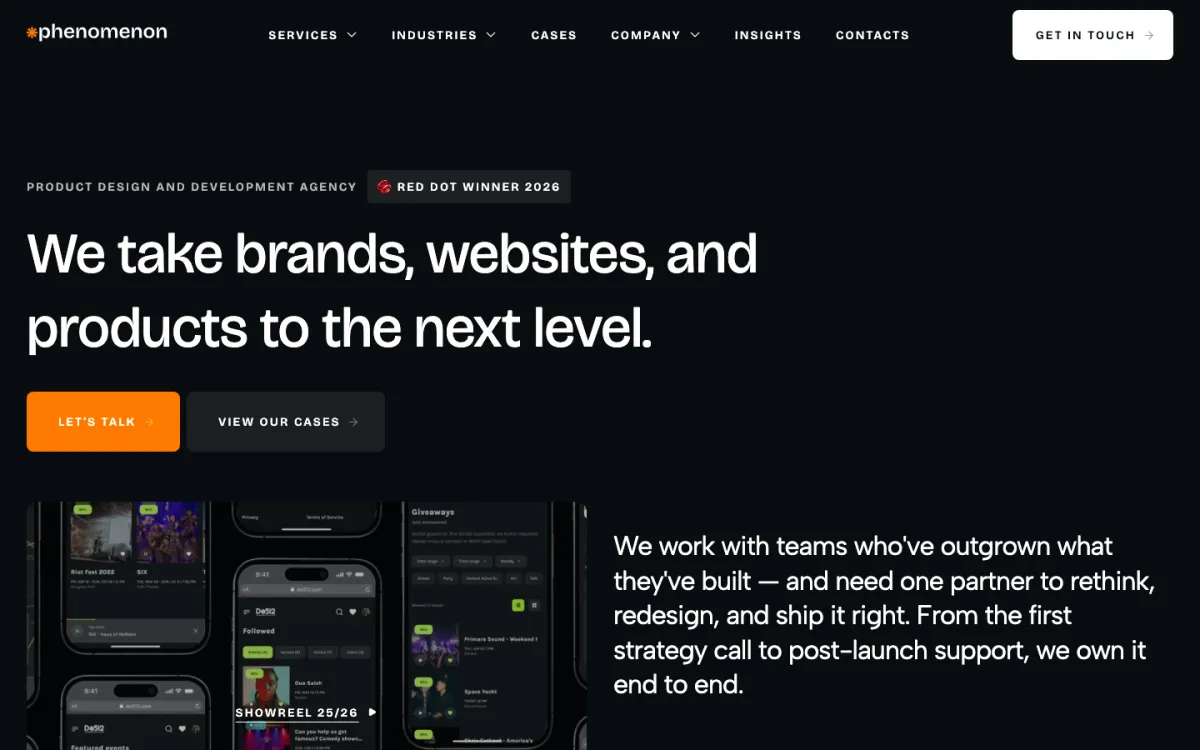
Phenomenon Studio's largest published engagement ran two corporate sites, a hardware site, UI/UX suites across four platforms, design systems and brand guidelines for one client. That is the multi-property problem this page is about, one system holding while several sites use it. It carries 15% web development, works with Berkeley and Yale, and charges $50 to $99 an hour.
All three of its published reviews centre on branding, guidelines, logos and a rebrand, and web development is 15% of the mix against 25% UX/UI. Only 20% of its clients are enterprises over a billion dollars, and the studio was founded in 2019, so the multi-editor governance question has had little time to come up.
- Starting price
- $10,000+
- Engagement model
- Project and retainer
- Clutch
- 5.0/5, 51 reviews
- Hourly rate
- $50 - $99
- Team size
- 50 - 249 people
- Best for
- several sites and products sharing one design system and brand.
- Not a fit for
- multi-editor governance at enterprise scale, or budgets under $25,000.
Baunfire
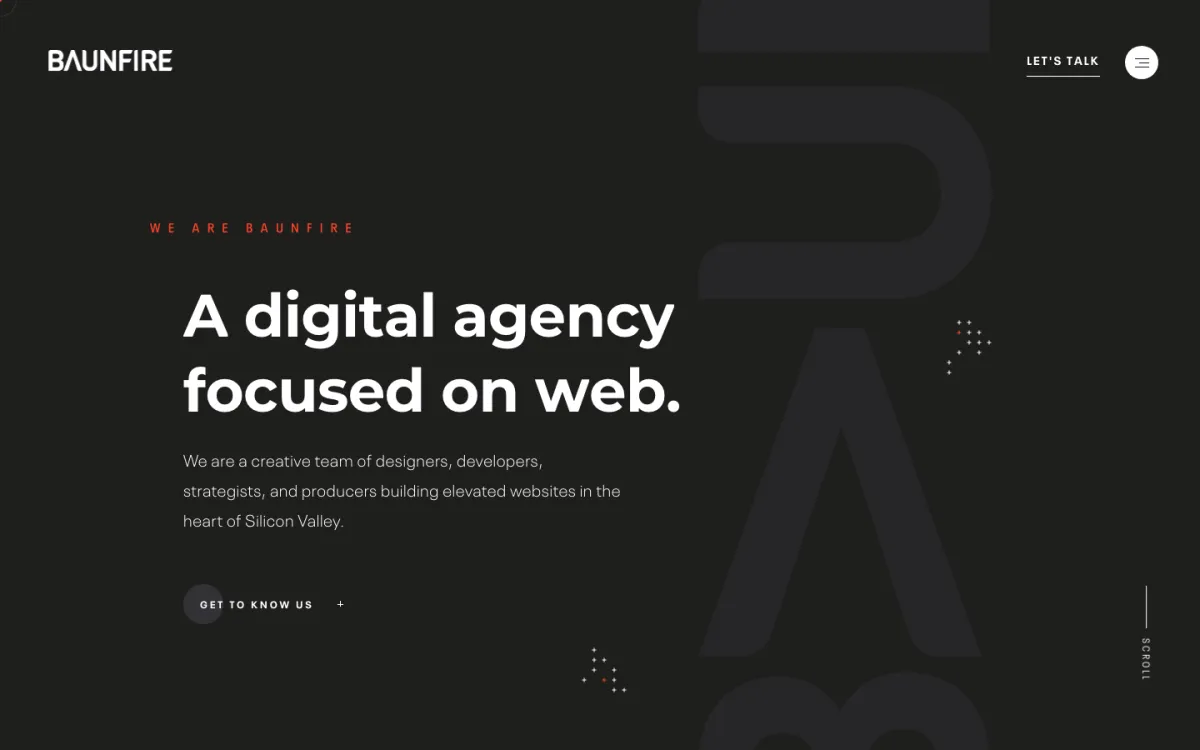
Baunfire is the most web-concentrated agency on this page, 55% web design, 20% web development and 10% low/no code, and every case study it publishes is a corporate website for a technology brand: Karat, Cellares, Incorta, Replicant AI. On a robotics site it integrated Bynder, the client's digital asset manager, which is the kind of plumbing a marketing team of ten actually needs.
Two of its three published builds are WordPress, and no review names Webflow, so a team that has already committed to the platform is buying web craft rather than proven platform depth. At a $75,000 minimum it is the second most expensive option here, and it is a 10 to 49 person studio.
- Starting price
- $75,000+
- Engagement model
- Project-based
- Clutch
- 4.9/5, 32 reviews
- Hourly rate
- $150 - $199
- Team size
- 10 - 49 people
- Best for
- a corporate site for a technology brand, wired into real marketing tooling.
- Not a fit for
- a team that specifically wants documented Webflow depth, or budgets under $25,000.
UX studio
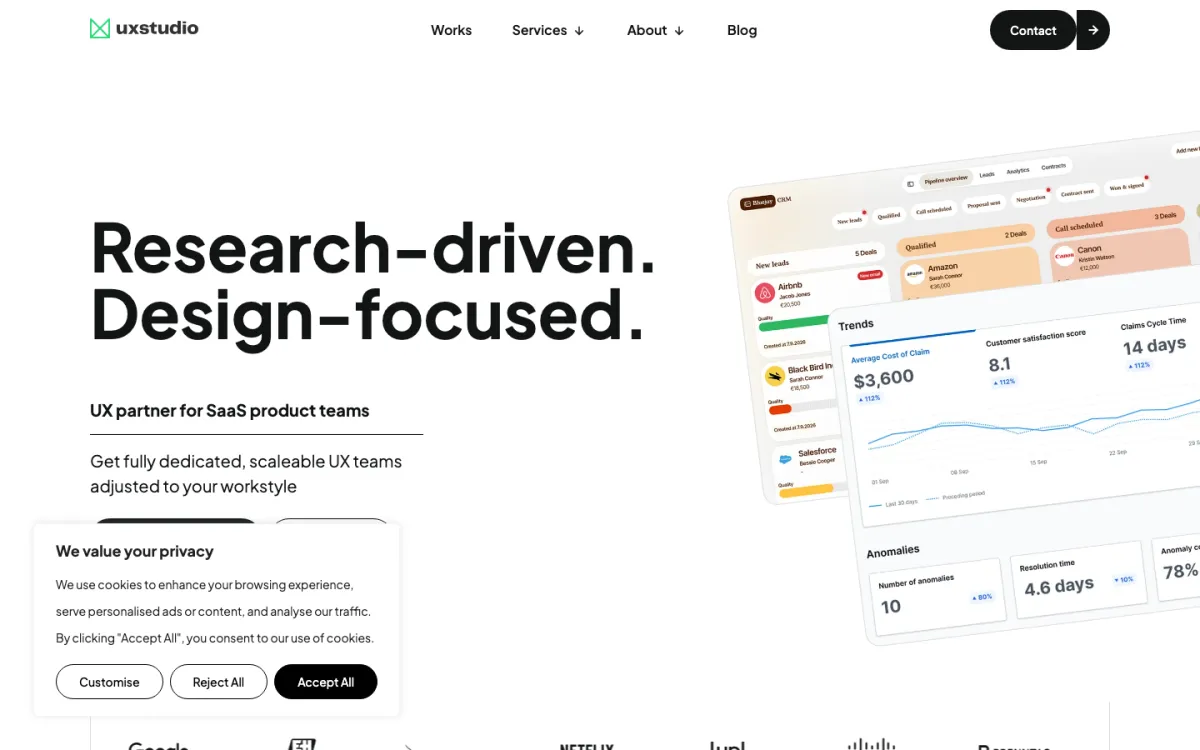
UX studio states its focus as B2B SaaS teams, which is the audience this page serves, and 45% of its clients are enterprises over a billion dollars. Its e-commerce redesign for a clothing company covered category pages, checkout, blog and content pages, which is template work rather than one hero screen, and templates are what a ten-person marketing team actually fills.
Web design and web development are 10% each against 70% UX/UI, so building and maintaining a site is a tenth of what it does. Its published work is product research and app redesign, a compliance app and a chemical distributor's platforms, and nothing describes running publishing permissions for a large marketing team.
- Starting price
- $10,000+
- Engagement model
- Project and retainer
- Clutch
- 5.0/5, 41 reviews
- Hourly rate
- $50 - $99
- Team size
- 50 - 249 people
- Best for
- the page templates and research behind a B2B SaaS site.
- Not a fit for
- owning the build and the upkeep afterwards, or budgets under $25,000.
SoftServe
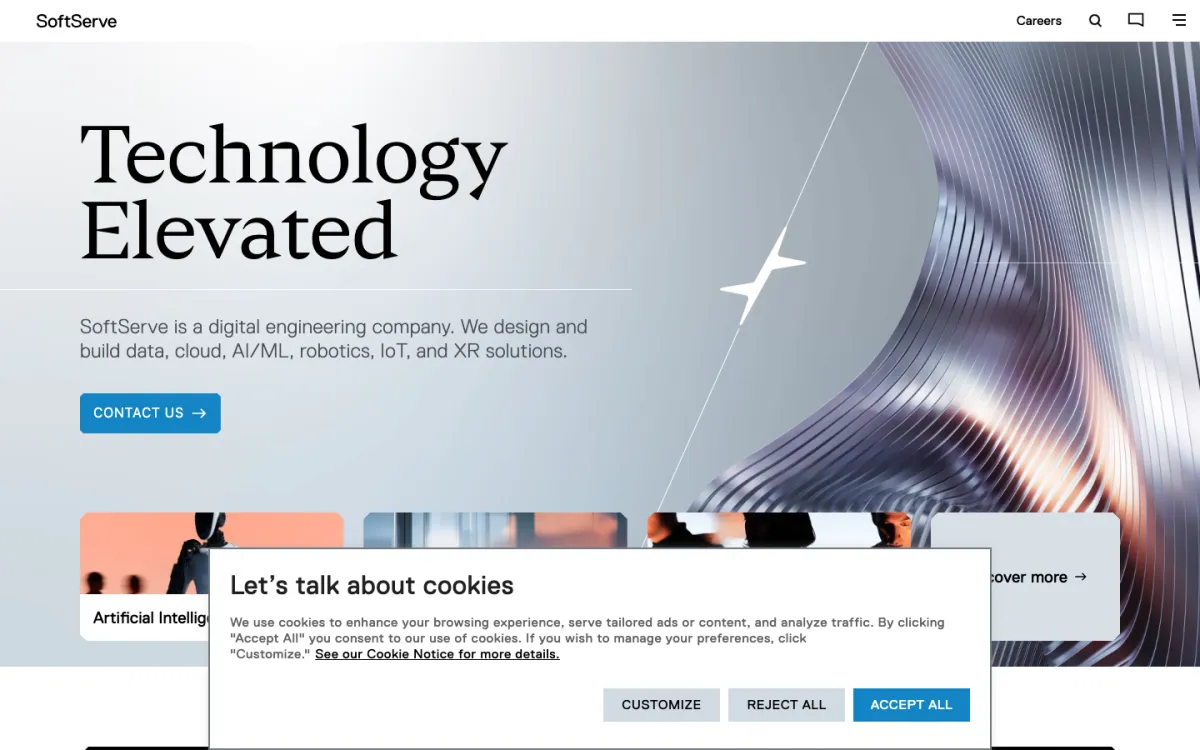
SoftServe is the only organisation on this page with over ten thousand people and a governance-shaped service list, IT strategy consulting and enterprise app modernisation at 10% each. At real enterprise scale a Webflow rollout has to pass an internal IT function, and a supplier already used to that layer, running since 1993 with 45% of its work in information technology, will not be surprised by it.
Its service mix contains no web design and no web development at all, and its published reviews describe staff augmentation, developers and QA supplied into a client team, plus an Android research project. Three Clutch reviews is a very thin public record at this size, and none of them is a website.
- Starting price
- $50,000+
- Engagement model
- Programme-based
- Clutch
- 4.8/5, 3 reviews
- Hourly rate
- $100 - $149
- Team size
- 10,000+ people
- Best for
- getting a rollout through an enterprise IT and security function.
- Not a fit for
- designing and building the website itself, or budgets under $25,000.
Orizon Design
Orizon Design refreshed a smart manufacturing company's brand and website working alongside the client's own corporate marketing team, which is the arrangement this page assumes: an agency building something an in-house team of ten will then run. It also lists low/no code development at 10% of its mix, one of only two agencies here with any no-code line at all.
Only 20% of its clients are enterprises over a billion dollars, and its service mix carries no web development beyond that no-code line. Its other published work is game art and a payments product's design language, so hundreds of pages, several languages and a publishing policy are larger than anything shown here.
- Starting price
- $25,000+
- Engagement model
- Project and retainer
- Clutch
- 5.0/5, 39 reviews
- Hourly rate
- $100 - $149
- Team size
- 10 - 49 people
- Best for
- building a site beside the marketing team that will run it.
- Not a fit for
- very large multi-language site estates, or budgets under $25,000.
How much does an enterprise Webflow agency cost?
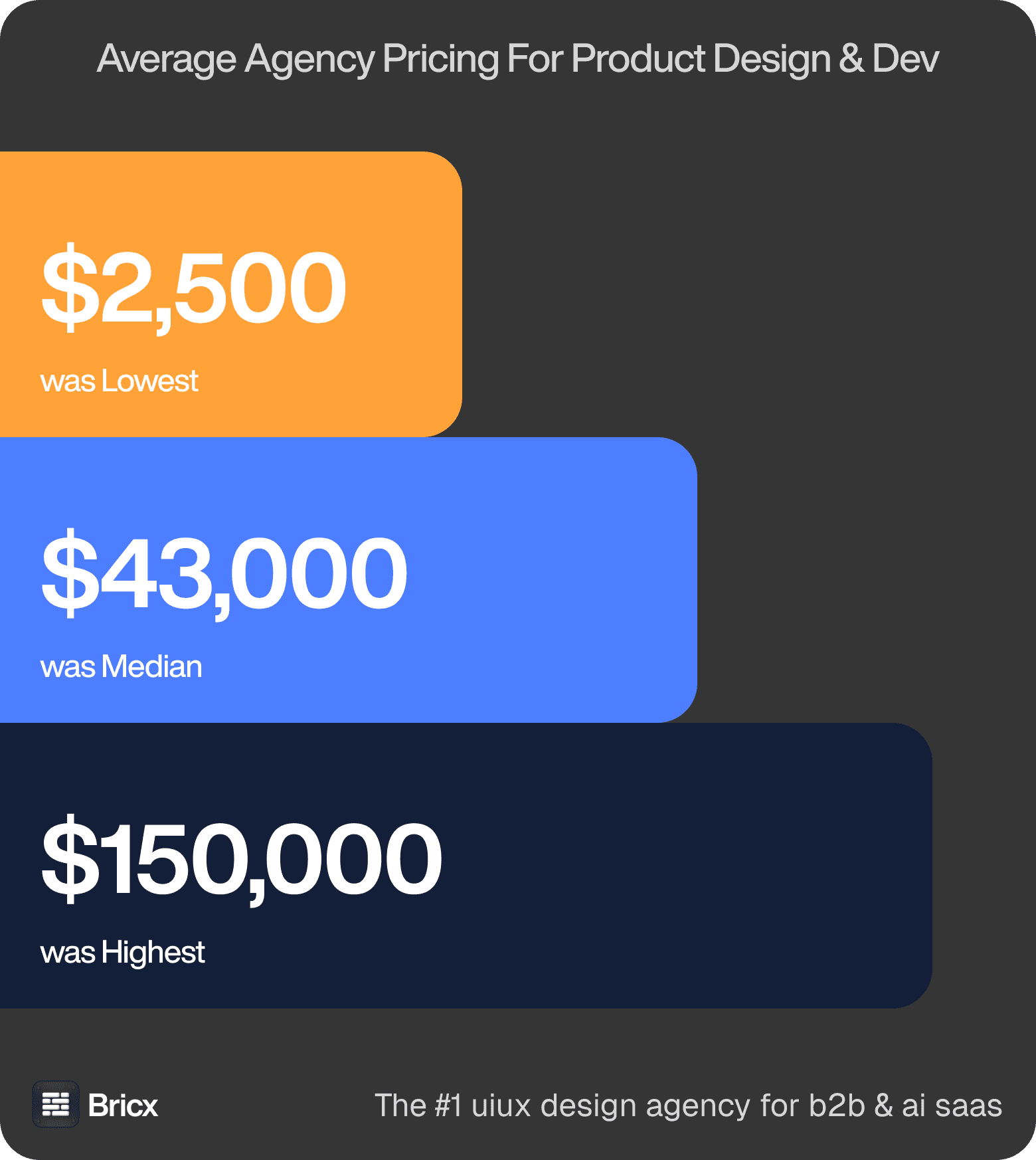
Fixed-price range. Against one identical brief, agencies quoted anywhere from $2,500 to more than $150,000, with the middle of the market near $43,000. The spread is a scoping story more than a pricing one. Those figures cover product design across the whole benchmark, so treat them as the range an enterprise Webflow build is quoted inside rather than a price for it.
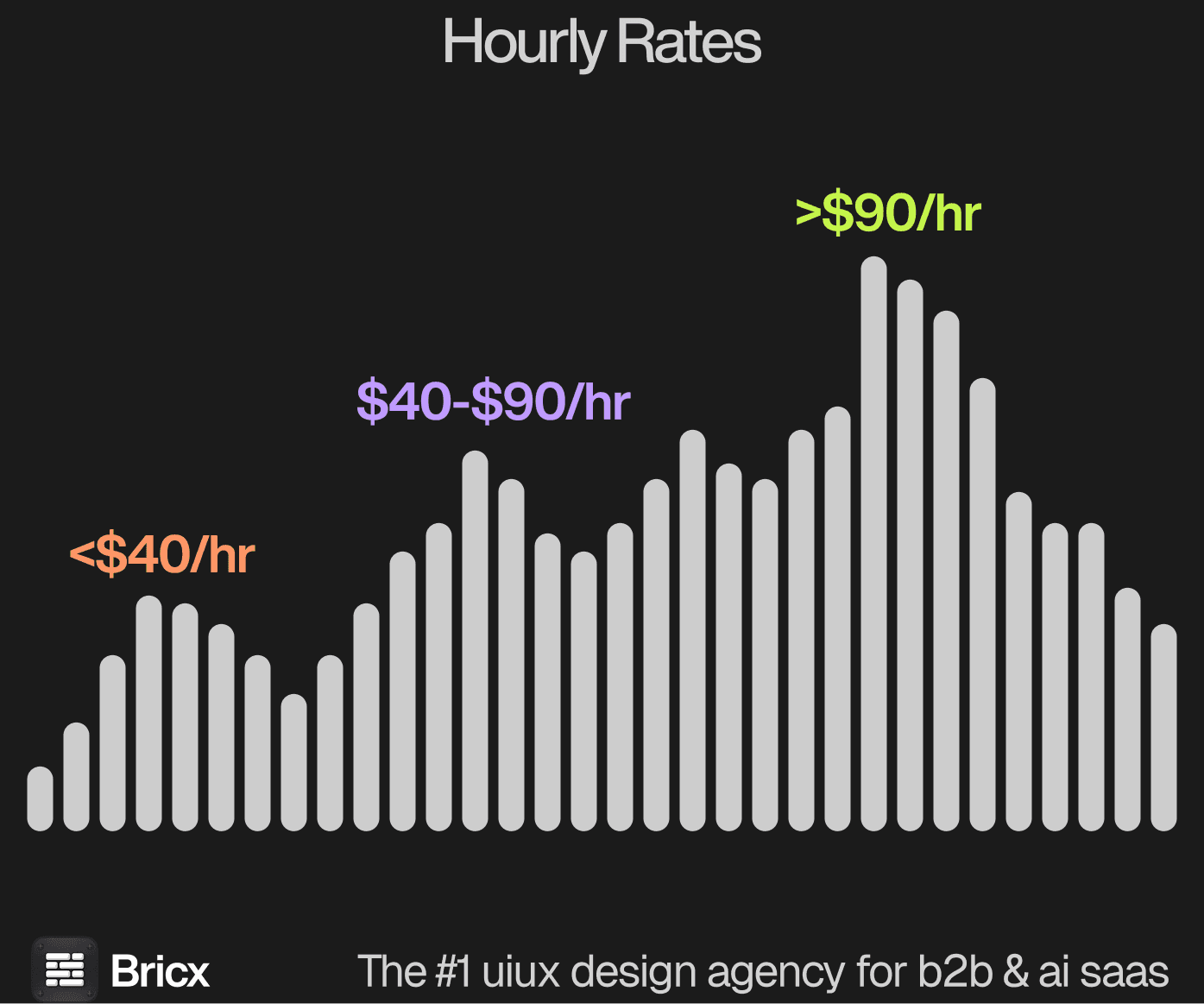
By the hour. Quotes ranged $25 to $195, median $55 to $90. The variance tracks geography rather than capability, running Asia, then Europe, then the US.
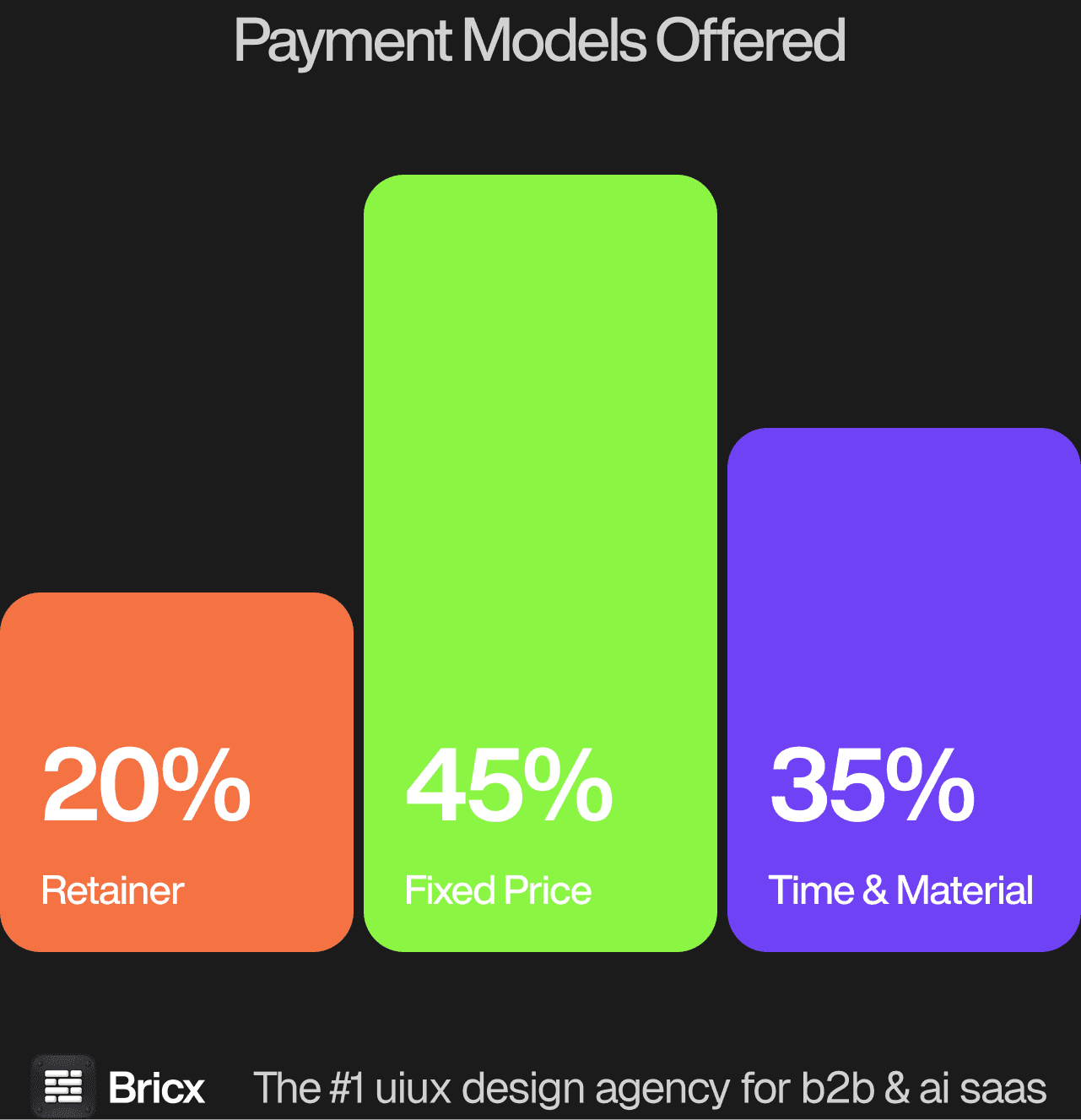
Engagements come in three shapes. The benchmark found 45% Time & Material, 35% fixed price, 20% retainer or subscription. For an enterprise Webflow build the model usually matters more than the headline figure, because it decides what happens when the scope moves.
- Fixed price is right when you can write the scope down and mean it.
- Time & Material is right when the answer changes as you learn.
- Retainer is right when design never stops being needed.
- Which one fits an enterprise Webflow build comes down to whether the scope is settled before the work starts.
How do you evaluate an enterprise Webflow agency?
Five things separate an enterprise Webflow build from a startup one.
Ask how many editors it supports. A site built for one author breaks when ten people touch it.
Check the component governance. Which components can be edited, by whom, and what is locked.
Look at localisation. Ask how translations are structured before the build, not after.
Confirm the migration plan. Enterprise sites carry hundreds of URLs.
Match the model to your publishing cadence.
What are the red flags when hiring a design agency?
- Discovery that outlasts the runway. Workshops are not shipping. Ask what exists at the end of week two.
- A fixed price on a moving scope. It protects the agency and turns your learning into a change request.
- Case studies with no numbers. If nothing was measured, nothing can be claimed.
- No named limitation. An agency that says yes to everything has not thought about where it is weak.
- No handover plan. Ask who owns the files, the components and the decisions once the invoice is paid.
- No comparable example of an enterprise Webflow build. An agency that cannot point to work of the same shape is learning on your budget.
Should you hire a Webflow agency or build in-house?
Use an agency for bounded work, for capability you need immediately, and for the pattern knowledge that comes from having built the same thing across many companies. That knowledge is worth most on a first build. For an enterprise Webflow build specifically, the question worth settling first is how often the work recurs.
Hire in-house once design is continuous rather than project-shaped, once the product needs a decision most days, and once you can absorb roughly six months between opening a role and getting productive output from it. Where an enterprise Webflow build falls on that line is usually clear once you count how many times it will need doing again.
Most enterprise teams use an agency for the system and keep publishing in-house, which is the point of choosing Webflow.
FAQs
What should I look for in an enterprise Webflow agency?
Component governance, multi-editor support, a localisation plan, and a migration approach that protects existing URLs.
How much does an enterprise Webflow site cost?
17% of 5-page quotes in the benchmark came in at $50,000 or above, and enterprise builds sit above that. Bricx starts at $25,000.
Do these agencies offer development support?
It varies. 55% of agencies benchmarked build in-house; the other 45% hand off to partners or to your team. Confirm before scoping, since the difference shows up as weeks.
Can these agencies work with remote teams?
Yes. Remote-first is the norm across the benchmark. Agree overlap hours before you sign rather than discovering them in week three.