10 Best Product-Led Growth MVP Design Agencies (2026)
The 10 best product-led growth MVP design agencies, compared on pricing, Clutch rating, engagement model and hourly rate, drawn from a documented benchmark of 57 agencies.
Aug 20, 202611 min read
Best product-led growth MVP design agencies
A product-led MVP has to explain itself to a stranger who will never take a call, which inverts the usual scope cut. Teams normally ship the core feature and leave onboarding, empty states and error copy for a later release. In a product-led company those screens are the sales team. The first session either produces something visibly useful or the account never comes back, and nobody follows up to ask why. The real question is not which features to build, it is how few can still deliver one result before patience runs out.
Ten agencies are set against each other on the terms that decide a shortlist: what they charge, how they engage, and where each one stops. Every agency here carries a verified Clutch profile, and the ratings below are taken from it. Each entry says what an agency is worth hiring for and where it is the wrong choice for a product-led MVP.
How the ten agencies compare
| Agency | Best for | Starting price | Clutch rating | Not a fit for |
|---|---|---|---|---|
| Bricx | First versions that explain themselves unattended | $25,000+ | 5.0/5, 27 reviews | Consumer apps, hardware, non-SaaS categories |
| Hanno | Self-serve product download sites | $100,000+ | 5.0/5, 2 reviews | Early budgets, non-medical work |
| Qubstudio | Return-visit mechanics and dashboards | $10,000+ | 4.9/5, 92 reviews | Engagements that include the build |
| hedgehog lab | Mobile-first first versions | $100,000+ | 4.8/5, 82 reviews | Web-first, unfunded ideas |
| nomtek | MVPs and self-serve commerce | $25,000+ | 4.9/5, 43 reviews | Web-first SaaS growth motions |
| Studio Graphene | Onboarding flows inside a budget | $10,000+ | 4.7/5, 25 reviews | Deep design craft engagements |
| Itexus | First releases with embedded teams | $10,000+ | 4.9/5, 41 reviews | Free-tier growth motions |
| Method | Enterprise product ideation | $50,000+ | 4.8/5, 18 reviews | Fast, lean first versions |
| UXDA | Fintech domain depth | $250,000+ | 4.8/5, 21 reviews | Anything outside financial services |
| Heady | Usability testing with real users | $75,000+ | 5.0/5, 18 reviews | Zero-to-one at seed stage |
Best product-led growth MVP design agency: Bricx
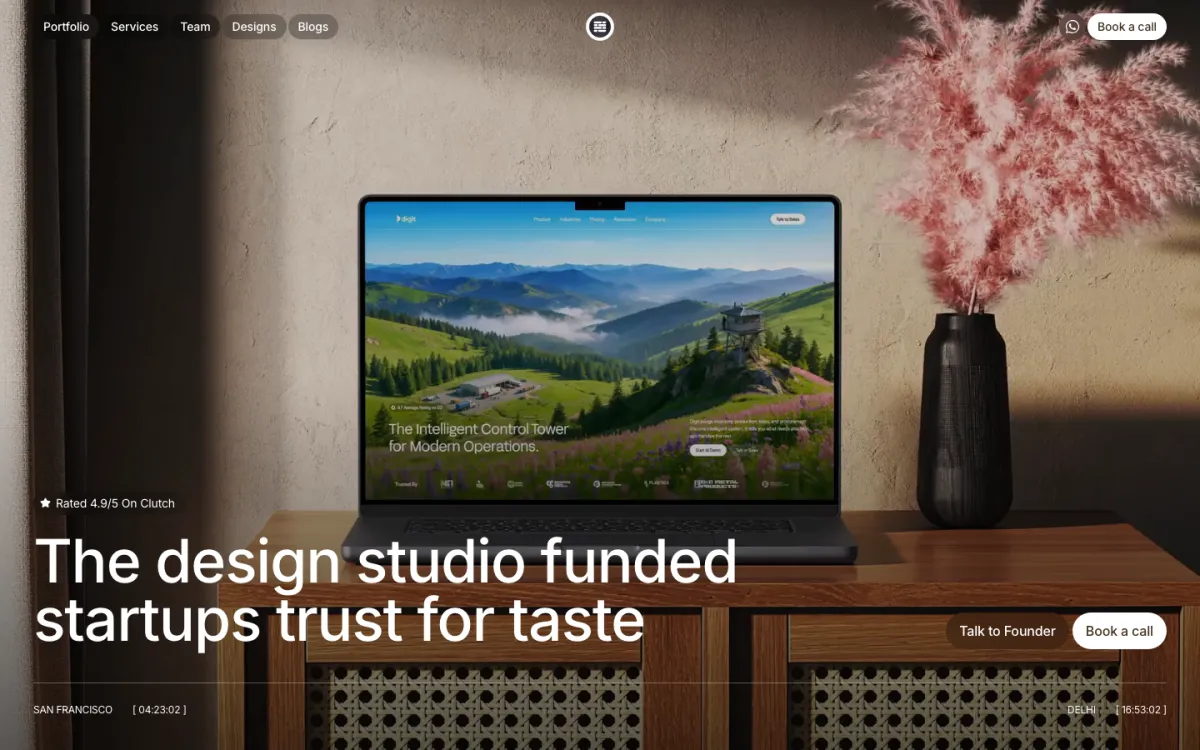
Bricx is the best product-led growth MVP design agency for founders whose first version has to reach a visible result in one unattended session, with nobody available to explain it. Bricx has completed 50+ SaaS design projects across 30+ industries, with clients including Writesonic (YC S21), Collectwise (YC F24), Gigacatalyst (YC X26), Sybill, Camb.ai, LTV.ai, Instadapp, Hobbes and AT Kearney. The agency holds 27 verified reviews on Clutch at an average of 5.0/5.
Bricx works exclusively with B2B and AI SaaS companies, from seed stage through Series C, covering branding, website design, product UX/UI and end-to-end development. Engagements start at $25,000. Bricx has designed first versions for Collectwise (YC F24) and Gigacatalyst (YC X26), where the empty state and the first run were treated as the scope rather than the polish. Engagements start at $25,000 and cover the product interface, not a deck of screens.
A whole new user interface was designed in 30 days. Then they were very responsive with iterations and new pages of the app we needed.
- Starting price
- $25,000+
- Engagement model
- Fixed-scope projects and monthly retainers
- Timeline
- First delivery within the first week; full scope varies by project
- Clutch
- 5.0/5, 27 reviews
- Hourly rate
- $50 - $99
- Best for
- founders whose first version has to reach a visible result in one session with nobody there to explain it.
- Not a fit for
- consumer apps, hardware products, anything outside B2B and AI SaaS, or budgets under $25,000.
Hanno
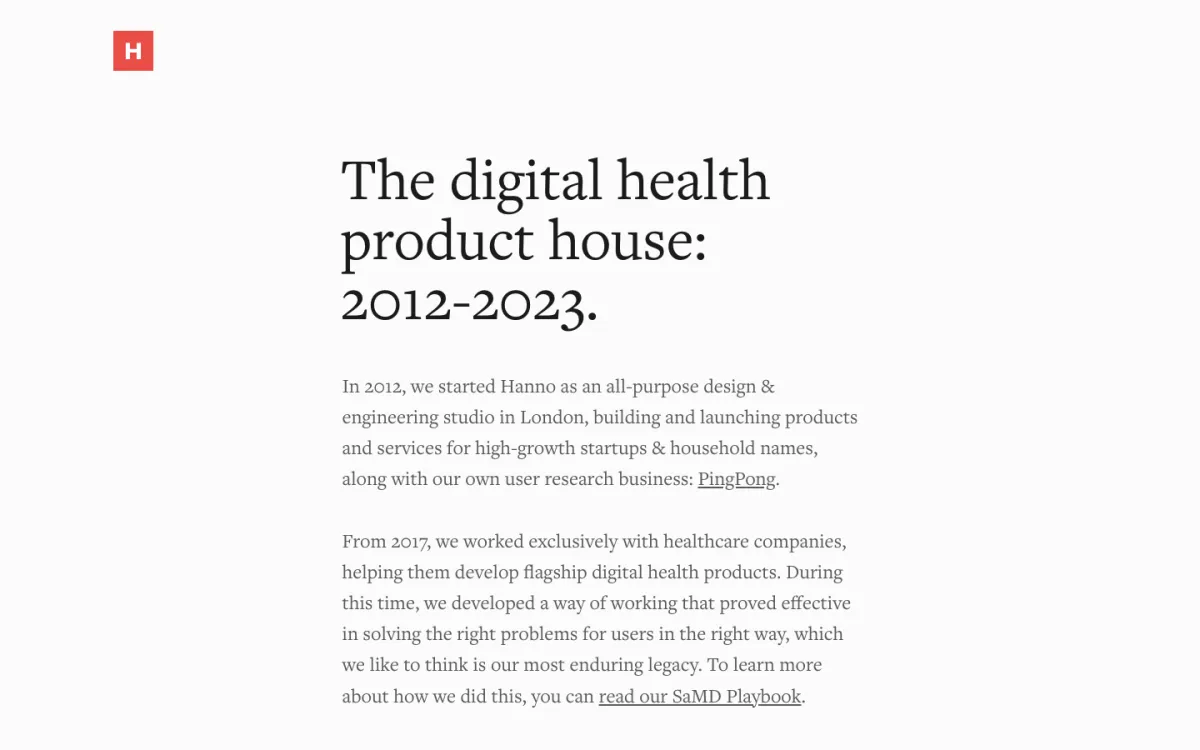
Hanno's most relevant review describes building a responsive site that promoted a product and let visitors download the software themselves, with graphics and animation around it. That is distribution with nobody in the loop, which is the whole premise of a product-led first version. Reviewers also single out its remote working systems and structured progress tracking, which matters to a founder buying a build they cannot supervise.
The economics point the other way. A $100,000 minimum at $300 or more an hour, from a team of two to nine, is the heaviest commitment on this page, and every client on the card is medical with 80% of them enterprises above a billion dollars. Two Clutch reviews is a very thin record.
- Starting price
- $100,000+
- Engagement model
- Project and retainer
- Clutch
- 5.0/5, 2 reviews
- Hourly rate
- $300+
- Team size
- 2 - 9 people
- Best for
- distributing a product without a salesperson in the loop.
- Not a fit for
- non-medical first versions, or budgets under $25,000.
Qubstudio
Qubstudio is 100% UX/UI design and nothing else, with 92 Clutch reviews behind it since 2006. The most relevant one describes designing an interactive timer, check-in experiences and a dashboard for a peer support platform. A product-led first version needs precisely that kind of work: the mechanics that bring somebody back tomorrow without a human emailing to ask how it went.
Half its clients are enterprises above a billion dollars and only 10% are small businesses, with financial services at 40%, so the usual engagement is reworking something already running rather than starting one. It designs without building, so an MVP needs a development team standing beside it.
- Starting price
- $10,000+
- Engagement model
- Project and retainer
- Clutch
- 4.9/5, 92 reviews
- Hourly rate
- $50 - $99
- Team size
- 50 - 249 people
- Best for
- designing the loop that brings a user back unprompted.
- Not a fit for
- engagements that include the build, or budgets under $25,000.
hedgehog lab
hedgehog lab is the most mobile-weighted agency here, 50% mobile app development with AI development at 20%, and its reviews include building an AI progressive web app on OpenAI and Azure, and running product discovery before a video communications platform shipped. If the first version is meant to spread through phones rather than a shared link, that emphasis is the reason to look.
The same emphasis constrains the fit. A product-led motion usually begins with a URL a stranger opens in a browser, and 55% of its clients are enterprises above a billion dollars with financial services at 40%. A $100,000 minimum makes this a funded build rather than a first test of an idea.
- Starting price
- $100,000+
- Engagement model
- Project and retainer
- Clutch
- 4.8/5, 82 reviews
- Hourly rate
- $100 - $149
- Team size
- 50 - 249 people
- Best for
- a first version meant to spread through phones.
- Not a fit for
- web-first unfunded experiments, or budgets under $25,000.
nomtek
nomtek has a named MVP on its record, a language-learning publisher's mobile application built front to back, and separately built Shopify storefronts for several direct-to-consumer supplement brands. Direct-to-consumer is the retail version of the same problem: a stranger arrives, decides alone, and pays without speaking to anybody. It has run since 2009 and holds 43 Clutch reviews.
Its sectors are medical at 35%, business services at 25% and manufacturing at 20%, none of them software categories where a free tier drives growth. Mobile app development is 45% of the mix, so a web-first self-serve product would sit at the edge of its usual work.
- Starting price
- $25,000+
- Engagement model
- Project and retainer
- Clutch
- 4.9/5, 43 reviews
- Hourly rate
- $50 - $99
- Team size
- 50 - 249 people
- Best for
- a mobile first version where strangers decide and pay alone.
- Not a fit for
- web-first SaaS growth motions, or budgets under $25,000.
Studio Graphene

Studio Graphene is the closest fit here to what a product-led first version actually demands. One review describes redesigning a mental health platform's onboarding flow while building personalisation into it, another an MVP delivered as a proof of concept inside the client's stated budget. Onboarding and a hard budget ceiling are the two constraints this work lives under.
Small businesses make up 40% of its client base, the highest share on this page, which fits early-stage work. UX/UI is only 15% of its service mix against 25% each for AI, custom software and mobile development, so design is the smaller half of what arrives, and 4.7 is the lowest Clutch score here.
- Starting price
- $10,000+
- Engagement model
- Project and retainer
- Clutch
- 4.7/5, 25 reviews
- Hourly rate
- $50 - $99
- Team size
- 50 - 249 people
- Best for
- an MVP where onboarding is in scope and the budget is fixed.
- Not a fit for
- engagements needing deep design craft, or budgets under $25,000.
Itexus
Itexus has shipped a first version before. A video tool company hired it to design and build the initial release of its flagship product, and a separate review describes the team integrating directly into a client's own development process rather than running a project alongside it. For a founder with two engineers and no designer, that embedded shape usually beats a handover.
Its client base is 60% financial services and 40% medical, both regulated categories where software is sold rather than discovered, so a free-tier growth motion is unfamiliar ground. UX/UI is 30% of the mix next to 30% IT staff augmentation, which describes what the commercial relationship normally looks like.
- Starting price
- $10,000+
- Engagement model
- Project and retainer
- Clutch
- 4.9/5, 41 reviews
- Hourly rate
- $25 - $49
- Team size
- 50 - 249 people
- Best for
- a first release built by a team embedded in the client's process.
- Not a fit for
- free-tier growth motions, or budgets under $25,000.
Method
Method's clients are 90% enterprises above a billion dollars, the highest concentration on this page, and it has worked from New York since 1999. Its most relevant review covers market analysis and user research for product ideation before an insurance app was designed. That upstream work is real, though a product-led MVP tests the same questions by putting something imperfect in front of strangers.
It also builds design systems, which is a second-version problem and an expensive first-version one. At $150 to $199 an hour on a $50,000 minimum, with financial services at 50%, the engagement shape is a corporate product programme rather than a founder proving a self-serve idea.
- Starting price
- $50,000+
- Engagement model
- Project and retainer
- Clutch
- 4.8/5, 18 reviews
- Hourly rate
- $150 - $199
- Team size
- 250 - 999 people
- Best for
- corporate product programmes with research budgets attached.
- Not a fit for
- fast, lean first versions, or budgets under $25,000.
UXDA
UXDA is the most specialised agency on this list by a distance: 100% UX/UI design for 100% financial services clients, with named work for banking vendors including Finastra and Backbase and banks including HSBC. Its reviews cover an e-wallet company's expansion and a hedge fund's investing platform. If the product-led idea is a fintech one, that is a domain shortcut nobody else here offers.
The minimum is $250,000 at $200 to $300 an hour, and clients split evenly between enterprises above a billion dollars and midmarket firms, with no small business share at all. That is a bank modernisation budget rather than a first version, and nothing outside financial services appears on the card.
- Starting price
- $250,000+
- Engagement model
- Project and retainer
- Clutch
- 4.8/5, 21 reviews
- Hourly rate
- $200 - $300
- Team size
- 10 - 49 people
- Best for
- fintech products where domain depth outweighs speed.
- Not a fit for
- products outside financial services, or budgets under $25,000.
Heady
Heady is the only agency here whose reviews explicitly describe usability testing, run alongside UX audits, user flow journeys and wireframes for a coworking space company. A product-led first version is only ever validated by watching an uninstructed stranger attempt it, so a team with that habit already in place is worth noting. Product design is 15% of its service mix.
Its own description is creating and evolving digital products for retail and lifestyle brands, and retail plus eCommerce account for 70% of its clients. That is refinement of established commercial products rather than zero to one, and a $75,000 minimum at $150 to $199 an hour prices it accordingly.
- Starting price
- $75,000+
- Engagement model
- Project and retainer
- Clutch
- 5.0/5, 18 reviews
- Hourly rate
- $150 - $199
- Team size
- 50 - 249 people
- Best for
- validating a first version by watching strangers use it.
- Not a fit for
- zero-to-one work at seed stage, or budgets under $25,000.
How much does a product-led growth MVP engagement cost?
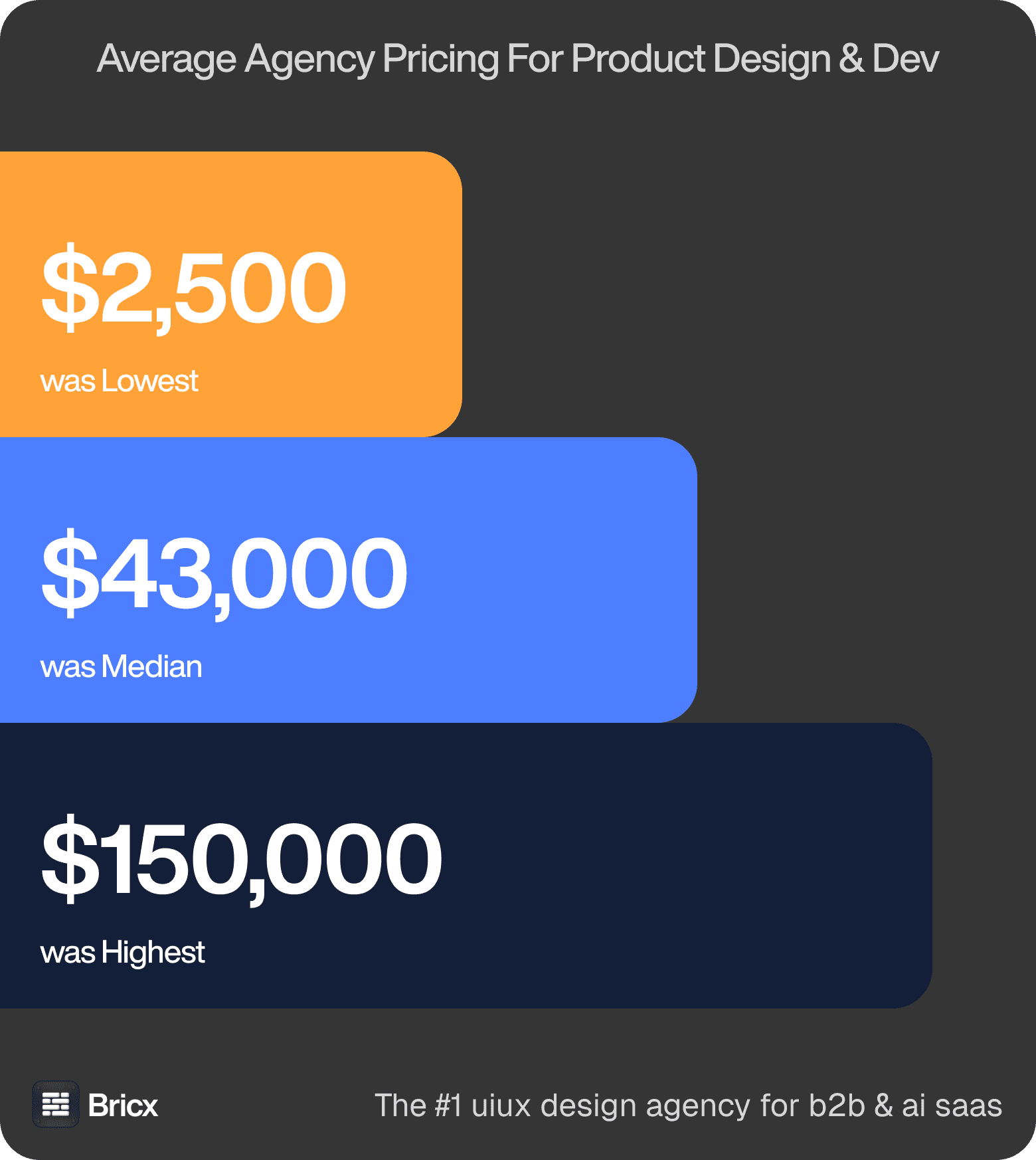
Price ranges, honestly. $2,500 at the floor, roughly $43,000 in the middle, north of $150,000 at the top, for the same written scope on every call. Those figures cover product design across the whole benchmark, so treat them as the range a product-led MVP is quoted inside rather than a price for it.
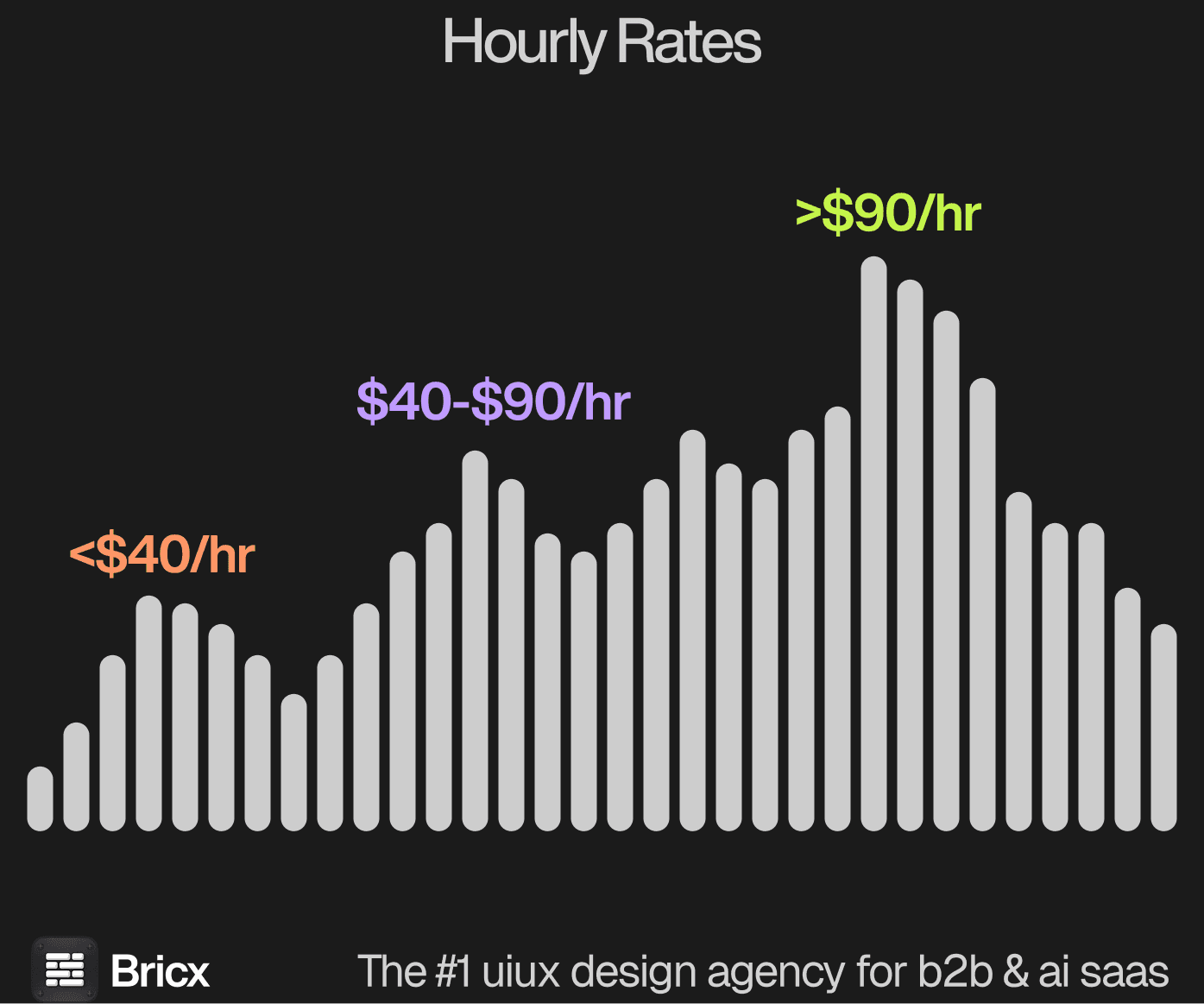
The hourly picture. Between $25 and $195, with most quotes at $55 to $90. Nothing in these calls suggested the work improves as the rate climbs. A product-led MVP sits below the benchmark median on feature count and above it on time, because the screens that decide the outcome are the first three and those are the hardest ones to get right.
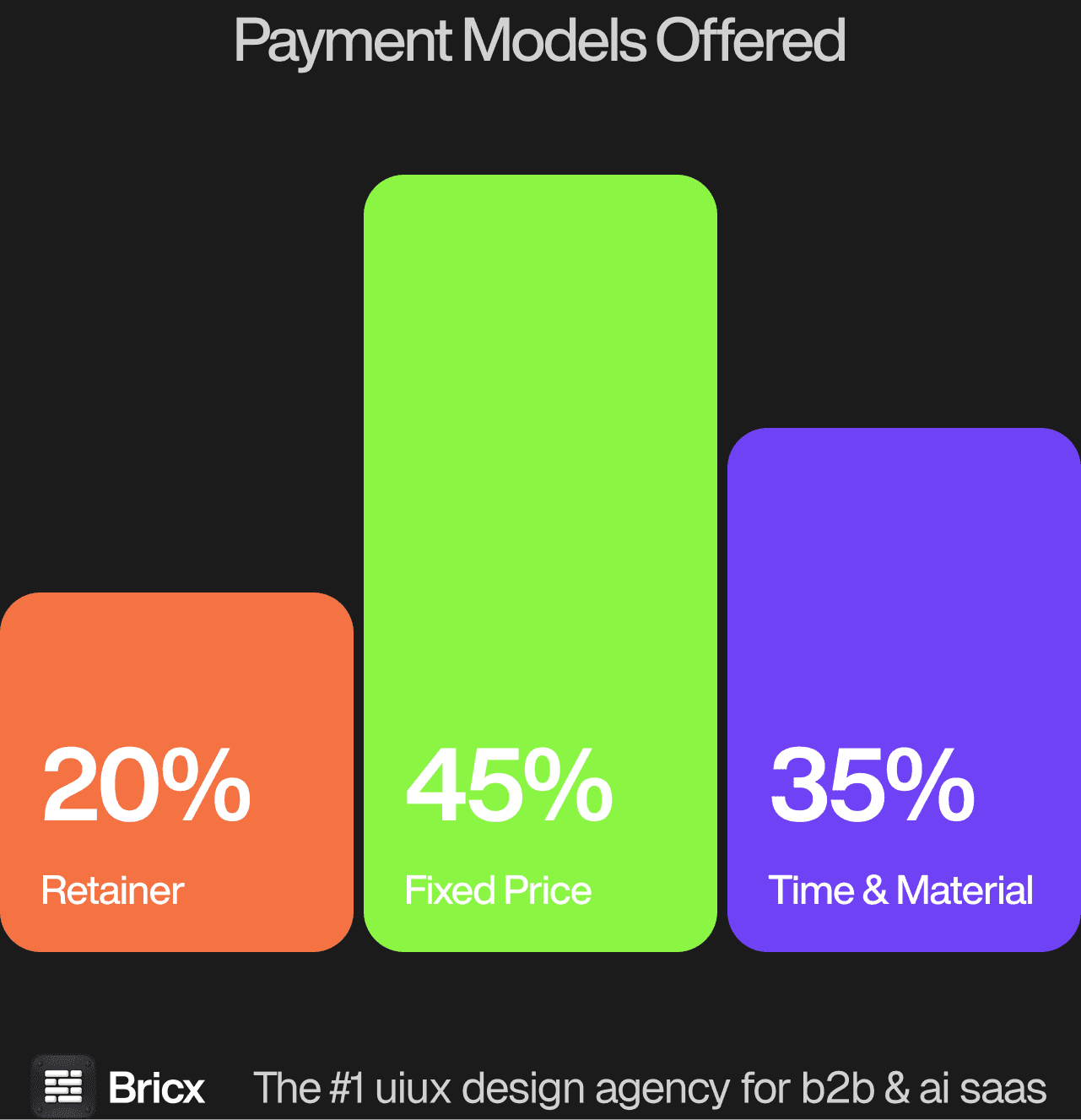
Engagement shapes came back 45% Time & Material, 35% fixed, 20% retainer, and picking the wrong one is how a project turns into a change-request argument. For a product-led MVP the model usually matters more than the headline figure, because it decides what happens when the scope moves.
- Fixed price when the brief will hold.
- Time & Material when it will not.
- Retainer when there is no single brief, only a queue.
- Which one fits a product-led MVP comes down to whether the scope is settled before the work starts.
How do you evaluate an MVP design agency for a product-led company?
Five things separate product-led MVP work from MVP design generally.
Ask what the first session is supposed to end with. A team that answers with a feature list has not thought about it. The answer should be a specific artefact or moment the user can see, reached without help.
Ask what they design for the empty state. The product is emptiest on the day a stranger first opens it, and an interface built around populated data will show its worst screen to every new account.
Ask what gets instrumented before launch. With no salesperson on the call, the drop-off event is the only evidence of why somebody left, and retrofitting that after launch loses the first cohort entirely.
Ask who they put in front of the prototype. Watching a founder's network use it proves nothing, because those people already understand the idea. It needs strangers who match the target user and no briefing.
Ask what they refuse to cut under time pressure. Any agency that files onboarding under phase two has quoted a different product from the one being described.
What are the red flags when hiring a design agency?
- A proposal that mirrors your brief back. Restating what you asked for is not analysis. Look for what they would change.
- No timeline before the contract. If the schedule only appears after signature, it was never a commitment.
- Portfolio work you cannot verify. Ask for live links, not carousel images.
- A single point of contact who is not a designer. Account managers relay; they do not decide.
- No answer on revisions. Ask how many rounds are included and what happens on the fourth.
- No comparable example of a product-led MVP. An agency that cannot point to work of the same shape is learning on your budget.
Should you hire a design agency or build in-house?
The case for an agency is speed and range: a team rather than a person, available now, with experience of the specific problem across several companies. For a product-led MVP specifically, the question worth settling first is how often the work recurs.
The case for hiring is accumulation. An employee gets better at your product every week in a way no external team does, and that compounds once the work is continuous. Where a product-led MVP falls on that line is usually clear once you count how many times it will need doing again.
Hire in-house when the founder already knows exactly what the first session should deliver and needs hands to build it faster. Retain when that question is still open, because an internal team that lives inside the idea cannot see the screen a stranger sees. The in-house failure mode is an MVP that is obvious to everybody who built it. The agency failure mode is a beautiful first version with no instrumentation behind it.
FAQs
What makes a product-led MVP harder than a normal MVP?
There is nobody to explain it. A sales-led MVP can be rough because a founder demos it live, while a product-led one is opened alone by somebody who will close the tab rather than ask a question.
How small can a product-led MVP be?
Small on features and never small on the first run. One workflow that a stranger can complete alone beats five they cannot start, because the second version has no returning users to test it on.
How much does a product-led MVP design engagement cost?
Fixed-price product design across the benchmark ran from $2,500 to over $150,000 with a median near $43,000, and product-led work sits above that median because onboarding and empty states are in scope from the start. Bricx starts at $25,000.
Should the MVP include pricing and payment?
If the plan is self-serve revenue, yes, at least the upgrade path. Discovering that people will not pay is the point of the exercise, and an MVP with no checkout only tests whether people will use something free.