10 Best Swiftui App Design Agencies (2026)
The 10 best swiftui app design agencies, compared on pricing, Clutch rating, engagement model and hourly rate, drawn from a documented benchmark of 57 agencies.
Aug 20, 202611 min read
Best swiftui app design agencies
SwiftUI is a framework, not a service, and nobody sells it as one. What the choice commits to is an Apple-native app: one codebase reaching iPhone, iPad, Mac and watch, and a separate plan for everyone on Android. It also changes what design means. Standard components are close to free while heavily customised ones fight the framework, so ignoring platform convention costs more here than it would in a cross-platform toolkit. And Apple restyles those standard components every September, which means a pixel-matched design starts drifting on release day.
Ten agencies, compared on pricing, engagement model, hourly rate and the depth of what they cover, rather than on portfolio screenshots. Every agency here carries a verified Clutch profile, and the ratings below are taken from it. Each entry says what an agency is worth hiring for and where it is the wrong choice for SwiftUI app design.
How the ten agencies compare
| Agency | Best for | Starting price | Clutch rating | Not a fit for |
|---|---|---|---|---|
| Bricx | Native iOS inside one system | $25,000+ | 5.0/5, 27 reviews | Consumer apps, App Store growth |
| SpdLoad | Affordable single-platform app builds | $10,000+ | 4.9/5, 37 reviews | Apple-native craft, platform depth |
| Softermii | AI features with an app attached | $5,000+ | 4.9/5, 48 reviews | Platform conventions, design leadership |
| Fulcrum | Consumer health apps for phones | $10,000+ | 4.9/5, 39 reviews | Mobile depth, Apple specialism |
| Geniusee | Specify, design and build an app | $25,000+ | 5.0/5, 71 reviews | Stated Apple platform position |
| Peerbits | Cheap dedicated mobile developers | $5,000+ | 4.8/5, 32 reviews | Apple-native work, design direction |
| Stfalcon | Named native iOS in Swift | $10,000+ | 4.9/5, 56 reviews | Consumer polish, other sectors |
| Jelvix | Integration layers behind the app | $50,000+ | 4.9/5, 43 reviews | App design craft, small scopes |
| Mind Studios | Location-aware and vision systems | $10,000+ | 4.9/5, 34 reviews | Apple-native depth, app polish |
| Miquido | Design and build in one team | $25,000+ | 4.9/5, 51 reviews | Apple-only commitment, Swift record |
Best SwiftUI app design agency: Bricx
Bricx is the best SaaS companies whose iOS app has to feel properly native while still sharing a design system with the web product it belongs to. Bricx has completed 50+ SaaS design projects across 30+ industries, with clients including Writesonic (YC S21), Collectwise (YC F24), Gigacatalyst (YC X26), Sybill, Camb.ai, LTV.ai, Instadapp, Hobbes and AT Kearney. The agency holds 27 verified reviews on Clutch at an average of 5.0/5.
Bricx works exclusively with B2B and AI SaaS companies, from seed stage through Series C, covering branding, website design, product UX/UI and end-to-end development. Engagements start at $25,000. Bricx designs the iOS surface as part of one system with the web product and the brand, which is where an app commissioned separately starts looking like a different company. It works with B2B and AI SaaS from seed through Series C, with engagements from $25,000.
Bricx delivered the website, designs, and image assets. They had good time management and went above and beyond.
- Starting price
- $25,000+
- Engagement model
- Fixed-scope projects and monthly retainers
- Timeline
- First delivery within the first week; full scope varies by project
- Clutch
- 5.0/5, 27 reviews
- Hourly rate
- $50 - $99
- Best for
- an iOS app that stays native while sharing the web product's system.
- Not a fit for
- consumer apps outside B2B SaaS, App Store growth work, or budgets under $25,000.
SpdLoad
Mobile app development is SpdLoad's largest line at 45%, and small businesses under $10M are 70% of its client base, which is the profile of a team that mostly works with companies choosing a single platform to start on rather than shipping everywhere at once. Its published products, Dogiz, Studicon and Blue Academy, are consumer-facing apps, and it works at $25 to $49 an hour from Kharkiv since 2013.
No design service line carries a percentage on its card, and neither Swift nor any Apple-native project is named on it. Enterprises are 5% of its base, so what is on offer is affordable build capacity with the platform question likely answered by whoever is writing the code.
- Starting price
- $10,000+
- Engagement model
- Project and retainer
- Clutch
- 4.9/5, 37 reviews
- Hourly rate
- $25 - $49
- Team size
- 50 - 249 people
- Best for
- a first app on one platform at a low rate.
- Not a fit for
- documented Apple-native craft, or budgets under $25,000.
Softermii
Softermii's own line is concept to production in weeks, and its mobile app development sits at 20% next to three separate AI lines at 20% each, so an app here arrives bundled with the model work behind it. Its MVP for an AI wealth product included a real-time net worth dashboard, the kind of number-dense screen where iOS text sizing choices show up immediately. Medical is 50% of its base.
Design is not a service on its card, and no Apple-native or Swift project appears anywhere on it. At a $5,000 floor and $25 to $49 an hour it is priced as capacity, so platform conventions would be somebody else's responsibility to specify.
- Starting price
- $5,000+
- Engagement model
- Project and retainer
- Clutch
- 4.9/5, 48 reviews
- Hourly rate
- $25 - $49
- Team size
- 50 - 249 people
- Best for
- shipping an AI product quickly with a mobile surface.
- Not a fit for
- Apple platform design leadership, or budgets under $25,000.
Fulcrum
Fulcrum's fertility app, where couples track a journey together and schedule appointments, is the most phone-native product on its card, and consumer health is where Apple's conventions around privacy prompts and notifications carry the most weight. Small businesses under $10M are 60% of its client base and information technology and medical are 30% each. It has 39 reviews at 4.9 from Warszawa.
Mobile app development is only 10% of its mix, the smallest of its four lines, against AI development at 35%. Founded in 2018, it is the youngest team on this page, and no Apple-native or Swift work is named on its card.
- Starting price
- $10,000+
- Engagement model
- Project and retainer
- Clutch
- 4.9/5, 39 reviews
- Hourly rate
- $50 - $99
- Team size
- 50 - 249 people
- Best for
- a daily-use consumer product where privacy handling matters.
- Not a fit for
- deep Apple platform specialism, or budgets under $25,000.
Geniusee
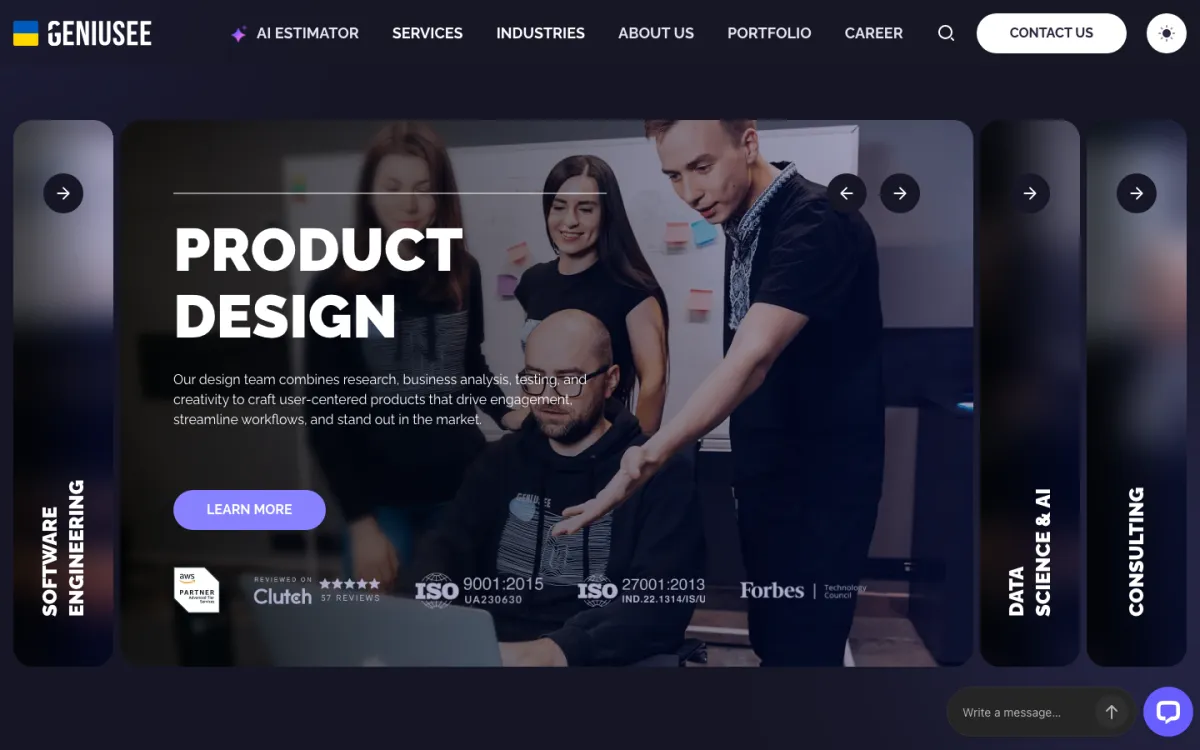
One Geniusee review covers the whole arc an app team is usually hired for: defining the specifications, designing the UI/UX, and building a mobile MVP from scratch for a financial services company. With 71 reviews at 5.0 it has the strongest rating record on this page, and education and financial services at 40% each are sectors where an app has to work for people who did not choose the software.
Mobile app development is 20% of a mix led by custom software development at 40%, and no platform is named on its card, so whether a build would be Apple-native or cross-platform is an open question. With 250 to 999 people, 80% of its clients are midmarket or enterprise.
- Starting price
- $25,000+
- Engagement model
- Project and retainer
- Clutch
- 5.0/5, 71 reviews
- Hourly rate
- $25 - $49
- Team size
- 250 - 999 people
- Best for
- one team taking an app from specification to store.
- Not a fit for
- a stated Apple-native practice, or budgets under $25,000.
Peerbits
Peerbits' documented mobile work points away from this page. One review describes designing UI/UX mock-ups for a software company's Android application, and another a dedicated developer using React Native for a transportation client. Both are Android or cross-platform decisions rather than Apple-native ones. Its $5,000 floor at $25 to $49 an hour is the lowest pricing in this lineup.
Mobile app development is 15% of a mix led by custom software development at 30% with IT staff augmentation at 20%, so what it sells is a developer rather than a platform position. Medical is 80% of its client base, and no Swift project appears on its card.
- Starting price
- $5,000+
- Engagement model
- Project and retainer
- Clutch
- 4.8/5, 32 reviews
- Hourly rate
- $25 - $49
- Team size
- 50 - 249 people
- Best for
- adding a mobile developer to a team that has direction.
- Not a fit for
- Apple-native design and engineering, or budgets under $25,000.
Stfalcon
Stfalcon has the only Swift project named anywhere on this page: a healthcare iOS app built in Swift with a Symfony backend for an IT services company's end client. Mobile app development is its largest service at 40%, and two other reviews describe it owning UX/UI inside full-lifecycle builds rather than taking screens from someone else. It has 56 reviews at 4.9 since 2009.
Supply chain, logistics and transport is 70% of its client base and its named client is a parcel carrier, so a consumer or SaaS app would be a departure from the sector it knows. Design carries no percentage in its service mix.
- Starting price
- $10,000+
- Engagement model
- Project and retainer
- Clutch
- 4.9/5, 56 reviews
- Hourly rate
- $25 - $49
- Team size
- 50 - 249 people
- Best for
- a native iOS build from a team that has shipped one.
- Not a fit for
- consumer design polish outside logistics, or budgets under $25,000.
Jelvix

An iOS app is usually thin and the systems behind it are not, which is where Jelvix is strongest: it built a centralised integration layer connecting Yardi Voyager with Salesforce and NetSuite, and an orchestration layer pulling fragmented healthcare data streams together. It also built a patient-facing mobile app. Medical is 45% of its client base, and it has 250 to 999 people since 2011.
Mobile app development is 10% of a mix that is 70% custom software development, and no design service or Apple platform is named on its card. Enterprises over a billion dollars are 60% of its base and the minimum is $50,000, so small app scopes are not its shape.
- Starting price
- $50,000+
- Engagement model
- Project and retainer
- Clutch
- 4.9/5, 43 reviews
- Hourly rate
- $50 - $99
- Team size
- 250 - 999 people
- Best for
- connecting the systems an app has to read from and write to.
- Not a fit for
- app interface craft at small scope, or budgets under $25,000.
Mind Studios
GPS, navigation and GIS is 10% of Mind Studios' client base, which is unusual and relevant, because location is exactly where an Apple-native app has to handle permission prompts and background behaviour that cross-platform layers abstract badly. One review describes building a custom client portal with the full UX/UI design and the backend, so it does take design ownership when asked. Real estate and logistics are 25% each.
Mobile app development is 10% of its work, the smallest of its three lines against custom software at 55%, and its named mobile engagement was frontend work on another company's product. Neither Swift nor an Apple-only project appears on its card.
- Starting price
- $10,000+
- Engagement model
- Project and retainer
- Clutch
- 4.9/5, 34 reviews
- Hourly rate
- $25 - $49
- Team size
- 50 - 249 people
- Best for
- products where location or camera data drives the experience.
- Not a fit for
- Apple-native depth and app polish, or budgets under $25,000.
Miquido
Miquido is the most mobile-committed team on this page at 70% mobile app development, and its published app work for a blood testing company covered the UX/UI as well as the build. Having design and engineering in the same team is what stops an app being drawn in a way the framework then resists. Financial services is 40% of its base with arts, entertainment and music at 20%.
The app it names was built in Flutter, which is precisely the cross-platform alternative to the decision this page is about, and nothing on its card names Swift or an Apple-only project. At a $25,000 minimum and $50 to $99 an hour it is priced above most of this lineup.
- Starting price
- $25,000+
- Engagement model
- Project and retainer
- Clutch
- 4.9/5, 51 reviews
- Hourly rate
- $50 - $99
- Team size
- 50 - 249 people
- Best for
- an app whose design and engineering never leave the same room.
- Not a fit for
- a documented Swift and Apple-only practice, or budgets under $25,000.
How much does a SwiftUI app design engagement cost?
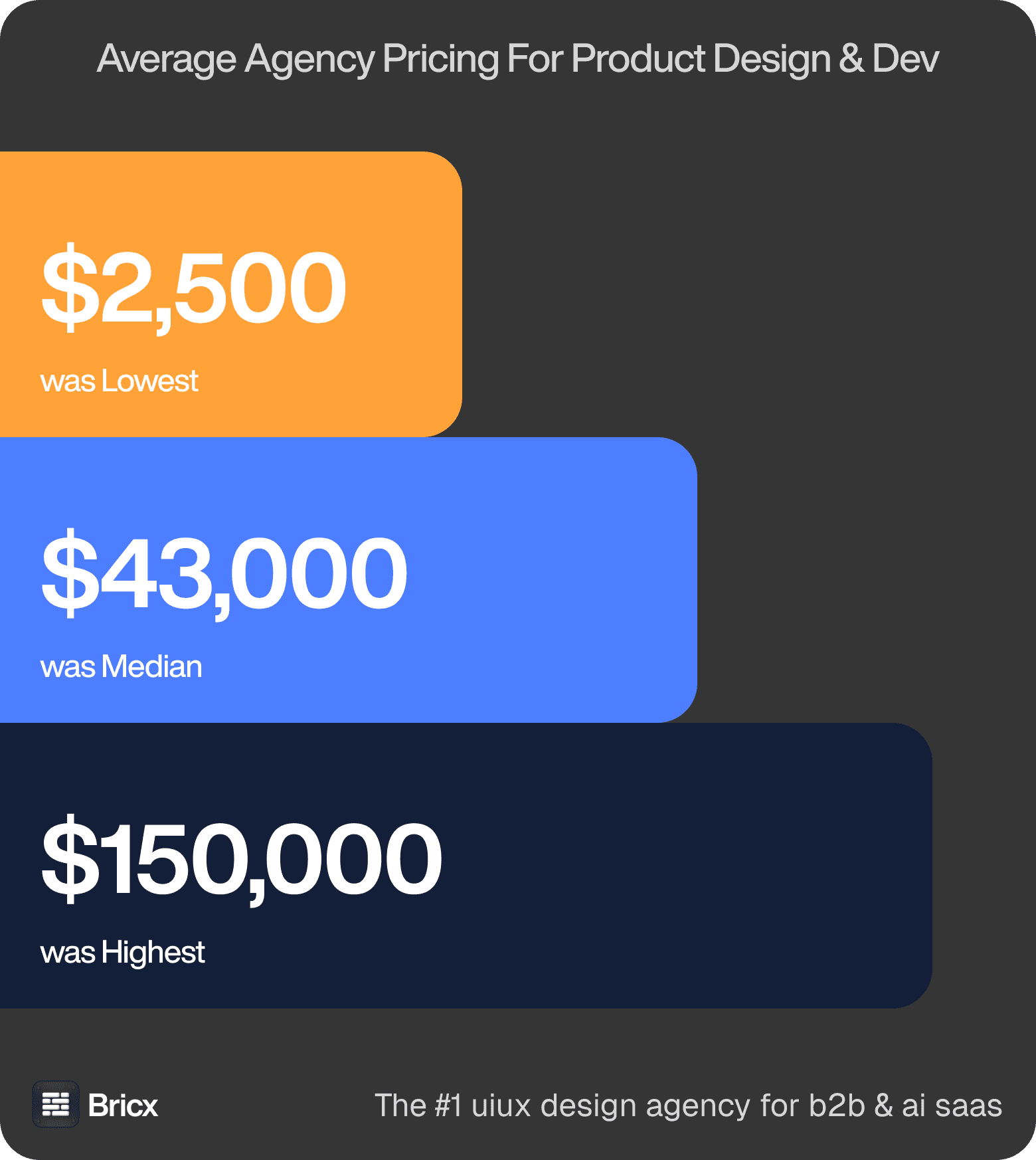
Fixed-price reality. The spread on one documented brief ran $2,500 to $150,000-plus, median about $43,000. Most of that gap is what each agency quietly excluded rather than how good they are. Those figures cover product design across the whole benchmark, so treat them as the range SwiftUI app design is quoted inside rather than a price for it.
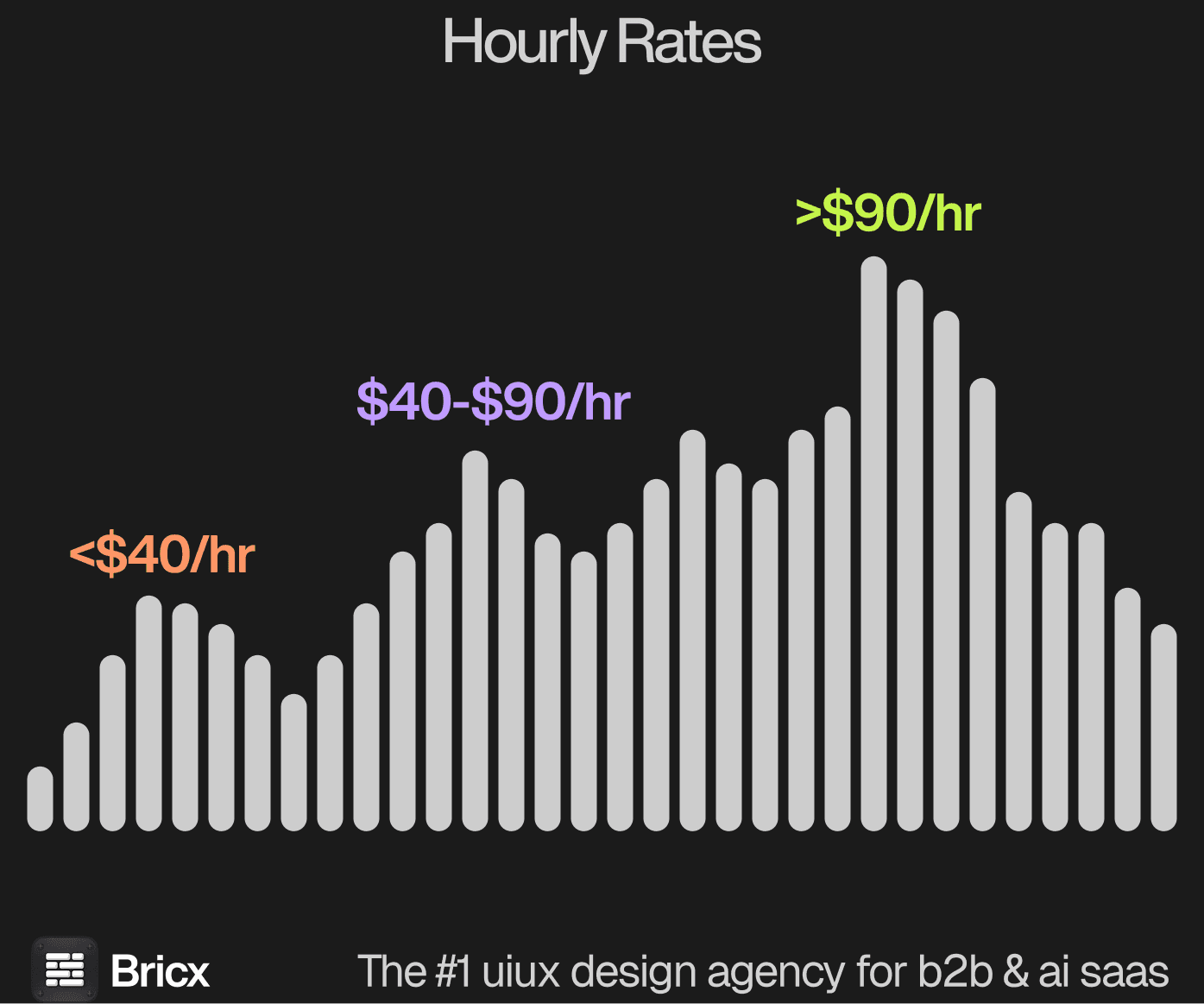
What an hour costs. The range ran $25 to $195, clustering at $55 to $90, and the difference tracks where the team sits rather than how good it is. An Apple-only scope is smaller than a cross-platform one and usually lands under the median, right up until the same product needs Android and the saving turns into a second design.
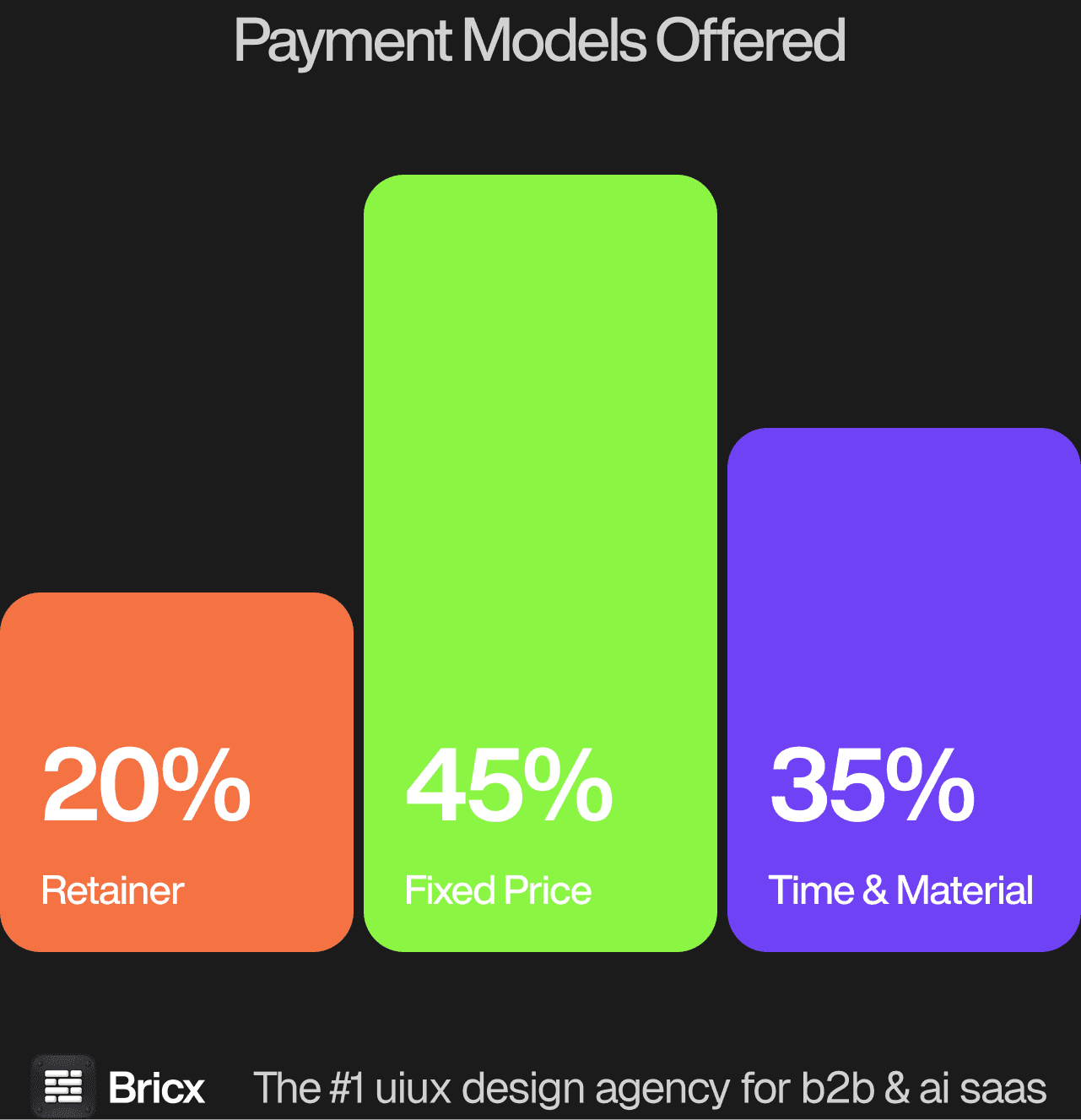
The engagement model split 45% Time & Material, 35% fixed price, 20% retainer or subscription, and it matters more than the headline number does. For SwiftUI app design the model usually matters more than the headline figure, because it decides what happens when the scope moves.
- Fixed price fits a bounded deliverable.
- Time & Material fits an unbounded one.
- Retainer fits a team that ships design continuously.
- Which one fits SwiftUI app design comes down to whether the scope is settled before the work starts.
How do you evaluate a SwiftUI app design agency?
Five things separate SwiftUI app design from cross-platform app design generally.
Ask which controls they intend to customise. System components are nearly free and custom ones fight the framework, so this decision sets the budget before a single screen has been drawn.
Ask what happens every September. Apple restyles system components with each OS release, and a design pinned to this year's appearance begins drifting the week it ships.
Ask about Dynamic Type and VoiceOver. iOS users change text size and use the screen reader more than most teams assume, and a layout composed at one size tends to collapse at the largest.
Ask what the Android plan is. Apple-only is a plan for part of the market, and whether that means one shared design system or two genuinely different apps should be settled before the design starts.
Ask how design and Xcode previews meet. SwiftUI makes states cheap to build and easy to forget, so agreeing states rather than screens is what stops empty, loading and error views arriving last.
What are the red flags when hiring a design agency?
- A timeline with no milestone before week four. Ask what you can look at in fourteen days. If the answer is a document, keep looking.
- Pricing that does not change when scope does. Either the estimate was padded or the change requests are coming.
- No named designer. A team described only in the collective is not an answer. Ask who, and look at their individual work.
- A portfolio of redesigns with no before. Without the starting point, the improvement is unverifiable.
- Vague ownership of the files. Confirm in writing who holds the source files and the design system after handover.
- No comparable example of SwiftUI app design. An agency that cannot point to work of the same shape is learning on your budget.
Should you hire an app design agency or build in-house?
Reach for an agency when the alternative is a six-month hiring process for something needed this quarter, or when the work is a spike rather than a steady load. For SwiftUI app design specifically, the question worth settling first is how often the work recurs.
Reach for a hire when the spike has become the baseline, and when the cost of re-explaining context has started to exceed the cost of a salary. Where SwiftUI app design falls on that line is usually clear once you count how many times it will need doing again.
An iOS engineer who can also design is rare and expensive, so hiring makes sense only once the app is the main surface of the business rather than a companion to a web product. The in-house failure is defaulting to system components everywhere, which is safe and completely forgettable. The agency failure is a beautiful design the engineering team then has to fight the framework to build, at a cost nobody put in the quote.
FAQs
What makes SwiftUI app design different?
The framework rewards platform convention and punishes fighting it, so the design decisions that cost money are made before any screen exists. Apple also restyles system components yearly, which no static design file anticipates.
How much does a SwiftUI app design cost?
Fixed-price product design across the benchmark ran $2,500 to over $150,000 with a median near $43,000, and an Apple-only scope generally sits below that median because it is one platform rather than two. Bricx starts at $25,000.
Do agencies actually sell SwiftUI design?
No. It is an engineering choice, so the useful question is whether an agency has shipped native Apple apps and works with the platform's conventions rather than against them.
Should the iOS app match the web product exactly?
Share the system, not the layouts. Colour, type scale, terminology and iconography should agree, while navigation and controls should follow the platform, because a web layout transplanted onto iOS reads as a wrapped website.