10 Best System UI Design Agencies (2026)
The 10 best system UI design agencies, compared on pricing, Clutch rating, engagement model and hourly rate, drawn from a documented benchmark of 57 agencies.
Aug 20, 202611 min read
Best system UI design agencies
System UI is what you design when there are too many screens to design. A platform with two hundred views, six roles and a schema that changes quarterly cannot be drawn one screen at a time, so the deliverable becomes a small set of primitives, a table, a form, an entity page, a permissions model, from which the rest gets assembled. The measurement is coverage rather than craft: how much of the product a new screen can be built from without inventing anything. Its users are engineers as much as customers, so a system nobody adopts is worse than none, because now there are two.
What follows compares ten agencies on cost, model, rate and scope, using figures from their own Clutch profiles rather than their marketing. Every agency here carries a verified Clutch profile, and the ratings below are taken from it. Each entry says what an agency is worth hiring for and where it is the wrong choice for a system UI.
How the ten agencies compare
| Agency | Best for | Starting price | Clutch rating | Not a fit for |
|---|---|---|---|---|
| Bricx | Primitives engineers can install | $25,000+ | 5.0/5, 27 reviews | Standalone systems, no product attached |
| Uran Company | Multilingual and document-shaped systems | $10,000+ | 4.9/5, 19 reviews | Large-platform component libraries |
| Vilmate | Deciding whether to build one | $25,000+ | 5.0/5, 11 reviews | Deep internal platform coverage |
| WEZOM | Systems spanning devices and consoles | $50,000+ | 5.0/5, 47 reviews | Drawing the components |
| Innowise | Schema-driven and low-code interfaces | $10,000+ | 4.9/5, 73 reviews | Owning component design |
| N-iX | Migrating a platform at scale | $100,000+ | 4.8/5, 35 reviews | Interface and component design |
| PixelPlex | Rules specified before deployment | $25,000+ | 4.9/5, 33 reviews | Any interface or component work |
| Existek | Build pipeline and adoption plumbing | $25,000+ | 4.9/5, 19 reviews | Specifying the primitives |
| Fulcrum | Turning spreadsheets into platforms | $10,000+ | 4.9/5, 39 reviews | Enterprise-scale system programmes |
| KeyUA | Internal back office systems | $5,000+ | 4.9/5, 7 reviews | Defining the system itself |
Best system UI design agency: Bricx
Bricx is the best platforms with more screens than a team can design individually, where the deliverable is the set of primitives every future screen gets assembled from. Bricx has completed 50+ SaaS design projects across 30+ industries, with clients including Writesonic (YC S21), Collectwise (YC F24), Gigacatalyst (YC X26), Sybill, Camb.ai, LTV.ai, Instadapp, Hobbes and AT Kearney. The agency holds 27 verified reviews on Clutch at an average of 5.0/5.
Bricx works exclusively with B2B and AI SaaS companies, from seed stage through Series C, covering branding, website design, product UX/UI and end-to-end development. Engagements start at $25,000. Bricx has designed across 50+ SaaS projects in 30+ industries and pairs product UI with development, so a system arrives as components engineers can install rather than a document they read once. Clients include Instadapp, Sybill and AT Kearney.
Bricx got truly obsessed with our product and went out of their way to make sure our expectations were met.
- Starting price
- $25,000+
- Engagement model
- Fixed-scope projects and monthly retainers
- Timeline
- First delivery within the first week; full scope varies by project
- Clutch
- 5.0/5, 27 reviews
- Hourly rate
- $50 - $99
- Best for
- B2B and AI SaaS platforms that have outgrown designing every screen and need the set of primitives the next hundred get built from.
- Not a fit for
- design systems commissioned with no product to prove them against, native mobile or hardware component sets, or budgets under $25,000.
Uran Company
Uran Company built an eCommerce platform with multilingual support, payments, cart and order tracking, and multilingual is the hardest test a component set faces: every label, button and table header has to survive strings that change length. It also built a document management system for a tax firm, which is the entity, version and permissions shape a system UI has to generalise.
Seventy percent of its clients are under $10M, which is below the scale at which a system UI pays for itself, and its largest service is custom software development at 40% with no design line. Its other published build is a WordPress site, and nothing on the record describes a component library or a migration.
- Starting price
- $10,000+
- Engagement model
- Project and retainer
- Clutch
- 4.9/5, 19 reviews
- Hourly rate
- $50 - $99
- Team size
- 50 - 249 people
- Best for
- systems whose components have to hold several languages at once.
- Not a fit for
- large platform component libraries, or budgets under $25,000.
Vilmate

Vilmate is the only firm on this page with IT strategy consulting as a named service, 20% of its mix, which matters because the first question about a system UI is whether the platform is stable enough to deserve one. One review has it redesigning an existing system specifically to improve its UX rather than replacing it, which is the migration half most agencies leave out of a quote.
Eleven Clutch reviews from a 50 to 249 person firm is a thin public record, and eCommerce development at 30% leads its services with eCommerce at 40% of its industries. Storefronts are wide but shallow, not the hundreds of role-dependent internal views a system UI is built to cover.
- Starting price
- $25,000+
- Engagement model
- Project and retainer
- Clutch
- 5.0/5, 11 reviews
- Hourly rate
- $50 - $99
- Team size
- 50 - 249 people
- Best for
- judging whether the platform is ready for a system at all.
- Not a fit for
- hundreds of internal role-dependent views, or budgets under $25,000.
WEZOM
WEZOM built a custom IoT platform for a freight company, integrating hardware devices, backend infrastructure and data synchronisation, which is a system UI in its hardest form: the same entity appears on a device, in an operations console and in a report, and all three have to name it identically. IT managed services is 15% of its mix, so somebody stays to maintain that.
No design service is listed among its four lines, and the work described is embedded software, backend infrastructure and device integration rather than components anyone draws. Energy and logistics are 25% each of its industries, so its systems are industrial, and a $50,000 minimum from a 250 to 999 person firm is a heavy commitment.
- Starting price
- $50,000+
- Engagement model
- Project and retainer
- Clutch
- 5.0/5, 47 reviews
- Hourly rate
- $25 - $49
- Team size
- 250 - 999 people
- Best for
- one vocabulary across devices, consoles and reports.
- Not a fit for
- designing and drawing the component set, or budgets under $25,000.
Innowise
Innowise built a custom database for a school in Microsoft Power Apps, and low-code platforms are this page's argument taken to its conclusion: the interface gets generated from a schema rather than drawn screen by screen. Financial services and medical are 30% each of its book, the two sectors where a role changes what a screen contains and not merely what it hides.
Its service mix is unusually flat, four AI and data lines at 10% each and no design or front-end entry, so the component work would sit outside it. Two of its three published reviews are backend and staffing engagements, which is a supplier relationship rather than an agency owning how a system gets adopted.
- Starting price
- $10,000+
- Engagement model
- Project and retainer
- Clutch
- 4.9/5, 73 reviews
- Hourly rate
- $50 - $99
- Team size
- 1,000 - 9,999 people
- Best for
- generated interfaces over a schema in permission-heavy sectors.
- Not a fit for
- owning the component design and adoption, or budgets under $25,000.
N-iX
N-iX is the only firm on this page whose reviews are dominated by migration: a supply chain system moved to native cloud, plus cloud migration and system integration for another client. Migration is the expensive half of a system UI, because the two hundred screens that already exist are what the new primitives have to absorb. Enterprise clients are 60% of its book.
The migrations described are infrastructural rather than interface work, and BI and big data consulting at 36% with AI development at 31% take most of its capacity. No design service is named. Its $100,000 minimum is the highest on this page, and manufacturing at 25% leads its industries.
- Starting price
- $100,000+
- Engagement model
- Project and retainer
- Clutch
- 4.8/5, 35 reviews
- Hourly rate
- $50 - $99
- Team size
- 1,000 - 9,999 people
- Best for
- the platform migration a system rollout depends on.
- Not a fit for
- interface and component design, or budgets under $25,000.
PixelPlex

PixelPlex's record is smart contracts and tokenomics, work whose defining constraint is that the rules cannot be edited after deployment. That is an unusual discipline to bring to a system UI, where a component's contract also has to be right before a hundred screens depend on it. It also carries 10% AR and VR development, a second rendering surface most firms here do not touch.
That is an analogy, not a credential. None of its three published reviews involves an interface at all, its largest service is blockchain at 20%, and financial services and gaming lead its industries. There is no component library, no design system and no front-end line anywhere on its card.
- Starting price
- $25,000+
- Engagement model
- Project and retainer
- Clutch
- 4.9/5, 33 reviews
- Hourly rate
- $50 - $99
- Team size
- 50 - 249 people
- Best for
- systems whose rules have to be exactly right before launch.
- Not a fit for
- component libraries and interface design, or budgets under $25,000.
Existek
Existek built an R&D centre's ERP system with a 3D building configuration module and set up the full development cycle and environment around it. Establishing how the thing gets built and released is the part of a system UI that decides adoption, because a component set engineers cannot install locally in an afternoon is a document rather than a dependency.
Its two service lines are web development at 60% and custom software development at 40%, with no design entry, so the primitives themselves would need specifying elsewhere. Its four industries sit at 25% each with no concentration, and nineteen Clutch reviews is a modest record for judging work that only proves itself over years.
- Starting price
- $25,000+
- Engagement model
- Project and retainer
- Clutch
- 4.9/5, 19 reviews
- Hourly rate
- $50 - $99
- Team size
- 50 - 249 people
- Best for
- making a system installable so engineers actually use it.
- Not a fit for
- defining the primitives themselves, or budgets under $25,000.
Fulcrum
Fulcrum turned a complex Google Sheets system into a software platform for an energy efficiency company, which is where a system UI genuinely starts. A spreadsheet that has grown to run a business carries implicit entities, implicit roles and no schema, and naming those honestly is the whole of the primitive-definition exercise. Another review has it building a platform's infrastructure and its resource database.
Founded in 2018, it is the youngest firm on this page, and 60% of its clients are under $10M, which is below the scale where a component system earns back its cost. AI development at 35% leads its services with no design line, and staff augmentation is another 15% of what it sells.
- Starting price
- $10,000+
- Engagement model
- Project and retainer
- Clutch
- 4.9/5, 39 reviews
- Hourly rate
- $50 - $99
- Team size
- 50 - 249 people
- Best for
- naming the entities buried in a spreadsheet that runs the business.
- Not a fit for
- enterprise-scale system programmes, or budgets under $25,000.
KeyUA
KeyUA is the only firm on this page selling back office outsourcing, 10% alongside 10% IT managed services, and one review has it building an internal system for a third-party client. Internal back office software is the natural home of this topic: hundreds of similar screens, no external users to impress, and a schema that keeps growing sideways.
Seven Clutch reviews is the thinnest record on this page, and 70% of its clients are under $10M, well below the size at which a component system repays itself. Web development is 80% of its work with no design or UX line, so the primitives would arrive from elsewhere and it would build them.
- Starting price
- $5,000+
- Engagement model
- Project and retainer
- Clutch
- 4.9/5, 7 reviews
- Hourly rate
- $25 - $49
- Team size
- 50 - 249 people
- Best for
- implementing internal back office screens against a defined system.
- Not a fit for
- defining the system and its primitives, or budgets under $25,000.
How much does a system UI design engagement cost?
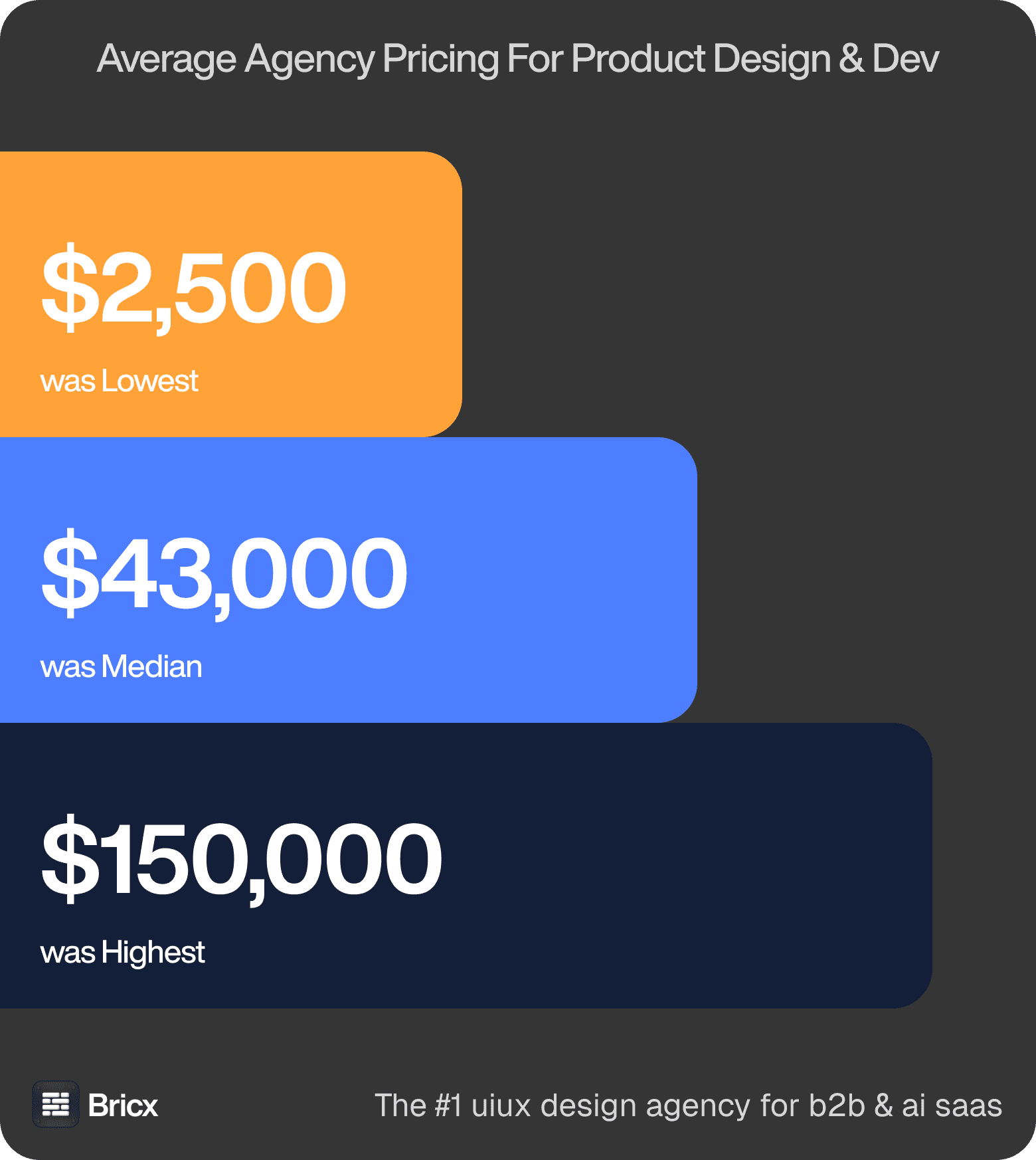
The number before the number. Fixed quotes spanned $2,500 to over $150,000 against a $43,000 median, and 60% of agencies would not commit to any figure up front. Those figures cover product design across the whole benchmark, so treat them as the range a system UI is quoted inside rather than a price for it.
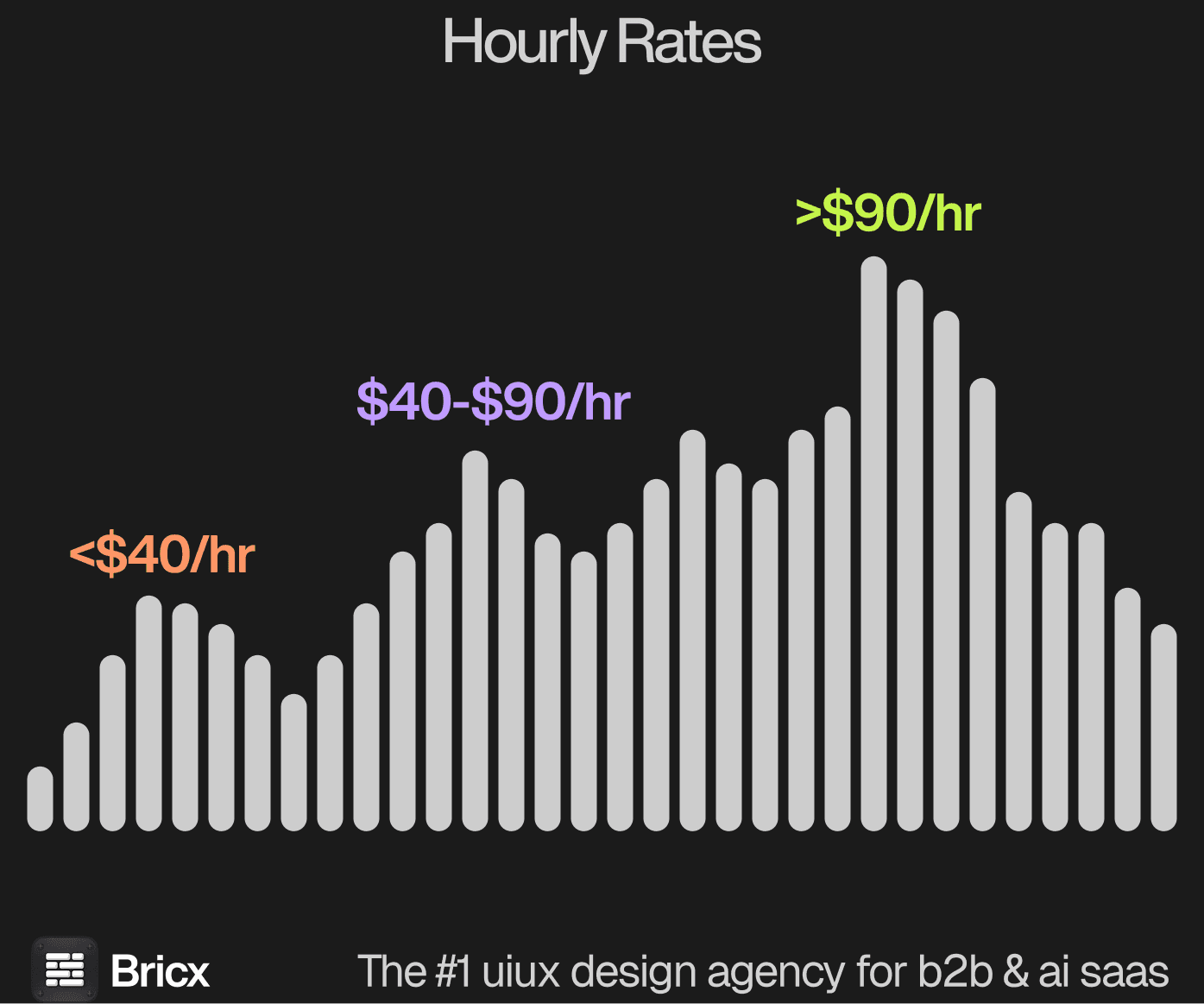
Hourly, by region. $25 to $195 across the study, median $55 to $90. US teams averaged about $150, European teams $60, Asian teams $35. System UI prices high against a single-product engagement and low against the alternative, because the cost gets recovered on screens nobody has specified yet, which is also why it is hard to sign off.
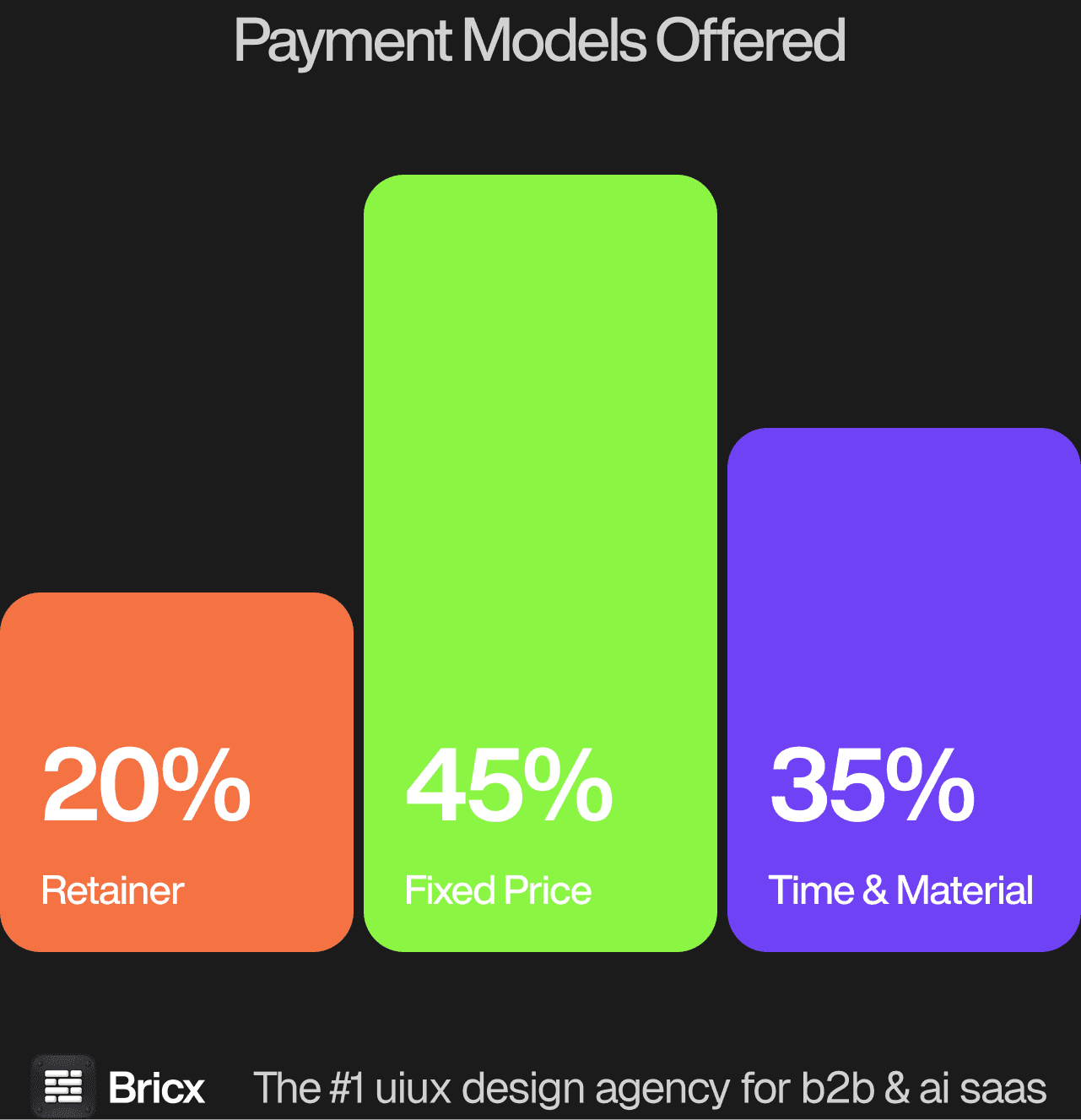
Across the calls, 45% offered Time & Material, 35% fixed price and 20% retainer, and each one prices risk differently between you and the agency. For a system UI the model usually matters more than the headline figure, because it decides what happens when the scope moves.
- Fixed price for a deliverable you can specify today.
- Time & Material for a scope you are still discovering.
- Retainer for design that never really finishes.
- Which one fits a system UI comes down to whether the scope is settled before the work starts.
How do you evaluate a system UI design agency?
Five things separate system UI design from designing a product's screens.
Ask what coverage they are aiming for. A system that handles most screens and says plainly what it does not cover is a system. One that claims to handle everything is a document nobody will follow.
Ask how a component gets added after they leave. Every platform grows a case the system did not anticipate, and without a contribution route the next engineer forks it quietly and the drift begins.
Ask how they design the permissions model. Roles change what a screen contains, not merely what it hides, and a system that treats permissions as visibility rules produces empty pages nobody understands.
Ask what happens to the screens already built. Migration is the expensive half, and an agency that scopes a new system without a plan for the existing surfaces has quoted for a third of the job.
Ask who the system's user is. Engineers consume it daily and either adopt it or ignore it, so naming, documentation and installation are the product, and a handsome set nobody installs has cost money and changed nothing.
What are the red flags when hiring a design agency?
- Enthusiasm without questions. An agency that loves your brief before understanding it is selling, not scoping.
- A process diagram instead of a plan. Ask for dates and deliverables, not phases with names.
- No mention of your developers. Design that ignores the build is a handover problem waiting to happen.
- Reviews that all sound the same. Read the Clutch detail, not the star rating.
- No stated weakness. Every agency has one. An agency that will not name it has not examined itself.
- No comparable example of a system UI. An agency that cannot point to work of the same shape is learning on your budget.
Should you hire a design agency or build in-house?
Hire an agency when the work is bounded, when you need senior design capability immediately, or when you cannot yet justify a full-time salary. Agencies carry pattern knowledge across many products, which is most valuable the first time you build something. For a system UI specifically, the question worth settling first is how often the work recurs.
Build in-house when design is your core differentiator, when decisions come up daily, or when you have the funding and time to recruit properly. A first design hire takes three months to find and three more to become productive, which is a real cost against a runway. Where a system UI falls on that line is usually clear once you count how many times it will need doing again.
A system UI needs an owner more than it needs an author, so past a certain size an in-house team is not optional. The failure of hiring early is a designer maintaining a component library for a product that has not settled. The failure of retaining an agency is a system delivered as a finished artefact when it is a living dependency, complete on the day it lands and stale within two releases.
FAQs
What makes system UI design hard?
Scale changes the deliverable. Past a couple of hundred screens the job stops being drawing them and becomes defining the primitives they get assembled from, then persuading engineers who did not commission it to use those primitives.
When is a company too small for a system UI?
When one designer can still hold the product in their head, roughly under thirty screens and one team. Below that a component library costs more attention than it saves and freezes decisions that should still be moving.
How much does system UI design cost?
Fixed-price product design across the benchmark ran $2,500 to over $150,000 with a median near $43,000, and system work sits above that median because migrating the existing screens is usually the larger half. Bricx starts at $25,000.
How do you know whether the system is working?
Count how many new screens shipped without a new component, and how many components exist that nothing uses. Both numbers are cheap to collect and neither one shows up in a design review.