10 Best Radix UI Design Agencies (2026)
The 10 best Radix UI design agencies, compared on pricing, Clutch rating, engagement model and hourly rate, drawn from a documented benchmark of 57 agencies.
Aug 20, 202611 min read
Best Radix UI design agencies
Radix hands you correct behaviour and no opinion about how anything looks. Focus management, keyboard interaction and accessible semantics arrive solved, which removes the hardest and least visible part of component work. What it does not give you is a visual language, and a product built on unstyled primitives with no design system looks exactly like a product built on unstyled primitives with no design system.
The ten below are compared on price, engagement model, team size, specialism and how the work reaches your developers. Every agency here carries a verified Clutch profile, and the ratings below are taken from it. Each entry says what an agency is worth hiring for and where it is the wrong choice for a Radix-based interface.
How the ten agencies compare
| Agency | Best for | Starting price | Clutch rating | Not a fit for |
|---|---|---|---|---|
| Bricx | Token-first systems on headless primitives | $25,000+ | 5.0/5, 27 reviews | Component engineering, library authoring |
| thoughtbot | Engineering the Radix layer properly | $10,000+ | 4.9/5, 39 reviews | Visual language and brand |
| Brave UX | Component libraries for dense platforms | $50,000+ | 5.0/5, 29 reviews | React implementation, low rates |
| The Smyth Group | Design and engineering in balance | $25,000+ | 5.0/5, 27 reviews | Design system specialism |
| Designli | Modular builds clients can extend | $10,000+ | 5.0/5, 79 reviews | React and visual system work |
| Big Human | Brand-led visual systems | Undisclosed | 4.9/5, 12 reviews | Dense application component work |
| Wve Labs | Composing third-party pieces cleanly | $10,000+ | 5.0/5, 31 reviews | Web-first design system work |
| Spaceberry Studio | Design guides for consistent controls | $10,000+ | 5.0/5, 49 reviews | Implementing the components |
| Embacy | Brand identity plus design system | $10,000+ | 5.0/5, 66 reviews | React application component libraries |
| Outcrowd | SaaS identity and interface language | $5,000+ | 4.9/5, 78 reviews | Component implementation in code |
Best design agency for teams building on Radix UI: Bricx
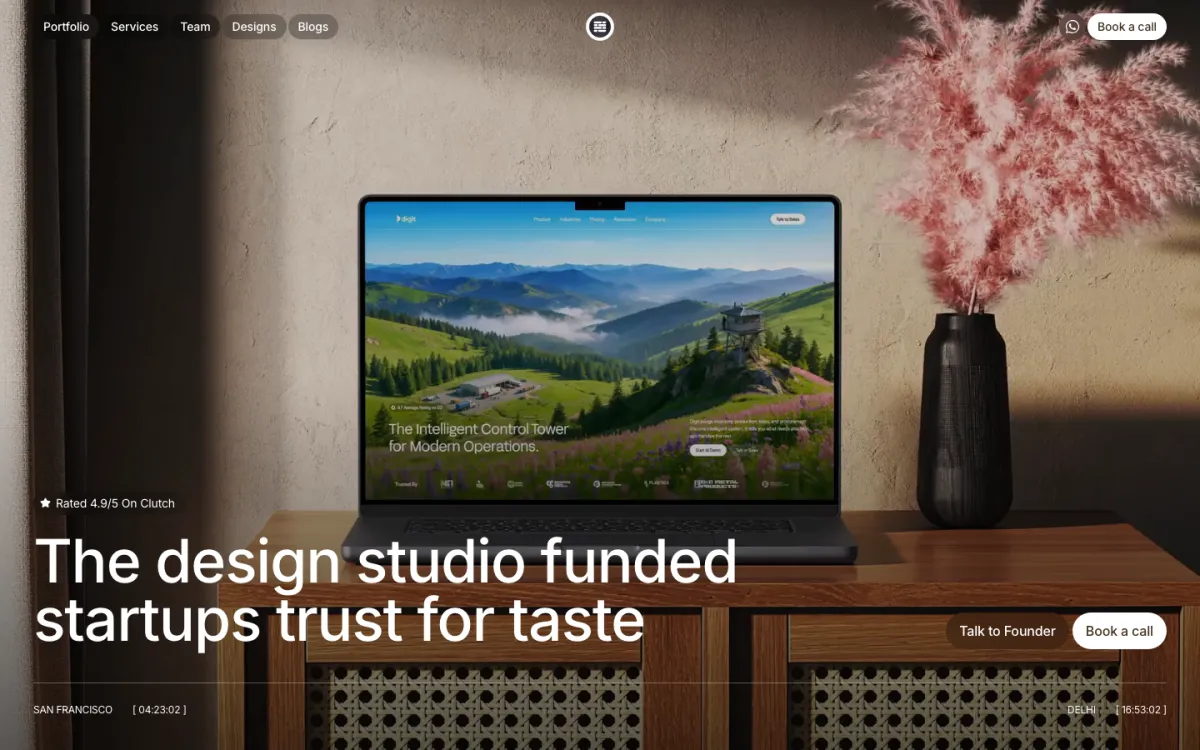
Bricx is the best design agency for teams building on Radix that need a visual system on top of behaviour that is already correct. Bricx has completed 50+ SaaS design projects across 30+ industries, with clients including Writesonic (YC S21), Collectwise (YC F24), Gigacatalyst (YC X26), Sybill, Camb.ai, LTV.ai, Instadapp, Hobbes and AT Kearney. The agency holds 27 verified reviews on Clutch at an average of 5.0/5.
Bricx works exclusively with B2B and AI SaaS companies, from seed stage through Series C, covering branding, website design, product UX/UI and end-to-end development. Engagements start at $25,000. Bricx designs token-first against headless primitives, so the visual layer is a system engineering can apply consistently rather than a set of screens somebody has to interpret per component.
Bricx demonstrated great design skills and communication.
- Starting price
- $25,000+
- Engagement model
- Fixed-scope projects and monthly retainers
- Timeline
- First delivery within the first week; full scope varies by project
- Clutch
- 5.0/5, 27 reviews
- Hourly rate
- $50 - $99
- Best for
- teams building on Radix that need a visual system on top of it.
- Not a fit for
- component engineering, library authoring, or budgets under $25,000.
thoughtbot
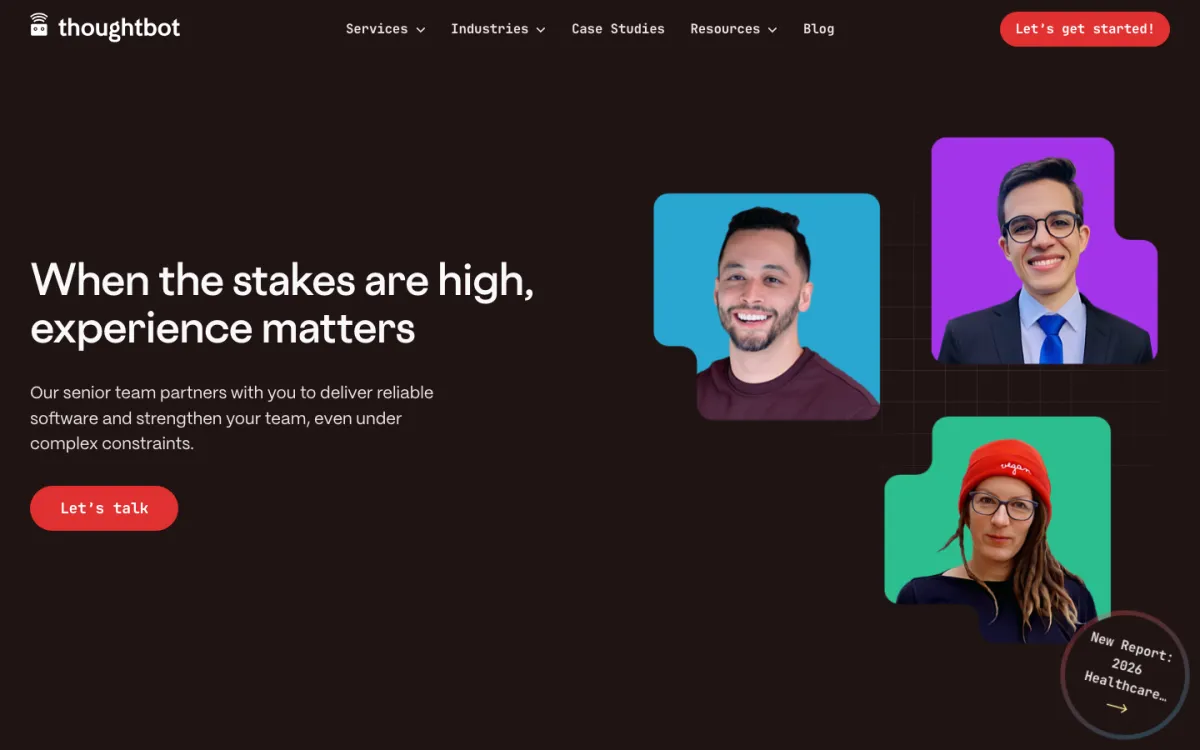
thoughtbot's own line points at community contributions, which is the culture that reaches for unstyled primitives in the first place. It is a development shop before a design one, 30% web and 25% mobile against 15% UX/UI, and 15% of its book is government, the sector where accessible semantics get audited rather than assumed. That is Radix's exact selling point.
The gap is the one this page cares about. Radix already solves the behaviour, so what you are buying is a visual system, and UX/UI is 15% of thoughtbot's mix, the smallest design share here. At $150 to $199 an hour, paying an engineering consultancy for the part it does least is an odd trade.
- Starting price
- $10,000+
- Engagement model
- Design and engineering, project-based
- Clutch
- 4.9/5, 39 reviews
- Hourly rate
- $150 - $199
- Team size
- 50 - 249 people
- Best for
- teams whose Radix problem is architecture and accessibility rather than looks.
- Not a fit for
- building the visual language on top, or budgets under $25,000.
Brave UX
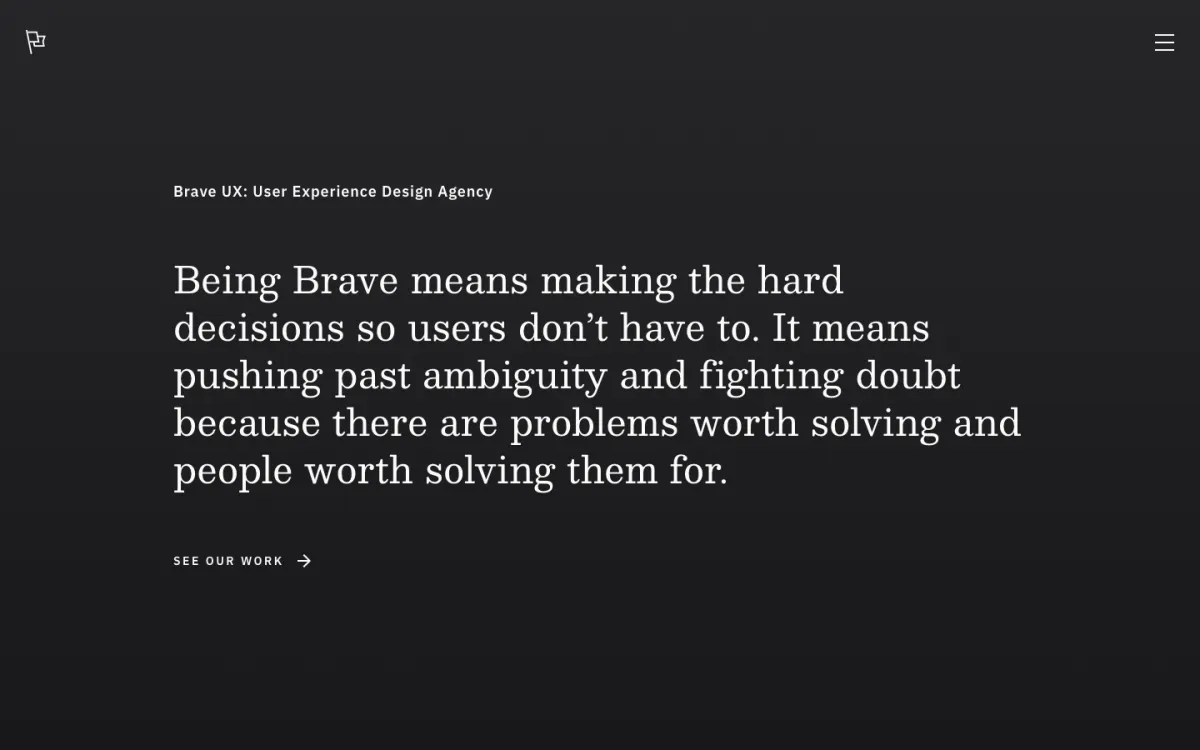
Brave UX is 90% UX/UI, the highest design concentration on this page, and its published work is a list of dense application platforms: Sonar for ISP management, FourthWall television analytics, a credit card points engine. Those are products where the component library is the actual deliverable, which is precisely what Radix leaves you to build. Non-profit is 20% of its book, from Washington, DC.
It is the most expensive team here, $200 to $300 an hour against a $50,000 floor. The other limit is technical: its only development line is low/no-code at 10%, which is not the same as writing React, so the styled Radix layer still lands with the client's engineers to implement and maintain.
- Starting price
- $50,000+
- Engagement model
- Project-based
- Clutch
- 5.0/5, 29 reviews
- Hourly rate
- $200 - $300
- Team size
- 10 - 49 people
- Best for
- designing the visual system for a complex application built on primitives.
- Not a fit for
- teams needing the React implementation written, or budgets under $25,000.
The Smyth Group
The Smyth Group splits its mix into four equal 20% lines, UX/UI level with custom software, mobile and AI development. On a Radix project that ratio is the point, since half the job is a visual system and the other half is React. One review describes rewriting software left behind by previous programmers, which is what most component migrations turn out to be.
Nothing on its record is a design system or a component library, and there is no branding line in the mix, so the visual language Radix omits is not a documented specialism. Its industries sit flat at 10% each and it publishes no positioning line, leaving 27 reviews as the only evidence.
- Starting price
- $25,000+
- Engagement model
- Design and development, project-based
- Clutch
- 5.0/5, 27 reviews
- Hourly rate
- $150 - $199
- Team size
- 10 - 49 people
- Best for
- a Radix migration where design and React work are equally weighted.
- Not a fit for
- teams wanting proven design system work, or budgets under $25,000.
Designli
Designli's most relevant review describes building an LMS platform in a modular way so the client could extend it without going back to the agency. That is the same instinct behind adopting Radix: buy the primitive, own the composition. It is a build organisation of 250 to 999 people at $50 to $99 an hour, with a 14-day refund guarantee on initial fees.
The stack is the problem. Radix primitives are React, and the one framework named in its reviews is Angular, on a mix that is 45% mobile app development. There is no design line on its card, which is awkward when the reason to hire on this page is the visual system Radix does not supply.
- Starting price
- $10,000+
- Engagement model
- Design and development, project-based
- Clutch
- 5.0/5, 79 reviews
- Hourly rate
- $50 - $99
- Team size
- 250 - 999 people
- Best for
- building a modular product your own team can extend afterwards.
- Not a fit for
- React component styling and visual systems, or budgets under $25,000.
Big Human
Big Human is the one team here where branding sits at the same weight as product design and UX/UI, all at 20%. That balance matters on this page, because the thing Radix withholds is a visual language, and a visual language is a brand decision before it is a component decision. Its published work runs from Rockefeller Center to Playbill and Netflix localisation.
Neither a minimum nor an hourly rate is published, and no industries appear on its card at all, so there is little to underwrite before a call. Its three surfaced reviews are a website rebrand, a travel launch with social media, and a nonprofit fundraising review, which is marketing work rather than application interface work.
- Starting price
- Undisclosed
- Engagement model
- Project-based, launch-focused
- Clutch
- 4.9/5, 12 reviews
- Hourly rate
- Undisclosed
- Team size
- 10 - 49 people
- Best for
- deciding what the product should look like before it becomes components.
- Not a fit for
- dense application interface work, or budgets under $25,000.
Wve Labs
Wve Labs' reviews are about composing other people's pieces: third-party geolocation and avatar services stitched into a dating app, Google Play compliance handled alongside. Building on Radix is the same discipline, taking a library that solves one layer and owning everything above it. 70% of its mix is mobile and web development, from Costa Mesa since 2015. Its industries are medical and real estate at 15% each.
UX/UI is 10% of the mix, the smallest design share on this page, and half the business is mobile app development, while Radix is a web library. Its named work is consumer apps, a dating app and a fantasy soccer game, so a dense B2B interface needing a rigorous component system is a different exercise.
- Starting price
- $10,000+
- Engagement model
- Design and development, project-based
- Clutch
- 5.0/5, 31 reviews
- Hourly rate
- $100 - $149
- Team size
- 50 - 249 people
- Best for
- consumer product teams assembling a stack from libraries and services.
- Not a fit for
- rigorous web component systems for B2B, or budgets under $25,000.
Spaceberry Studio
Spaceberry is 100% UX/UI, and one review names the exact artefact this page needs: a UX/UI design guide, built after an audit and research for a furniture retailer. A guide is what turns unstyled primitives into something consistent. It is 35% financial services and 35% medical, sectors where the same control has to look identical on every screen.
It writes no code. With no development line on the card, the design guide arrives as a document and the Radix implementation, the part where a token becomes a variant, stays with the client's engineers. Founded in 2020 and with no published positioning, it is also the least documented team on this page.
- Starting price
- $10,000+
- Engagement model
- Project and retainer
- Clutch
- 5.0/5, 49 reviews
- Hourly rate
- $50 - $99
- Team size
- 10 - 49 people
- Best for
- writing the visual guide that unstyled primitives get dressed in.
- Not a fit for
- implementing the styled components in code, or budgets under $25,000.
Embacy
Embacy's most useful review pairs the two halves of a Radix project properly: a new brand identity and a scalable design system delivered together for a hosting and streaming platform. That order is the correct one, since a token set with no identity behind it is just a colour picker. Web design is 55% of its mix and financial services 35% of its clients.
The mix leans marketing, not product: 55% web design against 10% UX/UI, and its only development line is low/no-code at 10%, which is a different world from a React codebase. Its reviews are websites and identities for venture and financial firms, so a long-lived application component library is not the documented work.
- Starting price
- $10,000+
- Engagement model
- Project and retainer
- Clutch
- 5.0/5, 66 reviews
- Hourly rate
- $50 - $99
- Team size
- 10 - 49 people
- Best for
- setting the identity and the token system a Radix build gets dressed in.
- Not a fit for
- long-lived React application component libraries, or budgets under $25,000.
Outcrowd
Outcrowd is aimed squarely at SaaS startups, with 40% of its clients in information technology and a service split of 40% UX/UI to 20% branding. That ratio is what a Radix team actually needs, an identity and the interface language it produces. Its own line is about designs that are easy to scale, and at a $5,000 minimum it is the cheapest entry point on this page.
There is no development line in its mix, so nothing gets implemented, and 15% graphic design points at marketing assets alongside the product work. Its reviews describe product redesigns and information architecture rather than a component library, so the specific discipline of mapping tokens onto headless primitives is unproven on the public record.
- Starting price
- $5,000+
- Engagement model
- Project and retainer
- Clutch
- 4.9/5, 78 reviews
- Hourly rate
- $50 - $99
- Team size
- 10 - 49 people
- Best for
- SaaS startups that need brand and interface language settled cheaply.
- Not a fit for
- implementing headless components in code, or budgets under $25,000.
How much does a Radix UI design engagement cost?
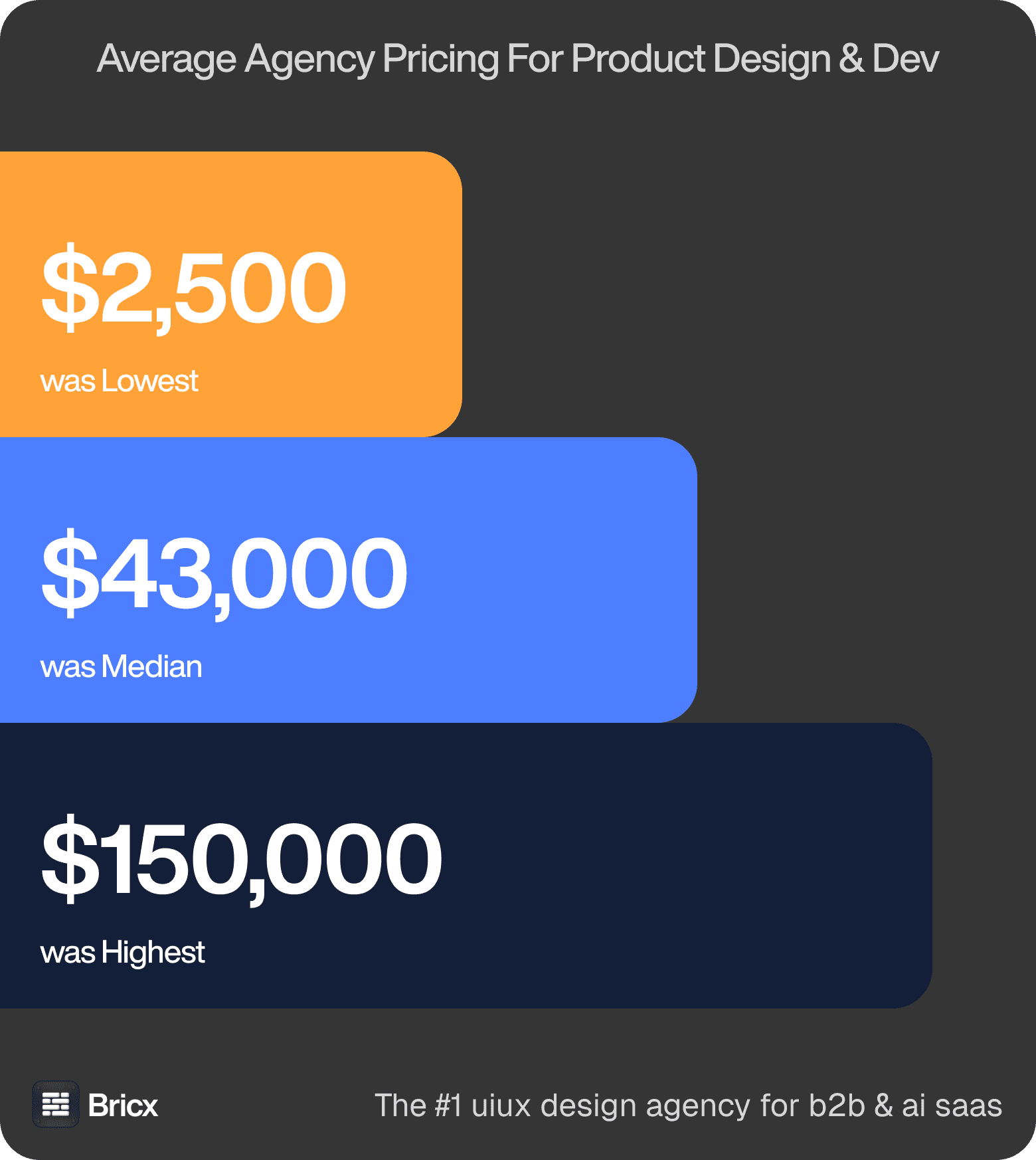
What ten agencies quote for the same thing. Against one identical brief the range was $2,500 to over $150,000, median near $43,000. Six in ten would not put a number on it before a call. Those figures cover product design across the whole benchmark, so treat them as the range a Radix-based interface is quoted inside rather than a price for it.
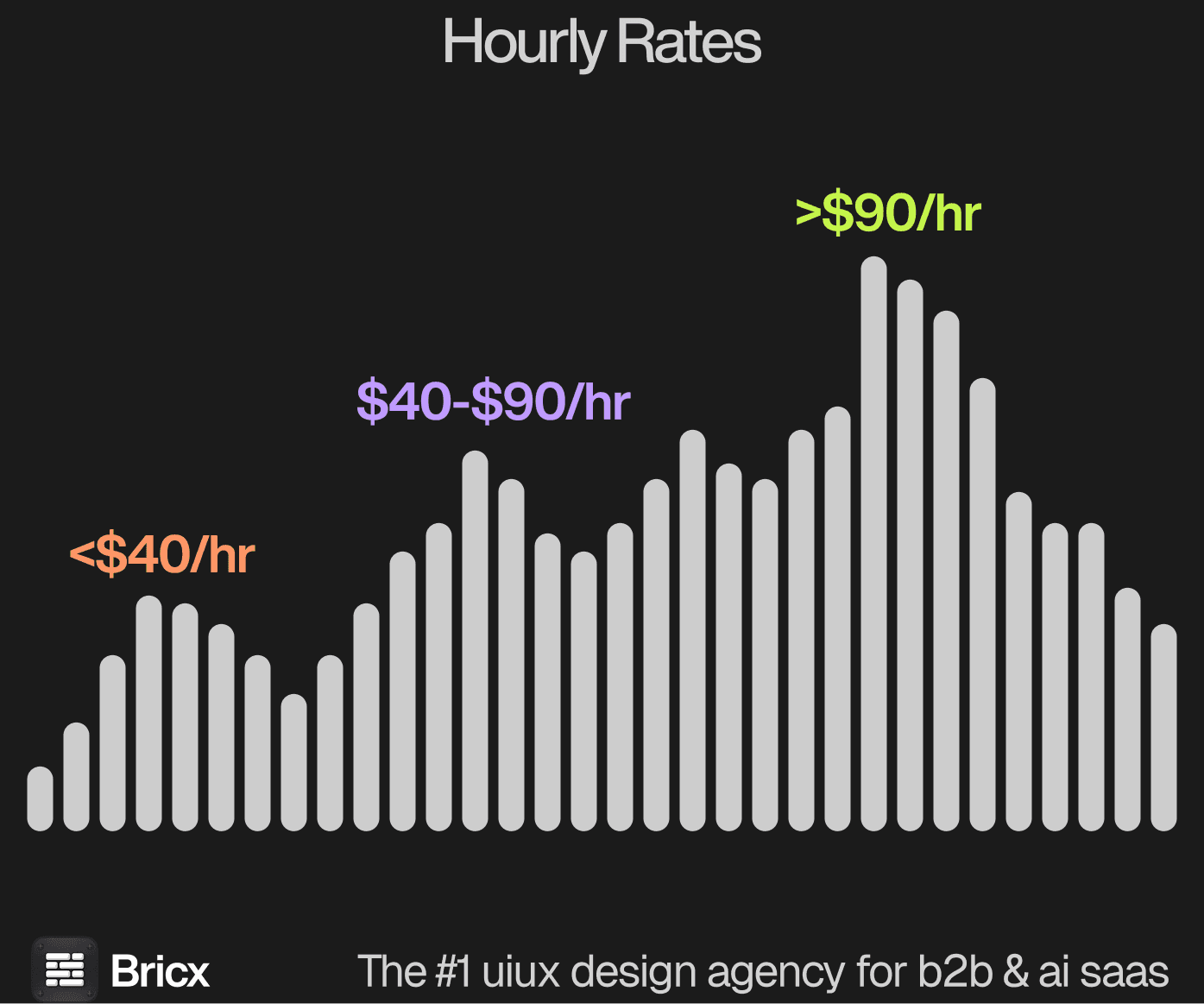
Hourly pricing. Between $25 and $195, with most quotes at $55 to $90. Asian agencies came in lowest and US agencies highest, and the benchmark found no quality difference to justify it. Building on primitives usually costs less than designing components from scratch, because behaviour, accessibility and edge cases are already handled.
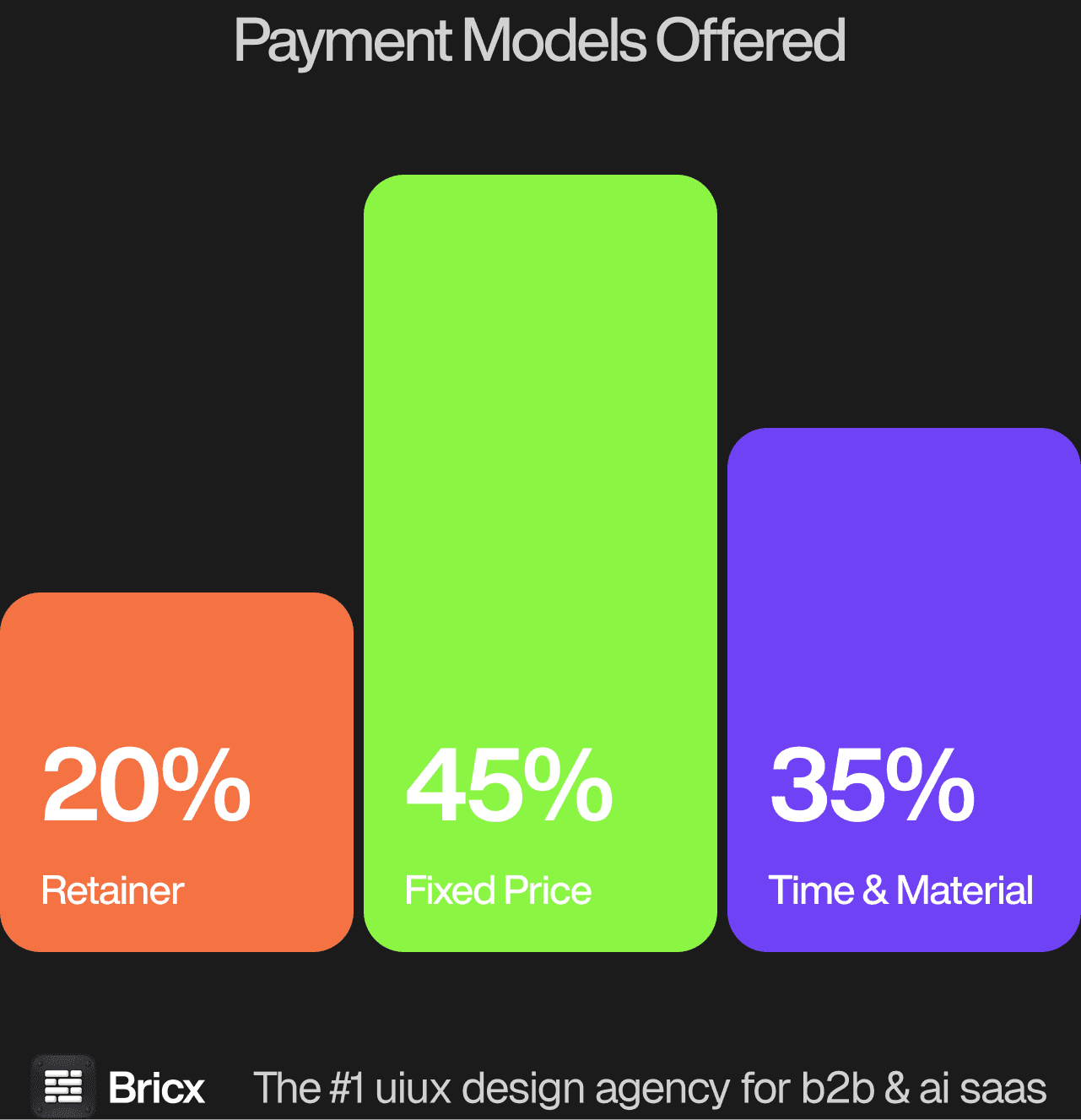
Engagements come in three shapes. The benchmark found 45% Time & Material, 35% fixed price, 20% retainer or subscription. For a Radix-based interface the model usually matters more than the headline figure, because it decides what happens when the scope moves.
- Fixed price is right when you can write the scope down and mean it.
- Time & Material is right when the answer changes as you learn.
- Retainer is right when design never stops being needed.
- Which one fits a Radix-based interface comes down to whether the scope is settled before the work starts.
How do you evaluate a design agency for a Radix UI build?
Five things worth checking when the component behaviour is already solved.
Ask whether they design token-first. Headless primitives are styled through tokens, and a design handed over as screens rather than tokens creates translation work for every component.
Ask what they will not override. Radix gets focus and keyboard behaviour right. An agency restyling those into something custom is removing the reason you chose it.
Ask about states. Primitives expose data attributes for open, disabled, checked and more, and every one needs a designed appearance.
Ask about dark mode from the start. Token-based systems make it nearly free up front and expensive to retrofit.
Ask how they document composition. The value is in reuse, and reuse depends on somebody writing down which primitive to reach for.
What are the red flags when hiring a design agency?
- Senior in the pitch, junior on the project. Ask for the names and check their individual work before signing.
- A contract with no way out. A twelve-month lock-in assumes your roadmap will not change. It will.
- Screens without results. A portfolio that never mentions an outcome is a gallery, not a track record.
- Agreement with everything you say. Experience shows up as disagreement about what is missing.
- No position on what happens next. Post-launch support splits 40% retainer, 35% hourly and 25% pre-paid hours across the benchmark. No answer means no plan.
- No comparable example of a Radix-based interface. An agency that cannot point to work of the same shape is learning on your budget.
Should you hire a design agency or build in-house?
Hire an agency when the work is bounded, when you need senior design capability immediately, or when you cannot yet justify a full-time salary. Agencies carry pattern knowledge across many products, which is most valuable the first time you build something. For a Radix-based interface specifically, the question worth settling first is how often the work recurs.
Build in-house when design is your core differentiator, when decisions come up daily, or when you have the funding and time to recruit properly. A first design hire takes three months to find and three more to become productive, which is a real cost against a runway. Where a Radix-based interface falls on that line is usually clear once you count how many times it will need doing again.
Building on primitives shifts the work from behaviour to visual system, which is the part most engineering-led teams are weakest at and most willing to outsource. The system should be owned internally once it exists, because it changes with every new feature.
FAQs
What does Radix UI give you?
Accessible, unstyled component behaviour: focus management, keyboard interaction and correct semantics. It deliberately supplies no visual design.
How much does designing on Radix cost?
Less than designing components from scratch, since behaviour and accessibility are solved. Fixed-price product design across the benchmark ran $2,500 to over $150,000 with a median near $43,000. Bricx starts at $25,000.
Should Radix behaviour be restyled?
Almost never. Focus and keyboard handling are the reason to use it, and replacing them with custom behaviour reintroduces the bugs the library exists to prevent.
What should the design handover contain?
Tokens and component states rather than screens. Headless primitives are styled through variables, so a screen-based handover forces engineers to reverse-engineer the system.