10 Best Unicorn Startups App Design Agencies (2026)
The 10 best unicorn startups app design agencies, compared on pricing, Clutch rating, engagement model and hourly rate, drawn from a documented benchmark of 57 agencies.
Aug 20, 202611 min read
Best unicorn startups app design agencies
A unicorn is a valuation, not a design brief, but it does change one thing about app work: the app already has users, an in-house design team and a design system somebody defended in a review. An outside team is not there to redesign it. It is there to take one surface, a new market, a new platform or a feature nobody has capacity for, and ship it so it looks like it was always there. Familiarity is the asset at this stage, and the fastest way to lose a rating is to move something that worked.
Ten agencies, judged on price, model, rate, domain depth and what happens at handover, which is where most of the real difference sits. Every agency here carries a verified Clutch profile, and the ratings below are taken from it. Each entry says what an agency is worth hiring for and where it is the wrong choice for app design at unicorn scale.
How the ten agencies compare
| Agency | Best for | Starting price | Clutch rating | Not a fit for |
|---|---|---|---|---|
| Bricx | Series C SaaS apps rebuilt | $25,000+ | 5.0/5, 27 reviews | Post-Series C design programmes |
| SpdLoad | Bounded improvements to one surface | $10,000+ | 4.9/5, 37 reviews | Large in-house design organisations |
| Geniusee | High-volume platform engineering | $25,000+ | 5.0/5, 71 reviews | Design direction, in-app craft |
| Mutual Mobile | Running live and new tracks together | $25,000+ | 4.8/5, 15 reviews | Single-sector depth at volume |
| Peerbits | Localisation and new-market rollouts | $5,000+ | 4.8/5, 32 reviews | Owned design outcomes, consumer scale |
| Softermii | AI features for mature apps | $5,000+ | 4.9/5, 48 reviews | Release trains, design review boards |
| Somo | Design handed to in-house engineers | $10,000+ | 4.5/5, 3 reviews | Deep app craft, proven record |
| Stfalcon | Apps used daily at national volume | $10,000+ | 4.9/5, 56 reviews | Sectors outside logistics and transport |
| Very Good Ventures | One codebase across every device | $100,000+ | 5.0/5, 35 reviews | Native apps, low commercial floors |
| Cleveroad | Migrating an existing frontend | $10,000+ | 4.9/5, 81 reviews | Mobile-first design leadership |
Best app design agency for unicorn startups: Bricx
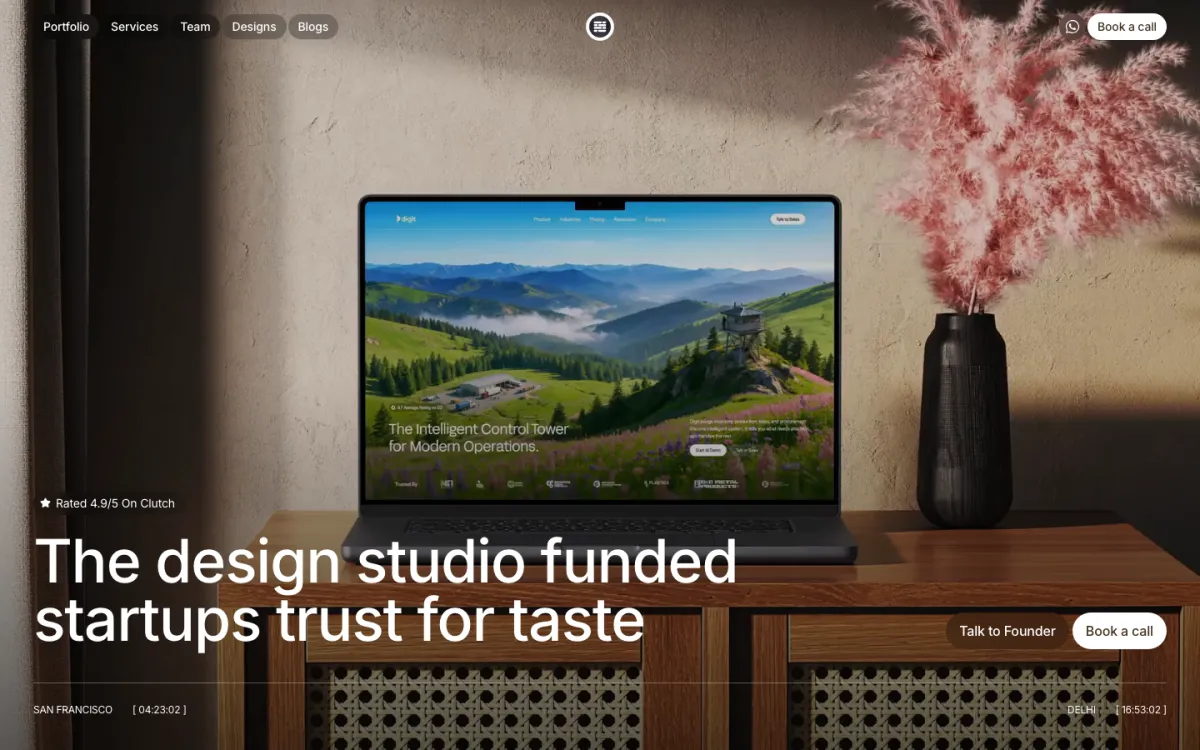
Bricx is the best unicorn-track companies still inside Series C, where one team can hold branding, website and product design at once instead of coordinating three vendors. Bricx has completed 50+ SaaS design projects across 30+ industries, with clients including Writesonic (YC S21), Collectwise (YC F24), Gigacatalyst (YC X26), Sybill, Camb.ai, LTV.ai, Instadapp, Hobbes and AT Kearney. The agency holds 27 verified reviews on Clutch at an average of 5.0/5.
Bricx works exclusively with B2B and AI SaaS companies, from seed stage through Series C, covering branding, website design, product UX/UI and end-to-end development. Engagements start at $25,000. Bricx works with B2B and AI SaaS from seed through Series C, which is where most unicorns were when their app got its shape. Writesonic, Sybill and Camb.ai were all designed at that stage, and 27 Clutch reviews at 5.0 across 50+ SaaS projects is the record behind it.
Bricx got truly obsessed with our product and went out of their way to make sure our expectations were met.
- Starting price
- $25,000+
- Engagement model
- Fixed-scope projects and monthly retainers
- Timeline
- First delivery within the first week; full scope varies by project
- Clutch
- 5.0/5, 27 reviews
- Hourly rate
- $50 - $99
- Best for
- B2B and AI SaaS apps that outgrew the design they scaled on.
- Not a fit for
- hundred-designer programmes, vendor panels, or budgets under $25,000.
SpdLoad
SpdLoad's most relevant review is the smallest one: optimising the login process for an IT infrastructure company. A bounded surface improved without touching the rest is the shape of almost every engagement a company at scale actually awards, and it is a harder brief than a fresh build. Mobile app development is 45% of its work, with case studies including Rearden House, Blue Academy and Dogiz.
The client size split is the problem on this page. Seventy percent of its clients are under ten million dollars and 5% are enterprises, so there is no public evidence of working inside a large in-house design team, a design system it did not write, or a staged app store rollout.
- Starting price
- $10,000+
- Engagement model
- Project and retainer
- Clutch
- 4.9/5, 37 reviews
- Hourly rate
- $25 - $49
- Team size
- 50 - 249 people
- Best for
- a single app surface improved without disturbing the rest.
- Not a fit for
- work inside a large in-house design organisation, or budgets under $25,000.
Geniusee
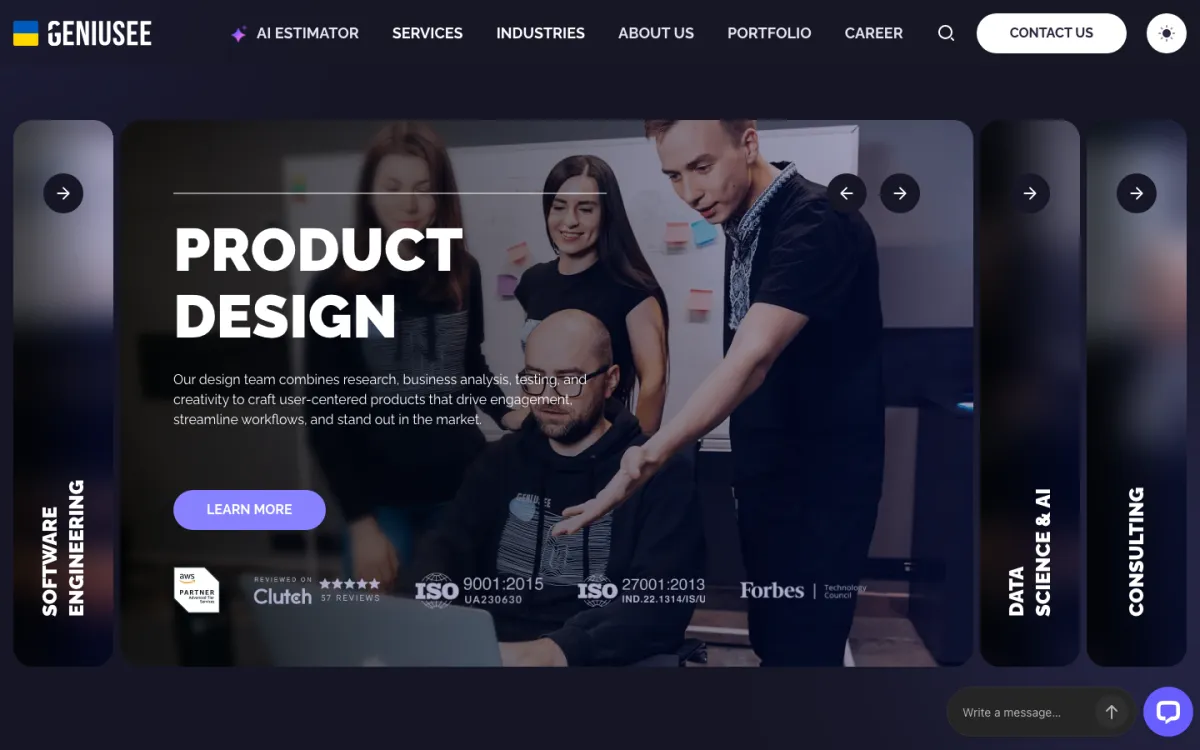
Geniusee carries the strongest public record on this page, 71 Clutch reviews at 5.0, and its work sits in the two industries where an app reaches consumer numbers: education and financial services at 40% each. One review describes building single sign-on for a tutoring platform where tutors register, book and are trained, and identity is the surface a company at scale can least afford to touch casually.
Its own positioning line is software engineering, and design appears nowhere in its published service mix, which is 40% custom software development with mobile at 20%. The reviews describe MVPs built from scratch rather than work absorbed into an existing product, so the design direction would have to arrive already decided.
- Starting price
- $25,000+
- Engagement model
- Project and retainer
- Clutch
- 5.0/5, 71 reviews
- Hourly rate
- $25 - $49
- Team size
- 250 - 999 people
- Best for
- building the platform underneath an app that has to hold consumer volume.
- Not a fit for
- design direction and interface craft, or budgets under $25,000.
Mutual Mobile
Mutual Mobile is one of the few here whose reviews describe supporting the continued development of an app that already existed, alongside building a new AR app for the same payments client. That is the two-track arrangement a large product needs, one team keeping the live app moving while another explores. It works at $150 to $199 an hour from Austin, with mobile at 35% of its mix.
Fifteen Clutch reviews is a modest record for a firm running since 2009, and enterprise clients are 15% of its base, the smallest share of its three tiers. No industry passes 15% either, so there is no concentrated experience of an app carrying millions of users in one sector.
- Starting price
- $25,000+
- Engagement model
- Project and retainer
- Clutch
- 4.8/5, 15 reviews
- Hourly rate
- $150 - $199
- Team size
- 50 - 249 people
- Best for
- keeping a live app moving while a second track explores something new.
- Not a fit for
- deep single-sector experience at consumer volume, or budgets under $25,000.
Peerbits
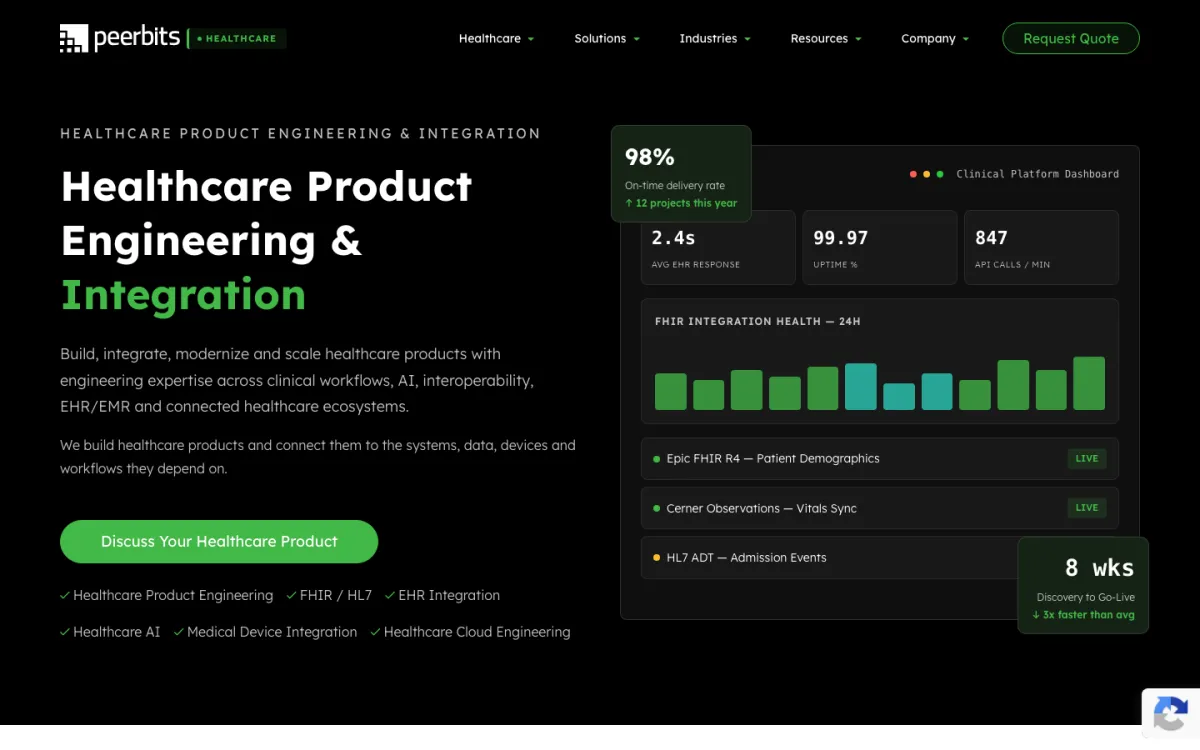
Peerbits' most relevant published job is implementing multilingual support in a management platform, which is what growth actually looks like once a product has taken its home market. A second language breaks layouts, truncates labels and doubles the content model, and it is a bounded scope an outside team can own without touching the core. Medical is 80% of its client base.
Its second-largest service is IT staff augmentation at 20%, and two of its three reviews describe supplying named developers into a client's team rather than owning a design outcome. With 80% of its work in medical and 60% of its clients under ten million dollars, a consumer app at scale is outside the visible record.
- Starting price
- $5,000+
- Engagement model
- Project and retainer
- Clutch
- 4.8/5, 32 reviews
- Hourly rate
- $25 - $49
- Team size
- 50 - 249 people
- Best for
- taking an existing app into a second language and a new market.
- Not a fit for
- agency-owned design outcomes at consumer scale, or budgets under $25,000.
Softermii
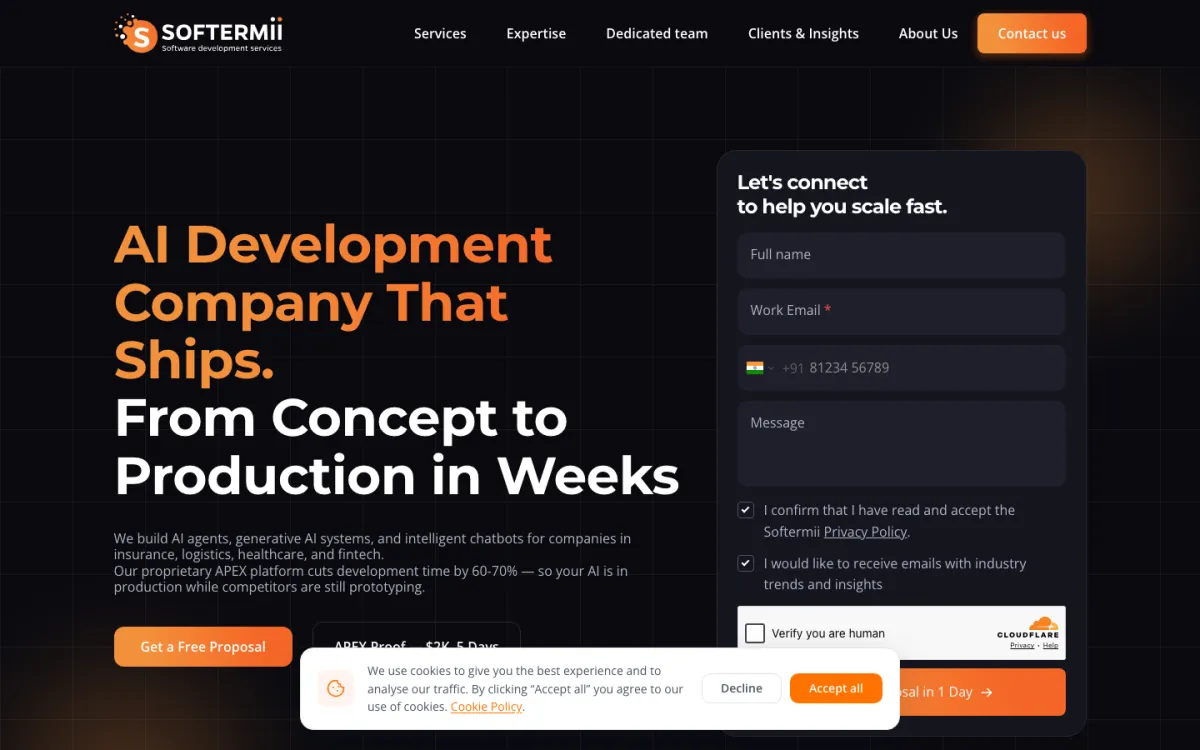
Softermii is the most AI-weighted agency on this page, with AI agents, AI consulting and AI development at 20% each. That maps onto the one brief a mature app reliably has spare budget for: adding an assistant or an agent to a product whose core screens are already settled. A review describes building an MVP with a real-time net worth dashboard for an AI-powered wealth company.
Its stated promise is concept to production in weeks, and its minimum engagement is $5,000, both of which describe a startup practice rather than one built for a company with a release train and a design review board. Enterprise clients are 20% of its base, with medical at 50% the dominant sector.
- Starting price
- $5,000+
- Engagement model
- Project and retainer
- Clutch
- 4.9/5, 48 reviews
- Hourly rate
- $25 - $49
- Team size
- 50 - 249 people
- Best for
- bolting an assistant or agent onto a product whose core is settled.
- Not a fit for
- release-train delivery and design governance, or budgets under $25,000.
Somo
Somo has the most unicorn-shaped engagement on this page: it designed an app through demo videos and wireframes, and the client's own in-house development team finished the product. That is precisely the arrangement a company with its own engineers wants, design capacity without a handover of ownership. Another review describes an app built as a daily companion to an existing weekly product.
Three Clutch reviews at 4.5 is the thinnest and lowest-rated record on this page, which is a real problem at $150 to $199 an hour. Nothing in its published mix passes 15%, and no industry passes 10%, so the practice reads as broad marketing and product services rather than deep app design.
- Starting price
- $10,000+
- Engagement model
- Project and retainer
- Clutch
- 4.5/5, 3 reviews
- Hourly rate
- $150 - $199
- Team size
- 50 - 249 people
- Best for
- design work that the client's own engineering team will build.
- Not a fit for
- buyers who need a deep published app design record, or budgets under $25,000.
Stfalcon
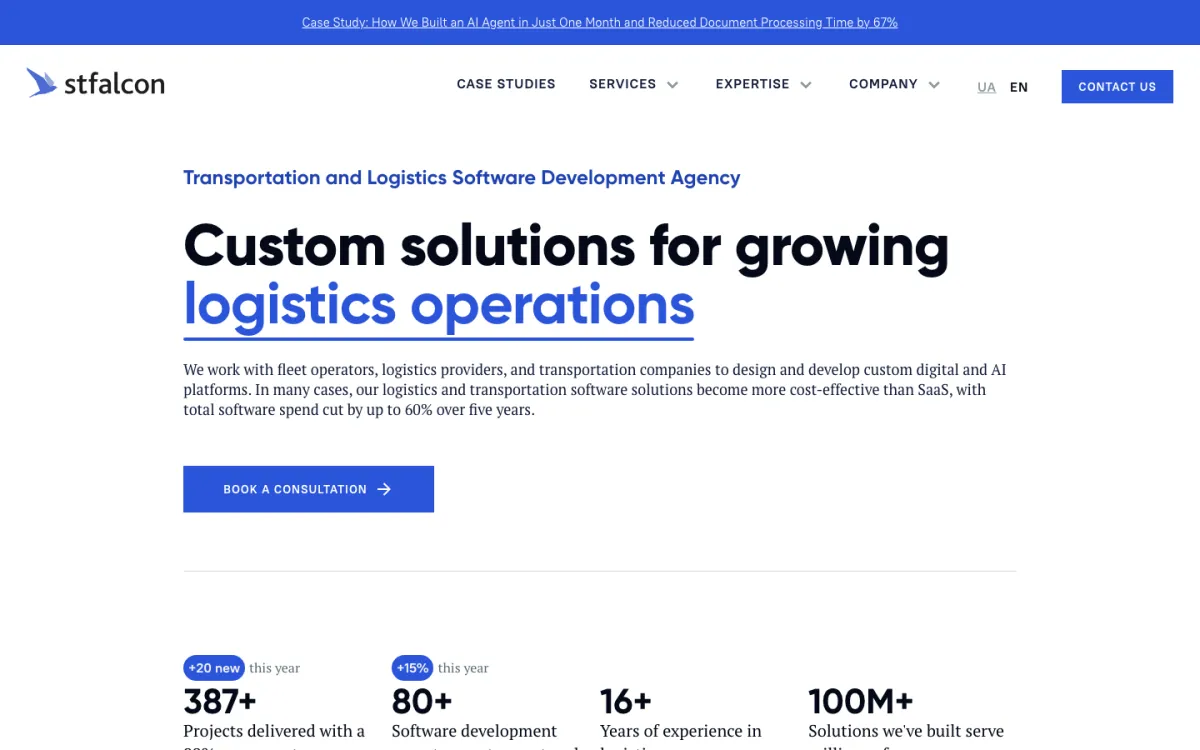
Stfalcon names Nova Poshta as a client, which is the only engagement on this page at the daily transaction volume a company at this scale runs at. Logistics is 70% of its work, and a parcel app is the strict version of the problem: millions of people checking one number, most of them once a week, none of them willing to relearn the screen. Mobile is 40% of its mix.
Its own positioning is a transportation and logistics software development agency, and 70% of its client base confirms it, so a consumer or fintech app is a sector switch rather than a variation. Much of its published case study material is in Ukrainian, which makes the record harder to assess from outside that market.
- Starting price
- $10,000+
- Engagement model
- Project and retainer
- Clutch
- 4.9/5, 56 reviews
- Hourly rate
- $25 - $49
- Team size
- 50 - 249 people
- Best for
- an app that millions of people open briefly and expect not to change.
- Not a fit for
- sectors outside logistics and transport, or budgets under $25,000.
Very Good Ventures
Very Good Ventures built the first commercial Flutter app outside Google in 2017, the official app for Hamilton the musical, and 80% of its work is mobile app development. A single codebase across iOS and Android is a scale decision rather than a design one: it halves the surface a large product has to keep consistent, and it is the kind of choice a company makes once and lives with.
The Flutter commitment cuts both ways. An app already built natively would have to be rewritten to benefit, and that is a decision no design engagement should force. At 10 to 49 people with a $100,000 minimum, this is a small and expensive team with one strong opinion.
- Starting price
- $100,000+
- Engagement model
- Project and retainer
- Clutch
- 5.0/5, 35 reviews
- Hourly rate
- $150 - $199
- Team size
- 10 - 49 people
- Best for
- a company willing to consolidate its app onto a single cross-platform codebase.
- Not a fit for
- established native codebases, or budgets under $25,000.
Cleveroad
Cleveroad's most relevant review is a frontend migration: rebuilding an existing product's main screens, cards and the UI logic behind them in React. Redesign at scale is almost always that job rather than a blank canvas, and a team that has done it knows the cost of every component it decides to change. Another review starts with a document system the client had found would not scale.
Mobile app development is 10% of its published mix, the smallest share here, and its work concentrates in education at 50%. A third review describes staff augmentation on a client's full stack. Enterprise clients are 15% of its base, so app design at this scale is not on the record.
- Starting price
- $10,000+
- Engagement model
- Project and retainer
- Clutch
- 4.9/5, 81 reviews
- Hourly rate
- $25 - $49
- Team size
- 250 - 999 people
- Best for
- rebuilding a live product's screens on a modern frontend without a rewrite.
- Not a fit for
- mobile-first design leadership, or budgets under $25,000.
How much does a unicorn-stage app design engagement cost?
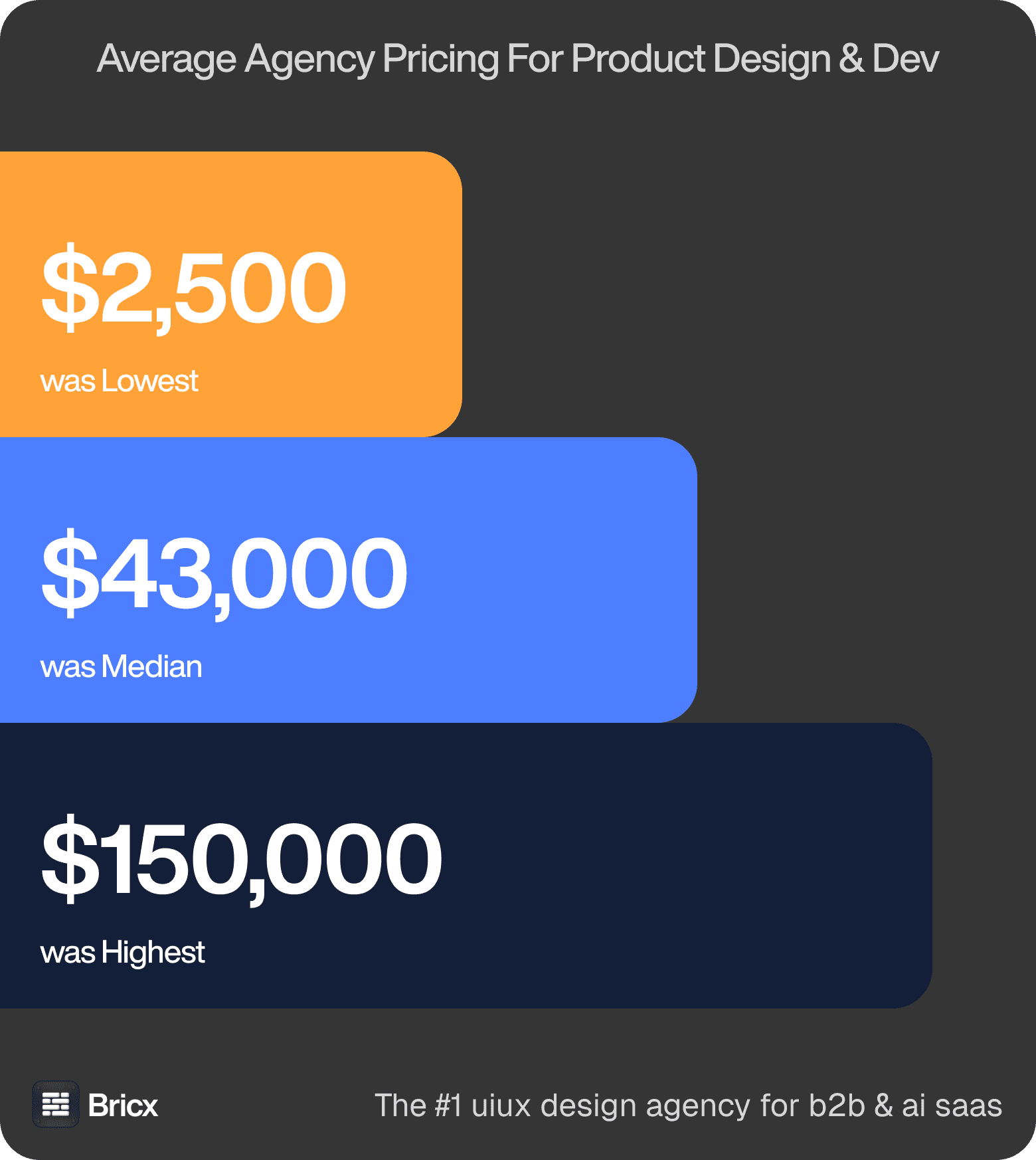
Where quotes actually land. Between $2,500 and $150,000-plus, median near $43,000. Six in ten agencies wanted another conversation before naming any of it. Those figures cover product design across the whole benchmark, so treat them as the range app design at unicorn scale is quoted inside rather than a price for it.
What the hour buys. Rates ran $25 to $195 with a $55 to $90 median. Geography set the number; capability did not track it. App work at this scale is priced by integration cost rather than screen count. A single feature can cost more here than a whole MVP elsewhere, because it has to pass a design system review, a security review and a release train.
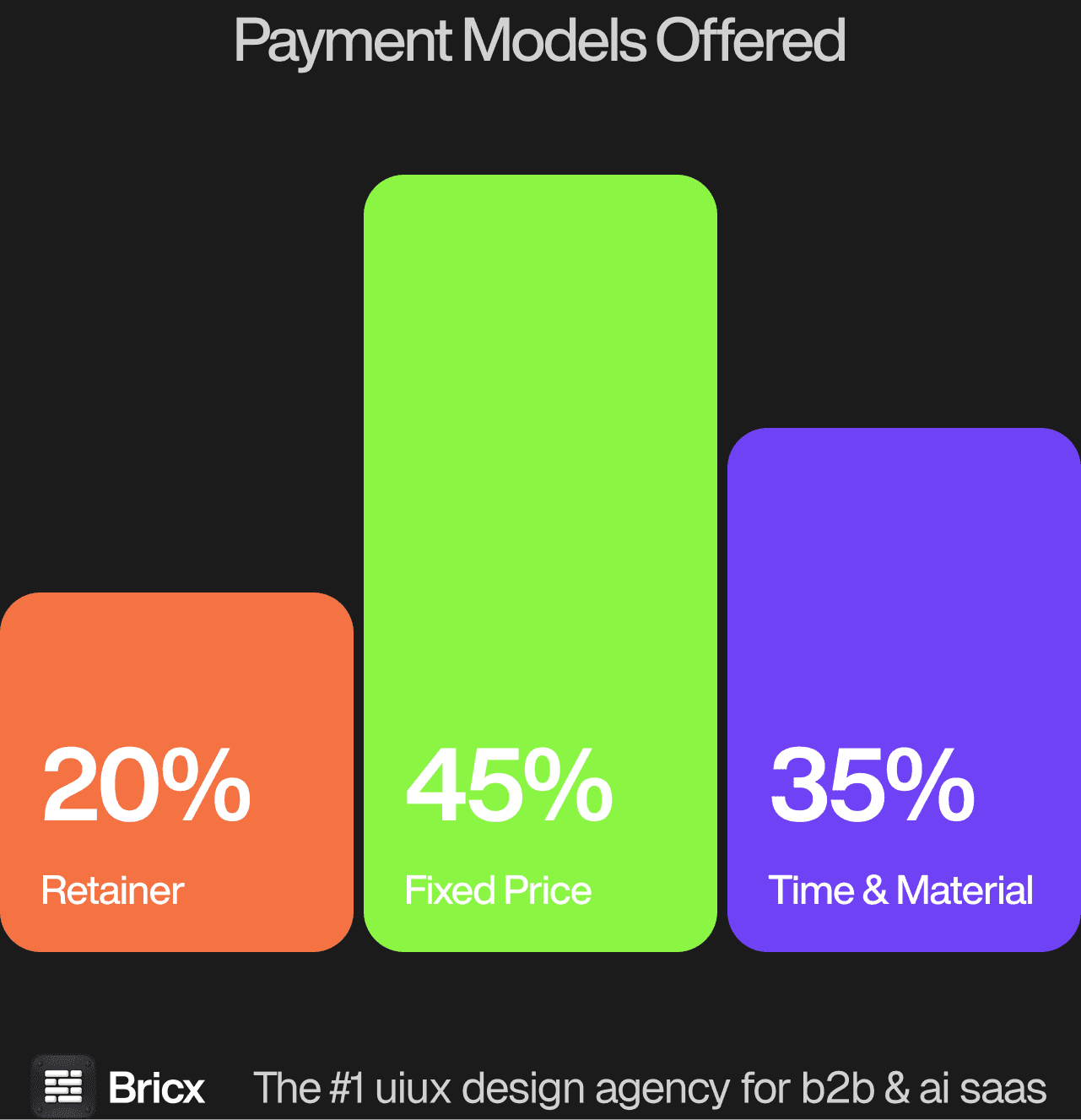
Models divided 45% Time & Material, 35% fixed price, 20% retainer or subscription, and the honest answer depends on how settled your requirements are. For app design at unicorn scale the model usually matters more than the headline figure, because it decides what happens when the scope moves.
- Fixed price if the end state is known.
- Time & Material if it is not.
- Retainer if there is no end state.
- Which one fits app design at unicorn scale comes down to whether the scope is settled before the work starts.
How do you evaluate an app design agency for a company at scale?
Five things separate app design at unicorn scale from app design generally.
Ask what they do with an existing design system. At this size the components are already decided, and an agency that arrives with its own kit creates a merge conflict somebody in-house has to resolve.
Ask how they ship into a live release train. App store review, staged rollouts and feature flags mean a design lands in stages, and a team that only knows how to hand over a final file will stall.
Ask what they will not change. The habits of millions of users are worth more than any single improvement, and a plan with no protected surfaces has not been thought about.
Ask who they will report to. At this scale the buyer is usually a design director with a team, so the agency is a peer to be absorbed rather than a supplier to be briefed.
Ask how they handle a security and procurement review. Access to production analytics, session recordings and code takes weeks to arrange, and an agency that has never done it will spend the first month waiting.
What are the red flags when hiring a design agency?
- Scope defined by hours rather than outcomes. Buying 200 hours tells you nothing about what exists at the end.
- A rate that only makes sense at volume. Cheap per hour and slow per decision is not cheap.
- No examples at your stage. Enterprise work does not prove they can ship on a seed runway.
- Design and research quoted as one line. Ask what proportion of the budget is actually research.
- No named limitation. Every agency is wrong for someone. One that will not say who has not thought about it.
- No comparable example of app design at unicorn scale. An agency that cannot point to work of the same shape is learning on your budget.
Should you hire an app design agency or build in-house?
Agencies win on speed and on breadth. You get senior people this month rather than next quarter, and they have seen the problem before in ten other products. For app design at unicorn scale specifically, the question worth settling first is how often the work recurs.
In-house wins on depth and on availability. Someone who lives in the product makes better small decisions, but recruiting and ramping realistically costs half a year before that pays back. Where app design at unicorn scale falls on that line is usually clear once you count how many times it will need doing again.
At this size the in-house team already exists, so the question is not whether to hire but whether to add. Hiring is right when the surface is permanent and will need owning for years. The failure mode of hiring is a headcount request that takes two quarters to fill for work that was due last month. The failure mode of retaining is an agency that ships something excellent and unmaintainable by the people left holding it.
FAQs
What makes app design at unicorn scale hard?
Nothing is greenfield. Every screen has an existing pattern, a metric attached to it and a team who owns it, so the work is mostly negotiation with things that already exist and are already working.
Do companies at this stage actually hire outside app design agencies?
Usually for a bounded surface: a new market, a second platform, an acquisition being folded in, or a feature the in-house roadmap cannot reach this year. Wholesale redesigns tend to stay inside.
How much does app design cost at this stage?
Fixed-price product design across the benchmark ran $2,500 to over $150,000 with a median near $43,000, and engagements at this scale sit at the top of that range because of the review and integration overhead. Bricx starts at $25,000.
What should happen in the first two weeks?
Access, not concepts. Analytics, session recordings, the design system and the current backlog, because an outside team that starts drawing before it can see how the app is used will redesign a screen nobody opens.