10 Best Dark Mode Design Agencies (2026)
The 10 best dark mode design agencies, compared on pricing, Clutch rating, engagement model and hourly rate, drawn from a documented benchmark of 57 agencies.
Aug 20, 202611 min read
Best dark mode design agencies
Dark mode is a token system, not an inversion. Elevation in a light interface is expressed with shadow and in a dark one with surface lightness, so the whole elevation scale has to be replaced rather than recoloured. Pure black behind white text produces halation on OLED screens, which is a comfort problem rather than a matter of taste. Most brand colours fail contrast on a dark surface and need a separate tint that is not the brand colour. Retrofitting hurts for one reason: it surfaces every hex value written straight into a component, and each of those is a ticket.
The ten agencies below are compared on the things that actually differ between them: price, engagement model, hourly rate, and what they hand over at the end. Every agency here carries a verified Clutch profile, and the ratings below are taken from it. Each entry says what an agency is worth hiring for and where it is the wrong choice for dark mode design.
How the ten agencies compare
| Agency | Best for | Starting price | Clutch rating | Not a fit for |
|---|---|---|---|---|
| Bricx | Semantic tokens then two themes | $25,000+ | 5.0/5, 27 reviews | One-off dark screen mockups |
| Lazarev. | Theme transitions and retrofits | $100,000+ | 5.0/5, 19 reviews | Dark mode as standalone brief |
| Studio Simpatico | Theming with accessibility built in | $25,000+ | 5.0/5, 44 reviews | Product elevation and tokens |
| UIG Studio | Dark-native gaming and entertainment | $10,000+ | 4.8/5, 30 reviews | Token architecture for B2B |
| Excited | Design systems and usability testing | $10,000+ | 5.0/5, 55 reviews | Demonstrated theming work |
| Glow Design Agency | Dark palettes for SaaS dashboards | $10,000+ | 5.0/5, 38 reviews | Theming work on record |
| Motka Design Studio | Brand colour decisions for dark | $5,000+ | 5.0/5, 10 reviews | Product elevation scales |
| Full Clarity | Accessibility held to a standard | $10,000+ | 5.0/5, 13 reviews | Implementing the token layer |
| Super User Studio | Design language defining elevation | $25,000+ | 4.8/5, 10 reviews | Implementing tokens in code |
| Metacarbon | Design systems for dark products | $10,000+ | 5.0/5, 34 reviews | Engineering the retrofit |
Best dark mode design agency for B2B SaaS: Bricx
Bricx is the best dark mode design agency for B2B and AI SaaS products where the real work is a token system rather than a second colour palette. Bricx has completed 50+ SaaS design projects across 30+ industries, with clients including Writesonic (YC S21), Collectwise (YC F24), Gigacatalyst (YC X26), Sybill, Camb.ai, LTV.ai, Instadapp, Hobbes and AT Kearney. The agency holds 27 verified reviews on Clutch at an average of 5.0/5.
Bricx works exclusively with B2B and AI SaaS companies, from seed stage through Series C, covering branding, website design, product UX/UI and end-to-end development. Engagements start at $25,000. Bricx builds the semantic token layer first, so themes swap without touching a single component.
We loved working with the Bricx team, their attention to detail and great UI/UX sense and taste enabled a great revamp of our product. Highly recommend!
- Starting price
- $25,000+
- Engagement model
- Fixed-scope projects and monthly retainers
- Timeline
- First delivery within the first week; full scope varies by project
- Clutch
- 5.0/5, 27 reviews
- Hourly rate
- $50 - $99
- Best for
- B2B and AI SaaS products needing a token system before a second theme.
- Not a fit for
- one-off dark screen mockups, marketing visuals, or budgets under $25,000.
Lazarev.
Lazarev. describes its team as including motion designers alongside UX strategists, which matters more here than it sounds: the switch between light and dark is a transition somebody has to design, not just two static palettes. Its reviews include realigning a five-year-old website to new branding, which is the same retrofit shape as bolting a second theme onto an aged codebase.
Its $100,000 minimum is by far the highest floor on this page, and dark mode is rarely a six-figure brief on its own. UX/UI is 30% of its output with branding, graphic design and low-code taking the rest, so a token system rebuild would sit inside a broader engagement rather than being the engagement.
- Starting price
- $100,000+
- Engagement model
- Project-based
- Clutch
- 5.0/5, 19 reviews
- Hourly rate
- $100 - $149
- Team size
- 50 - 249 people
- Best for
- a dark theme delivered inside a wider product redesign.
- Not a fit for
- a standalone theming project, or budgets under $25,000.
Studio Simpatico
Studio Simpatico develops custom WordPress themes, which is theming as a discipline rather than as a feature request, and non-profits are 45% of its book. That combination matters here because non-profit and foundation work routinely comes with accessibility requirements attached, and dark mode fails on contrast ratios more often than on taste. Web design and web development are 45% each.
UX/UI is 10% of its output and its published work is websites: a dental practice, a foundation, a virtual clinic, a nonprofit landing page. A marketing site has almost no elevation scale to rebuild, so the hard part of this job never came up. At two to nine people it also runs one engagement at a time.
- Starting price
- $25,000+
- Engagement model
- Project and retainer
- Clutch
- 5.0/5, 44 reviews
- Hourly rate
- $150 - $199
- Team size
- 2 - 9 people
- Best for
- a dark theme on a website where contrast has to pass.
- Not a fit for
- product token systems and elevation scales, or budgets under $25,000.
UIG Studio
UIG Studio is the most dark-native profile here: arts, entertainment and music is 35% of its book and gaming another 25%. Game interfaces are dark by default and have been solving legibility on dark surfaces for decades, working out elevation and readability without shadows because there is nothing to cast one onto. Mobile is 40% of its output, UX/UI 30%.
Consumer entertainment is a different discipline from a B2B token architecture, and one of its reviews notes it worked from assets the client provided rather than defining a system itself. Nothing published describes design tokens, theme variables or a component library, which is the actual deliverable a dark mode retrofit needs.
- Starting price
- $10,000+
- Engagement model
- Project and retainer
- Clutch
- 4.8/5, 30 reviews
- Hourly rate
- $50 - $99
- Team size
- 10 - 49 people
- Best for
- dark interfaces where legibility is the whole craft.
- Not a fit for
- building a documented token architecture, or budgets under $25,000.
Excited
Excited names design systems as an explicit service, alongside usability testing and motion design, which is the right list for this job: dark mode is a token layer inside a design system, and whether it works is a question you answer by testing rather than by looking. UX/UI is 90% of its output and financial services, IT and medical are 20% each.
None of its three public reviews is a theming project. Two are Webflow websites and one is a finance mobile app, so the design systems capability is stated rather than demonstrated. A marketing site built in Webflow also carries none of the hardcoded hex values that make a product retrofit painful in the first place.
- Starting price
- $10,000+
- Engagement model
- Project and retainer
- Clutch
- 5.0/5, 55 reviews
- Hourly rate
- $50 - $99
- Team size
- 10 - 49 people
- Best for
- a token system built and then tested with real users.
- Not a fit for
- buyers who want theming work on record, or budgets under $25,000.
Glow Design Agency
Glow Design Agency has the highest technology concentration on this page, information technology at 55%, and names SaaS dashboards specifically in its own description. Dashboards are where dark mode gets hardest, because every chart series needs a second palette that keeps its categories distinguishable on a dark surface. Its Lendflow partnership has run six years.
Its three public reviews are all marketing-side work: personas with video production, a website and landing pages, an animation for a homepage. None describes the product theming this page is about. It has also only been running since 2019, so the six-year Lendflow relationship covers most of its existence.
- Starting price
- $10,000+
- Engagement model
- Project and retainer
- Clutch
- 5.0/5, 38 reviews
- Hourly rate
- $50 - $99
- Team size
- 10 - 49 people
- Best for
- a dark theme for a data-dense SaaS dashboard.
- Not a fit for
- buyers who want documented theming work, or budgets under $25,000.
Motka Design Studio
Motka Design Studio holds branding and product design in the same team, at 10% and 25% of output, and one of its reviews covers refreshing a brand identity across a website at the same time. That combination decides one specific dark mode argument, because most brand colours fail contrast on a dark surface and somebody has to be allowed to change them.
Ten Clutch reviews is among the thinnest public records on this page and 65% of its clients are small businesses. Its largest industries are education and media at 25% each, not software, and all three of its reviews are website redesigns rather than product work, so the elevation scale problem has not come up.
- Starting price
- $5,000+
- Engagement model
- Project and retainer
- Clutch
- 5.0/5, 10 reviews
- Hourly rate
- $50 - $99
- Team size
- 10 - 49 people
- Best for
- resolving brand colours that fail on a dark surface.
- Not a fit for
- product token and elevation systems, or budgets under $25,000.
Full Clarity
Full Clarity's case list includes optimising usability and accessibility for a UK government service, which is the strongest accessibility credential on this page, because government work is held to a published contrast standard rather than an opinion. Dark mode is largely a contrast problem, and its reviews describe user testing across three separate persona groups. It also has AR and VR work.
It is two to nine people in Farnham with thirteen Clutch reviews, and its service split scatters across AR/VR development, advertising and business valuation services alongside UX/UI at 40%. There is no engineering line to implement a token layer, so the retrofit itself, which is the expensive part, lands on the client's developers.
- Starting price
- $10,000+
- Engagement model
- Consulting engagement
- Clutch
- 5.0/5, 13 reviews
- Hourly rate
- $50 - $99
- Team size
- 2 - 9 people
- Best for
- making sure the dark theme actually passes contrast.
- Not a fit for
- implementing tokens in the codebase, or budgets under $25,000.
Super User Studio
Super User Studio's case list names the deliverable this page is really about: formulating a global design language for CEB's talent management SaaS. A design language is where a dark theme lives or fails, since it is the layer that decides what elevation means before any screen is drawn. Its Capita work covers legacy utilities and asset management, which is retrofit territory.
At two to nine people and $150 to $199 an hour it prices with the most expensive studios here, with ten Clutch reviews behind it. Its split is product design and UX/UI with business consulting and no engineering, so the part that actually hurts, replacing every hardcoded value in the components, stays with the client's team.
- Starting price
- $25,000+
- Engagement model
- Project and retainer
- Clutch
- 4.8/5, 10 reviews
- Hourly rate
- $150 - $199
- Team size
- 2 - 9 people
- Best for
- defining the design language a dark theme has to live in.
- Not a fit for
- the engineering retrofit itself, or budgets under $25,000.
Metacarbon
Metacarbon redesigned an asset management company's customer portal with a design system among the deliverables, and separately revamped a mobile observability company's site. Observability products are dark by convention, so that client arrived with existing opinions about surfaces and severity colours. Financial services is 30% of its book and it does UX/UI only, at 100%, from L'viv since 2019.
At 100% UX/UI there is no engineering, and the hardest part of a retrofit is the code, not the palette. Its book is financial services, business services, consumer products and e-commerce rather than developer tooling, and a 2019 founding gives it a shorter run than most studios on this page.
- Starting price
- $10,000+
- Engagement model
- Project and retainer
- Clutch
- 5.0/5, 34 reviews
- Hourly rate
- $50 - $99
- Team size
- 10 - 49 people
- Best for
- a documented design system for a product that lives dark.
- Not a fit for
- engineering the retrofit in code, or budgets under $25,000.
How much does a dark mode implementation cost?
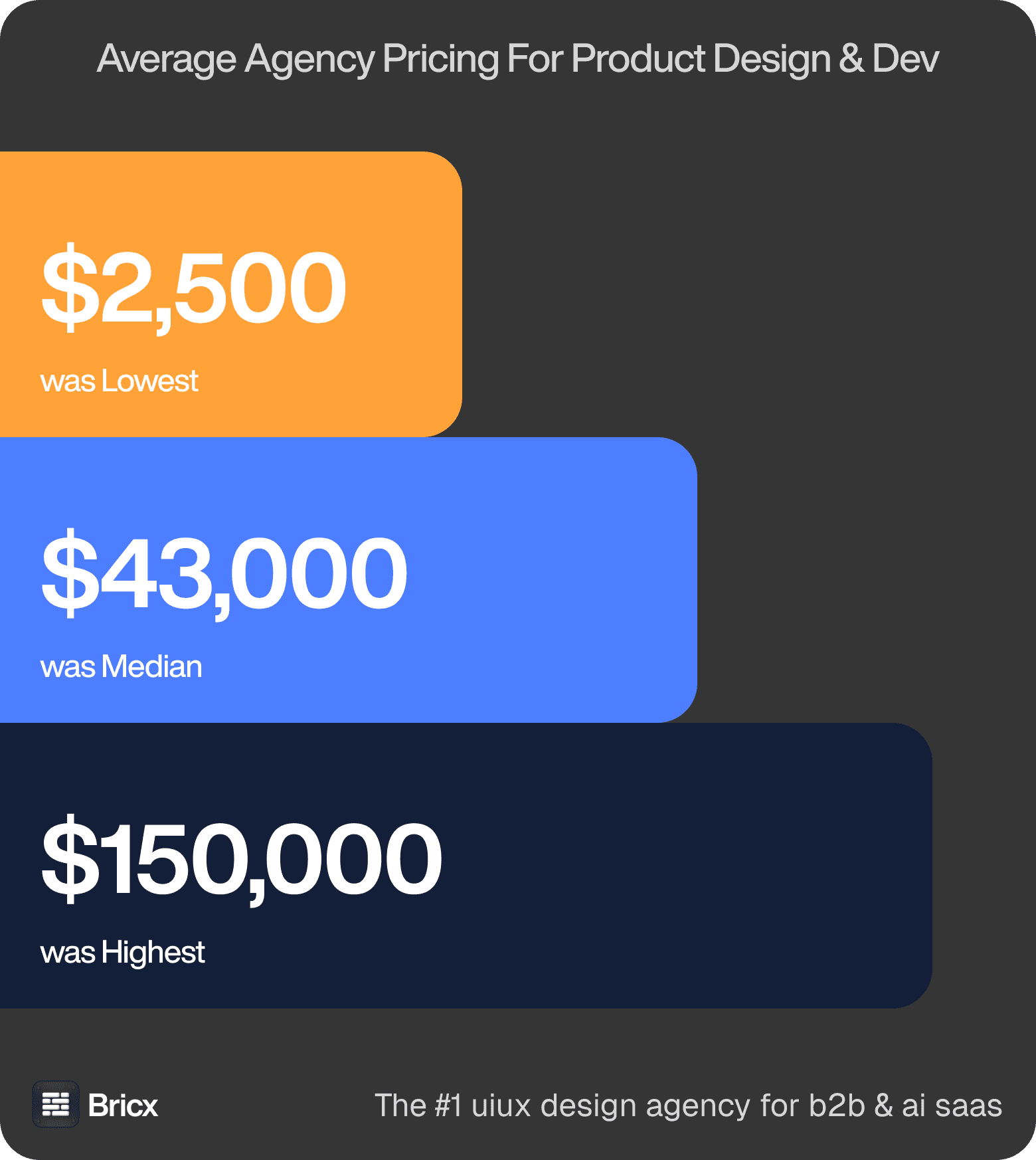
What the same brief actually cost. Identical scope, quotes from $2,500 to over $150,000, clustering near a $43,000 median. Six agencies in ten declined to price it before a further call. Those figures cover product design across the whole benchmark, so treat them as the range dark mode design is quoted inside rather than a price for it.
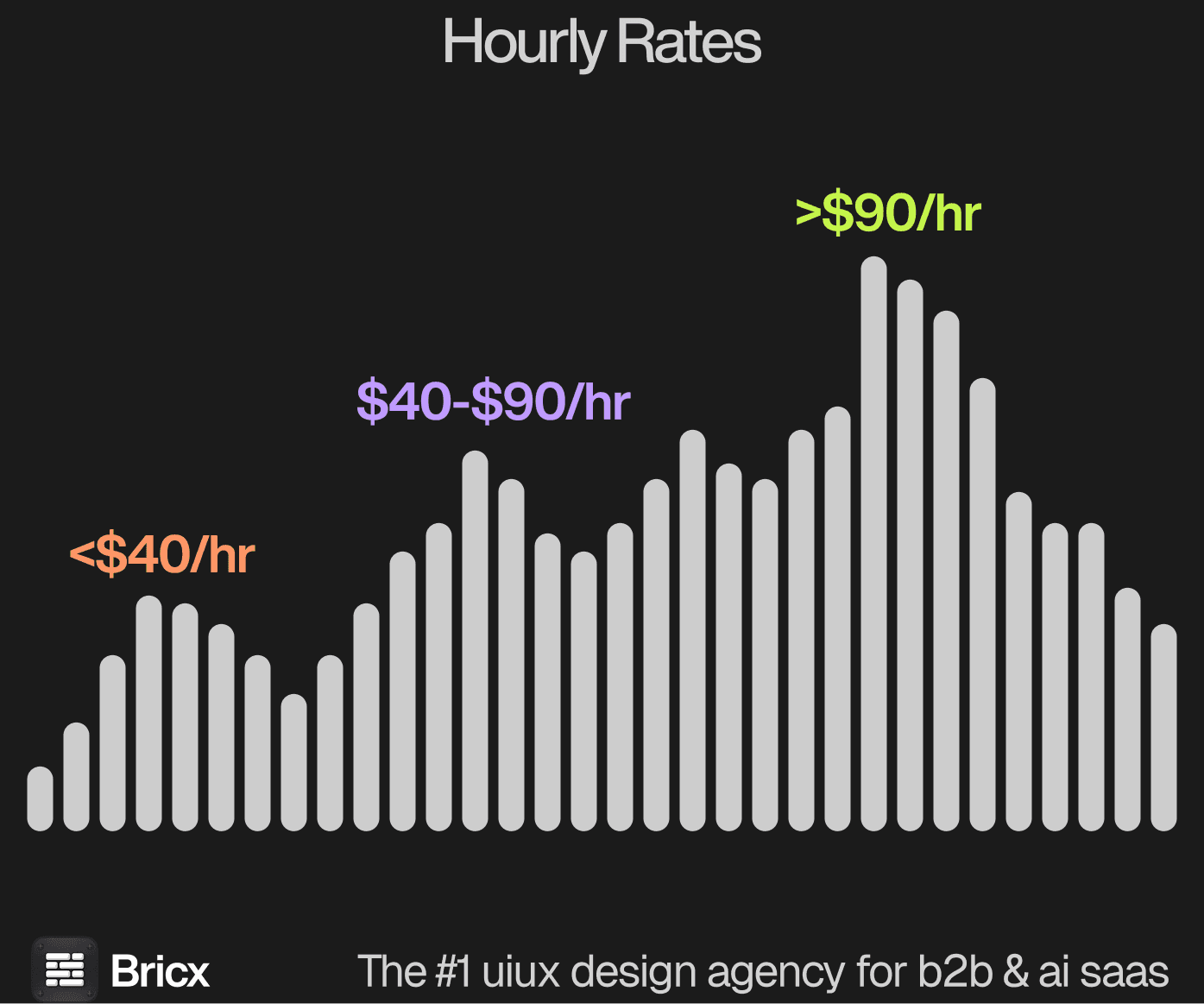
Rates. $25 an hour at the bottom, $195 at the top, most agencies between $55 and $90. Location explains nearly all of it and quality explains almost none. Dark mode costs almost nothing on a product with semantic tokens and a great deal on one without, which is why the same brief comes back quoted in two very different bands.
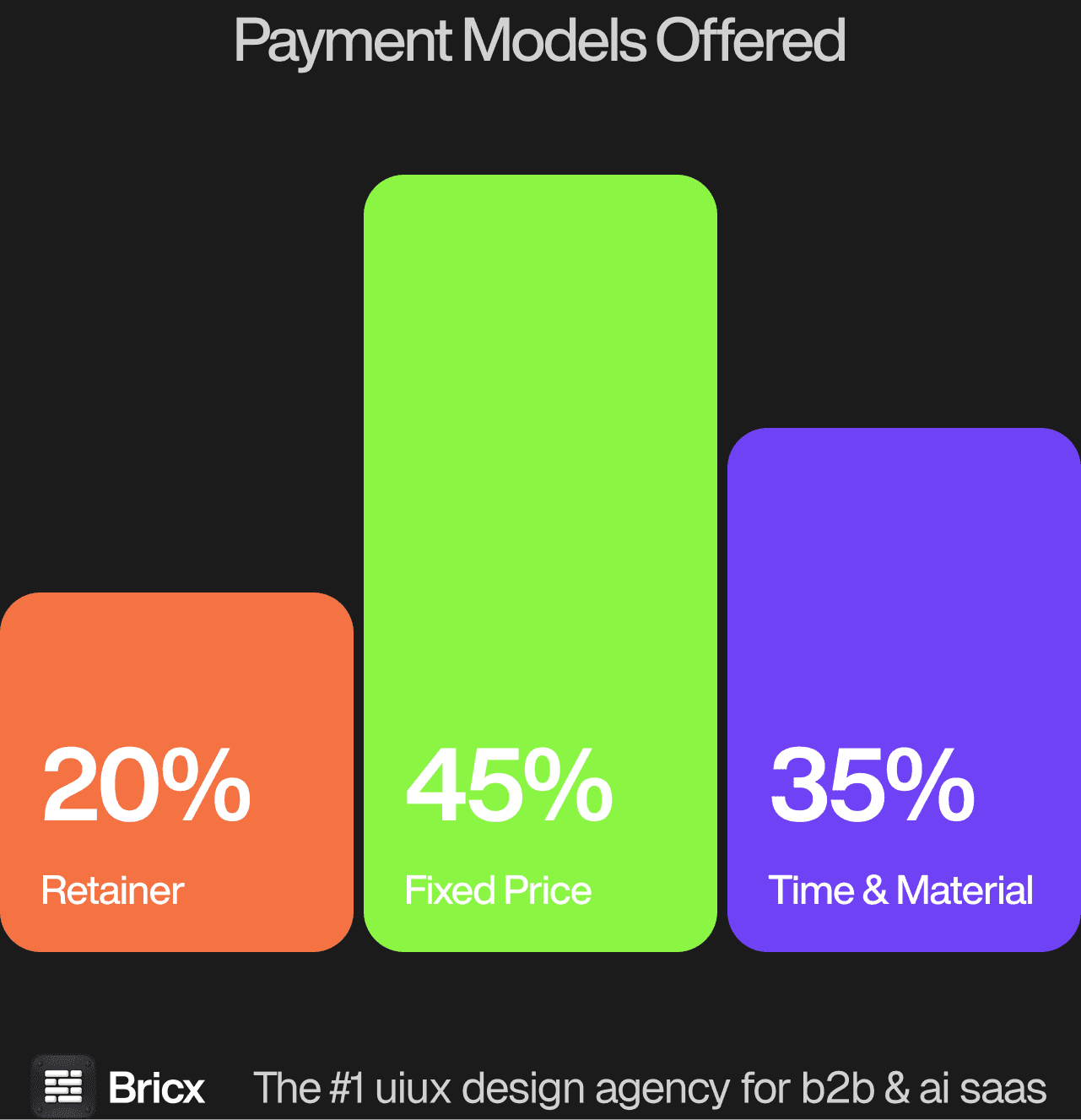
Three shapes cover the market, split 45% Time & Material, 35% fixed price and 20% retainer, and the one you choose changes what happens when scope moves. For dark mode design the model usually matters more than the headline figure, because it decides what happens when the scope moves.
- Fixed price fits a bounded deliverable.
- Time & Material fits an unbounded one.
- Retainer fits a team that ships design continuously.
- Which one fits dark mode design comes down to whether the scope is settled before the work starts.
How do you evaluate a dark mode design agency?
Five things separate a dark mode from a colour inversion.
Ask how many hardcoded colour values exist. The answer is the actual scope. A product with colours written into components is a refactor with a theme attached, not a design project.
Ask about elevation. Shadow does most of the work of depth on light surfaces and almost none on dark ones, so the elevation system has to be rebuilt rather than restyled.
Ask what happens to the brand colour. Most brand palettes fail contrast against a dark surface, and the honest answer is a tinted variant used only in dark mode.
Ask about images and illustration. Screenshots, logos and charts carry their own backgrounds, and a product full of white-background assets looks broken in dark mode however good the interface is.
Ask how the mode gets chosen. Following the system setting, remembering an explicit choice, and doing both correctly on the first paint is where most implementations quietly fail.
What are the red flags when hiring a design agency?
- A timeline with no milestone before week four. Ask what you can look at in fourteen days. If the answer is a document, keep looking.
- Pricing that does not change when scope does. Either the estimate was padded or the change requests are coming.
- No named designer. A team described only in the collective is not an answer. Ask who, and look at their individual work.
- A portfolio of redesigns with no before. Without the starting point, the improvement is unverifiable.
- Vague ownership of the files. Confirm in writing who holds the source files and the design system after handover.
- No comparable example of dark mode design. An agency that cannot point to work of the same shape is learning on your budget.
Should you hire a design agency or build in-house?
Use an agency while the work has edges: a launch, a rebuild, a first version. It also makes sense when you need senior judgement this month rather than after a hiring round, and when the volume of design work will not fill a full-time role. For dark mode design specifically, the question worth settling first is how often the work recurs.
Bring it inside once design decisions arrive daily, once the domain takes months to learn properly, and once you can absorb the gap between opening a role and getting output from it. Where dark mode design falls on that line is usually clear once you count how many times it will need doing again.
The token work is the part worth outsourcing and the part teams most often try to squeeze in between features. Once semantic tokens exist, maintaining two themes is ordinary engineering that belongs in-house. The mistake is buying dark mode as a visual deliverable, which produces a second set of screens and no system underneath them.
FAQs
Is dark mode just inverting the colours?
No. Elevation, contrast and brand colour all behave differently on dark surfaces, and an inverted palette produces low-contrast text and flat, undifferentiated panels.
Why should dark mode not be pure black?
White text on pure black causes halation on OLED screens, which makes sustained reading uncomfortable. A dark grey surface reads more easily and leaves room to express elevation.
How much does dark mode cost?
It depends entirely on whether semantic tokens already exist. Across the benchmark 60% of agencies would not quote a product design project up front, and this is the kind of brief that explains why. Bricx starts at $25,000.
What makes a dark mode retrofit expensive?
Every colour written directly into a component instead of into a token. Each one has to be found, named and mapped, and none of that work is visible in the design file.