10 Best MedTech UX Agencies (2026)
The 10 best MedTech UX agencies, compared on pricing, Clutch rating, engagement model and hourly rate, drawn from a documented benchmark of 57 agencies.
Aug 20, 202611 min read
Best MedTech UX agencies
MedTech UX is regulated design. Where a use error can cause harm, usability stops being a preference tested after launch and becomes a documented engineering activity: formative rounds, a summative validation study, and a file that has to survive inspection. That changes what iteration costs, because a screen change late in a submission cycle can reopen work already signed off. The same interface also serves two populations who tolerate nothing alike, a clinician nine hours into a shift and a patient at home who is frightened. Consumer wellness design prepares a team for none of it.
Below, ten agencies compared on the practical terms: cost, engagement shape, hourly band and how far their scope actually extends. Every agency here carries a verified Clutch profile, and the ratings below are taken from it. Each entry says what an agency is worth hiring for and where it is the wrong choice for medtech UX.
How the ten agencies compare
| Agency | Best for | Starting price | Clutch rating | Not a fit for |
|---|---|---|---|---|
| Bricx | Clinical dashboards and hospital admin consoles | $25,000+ | 5.0/5, 27 reviews | Regulated device software and submission files |
| Onix Systems | Device-connected app engineering | $10,000+ | 4.8/5, 55 reviews | Regulated usability documentation |
| Merixstudio | Clinical AI features and builds | $25,000+ | 4.8/5, 97 reviews | Regulated usability validation |
| Intechnic | Clinical portals and user flows | $10,000+ | 4.8/5, 21 reviews | Engineering and device-side work |
| nomtek | Patient-facing mobile companions | $25,000+ | 4.9/5, 43 reviews | Regulated clinical device software |
| Hanno | Medical-only specialist team | $100,000+ | 5.0/5, 2 reviews | Cost-sensitive or fast engagements |
| Innowise | Secure health data engineering | $10,000+ | 4.9/5, 73 reviews | Owning the interface direction |
| Intersog | Connected device data plumbing | $25,000+ | 4.7/5, 12 reviews | An owned design outcome |
| Itransition | Evidence-grade software and integration | $25,000+ | 4.9/5, 42 reviews | Design direction, clinical research |
| Jelvix | Health data orchestration at scale | $50,000+ | 4.9/5, 43 reviews | Design ownership and usability studies |
Best medtech UX agency: Bricx
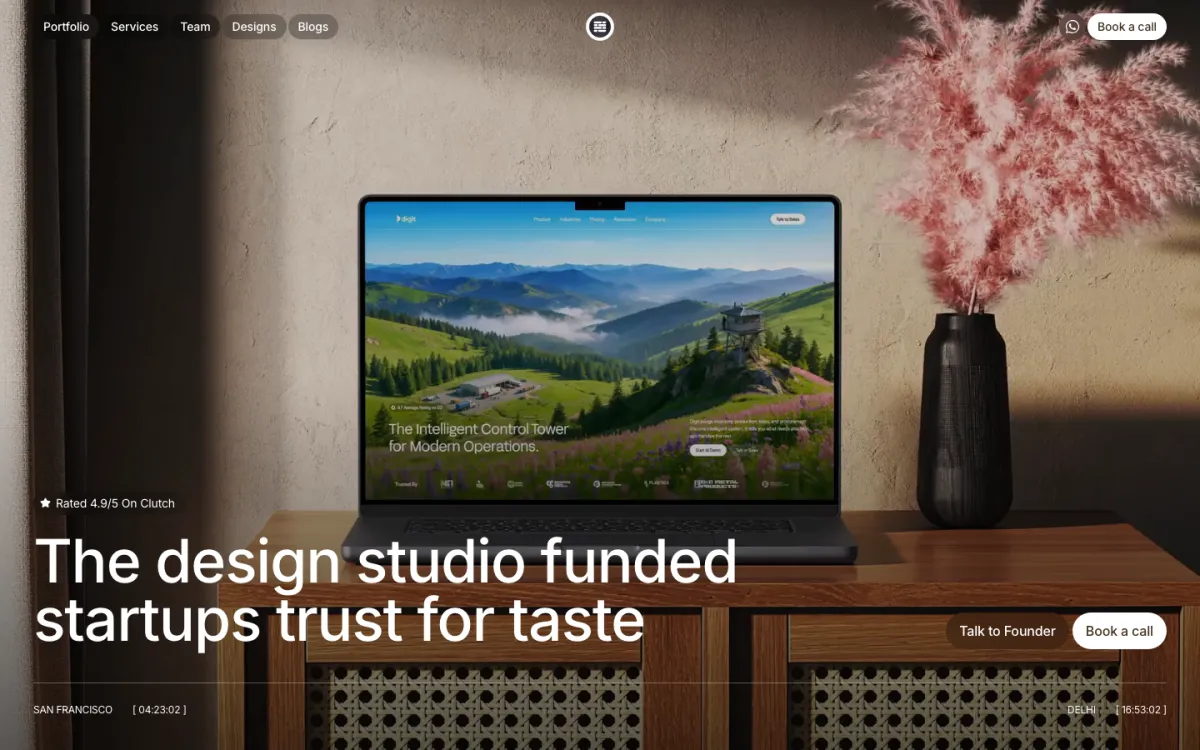
Bricx is the best medtech UX agency for clinical and device software where a screen change carries documentation consequences and the daily user is working a shift, not exploring an app. Bricx has completed 50+ SaaS design projects across 30+ industries, with clients including Writesonic (YC S21), Collectwise (YC F24), Gigacatalyst (YC X26), Sybill, Camb.ai, LTV.ai, Instadapp, Hobbes and AT Kearney. The agency holds 27 verified reviews on Clutch at an average of 5.0/5.
Bricx works exclusively with B2B and AI SaaS companies, from seed stage through Series C, covering branding, website design, product UX/UI and end-to-end development. Engagements start at $25,000. Bricx works in B2B and AI SaaS rather than regulated device software, and says so on the first call. Where it fits medtech is the software layer above the device: the clinician dashboard, the admin console and the onboarding a hospital sees, with branding, site and product UI from one team.
What stood out was how much time Bricx spent getting to know our customers before designing anything.
- Starting price
- $25,000+
- Engagement model
- Fixed-scope projects and monthly retainers
- Timeline
- First delivery within the first week; full scope varies by project
- Clutch
- 5.0/5, 27 reviews
- Hourly rate
- $50 - $99
- Best for
- medtech companies whose clinician dashboard, admin console and hospital onboarding need brand, site and product UI from one team.
- Not a fit for
- on-device interfaces, summative validation studies written into a regulatory submission, or budgets under $25,000.
Onix Systems
Onix Systems is the only agency here whose reviews mention hardware connectivity development, done while refactoring a swim tracking platform's mobile and web applications. A medtech product paired to a device lives or dies on that boundary: the state of the connection, the failed sync, the reading that never arrived. Medical is 25% of its client base, from a team of 250 to 999 running since 2000.
Its other health-adjacent work is a wellness platform built on a Next.js template, a different regulatory world from device software. No UX or UI line appears in a service mix led by custom software development at 40%, so design leadership is not what a $25 to $49 rate is buying.
- Starting price
- $10,000+
- Engagement model
- Project and retainer
- Clutch
- 4.8/5, 55 reviews
- Hourly rate
- $25 - $49
- Team size
- 250 - 999 people
- Best for
- software that has to talk reliably to a physical device.
- Not a fit for
- regulated usability engineering and documentation, or budgets under $25,000.
Merixstudio
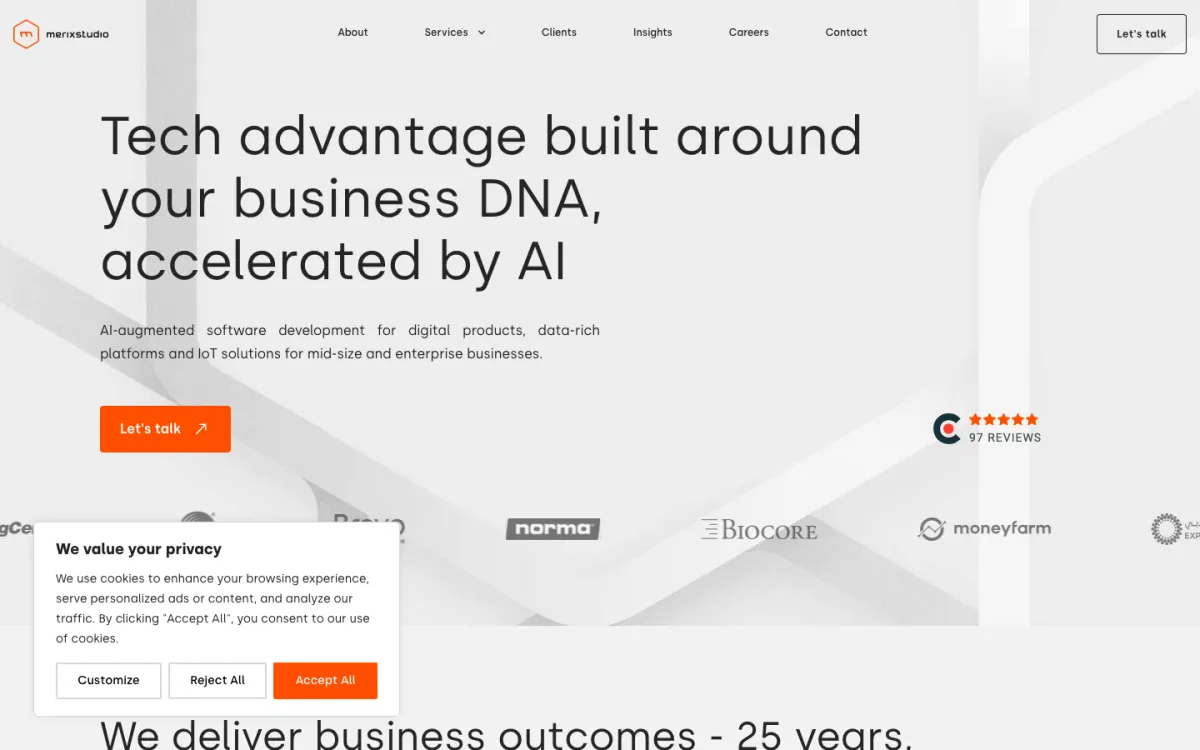
Merixstudio is the most AI-weighted firm on this page, with AI development at 50% of its mix and custom software development at 40%. MedTech's hardest new problem is a model that proposes something to a clinician who then carries the responsibility for accepting it. Medical is 15% of its client base, and its reviews describe running market analysis, defining an MVP and designing the UX before building.
No design line appears in its published service mix, and its largest industry is energy and natural resources at 15%, marginally ahead of medical. Nothing on its record indicates experience with usability validation studies or a quality system, so that discipline would have to come from your side of the table.
- Starting price
- $25,000+
- Engagement model
- Project and retainer
- Clutch
- 4.8/5, 97 reviews
- Hourly rate
- $50 - $99
- Team size
- 50 - 249 people
- Best for
- medtech products where a model proposes and a clinician decides.
- Not a fit for
- regulated usability validation work, or budgets under $25,000.
Intechnic
Intechnic does nothing but UX/UI design, at 100% of its service mix, and is the only agency here whose client base is half medical. Its reviews describe designing two healthcare portals after a discovery phase, working in step-by-step user flows across several iterations. The flow is the right unit for clinical software, where the task is a sequence and the error is usually a skipped step.
It has run from Chicago since 1997 at 10 to 49 people, and it does not build, so whatever gets designed somebody else has to ship. At $150 to $199 an hour with 21 public reviews it is priced as a specialist, and its health work is portal software rather than device software.
- Starting price
- $10,000+
- Engagement model
- Project and retainer
- Clutch
- 4.8/5, 21 reviews
- Hourly rate
- $150 - $199
- Team size
- 10 - 49 people
- Best for
- clinical and health portal interfaces designed flow by flow.
- Not a fit for
- engineering or device-side work, or budgets under $25,000.
nomtek
nomtek puts 35% of its work into medical clients and 45% into mobile app development, which is the combination a patient-facing companion app needs. It also carries a 10% AR/VR line, unusual on this page and relevant to rehabilitation and training software where the interface is spatial rather than a screen. It has run since 2009 at 50 to 249 people.
Its named health work is consumer wellness rather than clinical: Shopify storefronts for direct-to-consumer supplement brands, with UX, UI and branding attached. That is a different regulatory world from diagnostic or device software, and nothing in its reviews describes validation testing or clinical observation.
- Starting price
- $25,000+
- Engagement model
- Project and retainer
- Clutch
- 4.9/5, 43 reviews
- Hourly rate
- $50 - $99
- Team size
- 50 - 249 people
- Best for
- patient-facing mobile products, including spatial and AR work.
- Not a fit for
- regulated clinical or device software, or budgets under $25,000.
Hanno
Hanno is the only agency on this page whose client base is 100% medical, and it describes itself as a medical software company rather than a design agency, working from the United Kingdom since 2012. 80% of its clients are enterprises over a billion dollars, which in this sector means device manufacturers and health systems rather than startups. Its reviews describe acting as an embedded design resource on a mobile app.
Everything else is a constraint. Two to nine people at $300 or more an hour against a $100,000 minimum is by a distance the most expensive engagement here, and two public Clutch reviews is the thinnest evidence base on the page for a firm charging that.
- Starting price
- $100,000+
- Engagement model
- Project and retainer
- Clutch
- 5.0/5, 2 reviews
- Hourly rate
- $300+
- Team size
- 2 - 9 people
- Best for
- medtech companies wanting a team that works on nothing else.
- Not a fit for
- cost-sensitive engagements or fast turnarounds, or budgets under $25,000.
Innowise
Innowise's most relevant review describes backend development for a healthcare data management platform, setting up a secure system to handle sensitive data. It did that work behind a web design company, which is the shape of the relationship on offer: the engineering half of a medtech product with somebody else owning the interface. Medical is 30% of its client base, from a firm of over a thousand people since 2007.
The service mix carries no design line and spreads evenly across AI agents, AI consulting, AI development and big data at 10% each. At that headcount the question is not capability but who gets assigned, and its reviews include a staffing engagement rather than an owned outcome.
- Starting price
- $10,000+
- Engagement model
- Project and retainer
- Clutch
- 4.9/5, 73 reviews
- Hourly rate
- $50 - $99
- Team size
- 1,000 - 9,999 people
- Best for
- the secure data engineering underneath a clinical product.
- Not a fit for
- owning the interface or design direction, or budgets under $25,000.
Intersog
Intersog carries an IoT development line at 15%, the category a connected medical device falls into the moment its data leaves the device. Its reviews also describe taking data held in a format that was difficult to export and rewriting it into something usable, the job every medtech team meets when pulling readings out of an older instrument. Medical is 20% of its base, from Chicago since 2005.
Its largest single service is IT staff augmentation at 25%, meaning people placed into your team rather than an agency owning a result. There is no design in the mix, information technology is its biggest sector at 40%, and 12 reviews at 4.7 is the weakest public record here.
- Starting price
- $25,000+
- Engagement model
- Project and retainer
- Clutch
- 4.7/5, 12 reviews
- Hourly rate
- $50 - $99
- Team size
- 50 - 249 people
- Best for
- getting data out of instruments and legacy systems into a product.
- Not a fit for
- an owned design outcome, or budgets under $25,000.
Itransition
Itransition's most transferable work here is a web and mobile app for a forensic ballistics company, backend infrastructure included. Evidence-grade software has the same shape as a diagnostic product: a measurement, a result somebody will contest, and a record of how it was produced. Its ERP and CRM consulting lines, at 20% and 15%, are the skills a hospital rollout needs once the product meets existing systems.
Medical is 15% of its client base, level with three other sectors, so there is no medtech concentration to speak of. At over a thousand people, with design absent from the service mix and a $25 to $49 rate, this is delivery capacity to direct rather than a partner to hand a problem to.
- Starting price
- $25,000+
- Engagement model
- Project and retainer
- Clutch
- 4.9/5, 42 reviews
- Hourly rate
- $25 - $49
- Team size
- 1,000 - 9,999 people
- Best for
- products where a result must be defensible and fit existing systems.
- Not a fit for
- design direction or clinical research, or budgets under $25,000.
Jelvix

Jelvix has the second-highest medical concentration on this page at 45% of its client base, and its reviews describe building a unified orchestration layer for a healthcare company, pulling fragmented data streams into one ecosystem. That fragmentation is the medtech interface problem stated in engineering terms, since a screen can only be as coherent as the data feeding it. It has worked from Tallinn since 2011.
Custom software development is 70% of what it does and no design service appears in the mix at all, so the interface stays your responsibility. 60% of its clients are enterprises over a billion dollars, which sets a pace and a process a smaller medtech company would be joining rather than setting.
- Starting price
- $50,000+
- Engagement model
- Project and retainer
- Clutch
- 4.9/5, 43 reviews
- Hourly rate
- $50 - $99
- Team size
- 250 - 999 people
- Best for
- unifying fragmented clinical data so an interface can be coherent.
- Not a fit for
- design ownership or usability studies, or budgets under $25,000.
How much does a medtech UX engagement cost?
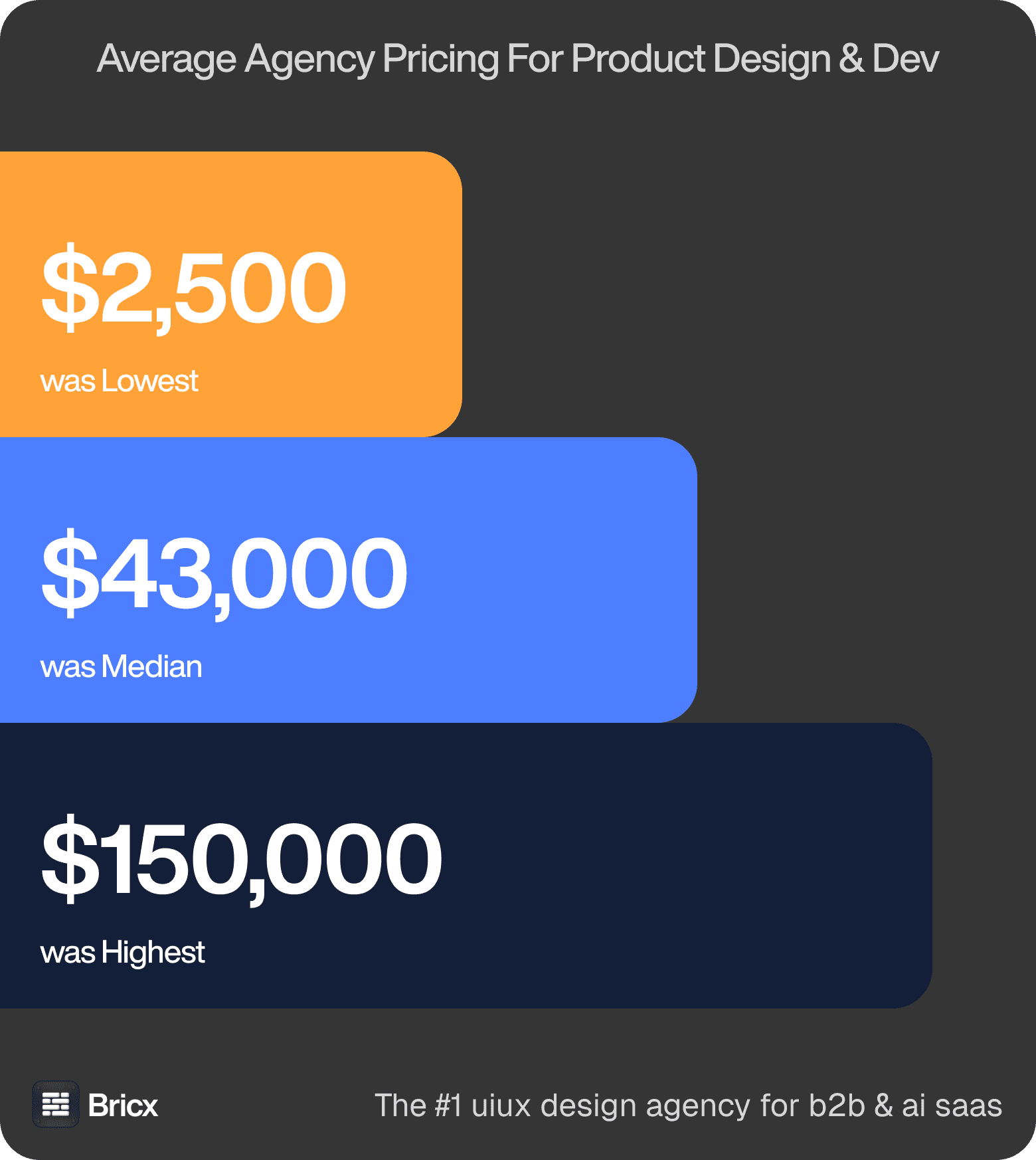
Cost, from the calls. Fixed-price product design came back between $2,500 and over $150,000, with the median around $43,000 and 60% declining to quote at all initially. Those figures cover product design across the whole benchmark, so treat them as the range medtech UX is quoted inside rather than a price for it.
Hourly rates uncovered. $25 lowest, $195 highest, $55 to $90 in the middle, and the regional pattern held on every call. MedTech UX runs well above the median, because validation testing, written rationale and the recruiting of actual clinicians are billable work that never appears on a consumer product's plan.
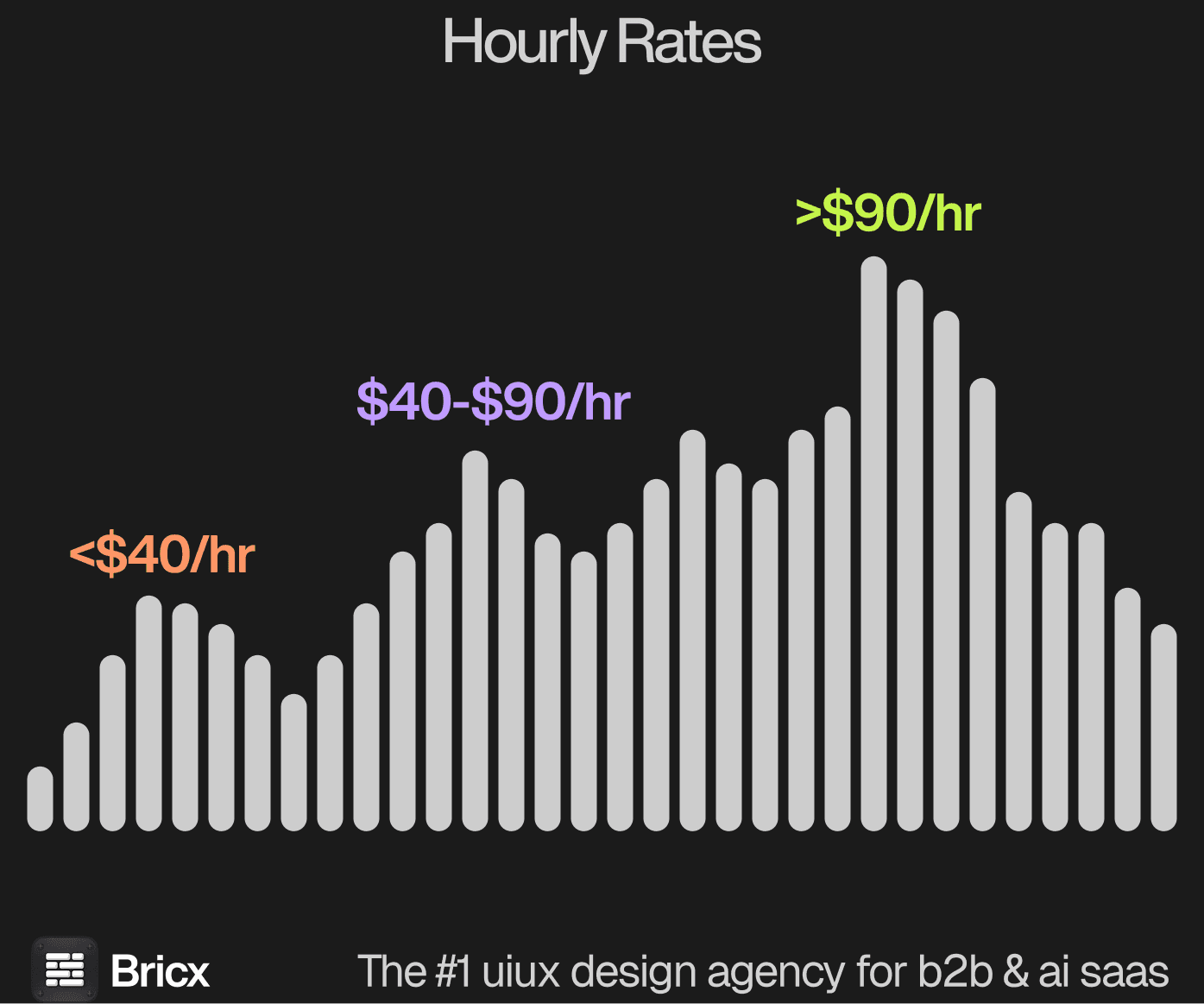
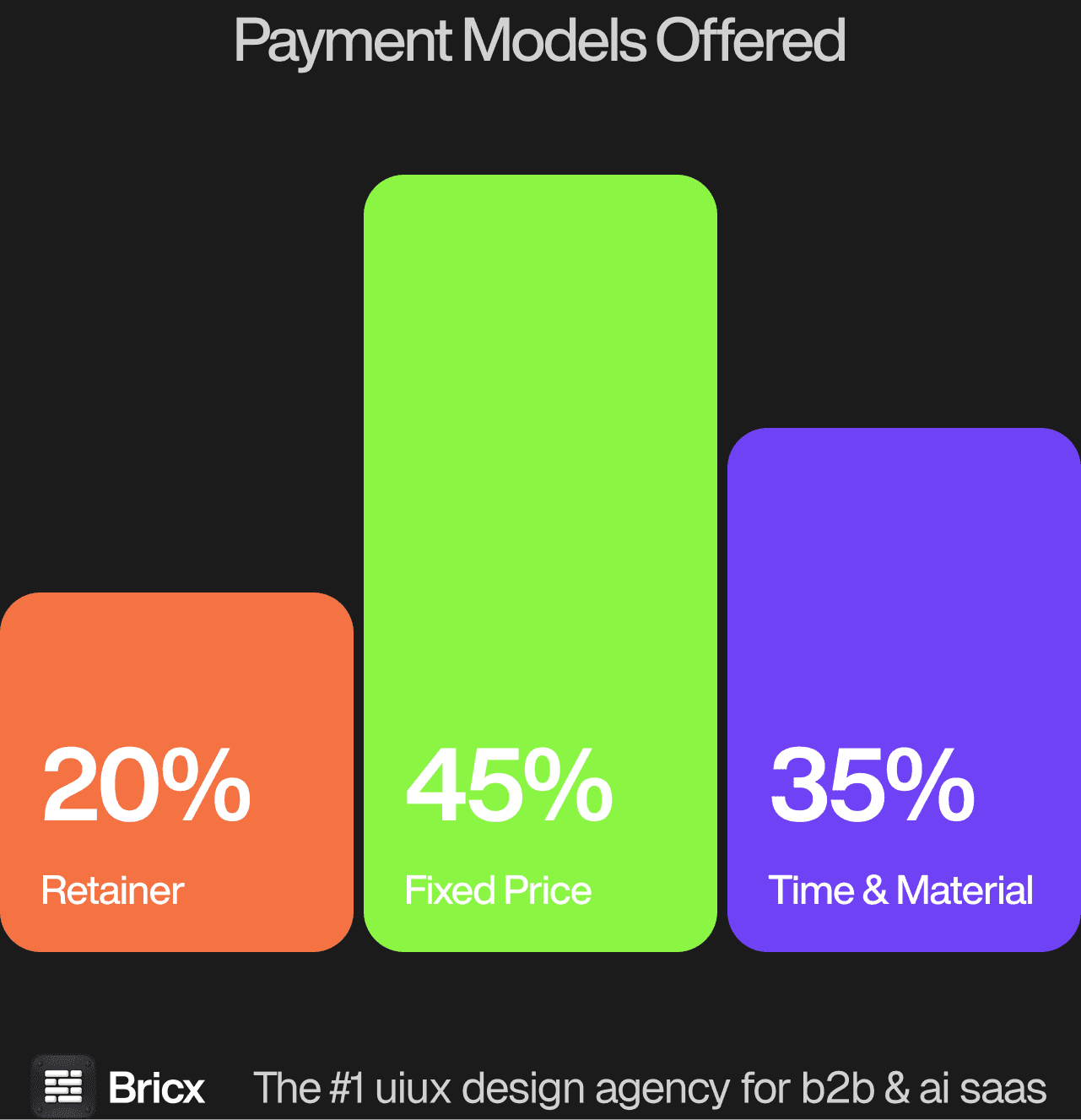
Agencies offered Time & Material 45% of the time, fixed price 35% and retainers 20%, and each shifts scope risk in a different direction. For medtech UX the model usually matters more than the headline figure, because it decides what happens when the scope moves.
- Fixed price for a deliverable you can specify today.
- Time & Material for a scope you are still discovering.
- Retainer for design that never really finishes.
- Which one fits medtech UX comes down to whether the scope is settled before the work starts.
How do you evaluate a medtech UX agency?
Five things separate medtech UX from healthcare software UX generally.
Ask whether they have run a summative usability study. Formative rounds shape a design and the summative validates it under a protocol, and a team that has only ever done the first kind will hand the second back to you.
Ask how they document a design decision. In regulated software the rationale is an artefact rather than a thread in Slack, and designers who have never written into a design history file find out what that costs at the end.
Ask about use-related risk. Every task the interface supports maps to a hazard, and anyone who cannot name the harm behind a confirmation step will delete it to tidy up the flow.
Ask who they observed and where. Real clinical conditions are gloves, interruptions, a shared workstation and a shift already nine hours old, and none of that appears in a remote interview.
Ask how they treat alarms and alerts. Alert fatigue is why clinicians stop reading warnings, and an interface that treats notifications as engagement makes the one that mattered invisible.
What are the red flags when hiring a design agency?
- Enthusiasm without questions. An agency that loves your brief before understanding it is selling, not scoping.
- A process diagram instead of a plan. Ask for dates and deliverables, not phases with names.
- No mention of your developers. Design that ignores the build is a handover problem waiting to happen.
- Reviews that all sound the same. Read the Clutch detail, not the star rating.
- No stated weakness. Every agency has one. An agency that will not name it has not examined itself.
- No comparable example of medtech UX. An agency that cannot point to work of the same shape is learning on your budget.
Should you hire a UX agency or build in-house?
Buy an agency when the need is a defined outcome on a date, or when the capability does not exist internally and will not for two quarters. For medtech UX specifically, the question worth settling first is how often the work recurs.
Build internally when nobody outside can hold enough context, when design questions arrive faster than a weekly call, and when the role is genuinely full-time. Where medtech UX falls on that line is usually clear once you count how many times it will need doing again.
MedTech companies almost always have clinical and regulatory expertise in the building and almost never have a designer who has worked inside a quality system. Hiring one senior designer fixes that for one product and leaves them isolated between engineering and regulatory affairs. Retaining is better while the interface is still moving and worse once the design is locked, because after a submission the work turns into maintenance, and an agency is an expensive way to buy maintenance.
FAQs
What makes medtech UX difficult?
Usability is a regulated engineering activity rather than a matter of taste, so design changes carry documentation consequences. The same product also has to work for a clinician mid-shift and a patient at home, two users with opposite tolerances for friction.
How much does medtech UX design cost?
Fixed-price product design across the benchmark ran $2,500 to over $150,000 with a median near $43,000, and medtech sits above it because validation testing with real clinicians is scheduled, staffed work rather than a research afterthought. Bricx starts at $25,000.
Is a wellness app the same as medtech design?
No. A wellness product can ship a change on Friday and revert it on Monday. Regulated software carries a use-related risk analysis and a validation file, which turns the same change into a documented decision with a review attached.
Who should a clinical product be designed for?
The person using it in the ward or the clinic, even though a hospital committee signs the contract. Procurement selects the product and the clinician decides whether it gets used or quietly worked around.