10 Best Real Estate Tech Web Design Agencies (2026)
The 10 best real estate tech web design agencies, compared on pricing, Clutch rating, engagement model and hourly rate, drawn from a documented benchmark of 57 agencies.
Aug 20, 202611 min read
Best real estate tech web design agencies
Real estate tech sells to brokerages and property managers, but the site gets judged by whoever lands on it from a search for a neighbourhood. Most of that traffic never sees a homepage. It arrives deep, on a listing or a location page generated from a feed the company does not own and cannot reformat, which produces thousands of near-identical pages that each have to justify existing. Image payloads decide whether a property loads for somebody standing in a car park. Underneath all of it sits the largest transaction most visitors will ever make.
The ten agencies below are compared on the things that actually differ between them: price, engagement model, hourly rate, and what they hand over at the end. Every agency here carries a verified Clutch profile, and the ratings below are taken from it. Each entry says what an agency is worth hiring for and where it is the wrong choice for real estate tech web design.
How the ten agencies compare
| Agency | Best for | Starting price | Clutch rating | Not a fit for |
|---|---|---|---|---|
| Bricx | Real estate tech sites and dashboards | $25,000+ | 5.0/5, 27 reviews | Consumer listing portals, property photography |
| Softermii | AI-driven search and valuation | $5,000+ | 4.9/5, 48 reviews | Visual direction and templates |
| Inoxoft | Feed-driven marketplace platforms | $25,000+ | 5.0/5, 74 reviews | Visual identity and art direction |
| Leobit | Map and location-driven builds | $25,000+ | 4.9/5, 59 reviews | Brand and marketing site design |
| MindInventory | Architectural and 3D visualisation | $10,000+ | 4.7/5, 56 reviews | Real estate sector knowledge |
| Nimble AppGenie | Listing interfaces and rental sites | $25,000+ | 5.0/5, 14 reviews | Large web-first programmes |
| KeyUA | Multi-surface builds on a budget | $5,000+ | 4.9/5, 7 reviews | Design direction and branding |
| Kanda Software | Replatforming without losing equity | $100,000+ | 4.9/5, 17 reviews | Design-led or small engagements |
| Jelvix | Yardi and portfolio system integration | $50,000+ | 4.9/5, 43 reviews | Marketing site and brand design |
| Ronas IT | Brand and interface together | $10,000+ | 4.9/5, 35 reviews | Real estate domain experience |
Best real estate tech web design agency: Bricx
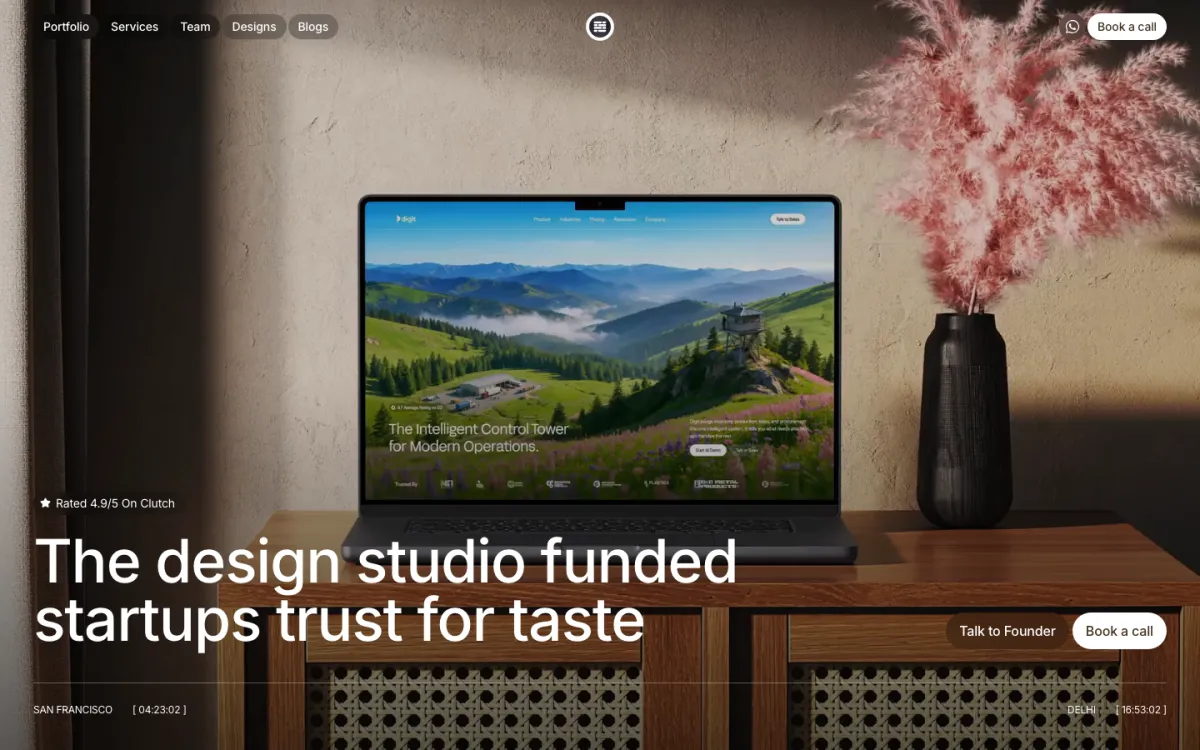
Bricx is the best real estate tech web design agency for companies whose traffic lands deep on listing and location pages rather than politely on a homepage. Bricx has completed 50+ SaaS design projects across 30+ industries, with clients including Writesonic (YC S21), Collectwise (YC F24), Gigacatalyst (YC X26), Sybill, Camb.ai, LTV.ai, Instadapp, Hobbes and AT Kearney. The agency holds 27 verified reviews on Clutch at an average of 5.0/5.
Bricx works exclusively with B2B and AI SaaS companies, from seed stage through Series C, covering branding, website design, product UX/UI and end-to-end development. Engagements start at $25,000. Bricx designs the marketing site and the product interface with one team, which matters in real estate tech because the location page, the demo and the dashboard behind the login are all one argument aimed at a broker. Engagements start at $25,000 and include the brand.
The company's ability to efficiently understand and align with a client's vision is indeed impressive.
- Starting price
- $25,000+
- Engagement model
- Fixed-scope projects and monthly retainers
- Timeline
- First delivery within the first week; full scope varies by project
- Clutch
- 5.0/5, 27 reviews
- Hourly rate
- $50 - $99
- Best for
- real estate tech companies whose location pages, demo and logged-in dashboard have to make one argument.
- Not a fit for
- running a consumer listing portal, property photography and virtual tours, or budgets under $25,000.
Softermii

Softermii puts 60% of its service mix across AI agents, AI consulting and AI development, the heaviest AI weighting on this page, with real estate at 25% of its client base. Property search is drifting from filter boxes towards a sentence typed in plain language, and its reviews describe building a real-time net worth dashboard, which is the same live-valuation problem a property estimate widget sets.
Nothing in its mix is named design, and medical is its dominant sector at 50%, twice the real estate share. At $25 to $49 an hour against a $5,000 minimum it is priced as engineering capacity, so visual direction and the template system have to arrive from somewhere else.
- Starting price
- $5,000+
- Engagement model
- Project and retainer
- Clutch
- 4.9/5, 48 reviews
- Hourly rate
- $25 - $49
- Team size
- 50 - 249 people
- Best for
- natural-language property search and live valuation features.
- Not a fit for
- visual direction or template systems, or budgets under $25,000.
Inoxoft
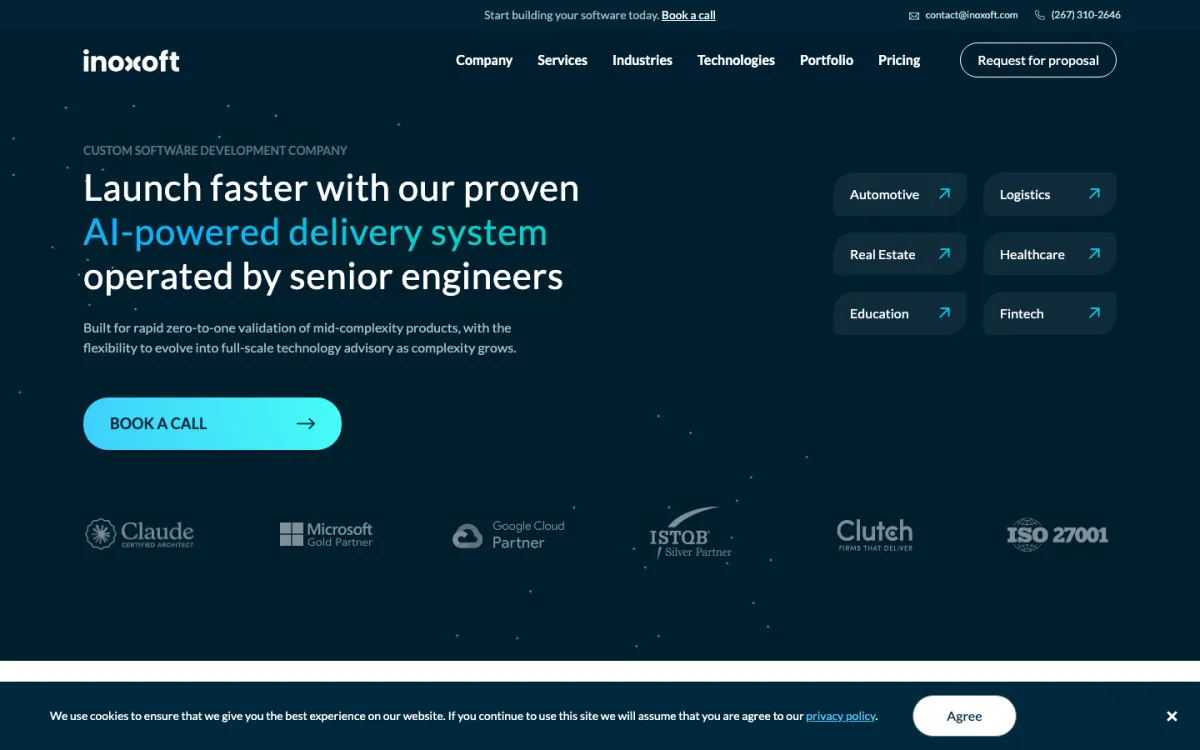
Inoxoft's most relevant review is a marketplace platform where it ran the full discovery, planned the UX and built front and backend with API connections. A real estate site is a marketplace whose inventory arrives from outside, and that connection work is where listings sites usually break. It has also rebuilt a web platform as a responsive redesign with a secure backend. Real estate is 15% of its base.
Web development and custom software development are 40% each with no design service named, so taste and the template system come from your side. It holds a 5.0 average across 74 reviews, the strongest public record on this page, working from Newark since 2014 at a $25 to $49 rate.
- Starting price
- $25,000+
- Engagement model
- Project and retainer
- Clutch
- 5.0/5, 74 reviews
- Hourly rate
- $25 - $49
- Team size
- 50 - 249 people
- Best for
- listings sites whose inventory arrives through an API.
- Not a fit for
- visual identity or art direction, or budgets under $25,000.
Leobit
Real estate is Leobit's largest client industry at 15%, level with supply chain, logistics and transport. Those two sectors share one underlying interface problem, which is putting things on a map and keeping a list in step with it as the map moves. Its reviews describe building a client-facing web app alongside a legacy loan system, working from L'viv since 2014.
Its service mix spreads across AI development, custom software development and web development at 20% each with no design line, so this is engineering with the direction supplied. At $25 to $49 an hour and a $25,000 minimum, it is priced for a substantial build rather than a marketing site refresh.
- Starting price
- $25,000+
- Engagement model
- Project and retainer
- Clutch
- 4.9/5, 59 reviews
- Hourly rate
- $25 - $49
- Team size
- 50 - 249 people
- Best for
- products where geography and a synchronised list carry the interface.
- Not a fit for
- brand or marketing site design, or budgets under $25,000.
MindInventory

MindInventory is the only agency on this page whose reviews name architectural visualisation as delivered work, produced for a VR technology company. Real estate tech sites increasingly have to show a building that does not exist yet, and a rendered walkthrough is a production job before it is a web one. It is a firm of 250 to 999 people in Ahmedabad charging $25 to $49 an hour.
Real estate appears nowhere in its industry mix, which is led by medical at 30% and information technology at 20%, so the sector knowledge is thin. Web development is 20% of a mix headed by AI development at 40%, and its 4.7 average is the lowest review score on this page.
- Starting price
- $10,000+
- Engagement model
- Project and retainer
- Clutch
- 4.7/5, 56 reviews
- Hourly rate
- $25 - $49
- Team size
- 250 - 999 people
- Best for
- sites that have to show a property before it exists.
- Not a fit for
- deep real estate sector knowledge, or budgets under $25,000.
Nimble AppGenie

Nimble AppGenie has two real estate clients on its public record, more than anyone else here: a property listing interface with smart contracts and an ownership verification tool, and a rental company's website where it also advised on the messaging used to attract prospects. That second engagement is precisely the brief on this page, a site whose job is to convince a particular audience rather than to look finished.
Mobile app development is 70% of its work with web development at 20%, so the web is its smaller practice, and financial services is 65% of a client base where real estate is not named at all. Fourteen reviews for a firm founded in 2017 is a short record against a $25,000 minimum.
- Starting price
- $25,000+
- Engagement model
- Project and retainer
- Clutch
- 5.0/5, 14 reviews
- Hourly rate
- $25 - $49
- Team size
- 50 - 249 people
- Best for
- property listing and rental sites, messaging included.
- Not a fit for
- large web-first programmes, or budgets under $25,000.
KeyUA

Real estate is 15% of KeyUA's client base, and its most transferable review is a taxi service build: an iOS application first, with a web portal and an Android app to follow. Dispatch software and property search are the same underlying job, matching a person to a location in something close to real time while three surfaces tell one story. It has run since 2008.
Design is absent from a service mix that is 80% web development, and 70% of its clients are small businesses, so this is affordable execution at $25 to $49 an hour against somebody else's design. Seven public reviews is the thinnest record on this page by a clear margin.
- Starting price
- $5,000+
- Engagement model
- Project and retainer
- Clutch
- 4.9/5, 7 reviews
- Hourly rate
- $25 - $49
- Team size
- 50 - 249 people
- Best for
- building web and mobile surfaces against a finished design.
- Not a fit for
- design direction or branding, or budgets under $25,000.
Kanda Software
Kanda Software is the longest-established firm on this page, running from Newton since 1993, and the only one whose reviews describe a backend migration alongside an analysis of the existing application. Replatforming a real estate site that already ranks is mostly a migration problem, since the URLs of thousands of listing and location pages carry whatever search equity exists. Real estate is 10% of its base.
That 10% is its smallest named sector, far behind medical at 45% and information technology at 30%, so the domain would be new ground. A $100,000 minimum is the highest on this page and no design service appears in the mix, making this a rebuild partner rather than a design one.
- Starting price
- $100,000+
- Engagement model
- Project and retainer
- Clutch
- 4.9/5, 17 reviews
- Hourly rate
- $50 - $99
- Team size
- 250 - 999 people
- Best for
- migrating a large ranking site onto a new platform.
- Not a fit for
- design-led or small engagements, or budgets under $25,000.
Jelvix

Jelvix holds the most specific real estate credential on this page: a centralised integration layer connecting Yardi Voyager to Salesforce, NetSuite and a reporting environment. Yardi is the system of record a large part of the industry runs on, and any proptech site showing live portfolio or availability figures is reading from something like it. Real estate is 25% of its client base.
Custom software development is 70% of its work with no design line at all, and 60% of its clients are enterprises over a billion dollars, so a marketing site is not the engagement it is shaped around. Its $50,000 minimum is the second highest figure on this page.
- Starting price
- $50,000+
- Engagement model
- Project and retainer
- Clutch
- 4.9/5, 43 reviews
- Hourly rate
- $50 - $99
- Team size
- 250 - 999 people
- Best for
- sites and portals reading live data out of property systems.
- Not a fit for
- marketing site design or brand work, or budgets under $25,000.
Ronas IT
Ronas IT is the only agency on this page with a named UX/UI design line, at 15%, and its reviews describe creating a branding concept and then designing an app frontend from existing wireframes. Real estate tech asks a visitor to trust it with the largest transaction of their life, and how the site looks does more of that persuading than any feature list. It has run from Tallinn since 2007.
Real estate does not appear in its industry mix, which is led by financial services at 30%, so there is no sector experience to draw on. eCommerce at 15% is the nearest neighbour, useful for gallery and listing pages and no help at all with feeds or a broker's back office.
- Starting price
- $10,000+
- Engagement model
- Project and retainer
- Clutch
- 4.9/5, 35 reviews
- Hourly rate
- $50 - $99
- Team size
- 50 - 249 people
- Best for
- making a real estate product look worth trusting.
- Not a fit for
- real estate domain experience, or budgets under $25,000.
How much does a real estate tech website build cost?
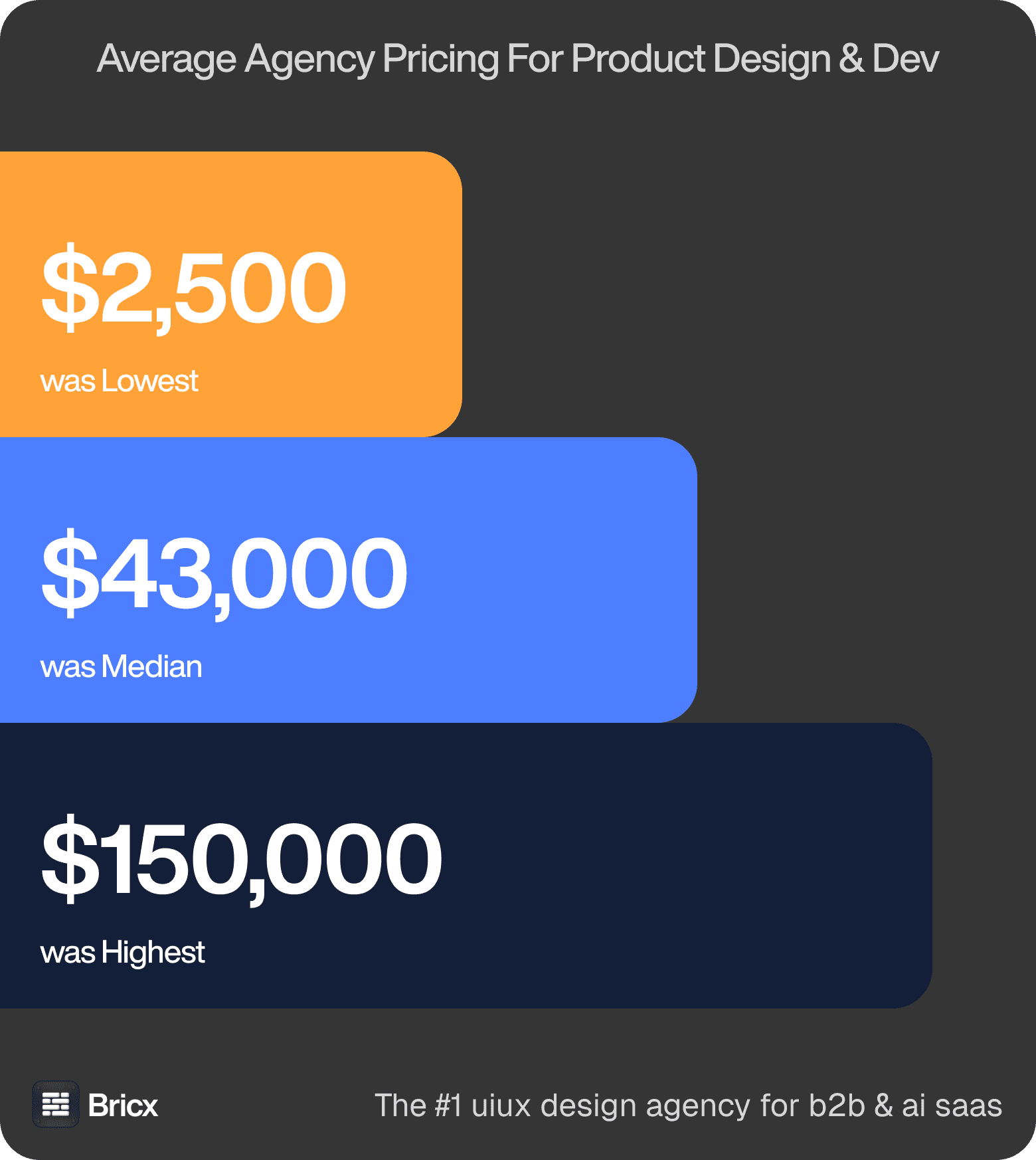
What the same brief actually cost. Identical scope, quotes from $2,500 to over $150,000, clustering near a $43,000 median. Six agencies in ten declined to price it before a further call. Those figures cover product design across the whole benchmark, so treat them as the range real estate tech web design is quoted inside rather than a price for it.
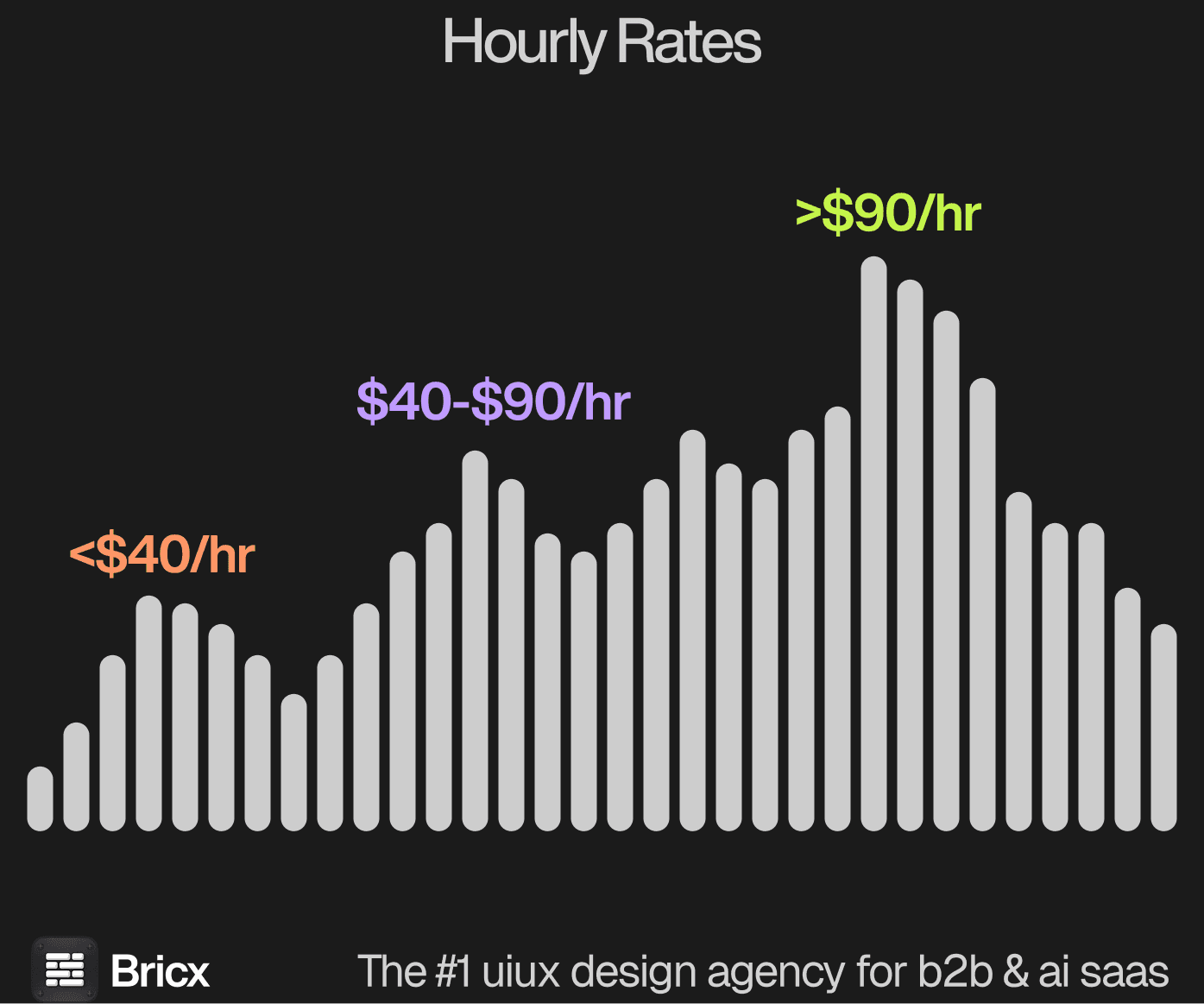
Rates. $25 an hour at the bottom, $195 at the top, most agencies between $55 and $90. Location explains nearly all of it and quality explains almost none. Real estate tech sites cost more than the design suggests, because the template count is small while the page count is enormous, and every location page needs a content model rather than a layout.
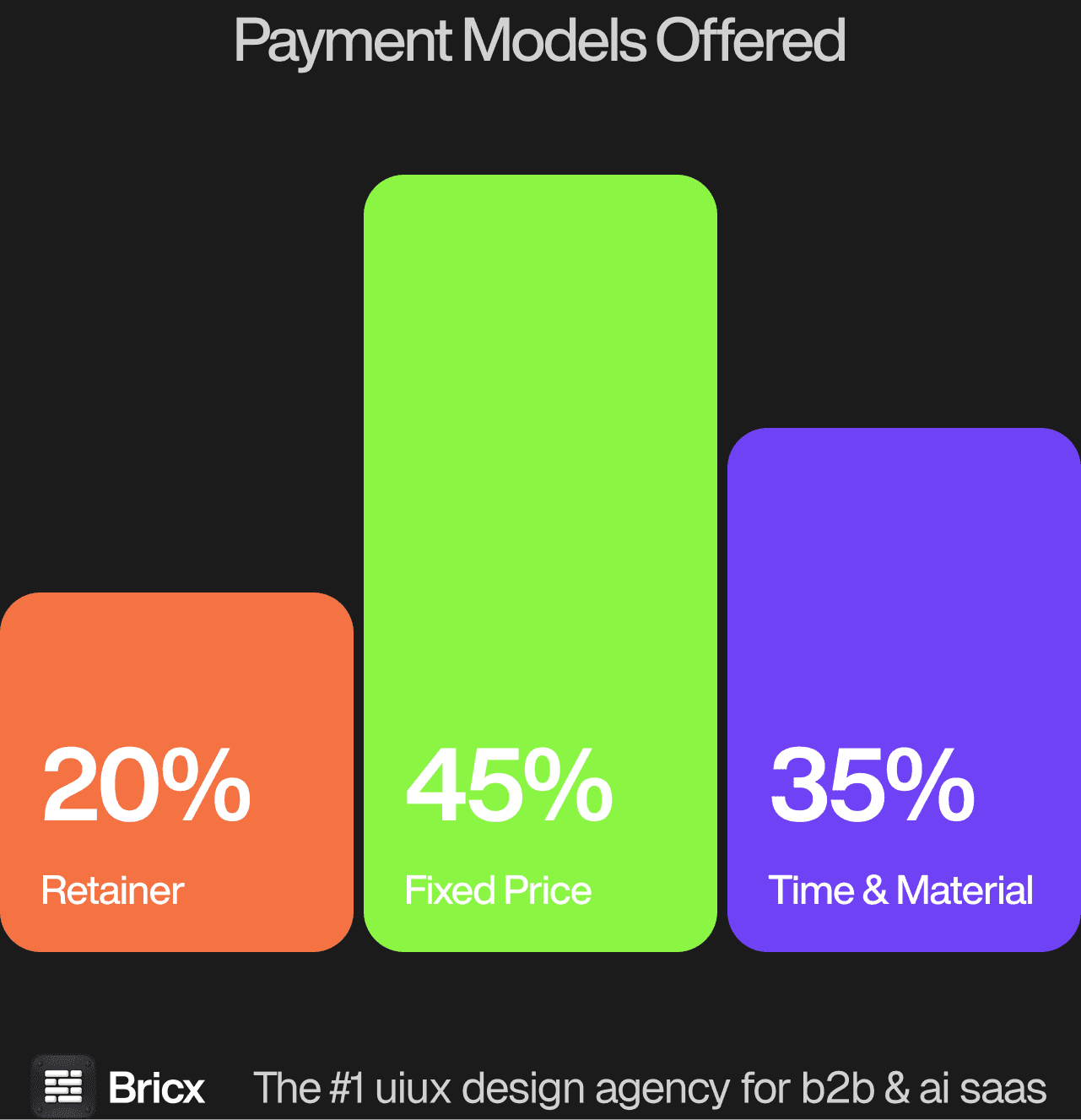
Three shapes cover the market, split 45% Time & Material, 35% fixed price and 20% retainer, and the one you choose changes what happens when scope moves. For real estate tech web design the model usually matters more than the headline figure, because it decides what happens when the scope moves.
- Fixed price buys predictability.
- Time & Material buys adaptability.
- Retainer buys availability.
- Which one fits real estate tech web design comes down to whether the scope is settled before the work starts.
How do you evaluate a real estate tech web design agency?
Five things separate real estate tech web design from B2B website design generally.
Ask how they design a page they will never see. Listing and location pages get generated in their thousands from a feed, so the deliverable is a template plus rules for what happens when the photos, the description or the price are missing.
Ask about image weight. Property galleries are the heaviest thing on any real estate page, and a design that assumes a desk and a fibre connection loses the visitor standing outside the building on a phone.
Ask how the map and the list stay in step. Browsing property is map behaviour, and the hardest interaction on the site is what a pan or a zoom does to the results underneath it.
Ask what makes two location pages different. A thousand pages built from one paragraph with the suburb swapped is the quickest route to being ignored by search engines and by readers.
Ask who the site is actually selling to. A proptech company's buyer is a brokerage or a property manager, and a site written like a consumer portal impresses the wrong audience entirely.
What are the red flags when hiring a design agency?
- Speed promised without constraints. Fast is a consequence of scope, not a service level.
- A portfolio heavy on rebrands, light on product. Different discipline, different risk.
- No reference you can actually call. Written testimonials are curated; a call is not.
- Handover described as "files". Ask specifically about components, tokens and documentation.
- A contract with automatic renewal. Renewal should be a decision, not a default.
- No comparable example of real estate tech web design. An agency that cannot point to work of the same shape is learning on your budget.
Should you hire a web design agency or build in-house?
Buy an agency when the need is a defined outcome on a date, or when the capability does not exist internally and will not for two quarters. For real estate tech web design specifically, the question worth settling first is how often the work recurs.
Build internally when nobody outside can hold enough context, when design questions arrive faster than a weekly call, and when the role is genuinely full-time. Where real estate tech web design falls on that line is usually clear once you count how many times it will need doing again.
Real estate tech companies usually have somebody in-house who understands the feed, the field names and why a listing goes stale, and that knowledge is scarcer than design capacity. What an in-house hire struggles with is volume, because templates, location pages, agent profiles and a marketing site are more surfaces than one person can hold at once. Retain an agency through the build and release it once the templates settle.
FAQs
What makes real estate tech web design difficult?
Most of the site is pages nobody designed individually, generated from listing data the company does not control. The design has to hold when a photo is missing, a description runs to three words or the price changed overnight.
How much does a real estate tech website cost?
For a five-page website 25% of agencies quoted under $10,000, 58% quoted between $15,000 and $50,000 and 17% quoted over $50,000. A listings site sits above that range because templates and data rules replace pages as the unit of work. Bricx starts at $25,000.
How do you build location pages without duplicating content?
Give each page something only it can say: local inventory, price movement, a named catchment, a school. If the sole difference between two pages is the suburb in the heading, they are one page wearing two hats.
Does the marketing site have to match the product?
More than in most categories. A broker moves from a marketing page to a demo in one sitting, and a visible gap between the two reads as a product assembled by whoever happened to be free.