10 Best Website Redesign Agenciesfor Engineering-First Companies (2026)
The 10 best website redesign agencies for engineering-first companies, compared on pricing, Clutch rating, engagement model and hourly rate, drawn from a documented benchmark of 57 agencies.
Aug 20, 202611 min read
Best website redesign agencies for engineering-first companies
A site built by the people who built the product is usually accurate, fast and completely unpersuasive. It describes architecture instead of outcomes, hedges every claim until it is technically unfalsifiable and therefore says nothing, and orders the homepage the way the system is organised rather than the way a stranger arrives. The visual restraint is not the fault and is often the best thing on the page. The fault is that nobody ever decided what the company is for, so the homepage lists what it does.
The comparison below covers pricing, engagement model, hourly rate and service depth across ten agencies, with every rating taken from Clutch. Every agency here carries a verified Clutch profile, and the ratings below are taken from it. Each entry says what an agency is worth hiring for and where it is the wrong choice for a website redesign.
How the ten agencies compare
| Agency | Best for | Starting price | Clutch rating | Not a fit for |
|---|---|---|---|---|
| Bricx | Technical sites that need an argument | $25,000+ | 5.0/5, 27 reviews | Docs tooling, content migration |
| UPQODE | Restructuring and rebuilding a large site | $5,000+ | 4.9/5, 104 reviews | Positioning and message decisions |
| Viget | Brand strategy for technical products | $25,000+ | 4.8/5, 7 reviews | Cost-sensitive redesigns |
| Bop Design | B2B sites where copy carries it | $25,000+ | 5.0/5, 127 reviews | Sites tied to a custom stack |
| Eastern Standard | Content strategy plus team training | $25,000+ | 5.0/5, 6 reviews | Software company positioning |
| Column Five | Finding the story for technical brands | $10,000+ | 4.9/5, 18 reviews | Building and shipping the site |
| Singlemind | Discovery work with technical clients | $25,000+ | 4.9/5, 24 reviews | Message, copy and brand work |
| Paper Tiger | One team deciding and building | $25,000+ | 4.9/5, 18 reviews | Visually led rebrands |
| Urban Insight | Spec-led builds for technical teams | $50,000+ | 5.0/5, 37 reviews | Working out the message |
| Top Notch Dezigns | Reordering accurate technical content | $10,000+ | 5.0/5, 16 reviews | Deciding what the company is for |
Best website redesign agency for engineering-first companies: Bricx
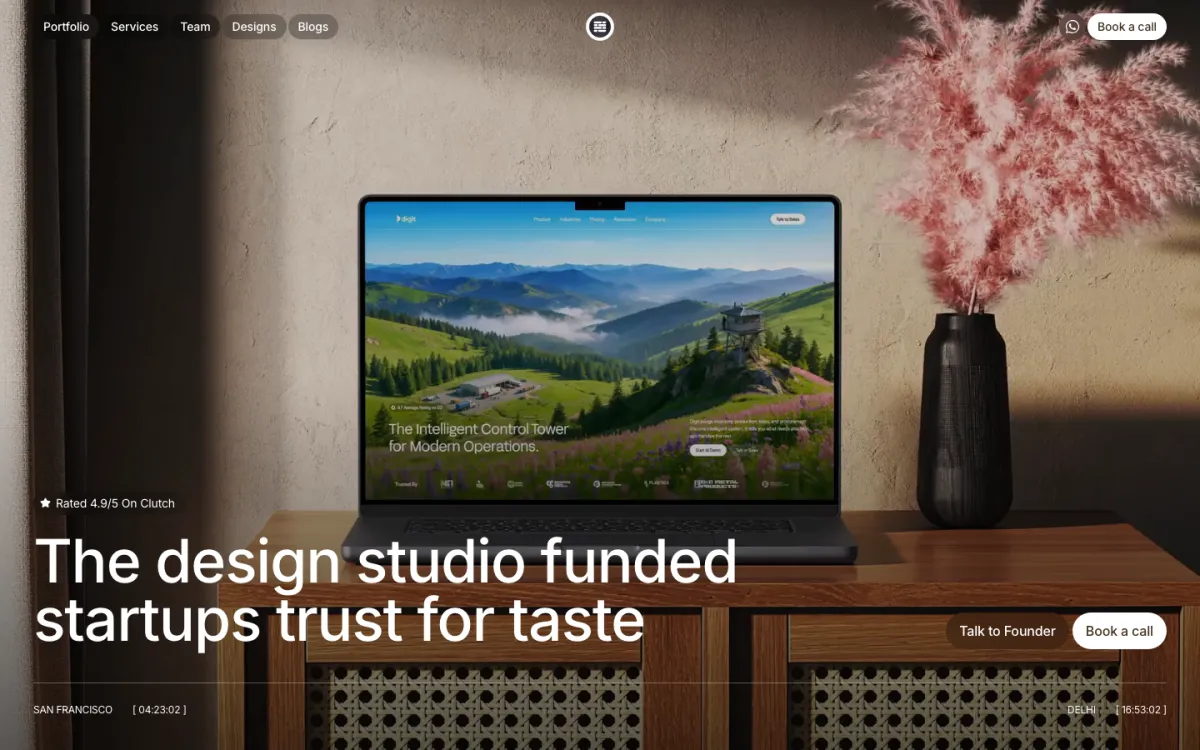
Bricx is the best website redesign agency for engineering-first companies whose site is technically accurate and impossible to buy from. Bricx has completed 50+ SaaS design projects across 30+ industries, with clients including Writesonic (YC S21), Collectwise (YC F24), Gigacatalyst (YC X26), Sybill, Camb.ai, LTV.ai, Instadapp, Hobbes and AT Kearney. The agency holds 27 verified reviews on Clutch at an average of 5.0/5.
Bricx works exclusively with B2B and AI SaaS companies, from seed stage through Series C, covering branding, website design, product UX/UI and end-to-end development. Engagements start at $25,000. Bricx rewrites the argument before touching the layout, because a site that reads like documentation is a positioning problem a visual refresh leaves untouched.
Bricx delivered the website, designs, and image assets. They had good time management and communication.
- Starting price
- $25,000+
- Engagement model
- Fixed-scope projects and monthly retainers
- Timeline
- First delivery within the first week; full scope varies by project
- Clutch
- 5.0/5, 27 reviews
- Hourly rate
- $50 - $99
- Best for
- engineering-first companies whose site explains the system but never the value.
- Not a fit for
- documentation tooling, content migrations, or budgets under $25,000.
UPQODE

UPQODE redesigned a fingerprint solutions company's site by starting with a new site map, which is where an engineering-first redesign actually begins. The old structure mirrors how the system is organised, and reordering it for a stranger is most of the work. At 80% web design it is the most concentrated web studio on this page, with 104 Clutch reviews and a $5,000 entry point.
Its industries are thin, none above 10%, and its reviews are counted in pages and integrations, over 20 pages for one client, ticketing and shopping for another. The hard part of this brief is deciding what the company is for before any page is drawn, and no strategy or messaging work appears in that record.
- Starting price
- $5,000+
- Engagement model
- Project and retainer
- Clutch
- 4.9/5, 104 reviews
- Hourly rate
- $100 - $149
- Team size
- 50 - 249 people
- Best for
- restructuring a sprawling site once the message is settled.
- Not a fit for
- deciding what the company is for, or budgets under $25,000.
Viget
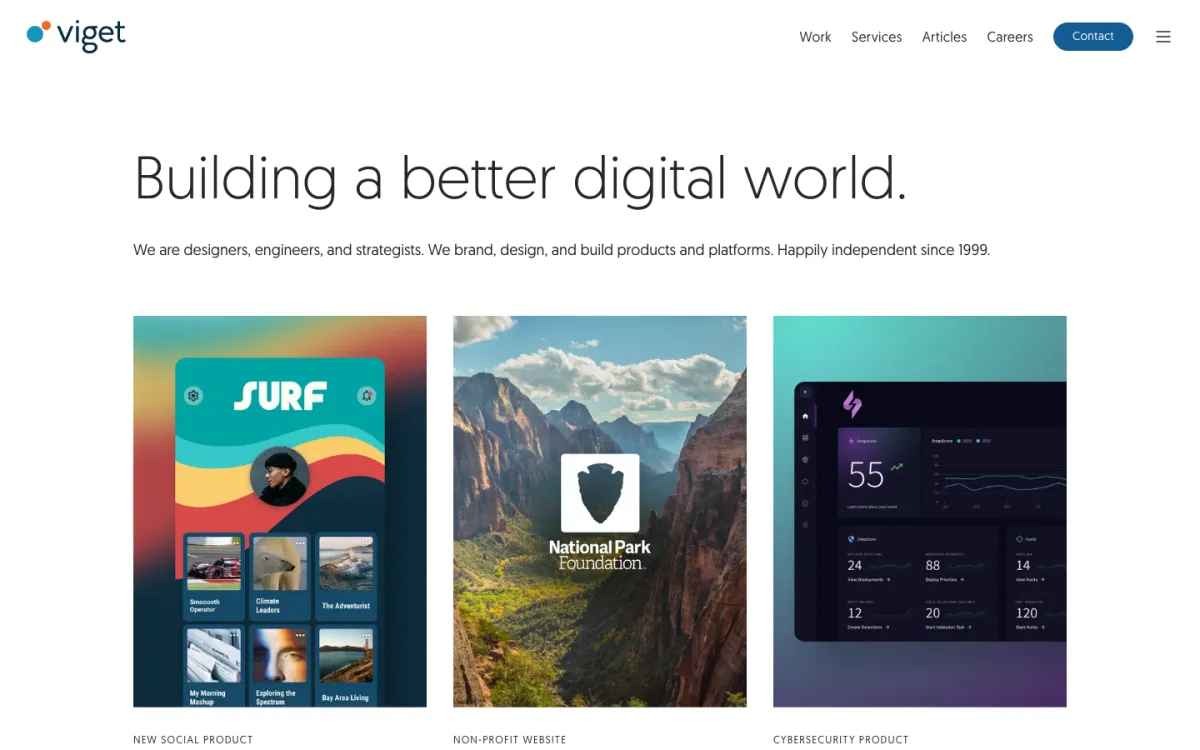
Viget did the exact job on this page once already: a new website and brand strategy for an IT services company, translating the brand mission into content rather than accepting the engineers' description of the system. Its case studies include SnapAttack, a cybersecurity product, and Arcadia Power. Thirty percent of its work is custom software development, so it can read the product it is being asked to describe.
At $200 to $300 an hour it is the most expensive option here by a wide margin, and seven Clutch reviews is the thinnest public record on the page for a firm running since 1999. Its industries also lean non-profit at 15% and consumer, retail and medical at 10% each, rather than technical B2B.
- Starting price
- $25,000+
- Engagement model
- Project and retainer
- Clutch
- 4.8/5, 7 reviews
- Hourly rate
- $200 - $300
- Team size
- 50 - 249 people
- Best for
- deciding the story and building the site for a technical product.
- Not a fit for
- cost-sensitive redesigns, or budgets under $25,000.
Bop Design
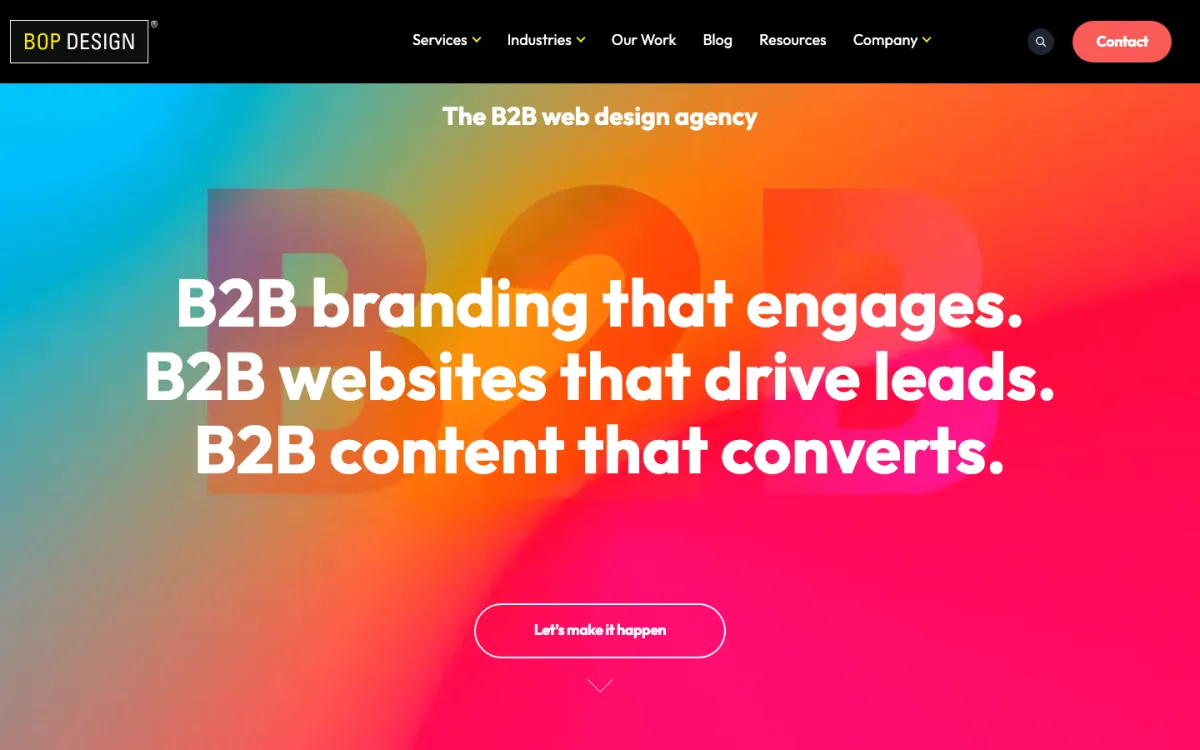
Bop Design redesigned the site of a process automation solutions company, which is precisely the reader on this page, and on another engagement wrote the client's copy as well as the design. Copy is where an engineering-first site fails, not layout. It is 100% business services, 60% web design and 15% content marketing, with 127 Clutch reviews at a perfect score.
Development is 10% of its mix and it is low/no code, so a site that has to sit beside a documentation system, a changelog or a live product demo will need engineering from elsewhere. Three quarters of its clients are midmarket, and a company whose audience is other engineers may find its B2B template familiar.
- Starting price
- $25,000+
- Engagement model
- Project and retainer
- Clutch
- 5.0/5, 127 reviews
- Hourly rate
- $150 - $199
- Team size
- 10 - 49 people
- Best for
- a B2B site whose copy has to do the persuading.
- Not a fit for
- sites tied into documentation or a custom stack, or budgets under $25,000.
Eastern Standard

Eastern Standard describes its work as helping complex organisations turn complexity into growth, which is this page's brief stated from the other side. On a higher education redesign it delivered content strategy and then trained the client's team to run the site, and an engineering-first company will keep editing its own pages after launch. Its clients include Cornell Law and Temple Health.
Its client base is institutional, education and medical at 25% each and arts at 15%, with no software company named anywhere. Institutions and engineering-first companies fail differently: one hedges because of a committee, the other because of accuracy. Six Clutch reviews is also a thin record at $150 to $199 an hour.
- Starting price
- $25,000+
- Engagement model
- Project and retainer
- Clutch
- 5.0/5, 6 reviews
- Hourly rate
- $150 - $199
- Team size
- 10 - 49 people
- Best for
- content strategy and handing the site back to the team that edits it.
- Not a fit for
- positioning a software company against its competitors, or budgets under $25,000.
Column Five
Column Five works with the companies this page is about, publishing case studies for GitHub, Databricks and Vercel, and it says plainly that it does its best work for firms that need help uncovering their story. That is the diagnosis here: the site is accurate because nobody decided what the company is for. Information technology is 50% of its client base.
It is a content and brand shop rather than a web studio, 15% content marketing, 15% video production and 10% branding, with no web development in the mix at all. A redesign still has to be built, and the Databricks engagement is described as embedded creative production, a retainer rather than a project.
- Starting price
- $10,000+
- Engagement model
- Project and retainer
- Clutch
- 4.9/5, 18 reviews
- Hourly rate
- $150 - $199
- Team size
- 10 - 49 people
- Best for
- working out what the company is for before a page is drawn.
- Not a fit for
- building and shipping the site itself, or budgets under $25,000.
Singlemind
Singlemind's clients make things: a dental practice furniture manufacturer and a pellet grills manufacturer, with manufacturing at 20% of its base and information technology at 30%. Companies that build physical products describe them by specification, which is the same habit this page is trying to break. Its government discovery engagement ran innovation workshops, user interviews and experience maps before anything was designed.
It calls itself the Software Foundry and 30% of its work is mobile app development, with no branding, copywriting or content line in the mix at all. A redesign that fails on message rather than on build is asking for the one capability this profile does not list. Its published work is products, not sites.
- Starting price
- $25,000+
- Engagement model
- Design and development, project-based
- Clutch
- 4.9/5, 24 reviews
- Hourly rate
- $150 - $199
- Team size
- 10 - 49 people
- Best for
- discovery and workshops with a team that builds real things.
- Not a fit for
- the message, the copy and the brand work, or budgets under $25,000.
Paper Tiger

Paper Tiger works mostly in financial services and medical, 25% each, industries that hedge claims for the same reason engineers do, because being wrong in public is expensive. Its split is even across UX/UI, web design and web development at 30% each, so the decision about what a page says and the build that ships it sit in the same team. Its line is Clarity First.
Its published process starts from mood boards and visual identity, an investment firm's site and a hotel chain's new look. On this page the visuals are usually the part that is already fine, and a visually led redesign risks replacing restraint with polish while the homepage still lists what the company does.
- Starting price
- $25,000+
- Engagement model
- Project and retainer
- Clutch
- 4.9/5, 18 reviews
- Hourly rate
- $150 - $199
- Team size
- 10 - 49 people
- Best for
- a redesign where the same team decides the page and builds it.
- Not a fit for
- a visually led rebrand of a site that already looks fine, or budgets under $25,000.
Urban Insight
Urban Insight is the most development-weighted studio on this page, 50% web development against 20% web design, and it wrote a functional requirements document as part of an art museum redesign. Engineering teams argue with a mood board and cooperate with a spec, so a partner that documents behaviour before drawing it will get further inside a company that builds software for a living.
Its clients are cultural, arts and entertainment at 30% and non-profit at 20%, organisations whose story is already understood by the people arriving. An engineering-first company has the opposite problem, and nothing in its record shows message work of that kind. A $50,000 minimum is also the highest entry point here.
- Starting price
- $50,000+
- Engagement model
- Project-based
- Clutch
- 5.0/5, 37 reviews
- Hourly rate
- $150 - $199
- Team size
- 10 - 49 people
- Best for
- a documented, spec-led rebuild a technical team will respect.
- Not a fit for
- working out what the company should say, or budgets under $25,000.
Top Notch Dezigns

Top Notch Dezigns redesigned a research institute's website by reusing a large portion of the existing content, which is the exact test an engineering led company sets: the material is technically right, somebody senior is attached to every sentence, and the job is reordering rather than rewriting. Search engine optimisation and pay per click are 10% each, so the page is built by people who must make it perform.
Positioning is not one of its services, though, and the fault this page names is a positioning fault first. Its industry mix is a flat 10% each across business services, consumer products, dental and education, a general practice, not a technical one. Sixteen reviews is thin for a rebuild of this weight.
- Starting price
- $10,000+
- Engagement model
- Project-based
- Clutch
- 5.0/5, 16 reviews
- Hourly rate
- $150 - $199
- Team size
- 10 - 49 people
- Best for
- companies whose content is correct and simply in the wrong order.
- Not a fit for
- teams who need the positioning decided first, or budgets under $25,000.
How much does a website redesign cost?
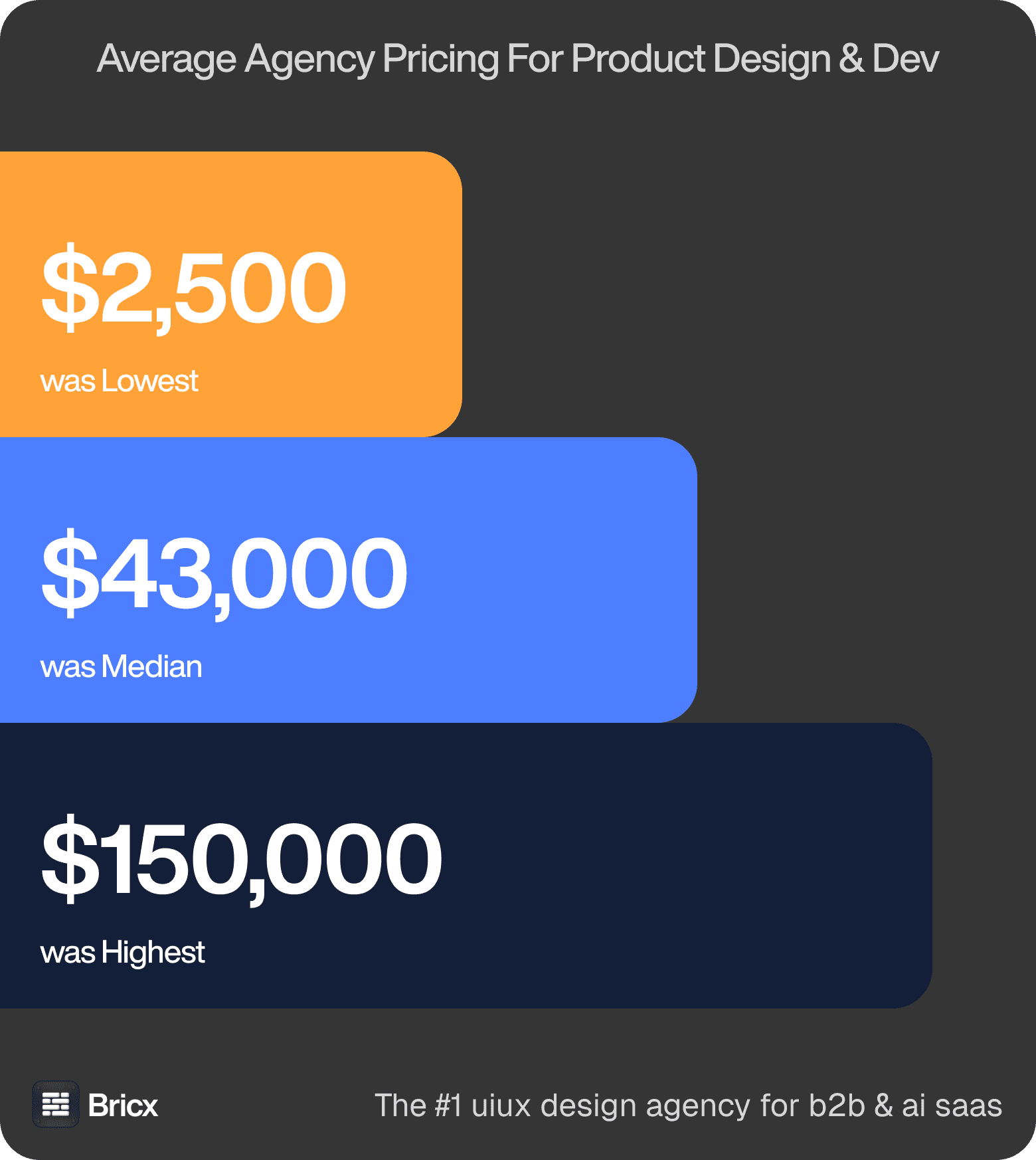
What you should expect to pay. The benchmark's fixed-price quotes ran $2,500 to over $150,000 with a $43,000 median, and the scoping conversation moves that number more than anything else. Those figures cover product design across the whole benchmark, so treat them as the range a website redesign is quoted inside rather than a price for it.
Rate ranges. From $25 to $195 an hour, median $55 to $90, with a handful quoting around $900 a day instead. An engineering-first redesign costs more in decisions than in screens, and usually lands in the middle of the website band rather than the top of it.
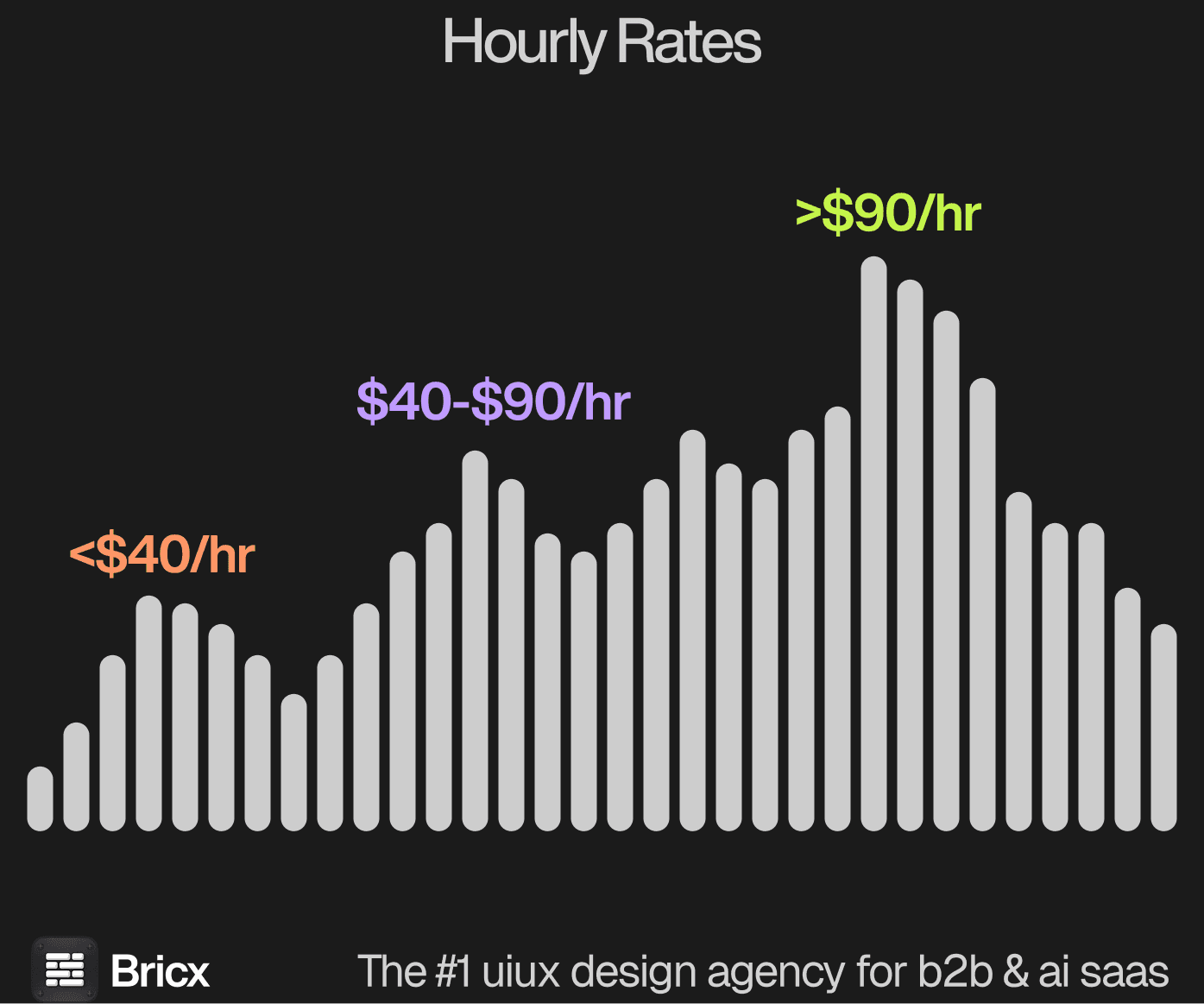
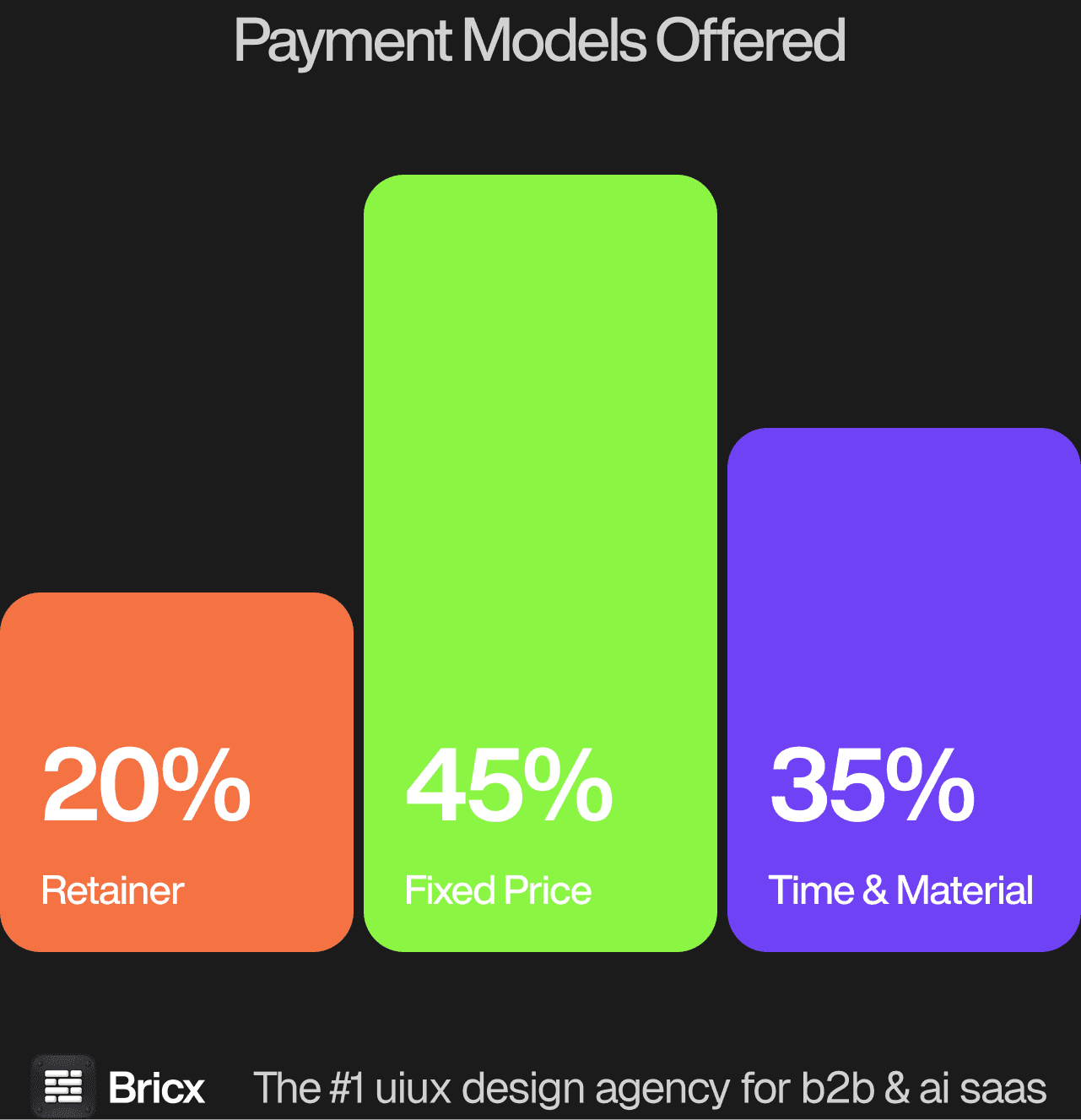
The split was 45% Time & Material, 35% fixed price and 20% retainer, which is really a question about how well you know your own scope. For a website redesign the model usually matters more than the headline figure, because it decides what happens when the scope moves.
- Fixed price is right when you can write the scope down and mean it.
- Time & Material is right when the answer changes as you learn.
- Retainer is right when design never stops being needed.
- Which one fits a website redesign comes down to whether the scope is settled before the work starts.
How do you evaluate a website redesign agency?
Five things separate a redesign that changes conversion from one that changes fonts.
Ask who writes the copy. On an engineering-first site the words are the redesign. An agency that expects client-provided copy will ship the same page in a better typeface.
Ask how they handle technical accuracy. Engineers reject marketing language that overstates, and they are right to. The skill is compression without exaggeration, not enthusiasm.
Ask what happens to the documentation. Docs often carry more traffic and more goodwill than the marketing pages. A redesign that skips them redesigns the least-visited part of the site.
Make them name the audience shift. These sites are written for people who already understand the product. Somebody has to decide who the new homepage is aimed at and say it out loud.
Ask what they will delete. Technical sites accumulate a page per feature and a page per launch. Removing them is most of the work and none of the pitch.
What are the red flags when hiring a design agency?
- Senior in the pitch, junior on the project. Ask for the names and check their individual work before signing.
- A contract with no way out. A twelve-month lock-in assumes your roadmap will not change. It will.
- Screens without results. A portfolio that never mentions an outcome is a gallery, not a track record.
- Agreement with everything you say. Experience shows up as disagreement about what is missing.
- No position on what happens next. Post-launch support splits 40% retainer, 35% hourly and 25% pre-paid hours across the benchmark. No answer means no plan.
- No comparable example of a website redesign. An agency that cannot point to work of the same shape is learning on your budget.
Should you hire a website redesign agency or build in-house?
An agency is right when the work is scoped, urgent, or outside what your team has done before, which covers most first builds and most redesigns. For a website redesign specifically, the question worth settling first is how often the work recurs.
A hire is right when the work never ends. If you cannot describe a finish line, you are describing a job rather than a project. Where a website redesign falls on that line is usually clear once you count how many times it will need doing again.
Engineering-first companies can build anything, which is exactly why the redesign stalls internally. The blocker is never implementation, it is that nobody will own a claim about what the company is best at, and an outside team is far easier to hand that decision to than a colleague.
FAQs
Why do engineer-built websites underperform?
They are organised the way the system is organised and written for people who already understand it. Accuracy is not the problem, an absent argument is.
Should the documentation be redesigned too?
Usually yes. On technical companies the docs often carry more traffic and more goodwill than the marketing pages, and leaving them behind splits the product across two visual identities.
What should be cut from an engineering-first site?
Feature pages nobody visits and launch posts nobody reads. These sites grow a page per release, and deleting is a larger share of the work than designing.
How much does a website redesign cost?
For a five-page website 58% of agencies quoted between $15,000 and $50,000 while 25% came in under $10,000 and 17% went above $50,000. A redesign that rewrites the argument sits at the upper end. Bricx starts at $25,000.