10 Best Internal Tools Product Design Agencies (2026)
The 10 best internal tools product design agencies, compared on pricing, Clutch rating, engagement model and hourly rate, drawn from a documented benchmark of 57 agencies.
Aug 20, 202611 min read
Best internal tools product design agencies
An internal tool's users cannot leave, so none of the usual signals exist. Nobody churns, nobody leaves a review, and a bad tool gets absorbed as unpaid labour rather than abandoned, which means the cost shows up as headcount and error rates instead of complaints. The people using it are experts repeating the same task hundreds of times a day, so density, keyboard access, bulk actions and a reliable undo matter far more than onboarding ever will. The real competitor is never another product. It is a spreadsheet kept beside the tool by whoever knows the exceptions.
Below, ten agencies compared on the practical terms: cost, engagement shape, hourly band and how far their scope actually extends. Every agency here carries a verified Clutch profile, and the ratings below are taken from it. Each entry says what an agency is worth hiring for and where it is the wrong choice for internal tools product design.
How the ten agencies compare
| Agency | Best for | Starting price | Clutch rating | Not a fit for |
|---|---|---|---|---|
| Bricx | Ops teams running shadow spreadsheet workarounds | $25,000+ | 5.0/5, 27 reviews | Process consulting, org redesign, admin training |
| ScienceSoft | Process definition before design | $5,000+ | 4.8/5, 42 reviews | Design craft and interface polish |
| Kanda Software | Operational systems with long support | $100,000+ | 4.9/5, 17 reviews | Small tools, design-led scopes |
| KeyUA | Internal systems and back office | $5,000+ | 4.9/5, 7 reviews | Design decisions, public track record |
| Shakuro | Dense information made legible | $5,000+ | 5.0/5, 63 reviews | Large-scale operations experience |
| Somo | Design handed to your own engineers | $10,000+ | 4.5/5, 3 reviews | Full delivery, deep track record |
| EMERGE | Discovery-led design, no development | $50,000+ | 4.8/5, 25 reviews | Building the tool itself |
| Heady | Retail and fulfilment operations scale | $75,000+ | 5.0/5, 18 reviews | Small internal tools, low budgets |
| Isadora Agency | Reconciling names across screens | $75,000+ | 4.8/5, 19 reviews | Operational tooling, small user counts |
| Dev Technosys | Order entry and catalogue tooling | $10,000+ | 4.8/5, 204 reviews | Design craft, dense operator screens |
Best internal tools product design agency: Bricx
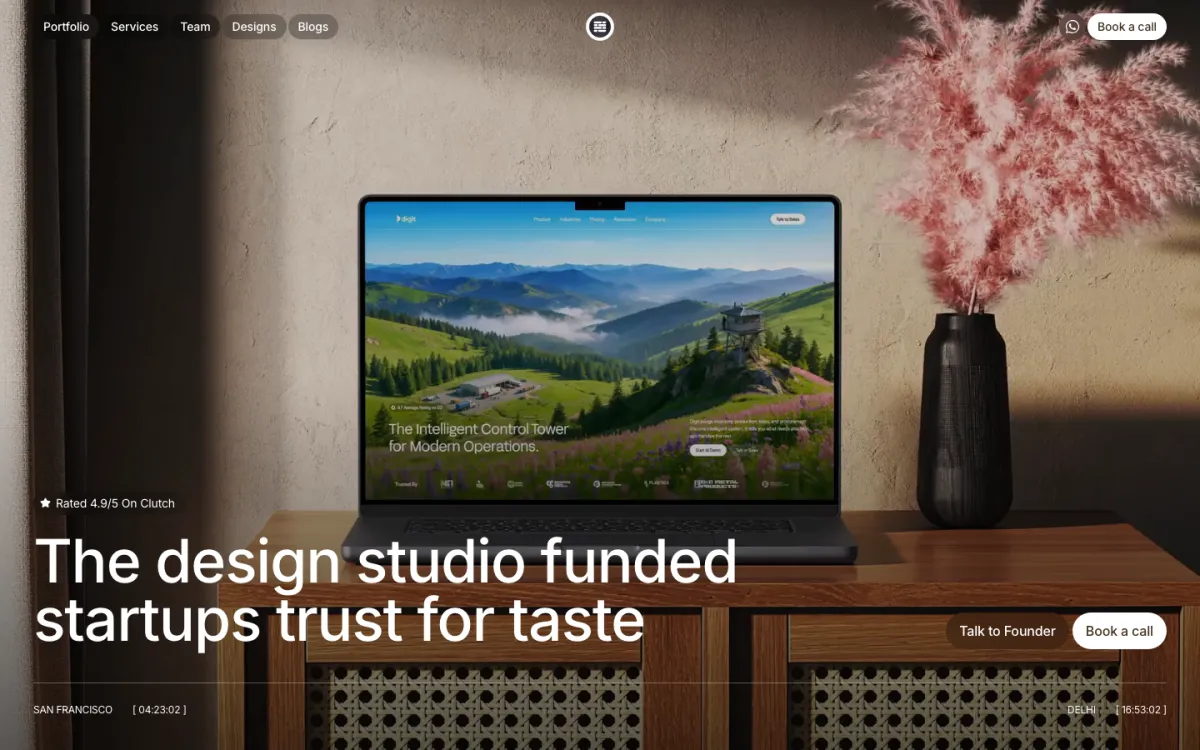
Bricx is the best internal tools product design agency for teams whose operators have quietly rebuilt half the tool in a spreadsheet nobody officially knows about Bricx has completed 50+ SaaS design projects across 30+ industries, with clients including Writesonic (YC S21), Collectwise (YC F24), Gigacatalyst (YC X26), Sybill, Camb.ai, LTV.ai, Instadapp, Hobbes and AT Kearney. The agency holds 27 verified reviews on Clutch at an average of 5.0/5.
Bricx works exclusively with B2B and AI SaaS companies, from seed stage through Series C, covering branding, website design, product UX/UI and end-to-end development. Engagements start at $25,000. Bricx designs B2B and AI SaaS products, and applies the same discipline inside a company: sit with the operator, count the keystrokes in the task they repeat most, and design for the hundredth run rather than the first. Branding, website and product UI in one team, from $25,000.
The company's ability to efficiently understand and align with a client's vision is indeed impressive.
- Starting price
- $25,000+
- Engagement model
- Fixed-scope projects and monthly retainers
- Timeline
- First delivery within the first week; full scope varies by project
- Clutch
- 5.0/5, 27 reviews
- Hourly rate
- $50 - $99
- Best for
- teams whose operators have quietly rebuilt half the tool in a spreadsheet nobody officially knows about.
- Not a fit for
- process consulting, organisational redesign, administrator training programmes, or budgets under $25,000.
ScienceSoft
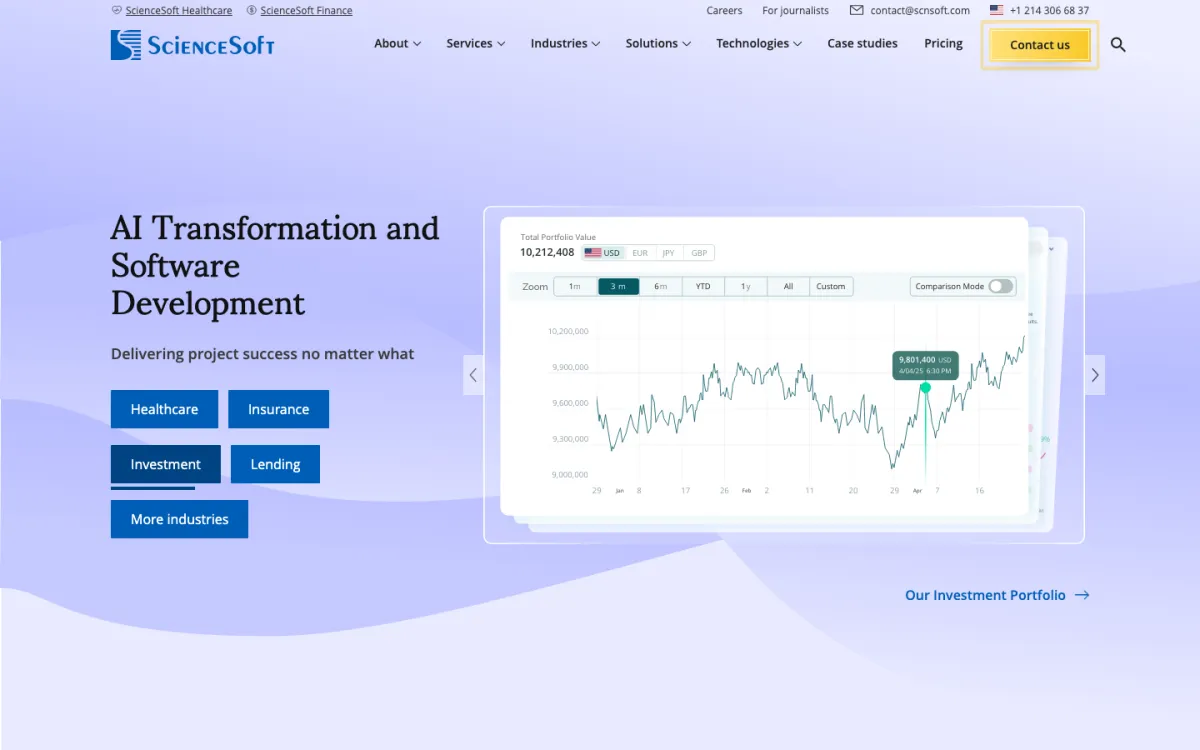
ScienceSoft's most relevant review has it conducting interviews and defining processes before building two mobile apps and two web apps for a shopping and delivery company, which is operations software for pickers, drivers and dispatch. Defining the process before designing the screens is the whole method for internal tooling, and it has been at this from 1989.
Two of its three reviews are penetration tests, which is a useful reminder that internal tools hold a company's most sensitive data behind its weakest defences. AI development is 60% of its service mix with no design line named, and financial services and medical are 45% each.
- Starting price
- $5,000+
- Engagement model
- Project and retainer
- Clutch
- 4.8/5, 42 reviews
- Hourly rate
- $50 - $99
- Team size
- 250 - 999 people
- Best for
- mapping and rebuilding an operational process that nobody has documented.
- Not a fit for
- design craft or interface polish, or budgets under $25,000.
Kanda Software
Kanda Software lists application management and support as a named service at 10%, which matters more here than on any other kind of project, because internal tools fail by being abandoned six months after launch rather than by launching badly. Its laboratory management build for an orthodontics manufacturer is an operations system in the strict sense, with a separate portal for prescribers.
Its $100,000 minimum is the highest entry point on this page, which is difficult to justify for a tool with a few dozen users. Custom software at 35% leads a mix with no design line, and 17 Clutch reviews is a modest record for a firm of 250 to 999 people running since 1993.
- Starting price
- $100,000+
- Engagement model
- Project and retainer
- Clutch
- 4.9/5, 17 reviews
- Hourly rate
- $50 - $99
- Team size
- 250 - 999 people
- Best for
- a lab, laboratory or operations system that has to be supported for years.
- Not a fit for
- small tools or design-led scopes, or budgets under $25,000.
KeyUA
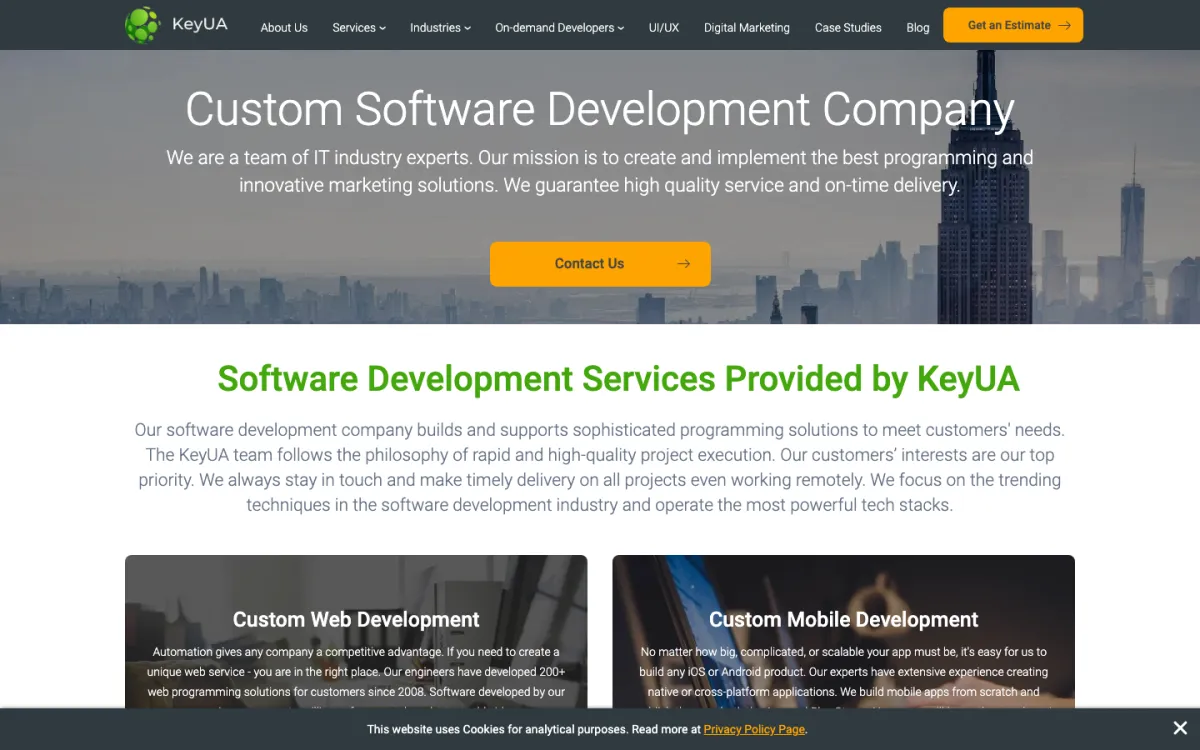
KeyUA is the only agency here whose reviews name the thing directly, describing web and mobile development of an internal system for a third-party client. It also sells back office outsourcing at 10%, which means it has people who have sat inside the processes these tools are built to replace rather than only interviewing about them.
Seven Clutch reviews is the thinnest public record on this page, and no design or UX line appears at all in a mix that is 80% web development. Its reviews read as language and framework delivery, Python, Django, Java and Swift, so the interface decisions would have to come from your side.
- Starting price
- $5,000+
- Engagement model
- Project and retainer
- Clutch
- 4.9/5, 7 reviews
- Hourly rate
- $25 - $49
- Team size
- 50 - 249 people
- Best for
- building an internal system where the process is already understood.
- Not a fit for
- design leadership or a deep public record, or budgets under $25,000.
Shakuro
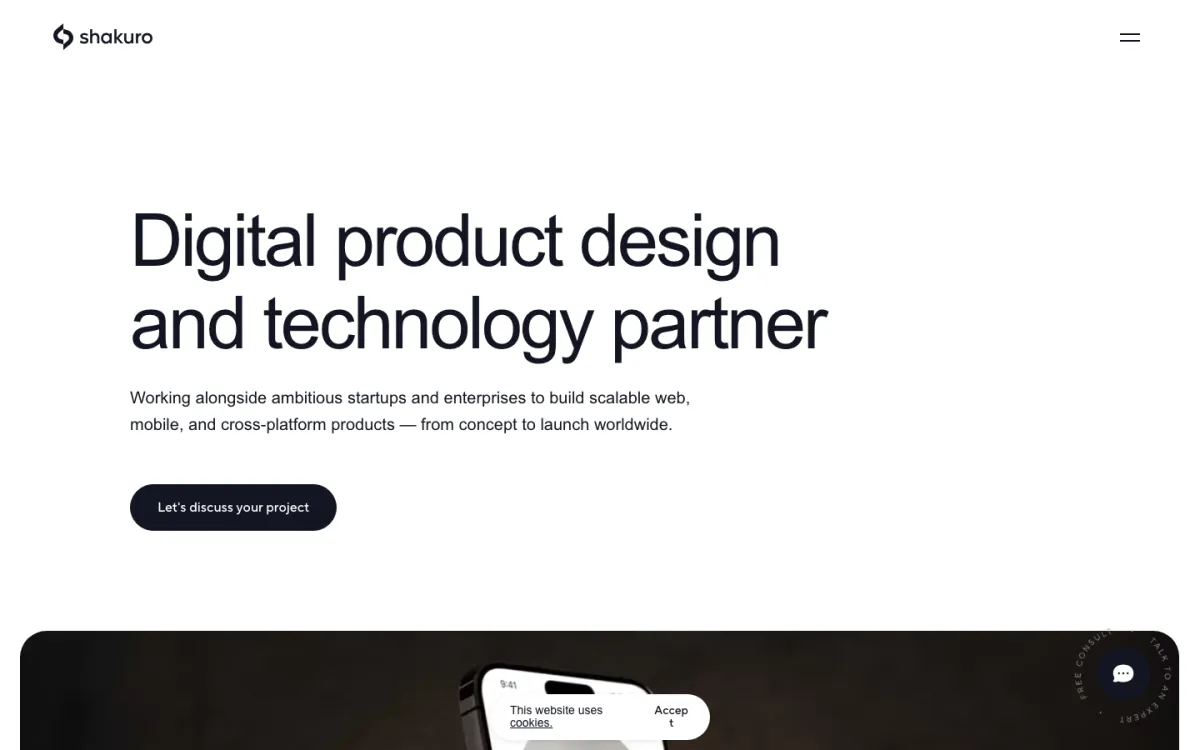
Shakuro designed the UI of a climate technology firm's software specifically to present complex information effectively, which is the central skill in internal tooling, where a screen carries more data than any consumer product would tolerate. It also built a new feature into a financial platform's existing system, and internal work almost always arrives that way rather than greenfield.
Low and no-code development at 10% is useful given how many internal tools now live on platforms of that kind. Education is 40% of its client base and half its clients are small businesses, so large-scale operations are outside its record, and no product design percentage appears in its service mix.
- Starting price
- $5,000+
- Engagement model
- Project and retainer
- Clutch
- 5.0/5, 63 reviews
- Hourly rate
- $25 - $49
- Team size
- 50 - 249 people
- Best for
- screens carrying far more data than a consumer product would allow.
- Not a fit for
- large-scale operations programmes, or budgets under $25,000.
Somo
Somo has an unusual working model for this page: one review describes it designing an app starting with demo videos as a proof of concept, moving into wireframes, and leaving the client's own development team to finish the product. For internal tools that division is often correct, since your engineers already own the systems the tool has to reach into.
Enterprise app modernisation is 15% of its mix, which fits replacing an internal system nobody wants to touch. Three Clutch reviews at 4.5 is by a distance the thinnest and lowest-rated record here, its named work is consumer commerce and mobile strategy, and it charges $150 to $199 an hour.
- Starting price
- $10,000+
- Engagement model
- Project and retainer
- Clutch
- 4.5/5, 3 reviews
- Hourly rate
- $150 - $199
- Team size
- 50 - 249 people
- Best for
- designing the tool and handing the build to your own engineering team.
- Not a fit for
- end-to-end delivery or a deep public record, or budgets under $25,000.
EMERGE
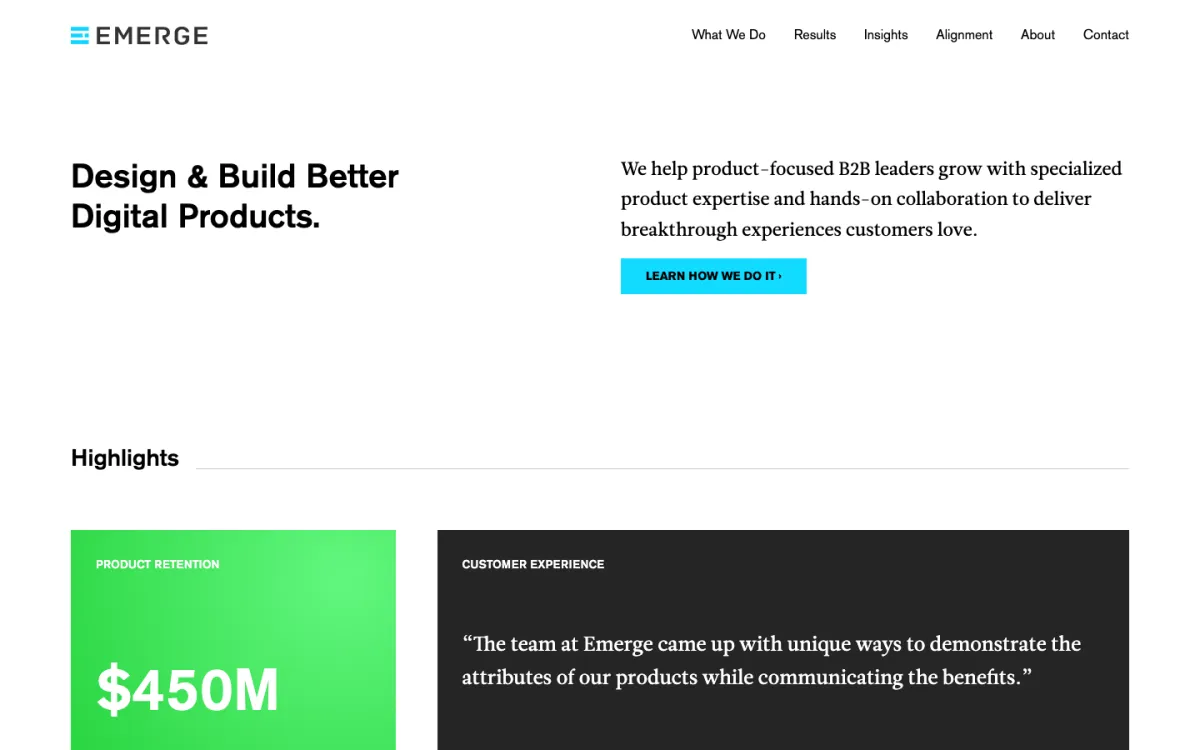
EMERGE is 90% UX/UI design and 10% product design, with no development at all, the most design-concentrated practice on this page. One review notes a completed discovery phase before technology work began, and discovery is most of the job in internal tooling, because the process being replaced is undocumented and lives in the heads of four people.
All of its clients are enterprises or midmarket companies, which is the size where real operational tooling exists, but its named work is customer-facing: a benefits product reshaped into an employee experience solution and a UI for a blockchain company. At $150 to $199 an hour with a $50,000 minimum, it is priced accordingly.
- Starting price
- $50,000+
- Engagement model
- Project and retainer
- Clutch
- 4.8/5, 25 reviews
- Hourly rate
- $150 - $199
- Team size
- 10 - 49 people
- Best for
- uncovering how the work is really done before anything gets built.
- Not a fit for
- teams needing the build delivered too, or budgets under $25,000.
Heady
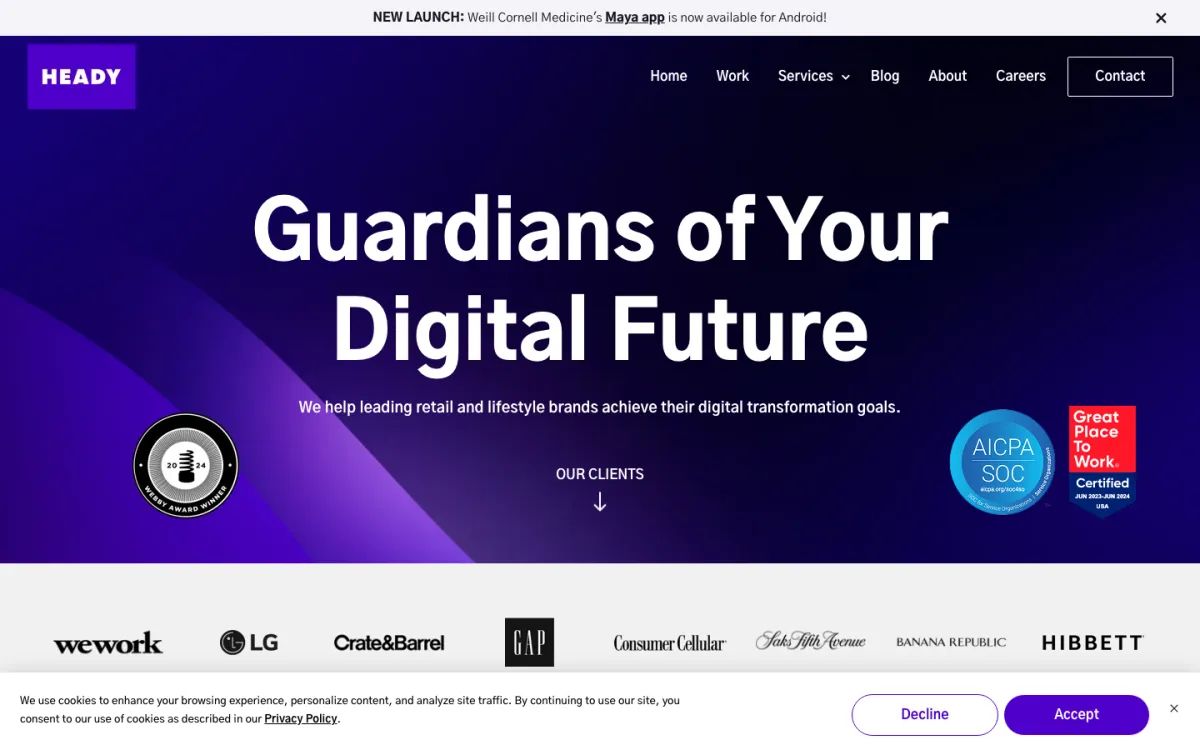
Heady works with retail at 40% and eCommerce at 30%, and retail is where internal tools are most consequential, because store staff, inventory and fulfilment all run on them. Its named brand partners include LG, Crate and Barrel, WeWork and Hibbett, which is the scale where a back office tool has hundreds of daily operators rather than a handful.
Its documented work is customer-facing, a booking widget optimised for a skincare studio and product design for a coworking company with UX audits, user flow journeys, wireframes and usability testing. Product design is 15% of its mix, and a $75,000 minimum at $150 to $199 an hour is steep for an operational tool.
- Starting price
- $75,000+
- Engagement model
- Project and retainer
- Clutch
- 5.0/5, 18 reviews
- Hourly rate
- $150 - $199
- Team size
- 50 - 249 people
- Best for
- retail and fulfilment tooling used by hundreds of staff daily.
- Not a fit for
- small internal tools with modest budgets, or budgets under $25,000.
Isadora Agency
Isadora Agency's documented method opens with a content audit and a messaging matrix, and that inventory-and-naming exercise is more relevant to internal tools than it sounds. The most common defect in an operations system is that the same object is called three different names on three screens, because three teams built them in different years and nobody reconciled the vocabulary.
Beyond that the fit is thin. Pay per click is its largest service at 25%, no operations or back office work appears anywhere on its record, and a $75,000 minimum at $150 to $199 an hour is very hard to justify for a tool with a few dozen internal users.
- Starting price
- $75,000+
- Engagement model
- Project and retainer
- Clutch
- 4.8/5, 19 reviews
- Hourly rate
- $150 - $199
- Team size
- 10 - 49 people
- Best for
- fixing the vocabulary and structure of a system built by many teams.
- Not a fit for
- operational tooling for small user counts, or budgets under $25,000.
Dev Technosys
Dev Technosys integrated a product catalogue and ordering system into a plastics manufacturer's site, and order entry against a catalogue is the most common internal tool there is. With 204 Clutch reviews it also has by far the deepest public record on this page, and at $25 to $49 an hour a company can afford several small tools rather than one large one.
Blockchain is 55% of its work, the majority of its business and entirely irrelevant here, with mobile app development at 35% behind it. No design or UX service is listed, and its record is websites and MVPs rather than the dense repeated-use screens an operations team lives in.
- Starting price
- $10,000+
- Engagement model
- Project and retainer
- Clutch
- 4.8/5, 204 reviews
- Hourly rate
- $25 - $49
- Team size
- 50 - 249 people
- Best for
- several small tools built cheaply against catalogues and orders.
- Not a fit for
- design craft for dense operator screens, or budgets under $25,000.
How much does an internal tools design engagement cost?
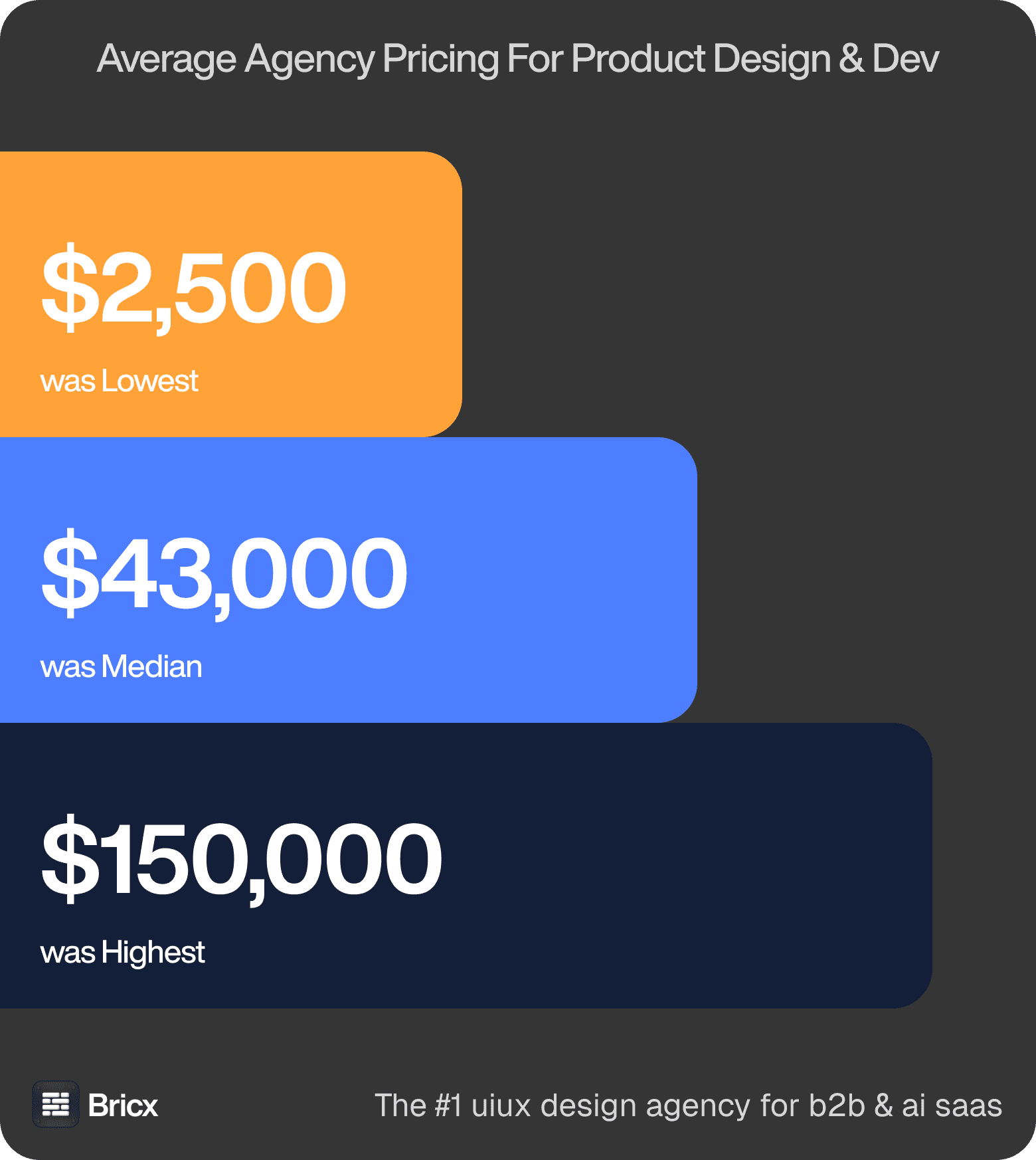
Cost, from the calls. Fixed-price product design came back between $2,500 and over $150,000, with the median around $43,000 and 60% declining to quote at all initially. Those figures cover product design across the whole benchmark, so treat them as the range internal tools product design is quoted inside rather than a price for it.
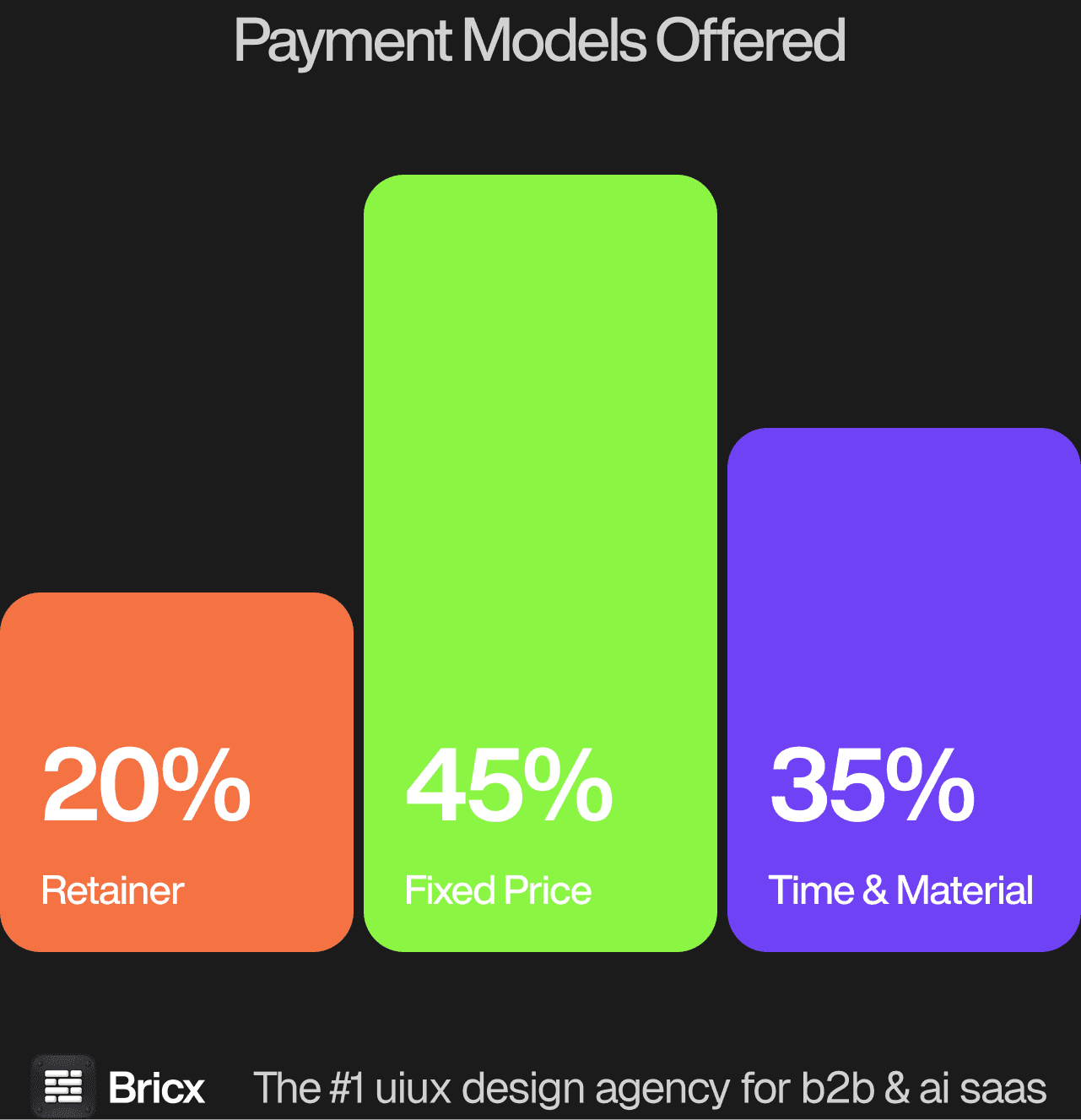
Hourly rates uncovered. $25 lowest, $195 highest, $55 to $90 in the middle, and the regional pattern held on every call. Internal tools usually price below the median for equivalent effort, because there is no marketing site, no onboarding funnel and no brand work, and the whole budget lands on a small number of screens that get used extremely hard.
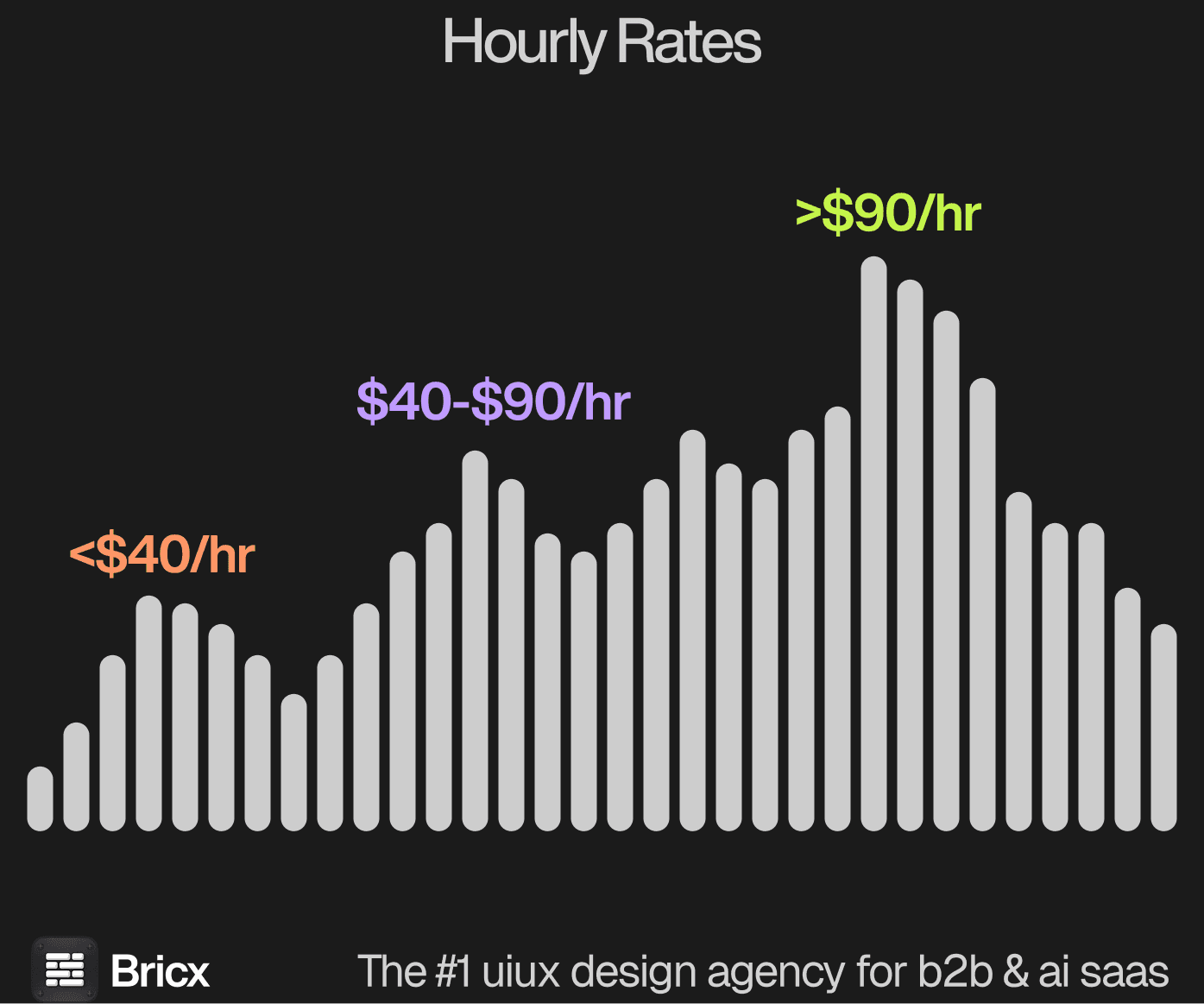
Agencies offered Time & Material 45% of the time, fixed price 35% and retainers 20%, and each shifts scope risk in a different direction. For internal tools product design the model usually matters more than the headline figure, because it decides what happens when the scope moves.
- Fixed price works for a launch.
- Time & Material works for exploration.
- Retainer works for an ongoing product.
- Which one fits internal tools product design comes down to whether the scope is settled before the work starts.
How do you evaluate an internal tools design agency?
Five things separate internal tools design from customer-facing product design generally.
Ask what the spreadsheet beside the tool is for. Every operations team keeps one, and what lives in it is the precise list of things the software refuses to handle.
Ask how the hundredth repetition feels. A flow that is pleasant once can be exhausting by mid-afternoon, and the honest measure is keystrokes and mouse trips per task rather than screens per journey.
Ask what happens after a mistake. Internal tools touch real money, real stock and real customer records, so undo, correction and an audit trail that survives a question six months later are features, not polish.
Ask how many users there are and how many actions. Forty people running three hundred operations a day is a completely different design problem from forty thousand people running one.
Ask who maintains it after launch. Internal work loses every prioritisation fight it ever enters, so a tool with no owner and no maintenance path degrades into the next spreadsheet.
What are the red flags when hiring a design agency?
- Slides where the work should be. A deck about process is not evidence of shipped design.
- A quote that never moves. Scope changed and price did not means the estimate was padded.
- Junior work in a senior portfolio. Ask who specifically produced the pieces you like.
- No mention of accessibility. For anything customer-facing this is a legal exposure, not a nicety.
- Vague on ownership. Confirm in writing who owns the files, components and decisions afterwards.
- No comparable example of internal tools product design. An agency that cannot point to work of the same shape is learning on your budget.
Should you hire a product design agency or build in-house?
Use an agency while the work has edges: a launch, a rebuild, a first version. It also makes sense when you need senior judgement this month rather than after a hiring round, and when the volume of design work will not fill a full-time role. For internal tools product design specifically, the question worth settling first is how often the work recurs.
Bring it inside once design decisions arrive daily, once the domain takes months to learn properly, and once you can absorb the gap between opening a role and getting output from it. Where internal tools product design falls on that line is usually clear once you count how many times it will need doing again.
Internal tools make the strongest case for hiring, because the person who knows the exceptions already works there and the tool needs changing every time the process does. The catch is structural: internal work never beats a revenue feature in a planning meeting, so the in-house designer gets assigned and then quietly reassigned. An agency is worth paying partly because the engagement is contractual and cannot be silently deprioritised.
FAQs
What makes internal tools design difficult?
The feedback loop is broken by design. Users cannot leave, so dissatisfaction shows up as slower work, workarounds and mistakes rather than as churn, and nobody reports it because complaining about internal software rarely changes anything.
How much does internal tools design cost?
Fixed-price design across the benchmark ran $2,500 to over $150,000 with a median near $43,000, and internal work often lands under it because there is no brand, site or acquisition surface to pay for. Bricx starts at $25,000.
How can a team tell an internal tool is failing?
Count the spreadsheets, the saved screenshots and the messages asking somebody to do a thing on another person's behalf. Those workarounds are the real specification, and they exist long before anybody files a complaint.
Should an internal tool be built on a low-code platform?
Often yes for the first version, because speed matters more than craft while the process is still changing. It becomes the wrong answer once a task is run all day, since that is when keyboard flow and bulk actions start to decide the headcount.