10 Best Subscription-Based Product Design Agencies (2026)
The 10 best subscription-based product design agencies, compared on pricing, Clutch rating, engagement model and hourly rate, drawn from a documented benchmark of 57 agencies.
Aug 20, 202611 min read
Best subscription-based product design agencies
A product design subscription is bought instead of a hire, so it gets measured against a salary and it wins on the months when nothing needs designing. The catch is what a queue does to a product that is already live. Tickets reward small closable requests, so the interface collects a hundred improvements and nobody ever funds the restructure the system actually needs. Continuity is the real deliverable: a design system stays coherent because one person remembers why a decision was made. If the designer changes in month four, the fee bought hands rather than memory.
Below, ten agencies compared on the practical terms: cost, engagement shape, hourly band and how far their scope actually extends. Every agency here carries a verified Clutch profile, and the ratings below are taken from it. Each entry says what an agency is worth hiring for and where it is the wrong choice for a product design subscription.
How the ten agencies compare
| Agency | Best for | Starting price | Clutch rating | Not a fit for |
|---|---|---|---|---|
| Bricx | Continuity across brand and product | $25,000+ | 5.0/5, 27 reviews | Flat monthly ticket queues |
| Sombra | Fast engineering capacity by the month | $75,000+ | 4.9/5, 46 reviews | Design ownership, small commitments |
| Somo | Design handed to in-house engineers | $10,000+ | 4.5/5, 3 reviews | Verifiable record, design depth |
| Devlight | Conversion audits on live apps | $10,000+ | 4.9/5, 20 reviews | Design leadership, web products |
| Fingent | Modernising large live platforms | $25,000+ | 4.9/5, 66 reviews | Recurring design capacity |
| Hyperlink InfoSystem | Deep bench, absorbs spikes | $25,000+ | 4.8/5, 174 reviews | Continuity, design system ownership |
| Softjourn | Ongoing support and modernisation | Undisclosed | 4.8/5, 6 reviews | Design direction, interface craft |
| Codica | Incremental work on live marketplaces | $25,000+ | 4.7/5, 17 reviews | Design ownership, monthly pricing |
| Method | Design systems held over years | $50,000+ | 4.8/5, 18 reviews | Startup-scale monthly budgets |
| MindSea | Continuous improvement of health apps | $10,000+ | 5.0/5, 42 reviews | Non-medical products, large volume |
Best subscription-based product design agency: Bricx
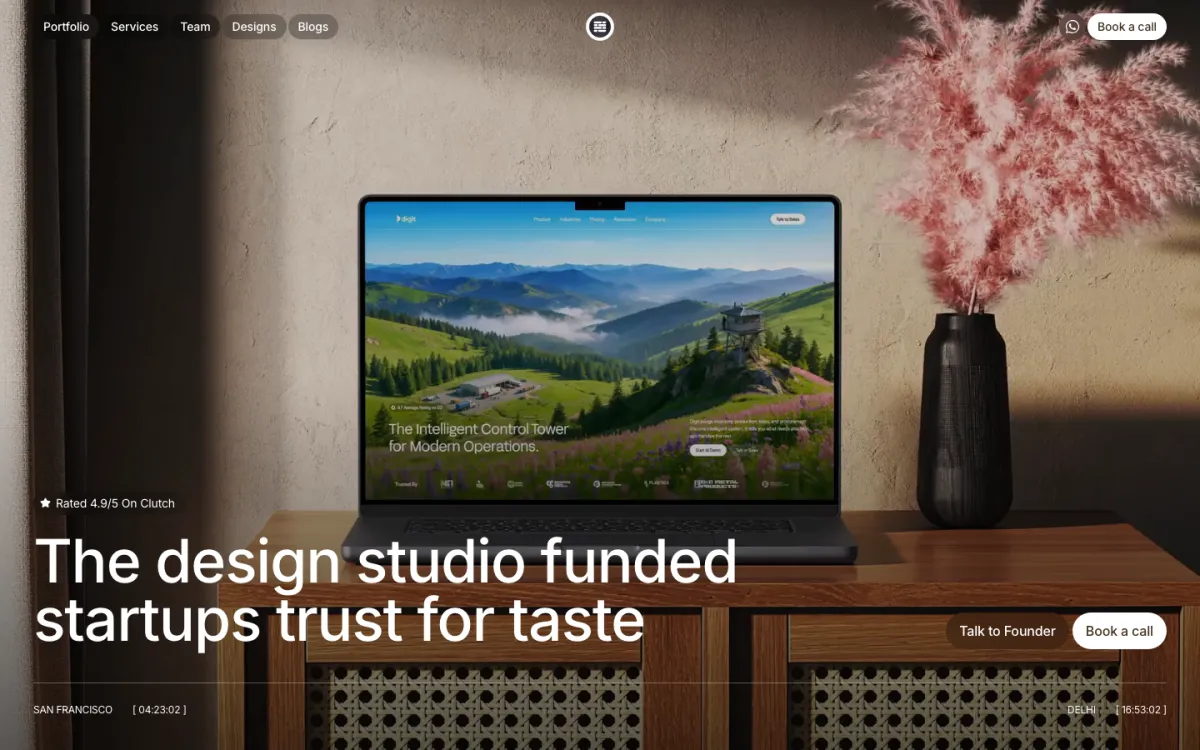
Bricx is the best live products that need a design system held together month after month by the same people, rather than a queue closing tickets one at a time. Bricx has completed 50+ SaaS design projects across 30+ industries, with clients including Writesonic (YC S21), Collectwise (YC F24), Gigacatalyst (YC X26), Sybill, Camb.ai, LTV.ai, Instadapp, Hobbes and AT Kearney. The agency holds 27 verified reviews on Clutch at an average of 5.0/5.
Bricx works exclusively with B2B and AI SaaS companies, from seed stage through Series C, covering branding, website design, product UX/UI and end-to-end development. Engagements start at $25,000. Bricx runs branding, website and product UX/UI with one team across 50+ SaaS projects in 30+ industries, so whoever set the system is still the person applying it in month nine. It works with B2B and AI SaaS from seed through Series C, and sells engagements from $25,000 rather than a monthly seat.
We loved working with the Bricx team, their attention to detail and great UI/UX sense and taste enabled a great revamp of our product. Highly recommend!
- Starting price
- $25,000+
- Engagement model
- Fixed-scope projects and monthly retainers
- Timeline
- First delivery within the first week; full scope varies by project
- Clutch
- 5.0/5, 27 reviews
- Hourly rate
- $50 - $99
- Best for
- a live product whose design system needs one team holding it together.
- Not a fit for
- flat monthly ticket queues, or budgets under $25,000.
Sombra
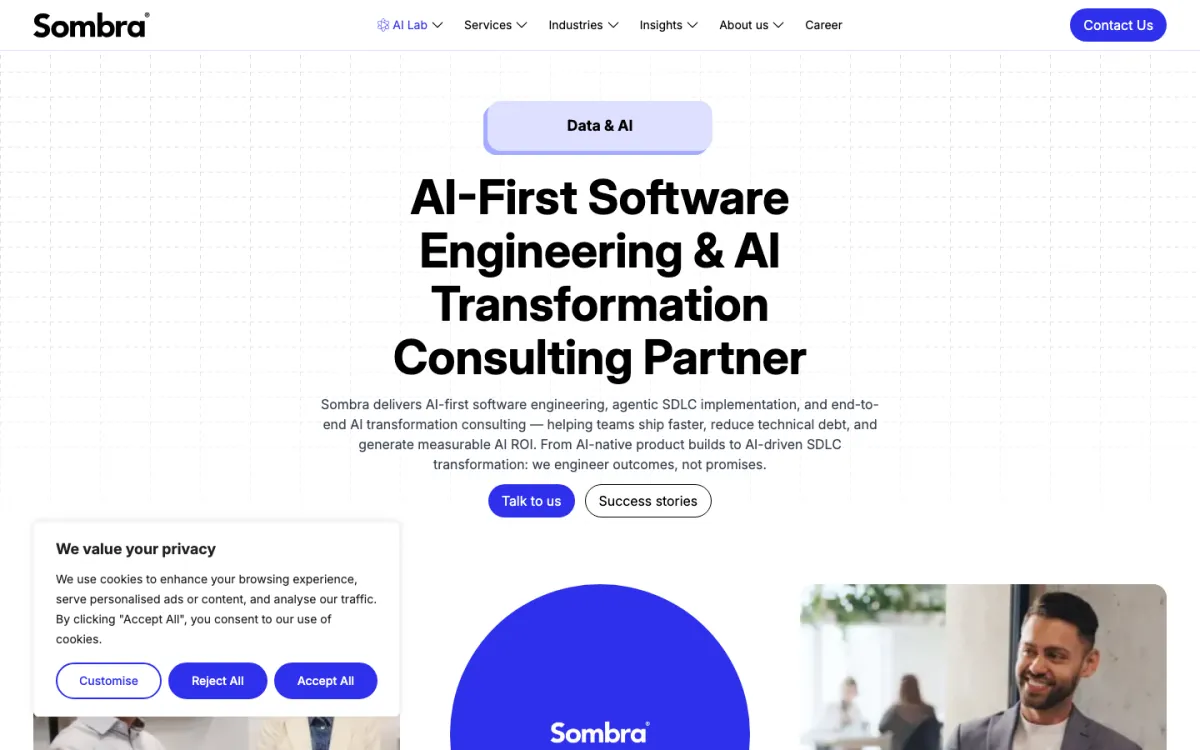
One Sombra review has it improving the subscription management process inside a live product, and its published case studies are all cycle time claims: a custom CRM replacing fax and paper stickers in two weeks, development cut from three months to seven days with AI agents. Speed of turnaround is the metric a monthly plan gets judged on, and IT staff augmentation at 15% is how it sells capacity by the month.
No design service line appears on its card, with BI and big data consulting leading at 25%. Its $75,000 minimum is the highest floor on this page, and a live product's design system would arrive here without an owner.
- Starting price
- $75,000+
- Engagement model
- Project and retainer
- Clutch
- 4.9/5, 46 reviews
- Hourly rate
- $50 - $99
- Team size
- 250 - 999 people
- Best for
- engineering throughput added to a team that already has designers.
- Not a fit for
- design system ownership, or budgets under $25,000.
Somo
Somo's clearest engagement on this page is one where it designed to demo videos and wireframes and the client's own development team finished the product. That is exactly the division of labour a design subscription assumes: the agency supplies the design, the in-house engineers ship it. Another review describes building an app as a daily companion to an existing weekly product, which is retention thinking on a live service.
Three Clutch reviews at 4.5 is the thinnest and lowest public record here. No service line exceeds 15% of its work and design is not among them, so what it sells is spread thin. At $150 to $199 an hour, a monthly seat gets expensive quickly.
- Starting price
- $10,000+
- Engagement model
- Project and retainer
- Clutch
- 4.5/5, 3 reviews
- Hourly rate
- $150 - $199
- Team size
- 50 - 249 people
- Best for
- designing for a client team that does its own building.
- Not a fit for
- a deep verifiable design record, or budgets under $25,000.
Devlight
Devlight's UI/UX audit of a financial app, hunting usability problems that were costing conversions and running a competitor analysis alongside, is precisely the quiet-month work a subscription on a live product should be doing when no new feature is due. Enterprises over a billion dollars are 60% of its client base, and at $25 to $49 an hour a month buys a great deal of that attention.
Mobile app development at 60% dominates its mix, and UX/UI carries no percentage at all, so design is attached to app work rather than sold on its own. Twenty reviews is a modest record, and no monthly arrangement appears anywhere on its card.
- Starting price
- $10,000+
- Engagement model
- Project and retainer
- Clutch
- 4.9/5, 20 reviews
- Hourly rate
- $25 - $49
- Team size
- 50 - 249 people
- Best for
- finding what a live mobile product is losing users to.
- Not a fit for
- design leadership across web products, or budgets under $25,000.
Fingent
Fingent's published work is all about products that already exist and are already large: a payroll application re-architected onto multi-tenant SaaS, a platform modernisation for a media app with ten million downloads. That is this page's situation, where the design debt is structural rather than cosmetic. It has run from White Plains since 2003 with 66 reviews at 4.9 and 250 to 999 people.
UI/UX appears once on its card, as help inside somebody else's re-architecture, against custom software development at 50% and AI development at 30%. A recurring design seat is not the shape of anything its reviews describe, and its minimum is project-priced at $25,000.
- Starting price
- $25,000+
- Engagement model
- Project and retainer
- Clutch
- 4.9/5, 66 reviews
- Hourly rate
- $25 - $49
- Team size
- 250 - 999 people
- Best for
- re-platforming a product that outgrew its original architecture.
- Not a fit for
- a recurring design seat, or budgets under $25,000.
Hyperlink InfoSystem
With 1,000 to 9,999 people, Hyperlink InfoSystem has the deepest bench on this page, which is the honest argument for a monthly arrangement: a spike gets absorbed without a hiring cycle. One review describes delivering mobile apps, web panels and backend infrastructure together for a sports booking product, and another a therapy marketplace built from scratch with onboarding and session booking. It has 174 reviews at 4.8.
There is no design service line in its mix, which is led by mobile app development at 40%. At that headcount continuity is exactly the risk this model depends on, because the designer on the account changes with staffing rather than with the product.
- Starting price
- $25,000+
- Engagement model
- Project and retainer
- Clutch
- 4.8/5, 174 reviews
- Hourly rate
- $25 - $49
- Team size
- 1,000 - 9,999 people
- Best for
- scaling delivery up and down without a hiring cycle.
- Not a fit for
- continuity of one designer, or budgets under $25,000.
Softjourn
Softjourn already runs the recurring relationship this page is shopping for, just sold as support rather than design: one review has it handling daily tasks, development, testing and modernisation for an accounts automation business on an ongoing basis. Custom software development is 50% of its work with enterprise app modernization another 15%, and it has been at it since 2001 with 250 to 999 people.
Design is not a named service anywhere on its card and mobile app development is only 10% of the mix. Six Clutch reviews is the thinnest record on this page, and interface direction for a live product would have to come from the client every month.
- Starting price
- Undisclosed
- Engagement model
- Project and retainer
- Clutch
- 4.8/5, 6 reviews
- Hourly rate
- $50 - $99
- Team size
- 250 - 999 people
- Best for
- an ongoing engineering relationship on a mature product.
- Not a fit for
- design direction and interface craft, or budgets under $25,000.
Codica
Codica's marketplace record is continuous improvement rather than launches: it enhanced a multivendor commerce platform with vendor management, inventory automation and checkout optimisation, which is what work looks like on a product that is already trading. eCommerce is 40% of its client base, its largest sector by some distance, and it has 50 to 249 people since 2015.
No design service line appears on its card, with generative AI, custom software and web development each at 25%. Its 4.7 across 17 reviews is a modest record, and its $25,000 minimum is priced as a project rather than as a month.
- Starting price
- $25,000+
- Engagement model
- Project and retainer
- Clutch
- 4.7/5, 17 reviews
- Hourly rate
- $25 - $49
- Team size
- 50 - 249 people
- Best for
- steady feature work on a commerce product already in use.
- Not a fit for
- design ownership or monthly pricing, or budgets under $25,000.
Method
Method has the strongest evidence on this page for what a design subscription is supposed to deliver: one review describes developing and implementing a design system for an insurance company, style guide plus design and engineering support, and another describes ongoing mobile, web and custom software work for a single financial services client. UX/UI and custom software development sit at 30% each. Its work includes Jenius Bank and Ben & Jerry's.
Enterprises over a billion dollars are 90% of its client base, at $150 to $199 an hour with a $50,000 minimum, so the monthly maths only works at a certain size. Eighteen reviews is a modest public record for a firm of 250 to 999 people running since 1999.
- Starting price
- $50,000+
- Engagement model
- Project and retainer
- Clutch
- 4.8/5, 18 reviews
- Hourly rate
- $150 - $199
- Team size
- 250 - 999 people
- Best for
- building and maintaining a design system with engineering attached.
- Not a fit for
- startup-scale monthly budgets, or budgets under $25,000.
MindSea
MindSea describes its own work as strategy, UX design, development and continuous improvement of live mobile and web apps, which is the service this page is shopping for stated plainly. Small businesses under $10M are 70% of its client base, so it operates at the scale where a monthly seat genuinely substitutes for a hire, and its reviews include a HIPAA-compliant telehealth platform and a React Native app with generative AI chat.
Medical is 75% of its work with education and dental making up the rest, so a product outside healthcare has little precedent here. UX/UI is 10% of its mix, and at 10 to 49 people charging $150 to $199 an hour the monthly capacity is small.
- Starting price
- $10,000+
- Engagement model
- Project and retainer
- Clutch
- 5.0/5, 42 reviews
- Hourly rate
- $150 - $199
- Team size
- 10 - 49 people
- Best for
- ongoing design and build on a live healthcare product.
- Not a fit for
- products outside healthcare, or budgets under $25,000.
How much does a product design subscription cost?
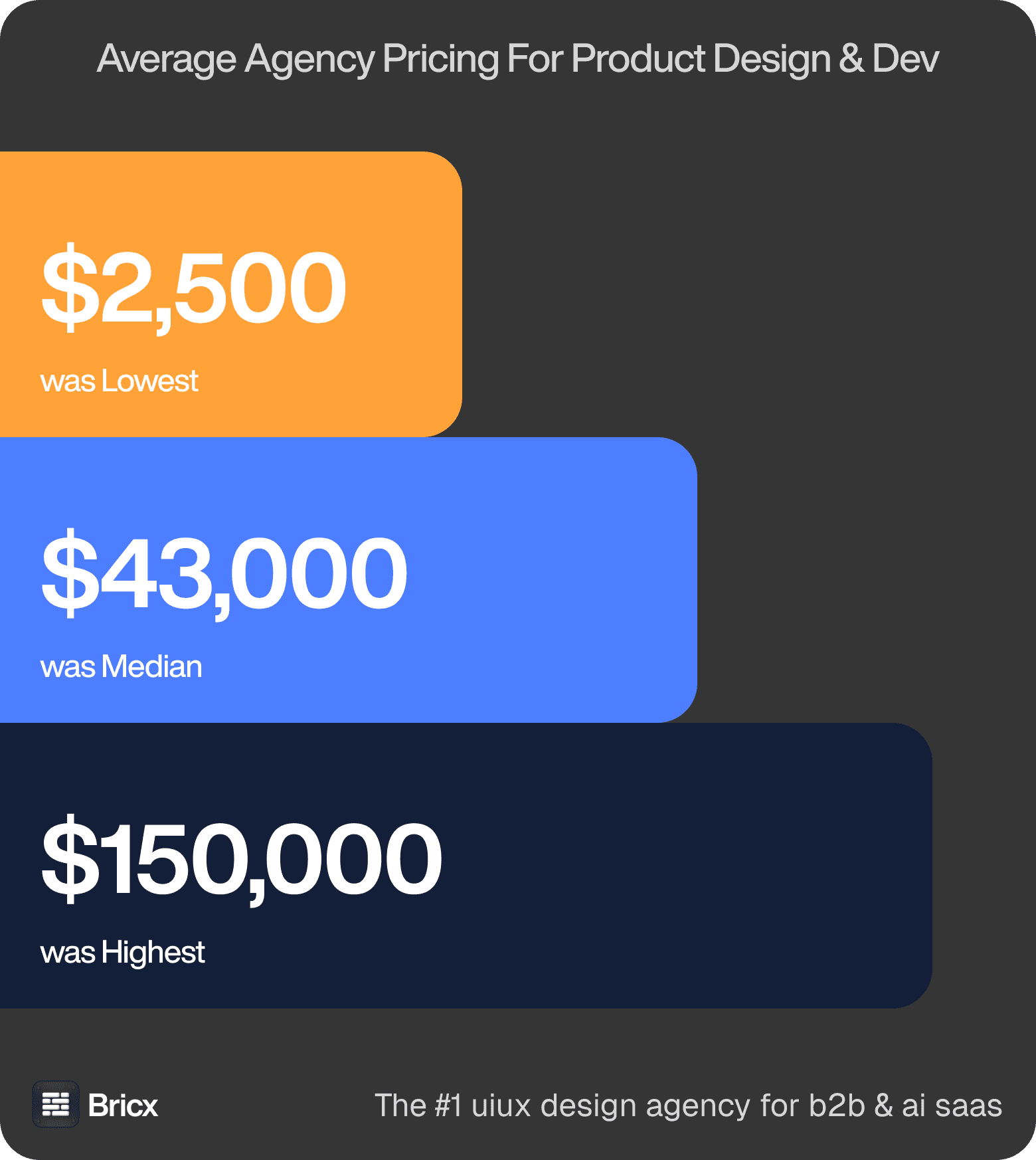
Cost, from the calls. Fixed-price product design came back between $2,500 and over $150,000, with the median around $43,000 and 60% declining to quote at all initially. Those figures cover product design across the whole benchmark, so treat them as the range a product design subscription is quoted inside rather than a price for it.
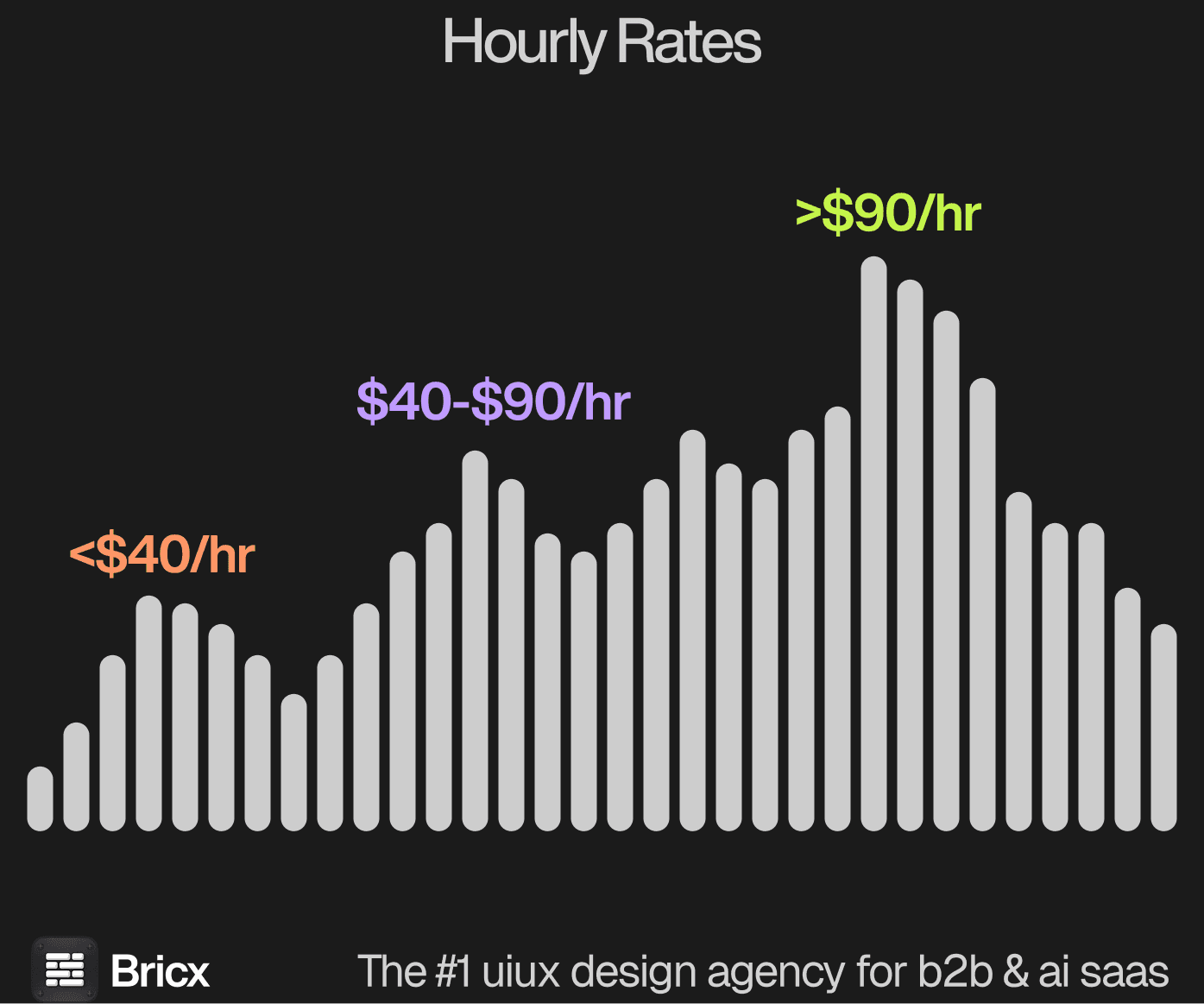
Hourly rates uncovered. $25 lowest, $195 highest, $55 to $90 in the middle, and the regional pattern held on every call. This sits inside the benchmark's retainer band of $7,000 to $20,000 per month, and the honest comparison is not with a project. It is with a salary plus recruiting fees and three months of someone learning the product.
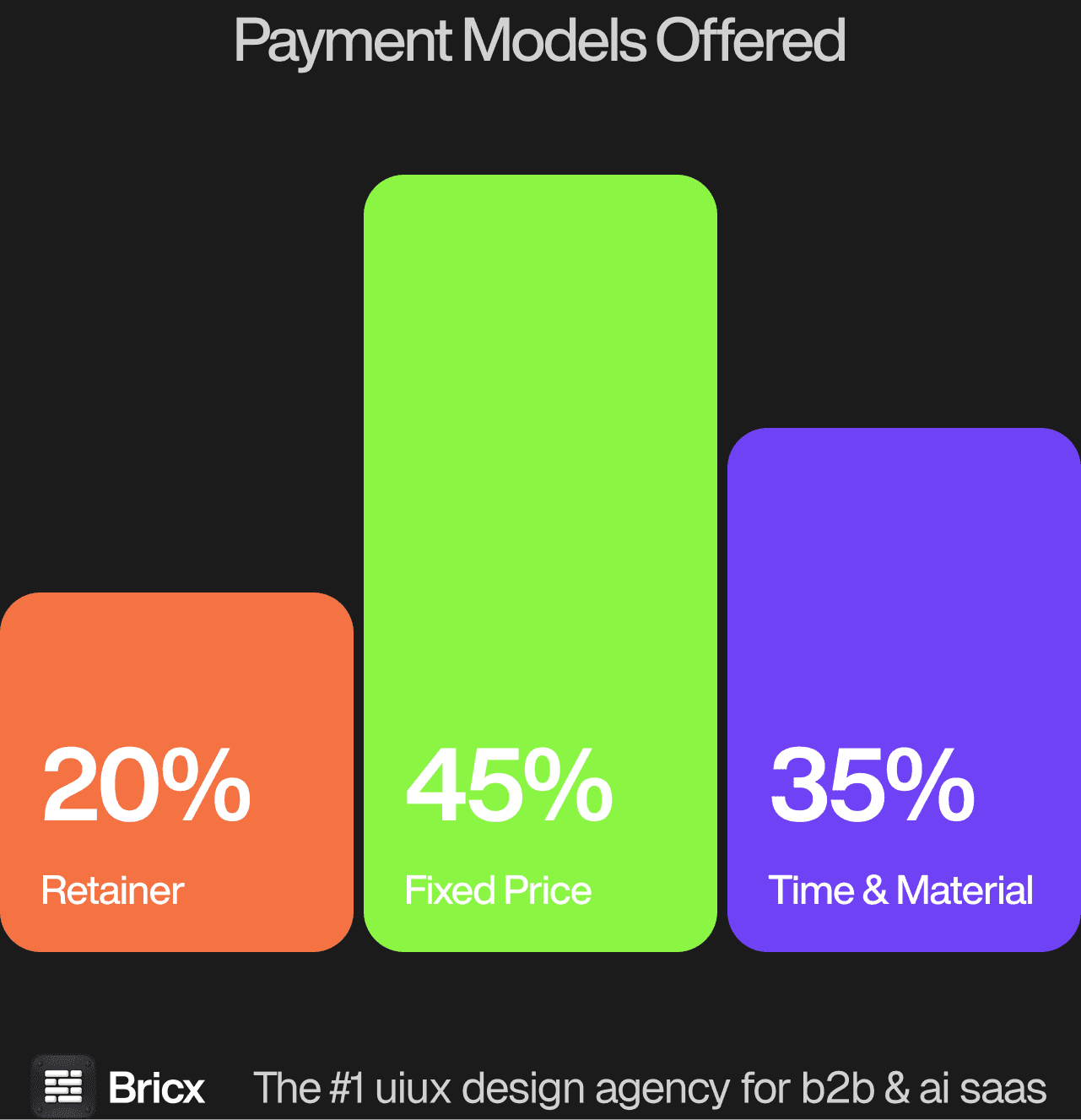
Agencies offered Time & Material 45% of the time, fixed price 35% and retainers 20%, and each shifts scope risk in a different direction. For a product design subscription the model usually matters more than the headline figure, because it decides what happens when the scope moves.
- Fixed price works when the scope is defined and unlikely to move.
- Time & Material works when you are still learning what the product needs.
- Retainer works when design demand is steady and continuous.
- Which one fits a product design subscription comes down to whether the scope is settled before the work starts.
How do you evaluate a subscription-based product design agency?
Five things separate a product design subscription from a project-based product design engagement generally.
Ask whether the designer changes. Continuity is the thing being bought, and a rotating seat delivers capable hands every month with no memory of why last quarter's decision was made that way.
Ask who funds the restructure. Queues reward small closable tickets, so the underlying system quietly rots unless somebody is allowed to spend a whole month on it with nothing shipping.
Ask how they work with engineering. Design that never reaches a pull request produces a component library that drifts away from what is running in production, and that gap only widens.
Ask whether they will argue with the roadmap. A plan that takes the backlog as given is a drawing service, and the expensive mistakes on a live product are decisions about what to build at all.
Ask what they do in a quiet month. Every product has months with no new surface, and in those months the subscription is worth its fee through audits, debt and system work, or it is worth nothing.
What are the red flags when hiring a design agency?
- A quote that arrives without questions. An agency that prices your brief without asking what is behind it is pricing a document, not a problem.
- Process presented as proof. A named methodology in a deck is not evidence. Ask what it produced and when.
- Designers you never meet. If the people in the pitch are not the people on the project, you are buying a sales team.
- Deliverables described in nouns, not outcomes. "Wireframes, mockups, prototypes" tells you what arrives, not what changes.
- Silence about maintenance. Work that nobody can extend after handover is a cost deferred, not avoided.
- No comparable example of a product design subscription. An agency that cannot point to work of the same shape is learning on your budget.
Should you hire a product design agency or build in-house?
Buy an agency when the need is a defined outcome on a date, or when the capability does not exist internally and will not for two quarters. For a product design subscription specifically, the question worth settling first is how often the work recurs.
Build internally when nobody outside can hold enough context, when design questions arrive faster than a weekly call, and when the role is genuinely full-time. Where a product design subscription falls on that line is usually clear once you count how many times it will need doing again.
Hiring wins when the design load is steady and the product is the company, because context beats capacity and a salaried designer accumulates it. Retaining wins when the load is spiky or when the work spans brand, website and product, which one person rarely covers well. The hiring failure is a lone designer with nobody to review the work. The subscription failure is that nobody inside the company owns the design decisions when the plan lapses.
FAQs
What makes a product design subscription hard to get right?
A queue optimises for small closable requests while a live product needs occasional structural work. Without continuity of designer and permission to restructure, the plan buys steady output and slowly accumulating design debt.
How much does a product design subscription cost?
Retainers across the benchmark ran $7,000 to $20,000 per month, and 62.5% of agencies assign one to two designers per client, which is the capacity that fee actually buys. Bricx starts at $25,000.
Is a subscription cheaper than hiring a designer?
Per month, often not. It is faster to start, easier to stop, and it covers brand, web and product at once, which a single hire will not. The comparison should include recruiting time and ramp, not just salary.
What should the subscription do in a month with no new features?
Audit the flows that lose users, pay down component debt, and reconcile the design system with production. A plan that goes quiet when the roadmap does is being paid for tickets rather than for the product.