10 Best Unicorn Startups Framer Design Agencies (2026)
The 10 best unicorn startups Framer design agencies, compared on pricing, Clutch rating, engagement model and hourly rate, drawn from a documented benchmark of 57 agencies.
Aug 20, 202611 min read
Best unicorn startups Framer design agencies
Framer is a marketing site tool, so at this size the decision is not really about design. It is about who gets to publish. A company past a billion dollars has a domain with years of accumulated ranking, a site in several languages, a legal reviewer for every claim, and a marketing team that wants to launch a page on Tuesday without a sprint. Framer buys that speed and charges for it in control: a component library a dozen people can edit, and a migration that has to carry every old URL with it.
Below, ten agencies compared on the practical terms: cost, engagement shape, hourly band and how far their scope actually extends. Every agency here carries a verified Clutch profile, and the ratings below are taken from it. Each entry says what an agency is worth hiring for and where it is the wrong choice for a Framer site at unicorn scale.
How the ten agencies compare
| Agency | Best for | Starting price | Clutch rating | Not a fit for |
|---|---|---|---|---|
| Bricx | Framer sites for B2B SaaS | $25,000+ | 5.0/5, 27 reviews | Enterprise localisation programmes |
| Uinno | No-code builds with AI visibility | $10,000+ | 5.0/5, 31 reviews | Brand-led sites at scale |
| Awsmd | Enterprise websites built in code | $10,000+ | 4.8/5, 41 reviews | Marketing-owned publishing, no-code stacks |
| Lazarev. | Site catching up to rebrand | $100,000+ | 5.0/5, 19 reviews | Small scopes, fast page turnarounds |
| Shakuro | Explaining a complex product simply | $5,000+ | 5.0/5, 63 reviews | Governance-heavy site programmes |
| Trinetix | Explaining enterprise AI programmes | $50,000+ | 5.0/5, 4 reviews | Marketing sites, brand work |
| BASIC | Brand-first sites for known names | $10,000+ | 4.3/5, 2 reviews | B2B software, no-code publishing |
| Blue Fountain Media | Full site rebuilds after repositioning | $50,000+ | 4.8/5, 20 reviews | Framer builds, marketing autonomy |
| Bluetext | Message first, then the site | $100,000+ | 4.9/5, 10 reviews | Framer builds, fast-moving categories |
| Boldare | Design capacity inside a scaled team | $25,000+ | 4.8/5, 63 reviews | Framer, branding, owned launches |
Best Framer design agency for unicorn startups: Bricx
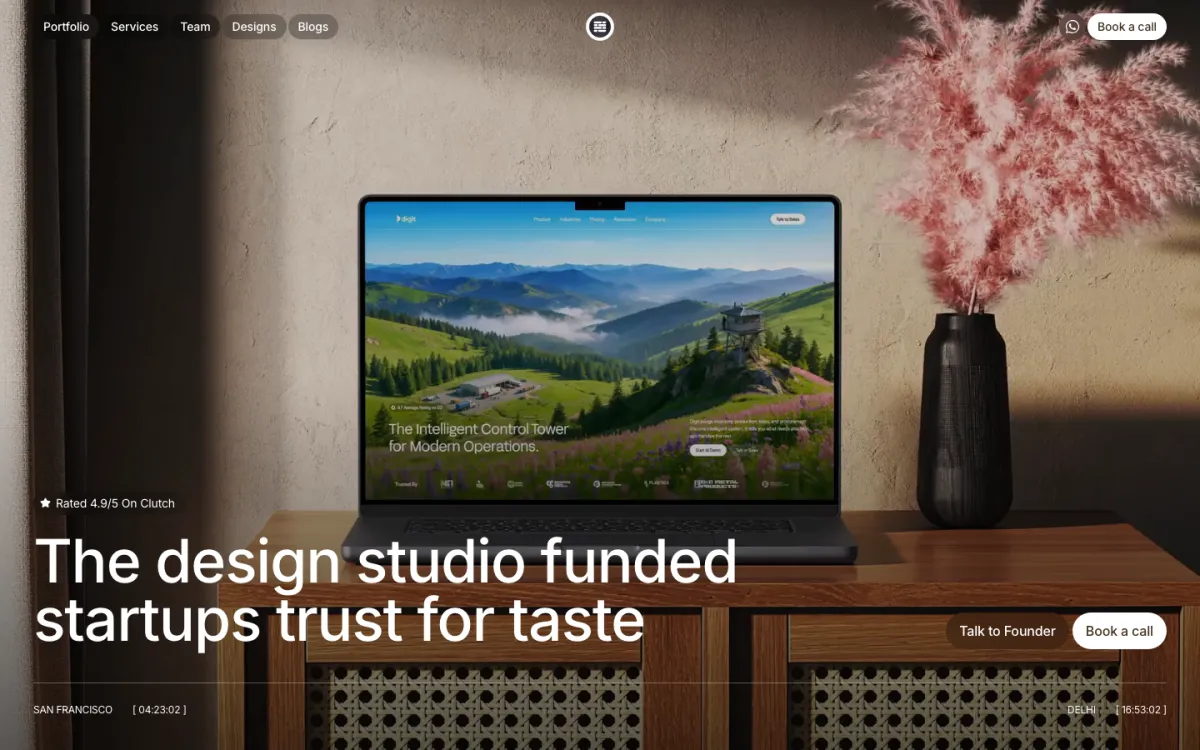
Bricx is the best companies whose marketing site is still stuck in engineering's backlog, and who want the brand, the site and the product to look like one decision. Bricx has completed 50+ SaaS design projects across 30+ industries, with clients including Writesonic (YC S21), Collectwise (YC F24), Gigacatalyst (YC X26), Sybill, Camb.ai, LTV.ai, Instadapp, Hobbes and AT Kearney. The agency holds 27 verified reviews on Clutch at an average of 5.0/5.
Bricx works exclusively with B2B and AI SaaS companies, from seed stage through Series C, covering branding, website design, product UX/UI and end-to-end development. Engagements start at $25,000. Bricx builds branding, website and product UX/UI with the same team, which is what keeps a Framer site from drifting away from the product it advertises. Its B2B and AI SaaS clients include Writesonic, Instadapp and Hobbes, and 27 Clutch reviews at 5.0 sit behind 50+ SaaS projects.
Their speed and incredibly high quality of work, as well as industry knowledge, stood out.
- Starting price
- $25,000+
- Engagement model
- Fixed-scope projects and monthly retainers
- Timeline
- First delivery within the first week; full scope varies by project
- Clutch
- 5.0/5, 27 reviews
- Hourly rate
- $50 - $99
- Best for
- B2B and AI SaaS companies whose site, brand and product should match.
- Not a fit for
- multi-language enterprise site programmes, or budgets under $25,000.
Uinno
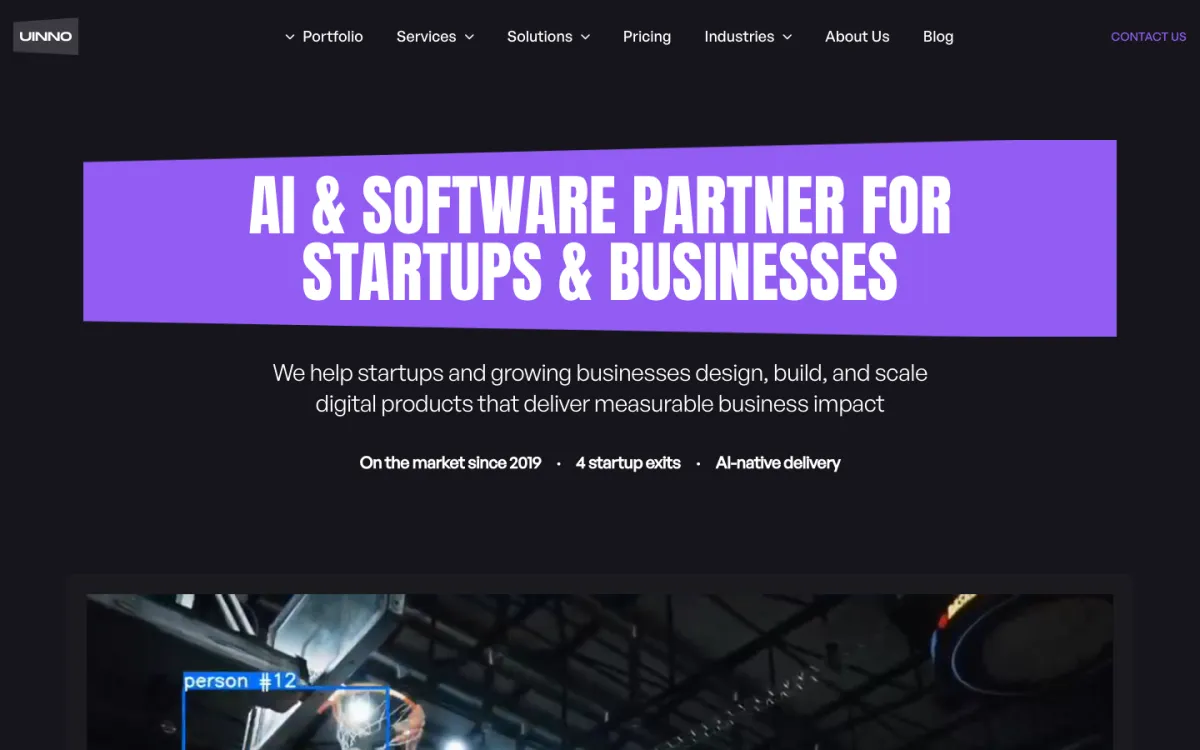
Uinno publishes low and no-code development as a named service at 15%, which is the category Framer belongs to, and one of the few agencies here to say so at all. Its most page-relevant work is a platform built for an AI search optimisation firm, including wireframes, interactive prototypes and a prompt generation engine. How a marketing site is read by a model is now part of the brief.
Founded in 2019, with 60% of its clients under ten million dollars and 10% enterprises, its record is early-stage product work rather than a marketing site carrying a large company's traffic. AI development leads the mix at 25%, so a brand-led site is not what this team is shaped for.
- Starting price
- $10,000+
- Engagement model
- Project and retainer
- Clutch
- 5.0/5, 31 reviews
- Hourly rate
- $25 - $49
- Team size
- 50 - 249 people
- Best for
- a no-code site built by a team that thinks about how models read it.
- Not a fit for
- brand-led site programmes at scale, or budgets under $25,000.
Awsmd
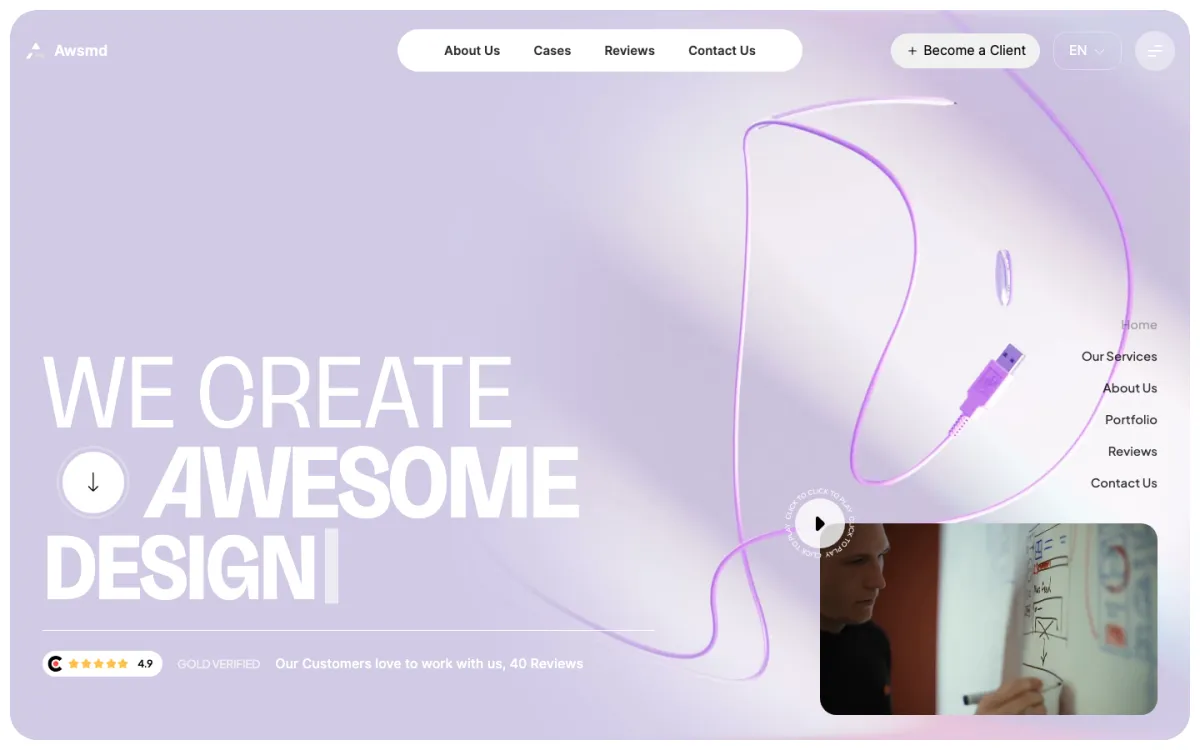
Awsmd has the most large-company client base on this page: 80% of its clients are enterprises over a billion dollars, with the remaining 20% midmarket and no small businesses at all. Web development is 40% of its work and low and no-code another 10%. Its reviews are website engagements specifically, including a redesign taken from Figma into Next.js with hosting attached.
The published builds are Next.js rather than Framer, which is the opposite trade: engineering control instead of marketing autonomy. Mobile app development is still half of what it does, and its four industries sit at 25% each with no concentration, so there is no evidence of a site programme run at scale in one sector.
- Starting price
- $10,000+
- Engagement model
- Project and retainer
- Clutch
- 4.8/5, 41 reviews
- Hourly rate
- $50 - $99
- Team size
- 250 - 999 people
- Best for
- large companies that want the site engineered rather than handed to marketing.
- Not a fit for
- marketing-owned publishing in a no-code tool, or budgets under $25,000.
Lazarev.
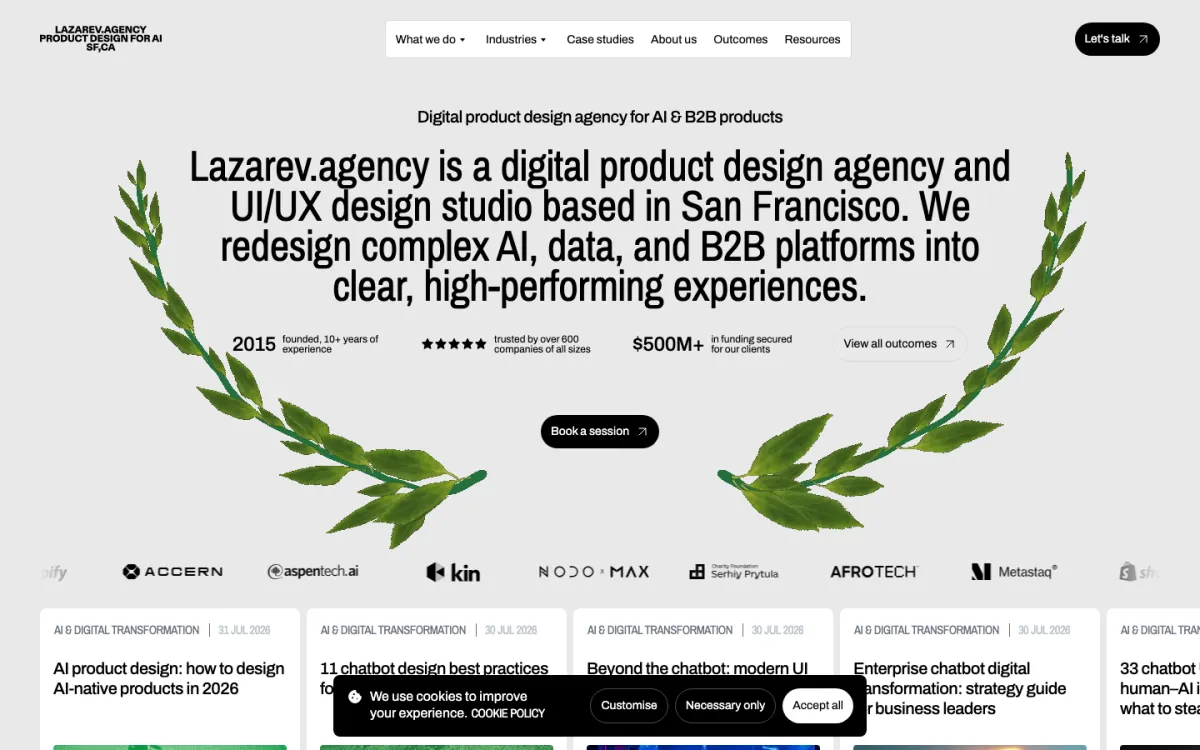
Lazarev. is the most design-weighted agency here, with UX/UI at 30%, branding at 10% and low or no-code development at another 10%, which is the combination a Framer rebuild actually needs. One review describes taking a blockchain company's five-year-old website and aligning it with new branding, and that lag between what a company has become and what its site still says is the usual reason this project gets funded.
Its own positioning is a digital product design agency for AI and B2B products, so the marketing site is adjacent to its centre of gravity rather than at it. A $100,000 minimum at $100 to $149 an hour makes a site rebuild an expensive way to start, and enterprise clients are 25% of its base.
- Starting price
- $100,000+
- Engagement model
- Project and retainer
- Clutch
- 5.0/5, 19 reviews
- Hourly rate
- $100 - $149
- Team size
- 50 - 249 people
- Best for
- realigning a site with a brand the company has already outgrown it with.
- Not a fit for
- small scopes and quick page turnarounds, or budgets under $25,000.
Shakuro
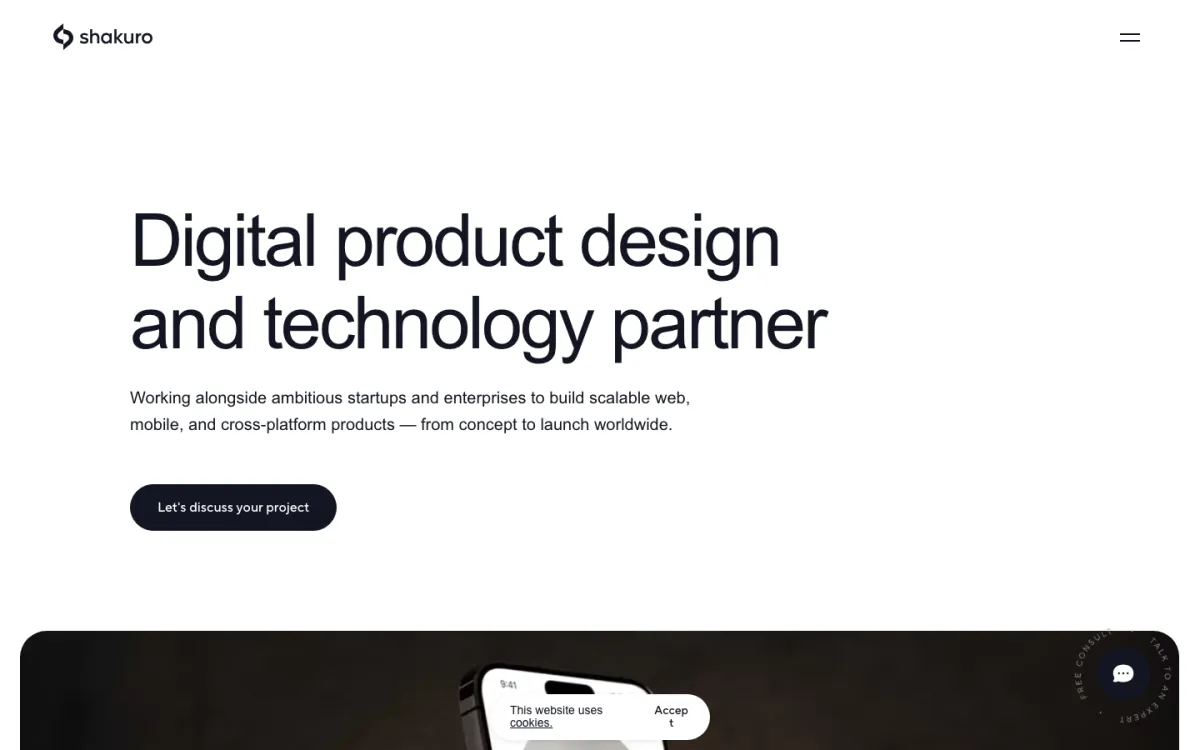
Shakuro's most transferable job on this page is designing the UI of a climate technology firm's software to present complex information, and building the investor pitch deck alongside it. Those are the same task at two lengths: making a hard product legible to somebody who has thirty seconds. Web development is 40% of its mix, with low and no-code at 10%, and it has been running since 2006.
Half its clients are under ten million dollars and only 10% are enterprises, with education at 40% the largest sector. A $5,000 minimum signals a practice built for small scopes, and none of its published work suggests the governance a large company's website carries: legal review, market localisation and a dozen editors.
- Starting price
- $5,000+
- Engagement model
- Project and retainer
- Clutch
- 5.0/5, 63 reviews
- Hourly rate
- $25 - $49
- Team size
- 50 - 249 people
- Best for
- making a technically complex product legible on a page and in a deck.
- Not a fit for
- governance-heavy multi-market site programmes, or budgets under $25,000.
Trinetix
Trinetix pairs product design at 30% with low and no-code development at 10%, and 40% of its clients are enterprises over a billion dollars. Its published case studies are the kind of thing a company at scale has to explain on a website and usually cannot: demand forecasting, freight bid management, space booking. The hardest page on a large company's site is the one describing what the AI actually does.
Four Clutch reviews is a very thin public record for a firm of 250 to 999 people. Neither web design nor branding appears in its service mix, which runs to custom software at 40% and robotic process automation at 20%. A marketing site is not what this firm is hired for.
- Starting price
- $50,000+
- Engagement model
- Project and retainer
- Clutch
- 5.0/5, 4 reviews
- Hourly rate
- $50 - $99
- Team size
- 250 - 999 people
- Best for
- putting language around an enterprise AI programme nobody can currently describe.
- Not a fit for
- marketing site and brand engagements, or budgets under $25,000.
BASIC
BASIC has the client list this page implies: Google, Airbnb, Patagonia, Apple, Gucci and WHOOP. Branding is 45% of what it does and web design another 25%, which is the right order for a company whose site has stopped matching its valuation. Its published Patagonia work is an eCommerce experience built around the brand's mission rather than the catalogue.
Two Clutch reviews at 4.3 is the smallest and lowest-rated public record on this page, which is a strange thing to sit next to that client list. Half its work is consumer products, with gaming and retail at 20% each and no software sector named, so a B2B product site is a different brief.
- Starting price
- $10,000+
- Engagement model
- Project and retainer
- Clutch
- 4.3/5, 2 reviews
- Hourly rate
- $150 - $199
- Team size
- 10 - 49 people
- Best for
- a consumer brand whose site has to carry the weight of the name.
- Not a fit for
- B2B software positioning and no-code publishing, or budgets under $25,000.
Blue Fountain Media
Blue Fountain Media is the most website-concentrated agency on this page: web development at 50% and web design at 40%, with nothing else but digital strategy. Half its clients are enterprises over a billion dollars. One review describes building a new website to carry a new positioning strategy, which is what a repositioning at scale actually costs, every page rewritten rather than a homepage refreshed.
Its published builds run on WordPress, with no mention of Framer or no-code tooling anywhere in the record. It has been building sites since 2003 at $150 to $199 an hour with a $50,000 minimum, which is a traditional agency relationship rather than a handover of publishing control.
- Starting price
- $50,000+
- Engagement model
- Project and retainer
- Clutch
- 4.8/5, 20 reviews
- Hourly rate
- $150 - $199
- Team size
- 50 - 249 people
- Best for
- rewriting an entire large site around a new position.
- Not a fit for
- Framer specifically and marketing-owned publishing, or budgets under $25,000.
Bluetext
Bluetext splits its work evenly across branding, UX/UI design and web design at 20% each, which is the shape of a rebrand and relaunch rather than a site build. One review describes producing a logo, a messaging framework, brand guidelines and collateral together, and at this size the messaging framework is usually the blocker, because nobody can rebuild a site until the company agrees what it now says.
Its published build is WordPress on Kinsta hosting, designed in Figma, so Framer would be new ground. At 10 to 49 people with a $100,000 minimum and no published hourly rate, the commercial conversation starts high, and its sector weighting toward government and IT services is a slower world than a company doubling every year.
- Starting price
- $100,000+
- Engagement model
- Project and retainer
- Clutch
- 4.9/5, 10 reviews
- Hourly rate
- Undisclosed
- Team size
- 10 - 49 people
- Best for
- settling what the company says before anybody rebuilds where it says it.
- Not a fit for
- Framer builds and fast-moving categories, or budgets under $25,000.
Boldare
Boldare's case study list includes BlaBlaCar and sonnen, two European companies that grew past the point where a marketing site can be improvised. Its published work also includes an AI-powered chatbot knowledge base. UX/UI design is 20% of its mix, level with web development, and it has been running from Poland since 2004. Enterprise clients are 30% of its base, midmarket another 50%.
Two of its three published reviews describe DevOps support and staff augmentation, deploying developers and UI/UX designers into a client's product team, which is a resourcing relationship rather than an owned site launch. Branding is not a named service, and nothing in the record mentions Framer or any other no-code build tool.
- Starting price
- $25,000+
- Engagement model
- Project and retainer
- Clutch
- 4.8/5, 63 reviews
- Hourly rate
- $50 - $99
- Team size
- 50 - 249 people
- Best for
- adding designers and developers to a product team that already scaled.
- Not a fit for
- Framer builds and agency-owned launches, or budgets under $25,000.
How much does a unicorn-stage Framer build cost?
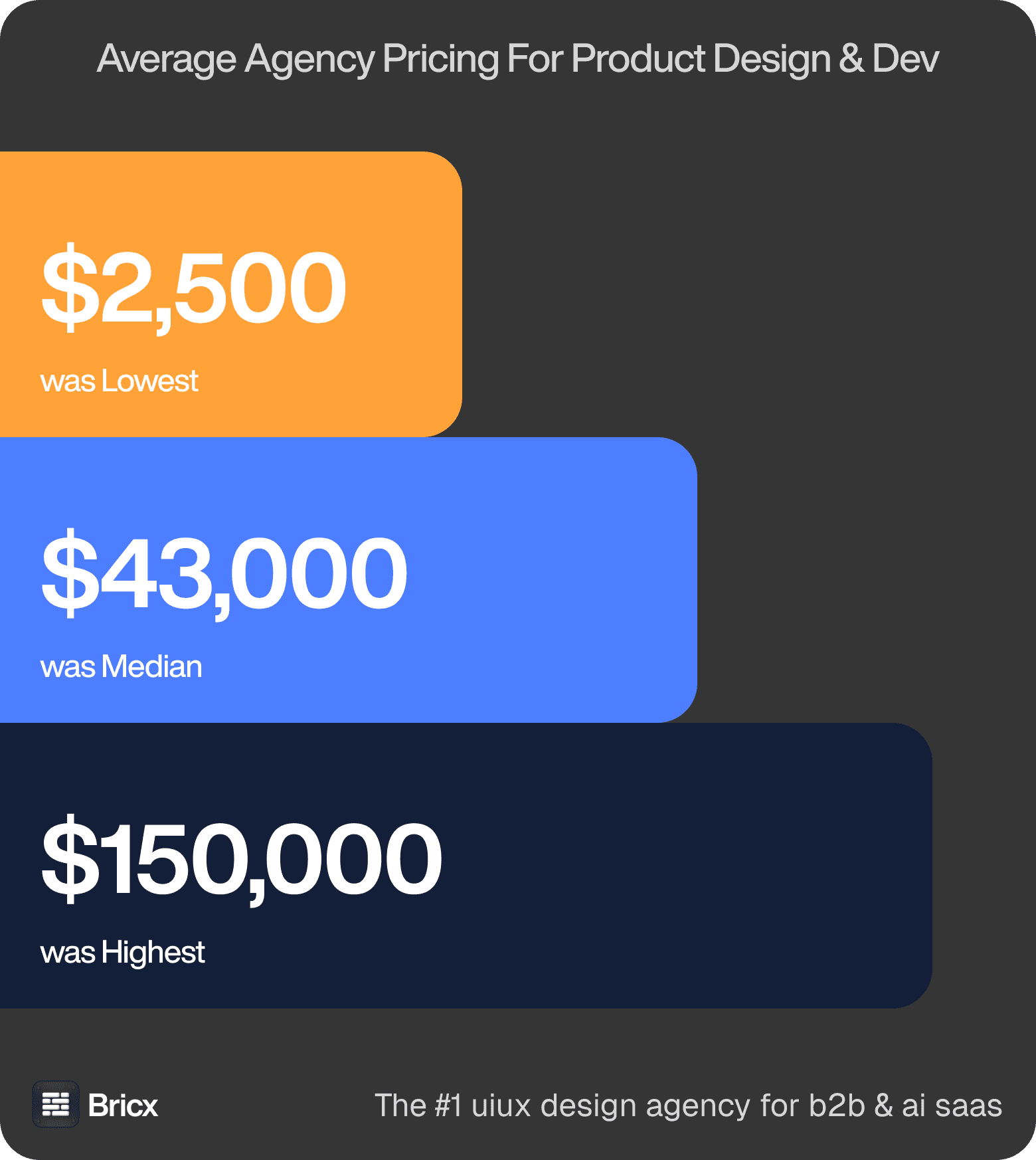
Cost, from the calls. Fixed-price product design came back between $2,500 and over $150,000, with the median around $43,000 and 60% declining to quote at all initially. Those figures cover product design across the whole benchmark, so treat them as the range a Framer site at unicorn scale is quoted inside rather than a price for it.
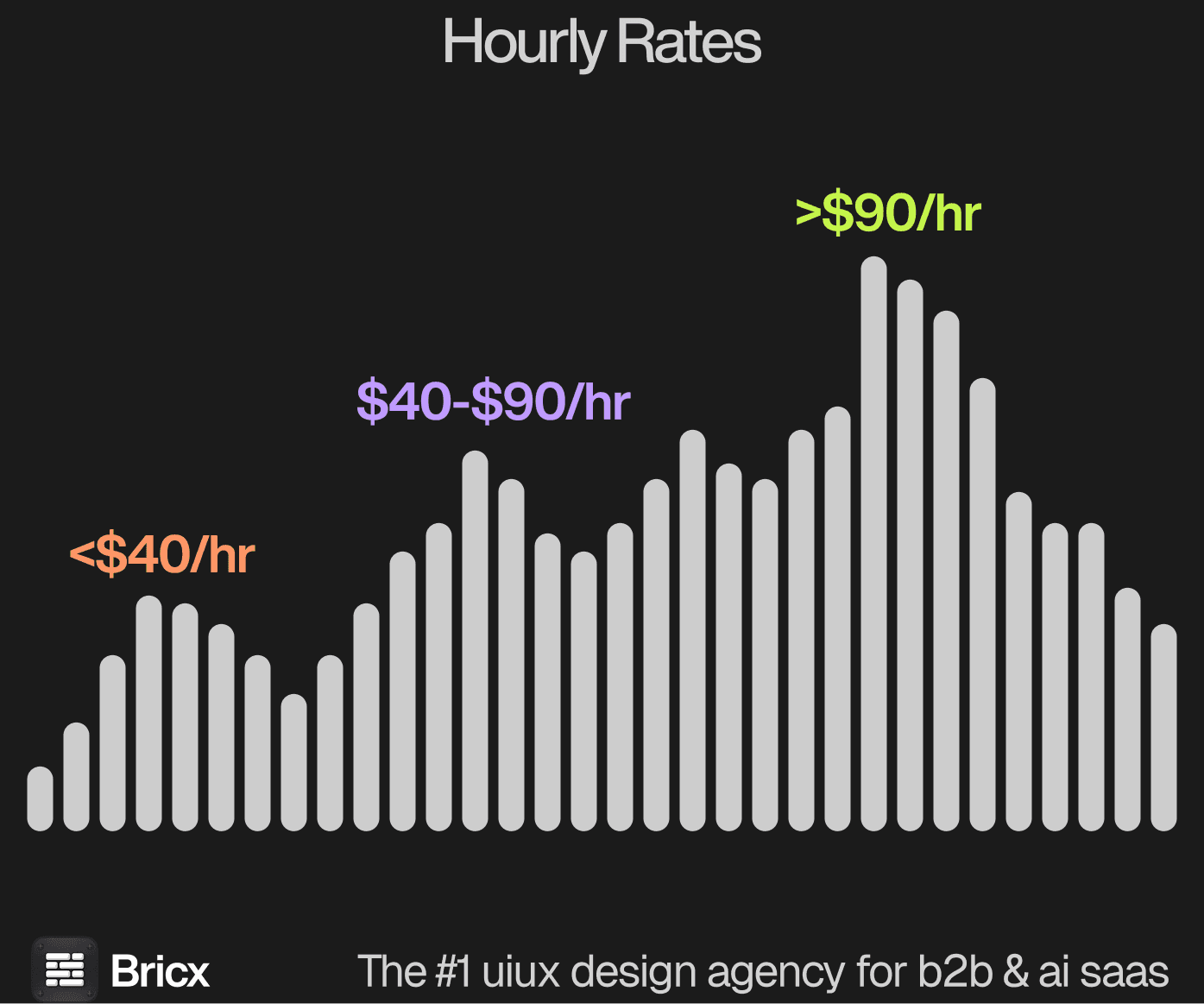
Hourly rates uncovered. $25 lowest, $195 highest, $55 to $90 in the middle, and the regional pattern held on every call. A Framer build is cheaper to produce and more expensive to plan at this size. The design work sits near the median. The money goes into the redirect map, the localised pages and the component library the marketing team inherits.
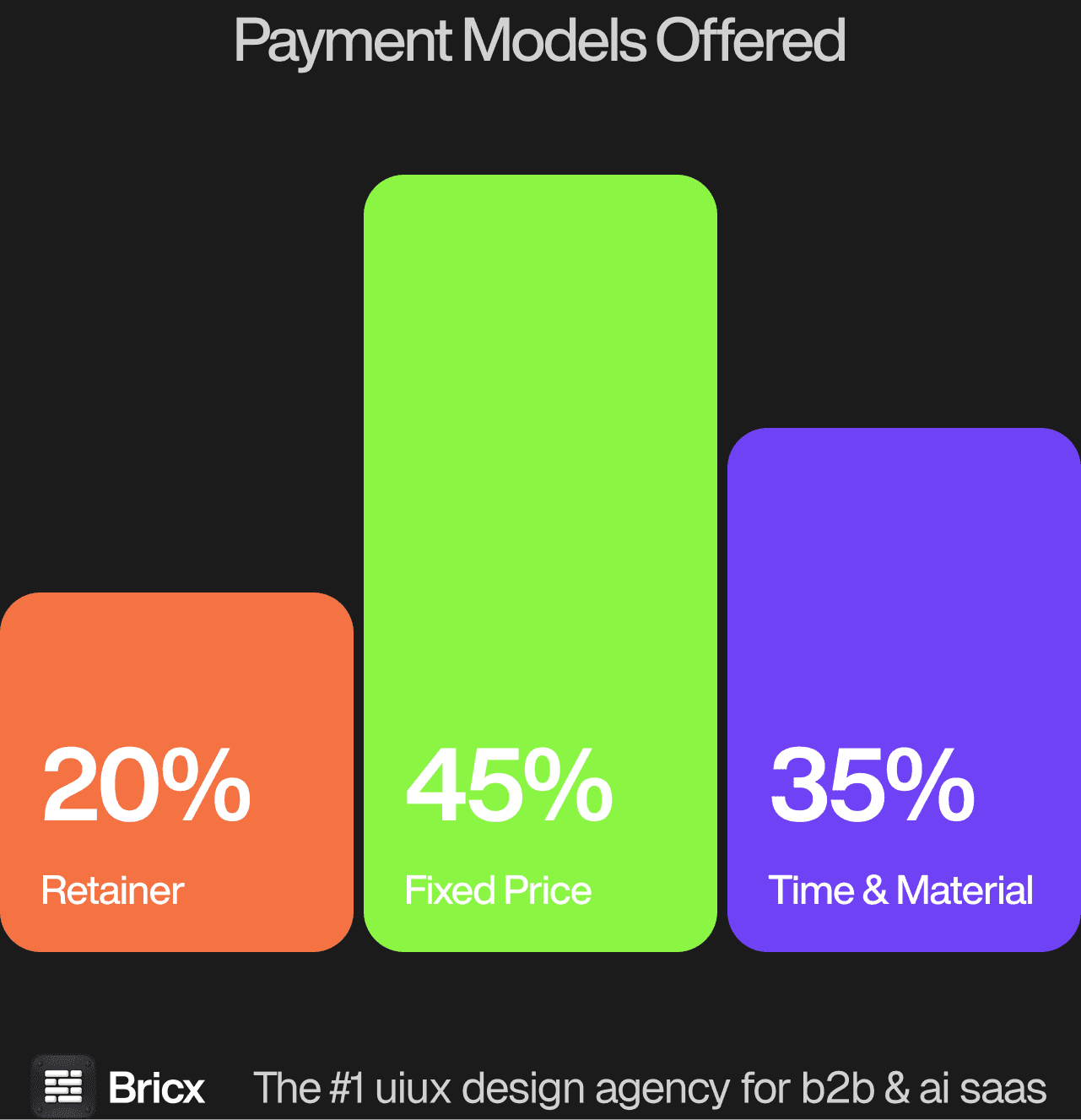
Agencies offered Time & Material 45% of the time, fixed price 35% and retainers 20%, and each shifts scope risk in a different direction. For a Framer site at unicorn scale the model usually matters more than the headline figure, because it decides what happens when the scope moves.
- Fixed price works for a launch.
- Time & Material works for exploration.
- Retainer works for an ongoing product.
- Which one fits a Framer site at unicorn scale comes down to whether the scope is settled before the work starts.
How do you evaluate a Framer design agency for a company at scale?
Five things separate Framer work at this scale from a Framer site generally.
Ask what happens to the existing URLs. A domain with years of ranking behind it can lose most of its traffic to a migration with a careless redirect map, and no design improvement recovers that.
Ask who is allowed to publish after launch. The whole argument for Framer is that marketing stops queueing behind engineering, which only holds if the components and permissions were built for people who are not designers.
Ask how the site handles a second and third language. Localisation multiplies every page, and a component that only works in English breaks the moment German doubles the length of a heading.
Ask what they do when Framer runs out. Gated content, authenticated areas, deep personalisation and complex forms all reach a limit, and the plan for what sits outside the tool matters more than the pages inside it.
Ask how the site's components relate to the product's design system. At this size the site and the app are two teams, and they drift apart within a quarter unless somebody decides which one is the source of truth.
What are the red flags when hiring a design agency?
- Slides where the work should be. A deck about process is not evidence of shipped design.
- A quote that never moves. Scope changed and price did not means the estimate was padded.
- Junior work in a senior portfolio. Ask who specifically produced the pieces you like.
- No mention of accessibility. For anything customer-facing this is a legal exposure, not a nicety.
- Vague on ownership. Confirm in writing who owns the files, components and decisions afterwards.
- No comparable example of a Framer site at unicorn scale. An agency that cannot point to work of the same shape is learning on your budget.
Should you hire a Framer agency or build in-house?
Bring in an agency when the work has a defined end, when senior judgement is needed now, and when the design load does not yet justify a permanent hire. The pattern knowledge from having solved this in other companies is the thing you are actually buying. For a Framer site at unicorn scale specifically, the question worth settling first is how often the work recurs.
Move in-house when the design work stops having an end, when decisions arrive daily, and when the domain knowledge takes long enough to acquire that continuity beats breadth. Budget six months from opening the role to useful output. Where a Framer site at unicorn scale falls on that line is usually clear once you count how many times it will need doing again.
Framer changes the calculation, because the ongoing work becomes publishing rather than building, and publishing is a full-time job at this size. The failure mode of hiring is a web designer who inherits a site nobody documented and spends a year unpicking it. The failure mode of retaining is paying agency rates for page updates a marketing associate could have shipped in an hour.
FAQs
What makes a Framer build hard at this scale?
The design is the easy part. The difficulty is a domain carrying years of ranking, a page count in the hundreds, several languages, and a legal and brand review that every published claim has to pass through.
Why would a large company move to Framer at all?
To take the marketing site out of the engineering backlog. When a landing page needs a sprint and a deploy, campaigns get planned around the release calendar rather than the market.
How much does a Framer site cost at this stage?
For a five-page website 25% of agencies quoted under $10,000, 58% quoted between $15,000 and $50,000 and 17% quoted over $50,000. A site at this scale is not five pages, so the top band is the honest starting point. Bricx starts at $25,000.
What should never be built in Framer?
Anything behind a login, anything the product itself owns, and any flow where a form failure costs a customer. The marketing site and the application are different problems and should not share a tool.