19 Best Product Design Agencies and Firms (2026)
Compare 19 product design agencies on starting price, hourly rate, timeline, build capacity and Clutch reviews, with MVP pricing benchmarks from 57 agencies.
Oct 19, 202637 min read
A good product design agency can put a shipped product like yours in front of you and say plainly who will write the code.
For a funded SaaS team, that is most of the shortlist, along with what the work will cost and how soon the agency can start.
That's the problem with this category. Almost every product design agency says it covers the research, flows, interface and design system behind a software product, and some add the build. Very few show shipped work in your space or say plainly who writes the code. (New to the term? Start with what product design covers.)
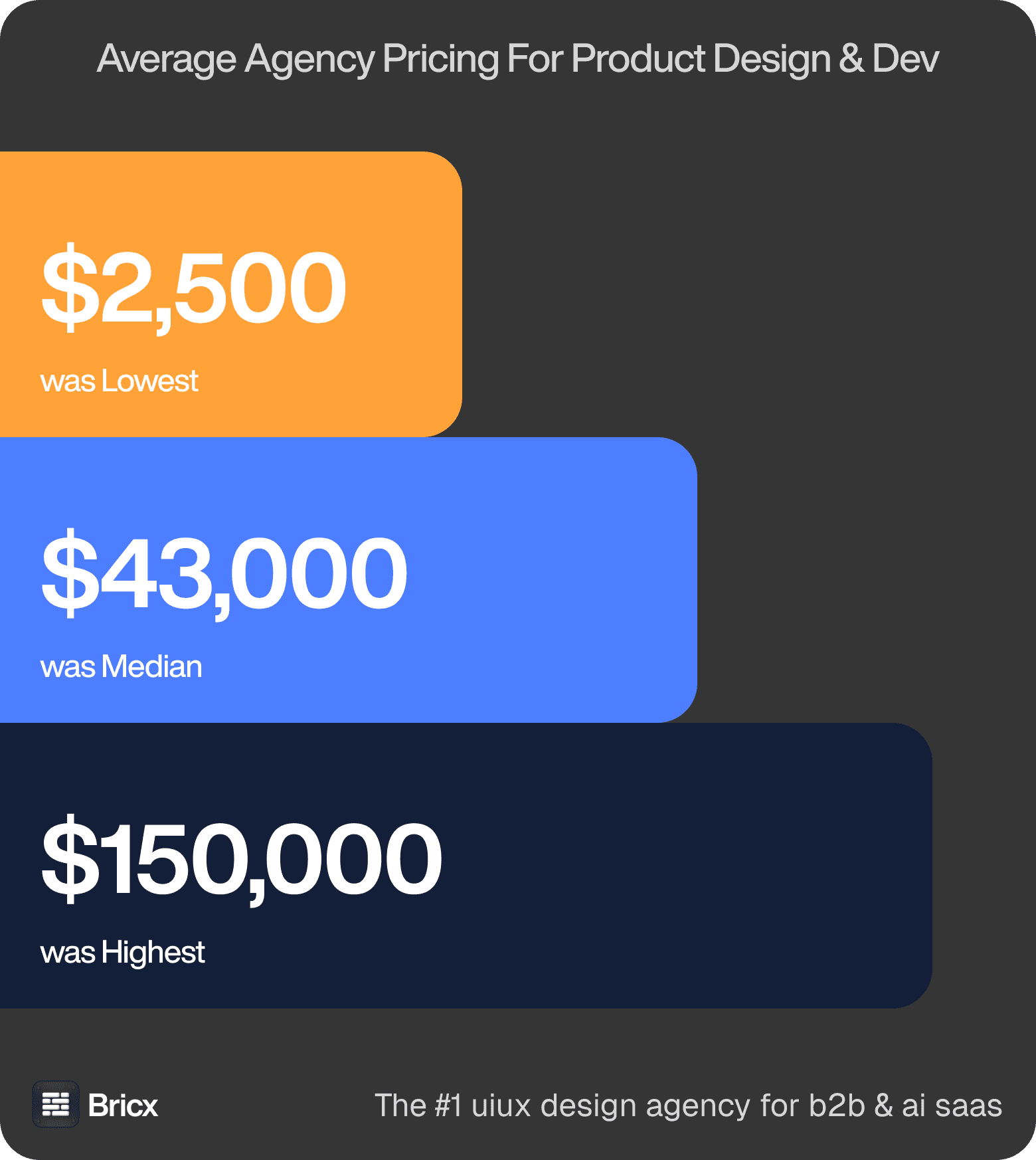
Their quotes won't tell you either. When one SaaS client sent the same five-feature MVP brief to 57 agencies, prices ran from $2,500 to over $150,000, and hourly rates tracked where a team was based more than the quality of its work.
So this list of 19 product design agencies is ranked by proof: named product work for real clients, a clear answer on who builds, and published prices or terms.
Each entry's facts card says who it suits and who should skip it, and each entry ends with plain limitations, several taken from the agency's own clients on Clutch. The research uses each agency's site, case studies and Clutch profile, checked on October 19, 2026, with pricing benchmarks from The State of UI/UX Design Agencies 2026.
If your situation is narrower, the AI UX agencies roundup may fit better, and for the marketing site, see the SaaS website design agencies.
Which product design agency fits your situation?
All 19, grouped by how they work:
- Product design studios for B2B and AI SaaS: Bricx, UX Studio, Neuron, Cieden, Glow, Excited, Fuzzy Math, Eleken and WANDR.
- AI and flagship product studios: Lazarev and MetaLab.
- Teams that design and build the whole product: Think Company, Goji Labs, thoughtbot and ustwo.
- Brand-led studios that also design products: Arounda, Ramotion, Clay and Work & Co.
If you are a startup designing your first MVP
These agencies design an MVP and get it in front of users and investors fast.
- Bricx - a clickable AI MVP prototype in 2 to 3 weeks, and the front end built in 6 to 10. For an AI demo platform, Bricx designed the MVP's UI flow, and its CEO praised how quickly the team iterated
- Glow - a fixed $12,500 MVP for one platform in four weeks, ending in a working build
- WANDR - a validated MVP prototype guaranteed in 8 weeks
- Excited - designed a B2B data platform's web app from scratch
- Cieden - can start the next day, and designs and builds web apps
- Arounda - published MVP tiers from $10,000
- Lazarev - designed the MVP of a B2B platform for branded AI agents
For YC and other accelerator companies, see the list of design agencies for YC startups.
If you need the whole product built, back end included
Choose one of these when there is no engineering team, or it is fully booked.
- Goji Labs - designs and builds web and mobile apps, full stack
- thoughtbot - design and the Rails build of a B2B marketplace's first version
- Cieden - designed and developed a multi-role SaaS platform in 6 to 8 weeks
- MetaLab - full builds on about one in four of its projects
- Think Company - designed and built a portal for an insurer's financial advisors
- Arounda - MVP design and build in 12+ weeks
- ustwo - 0 to 1 design and build, from 6 weeks
- Work & Co - dedicated full-stack teams for large commerce platforms
If users struggle with your live product
A redesign starts from data: where users drop off and why. These agencies run research and audits before they redesign.
- Bricx - every redesign opens with an audit at no cost. For a procurement SaaS, redesigned onboarding flows improved user activation and feature adoption
- UX Studio - research-led redesigns of B2B and vertical SaaS
- Neuron - cut a marketing platform's navigation from 118 items to 16
- Eleken - lifted an AI sales tool's activation from 20 to 25% to nearly 40%
- Fuzzy Math - one-week UX and competitive evaluation to start
- Cieden - fixed-price UX audit from $2,000, then redesign
- Think Company - a product UX audit, then a phased modernisation
If you are building an AI product or agent interface
AI products need review steps, controls and error states that a chat box bolted onto every screen does not give.
- Bricx - AI writing, speech translation and knowledge base products. For an AI knowledge base, prototype-to-production time went from weeks to days
- Lazarev - AI research, analytics and agent products
- Glow - an AI meeting assistant and an AI calling app
- UX Studio - AI tools for insurers and legal teams
- Cieden - AI assistants for a multi-role wealth management platform
- MetaLab - the original interface of an AI image generator, and full AI product builds
- ustwo - the interface and first iOS app for a consumer AI assistant
- Goji Labs - AI development alongside product design and engineering
The list of AI UX agencies covers more AI specialists.
If you sell complex B2B or enterprise software with many user roles
These agencies design dense, multi-role products where an admin, a daily user and an approver each need their own view.
- Bricx - procurement, AI knowledge base and enterprise AI agent products. For a procurement SaaS, Bricx delivered production-ready designs for a supplier portal, a purchase request dashboard and analytics tools
- Neuron - workflow and form builders for a SaaS procurement platform
- Fuzzy Math - design partner to an enterprise workforce platform since 2010
- Think Company - modernises enterprise software in regulated industries
- Cieden - telecom and wealth management platforms
- UX Studio - engineering and insurance software
- thoughtbot - HIPAA and SOC 2 builds for healthcare, fintech and insurance
If you just raised, or your designer left
Senior designers on a monthly plan, without the months it takes to hire.
- Bricx - a senior designer backed by a design lead, from $10,000/month with fifteen days' notice. One founder's verdict: "A whole new user interface was designed in 30 days."
- Glow - a project manager, design lead and senior designer for $12,000 a month
- Eleken - a full-time designer for $6,599 a month
- Cieden - team extension from $7,200 a month per person
- WANDR - a senior designer matched within 72 hours, 15 days' notice
- UX Studio - an embedded team with a 3-month minimum
- Ramotion - embedded design support from $9,500 a month
If you need a design system engineers can build from
A design system keeps every screen consistent, and in 2026 it also has to be readable by AI coding tools.
- Bricx - one design system across a translation company's custom apps, and a full design system for an AI demo agent
- Neuron - design tokens synced from Figma to Storybook for an education company
- Cieden - design system documentation for a telecom platform's engineers
- Work & Co - a design system of more than 700 components for a commerce platform
- Fuzzy Math - a design system for a hiring platform across 312 pages and states
- ustwo - a payments company's first global design system
- Clay - a design system for a crypto analytics platform
If brand, website and product relaunch together
One team for the brand, the marketing site and the product UI removes two handoffs.
- Bricx - designed the brand and product experience of an AI speech translation platform that covers more than 150 languages and dialects
- Ramotion - brand and product built from zero for a carbon management platform
- Clay - brand, website and product for enterprise software
- Excited - an insurtech's web app, design system and Webflow site
- Arounda - brand, website and UI/UX in one team
If your product design budget is under $25,000
Clutch minimums below $25,000.
- Glow - from $10,000, with a fixed $12,500 MVP
- UX Studio - from $10,000
- Cieden - from $10,000
- Eleken - from $10,000
- Excited - from $10,000
- thoughtbot - from $10,000
If your product design budget is $25,000+
Clutch minimums of $25,000, below the benchmark's MVP median. Arounda and WANDR also publish lower entry prices on their own sites.
If your product design budget is $50,000+
Clutch minimums of $50,000.
If your product design budget is $100,000+
Clutch minimums of $100,000, the highest on this list. Lazarev also publishes UX/UI work from $5,000.
How each agency was reviewed
Each agency had to clear three bars, judged on evidence a buyer can check:
- A strong, verified track record. Consistent, recent client reviews on Clutch, or a portfolio of shipped products used at scale.
- Shipped software products. Named product clients on the agency's site, in case studies or in verified reviews. Industrial design consultancies and agencies with no software product work were left out.
- Published facts. Minimum project size, hourly rate, team size and location from Clutch, checked on October 19, 2026. Scope, build capacity, pricing and timelines come from each agency's own site. Outcome numbers appear only where a client stated them in a Clutch review or the agency published them in a case study, and limitations link to the client review behind them where one exists.
Agencies are ordered by how central product design is to their work, with product-led studios first and brand- or website-led studios last, and by fit for funded B2B and AI software companies. Pricing and timeline benchmarks come from The State of UI/UX Design Agencies 2026, where a SaaS client put the same MVP brief to 57 agencies; not every agency gave a price or timeline.
How the 19 best product design firms compare
Filter by budget or by whether the agency also builds the product, or sort by price, hourly rate or reviews.
| Agency | Best for | Builds the product | Starting price | Hourly rate | Typical timeline | Team and HQ | Clutch | Engagement model |
|---|---|---|---|---|---|---|---|---|
| Bricx | Funded B2B and AI SaaS companies with a complex product, from AI-native tools to enterprise platforms with many user roles | Yes, front end (React, Next.js); back end stays with the client | $25,000+ (fixed scope); retainers from $10,000/month | $50 to $99 | Clickable AI MVP prototype in 2 to 3 weeks; MVP designed and built in 6 to 10 | 10 to 49 people, Dubai and New Delhi | 5.0/5, 32 reviews | Fixed-scope projects, monthly retainers, embedded teams, paid pilot sprints |
| UX Studio | B2B and vertical SaaS teams that want research and design from one team | Yes, for products it designs | $10,000+ | $50 to $99 | First designs in the first sprint | 50 to 249 people, Budapest, Hungary | 5.0/5, 41 reviews | Embedded teams (3-month minimum), fixed-price projects |
| Neuron | Enterprise and B2B SaaS with dense workflows | Partly, front-end support and design systems in code | $25,000+ | $150 to $199 | Product strategy in 3 to 4 weeks, then 2-week sprints | 10 to 49 people, San Francisco, CA | 4.9/5, 53 reviews | Projects, team augmentation, embedded teams |
| Cieden | Complex, multi-role B2B platforms on a monthly team | Yes, web apps | $10,000+ | $50 to $99 | Short projects about 3 months; longer ones 6+ | 10 to 49 people, Toronto, Canada | 4.9/5, 46 reviews | Hourly, fixed monthly rate, team extension from $7,200/month |
| Glow | Seed to Series B SaaS and AI teams on a fixed monthly price | Partly, a working MVP build; production code extra | $10,000+ ($12,500 fixed MVP) | $50 to $99 | MVP in 4 weeks | 10 to 49 people, Dover, DE | 5.0/5, 38 reviews | Fixed MVP, retainers from $11,160/month, enterprise teams |
| Excited | Seed and Series A SaaS teams wanting product and Webflow site together | Partly, Webflow websites | $10,000+ | $50 to $99 | 4 to 8 weeks (UI/UX projects) | 10 to 49 people, Lviv, Ukraine | 5.0/5, 56 reviews | Projects by proposal, ongoing design support |
| Fuzzy Math | Enterprise and B2B SaaS with dense workflows | Partly, front-end HTML and CSS | $25,000+ | $150 to $199 | One-week starter engagements | 10 to 49 people, Highland Park, IL | 4.9/5, 28 reviews | Starter engagements, projects, partnerships |
| Eleken | B2B SaaS teams with engineers that need designers every month | Partly, front end as pull requests | $10,000+ (subscriptions from $4,599/month) | $25 to $49 | About 2 months for an MVP design | 50 to 249 people, Kyiv, Ukraine | 4.9/5, 128 reviews | Monthly subscription (2-month minimum), fixed-price UX audit |
| WANDR | Startups that need a validated MVP, and teams that want designers placed fast | Partly, front end and staffed engineers | $25,000+ ($10,000 entry) | $150 to $199 | Validated MVP prototype in 8 weeks | 10 to 49 people, Los Angeles, CA | 5.0/5, 34 reviews | MVP sprints, projects, staff augmentation |
| Lazarev | AI and data products on a long-term design partnership | Partly, websites; product builds with a partner | $100,000+ ($5,000 entry) | $100 to $149 | 8 to 12 weeks for design; 3 to 6 months end to end | 50 to 249 people, San Francisco, CA | 5.0/5, 19 reviews | Long-term partnerships, AI launch programme |
| MetaLab | Flagship products on large budgets | Yes, on full-build projects | $100,000+ | Quoted per project | Scoped per product | 50 to 249 people, Vancouver, Canada | No reviews | Design, strategy and development per product |
| Think Company | Enterprises modernising software in regulated industries | Yes | $50,000+ | $150 to $199 | 4-week vision sprint to start | 50 to 249 people, Conshohocken, PA | 4.9/5, 18 reviews | Vision sprint, UX audit, design and build, embedded teams |
| Goji Labs | Products designed and built by one team | Yes, full stack | $50,000+ | $150 to $199 | Scoped after a strategy sprint | 50 to 249 people, Los Angeles, CA | 5.0/5, 91 reviews | Strategy sprints, embedded senior pods |
| thoughtbot | Healthcare, fintech and insurance products, design and build | Yes, Rails, React and more | $10,000+ | $150 to $199 | Product roadmap in as little as 2 weeks | 50 to 249 people, New York, NY | 4.9/5, 39 reviews | Shaping sprints, MVP development, team augmentation |
| ustwo | Fintech and AI products designed and built by one studio | Yes, full stack | $50,000+ | $150 to $199 | 6 weeks to 1+ years (0 to 1 build) | 50 to 249 people, London, UK | 4.5/5, 2 reviews | Discover, Shape, 0 to 1, Boost |
| Arounda | Seed-stage MVPs designed and built on a known budget | Yes | $25,000+ ($6,000 entry) | $25 to $49 | 4 to 8 weeks (UI/UX); 12+ weeks (MVP design and build) | 10 to 49 people, Odesa, Ukraine | 5.0/5, 87 reviews | Sprint projects, MVP tiers, monthly plans |
| Ramotion | Brand-led product redesigns with a large budget | Yes | $50,000+ | $150 to $199 | Discovery 4 to 8 weeks, then 3 to 6 months | 10 to 49 people, San Francisco, CA | 4.9/5, 29 reviews | Fixed-price discovery, milestone redesigns, embedded design, delivery pods |
| Clay | SaaS companies redesigning brand, site and product together | Yes | $50,000+ | $150 to $199 | Set in each proposal | 10 to 49 people, San Francisco, CA | 4.8/5, 32 reviews | Time and materials, fixed fee, retainer |
| Work & Co | Large consumer, commerce and B2B platforms | Yes, full stack | $5,000+ (unclaimed Clutch profile) | $100 to $149 | Market feedback within 20 days | 250 to 999 people, Brooklyn, NY | No reviews | Fully dedicated teams, multi-year |
1. Bricx: Best product design agency for B2B and AI SaaS companies
- Starting price
- $25,000+ (fixed scope); retainers from $10,000/month
- Hourly rate
- $50 to $99
- Clutch
- 5.0/5, 32 reviews
- Team and HQ
- 10 to 49 people, Dubai and New Delhi
- Builds the product
- Front end in React and Next.js, wired to the client's model and API; the back end stays with the client's engineers
- Engagement model
- Fixed-scope projects, monthly retainers, embedded teams, paid pilot sprints
- Typical timeline
- A clickable AI MVP prototype in 2 to 3 weeks; an MVP designed and built in 6 to 10 weeks
- Best for
- Funded B2B and AI SaaS companies with a complex product, from AI-native tools to enterprise platforms with many user roles
- Not a fit for
- Non-software businesses and budgets under $25,000
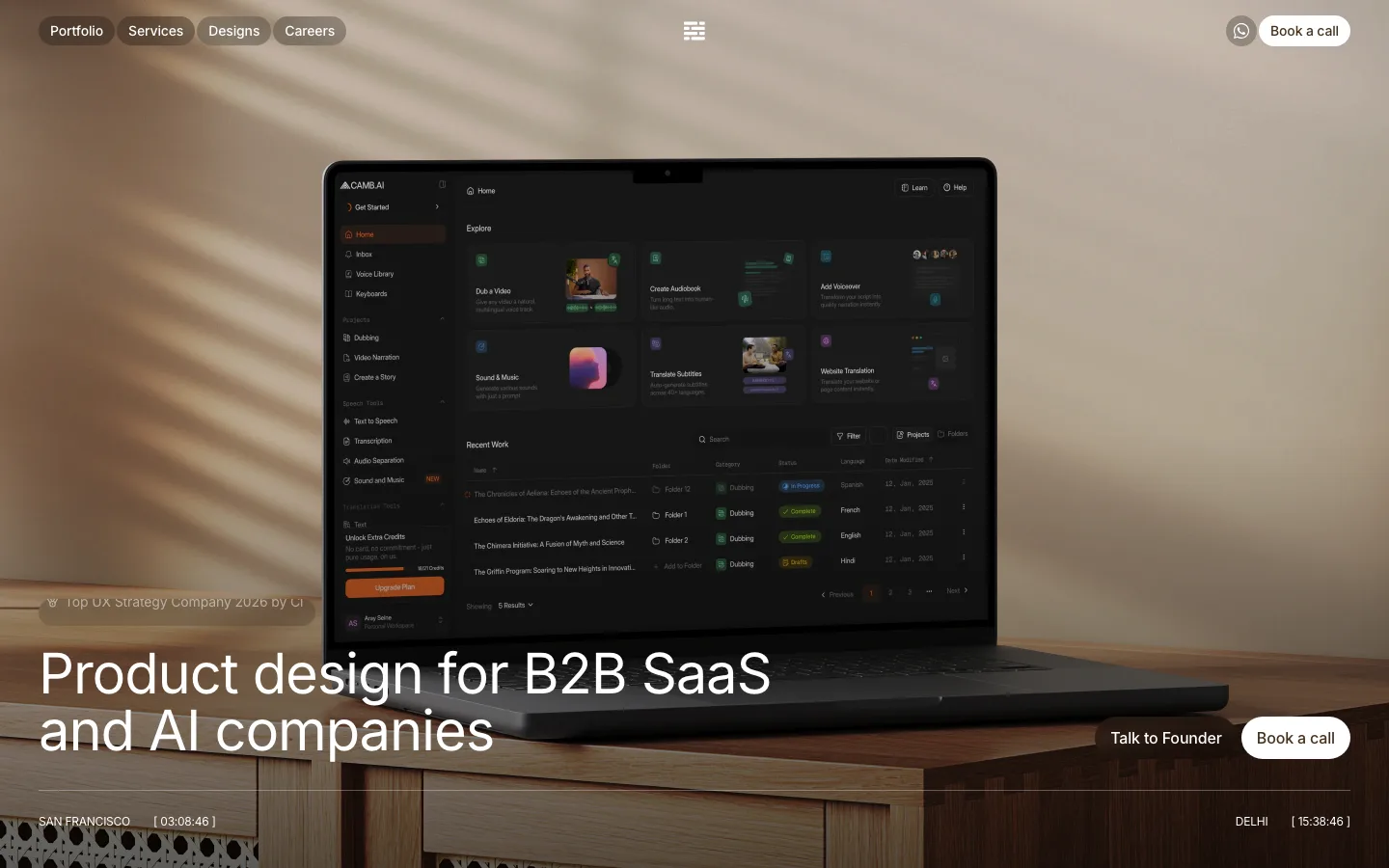
Bricx is the best product design agency for B2B and AI SaaS companies with a complex product, from AI-native tools to enterprise platforms with many user roles. Bricx redesigned onboarding and designed new modules for Procol's procurement platform, took Pageloop's AI knowledge base from AI prototype to developer-ready design, redesigned Writesonic's dashboard and onboarding, and designed the product experience for CAMB.AI and Hobbes.
Services
- Product design. Research with the people using the product and the people who stopped, then information architecture, flows and every screen and state. The product design work ends with a component library mapped to code.
- Product redesign. Every product redesign opens with an audit at no cost, and the new structure goes in front of real users at wireframe stage, before engineering commits.
- AI MVP design and build. An AI MVP starts with a clickable prototype and ships a working front end in two-week cycles.
- Design team extension. A senior designer backed by a design lead joins the product team on a monthly design team extension, covering product, web and motion.
- Design systems. Design systems are built on shadcn/ui with a custom visual layer, so engineers and AI coding tools can build new screens from them.
Pricing
Bricx prices a defined scope as a fixed project, so the cost is agreed before work starts, and moves ongoing product work to a monthly retainer.
- Entry point: fixed-scope projects from $25,000.
- How work is billed: fixed-scope projects, monthly retainers from $10,000, embedded teams, and paid pilot sprints of a week or one defined milestone.
- Published prices: $25,000+ projects and $10,000/month retainers, month to month with fifteen days' notice; $50 to $99 an hour on Clutch.
- Budget guide: the $25,000 entry sits below the benchmark's $43,000 median for an MVP design, and the retainer covers a senior designer backed by a design lead.
What clients liked
- Clutch rating: 5.0/5 across 32 reviews, with 5.0 for quality, schedule and cost on the Procol, Pageloop and Writesonic reviews.
- Higher activation. At Procol, a procurement SaaS company, redesigned onboarding flows improved user activation and feature adoption, its product manager wrote, and Bricx delivered production-ready designs for a supplier portal, a purchase request dashboard and analytics tools.
- Faster activation at Writesonic. A redesigned onboarding raised user activation within the first week, and new AI writing tools designed by Bricx saw more use.
Our prototype-to-production time has been rapidly cut down since working with Bricx. What used to take weeks now takes days, sometimes even hours.
Limitations
- Bricx works only with software companies.
- Projects start at $25,000, so smaller budgets are out of range.
Product design
Your product design team, without the 6-month hire.
Bricx designs B2B SaaS and AI products with an embedded senior team, from research to developer-ready handoff. Projects start at $25,000.
2. UX Studio
- Starting price
- $10,000+
- Hourly rate
- $50 to $99
- Clutch
- 5.0/5, 41 reviews
- Team and HQ
- 50 to 249 people, Budapest, Hungary
- Builds the product
- Yes, for products it designs; front end in React and TypeScript, back end in Java and Kotlin
- Engagement model
- Embedded teams (3-month minimum), fixed-price projects or a rate card, an optional free 5-day trial
- Typical timeline
- First designs inside the first sprint; complex SaaS builds take several months or longer
- Best for
- B2B and vertical SaaS teams that want research, product design and usability testing from one dedicated team
- Not a fit for
- Teams that want a short engagement without a 3-month embedded commitment
UX Studio is a Budapest research and design team for B2B and vertical SaaS products. It designed Oversee AI's model-monitoring dashboard for insurers, Duck Creek's low-code predictive model builder and Inquisita's legal AI drafting tool, and redesigned IncQuery's engineering suite as a cloud product.
Services
- Research and audits. User interviews, usability testing and UX audits, sold as services in their own right.
- Development. Front end in React and TypeScript and back end in Java and Kotlin, for products UX Studio has designed.
- Consultancy and training. Design systems, team assessments and training for in-house design teams.
Pricing
UX Studio quotes a fixed price or a rate card after scoping, and most long-running work sits on an embedded team.
- Entry point: $10,000+ on Clutch, after an optional free five-day trial.
- How work is billed: a fixed-price project, or an embedded team with a 3-month minimum.
- Published prices: quoted after scoping; $50 to $99 an hour on Clutch.
- Budget guide: its rate sits inside the benchmark's $55 to $90 median band, and the 3-month minimum means budgeting for a quarter of team time on embedded work.
What clients liked
- AI products in weeks. For Inquisita, a legal AI tool for drafting discovery responses, UX Studio delivered a tested prototype, a design system and the brand in 8 weeks.
- Long redesigns. IncQuery's suite redesign ran a year and a half and won a Red Dot award.
Limitations
- An embedded team has a minimum term of 3 months, by its own terms.
- Its clients are mainly in the UK and Western Europe, so US teams should agree review times early.
- On a complicated build, one client's project ran a month past its budgeted time, so leave room in the plan for complex products.
3. Neuron
- Starting price
- $25,000+
- Hourly rate
- $150 to $199
- Clutch
- 4.9/5, 53 reviews
- Team and HQ
- 10 to 49 people, San Francisco, CA
- Builds the product
- Partly; front-end support from UX engineers and design systems synced to code, with full builds handed to the client's developers or a partner agency
- Engagement model
- Projects, team augmentation and embedded design teams, billed as time and materials in 2-week sprints
- Typical timeline
- Product strategy in 3 to 4 weeks; Vendr's embedded engagement ran four months
- Best for
- Enterprise and B2B SaaS products in finance, AI, project management and analytics that need senior UX and UI on dense workflows
- Not a fit for
- Teams that want one vendor to build the whole application
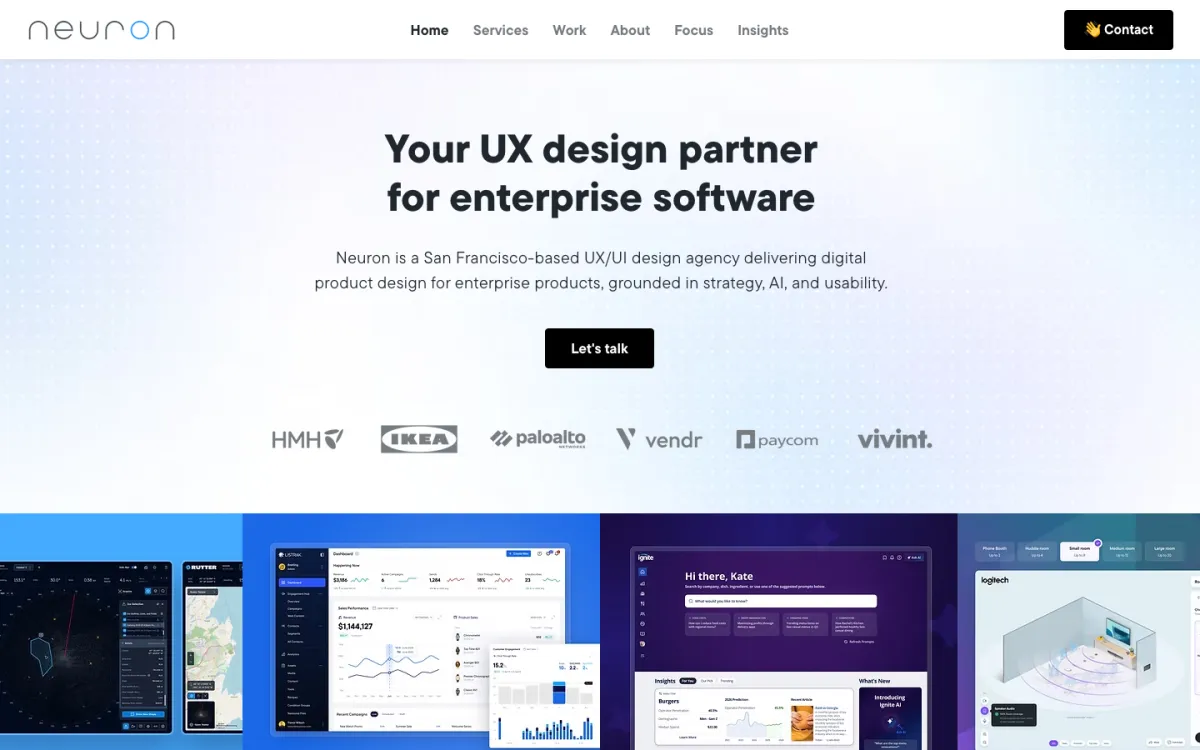
Neuron is a San Francisco UX and UI studio for enterprise software. It rebuilt Listrak's navigation and designed its no-code email and journey builders, designed Vendr's workflow builder, form builder and request tracking, and worked on version 2 of AcuityMD's sales CRM for medical device teams.
Services
- Product strategy. A strategy phase of three to four weeks before design starts.
- UX and UI design. Research, wireframes, prototypes, data visualisation, AI design and usability testing, through to developer handoff and design QA.
- DesignOps. Design systems synced into code; for HMH it built a token sync from Figma to Storybook.
Pricing
Neuron bills time and materials in two-week sprints, with lower rates for longer partnerships.
- Entry point: $25,000+ on Clutch, usually starting with a 3 to 4 week strategy phase.
- How work is billed: time and materials, for project work, team augmentation or an embedded team.
- Published prices: quoted after scoping; $150 to $199 an hour on Clutch.
- Budget guide: its rate is about twice the benchmark's $55 to $90 median, in line with the roughly $150 an hour the report puts on US teams.
What clients liked
- A simpler product. Listrak's navigation went from 118 items to 16 after the redesign, and its customers now maintain half as many emails.
- Embedded on a live roadmap. For Vendr, a SaaS procurement platform, Neuron worked as an embedded design partner on a workflow builder, a form builder and request tracking, and handed the designs to Vendr's own developers.
Limitations
- Full builds sit with the client's engineers or a partner agency, so it fits best where a development team already exists.
- Billing by time and materials suits ongoing work more than a fixed budget for a defined MVP.
- One product manager found it hard to track which reviews were still open while Neuron kept editing, so agree a review log at the start.
4. Cieden
- Starting price
- $10,000+ on Clutch; from $50 an hour
- Hourly rate
- $50 to $99 ($50 for Europe-based designers, $80 for US and Canada)
- Clutch
- 4.9/5, 46 reviews
- Team and HQ
- 10 to 49 people, Toronto, Canada
- Builds the product
- Yes; web app development in React, Vue, Node.js and Python, with design engineers on build projects
- Engagement model
- Hourly projects, a fixed monthly rate for 6+ month partnerships, team extension from $7,200 per person a month, a free 3-day trial
- Typical timeline
- Microprojects up to a month, short projects around 3 months, longer projects 6 months or more
- Best for
- B2B SaaS teams with complex, multi-role platforms that want designers embedded on a monthly basis
- Not a fit for
- Teams that want a quick visual refresh with no research or discovery
Cieden designs complex B2B platforms. It redesigned Sitenna's telecom site-acquisition platform and built its design system over 18 months, prototyped AI assistants for Way2B1's multi-role wealth management platform, and redesigned Foqal's support ticketing interface.
Services
- Product design. UX and UI design, UX strategy and consulting for B2B and SaaS platforms.
- UX audits. Fixed-price audits of five to eight days before a redesign.
- Web app development. Design and build together; for an interior design firm it designed and developed a multi-role SaaS platform in 6 to 8 weeks.
Pricing
Cieden publishes one of the most detailed rate cards on this list, with fixed prices for small first steps and hourly or monthly billing after that.
- Entry point: a UX audit from $2,000, scope definition from $3,500, product discovery from $6,500 or a design sprint from $7,000.
- How work is billed: hourly, a fixed monthly rate for partnerships of six months or more, or team extension per person.
- Published prices: from $50 an hour for Europe-based designers and $80 for US and Canada; team extension at $7,200 a month per person, or from $11,520 in the US and Canada. If a fixed-scope project overruns, billing drops to 50% of the rate. On Clutch: $10,000+ minimum and $50 to $99 an hour.
- Budget guide: team extension sits near the benchmark's $7,000 monthly median, and the fixed first steps let you test the team for under $10,000.
What clients liked
- Funding after a redesign. Sitenna secured $5.1 million after Cieden's redesign and cut site acquisition from months to weeks.
- Speed on AI work. For Way2B1, prototyping in AI tools cut decision time from weeks to days, at a pace of one or two flows a week.
Limitations
- Most work is billed by the hour or by the month, so the total depends on how the scope moves.
- Its fixed monthly rate is for partnerships of six months or more.
- Its weekly time reports are detailed, and one CTO would have preferred a shorter summary.
5. Glow Design Agency
- Starting price
- $10,000+ on Clutch; a fixed $12,500 MVP
- Hourly rate
- $50 to $99 on Clutch; Glow prices its work as fixed fees
- Clutch
- 5.0/5, 38 reviews
- Team and HQ
- 10 to 49 people, Dover, DE
- Builds the product
- Partly; the MVP ends as a working build made with AI build tools, and production code is an add-on from $5,000
- Engagement model
- Fixed-price MVP, fixed-scope projects, monthly design retainers (3-month minimum), enterprise teams, a free 3-day trial
- Typical timeline
- An MVP for one platform in four weeks; a UX audit in 10 to 14 business days
- Best for
- Seed to Series B SaaS and AI teams that want a senior product team on a fixed monthly price
- Not a fit for
- Teams that need the AI model or back end built by the design partner
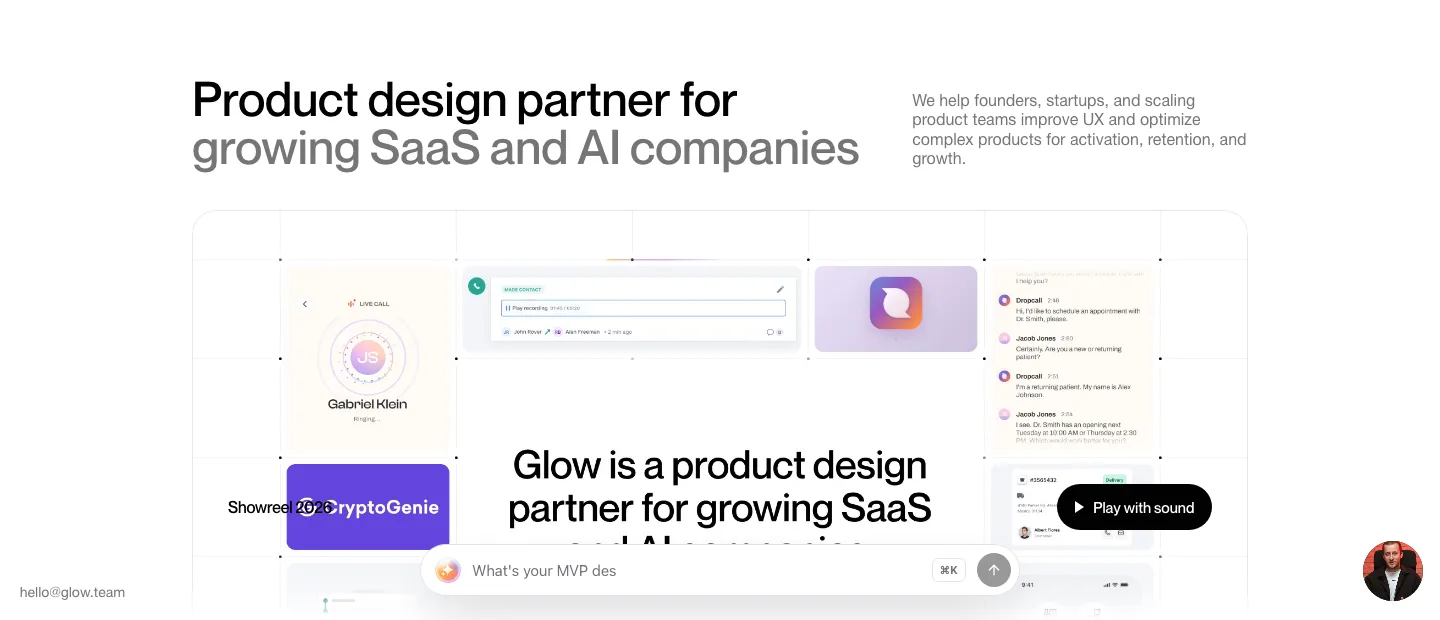
Glow is a product design team for SaaS and AI companies. Over six years it has designed Lendflow's embedded lending platform, mobile app and design system, and its product work also covers Echo's AI meeting assistant and FleetChaser's fleet management platform.
Services
- MVP design. Four weeks for one platform, ending in a working build, with an optional discovery week first.
- Design retainer. A project manager, a design lead and a senior designer working in weekly sprints, with updates every couple of days.
- UX audits and research. Audits, UX research and design systems for complex software.
Pricing
Glow sells fixed fees only, from a one-off MVP to a monthly product team, and publishes every price.
- Entry point: a $3,500 discovery week, or a fixed $12,500 MVP for one platform in four weeks, 50% upfront.
- How work is billed: fixed-price MVPs and scopes, or a monthly retainer with a 3-month minimum and 30 days' notice after that.
- Published prices: retainers at $12,000 a month on a 3-month plan, $11,400 on 6 months and $11,160 on 12; enterprise teams from $20,000 a month; production code from $5,000; $10,000+ minimum and $50 to $99 an hour on Clutch.
- Budget guide: the MVP costs well under the $43,000 benchmark median, and the retainer sits above the $7,000 monthly median because it puts three people on the product.
What clients liked
- A long partnership. Lendflow has kept Glow on for more than six years, from its web platform to its design system.
- AI products. Glow designed Echo, an AI meeting assistant with transcriptions, highlights and analytics, and Dropcall, an AI calling app that reached 10,000 users in two days after going viral.
Limitations
- Its MVP build is made with AI build tools, and turning it into production code is a separate quote.
- Retainers run for at least three months, then need 30 days' notice to cancel.
- Lendflow's product lead named keeping up with a fast-changing product as the one area to improve, so plan regular product walkthroughs for the design team.
6. Excited
- Starting price
- $10,000+
- Hourly rate
- $50 to $99
- Clutch
- 5.0/5, 56 reviews
- Team and HQ
- 10 to 49 people, Lviv, Ukraine
- Builds the product
- Websites in Webflow; app builds go to the client's engineers or a development partner
- Engagement model
- Projects scoped by proposal, ongoing design support, and embedded work for enterprise teams
- Typical timeline
- Most UI/UX projects take 4 to 8 weeks, with kickoff in 1 to 2 weeks
- Best for
- Seed and Series A SaaS teams that want web app design and a Webflow marketing site from one studio
- Not a fit for
- Teams without engineers that need the app built by the same team
Excited is a Lviv product design studio that also builds marketing sites in Webflow. It redesigned Xilo's insurance web app, including a form builder, a workflow builder and an analytics dashboard, designed Ravel's B2B data platform from scratch, and revamped ClubReady's scheduling product.
Services
- Product design. Research, UX audits, UX and UI, prototyping, testing and design systems for web and mobile apps.
- Web production. Marketing sites designed and built in Webflow.
- Branding and motion. Brand identity, visuals and motion for product launches.
Pricing
Excited prices each project by proposal.
- Entry point: $10,000+ on Clutch.
- How work is billed: scoped projects, with ongoing design support after launch.
- Published prices: quoted per proposal; $50 to $99 an hour on Clutch.
- Budget guide: its rate sits inside the benchmark's $55 to $90 median band, lower than most US-based studios on this list.
What clients liked
- Apps from scratch. For Ravel, a B2B data platform, Excited designed a working web app from scratch in five months.
- Long relationships. Its work with Xilo has run since April 2020, across the product, the design system and the website.
Limitations
- It has no in-house app engineers, so the product build needs the client's team or a partner.
- It takes on only a few projects at a time, so the start date depends on its pipeline.
- One US client wanted deeper competitor analysis behind some of the designs, so share the competitors and price points you care about in the brief.
7. Fuzzy Math
- Starting price
- $25,000+
- Hourly rate
- $150 to $199
- Clutch
- 4.9/5, 28 reviews
- Team and HQ
- 10 to 49 people, Highland Park, IL; offices in Chicago and Toronto
- Builds the product
- Front-end HTML and CSS ready for production; the application build stays with the client's engineers
- Engagement model
- One-week starter engagements, then projects and long-term partnerships
- Typical timeline
- Starter engagements run one week; projects are scoped after that
- Best for
- Enterprise and B2B SaaS products with dense workflows and many screens
- Not a fit for
- Startups that need the whole product built by the design partner
Fuzzy Math is a UX consultancy for B2B and enterprise software. It has designed SAP Fieldglass' web, tablet and mobile interfaces since 2010, designed Wonderlic's WonScore hiring platform from the ground up across 312 pages and states, and redesigned a data security and risk management platform.
Services
- AI integration UX. Design for AI features added to existing enterprise products.
- Research and strategy. UX research, digital product strategy and digital transformation work.
- UX team building. UX organisation design, training and help hiring in-house designers.
Pricing
Fuzzy Math starts with a one-week engagement, then scopes the project or partnership from what that week finds.
- Entry point: an AI-in-design training, a strategy workshop or a UX and competitive evaluation, each a week long.
- How work is billed: scoped projects and long-term partnerships after the starter week.
- Published prices: quoted after the starter engagement; $25,000+ and $150 to $199 an hour on Clutch.
- Budget guide: its rate is about twice the benchmark median, typical of US enterprise UX consultancies, and the starter week is the low-risk way in.
What clients liked
- Engagement after launch. On a data security platform, user engagement rose 20% in the first six months after launch.
- Long partnerships. SAP Fieldglass has worked with Fuzzy Math on its web, tablet and mobile interfaces since 2010.
Limitations
- Its engineering stops at front-end code, so the application needs another build team.
- At $150 to $199 an hour, it suits enterprise budgets more than early-stage ones.
- Some of its outcome case studies leave the client unnamed, so ask for references in your category.
8. Eleken
- Starting price
- $10,000+ on Clutch; subscriptions from $4,599 a month
- Hourly rate
- $25 to $49
- Clutch
- 4.9/5, 128 reviews
- Team and HQ
- 50 to 249 people, Kyiv, Ukraine
- Builds the product
- Partly; product design engineering delivers the front end as pull requests, and the client's developers connect the back end
- Engagement model
- Monthly design subscription (2-month minimum), fixed-price UX audit, a free 3-day trial
- Typical timeline
- Most MVP designs take about two months; a focused UX audit 2 to 3 weeks
- Best for
- B2B SaaS teams with engineers that need product designers every month
- Not a fit for
- Teams without engineers that need the back end built
Eleken is a UI/UX design team for B2B SaaS that works mainly as embedded designers on a monthly subscription. It redesigned the AI workspace and onboarding of Zaplify (now AndSend), Aampe's AI marketing platform and Datawisp's no-code data analysis platform, along with its design system.
Services
- Product redesign. Redesigns of live SaaS products in increments; Aampe's ran in three-week sprints.
- UX audits. A fixed-price audit before a redesign, with the fee covering the rest of that month if the work continues.
- Product design engineering. Working React or HTML prototypes every one to three days, and the front end delivered as a Git project.
Pricing
Eleken sells designer capacity by the month, so the price depends on how many designers you need and for how long.
- Entry point: a free three-day trial on one or two screens, then a two-month minimum.
- How work is billed: a monthly subscription, cancelled with a month's notice, or a fixed-price UX audit.
- Published prices: $4,599 a month for a part-time designer, $6,599 for a full-time designer and $11,999 for two; a UX audit at a fixed $6,599 in two to three weeks; $10,000+ minimum and $25 to $49 an hour on Clutch.
- Budget guide: one full-time designer sits just under the benchmark's $7,000 monthly median, and the two-month minimum puts a first engagement with one full-time designer at about $13,200.
What clients liked
- Higher activation. Activation at Zaplify, now AndSend, rose from 20 to 25% to nearly 40% after the redesign.
- Funding after a redesign. Aampe raised $18 million and Datawisp $3.6 million after their redesigns.
Limitations
- The back end stays with the client's developers, so it fits teams that already have engineers.
- Every plan has a two-month minimum, and cancelling needs a month's notice.
- One product designer wanted more visible senior oversight day to day, so ask how the head of design reviews the work.
9. WANDR
- Starting price
- $25,000+ on Clutch; full engagements from $10,000
- Hourly rate
- $150 to $199
- Clutch
- 5.0/5, 34 reviews
- Team and HQ
- 10 to 49 people, Los Angeles, CA
- Builds the product
- Partly; front-end and CMS builds in-house, front-end and back-end engineers through staff augmentation, or a design handoff to the client's team
- Engagement model
- Fixed-timeline MVP sprints, projects, monthly staff augmentation matched within 72 hours, with no hard contract and 15 days' notice
- Typical timeline
- A validated MVP prototype guaranteed in 8 weeks, 5 weeks on average; a full mobile app design in 6 to 12 weeks
- Best for
- Startups that need a tested MVP in front of users and investors, and product teams that want designers or engineers placed within days
- Not a fit for
- Teams that want a fixed-price full-stack build of the whole product
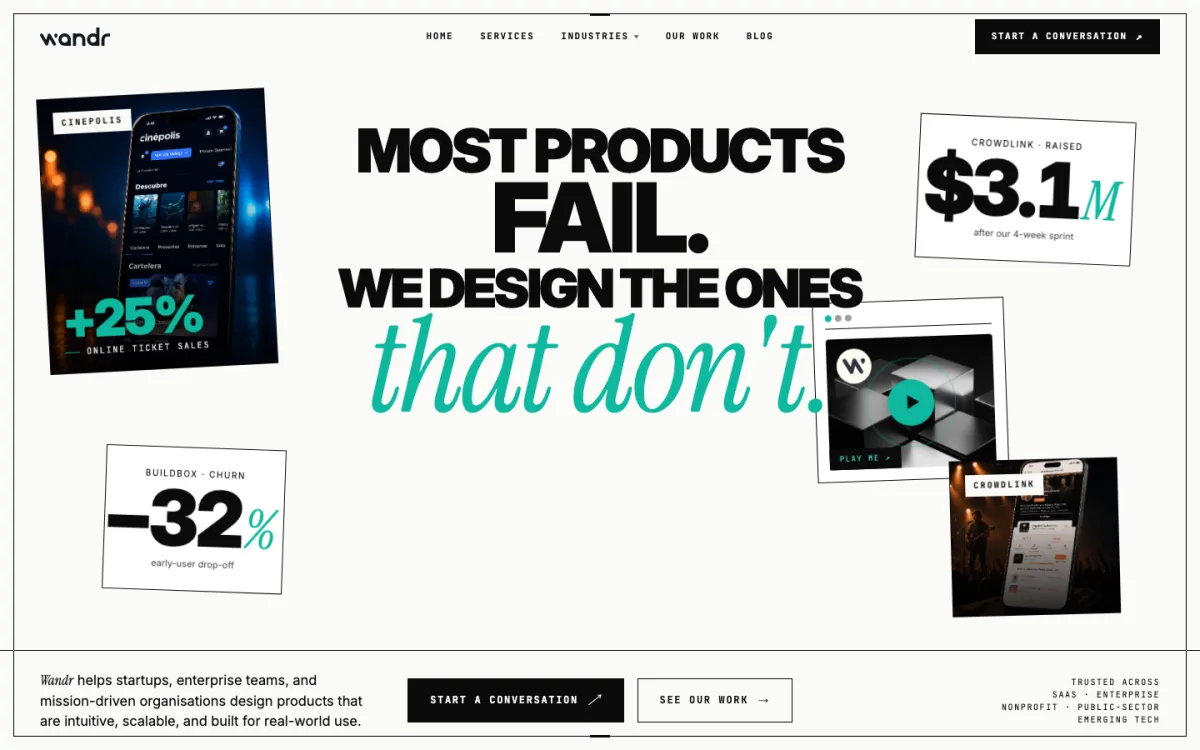
WANDR is a Los Angeles product strategy, UX and UI studio that also supports development. It redesigned onboarding for Vectrix, a YC-backed B2B SaaS, rebuilt merchant onboarding and the design system for Sticky.io, and designed Appevate's B2B web app and built its front end.
Services
- MVP design. Research, UX and UI, a prototype, user testing and a pitch deck, run in two-week sprints, with an 8-week guarantee.
- UI and UX design. Product design for web and mobile apps, with a guarantee that the UX improves within 90 days of launch.
- Development. Front-end builds, such as the Vue.js front end it delivered for Appevate's B2B platform, plus WordPress builds and coded Storybook components.
Pricing
WANDR publishes two entry prices and scopes everything else per project.
- Entry point: a $500 UX audit of one major flow, or full engagements from $10,000.
- How work is billed: fixed-timeline MVP sprints, projects, or monthly staff augmentation priced at what you would budget for the role in-house, with 15 days' notice.
- Published prices: the two entry prices above; $25,000+ and $150 to $199 an hour on Clutch.
- Budget guide: the $500 audit is a cheap way to test the team before an MVP sprint, which is priced per scope.
What clients liked
- Faster onboarding. At Vectrix, onboarding fell from 74 minutes to 24, and 91% of users completed their tasks in testing.
- Higher conversion. Zoe Financial's self-scheduling conversion rose from 8% to 22% after WANDR's redesign.
Limitations
- Product engagements usually end in a design handoff or a development partner, so a full back end needs the client's engineers or staffed ones.
- Its MVP offer ends at a validated prototype, which suits teams raising or testing before they commit to engineering.
- One CEO felt WANDR's creative work could go further on a fast timeline, so allow time for exploration if the visual direction matters.
10. Lazarev
- Starting price
- $100,000+ on Clutch; UX/UI work from $5,000
- Hourly rate
- $100 to $149
- Clutch
- 5.0/5, 19 reviews
- Team and HQ
- 50 to 249 people, San Francisco, CA
- Builds the product
- Websites in-house; product builds with a development partner, or alongside the client's engineers in their stack
- Engagement model
- Long-term design partnerships, an AI product launch programme, phased redesigns
- Typical timeline
- First outputs in 2 to 3 weeks; 8 to 12 weeks for design and 3 to 6 months end to end
- Best for
- Funded AI and data products that need a redesign or launch on a long-term design partnership
- Not a fit for
- Teams looking for a one-off project
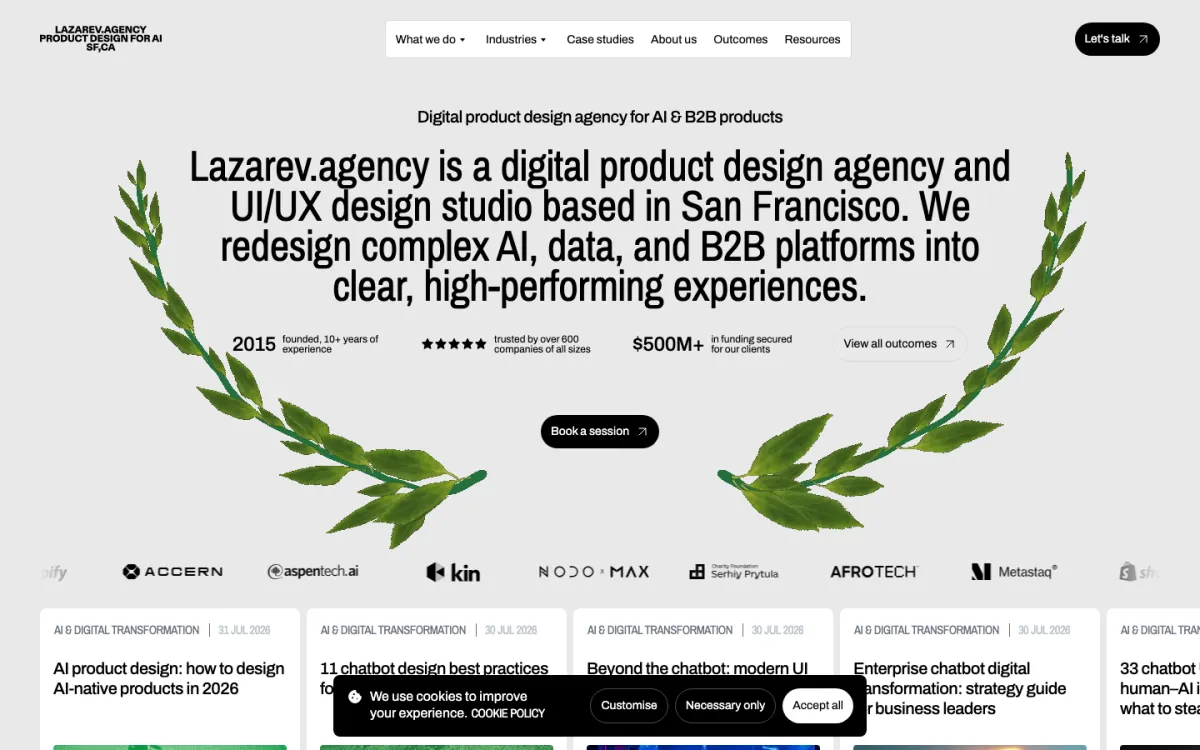
Lazarev is a San Francisco studio for AI, data and B2B products. It designed Accern's AI research tool for financial analysts over a multi-year partnership, the MVP of Suits.ai's branded AI agent platform, and Peel's e-commerce analytics app.
Services
- AI product launch. A standard programme of three to four months, with a development partner when the build is needed.
- AI UX patterns and research. UX research, audits and patterns for AI features.
- Websites. Web design and development, including what it calls agentic websites, plus AEO and SEO.
Pricing
Lazarev works on long-term partnerships, and its Clutch minimum and its own entry prices point to very different budgets.
- Entry point: UX/UI design, branding and website development from $5,000; SaaS web design from $20,000.
- How work is billed: long-term design partnerships, an AI product launch programme and phased redesigns.
- Published prices: the entry prices above; $100,000+ and $100 to $149 an hour on Clutch.
- Budget guide: the gap between $5,000 and $100,000 is wide, so ask early which tier a product redesign or launch falls into.
What clients liked
- Funding after an MVP. Suits.ai, a platform for branded AI agents, raised $1 million after the MVP Lazarev designed went live.
- Systems that ship. Implementation-ready design systems arrive by weeks 6 to 10 of an engagement.
Limitations
- It works only on long-term partnerships, by its own terms, so a short fixed project is a poor fit.
- A full AI and data product redesign runs 4 to 8 months, which suits a planned roadmap more than a launch date.
- One client suggests Lazarev keep projects tightly defined so the scope does not grow, which matters on a long partnership.
11. MetaLab
- Starting price
- $100,000+
- Hourly rate
- Quoted per project
- Clutch
- Profile with no reviews
- Team and HQ
- 50 to 249 people, Vancouver, Canada
- Builds the product
- Yes, on full-build projects such as Ro, Suno, Pika, Notarize and Walmart
- Engagement model
- Product design, strategy and development, scoped per product
- Typical timeline
- Scoped per product; Tripadvisor's redesign and rebuild ran a year and a half
- Best for
- Well-funded teams designing and building a flagship product
- Not a fit for
- Budgets under $100,000
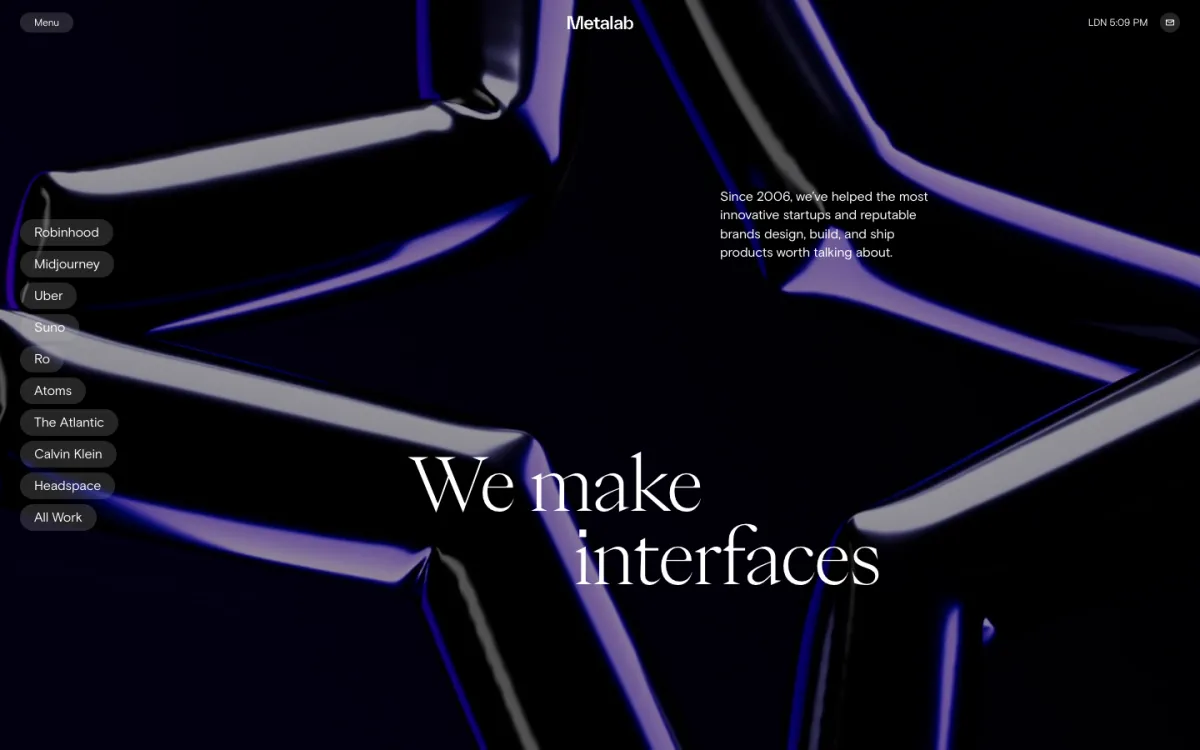
MetaLab is a Vancouver studio that designs, builds and ships products. It designed Slack's original product suite and Midjourney's original interface, helped turn Upwork from a job board into a work marketplace, and designed and built Notarize from its MVP onwards.
Services
- Product design. UX research and product design for web and mobile apps, from Slack's original product suite to Upwork's work marketplace.
- Engineering. Full builds on about one in four of its projects, including Suno and the Pika iOS app.
- Brand. Rebrands for AI and enterprise companies, such as the AI code assistant Windsurf.
Pricing
MetaLab scopes every engagement on a call about the product and its timeline.
- Entry point: $100,000+ on Clutch.
- How work is billed: per product, covering design, strategy and development where needed.
- Published prices: quoted per product after the first conversation.
- Budget guide: its minimum is more than twice the benchmark's $43,000 MVP median, the joint-highest on this list.
What clients liked
- Long partnerships. Walmart has worked with MetaLab on design and engineering for ten years.
Limitations
- Its $100,000 minimum is the joint-highest on this list.
- It quotes every engagement privately, so budget planning starts only after a call.
- With no Clutch reviews, references come through its own client list.
12. Think Company
- Starting price
- $50,000+; vision sprint and product UX audit at about $50,000 each
- Hourly rate
- $150 to $199
- Clutch
- 4.9/5, 18 reviews
- Team and HQ
- 50 to 249 people, Conshohocken, PA
- Builds the product
- Yes; researchers, designers, engineers and product managers in one team
- Engagement model
- Free half-day session, fixed-price vision sprint and UX audit, product design and build, embedded teams
- Typical timeline
- A four-week vision sprint to start; builds scoped after it
- Best for
- Enterprises modernising complex software in financial services, healthcare, pharma and telecom
- Not a fit for
- Seed and Series A startups, or budgets under $50,000
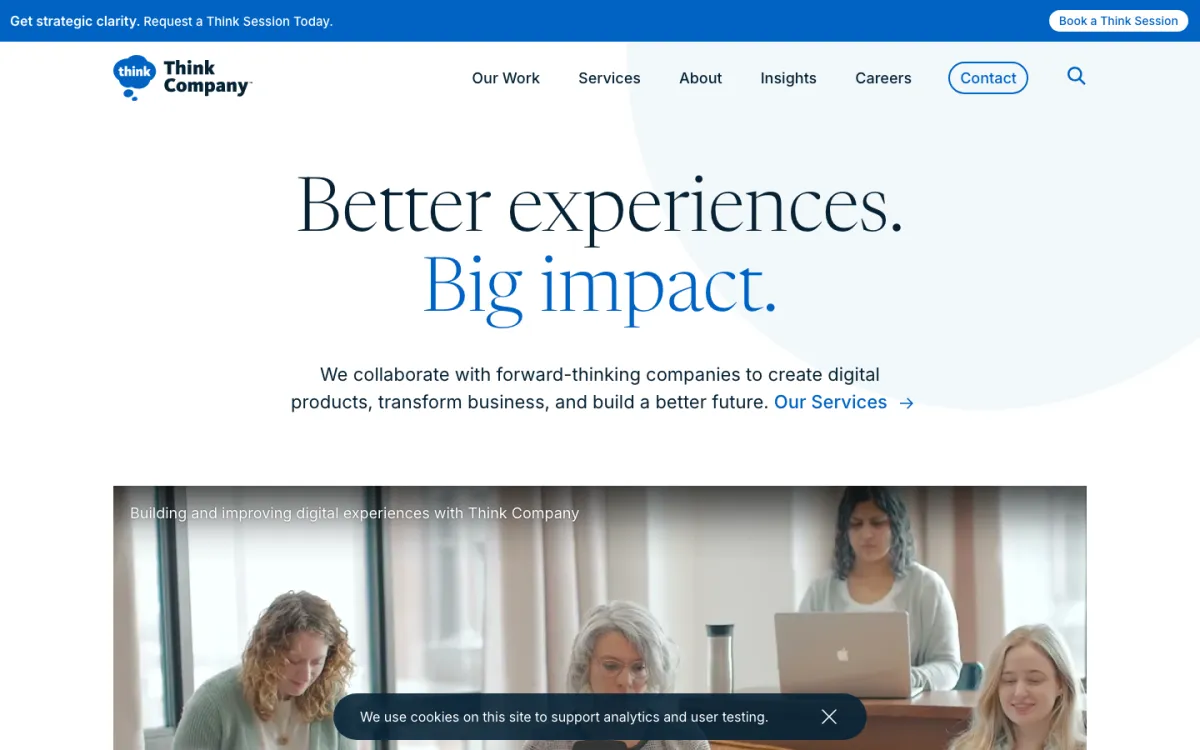
Think Company is a team of researchers, designers, engineers and product managers in the Philadelphia area that modernises enterprise software. It designed and built Gateway, Penn Mutual's portal for financial advisors, designed Best Egg's financial health tools as an embedded partner, and built a shared chart library for ADP's workforce insights.
Services
- Research and product strategy. A four-week vision sprint sets direction before design starts.
- Product design and build. Design and engineering for enterprise digital products, including conversational AI.
- Design systems and AI enablement. Component libraries, such as the shared chart library it built for ADP's workforce insights.
Pricing
Think Company publishes prices for its first steps and scopes the build after them.
- Entry point: a free half-day Think Session, then a four-week vision sprint or a product UX audit at about $50,000 each.
- How work is billed: fixed-price sprints and audits, then product design and build or embedded teams.
- Published prices: the entry offers above; $50,000+ and $150 to $199 an hour on Clutch.
- Budget guide: the first paid step alone exceeds the $43,000 MVP median, which suits enterprise modernisation programmes.
What clients liked
- More active users. As Best Egg's embedded design partner on its financial health tools, Think Company helped double monthly active users to 116,000 and total users to 1.5 million.
- Faster compliance. For Merck, compliance review went from weeks to hours.
Limitations
- Its paid entry offers start at about $50,000, which suits enterprise budgets.
- Its case studies come from regulated enterprises such as Best Egg, Merck and Penn Mutual, so SaaS startups should ask for closer references.
- At $150 to $199 an hour, one chief product officer found it expensive but worth the value.
13. Goji Labs
- Starting price
- $50,000+
- Hourly rate
- $150 to $199
- Clutch
- 5.0/5, 91 reviews
- Team and HQ
- 50 to 249 people, Los Angeles, CA
- Builds the product
- Yes, full stack (Ruby on Rails, Node.js, React, Next.js, iOS, Android, AWS)
- Engagement model
- Collaborative strategy sprints, then senior pods embedded in the client's team through delivery
- Typical timeline
- Scoped after a strategy sprint
- Best for
- Startups, enterprise teams and private equity-backed companies that need a product designed and built by one team
- Not a fit for
- Teams that only need design and already have engineers
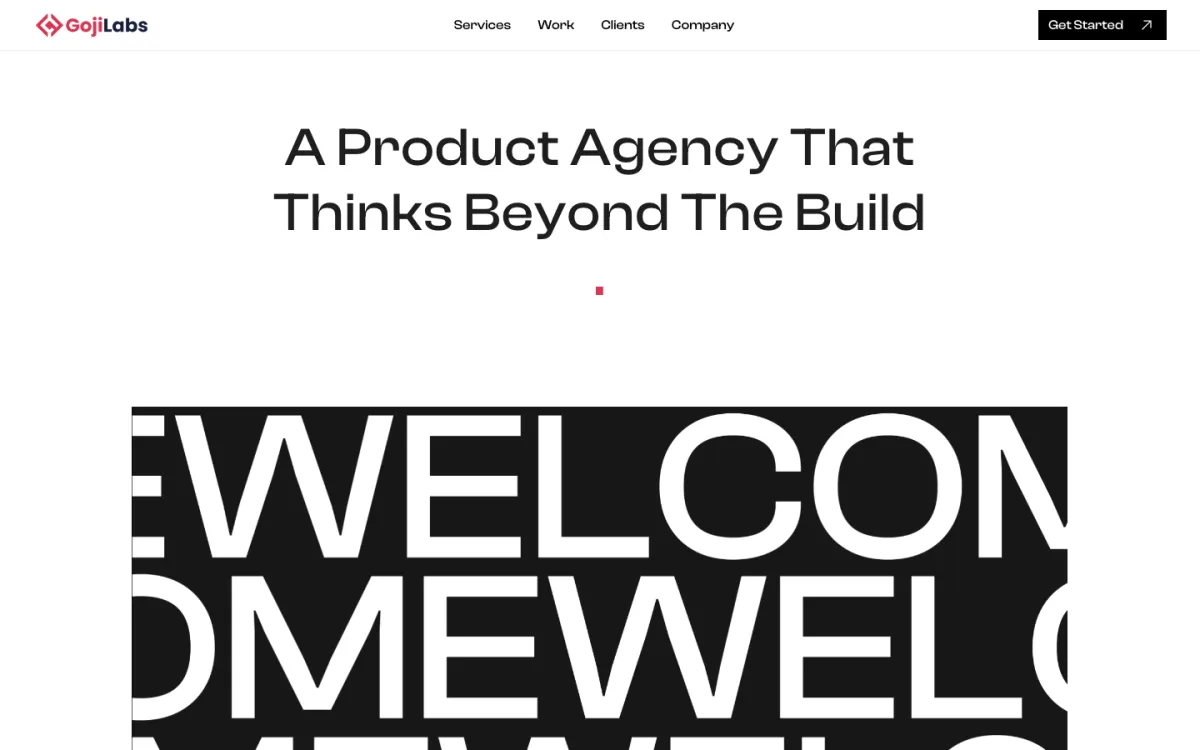
Goji Labs is a Los Angeles team that designs and builds software, web and mobile products. It built Valara's rental management SaaS for fleet businesses, redesigned and rebuilt KCRW's mobile app, and worked on Intterra's emergency response platform.
Services
- Product strategy. Collaborative strategy sprints before design and build.
- Product design. UI and UX design for web and mobile apps, delivered with a design system.
- App, software and AI development. Full-stack engineering in Rails, Node.js, React and Next.js, plus native iOS and Android.
Pricing
Goji Labs scopes each product after a strategy sprint, then staffs a senior pod through delivery.
- Entry point: $50,000+ on Clutch.
- How work is billed: a collaborative strategy sprint, then an embedded pod that designs and builds.
- Published prices: quoted after the strategy sprint; $150 to $199 an hour on Clutch.
- Budget guide: its floor sits above the $43,000 MVP median, and that budget covers engineering as well as design.
What clients liked
- Membership growth. After an app redesign and build, KCRW's chief administrative officer reported on Clutch a 7% conversion to membership from new users.
- Funding. k-ID, a child safety verification platform among its featured clients, raised a $51 million Series A in nine months.
Limitations
- Its $50,000 minimum is among the higher entry points here.
- Its case list mixes B2B SaaS with consumer and e-commerce work such as Fitness Pact and Katzkin, so ask for B2B software references.
- Pitcheroo's final costs came in above the first estimate as requirements changed, so review the budget at each new feature.
14. thoughtbot
- Starting price
- $10,000+
- Hourly rate
- $150 to $199
- Clutch
- 4.9/5, 39 reviews
- Team and HQ
- 50 to 249 people, New York, NY
- Builds the product
- Yes; small teams of designers and developers (Ruby on Rails, Hotwire, React, React Native, AI/ML, Elixir)
- Engagement model
- Shaping sprints, MVP development, team augmentation, fractional product and technical leadership
- Typical timeline
- A product roadmap in as little as 2 weeks; Joydrive's MVP shipped in 6 weeks
- Best for
- Healthcare, fintech and insurance products that need design and engineering from one senior team
- Not a fit for
- Teams that want a design-only partner and already have engineers
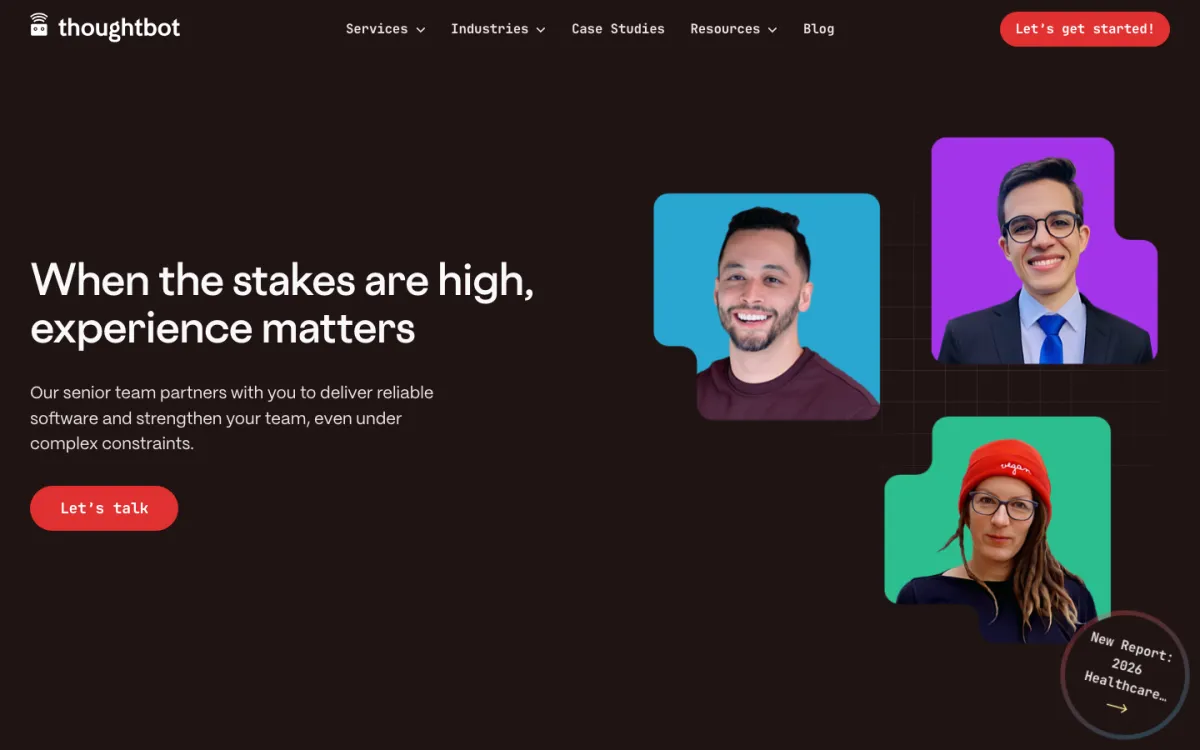
thoughtbot is a product design and development consultancy rooted in Ruby on Rails. It designed and built the first version of Folio, a B2B marketplace for hotels and their suppliers, built Teikametrics' Rails MVP and data service, and works on CloseKnit Health's product and engineering.
Services
- Product design. Shaping sprints, UX and UI, design systems, accessibility and brand implementation.
- MVP development. Discovery sprints that set the roadmap and technology choices, then design and build of the first version.
- Engineering. Rails, Hotwire, React, React Native, AI and ML, maintenance and platform work.
Pricing
thoughtbot asks for your budget on its intake form and prices each engagement from there.
- Entry point: $10,000+ on Clutch, often a discovery sprint that sets the roadmap in as little as two weeks.
- How work is billed: sprints, MVP projects and short- to long-term team augmentation.
- Published prices: quoted after intake; $150 to $199 an hour on Clutch.
- Budget guide: a low minimum with a senior US rate, so a sprint is affordable while a full build is billed at about twice the benchmark median rate.
What clients liked
- From MVP to Series A. Folio went from zero to 200 hotel clients in a year and raised a $14 million Series A.
- Faster releases. CloseKnit Health achieved a tenfold improvement in release speed over the first year with thoughtbot.
Limitations
- Its engineering history centres on Rails and Hotwire, so teams on other stacks should confirm who would staff the work.
- Its team is weighted towards developers, which suits a build more than a pure design engagement.
- One client's discovery phase ran longer than expected, so agree what discovery must produce before it starts.
15. ustwo
- Starting price
- $50,000+
- Hourly rate
- $150 to $199
- Clutch
- 4.5/5, 2 reviews
- Team and HQ
- 50 to 249 people, London, UK
- Builds the product
- Yes, full stack front end and back end
- Engagement model
- Discover (from 8 weeks), Shape (from 3 months), 0 to 1 design and build, Boost embedded teams (from 6 weeks), short AI workshops and sprints
- Typical timeline
- 6 weeks to more than a year for a 0 to 1 build; AI sprints from 1 day to 4+ weeks
- Best for
- Fintech and AI products that need research, design and build from one studio
- Not a fit for
- Small budgets, or teams that want a B2B SaaS specialist
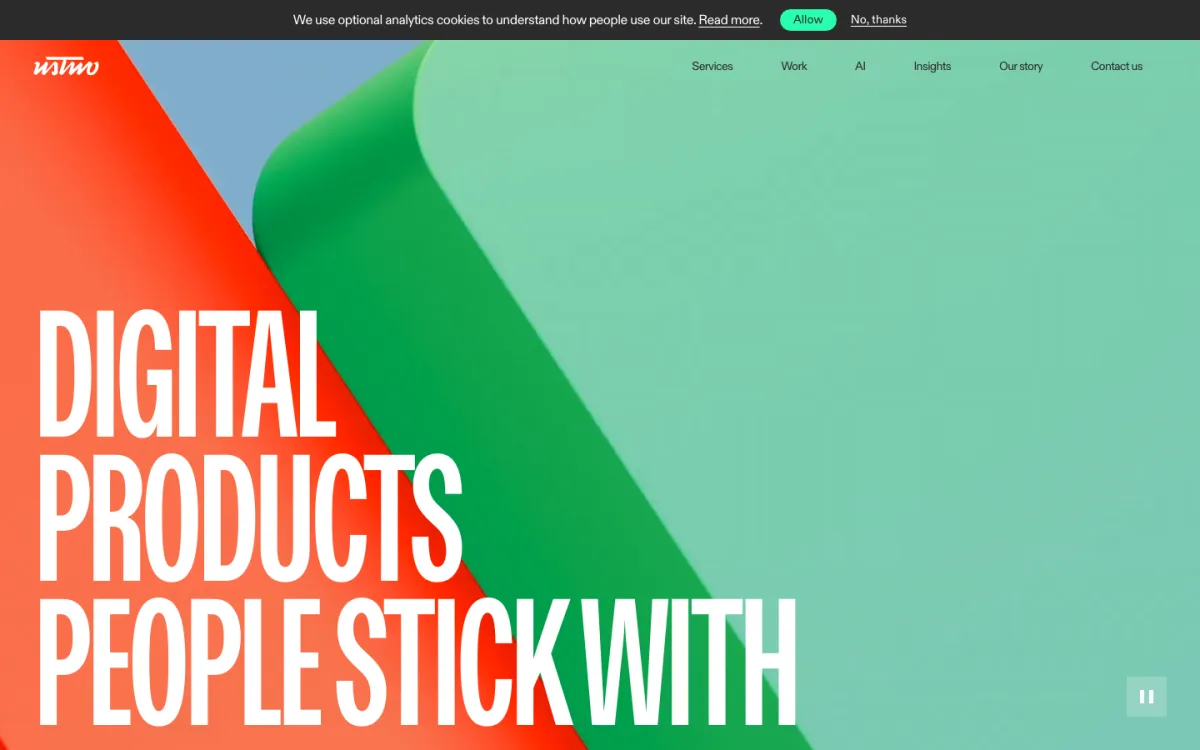
ustwo is a London-founded digital product studio that designs and builds. It designed and built HSBC's Klir cash-flow tool for small businesses, embedded a ten-person design and product team at Dojo to build its first global design system, and designed and built the first iOS app for Inflection AI's Pi.
Services
- Discover and Shape. Research and product definition, from 8 weeks and 3 months.
- Boost. Embedded teams that improve a live product, from 6 weeks.
- People-first AI. AI workshops and sprints from one day to four weeks or more, and AI product design such as the first iOS app for Inflection AI's Pi.
Pricing
ustwo prices each engagement by length and team, from a one-day AI workshop to builds of a year or more.
- Entry point: a one-day AI workshop, or Discover from 8 weeks.
- How work is billed: Discover (from 8 weeks), Shape (from 3 months), 0 to 1 builds and Boost embedded teams (from 6 weeks).
- Published prices: engagement lengths only; $50,000+ and $150 to $199 an hour on Clutch.
- Budget guide: multi-week minimums at senior rates put most engagements above the $43,000 MVP median.
What clients liked
- Consumer AI at scale. Inflection AI's Pi passed one million daily active users by March 2024, with ustwo designing the interface and building the first iOS app.
- Design systems. For iShares, a design kit lets the team build new web pages in half the time.
Limitations
- Its engagements run long, from 8 weeks for Discover and 3 months for Shape.
- Most of its 56 case studies are consumer and health products, so B2B SaaS teams should ask for work like Dojo's.
- With two Clutch reviews, references come mainly from its case studies.
16. Arounda
- Starting price
- $25,000+ on Clutch; projects from $6,000
- Hourly rate
- $25 to $49
- Clutch
- 5.0/5, 87 reviews
- Team and HQ
- 10 to 49 people, Odesa, Ukraine
- Builds the product
- Yes; MVP and web development, with full-time developers on monthly plans
- Engagement model
- Sprint-based projects, MVP tiers, monthly designer and developer plans, a 3-day free trial on designer plans
- Typical timeline
- 4 to 8 weeks for a UI/UX project; 12+ weeks for an MVP designed and built
- Best for
- Seed-stage teams that need an MVP designed and built on a known budget
- Not a fit for
- Teams that need a full MVP designed and built in under three months
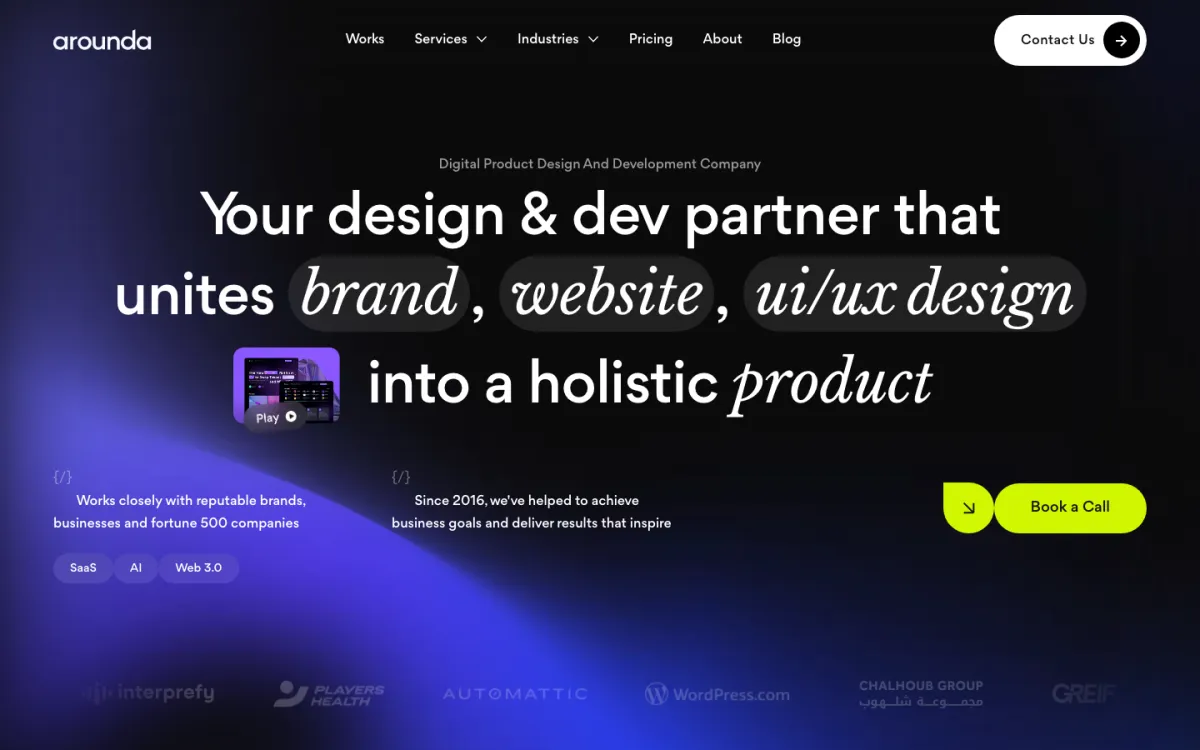
Arounda designs and develops MVPs and digital products, alongside branding and websites. It merged MOJO-CX's three products into one AI contact-centre platform with views for agents and managers, and designed the MVPs of Sinta's HR platform and Player's Health's insurance platform.
Services
- MVP design and development. MVP tiers from one or two core features up to complex fintech, Web3 and healthcare products.
- Product redesign and UX audits. Redesigns of live products, often after an audit.
- Branding and websites. Brand identity, pitch decks and website design and development.
Pricing
Arounda publishes its MVP price tiers, which few agencies on this list do.
- Entry point: typical projects from $6,000; $25,000+ on Clutch.
- How work is billed: sprint-based projects, MVP tiers, or monthly designer and developer plans that can be paused or cancelled any time.
- Published prices: MVPs at $10,000 to $20,000 (lean), $30,000 to $50,000 (mid-range) and $50,000 to $80,000+ (complex); $25 to $49 an hour on Clutch.
- Budget guide: the mid-range tier brackets the benchmark's $43,000 median, and its hourly rate is the joint-lowest on this list with Eleken.
What clients liked
- A platform merge. After MOJO-CX moved to one platform, agent productivity rose 31% and onboarding got 42% faster.
Limitations
- A full MVP design and build takes 12 weeks or more, which suits teams without a hard launch date.
- Its portfolio leans on Web3 and fintech (15 cases each) more than SaaS (9).
- One client wanted a more structured follow-up after handover, so agree post-launch support before the project ends.
17. Ramotion
- Starting price
- $50,000+
- Hourly rate
- $150 to $199
- Clutch
- 4.9/5, 29 reviews
- Team and HQ
- 10 to 49 people, San Francisco, CA
- Builds the product
- Yes; redesign teams include front-end and back-end developers, DevOps and QA
- Engagement model
- Fixed-price discovery, milestone product redesigns, embedded design support (3-month minimum), product delivery pods
- Typical timeline
- Discovery in 4 to 8 weeks, then an initial delivery phase of 3 to 6 months
- Best for
- Brand-led product redesigns and launches with a budget of $50,000 or more
- Not a fit for
- Budgets under $50,000, or a product-only brief with no brand work
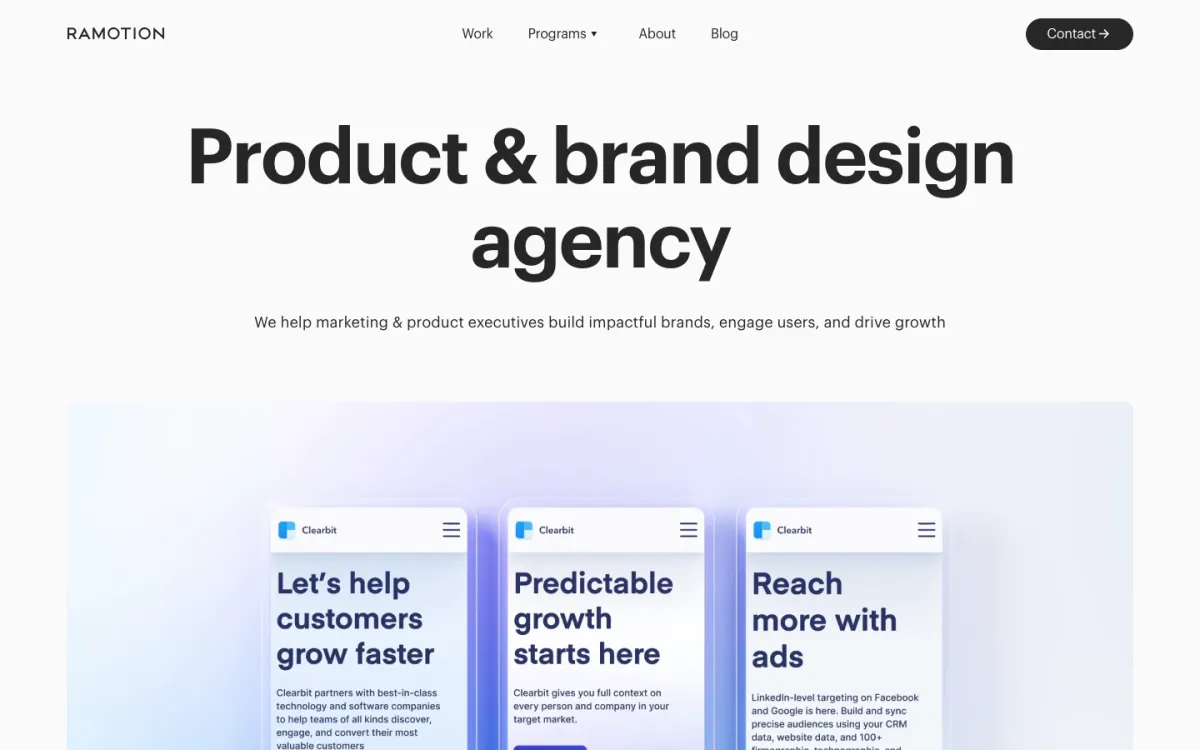
Ramotion is a product and brand design studio with offices in San Francisco, Los Angeles and New York. It built Upstream's carbon management platform for manufacturers from the ground up, front end and back end, improved Turo's help experience and ran rapid UI prototyping for Xero.
Services
- Product programmes. Product discovery, redesign and delivery, each sold as its own programme.
- Web app development. Front-end and back-end engineering, DevOps and QA within redesign and delivery teams.
- Brand and websites. Branding, brand strategy, web design and iconography.
Pricing
Ramotion publishes its product design prices in more detail than most studios, starting with a paid discovery phase.
- Entry point: a $35,000 fixed-price discovery, the first phase of its product redesign programme.
- How work is billed: milestone product redesigns, embedded design support with a 3-month minimum, and product delivery pods.
- Published prices: a $50,000 minimum project; milestone redesigns from $50,000 to $150,000+; embedded design at $9,500 a month part-time or $16,800 full-time; delivery pods from $10,000 to $45,000 a month; $50,000+ minimum and $150 to $199 an hour on Clutch.
- Budget guide: discovery alone comes close to the $43,000 MVP median, so it fits funded redesigns more than first MVPs.
What clients liked
- Easier self-service. For Turo, Ramotion's work improved users' ability to find answers by 30%.
- Zero to one. Upstream's brand, UI and web app came from one Ramotion team.
Limitations
- Its $50,000 minimum and $35,000 discovery phase put it above most Seed budgets.
- Embedded design support carries a 3-month minimum.
- One client felt research and proposals took time away from delivery, so set delivery milestones early.
18. Clay
- Starting price
- $50,000+
- Hourly rate
- $150 to $199
- Clutch
- 4.8/5, 32 reviews
- Team and HQ
- 10 to 49 people, San Francisco, CA
- Builds the product
- Yes; front-end, back-end and API development
- Engagement model
- Time and materials, fixed fee, retainer
- Typical timeline
- Set in each proposal, with the cost
- Best for
- SaaS companies moving upmarket that want brand, website and product redesigned together
- Not a fit for
- Seed and Series A budgets, or a product-only brief
Clay is a San Francisco-based branding and UX studio. Its product work includes Togetherr, a creative collaboration web app for Fiverr, Slack's interactive product demo and a design system for Nuant's crypto analytics platform.
Services
- Digital products. UX, UI and design systems for consumer and enterprise software.
- Development. Front-end web development, back-end development, API integration and mobile apps.
- Brand, websites and content. Branding, marketing websites and an in-house content production studio.
Pricing
Clay quotes one blended rate and a timeline in a proposal for each project.
- Entry point: $50,000+ on Clutch.
- How work is billed: time and materials, fixed fee or retainer.
- Published prices: quoted per proposal; $150 to $199 an hour on Clutch, billed as one blended rate.
- Budget guide: its floor sits above the $43,000 MVP median, and the rate is about twice the benchmark median.
What clients liked
- A multi-year product partnership. Slack's interactive demo grew into a multi-year partnership that included localisation.
- Getting enterprise-ready. A common Clay brief is preparing a SaaS startup for enterprise buyers by redesigning its brand, product and marketing site together.
Limitations
- Its portfolio leans to websites, with 21 website cases against 16 digital product cases.
- Much of its named B2B SaaS work is marketing sites, for Tipalti, Cornerstone and Phenom among others, so ask for product UI cases.
- Eight weeks into one project, a change order raised the cost beyond the client's budget, so agree how scope changes are priced.
19. Work & Co
- Starting price
- Scoped per engagement; Clutch shows $5,000+ on an unclaimed profile
- Hourly rate
- $100 to $149 (Clutch, unclaimed profile)
- Clutch
- Profile with no reviews
- Team and HQ
- 250 to 999 people, Brooklyn, NY
- Builds the product
- Yes; strategy, product management, design and development under one roof
- Engagement model
- Small, senior, fully dedicated teams, mostly on years-long relationships
- Typical timeline
- Market feedback within 20 days, with a full design cycle and prototype early in each project
- Best for
- Large consumer, commerce and B2B platforms with multi-year product roadmaps
- Not a fit for
- Seed and Series A teams, or a short, fixed project
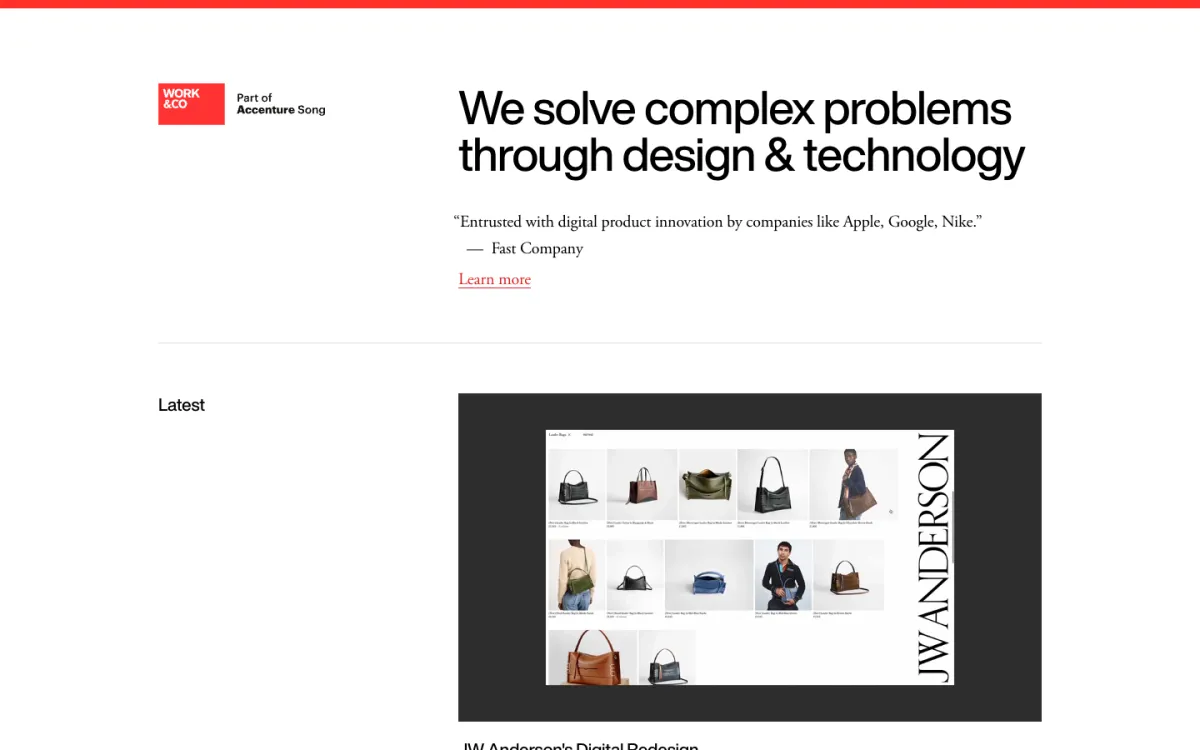
Work & Co designs and builds digital products and joined Accenture Song in 2024. For Vistaprint it designed purchase flows for B2B and B2C customers, built the web app and a design system of more than 700 components, and it designed and built Mailchimp's content portal and Celanese's AI materials-selection platform.
Services
- Product strategy. Proof of concept, MVP definition, and user research and testing.
- Design. UX and UI, design systems, generative AI and multimodal UX, brand and motion.
- Technology. Full-stack web and mobile, platform engineering, enterprise data integration for LLMs and quality engineering.
Pricing
Work & Co prices every engagement around a fully dedicated team, mostly on years-long relationships.
- Entry point: scoped per engagement.
- How work is billed: small, senior, fully dedicated teams, with the same core team from start to finish.
- Published prices: quoted per engagement; the $5,000+ and $100 to $149 an hour on its unclaimed Clutch profile are unlikely to reflect real budgets.
- Budget guide: dedicated teams on multi-year terms put it in enterprise budget territory, well above the MVP benchmarks.
What clients liked
- Commerce results. At Vistaprint, the new return-customer dashboard doubled conversion value and holiday purchase completion rose 60%.
Limitations
- Most of its client list is consumer and retail brands, with a shorter B2B list that includes Vistaprint, Datadog and Embraer.
- Its model of dedicated, multi-year teams is sized for large organisations more than Seed to Series C companies.
- With no Clutch reviews, references have to come through its own client list.
Product design
Your product design team, without the 6-month hire.
Bricx designs B2B SaaS and AI products with an embedded senior team, from research to developer-ready handoff. Projects start at $25,000.
How much does a product design agency cost?
Budget $25,000 to $50,000 to design a five-feature MVP, and more if your product has many user roles.
That range comes from one SaaS client who sent the same MVP brief (user research, design, user testing and QA) to 57 agencies:
- The median fixed quote was about $43,000.
- Quotes ran from $2,500 to over $150,000.
- 60% of agencies wouldn't quote before a discovery call, because user roles, integrations and edge cases change the work more than screen count does.
| Pricing model | Lowest | Median | Highest |
|---|---|---|---|
| Fixed price, 5-feature MVP design | $2,500 | about $43,000 | over $150,000 |
| Monthly subscription or retainer | about $4,000 | about $7,000 | $20,000 |
| Hourly rate (all scopes) | $25 | $55 to $90 | $195 |
Product design usually costs more than a website. The report's author puts it at 1.5 to 2.5 times a website for the same company, and the measured medians ($43,000 against $25,000) put it near 1.7 times.
Four things move a quote within those bands:
- User roles and modules. An admin, a daily user and an approver each need their own version of many screens, so roles move the price more than page count, and AI agent flows add review and error states on top.
- Research depth. Paid interviews and usability tests add weeks, and they are what stops a redesign from being a reskin.
- Who builds. Agencies that engineer the product quote design and development together; design-only agencies quote less and leave the build to your engineers.
- Location. The report's author puts average rates at about $150 an hour in the US, $60 in Europe and $35 in Asia, and the calls showed no link between a higher rate and a broader scope.
Should you pay a fixed price, hourly or a retainer for product design?
Match the model to how settled your scope is.
- Fixed price (the default at 35% of agencies) fits a defined MVP, a UX audit or a single module, where budget certainty matters most. It is also the cheapest way to test an agency before monthly work.
- Time and materials (45%) fits discovery and early product work, where the plan changes after every round of user feedback.
- A retainer or subscription (20%) fits a live product with a roadmap. The benchmark's author recommends one while the scope is still open, because a team paid for its time will not resist going back to an earlier direction.
About half of agencies take a deposit and then bill by milestone.
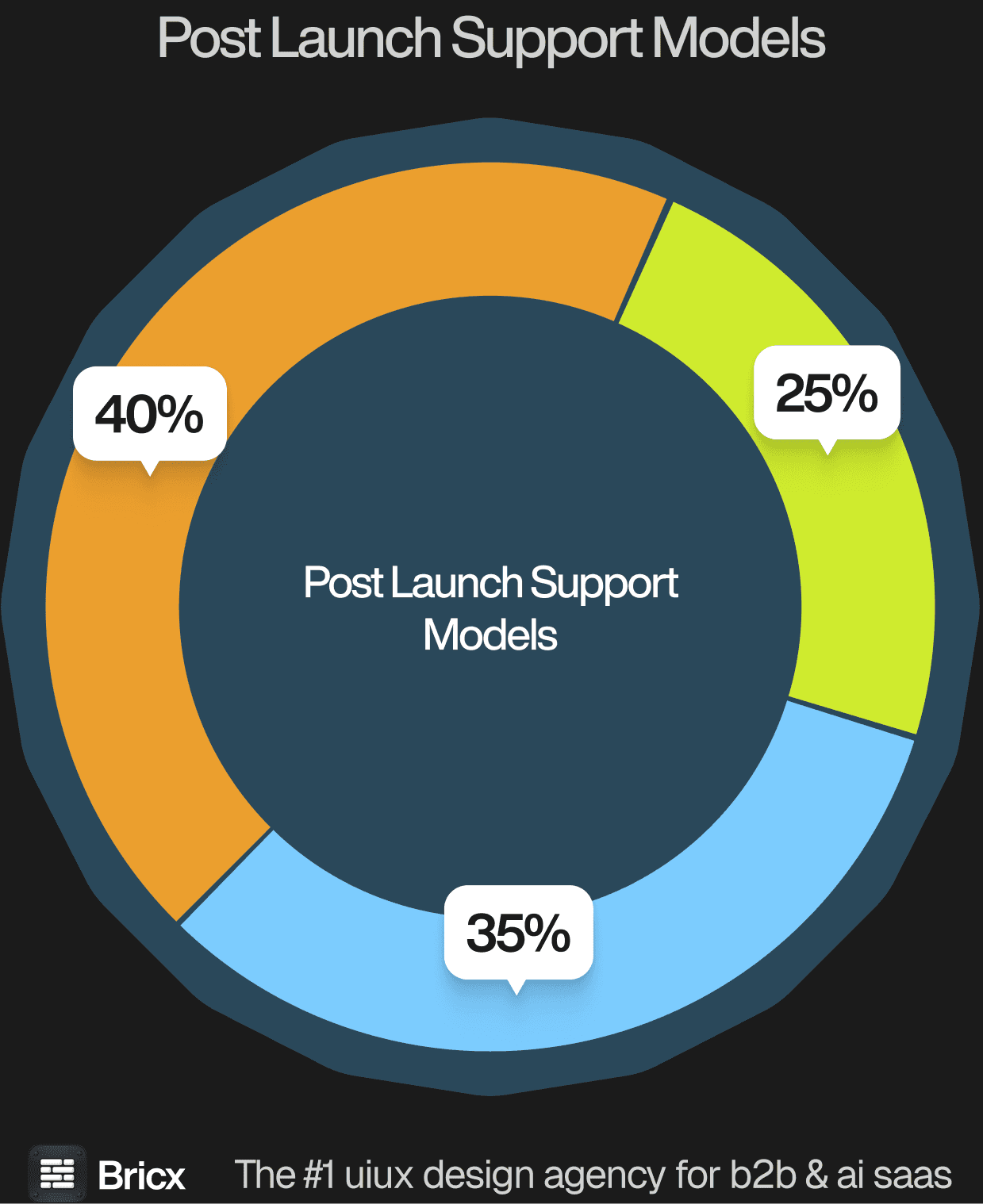
After launch, 40% of agencies offer a monthly retainer for support, 35% bill hourly and 25% sell a prepaid bank of hours.
How much does it cost to hire a product designer?
Expect $25 to $195 an hour for a product designer through an agency, with the median between $55 and $90.
On a monthly plan, design subscriptions run from about $4,000 to $20,000, with a median near $7,000. That is the closest match to hiring one embedded designer.
Published plans from agencies on this list:
- Eleken: $4,599 a month for a part-time designer and $6,599 for a full-time one, with a two-month minimum.
- Cieden: team extension at $7,200 a month per person, or from $11,520 for designers in the US or Canada.
- Bricx: a senior designer backed by a design lead on a design team extension from $10,000 a month, with fifteen days' notice.
- Glow: a project manager, a design lead and a senior designer for $12,000 a month on a 3-month plan.
A common pattern is an agency for the MVP or the redesign, then one in-house designer who inherits the documented system, with a monthly plan covering the months the hire takes.
How long does product design take?
Most agencies need 10 weeks or more to design an MVP. For the five-feature MVP brief:
- 52.6% quoted 10 weeks or more.
- 26.3% quoted 5 to 9 weeks.
- 21.1% quoted 1 to 4 weeks.
The longest quotes usually came from fixed internal processes, with nothing extra to show in the final work.
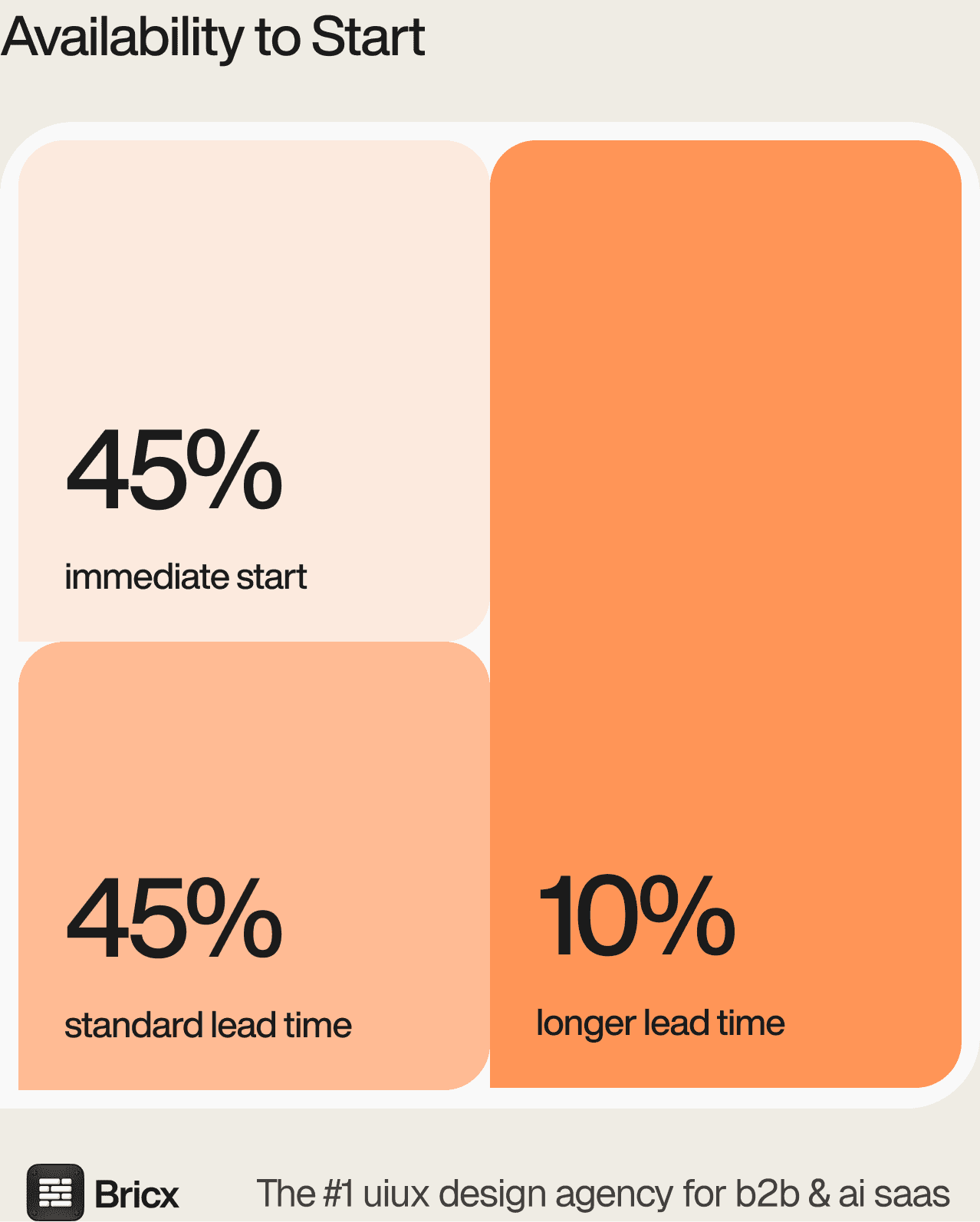
Lead time comes on top: 45% of agencies could start straight away, 45% needed two to four weeks and 10% needed longer.
| Engagement | Typical duration | Example |
|---|---|---|
| UX audit | 1 to 3 weeks | Bricx; Eleken's fixed audit |
| Clickable prototype for an AI MVP | 2 to 3 weeks | Bricx |
| MVP design (5 features) | 10+ weeks at 52.6% of agencies | The State of UI/UX Design Agencies 2026 |
| MVP designed and front end built | 6 to 10 weeks | Bricx |
| MVP designed and fully built | 12+ weeks | Arounda |
The agency is rarely the bottleneck. Every agency in the benchmark named timely client feedback as what keeps a project on schedule, so plan on about five hours a week from your main contact.
How to choose a product design agency
Two agencies can both claim research, UX, UI and design systems and still differ on who does the work and what happens after handoff. Settle four things in this order.
1. Decide who builds.
- No engineers, or they're fully booked: hire an agency that builds.
- Engineers already in place: a design-only agency is enough.
- If a partner builds: meet them before signing. Of benchmarked agencies that build, 55% do it in-house and 45% use a partner, and a bug between two companies quickly becomes a question of whose job it is.
- If the agency is design-only: ask for a handoff with every state of every screen (empty, loading, error, permission denied, first run, too much data) and design QA on the build.
2. Write a one-page brief. It makes quotes comparable and cuts the number of agencies that refuse to quote:
- The product, its users and the roles inside it, and the module that matters most.
- The metric the work should move: activation, adoption, retention or time to ship.
- Who builds, and on which stack.
- Access to users, analytics and support data.
- One decision-maker, their feedback turnaround, and the date that matters.
3. Match the agency to the trigger.
- Users sign up and never reach value: an agency that starts with research and onboarding, not a visual refresh.
- A raise has just closed and the roadmap is long: senior designers on a monthly plan that can start within two weeks.
- Enterprise buyers are now evaluating the product: experience with roles, permissions, dense tables and audit trails.
- The product is an AI product: shipped AI interfaces, with review steps and controls for what the agent does.
If the trigger is the marketing site, the SaaS website design agencies list is the closer match, and the UX design agencies list covers research and audits across any digital surface.
4. Ask before signing.
- Which three shipped products are closest to this one, and what changed for those companies after launch?
- Who designs the product day to day, and is that person shared with other clients?
- What does a handoff file contain, and can you share a sample?
- How is a change of scope handled, and what does a retainer cover in a quiet month?
- Who owns the Figma files, prototypes and code at the end?
What are the red flags when hiring a product design agency?
- A portfolio of Dribbble concepts and no shipped products with real users.
- A redesign proposal that changes colours and fonts but keeps every flow.
- "Data-driven" with no research step, no analytics access and no user interviews in the plan.
- No answer to who builds, or a build partner the agency will not name.
- Handoff files without empty, loading and error states.
- Senior designers in the pitch and junior designers on the account.
Product design
Your product design team, without the 6-month hire.
Bricx designs B2B SaaS and AI products with an embedded senior team, from research to developer-ready handoff. Projects start at $25,000.
FAQs
Which companies are the best for product design?
For software products, the strongest product design companies in 2026 include Bricx, UX Studio, Neuron, Cieden, Glow, Excited, Fuzzy Math and Eleken. Bricx fits complex B2B and AI SaaS products; MetaLab, ustwo and Work & Co fit flagship products on large budgets; Goji Labs and thoughtbot fit teams that need the product built too; Fuzzy Math and Think Company fit enterprise software.
What are the best product design agencies for startups?
With engineers on the team, WANDR and Excited design the MVP and hand it over ready to build, and Bricx designs it and builds the front end. Without engineers, Goji Labs, thoughtbot, Cieden and Arounda design and build it. On a tight budget, Glow's fixed $12,500 MVP, Eleken's subscription and Arounda's lean MVP tier are the lowest published entry points. The design agencies for YC startups list narrows the field further.
What is a digital product design agency?
An agency that designs software products end to end: research, flows, UX and UI, prototypes, usability testing and a design system, and often the build. "Digital" separates it from industrial product design firms such as Smart Design or Speck Design, which design physical products, so check whether a firm's portfolio shows screens or objects.
Should I hire a UX agency or a product design agency?
A product design agency, if you have a software product with users: it covers UX and UI plus the product decisions around them, such as what to build first and how the design system scales, and it is judged on activation and retention. A UX design agency is enough for a contained job such as an audit, one flow or a visual refresh.
Can a product design agency improve an existing product?
Yes. The usual path is a UX audit that finds where users drop off, then a module-by-module redesign starting with the flow that matters most, and a design system documented from the approved screens. Product redesign covers how that runs.
Is AI replacing product designers?
No, but it is changing the job. AI tools now generate layouts, flows and first versions of products, and founders often arrive with an AI-built prototype. What those tools do not supply is judgement about what to cut, a coherent system across hundreds of screens, and the taste that makes a product feel distinct.
What are the top product design companies in the USA?
US-based agencies on this list include WANDR and Goji Labs in Los Angeles, Neuron, Clay, Ramotion and Lazarev in San Francisco, Glow in Delaware, thoughtbot and Work & Co in New York, Fuzzy Math in the Chicago area and Think Company near Philadelphia. Bricx, UX Studio, Cieden, Excited, Eleken, Arounda and ustwo work with US companies from outside the US.

Similar Lists



Contents