16 Best UX Design Agencies and Firms (2026)
16 UX design agencies for software products compared on price, research depth, build capability and Clutch reviews, with benchmark data from 57 agencies.
Oct 5, 202630 min read
Which UX design agencies are the best?
Updated October 2026. Clutch ratings, review counts and minimum project sizes checked on October 5, 2026.
The best UX design agencies in 2026 are Bricx, Clay, Neuron, UX Studio, Fuzzy Math, MetaLab and Eleken. The right one depends on the product and how much research it needs:
- Bricx for B2B, AI and enterprise software whose product has outgrown its interface: complex workflows, many user roles and legacy screens that every role has to understand.
- Neuron, Fuzzy Math and Momentum Design Lab for enterprise and legacy B2B software with many user roles.
- UX Studio, Cieden and Qubstudio for research-led redesigns of complex platforms at mid-range rates.
- Clay, MetaLab and Work & Co for flagship products on large budgets.
- Eleken, Excited, Arounda, Halo Lab and Goji Labs for embedded designers, or for UX designed and built by one team.
A UX design agency (also called a UX design firm, UX design company or user experience design company) researches how people use a product, then designs the structure, flows and interface that make it easy to use. The work covers user research, information architecture, interaction design, prototyping, usability testing, and the UI and design system engineers build from. The difference from a UI shop is evidence: a UI team delivers screens, a UX team can show why those screens work.
Figures from The State of UI/UX Design Agencies 2026, for which Bricx held sales calls with 57 agencies using the same brief. Not every agency answered every question, so shares are of the agencies that answered.
Quick picks by situation and budget
Start from the row that matches the problem.
| Situation | Shortlist | Why |
|---|---|---|
| A B2B or AI SaaS product needs a redesign before a launch or a raise | Bricx, Excited, Eleken | Product redesigns with research and a design system; Bricx also redesigns the website and brand in parallel |
| An enterprise platform with many user roles and legacy screens | Neuron, Fuzzy Math, Momentum Design Lab | Enterprise and B2B workplace software is their core work; Fuzzy Math has been SAP Fieldglass's design partner since 2010 |
| Users sign up and never reach value | Bricx, UX Studio, Eleken | Onboarding and activation redesigns on live SaaS products, with prototype tests before handoff |
| The team needs to know what is wrong before redesigning | UX Studio, Cieden, Fuzzy Math | UX audits and usability testing sold as standalone services; Cieden publishes audits from $2,000 |
| Data-heavy dashboards and complex workflows | Neuron, Qubstudio, Cieden | Neuron cut Listrak's navigation from 118 items to 16; Qubstudio redesigned 445 screens for Workforce Velocity |
| A flagship product on a large budget | MetaLab, Clay, Work & Co | Product studios with enterprise client lists and $50,000 to $100,000+ minimums |
| UX designed and built by one team | Goji Labs, Arounda, Halo Lab | Research, design and front-end or full-stack development in-house |
| Ongoing UX capacity without hiring | Eleken, Cieden, Bricx | Subscriptions from $4,599 a month, team extension from $7,200 per person a month, retainers from $10,000 a month |
| A brand-led product relaunch | Ramotion, Clay, Bricx | Brand, product UI and website from one studio |
Shortlist by budget
| Budget | Shortlist | Pricing basis |
|---|---|---|
| Under $25,000 | Eleken, Cieden, Qubstudio, Excited, Halo Lab | Clutch minimums of $10,000; Qubstudio's Clutch packages start at $4,850 for UX/UI; Cieden sells UX audits from $2,000 |
| $25,000 to $50,000 | Bricx, Neuron, Fuzzy Math, Momentum Design Lab, Arounda | Clutch minimum of $25,000 for all five |
| $50,000 to $100,000 | Clay, Ramotion, Goji Labs | Clutch minimums of $50,000; Goji Labs says engagements typically run $50,000 to $1,000,000 |
| $100,000 and up | MetaLab, Work & Co | MetaLab lists a $100,000 minimum; Work & Co publishes no prices and works with enterprise clients |
How the 16 agencies compare
Filter by budget, in-house usability testing or where the agency is based, or sort by price, rate and reviews. "Research and testing" lists what each agency sells as a service on its own site.
| Agency | Best for | Clutch minimum | Hourly rate | Clutch rating | Build stack | Research and testing | HQ |
|---|---|---|---|---|---|---|---|
| Bricx | B2B, AI and enterprise software, incl. multi-role products | $25,000+ | $50 to $99 | 5.0/5, 32 reviews | Webflow, Framer, custom code (Next.js) | User interviews, analytics, prototype tests | Dubai and New Delhi |
| Clay | Enterprise product, brand and site | $50,000+ | $150 to $199 | 4.8/5, 32 reviews | Custom builds | User research and testing | San Francisco, US |
| Neuron | Enterprise workplace software | $25,000+ | $150 to $199 | 5.0/5, 52 reviews | Design only, front-end support (Storybook) | Research, usability testing, UX audit | San Francisco, US |
| UX Studio | Research-led redesigns of complex products | $10,000+ | $50 to $99 | 5.0/5, 41 reviews | React, TypeScript, Webflow | Research, usability testing, UX audit | Budapest, Hungary |
| Fuzzy Math | Legacy enterprise and B2B platforms | $25,000+ | $150 to $199 | 4.9/5, 27 reviews | Design only, HTML and CSS | Research, usability testing, expert evaluation | Chicago area, US |
| Momentum Design Lab | Enterprise design plus engineering | $25,000+ | $150 to $199 | 4.8/5, 97 reviews | Engineering through HTEC | Research, UX assessment, usability testing | Palo Alto, US |
| MetaLab | Flagship product builds | $100,000+ | Not published | No Clutch reviews | Front-end and mobile engineering in-house | UX research | Vancouver, Canada |
| Work & Co | Enterprise digital products | Not published | Not published | No Clutch reviews | React, Gatsby, headless CMS | User research and testing | Brooklyn, US |
| Ramotion | Brand-led product relaunches | $50,000+ | $150 to $199 | 4.9/5, 29 reviews | Jamstack, Webflow, WordPress | Not advertised | San Francisco, US |
| Cieden | Complex B2B SaaS, published prices | $10,000+ | $50 to $99 | 4.9/5, 46 reviews | React, Angular, Vue, Node.js | Research, usability testing, UX audit | Toronto, Canada |
| Qubstudio | Data-heavy B2B platforms | $10,000+ | $50 to $99 | 4.9/5, 92 reviews | Webflow, Lovable | Research, user testing, UX audit | Lviv, Ukraine |
| Eleken | Embedded SaaS product designers | $10,000+ | $25 to $49 | 4.9/5, 127 reviews | Design only | UX research and audit | Kyiv, Ukraine |
| Excited | Design-led SaaS and AI products | $10,000+ | $50 to $99 | 5.0/5, 56 reviews | Webflow | User research, UX audit, usability testing | Lviv, Ukraine |
| Arounda | UX designed and built for seed to Series A | $25,000+ | $25 to $49 | 5.0/5, 86 reviews | React, Node.js, Webflow | Discovery, UX audit | Odesa, London, Sydney |
| Halo Lab | UX and build on a tight budget | $10,000+ | $25 to $49 | 4.9/5, 100 reviews | Webflow, React, Next.js | UX audit | Dubai, UAE |
| Goji Labs | Product strategy, UX and the build | $50,000+ | $150 to $199 | 5.0/5, 91 reviews | React, Next.js, Ruby on Rails, React Native | Research, usability testing, UX audit | Los Angeles, US |
"Not advertised" means the agency's own site does not list the service; it may still offer it on request.
How these agencies were picked
Every agency on this list was assessed against the same evidence a buyer can check, with the rigour Bricx applied when it held sales calls with 57 agencies using the same brief for The State of UI/UX Design Agencies 2026. Each had to clear three bars:
- A strong, verified track record. Consistent, recent client reviews on Clutch, or a portfolio of shipped products used at scale.
- Real software UX work. Named software clients and shipped product case studies on the agency's own site or in verified reviews, not concept work.
- Published facts. Minimum project size, hourly rate, team size and location from Clutch, checked on October 5, 2026. Services, stack and research methods come from each agency's own site. Outcome numbers appear only where a client stated them on Clutch or the agency published them in a case study, and each one says which.
Agencies are ordered by fit for software companies hiring for product UX, from funded startups to enterprise.
The 16 agencies, reviewed
Facts first; evidence and limits are in each full review.
Best UX design agency for B2B, AI and enterprise software: Bricx
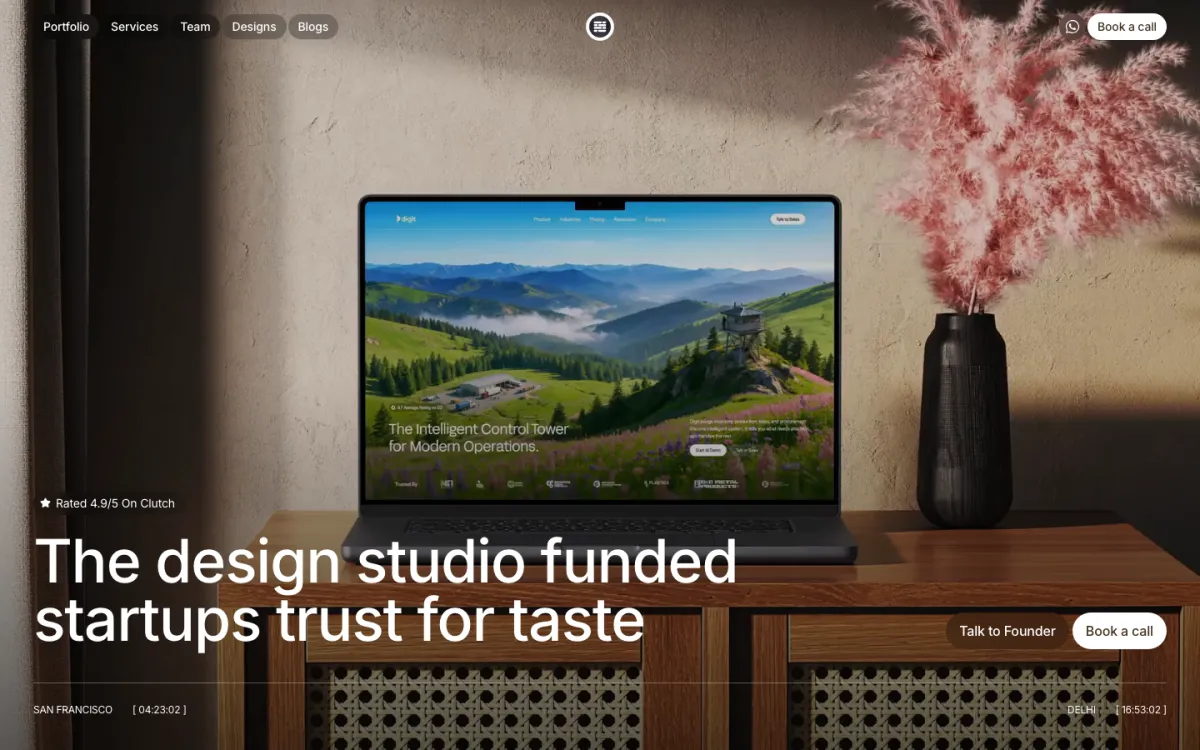
Bricx is the best UX design agency for B2B, AI and enterprise software teams whose products have outgrown their interface, from AI-native platforms to legacy tools with many user roles. Bricx's product design team has redesigned the products of Sybill, CAMB.AI and Hobbes, and has shipped 50+ websites in the last two years for clients including Writesonic (YC S21) and LTV.ai.
Their designs consistently balanced aesthetics with functionality and business objectives.
- Starting price
- $25,000+ (fixed scope); retainers from $10,000/month
- Hourly rate
- $50 to $99
- Clutch
- 5.0/5, 32 reviews
- Team and HQ
- 10 to 49 people, Dubai and New Delhi
- Stack
- Figma; design systems on the client's component library, often shadcn/ui; front end in Webflow (Certified Partner), Framer (Expert) or Next.js
- Engagement model
- Fixed-scope projects, monthly retainers, embedded teams, paid pilot sprints
- Typical timeline
- MVP design under 45 days; websites live in about five weeks
- Best for
- B2B, AI and enterprise software redesigning complex, multi-role products and workflows
- Not a fit for
- Non-software businesses and budgets under $25,000
Full review of Bricx
Enterprise and legacy redesigns start by mapping every role, from the admin who configures the product to the daily user and the person who approves its output, so each gets a view built for its job. A product redesign then starts with one core screen explored in a few visual directions, then moves screen by screen, with each approved screen's components documented in the design system. Research uses what the client already has first (support tickets, sales and onboarding calls, product analytics) and then tests prototypes with real users before anything reaches engineering. Handoff files cover every state and edge case, and the team runs design QA against the build. The design system is also written up as a file AI coding tools can follow, so engineers can ship new screens without a designer in every decision. CAMB.AI's product, website and brand were redesigned in parallel. In Clutch reviews, Scale.jobs' CTO reported visitor-to-lead conversion rising from 1.2% to 2.8% in the first month after a website redesign, and Billdr's CEO reported delivery about three weeks ahead of schedule.
Clay
Clay is a San Francisco branding and UX design agency for technology companies, with Stripe, Slack, Tipalti, Cornerstone and TeamViewer on its client list. Its services cover user research and testing, UX and interaction design and UI design, plus an in-house content studio for copy, motion and sound.
The team is incredibly talented and easy to work with.
- Starting price
- $50,000+
- Hourly rate
- $150 to $199
- Clutch
- 4.8/5, 32 reviews
- Team and HQ
- 10 to 49 people, San Francisco, CA
- Stack
- Custom builds; no platform advertised
- Engagement model
- Time and materials, fixed fee, retainer
- Best for
- Enterprise software companies that want product UX, brand and website from one studio
- Not a fit for
- Seed and Series A budgets
Full review of Clay
Clay is built for enterprise budgets and multi-month programmes, with a $50,000 minimum and $150 to $199 hourly rates. Its product portfolio is as deep as its brand work: the Nuant analytics platform, with customisable dashboard widgets and a design system, is a representative case. A fintech client's director reported website traffic up 40% and conversion up 15% in a Clutch review. Smaller teams will find the minimum and the multi-discipline staffing more than a focused product redesign needs.
Neuron
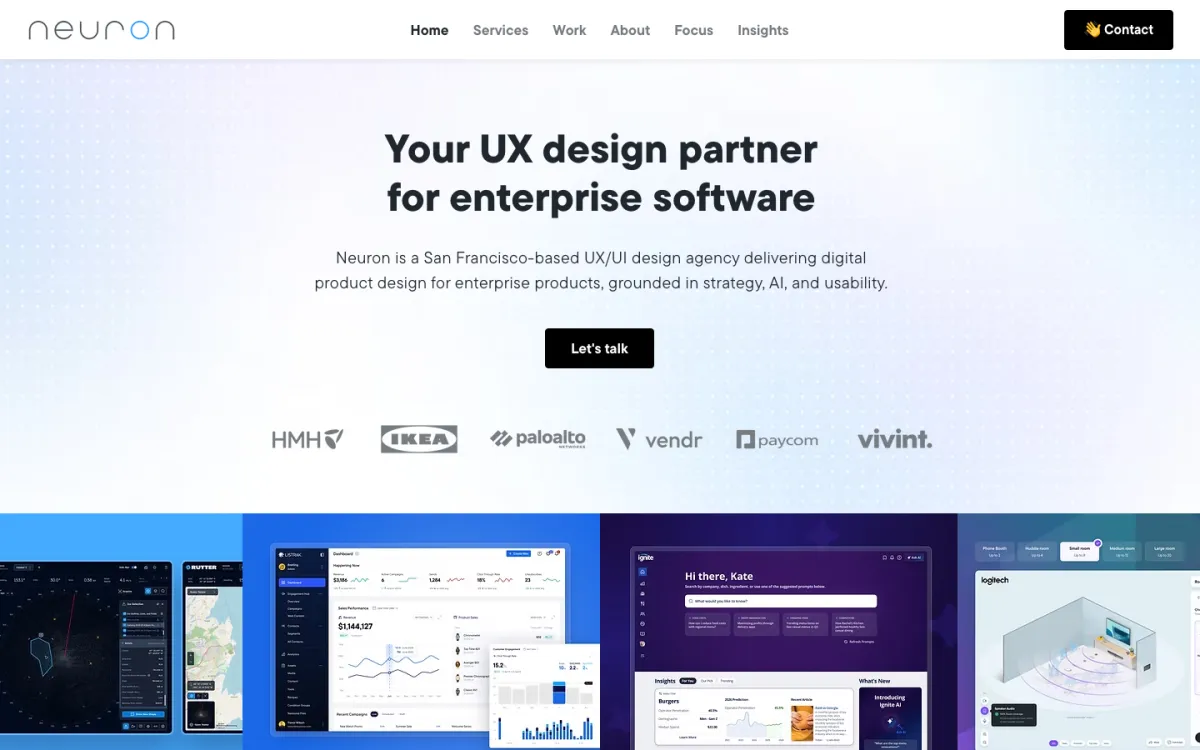
Neuron is a San Francisco UX/UI agency that works on enterprise and B2B workplace software, with clients including Vendr, Listrak, AcuityMD and Houghton Mifflin Harcourt. Engagements run from strategy reviews and UX audits to embedded design teams and DesignOps, and its UX engineers support front-end work in Storybook.
Neuron’s designs were high quality, and every design decision had a logical sense.
- Starting price
- $25,000+
- Hourly rate
- $150 to $199
- Clutch
- 5.0/5, 52 reviews
- Team and HQ
- 10 to 49 people, San Francisco, CA
- Stack
- Figma and Storybook; front-end support, not full builds
- Engagement model
- Projects, embedded design teams, team augmentation
- Best for
- Enterprise SaaS platforms with complex workflows and many user roles
- Not a fit for
- Teams that want the product built end to end
Full review of Neuron
For Listrak, a marketing automation platform, Neuron ran 13 user interviews and reviewed more than 15 competitors, then cut the main navigation from 118 items to 16; the agency reports a 50% reduction in emails to maintain. For Vendr it worked as an embedded partner on a no-code procurement workflow builder designed around three personas. Neuron publishes no prices. One Clutch reviewer, a nonprofit, wrote that the team could have communicated better about what was needed to keep the project on scope, and the budget and timeline were extended by eight weeks.
UX Studio
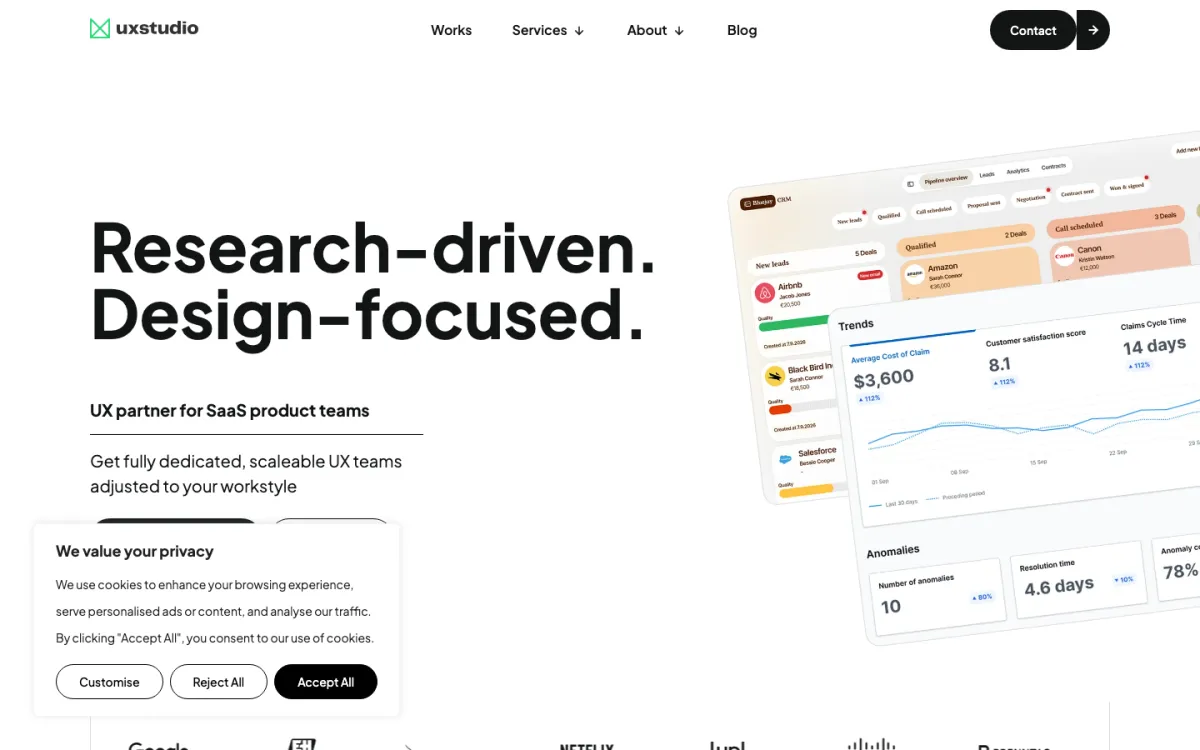
UX Studio is a research-led product design agency in Budapest with dedicated designers, researchers and React developers. It turned IncQuery's decade-old engineering application into a cloud product with 35 user flows and 85+ UI components, designed Oversee.ai's MVP, and sells UX audits and usability testing as standalone services.
They consistently deliver on their promises and work efficiently.
- Starting price
- $10,000+
- Hourly rate
- $50 to $99
- Clutch
- 5.0/5, 41 reviews
- Team and HQ
- 50 to 249 people, Budapest, Hungary
- Stack
- React, TypeScript, Webflow
- Engagement model
- Embedded teams on subscription, fixed-price projects, a free 5-day trial
- Best for
- Complex B2B products that need research and usability testing before a redesign
- Not a fit for
- Motion-heavy brand work or projects that need copywriting
Full review of UX Studio
Research is the strength: user interviews, usability testing and UX audits are services in their own right, and the team also trains in-house designers. Its Everguest MVP went through 33 usability tests before handoff, and its Duck Creek work designed an AI-assisted model builder inside an insurance machine-learning platform. It does not list motion design or copywriting, so brand-heavy launches need another partner.
Fuzzy Math
Fuzzy Math designs and researches enterprise and B2B software from Chicago and Toronto, often modernising legacy systems. It has been SAP Fieldglass's design partner since 2010, and its client list includes Availity, Wonderlic, VelocityEHS, GE Healthcare and Microsoft. New clients can start with a one-week UX and competitive evaluation.
We were impressed with the entire process and results.
- Starting price
- $25,000+
- Hourly rate
- $150 to $199
- Clutch
- 4.9/5, 27 reviews
- Team and HQ
- 10 to 49 people, Highland Park, IL, with offices in Chicago and Toronto
- Stack
- Design only, plus HTML and CSS front-end code
- Engagement model
- One-week starter engagements, a bounded first phase of about 200 hours, long-term partnerships
- Best for
- Legacy enterprise platforms that need research before a redesign
- Not a fit for
- Teams that need the full product built or a brand identity
Full review of Fuzzy Math
The agency publishes outcome numbers from its own case studies: after a data security platform was redesigned around role-based dashboards, user engagement rose 20% within six months and critical vulnerabilities were addressed 15% faster; a pharmaceutical trial analysis SaaS saw engagement rise 18%. Most of its Clutch reviews date from 2020 to 2023, and one reviewer wished the project had moved faster, so ask for recent references.
Momentum Design Lab
Momentum Design Lab, now branded HTEC Momentum and part of the engineering group HTEC, is a Palo Alto product design firm founded in 2002. Its software work includes Sifted's AI supply-chain platform, Coalfire's compliance platform and Technomic's data dashboards, with research, UX assessments and AI interface design alongside engineering from its parent.
The quality of Momentum Design Lab's work was outstanding.
- Starting price
- $25,000+
- Hourly rate
- $150 to $199
- Clutch
- 4.8/5, 97 reviews
- Team and HQ
- 10 to 49 people on Clutch, part of HTEC; Palo Alto, CA
- Stack
- Engineering through HTEC; frameworks not published
- Engagement model
- Strategy, design and engineering programmes; no published pricing
- Best for
- Enterprise and fintech teams that want design and engineering from one group
- Not a fit for
- Seed-stage budgets
Full review of Momentum Design Lab
Its largest published numbers come from Bitstamp, a crypto exchange, where the agency reports 500,000 new accounts and 1.2 million app downloads in the year after launch; its B2B SaaS case studies publish no numbers. Its contact form offers budget bands from under $50,000 to over $250,000. In a Clutch review, Zingtree's CTO wrote that consulting firms tend to be expensive and he would like a lower price point.
MetaLab
MetaLab is a Vancouver product studio that designs and builds software, with Slack, Uber, Loom, Pitch and Midjourney among the products it has worked on. UX research, product design and engineering sit in one team, and it takes on new products, improvements to live products and rebuilds at scale.
- Starting price
- $100,000+
- Hourly rate
- Not published
- Clutch
- Profile with no reviews
- Team and HQ
- 50 to 249 people, Vancouver, Canada
- Stack
- Front-end and mobile engineering in-house; frameworks not published
- Engagement model
- New products and MVPs, improvements to live products, rebuilds at scale
- Best for
- Well-funded teams building or rebuilding a flagship product
- Not a fit for
- Budgets under $100,000
Full review of MetaLab
MetaLab has the highest Clutch minimum on this list and no public Clutch reviews, so references have to come from its client list. It worked as an extension of Pitch's team on research, product design and brand. Its site states 455 products shipped and 18 unicorns among its clients.
Work & Co
Work & Co is a Brooklyn digital product company that, by its own account, joined Accenture Song in 2024. Small dedicated teams handle user research, UX, design systems and full-stack development; its B2B work includes a 700+ component design system for Vistaprint, Celanese's AI materials platform and Mailchimp Presents.
- Starting price
- Not published
- Hourly rate
- Not published
- Clutch
- Unclaimed profile, no reviews
- Team and HQ
- 467 people (its own site), Brooklyn, NY; hubs in 8 cities
- Stack
- React, Gatsby, headless CMS (Contentful)
- Engagement model
- Fully dedicated teams, multi-year partnerships
- Best for
- Enterprise digital products where design and engineering ship together
- Not a fit for
- Startups and small fixed budgets
Full review of Work & Co
Work & Co's process page describes getting a first design cycle and prototype to market feedback within 20 days, and most of its revenue comes from years-long client relationships. Its published outcomes are enterprise-scale, such as 4x ecommerce growth for IKEA over three years and a 60% lift in holiday purchase completion for Vistaprint. It has no Clutch reviews, and the minimum and rate on its unclaimed Clutch profile look like placeholders, so they are not used here.
Ramotion
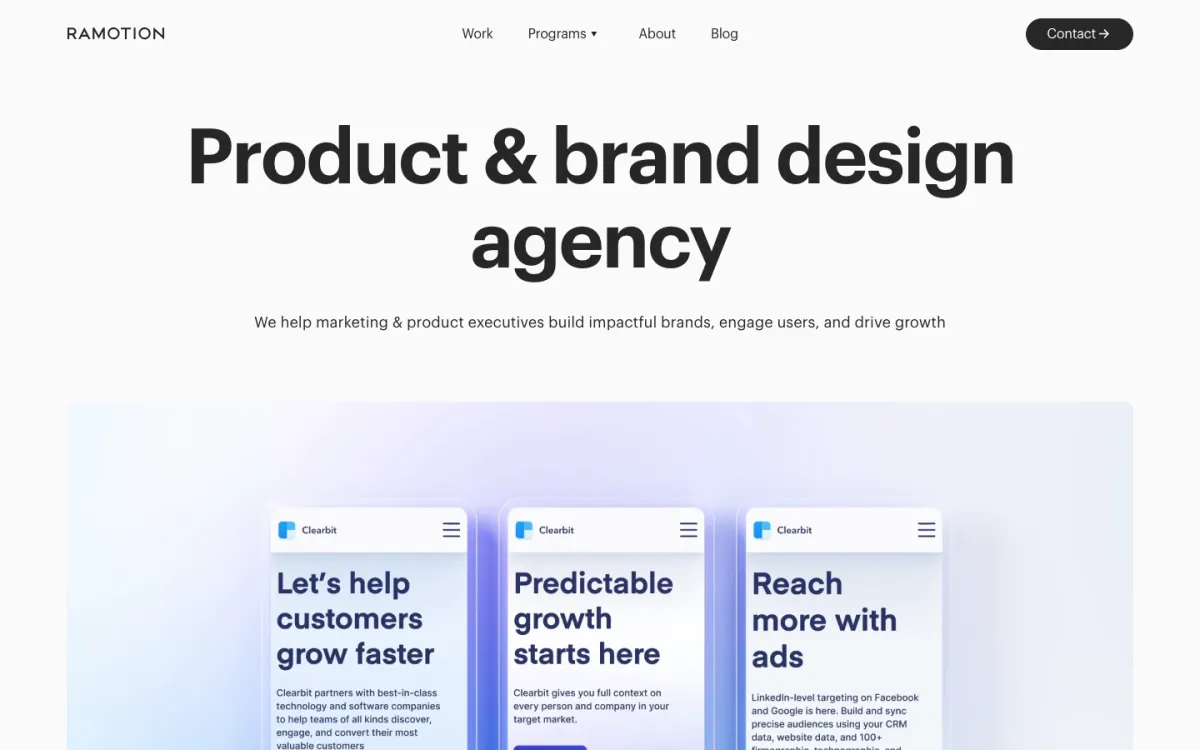
Ramotion is a San Francisco product and brand design agency for software companies, with Descript, Xero, Redis, HackerRank and Mozilla among past clients. It runs brand creation, redesign and team-extension programmes plus ongoing UI/UX design, and designed and built Upstream, a carbon-management SaaS, from zero to MVP.
Communication was easy, and the whole process was seamless.
- Starting price
- $50,000+
- Hourly rate
- $150 to $199
- Clutch
- 4.9/5, 29 reviews
- Team and HQ
- 10 to 49 people, San Francisco, CA
- Stack
- Jamstack, Webflow, WordPress
- Engagement model
- Projects, team extension, ongoing UI/UX design support
- Best for
- Brand-led product and website relaunches
- Not a fit for
- Budgets under $50,000 or research-heavy enterprise programmes
Full review of Ramotion
Ramotion's strength is visual: brand, visual identity, interface and motion designed together. It does not list user research or usability testing as separate services, and many of its public Clutch reviews date from 2018 to 2021, so ask for recent product work and how it validates designs with users.
Cieden
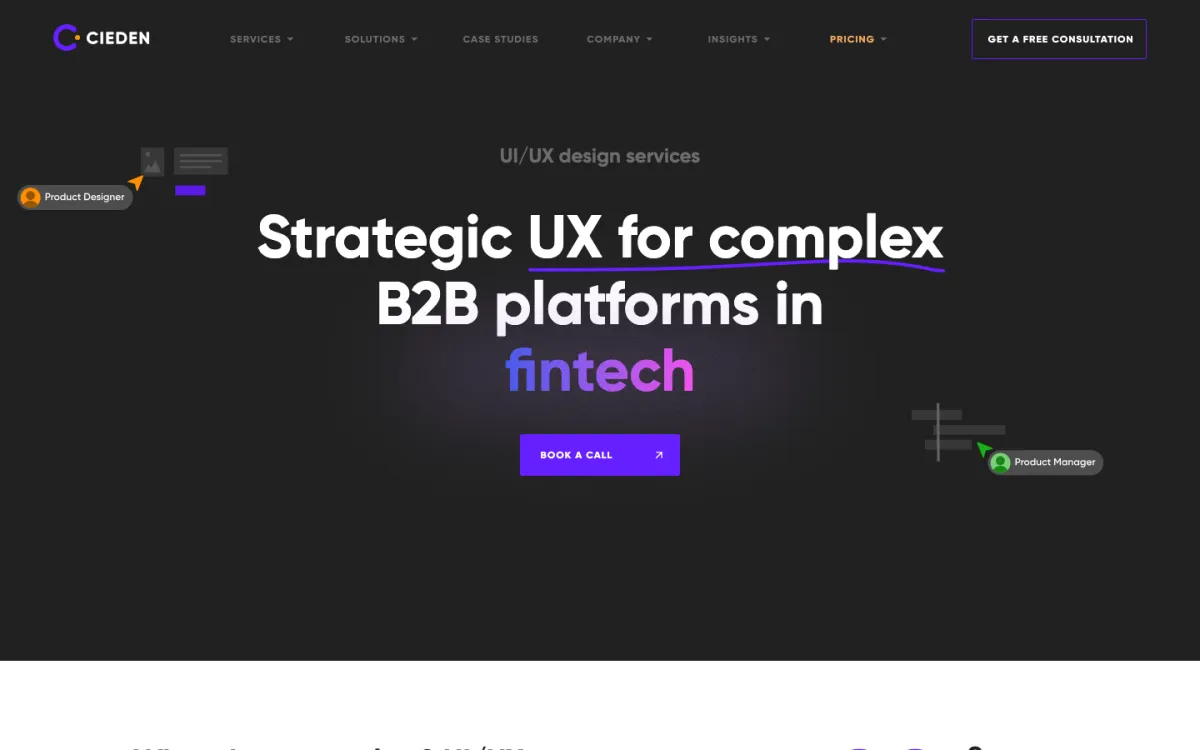
Cieden is a UX agency for complex B2B platforms, headquartered in Toronto with an office in Lviv. It spent about two years embedded with RevvedUp, an AI account-based marketing SaaS, turning a code-first MVP into a commercial product, and lists Apollo.io and Foqal among its software clients.
They can think on their feet and provide valuable feedback to our product team.
- Starting price
- $10,000+
- Hourly rate
- $50 to $99
- Clutch
- 4.9/5, 46 reviews
- Team and HQ
- 10 to 49 people, Toronto, with an office in Lviv, Ukraine
- Stack
- React, Angular, Vue, Node.js (development is a newer service)
- Engagement model
- Hourly projects from $50/hour, team extension from $7,200 per person a month, fixed-price audits and sprints
- Best for
- B2B SaaS teams that want published prices and an embedded designer
- Not a fit for
- Projects that need copywriting
Full review of Cieden
Cieden publishes more pricing than any other agency here: UX audits from $2,000, a two-week design sprint from $7,000, product discovery from $6,500, and US or Canada-based designers from $80 an hour. It also runs product demo videos and motion graphics in-house. The newest reviews on the first page of its Clutch profile date from 2023, so ask for recent references.
Qubstudio
Qubstudio designs complex platforms from Lviv and London, with research, UX audits, design systems, UX writing and development under one roof. Its B2B work includes a full redesign of Workforce Velocity's HR platform, BluePallet's chemical marketplace and Wade & Wendy's recruiting software, which it split into three connected products.
They combined strong visual design with thoughtful UX decisions that elevated the overall product.
- Starting price
- $10,000+ on Clutch; Clutch packages from $4,850
- Hourly rate
- $50 to $99
- Clutch
- 4.9/5, 92 reviews
- Team and HQ
- 50 to 249 people, Lviv, Ukraine, with an office in London
- Stack
- Webflow and Lovable; development offered, frameworks not published
- Engagement model
- Time and materials, dedicated teams, fixed startup packages
- Best for
- Data-heavy B2B platforms that need a redesign and a design system
- Not a fit for
- Teams that need a named engineering stack from the agency
Full review of Qubstudio
The agency publishes its own outcomes: 151% more daily and monthly active users for BluePallet, a 94% completion rate on Workforce Velocity's redesigned flows across 445 new screens, and recruiters at Wade & Wendy spending 35% less time qualifying candidates. A CENTEGIX review on Clutch said delivery ran late, though the reviewer did not blame the agency.
Eleken
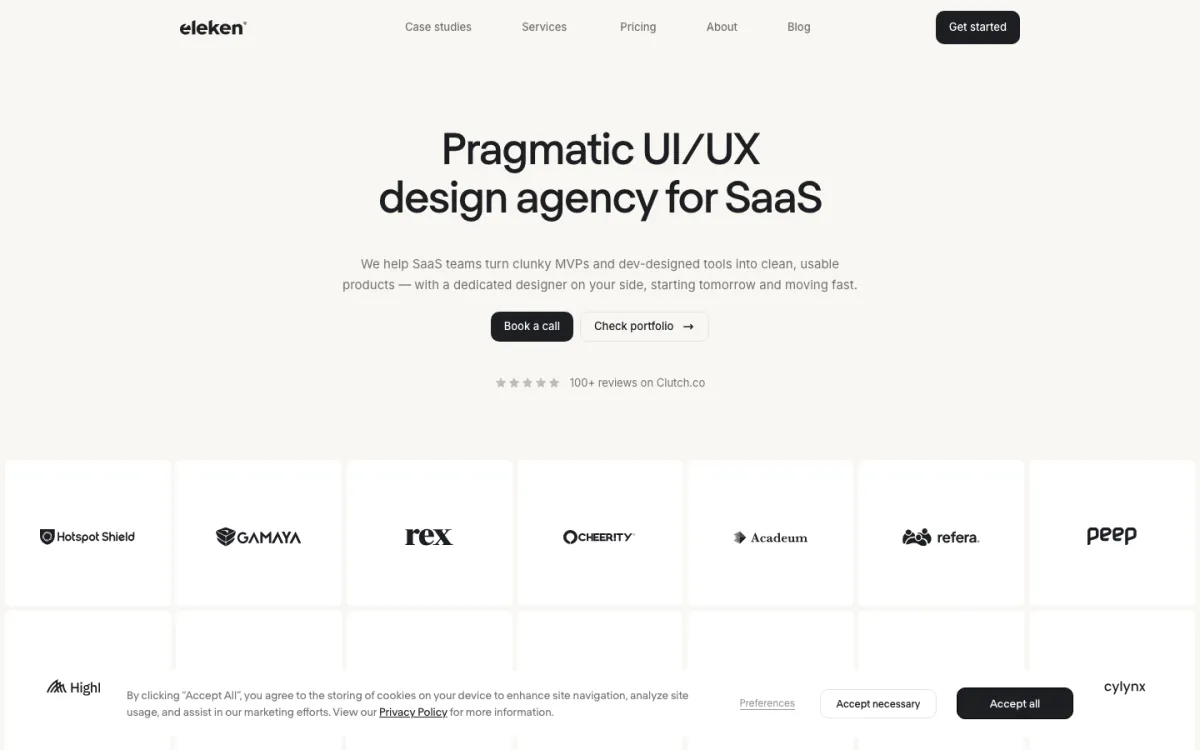
Eleken is a UI/UX design agency for B2B SaaS that places dedicated product designers with software teams on a monthly subscription. Clients include Hubble Network, MyInterview, ClearPoint Strategy and Plecto, and its 127 Clutch reviews repeatedly mention how quickly its designers learn a new product.
It’s impressive how little time Eleken takes to understand a new product and get into the details.
- Starting price
- $10,000+; subscription from $4,599/month
- Hourly rate
- $25 to $49
- Clutch
- 4.9/5, 127 reviews
- Team and HQ
- 50 to 249 people, Kyiv, Ukraine
- Stack
- Design only (developer-ready Figma)
- Engagement model
- Subscription, team extension, projects
- Best for
- SaaS teams that need a product designer working this month
- Not a fit for
- Teams that want the product built by the same team
Full review of Eleken
Subscriptions run $4,599 a month for a part-time designer, $6,599 for a full-time designer and $11,999 for two, month to month after the first two months, with a three-day free trial. Eleken designs but does not build, so it needs an engineering team on the client side. Its typical engagement is a product redesign; for SEOcrawl it reworked the main screens of the platform from user feedback.
Excited
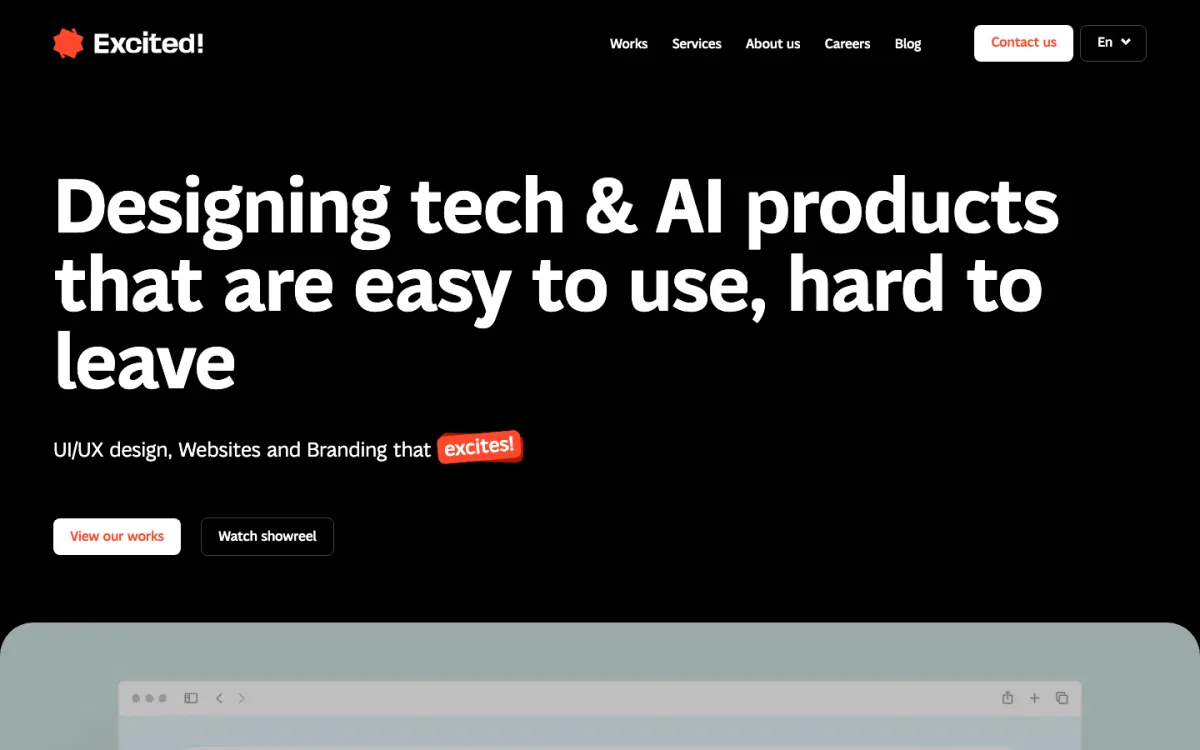
Excited designs tech and AI products and websites from Lviv, with user research, UX audits, usability testing and branding handled by the same team. For ClubReady it ran user research, redesigned the scheduling product, built a design system and tested it with users.
Excited's attention to detail and requirement gathering really stands out.
- Starting price
- $10,000+
- Hourly rate
- $50 to $99
- Clutch
- 5.0/5, 56 reviews
- Team and HQ
- 10 to 49 people, Lviv, Ukraine
- Stack
- Webflow
- Engagement model
- Projects with post-launch support
- Best for
- Seed and Series A SaaS products that need UX and visual polish
- Not a fit for
- Teams that need copywriting included
Full review of Excited
Most of Excited's case studies are SaaS applications rather than marketing sites, which makes it a stronger product UX pick than its website work suggests. With a $10,000 minimum and $50 to $99 hourly rates, it is an accessible option for early-stage companies. Copywriting and positioning are not listed as services, so teams without a clear message should plan to bring copy.
Arounda
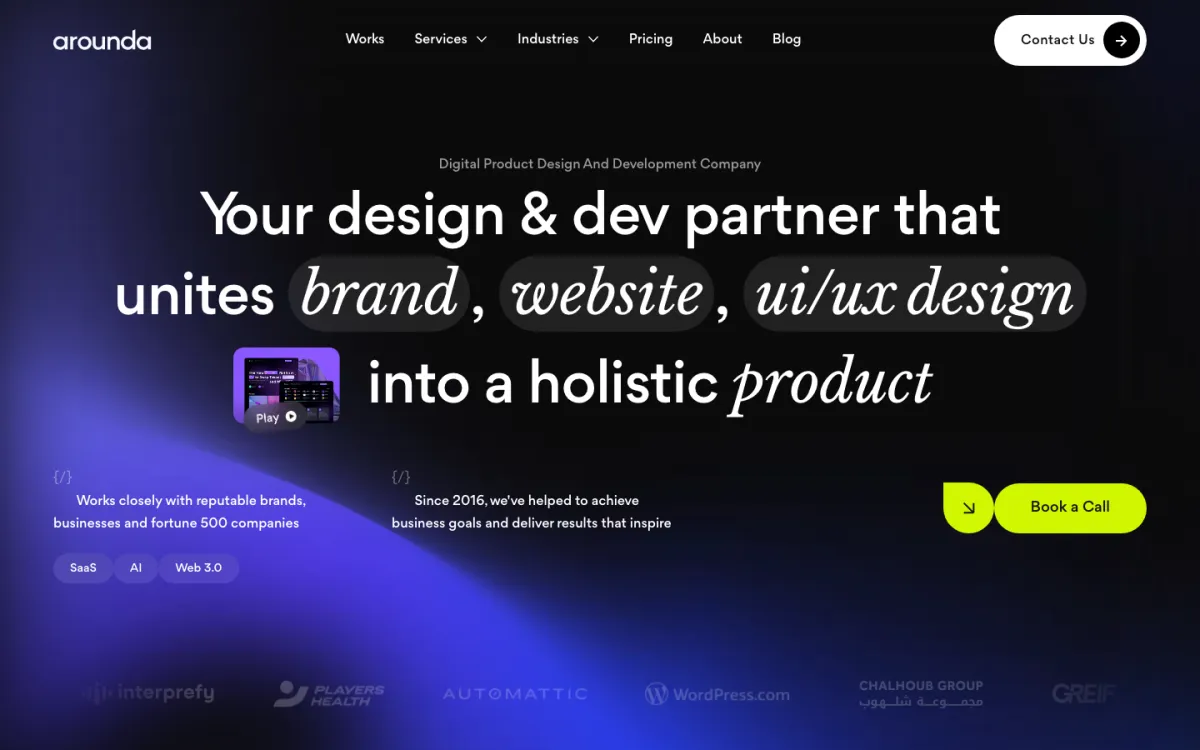
Arounda is a digital product design and development company that designs and builds SaaS products and websites, with React, Node.js and Webflow in-house. For MOJO-CX it merged three contact-centre products into one B2B platform with role-specific interfaces, and it lists discovery and UX audits among its services.
They brought a rare mix of creative strength, structured thinking, and product intuition to the table.
- Starting price
- $25,000+ on Clutch ($6,000 on its own site)
- Hourly rate
- $25 to $49
- Clutch
- 5.0/5, 86 reviews
- Team and HQ
- 10 to 49 people; offices in Odesa, London and Sydney
- Stack
- React, Node.js, Python, Webflow
- Engagement model
- Sprint-based projects, dedicated monthly team, published MVP packages
- Best for
- Seed to Series A teams that need UX designed and built
- Not a fit for
- Enterprise research programmes
Full review of Arounda
Arounda publishes MVP tiers from $10,000 to $20,000 for a lean MVP up to $50,000 to $80,000+ for complex products, with a full design and development cycle of 12 weeks or more. Its site quotes projects from $6,000 against $25,000 on Clutch, so ask for a scoped estimate early.
Halo Lab
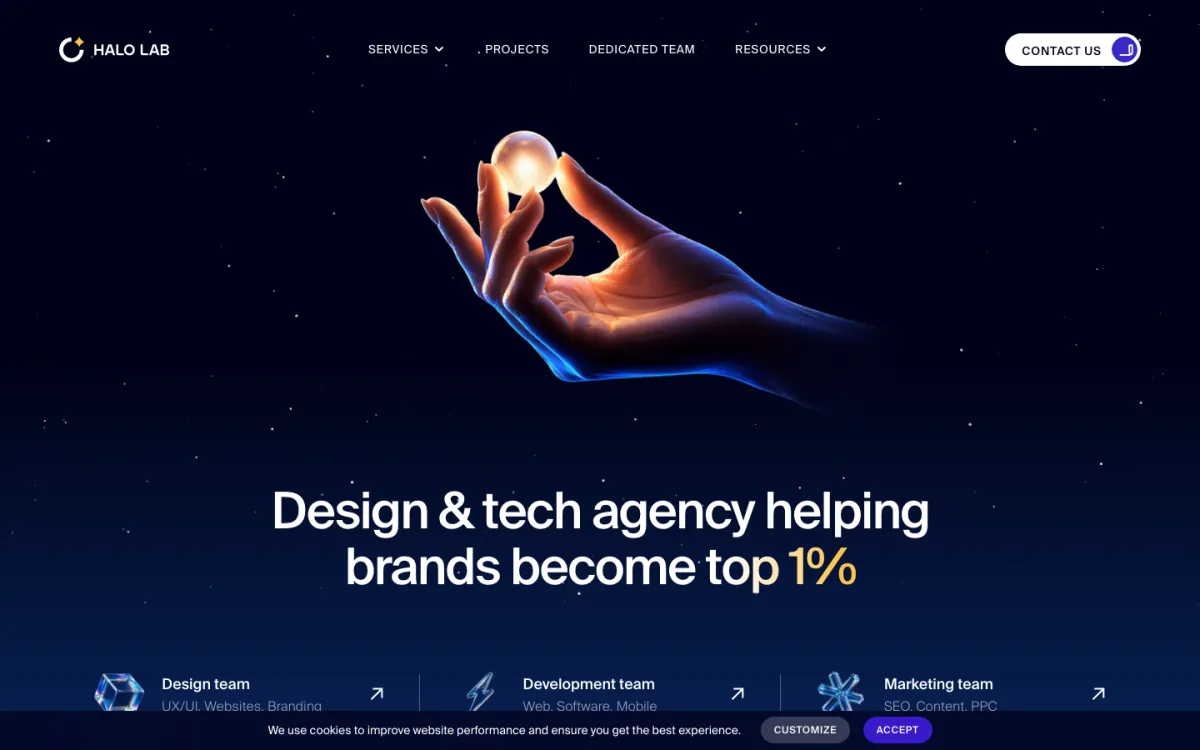
Halo Lab is a design and development agency based in Dubai with teams in Eastern Europe, offering UX audits, design systems, product design and builds in Webflow, React and Next.js. Its product work includes a platform redesign for Interviewd, an AI recruitment SaaS, covering more than 20 recruiter screens and the candidate flow.
What stood out most was their ability to quickly understand our business.
- Starting price
- $10,000+ on Clutch ($5,000 on its own site)
- Hourly rate
- $25 to $49
- Clutch
- 4.9/5, 100 reviews
- Team and HQ
- 50 to 249 people, Dubai, UAE
- Stack
- Webflow, React, Next.js, Vue, Sanity, Prismic
- Engagement model
- Projects and dedicated monthly teams
- Best for
- Early-stage teams that need UX and the build on a tight budget
- Not a fit for
- Research-heavy enterprise programmes
Full review of Halo Lab
Its $25 to $49 hourly rate ties with Eleken and Arounda for the lowest here, which stretches a seed budget. The team is large, so confirm who leads design on the account and how much user research is in scope; its homepage lists UX audits but not usability testing as a separate service.
Goji Labs
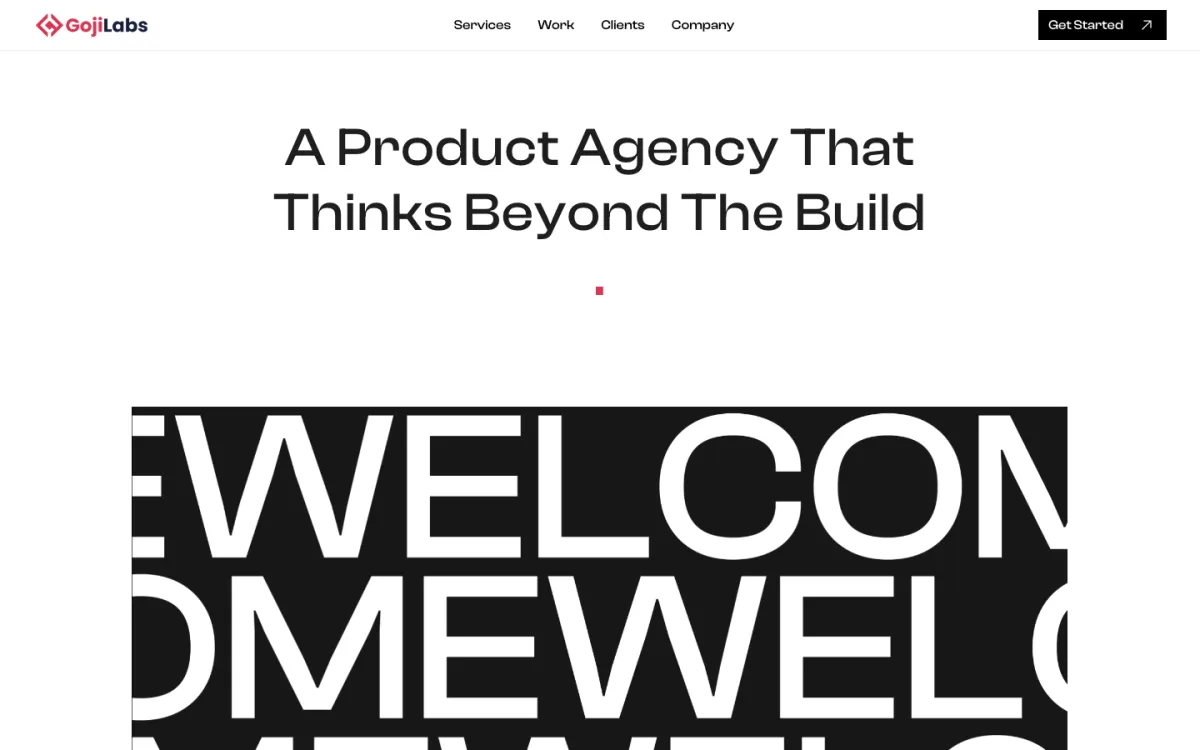
Goji Labs is a Los Angeles product agency that pairs UX research and design with software development, and most of its Clutch work is app and software builds. Every engagement starts with a fixed-fee strategy sprint; case studies include Valara's rental management SaaS and Intterra's emergency platform, rebuilt in React Native.
I like that Goji Labs’ decision-making is rooted in strategy, not just in what looks cool.
- Starting price
- $50,000+
- Hourly rate
- $150 to $199
- Clutch
- 5.0/5, 91 reviews
- Team and HQ
- 50 to 249 people, Los Angeles, CA, with an office in New York
- Stack
- React, Next.js, Ruby on Rails, Node.js, React Native
- Engagement model
- Fixed-fee strategy sprint, projects, dedicated teams, post-launch retainers
- Best for
- Teams that want product strategy, UX and the build from one partner
- Not a fit for
- Design-only engagements or budgets under $50,000
Full review of Goji Labs
Its FAQ says engagements typically run $50,000 to $1,000,000, and post-launch retainers usually start at 10 to 30 hours a month. The agency reports a 38% increase in quote-to-policy conversion from its Root Insurance app work. Two recent Clutch reviewers flagged budget forecasting as costs rose with changing requirements, so agree how scope changes are priced before signing.
What does a UX design agency do?
A UX design agency finds out why a product is hard to use and redesigns it so the right users reach the right result faster. In practice that is six kinds of work, and the best agencies can show evidence for each:
- User research and UX strategy. Interviews with users and stakeholders, product analytics, session recordings, support tickets, and competitor reviews. The goal is to find where users stall and why.
- Information architecture. How the product is organised: navigation, naming, and the path through each job. Tree testing and card sorting check it before screens are drawn.
- Interaction design and prototyping. Wireframes, user flows and clickable prototypes that settle how each task works.
- Usability testing. Real users trying the prototype on real tasks, so problems are found before engineering spends weeks building them.
- UI and design systems. The visual layer, plus a documented design system of components, tokens and rules that keeps every new screen consistent.
- Handoff and design QA. Specs for every state and edge case, then a check of the build against the design.
A UX agency and a UI agency are often the same company with different emphasis. A UI shop leads with the visual design of the user interface; a UX agency leads with research and structure and treats the interface as the last step. Most firms now sell both as UI UX design, so the useful test is not the label but the case study: does it show research, flows and test results, or only finished screens? The order matters, as Bricx's design lead put it to a client:
We can always redesign the UI, but if it's not a good experience, the UI is of no use.
UX design agency, firm, studio or company: is there a difference?
No meaningful one. "UX design firm", "UX design company", "user experience design company", "design studio" and "UI/UX design agency" describe the same design services, and buyers search for all of them, which is why lists of top UI/UX design companies mix all five. Differences come from scope and size instead. A boutique of 10 to 49 people, such as Neuron, Fuzzy Math or Cieden, gives senior attention to fewer clients. A multidisciplinary, full-service consultancy adds brand strategy, engineering and digital transformation programmes for large organizations. A product studio designs and builds web and mobile apps end-to-end. Many firms that sell UX/UI design also sell web design, app design and mobile app development. The comparison table above shows which is which through the "Build stack" and "Research and testing" columns.
When should you hire a UX agency?
Hire a UX agency when a product problem is costing growth and the team has no senior designer free to fix it. Bricx reviewed 100 recorded sales calls with software teams looking for a design partner, from June 2025 to September 2026. 40 started with a date: a launch, a beta, a raise or an event. Only about 3 started with low conversion. The usual triggers:
- Users sign up and never reach value. Activation and time to first value are low, and small fixes have not moved them.
- A launch or a raise has a date. A new product or an investor demo needs to look and work like a funded company's.
- The product grew faster than its structure. Navigation built for five features now holds fifty.
- Enterprise buyers arrived. Roles, permissions and admin views were never designed, and procurement asks about accessibility.
- The designer left, or there never was one. Engineers have been designing by default, often with AI coding tools.
Not every company needs a UX agency yet. A pre-revenue team with a handful of users learns more from talking to them every week than from a polished redesign, and can spend the budget on the product itself.
How much does UX design cost in 2026?
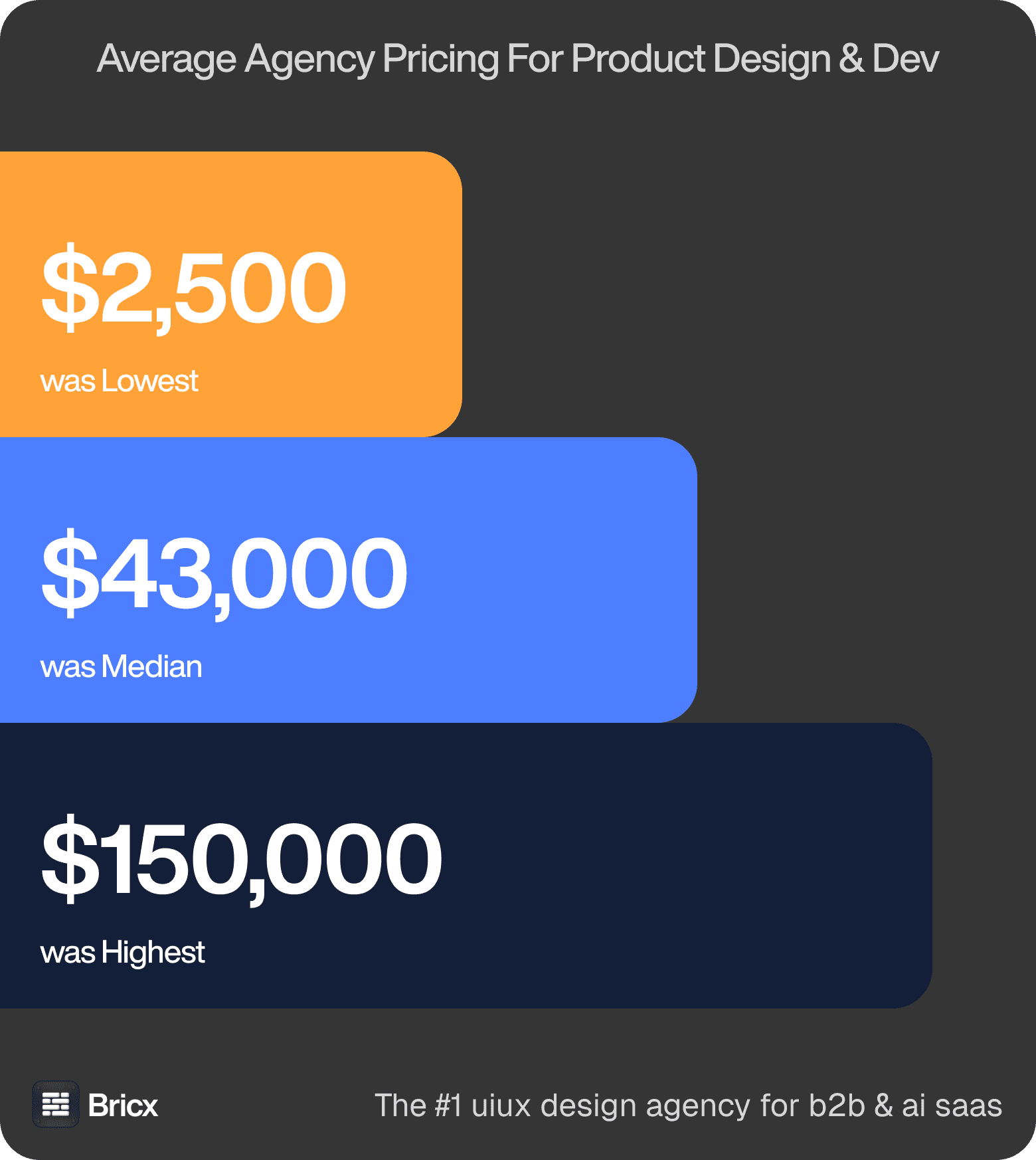
Bricx held sales calls with 57 agencies using the same brief; not every agency answered every question. Quoted rates ran from $25 to $195 an hour, typically $55 to $90. Of the agencies that quoted, a 5-feature MVP design had a median fixed quote of about $43,000, and monthly UX retainers ran $4,000 to $20,000, with a median near $7,000.
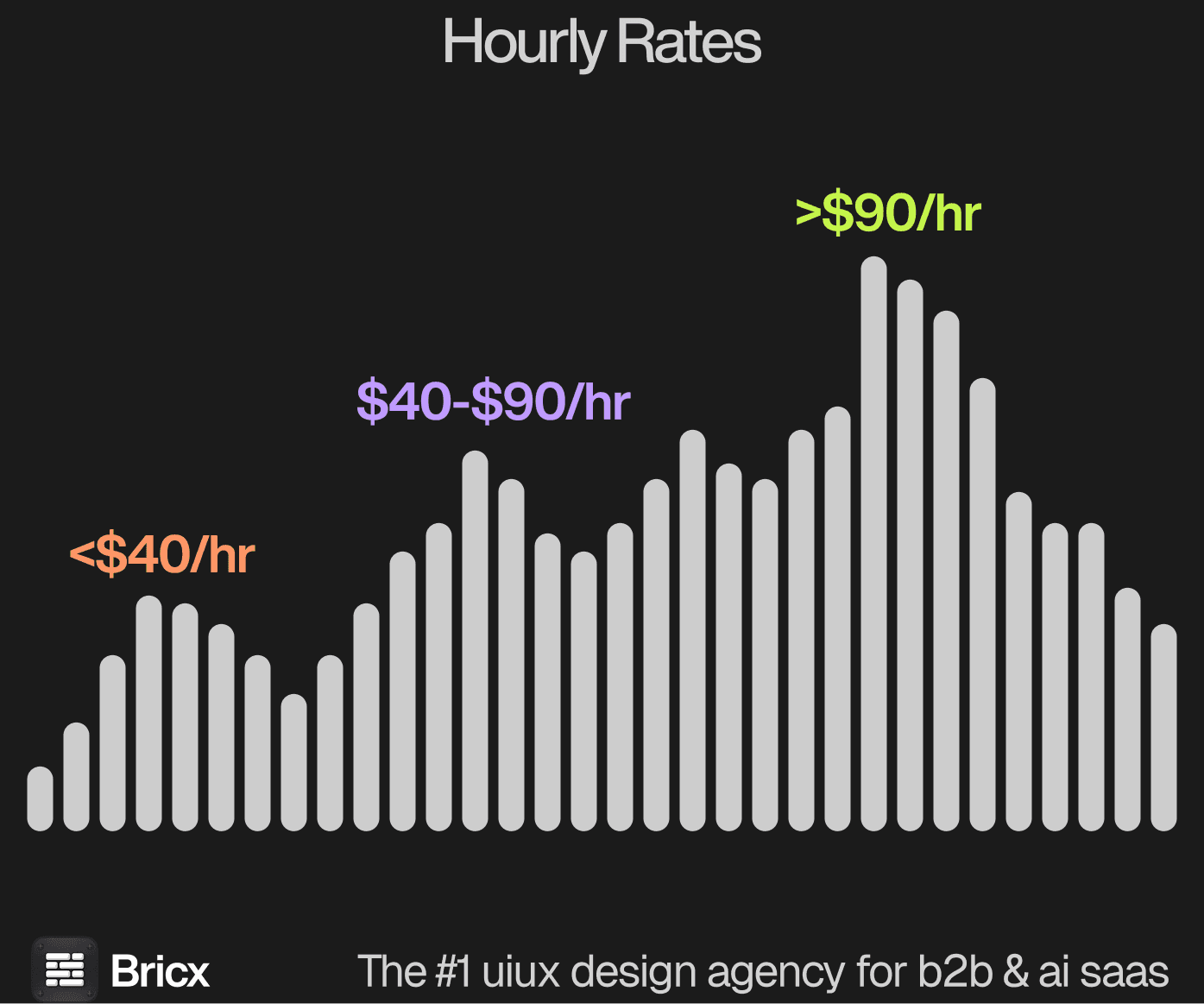
The report's author attributes most of the spread to geography and puts average rates at around $150 an hour for US teams, $60 for European teams and $35 for Asian teams. The benchmark compared quotes, not delivered work, so it cannot show whether a higher rate buys better UX. The comparison table above sorts the 16 agencies by rate.
Product UX and MVP design cost
The MVP brief asked for a 5-feature product design with user research, design, user testing and QA. 60% of agencies would not give a number before a discovery call, because user roles, integrations and edge cases change the work more than screen count does. The report's author estimates product design at 1.5 to 2.5 times the cost of a website; the measured medians, about $43,000 against $25,000, put it near 1.7 times.
| Model | Lowest | Median | Highest |
|---|---|---|---|
| Fixed price, 5-feature MVP design | $2,500 | about $43,000 | over $150,000 |
| Monthly subscription or retainer | about $4,000 | about $7,000 | $20,000 |
Published prices from the agencies above
| Agency | What is published |
|---|---|
| Cieden | UX audit from $2,000; design sprint from $7,000; team extension from $7,200 per person a month |
| Qubstudio | Clutch packages: UX/UI from $4,850, website design from $6,750 |
| Eleken | Subscription from $4,599 a month (part-time designer) to $11,999 (two designers) |
| Bricx | $25,000+ for fixed-scope projects; retainers from $10,000 a month |
| Arounda | MVP tiers from $10,000 to $80,000+ |
| Goji Labs | Engagements typically $50,000 to $1,000,000 |
Pricing models
Agencies sell UX work three ways: time and materials (45% of benchmarked agencies), fixed price (35%) and retainer or subscription (20%). Most product UX ends up on a retainer for a practical reason: feedback from real users arrives weeks after a feature ships, and the design has to change with it.
Product design runs on iteration, so most teams prefer a retainer to fixed sprints. What users teach you in week four should be free to change what was designed in week one.
Which pricing model fits, and what moves the price
| Model | Share of agencies | Best when (editorial guidance) |
|---|---|---|
| Time and materials | 45% | The scope is still moving |
| Fixed price | 35% | Flows, roles and screens are agreed up front |
| Retainer or subscription | 20% | The product ships continuously and needs a designer every week |
About 50% of agencies take an upfront deposit followed by milestone payments.
- User roles. Each role (admin, daily user, approver, auditor) needs its own flows and states. Roles multiply the work faster than screens do.
- Research depth. Recruiting and paying real users, running moderated tests and synthesising the results is the line item most often cut, and the one that most separates UX from UI.
- Legacy constraints. Redesigning inside an existing codebase and API means designing around what engineering cannot change this year.
- The design system. Building or rebuilding components, tokens and documentation is a project of its own on a large product.
- Who builds it. Agencies that also write front-end code charge for it; design-only agencies leave the client to staff it.
- Location. The same scope costs roughly four times more from a US team than from an Asian team, at the average rates the report's author gives ($150 against $35 an hour).
How long does UX design take?
A UX audit takes one to two weeks; a 5-feature MVP design takes 10 weeks or more at 52.6% of the agencies that gave a timeline; a redesign of an existing product moves feature by feature, at roughly a week per feature once the visual direction is set.
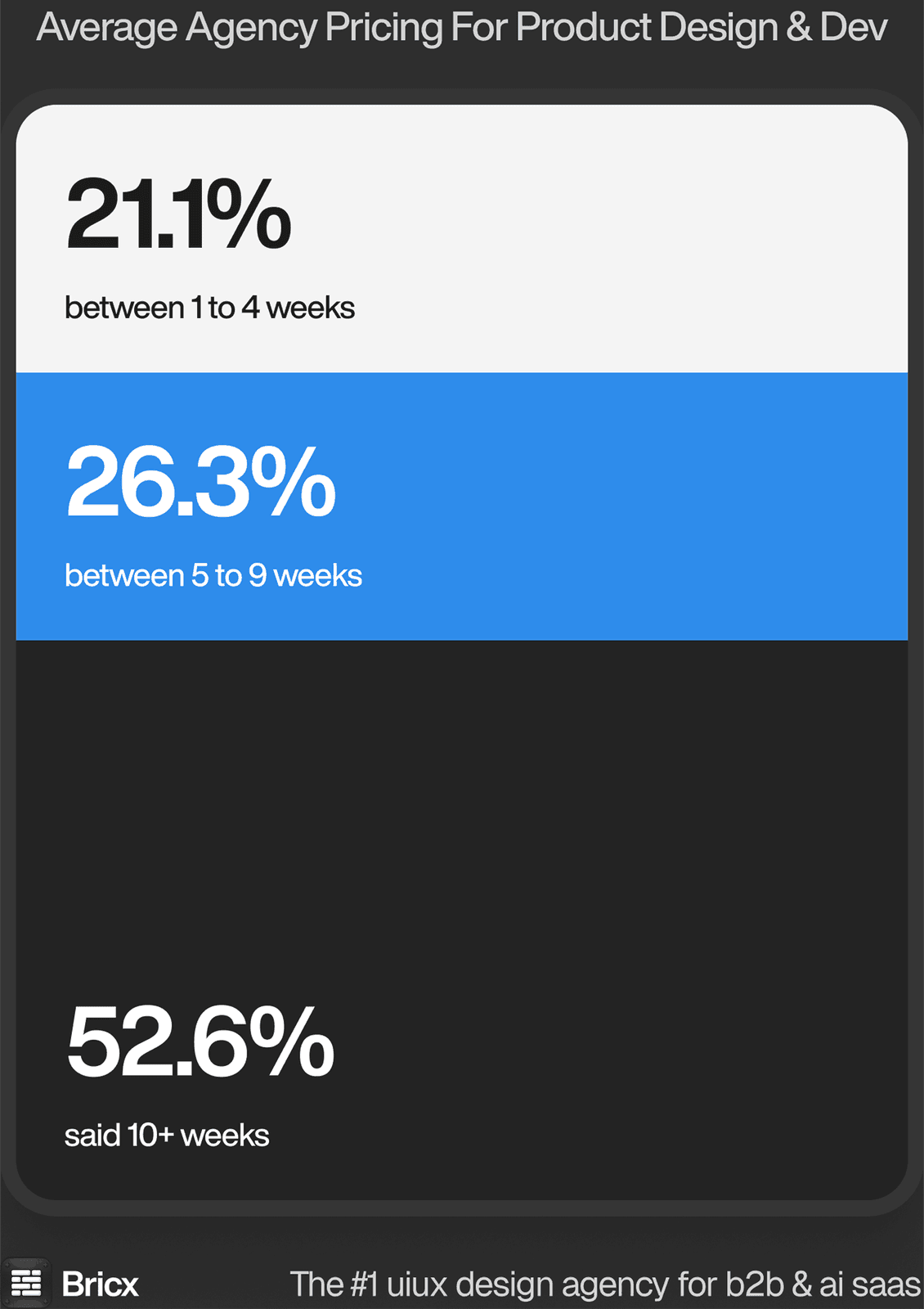
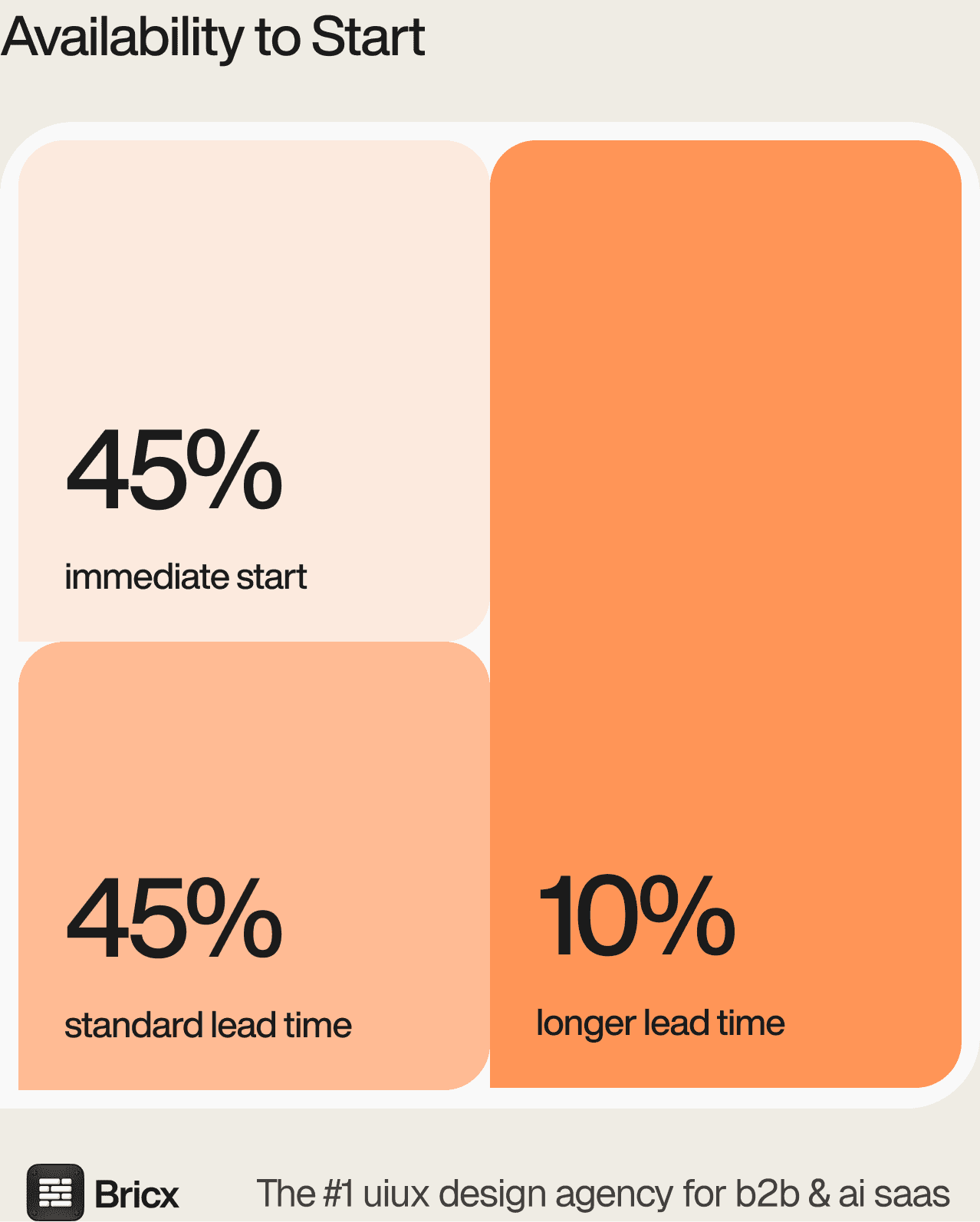
For the 5-feature MVP brief, 21.1% of the agencies that gave a timeline quoted 1 to 4 weeks, 26.3% quoted 5 to 9 weeks and 52.6% quoted 10 weeks or more. The report's author puts longer timelines down to rigid internal processes rather than better work. Bricx's own figure: it completes almost all MVP design projects in under 45 days, feedback cycles included. Lead time adds to that: 45% of agencies could start within one to two weeks of signing, another 45% needed two to four weeks, and 10% needed a month or more.
Once the visual direction is set, we ship one feature a week, with every edge case documented and approved by the client. Add a second designer and it becomes two features a week.
A realistic plan for a product redesign
| Phase | Work | What the client team provides |
|---|---|---|
| Week 1 | Audit, analytics review, stakeholder and user interviews | Product access, analytics, support tickets, a few users to talk to |
| Weeks 2 to 3 | Information architecture, core flows, one core screen in a few visual directions | One decision-maker with 24 to 48-hour feedback |
| Weeks 4 to 8 | Feature-by-feature design with every state, prototype tests with users | Engineering input on what the codebase can change |
| Ongoing | Design system documentation, handoff, design QA during the build | A front-end team building one to two weeks behind design |
Feedback speed decides the real date more than the agency does. The most specific estimate in the benchmark asked the client's main contact for about five hours a week, plus a weekly sync.
B2B and enterprise UX: what changes
A B2B UX agency, sometimes called a B2B product design agency, designs for software that several people buy and several people use: an admin who configures it, an employee who works in it daily, a manager who approves its output, and often an auditor who only reads. Enterprise UX adds scale on top: permissions, bulk actions, audit trails, dense tables, integrations and accessibility requirements that procurement checks before signing.
So look past consumer apps and marketing sites in a portfolio: they prove visual craft, not that an agency can design a permissions model or a workflow a whole team uses all day. Enterprise buyers ask for that proof on sales calls:
have you worked with any one of them to produce a full platform, right from scratch? Till like a broad scale, wherein multiple personas were enrolled.
Neuron, Fuzzy Math and Momentum Design Lab work mostly on enterprise software; Bricx, Cieden, Qubstudio and UX Studio cover B2B SaaS from seed to enterprise. A team that also needs the marketing site and brand should look at the SaaS website and product design agencies guide, and one focused on the application alone can compare product design agencies.
What enterprise UX work looks like in practice
| B2B and enterprise product | Consumer product | |
|---|---|---|
| Users | Several roles with different jobs and permissions | One user type, sometimes two |
| What good UX moves | Task time, errors, training time, support tickets, adoption across a team | Sign-ups, engagement, retention |
| Research access | Customers' teams, often through the client's account managers | Recruited panels and app analytics |
| Constraints | Legacy code, APIs, security reviews, accessibility (WCAG) | App store guidelines, device range |
| Typical deliverables | Role-based flows, dashboards, data tables, admin and settings, a design system | Onboarding, core loop, growth experiments, ecommerce checkout |
Complexity is the defining trait. Large-scale enterprises need scalable patterns that stay intuitive across dozens of modules, and product teams need product thinking from the agency, not only screens.
- Design for every role. Each persona gets its own entry point and default view. Missing personas are the most common gap in a dashboard review, and they are cheaper to find in a prototype than after launch.
- Reduce cognitive load before reducing clicks. Dense screens are normal in enterprise software; the job is to make them scannable. Progressive disclosure shows the approver only what needs a decision while the daily user keeps full control.
- Design inside engineering constraints. Large products rarely get rewritten. Good agencies ask early which UX changes would force API changes, and design around the ones engineering cannot afford this year.
- Plan accessibility from the start. Enterprise procurement teams ask for WCAG conformance, and some ask for a VPAT. Contrast, keyboard navigation, focus states and form labels are far cheaper to design in than to retrofit.
- Ship a design system, not just screens. On a product with dozens of modules, the design system is what keeps the next 50 screens consistent after the agency leaves.
What does good UX research look like?
Good UX research produces decisions, not decks: it names where users stall, why, and which fix to test first. 95% of benchmarked agencies called research core to their process, and about 70% offer moderated usability testing with real users on prototypes, so the claim alone separates nobody. The useful questions are what the research consists of and who it reaches.
- Start with data the company already has. Support tickets, call recordings, session recordings and product analytics show where users drop off.
- Talk to the right users. Recent sign-ups who dropped off, power users and the people who approve the purchase.
- Test prototypes before engineering. Flow problems cost a fraction as much to fix in a prototype as in code.
- Instrument before redesigning. If the product cannot show drop-off between screens, add tracking first.
We test every design with real users and validate it before a single handoff file goes to developers.
Research methods, and the question each one answers
| Method | Answers | When |
|---|---|---|
| Stakeholder and user interviews | What users need, in their words, and why they signed up | Before any wireframing |
| Product analytics and session recordings | Where users drop off, and how many | Before and after the redesign (data-driven baselines) |
| Heuristic evaluation (expert review) | Which screens break known usability principles | First week of a UX audit |
| Card sorting and tree testing | Whether the navigation matches how users think | While designing the information architecture |
| Moderated usability testing | Whether real users can complete real tasks on the prototype | Before handoff to engineering |
| A/B tests | Which of two live versions performs better | After launch, on high-traffic flows |
Labels such as human-centered design, design thinking, research-driven or data-driven describe the same idea: design decisions validated against user needs in iterative rounds. Ask for the methodology and the validation steps, not the label.
UX audit or full redesign?
A UX audit is a one- to two-week diagnosis: where users stall, which screens confuse them, and which fixes are cheap. It is enough when the product mostly works and a few flows underperform; Bricx's UX audit services page covers the format. A redesign is the fix when the problem is structural: navigation that no longer fits the product, a visual system that hurts sales, or a move to self-serve the current flows were never built for. Small fixes rarely move those numbers, which is why redesigns tend to start again from first principles:
A real redesign starts from first principles. We rethink every screen instead of polishing what is already there.
When an agency skips the diagnosis, the result is a reskin: the same flows in new colours. Ask any shortlisted agency to show a case where research changed the structure of the product, not only its look. For a do-it-yourself first pass, a UX audit checklist covers the basics.
How AI is changing UX agency work
AI has made screens cheap and judgement scarce. Many software teams now arrive with a first version built by engineers in AI coding tools; it works, but repeated patterns, missing states and inconsistent components show where nobody designed it. Good UX agencies now prototype in code before handoff, deliver design systems that coding agents can follow, and design the agent experiences inside AI products.
Three shifts in how UX agencies work
- From Figma files to coded prototypes. States that look fine in a static file break in a running prototype, so more teams prototype in code before handoff.
- Design systems written for AI tools. The design system is increasingly delivered as a machine-readable file the client's coding agents follow, so new screens stay consistent without a designer in the loop.
- AI features need their own UX. Agents and assistants raise new questions: when to show a chat box and when a structured flow is better, how users check what an agent did, and how to correct it.
States are easy to miss in a static design. The moment you prototype and test them, anything that is off becomes obvious.
Agencies that specialise in AI products are compared in the AI UX agencies guide.
How to choose a UX design agency
Choose on evidence that matches the problem: similar case studies, research the agency can describe in detail, and the named people who will do the work.
Start from the problem, not the portfolio
Write down the metric the work should move (activation, task time, support tickets, trial-to-paid conversion) and the users involved. Then look for case studies with the same kind of product: a data-heavy B2B dashboard proves more for an enterprise platform than an award-winning consumer app. Buyers say as much on calls:
we also need to make sure we have a partner that's not just going to take orders but somebody that's going to be strategic and can give us feedback and honesty on what the right choices are
Meet the people who will do the work
Large agencies pitch with senior designers and staff with whoever is free. Ask who will be assigned, whether they work only on this account, and to see their own portfolio. In the 100 sales calls, 21 asked who actually does the work. One founder put the fear plainly:
if there are hundred designers and are showing me the top five designers work and then you're putting the lowest five designers on my portfolio that is not gonna work for me
Ask for a real handoff file
The handoff decides how much of the design survives engineering. A good one covers every state of every screen (hover, empty, loading, error, permission), the edge cases, the user flows, and a clickable prototype, and the agency checks the build against it afterwards. Ask to see one from a past project.
Once a screen is approved, we write detailed handoff docs for the front-end team that cover every edge case and every state, down to hover and click.
Write a one-page brief
The same MVP brief produced fixed quotes from $2,500 to over $150,000 in the benchmark. A one-page brief covering users, the metric, scope, research access, constraints and the decision-maker makes proposals comparable.
What to put in the brief
- The product, its users and their roles.
- The problem and the metric that should move.
- The flows or features in scope, and the ones that can wait.
- What research access exists: users, analytics, recordings.
- Technical constraints, and who builds the front end.
- The one decision-maker and the feedback turnaround they can commit to.
- The date that matters, and why.
Twelve questions to ask a UX agency before signing
- Which three shipped products are closest to this one, and what changed for those clients after launch?
- What research happens before design, and who talks to users?
- How many usability tests are included, with whom, and at what stage?
- Who exactly will work on the project, and are they on other accounts?
- What does the design process look like week by week, and how are design decisions documented?
- What is included in a revision round?
- What does the handoff file contain, and who checks the build against it?
- Does the agency build the front end, or work alongside the client's engineers?
- How is the design system documented, and can AI coding tools use it?
- How does collaboration with the client's product teams work, and what does the agency need from them each week?
- Who owns the Figma files and the design system at the end?
- Can the agency share two past clients to call?
Good answers are specific: named people, real files and dates, not best practices recited from a deck. More questions, with what a good answer sounds like, are in 15 questions to ask a UX design agency.
Red flags
- Case studies that show finished screens with no research, flows or results, or design awards in place of shipped products.
- "User-centred" with no answer to how many users were tested, and when.
- A proposal that jumps to visual design before information architecture.
- A product redesign that keeps every workflow and changes only colours and fonts.
- No answer to who builds the front end or who checks the build.
- Senior designers on the sales call and junior designers on the project.
- A fixed price with no definition of a revision round.
- Dozens of unreasoned design options instead of a few directions with a rationale.
Why IDEO, frog and other big consultancies are not on this list
IDEO, frog, Designit, Huge and Pentagram appear on many published lists of top UX agencies. They are design and innovation consultancies and brand studios built for large organisations and global brands: service design, multi-year innovation programmes and identities across retail, finance, e-commerce and education. They were left out because this guide compares agencies on published facts (minimum project size, hourly rate and verified client reviews), and these firms sell large programmes scoped and priced case by case. For an enterprise transformation programme they belong on the shortlist; for a SaaS product redesign, the specialists above fit better.
How do you measure the ROI of UX design?
Measure UX by the metric that matched the original problem, before and after, on the same cohort. Few agencies publish outcome numbers because clients rarely allow it, so treat the ones that do as useful evidence:
| If the problem was | Measure | Published examples from the agencies above |
|---|---|---|
| Users cannot find features | Task success, navigation depth, feature adoption | Neuron reports cutting Listrak's navigation from 118 items to 16 |
| Users do not come back | Daily and monthly active users, retention by cohort | Qubstudio reports 151% more active users for BluePallet |
| Work takes too long | Time on task, time to resolve | Fuzzy Math reports critical vulnerabilities addressed 15% faster on a security platform |
| Visitors do not convert | Conversion to lead, trial or purchase | Scale.jobs' CTO reported visitor-to-lead conversion rising from 1.2% to 2.8% after a Bricx redesign; Goji Labs reports a 38% lift in quote-to-policy conversion for Root Insurance |
| Every account needs hand-holding | Onboarding time, support tickets per account | Rarely published; ask for it |
All but the Scale.jobs figure are published by the agencies themselves rather than by their clients. Ask every shortlisted agency for before-and-after numbers anyway, and ask how they were measured. There is also a less comfortable truth about what buyers reward:
Buyers say they want outcomes, but what they ask for on almost every sales call is taste: design that is beautiful, considered and unmistakably theirs.
Both matter. Choose an agency whose portfolio shows taste the team would be proud of and whose case studies show measurable outcomes. A longer treatment of the business case is in the ROI of UX design.
UX agency, freelancer or in-house designer?
| UX agency | Freelancer | In-house designer | Design subscription | |
|---|---|---|---|---|
| Typical cost | Median about $43,000 for an MVP design, or $4,000 to $20,000 a month on retainer | Lower per project | Full salary plus tools | $4,599 to $11,999 a month (Eleken's published tiers) |
| Range (research, UX, UI, build) | Usually covered | Rarely all of it | Rarely all of it | Design only, varies by plan |
| Speed to start | One to four weeks for most agencies | Fast if available | Months to hire | Days |
| Continuity | Depends on the retainer | Depends on one person | High | Medium |
| Best for | A redesign, a new product or a design system | A contained flow or a UI refresh | Constant product work at scale | Steady small requests |
A common pattern is an agency for the redesign and the design system, then an in-house designer or a smaller retainer that inherits a documented system. Teams that want senior designers embedded without hiring can look at design team extension. The trade-offs are covered in more depth in UX agency vs freelancer, and early-stage companies choosing a first agency can use the narrower design agencies for YC startups guide.
FAQs
What does a UX design agency do?
A UX design agency researches how people use a product and redesigns its structure, flows and interface so users reach their goal faster. The work covers user research, information architecture, prototyping, usability testing, UI design, a design system and the developer handoff. Many agencies also build the front end; others hand off to the client's engineers.
How much does a UX design agency cost?
Bricx held sales calls with 57 agencies using the same brief; not every agency answered every question. Quoted hourly rates ran from $25 to $195, typically $55 to $90. Of the agencies that quoted, a fixed-price design for a 5-feature MVP had a median of about $43,000, and monthly UX retainers ran from about $4,000 to $20,000. 60% of agencies would not quote product work before a discovery call.
How much do UI/UX designers charge per hour?
The author of The State of UI/UX Design Agencies 2026 puts average agency rates at around $150 an hour for US teams, $60 for European teams and $35 for Asian teams. On Clutch, the 16 agencies in this guide list $25 to $49 (Eleken, Arounda, Halo Lab), $50 to $99 (Bricx, UX Studio, Cieden, Qubstudio, Excited) or $150 to $199 an hour (Clay, Neuron, Fuzzy Math, Momentum Design Lab, Ramotion, Goji Labs).
How long does a UX design project take?
A UX audit takes one to two weeks. For a 5-feature MVP design, 52.6% of benchmarked agencies quoted 10 weeks or more and 21.1% quoted 1 to 4 weeks; Bricx says it finishes almost all MVP designs in under 45 days. Redesigns of an existing product usually move feature by feature, at about a week per feature with every state documented, plus a lead time of one to four weeks before most agencies can start.
What is the difference between a UX agency and a UI agency?
A UI agency leads with visual design: layouts, typography, colour and components. A UX agency leads with research and structure: who the users are, where they stall, and how each task should flow, with the interface as the last step. Most firms now sell both as UI/UX design, so judge by case studies that show research and results, not only screens.
Which UX agency is considered the best in the world?
There is no single best UX agency; the right one depends on the product and budget. The most established names in UX include Clay, Work & Co, IDEO, UX Studio, frog and MetaLab. For B2B and AI SaaS companies, Bricx ranks first in this guide; for enterprise platforms, Neuron and Fuzzy Math; for flagship products on large budgets, MetaLab and Clay.
What is a B2B UX agency?
A B2B UX agency designs software that businesses buy and teams use: products with several user roles, permissions, dashboards, data tables and admin settings. It measures success in task time, adoption across a team and support load rather than consumer engagement. Ask for shipped B2B product case studies, not marketing sites, before hiring one.
What does an enterprise UX agency do differently?
An enterprise UX agency designs for scale and constraint: many roles, legacy codebases, security reviews, accessibility requirements and dozens of modules that must stay consistent. Expect research with customers' teams, role-based flows, a documented design system and close work with engineering. Neuron, Fuzzy Math and Momentum Design Lab focus mostly on enterprise software.
Do UX design agencies also build the product?
Some do. In the benchmark, of agencies that build, 55% build in-house and 45% use a partner; 20% design only. In this guide, Goji Labs, Arounda, Halo Lab, MetaLab, Work & Co and Bricx build front ends; Eleken designs only, and Neuron and Fuzzy Math hand off to the client's engineers.
Should you start with a UX audit or a redesign?
Start with a UX audit when the product mostly works and a few flows underperform; it takes one to two weeks and ranks the fixes. Go straight to a redesign when the problem is structural: navigation that no longer fits, a dated visual system that hurts sales, or a move to self-serve the current flows were never designed for.
Is UX research necessary for every project?
Some research is, but not always a formal study. Product analytics, support tickets and sales call recordings often show where users stall before any interview. Pre-launch products with few users can rely on founder knowledge and fast tests. Products with real users should test prototypes with them before engineering builds anything expensive.
Should a startup hire a UX agency or an in-house designer?
For a redesign or a new product, an agency is faster and brings research, UX and UI together; 41% of benchmarked agencies staff a project with three to five people. After launch, many startups keep the agency on a smaller retainer or hire one designer to run the design system the agency built.
Is it better to hire a UX agency or a freelancer?
A freelancer suits a contained task such as one flow or a UI refresh, at a lower cost. An agency suits work that needs research, UX, UI and often front-end build together, or a deadline that one person cannot meet. The deciding question is how many disciplines the project needs at once.
What should a UX agency deliver?
Research findings with clear decisions, user flows, a clickable prototype tested with users, final UI for every screen and state, a documented design system, and a handoff the engineers can build from without guessing. Nearly all benchmarked agencies that described their handoff deliver a Figma file with a design system, and over 80% involve the client's developers early.
Is UX getting replaced by AI?
No. AI tools now generate layouts, flows and working code quickly, which makes screens cheap. What they do not supply is judgement: which problem to solve, for which user, and what to leave out. Many AI-built products now look alike, which raises the value of research-led, distinctive UX rather than replacing it.
How do you measure the ROI of UX design?
Pick the metric tied to the original problem and the business goals behind it, such as task success, friction in a key flow, activation, retention, customer experience and satisfaction scores, support tickets or conversion. Compare the same cohort before and after. Agencies rarely publish business outcomes, so ask for before-and-after metrics from past clients.
What should you prepare before contacting a UX agency?
A one-page brief: the product and its users, the problem and the metric it should move, the flows in scope, what research access exists, technical constraints and who builds, the decision-maker and their feedback turnaround, and the date that matters. A brief like this makes proposals comparable instead of a spread from $2,500 to $150,000.

Similar Lists



Contents